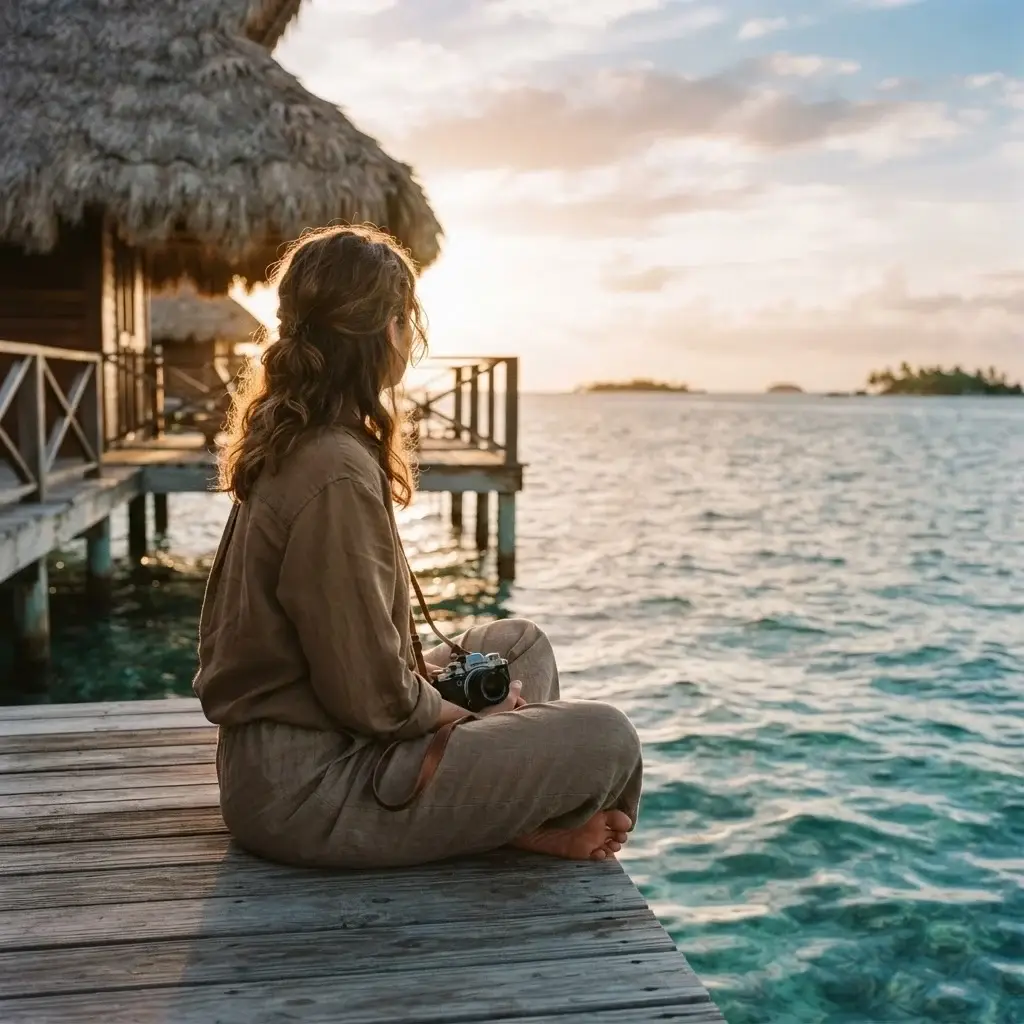
For a long time, I assumed overwater bungalows were the exclusive domain of the Maldives and Bora Bora. The kind of places that show up in travel magazines next to phrases like “a trip of a lifetime” and budgets that make your eyes water. I figured that if you were working flexible jobs, saving carefully, and trying to make travel a sustainable lifestyle rather than a single blowout event, a bungalow perched over turquoise water was simply not in the picture.
I was wrong.
The Americas have some genuinely spectacular overwater bungalow options, and they span a much wider price range than most people realize. From an affordable glass-floored bungalow in Panama’s Bocas del Toro archipelago to Mexico’s only true overwater resort sitting on one of the Riviera Maya’s most beautiful beaches, these experiences are more accessible than the Instagram version of them suggests. Whether you are planning something special for two, thinking about going solo, or trying to figure out the honest difference between a $500 night and a $2,500 night, this guide is for you.
Let me walk you through the real options, destination by destination, with actual prices, logistics, and the kind of practical detail that makes the difference between dreaming and actually booking.
Why the Americas for Overwater Bungalows?
The honest answer is proximity and value. Flying from New York or Miami to Cancun takes about three hours. Getting to Bocas del Toro, Panama is a short connection from most major US hubs. Belize is under three hours from a handful of US cities. Compare that to 18 hours and multiple connections to reach the Maldives, and the Americas start looking extremely appealing.
There is also genuine diversity here. The Caribbean and Central American coastlines sit on top of some of the most biodiverse reef systems in the world. You are not trading quality for convenience. In several of these destinations, the snorkeling and diving from your private deck can be extraordinary, sometimes more authentic and less crowded than the heavily developed resort zones of Southeast Asia. That matters if cultural richness and real nature are part of what you travel for.
That said, the Americas cannot yet match Bora Bora or the Maldives in sheer volume of overwater bungalow options. Choices are still more limited, and some properties feel like they are using the “overwater” label loosely. I have tried to be honest throughout this guide about which properties deliver the real thing.
Mexico: The Only Overwater Bungalows in the Country
Palafitos at El Dorado Maroma, Riviera Maya
If you want an overwater bungalow and you want to stay in Mexico, there is exactly one place to go. Palafitos at El Dorado Maroma holds the distinction of being the only true overwater bungalow resort in the entire country. That alone makes it worth knowing about.
Palafitos sits on Maroma Beach, widely considered one of the most beautiful stretches of coastline on the Riviera Maya, roughly 45 minutes south of Cancun. There are 30 bungalows in total, all adults-only and all-inclusive. What you are getting is glass-bottom floors so you can watch fish move beneath your feet, a private infinity pool on your deck, a ladder that drops directly into the Caribbean Sea, and an outdoor rain shower open to the sky. The setting is genuinely beautiful, and the all-inclusive structure means meals, drinks, and many activities are wrapped into the rate.
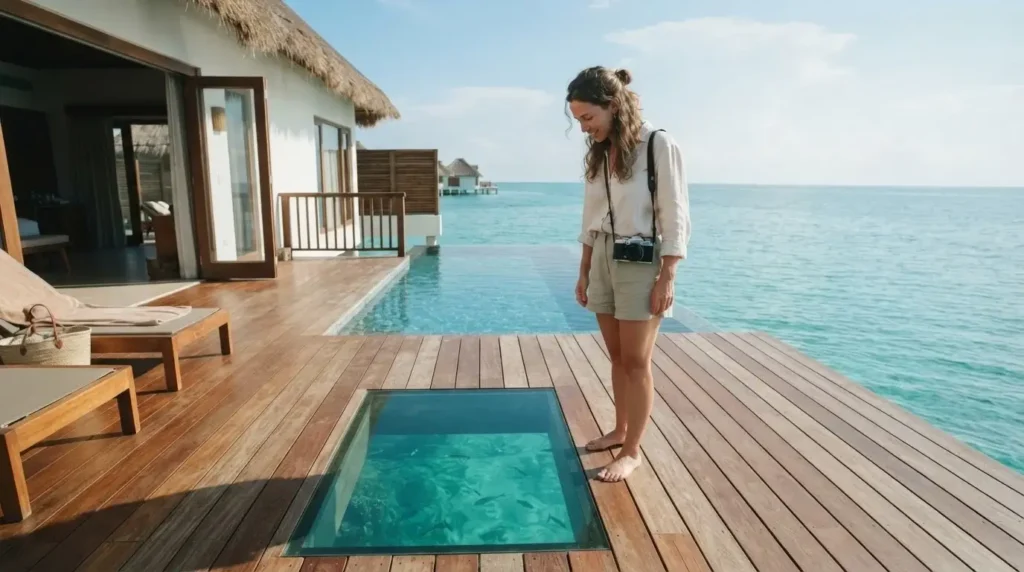
Nightly rates at Palafitos typically run around $1,249 based on current booking data, making it a luxury experience but one that sits on the more accessible end of the overwater bungalow spectrum when you factor in that most food and drink is already covered. Americans need no visa for Mexico. You fly into Cancun, take a short hotel transfer, and you are there. For a first overwater bungalow experience, the logistics are about as simple as it gets.
One honest note: because it is adults-only and positions itself as a romantic destination, you will mostly be surrounded by couples. Solo travelers can absolutely enjoy it, but the atmosphere leans heavily toward the honeymoon crowd. If that sounds isolating rather than peaceful to you, Panama might be a better fit for the solo experience.
What to eat nearby: The all-inclusive format at Palafitos covers gourmet meals on property. If you venture toward Playa del Carmen, about 30 minutes north, look for local cochinita pibil (slow-roasted pork marinated in achiote) served in a traditional market or neighborhood taqueria, one of the Yucatan’s most beloved dishes.
Belize: A Private Island, A World-Class Reef, and 30 Guests Maximum
Thatch Caye Resort, Dangriga
Belize is one of the most underrated overwater bungalow destinations in the Americas, and Thatch Caye Resort is the reason why. This is an award-winning all-inclusive private island resort with overwater bungalows built from reclaimed materials, a maximum of 30 guests at any time, and a commitment to sustainability that is genuinely baked into how the property operates, not just a marketing claim. Solar energy, no single-use plastics, a program that donates a portion of each reservation to local Belizean charities. The island has a different energy from a standard resort, quieter, more communal, more focused on actually being present.
Getting there requires a flight into Belize City or nearby Dangriga, followed by a boat transfer out to the island. That transfer is part of the experience and not something to dread. A premier overwater bungalow runs approximately $1,010 per night all-inclusive, which puts it in a similar range to Palafitos but covers all meals, drinks, water toys, and kayaks.
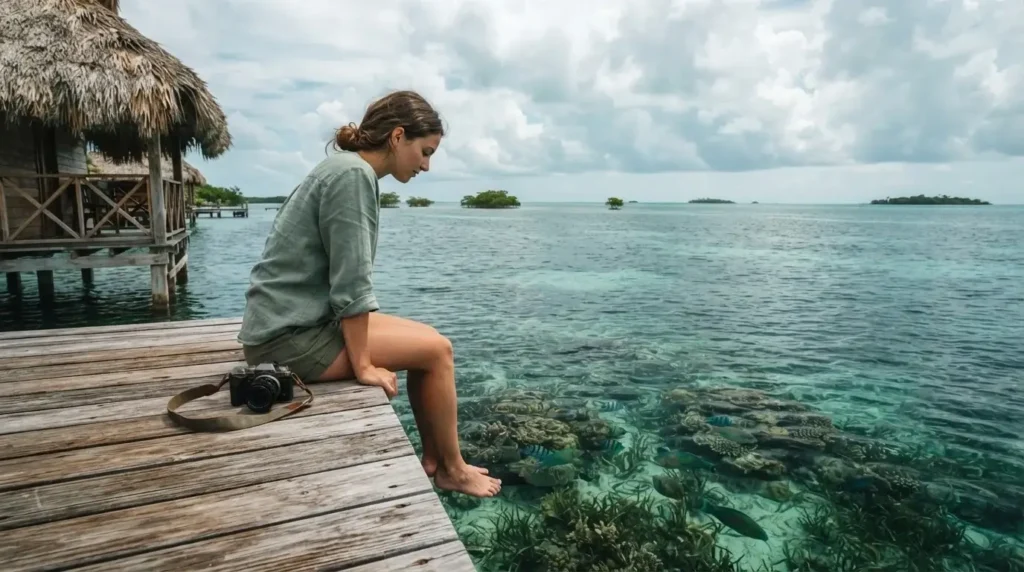
The reason the snorkeling here deserves special attention is the reef right outside your door. Belize is home to one of the most extraordinary marine ecosystems in the Western Hemisphere. The Belize Barrier Reef Reserve System, inscribed as a UNESCO World Heritage Site, is the largest barrier reef in the Northern and Western Hemispheres and the second largest reef system in the world. Over 500 species of fish, 65 species of coral, and critically endangered sea turtles, manatees, and American crocodiles call this reef complex home. When solo travelers and couples who report staying at properties near the reef consistently describe it as snorkeling unlike anything they have experienced in the Caribbean, that is the context that explains why.
For US citizens, Belize requires a valid passport book (not a passport card, which is not accepted for air or land entry), plus proof of onward travel. No visa is required. You can stay up to 30 days on a tourist entry. The U.S. Embassy in Belize confirms that no visa is required for US citizens visiting for tourism.
What to eat: If you get off the island for a day trip toward Dangriga or Hopkins, try hudut, a traditional Garifuna dish of fresh fish cooked in coconut milk and served with mashed plantains. It is deeply satisfying and specific to the Garifuna culture of Belize’s southern coast. The communal dining at Thatch Caye often features fresh Belizean fish, sometimes caught that same day by guests.
Panama: The Budget-Friendly Pick and the Luxury Splurge, Side by Side
Bocas del Toro, Panama’s Caribbean archipelago, is something of a secret weapon for overwater bungalow seekers. It is genuinely beautiful, culturally interesting, and offers two very different price points within the same general region.
Sol Bungalows: The Most Affordable Overwater Bungalow in the Americas
If your goal is to experience sleeping over water without spending a mortgage payment, Sol Bungalows in Bocas del Toro is the answer. This intimate property has four overwater bungalows with glass floors, thatched roofs, and direct Caribbean Sea access, sitting near the western tip of Isla Solarte. Rates range from approximately $66 to $525 per night depending on season and bungalow type. This is genuinely the most accessible overwater bungalow experience in the Americas, full stop. It is rated among the top properties in Bocas del Toro, the service is personal, and the setting is beautiful. You will not have butler service or a private infinity pool, but you will wake up over the water, watch fish through your glass floor, and have breakfast brought to your deck. That core experience? It is all there.
Nayara Bocas del Toro: The Luxury End of Panama
For travelers wanting the full luxury overwater experience, Nayara Bocas del Toro is Panama’s most celebrated option, with nightly rates roughly between $1,112 and $1,777. The property draws on Balinese-influenced design, with expertly carved teak wood interiors, private plunge pools, and a secluded setting on the far end of the archipelago. Travelers who have stayed there consistently describe the food as excellent and the atmosphere as genuinely romantic and private. It is a resort that rewards slow travel and people who genuinely want to switch off.
Getting to Bocas del Toro from the US involves flying to Panama City’s Tocumen International Airport and then connecting to Bocas del Toro on a short domestic flight, or flying into Costa Rica and crossing overland. The Panama Tourism Authority’s official travel requirements page confirms that US citizens, along with most nationalities, do not need a visa for Panama and can stay up to 90 days. You will need a valid passport with at least 3 months of validity beyond your entry date, a return ticket, and proof of at least $500 in funds, cash or credit card.
One cultural note that makes Bocas del Toro particularly interesting: the archipelago has a rich mix of Ngabe indigenous communities, Afro-Caribbean culture from generations of West Indian immigrants, and a laid-back traveler community. Eating at small local sodas (informal family restaurants) along the main strip in Bocas Town, trying ropa vieja (shredded beef in tomato sauce), patacones (fried plantain), and fresh seafood prepared with local coconut, is a genuinely worthwhile part of the experience beyond the bungalow itself.
Aruba: Sunshine Guaranteed, One Exclusive Property
Aruba Ocean Villas, Savaneta
Aruba occupies an unusual spot in the Caribbean. It sits outside the hurricane belt, which means the weather is consistently sunny and dry year-round, an advantage that matters a lot when you are spending serious money on a vacation. It is one of the few Caribbean islands where “the weather will be fine” is not just hopeful thinking.
Aruba has exactly one overwater villa property, and it is a small, intimate, design-forward collection of 8 bespoke villas on the island’s quiet southern coast in Savaneta. According to Aruba Ocean Villas’ official site, rates start from $1,199 per night for the Lou Lou villa and climb to $2,459 per night for Kita Bonita, which includes a private saltwater pool, overwater hammock, custom stone bathtub, and direct Caribbean Sea access. The Sophia villa, with its stone bathtub, alfresco bar, and palapa lounge, starts from $2,349 per night.
Each villa has its own personality. They are not cookie-cutter rooms.
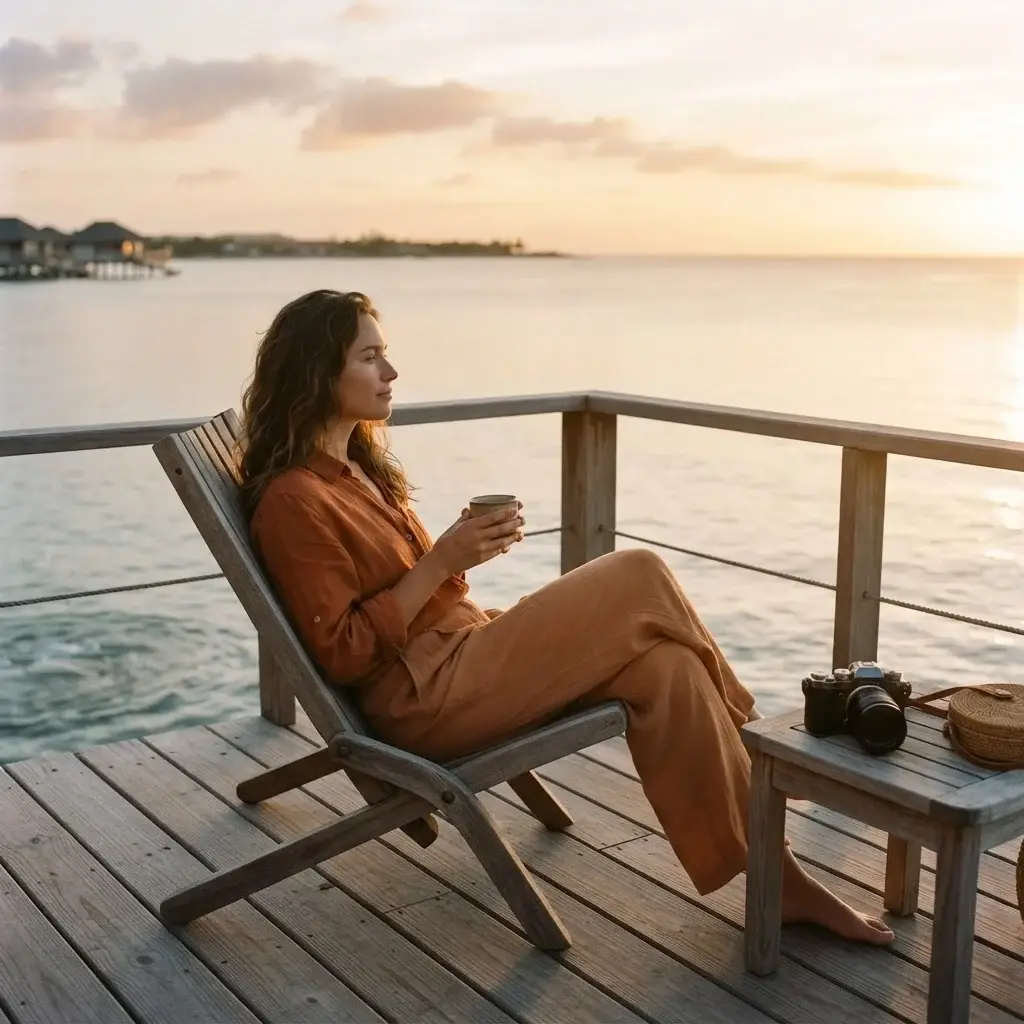
The property uses eco-conscious materials, emphasizes harmony with the marine environment, and includes daily breakfast. Because there are only 8 villas total, the experience feels genuinely exclusive and private in a way that a 200-room resort simply cannot replicate.
Aruba is a constituent country of the Kingdom of the Netherlands, which means American travelers need no visa for stays up to 30 days, just a valid US passport. The main airport, Queen Beatrix International, receives direct flights from a dozen US cities, making the logistics refreshingly straightforward.
What to eat in Aruba: Do not leave Aruba without trying keshi yena, a traditional dish of Gouda cheese stuffed with seasoned meat (usually chicken or beef), dried fruits, and olives, then baked until golden. It is comfort food with a distinctly Aruban-Dutch-Caribbean character, and you will find it at small local restaurants away from the main resort strip. Savaneta itself has a handful of local eateries worth exploring during your stay.
Jamaica and St. Lucia: The All-Inclusive Couples Resort Option
If you want the convenience of a large all-inclusive resort with overwater bungalow options, Sandals operates properties with overwater suites in both Jamaica and St. Lucia, with the Sandals Grande St. Lucian in St. Lucia being one of the most talked-about. Rates start at approximately $2,532 per person per night for the overwater bungalow category, making it one of the more expensive entries on this list on a per-person basis.
What Sandals offers that some of the smaller properties do not is infrastructure: multiple restaurants, entertainment, watersports, and a social atmosphere that suits travelers who want company and activity built into their stay. For solo travelers who want to go out and meet people, the Sandals social environment is actually easier to navigate than a private 8-villa property where you are the only guest. The tradeoff is that these resorts are heavily couples-oriented and the overwater bungalows within a large resort feel less secluded than a standalone property like Thatch Caye or Aruba Ocean Villas.
St. Lucia is particularly worth singling out for its landscape. The dramatic Piton mountains, lush rainforest, and black-sand volcanic beaches give it a completely different character from the flat, dry beauty of Aruba. Solo travelers report that St. Lucia’s cultural warmth, local markets, and ease of getting around make it one of the friendlier Caribbean islands to explore beyond the resort gates.
How to Choose: A Simple Framework for the Right Decision
With so many options across such a range of prices and experiences, here is an honest way to think about which property actually fits you.
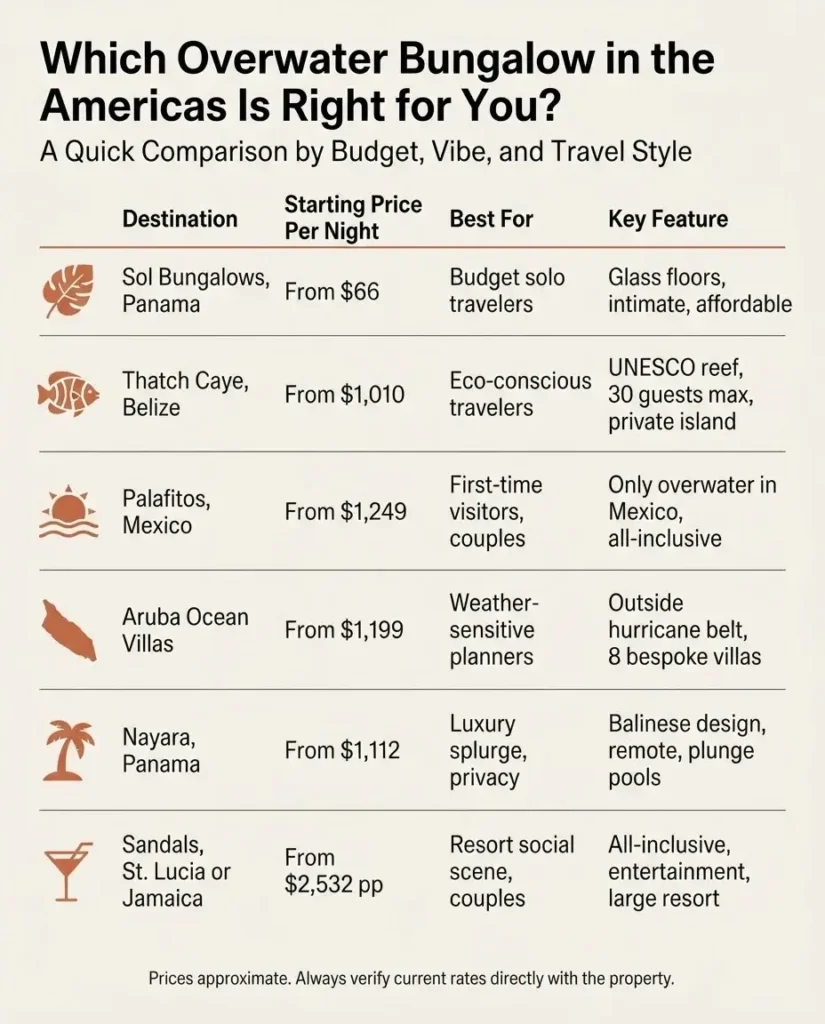
If budget is your first priority, Sol Bungalows in Panama is the clear answer. Nothing else in the Americas comes close on affordability for a genuine overwater experience.
If you want the combination of ecological significance, authentic cuisine, and serious marine life in the water below your bungalow, Thatch Caye in Belize stands apart. The reef alone justifies the trip, and the maximum 30-guest cap means it never feels like a theme park.
If you want the simplest logistics from the US, Mexico’s Palafitos Maroma is the obvious choice: a short flight from most US cities, no visa, and everything covered in the all-inclusive rate.
If weather certainty matters most to you, book Aruba. Its position outside the hurricane belt and its near-guaranteed sunshine give it a reliability that the rest of the Caribbean cannot match.
If you want the social energy of a large resort with overwater options included, Sandals in Jamaica or St. Lucia delivers that experience. Just go in knowing that “per person” pricing adds up quickly for two.
A Few Things No One Tells You Before You Book
First, overwater bungalows can be very warm. The open water amplifies both heat and humidity, and properties vary widely in how well they manage this. Always check whether your bungalow has a functioning air conditioner for the bedroom. It matters.
Second, connectivity is often limited by design. Several of these properties intentionally restrict Wi-Fi to common areas to encourage genuine disconnection.
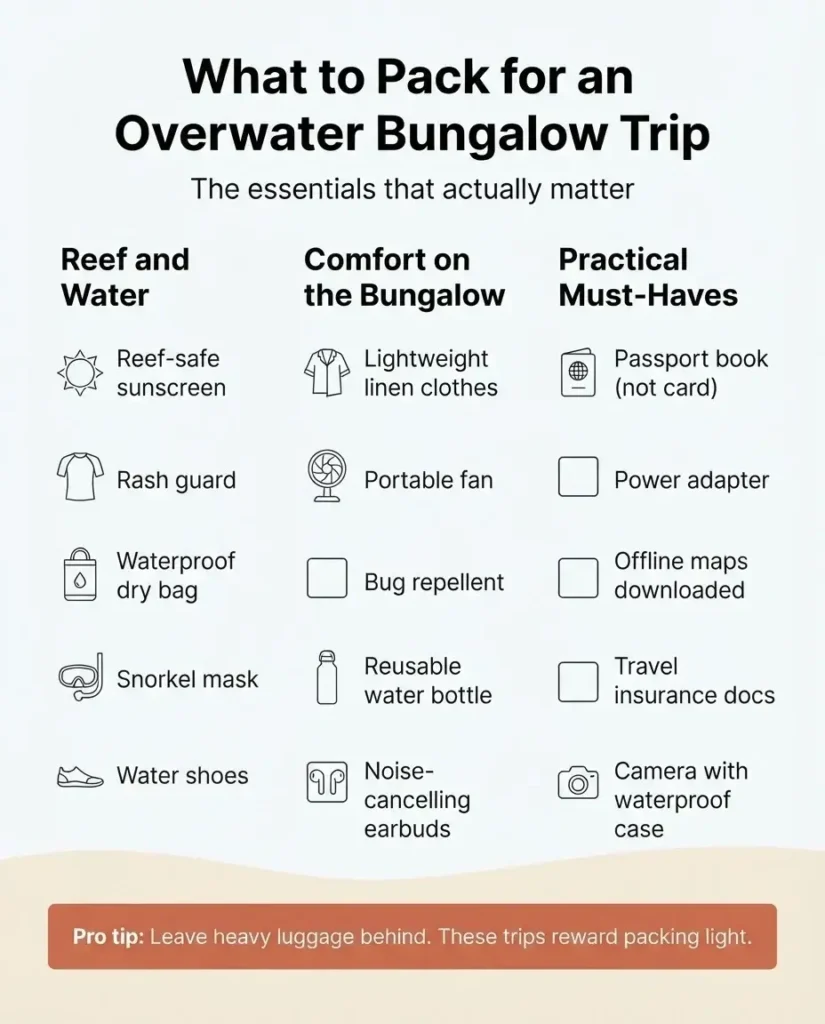
If you are working remotely and need connectivity, confirm this before booking. For some of us, the offline experience is exactly the point. For others, it would be a stressful few days.
Third, the “overwater” label is used loosely in some marketing. Ask specifically whether the bungalow extends directly over open water with ocean or lagoon below it, or whether it simply has a water view. These are very different things. Properties like Palafitos, Thatch Caye, Sol Bungalows, and Aruba Ocean Villas all deliver the genuine article. Glass floors, ladders into the water, and the sound of waves beneath your bed at night. That is the experience worth seeking.
Finally, going solo to an overwater bungalow is absolutely something you can do. Solo travelers on forums consistently report that the experience of waking up over the water, setting your own pace, reading on your private deck, and snorkeling whenever you feel like it is deeply restorative. Yes, you will likely be surrounded by couples in some of these properties. That does not diminish your experience. In fact, if you are anything like me when I first started choosing how to spend my limited travel time, you will discover that doing something purely for yourself, on your terms, with no compromise on timing or activities, is one of the better gifts you can give yourself.
Final Thoughts
Overwater bungalows in the Americas are real, achievable, and genuinely spectacular. You do not need to fly to the other side of the world or spend $5,000 a night to wake up over turquoise water with fish swimming beneath your floor. From a $66/night bungalow in Panama to a glass-floored suite on Mexico’s most beautiful beach, the range here is wider than the travel media gives it credit for.
The harder question is not whether you can afford it. It is whether you will actually book it. There will always be a reason to wait. A better time, a better moment, a better excuse. I have given myself enough of those over the years to know they are mostly fear in a sensible outfit.
The reef is there. The water is there. The bungalow is there. What are you waiting for?