The Most Stunning Botanical Gardens in Europe for Solo Trips

The first time I understood that a garden could stop me in my tracks, I was broke, jet-lagged, and backpacking through Europe with a pack that weighed more than my confidence. I had planned my days around museums and old churches, the things you’re “supposed” to see. But it was a quiet afternoon wandering through green, humid glasshouses, alone, with nobody to hurry me, that I remember most clearly all these years later. No entry line stress. No pressure to have an opinion. Just leaves the size of dinner tables and the strange peace of being small next to something growing.
That’s the thing nobody tells you about botanical gardens. They are one of the friendliest possible things to do as a solo traveler. You never look out of place alone in a garden. You can sit on a bench for an hour and nobody blinks. And they’re often the best value ticket in an expensive city.
So let me walk you through the botanical gardens in Europe I’d actually build a trip around, what they cost right now, when to go so you don’t arrive to a field of mud, and how to reach the ones that sit a little outside the city. I’ve been honest about which places I’ve stood in myself and which I’m recommending from solid research, because that difference matters when you’re spending your own money and time.
First, What Makes a Garden “Botanical” (And Why It Matters for You)
Quick myth-buster, because it’ll save you disappointment. A botanical garden is not just a pretty park. It’s a scientific collection, plants gathered, labeled, and cared for so people can study and enjoy them. That difference is why a real botanical garden is usually worth a longer, slower visit than a landscaped city park. There are named species, glasshouses full of climates you’d otherwise need a plane to reach, and staff who genuinely love this stuff.
For a solo traveler this matters in a practical way. Botanical gardens tend to be safe, calm, well-signposted, and easy to enjoy at your own pace. They’re the kind of place I’d send a first-timer who feels nervous about eating alone or navigating a new city, because a garden asks nothing of you except that you show up and look around.
Royal Botanic Gardens, Kew (London, England)
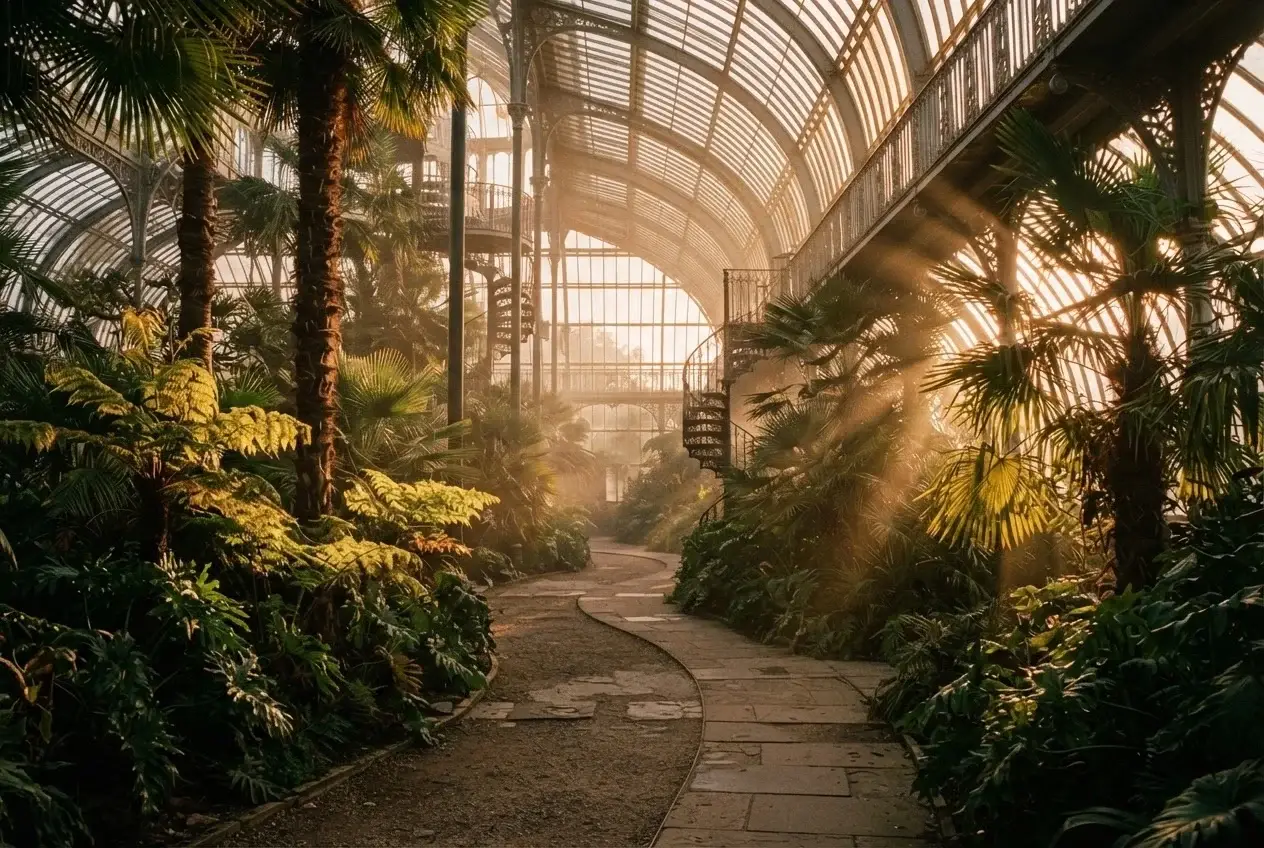
If you only visit one, Kew is the one I’d point you toward. It’s enormous, it’s a UNESCO World Heritage Site, and its Victorian glasshouses are the kind of architecture that makes you forget to check your phone. The Palm House alone, all curved glass and dripping tropical air, is worth the trip.
Be ready for the price, though, because Kew is not a cheap ticket. Based on the current rates listed on the official Kew Gardens tickets page, a peak-season adult ticket (running from the start of February through the end of October) is around £25 booked online, or £28 at the gate, and it drops to roughly £17 online in the quieter winter months. Here’s my money-saving tip that most listicles skip: in summer there’s an after-4pm ticket for about £10 online. If you’re a slow, evening-light kind of traveler like me, that late ticket buys you golden hour in the gardens for a fraction of the cost.
Kew opens daily from 10am, and I’d give it a full half-day at minimum. Getting there is easy and solo-friendly: take the District line to Kew Gardens station, and it’s a short signposted walk to the Victoria Gate. Afterward, the village around the station has relaxed cafés where a solo lunch feels completely normal.
Keukenhof (Lisse, Netherlands): The One With a Deadline
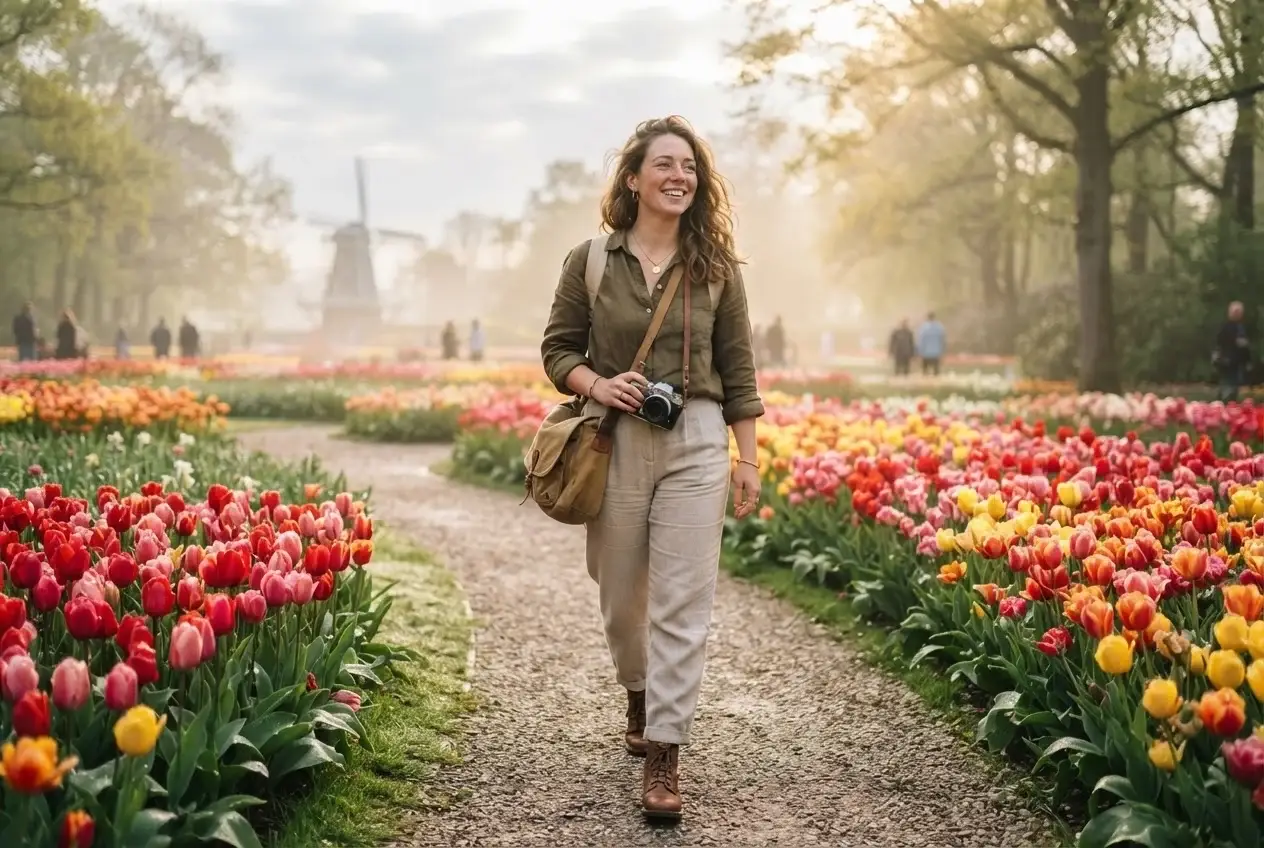
Keukenhof is the garden people picture when they picture the Netherlands: rivers of tulips in colors that look almost fake. It really is that stunning. But it comes with the strictest catch on this whole list, and getting this wrong is the single most common mistake I see travelers make.
Keukenhof is only open for about eight weeks in spring. That’s it. According to the official Keukenhof website, the garden runs a fixed season from roughly mid-March to early May, closing entirely for the rest of the year. In 2026 it’s open from around 19 March to 10 May, and the site already lists the 2027 window as 18 March to 9 May. Show up in July expecting tulips and you’ll find locked gates. This is why “when do the tulips bloom” is one of the most searched garden questions in Europe, and the honest answer is a narrow, glorious window in April.
For a solo traveler, the logistics are refreshingly simple. From Amsterdam, Schiphol, or a few other hubs, you can buy a combined bus-and-entry ticket that gets you door to door without renting a car or decoding a route. Go on a weekday morning right at opening if you can, because it fills up fast, and the early light on the tulips is the version worth photographing.
Orto Botanico di Padova (Padua, Italy): The Oldest of Them All
Here’s the answer to a trivia question that impresses fellow travelers: the oldest academic botanical garden in the world still sitting in its original spot is in Padua, Italy, founded in 1545. It’s been a UNESCO World Heritage Site since 1997, and you can read the full listing on the UNESCO World Heritage site if you want the history before you go.
What makes Padua special isn’t scale, it’s soul. Standing in a garden laid out almost five hundred years ago, where students studied medicinal plants before half the modern world was mapped, does something to your sense of time. It’s compact enough to see in an hour or two, which makes it a perfect solo half-day paired with the rest of Padua’s old center. And Padua is an easy, cheap train hop from Venice, so you can trade the crushing Venice crowds for something quieter and older and, in my opinion, more moving.
While you’re there, eat like the students have for centuries: find a spot for a plate of bigoli pasta and a spritz, which was practically invented in this corner of Italy. A solo aperitivo in a Veneto square is one of the gentlest ways to end a day of walking.
Villa Taranto (Lake Maggiore, Italy): Gardens on the Water
If Padua is history, Villa Taranto is pure romance. It sits on the western shore of Lake Maggiore in northern Italy, sixteen hectares of terraced gardens, water-lily ponds, and something like twenty thousand plants collected from around the world. From what garden lovers consistently report, this is the one that converts even people who “aren’t really into gardens.”
The official Villa Taranto gardens page is the place to check the current season and hours before you go, because like many lake gardens it runs on a spring-to-autumn schedule rather than year-round. The dahlia displays in late summer and the spring bulbs are the two peak moments to aim for.
Reaching it solo is genuinely lovely rather than a chore. You take a ferry across Lake Maggiore, and the boat ride is half the experience. Arriving at a garden by water, stepping off onto a dock surrounded by mountains, is the kind of small cinematic moment that reminds you why you left the office in the first place.
Real JardÃn Botánico de Madrid (Spain): The Best-Value Escape
Right next to the Prado, in the heart of one of Europe’s great museum districts, sits a botanical garden that most tourists rush straight past. That’s their loss and your gain. Founded in 1755, the Real JardÃn Botánico is an oasis of calm a few steps from the busiest street in Madrid, and it’s one of the best-value tickets in the city.
The current details on the garden’s official visitor guide from the CSIC put adult entry at around €4, with concessions closer to €1, and it’s open every day of the year except Christmas and New Year. Even better for budget travelers: entry is free on Tuesday mornings and free for anyone under 18. For four euros and a bench in the shade, it’s the smartest afternoon reset in Madrid, especially after the sensory overload of the Prado next door.
Since you’re in the neighborhood, this is prime territory for a solo food win. Grab a proper cup of chocolate con churros or a menú del dÃa at a local spot near Atocha, then take it slow among the greenhouses.
Palmengarten (Frankfurt, Germany): The Underrated One
Frankfurt gets written off as a banking city with an airport, which means its botanical garden stays blissfully uncrowded. The Palmengarten is a large, beautifully kept garden with tropical and desert houses that make a gray German afternoon feel like a trip to another continent.
It’s also a bargain. The official Palmengarten visitor information lists adult entry at around €9, and it’s free for anyone under 18, which makes it one of the easiest low-commitment stops on this list. If you’re passing through Frankfurt on a layover, and half of Europe’s travelers do, this is a far better use of a spare few hours than sitting in the terminal.
Bodnant Garden (Conwy, North Wales)
For something wilder and greener, Bodnant sits in a valley in North Wales with mountain views behind it, and it’s the garden I’d send anyone who wants nature over neat symmetry. It’s an 80-acre National Trust garden famous for its laburnum arch, a tunnel of hanging yellow blossom that draws people from all over each spring.
Check the current opening details and that laburnum timing on the official National Trust Bodnant Garden page, because the arch has a short bloom window in late spring that’s worth planning around. Wales is one of my favorite places to travel solo in the whole of Britain, quiet, kind, and genuinely affordable, and Bodnant is a good excuse to get off the beaten London-Edinburgh track that most first-timers stick to.
How to Actually Plan This: Seasons, Money, and Doing It Alone
Let me pull this together into something you can use, because a list is only useful if it helps you make a decision.
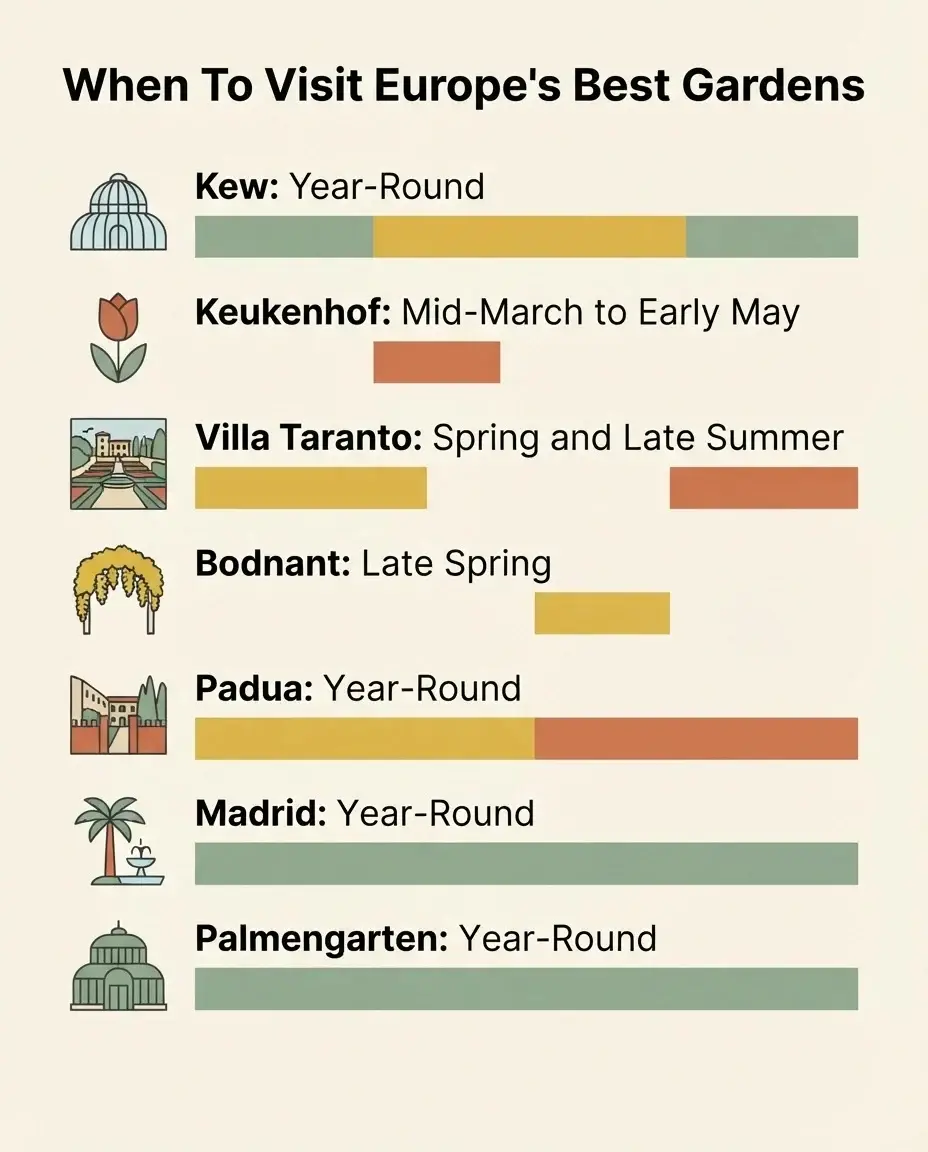
Get the season right first. This is the mistake that ruins garden trips. Keukenhof is spring only. Villa Taranto peaks in spring and late summer and closes in winter. Bodnant’s famous arch is a late-spring thing. Kew, Padua, Madrid, and Frankfurt’s glasshouses give you something year-round, which makes them the safest bets if your dates are fixed. If I were building a first garden trip, I’d anchor it to April or May, when the widest range of these places are at their best.
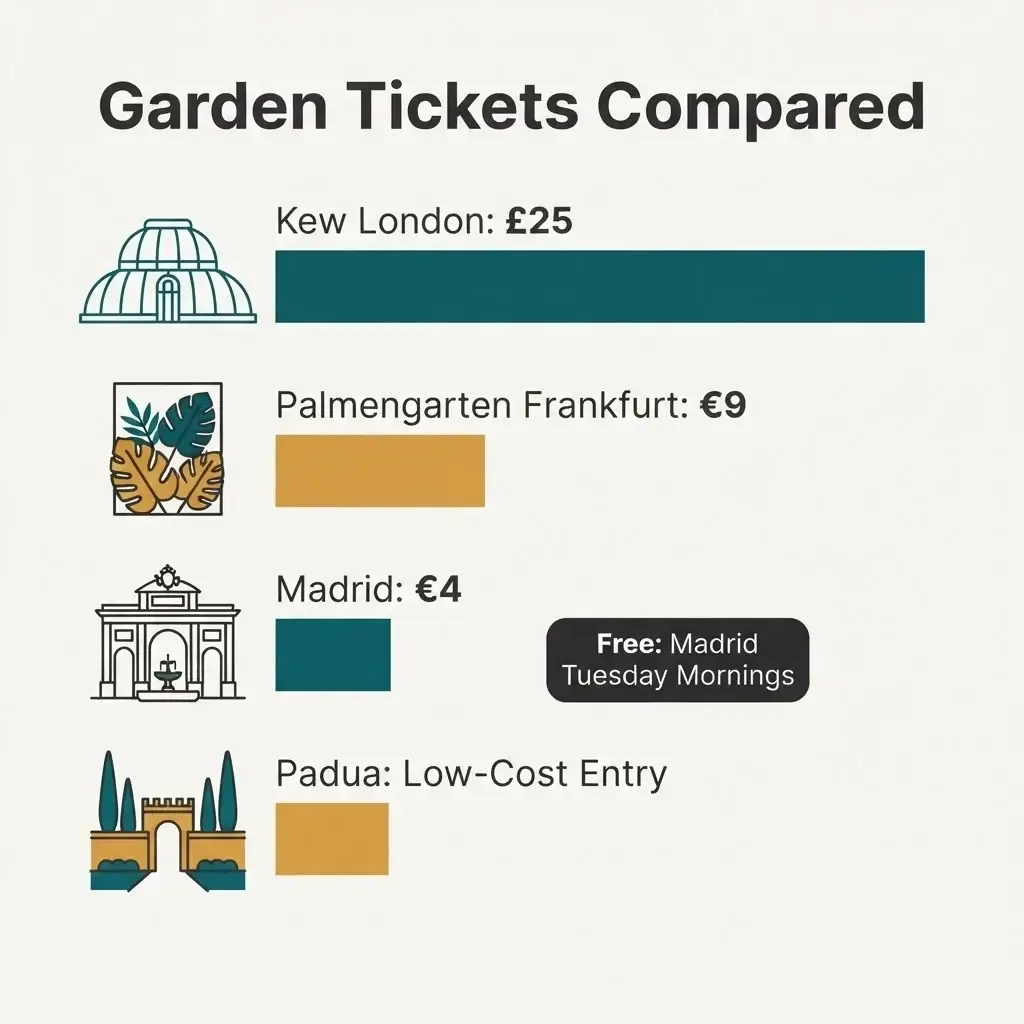
Are botanical gardens free? Some are close to it. Madrid at €4 and free Tuesday mornings, Frankfurt at €9 and free for under-18s, and free entry rules for young visitors at several. The big-name exception is Kew, which is a premium ticket. Budget accordingly and use tricks like Kew’s after-4pm summer entry.
On doing it solo. I spent years working flexible, unglamorous jobs so I could afford to travel the way I wanted, and gardens were always where my money went furthest. They’re safe, they’re calm, and they never make you feel like the odd one out for being alone. If you’re nervous about your first solo trip, a garden is the perfect gentle first outing. Buy the ticket, walk in, and let yourself go slowly.

The perfect moment to plan this won’t arrive on its own. But the tulips have a date on the calendar, the glasshouses are open right now, and a bench in a quiet garden somewhere in Europe is genuinely waiting for you. Pick a season, pick one garden, and start there.