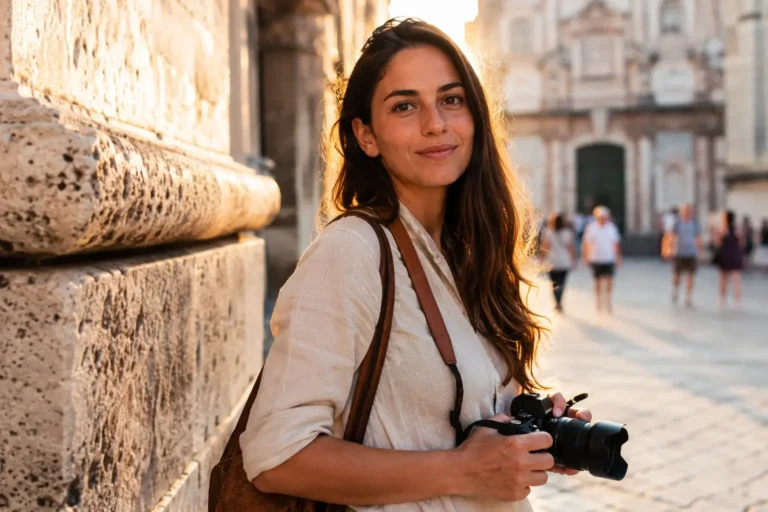

When I was living in New York City, working as a sightseeing guide, I spent my days talking to people who were visiting the Big Apple for the first time. They were usually a mix of wide-eyed wonder and nervous energy. I remember one woman from Ohio—she was about to take her first-ever solo trip to Europe. She looked at me, clutching her bag, and asked, “Emma, how do you manage to feel safe in places you’ve never been?”
I told her exactly what I tell you now: Safety isn’t about being fearless. It’s about being prepared and trusting the gut instinct that tells you when something feels “off.”
After leaving my rigid office job and spending years backpacking through China, teaching in Thailand, and living with families in Ghana, I learned that the world is a much friendlier place than the news makes it seem. But that doesn’t mean you shouldn’t be smart. One of the simplest, most effective ways to bolster your confidence—and actually act on that gut instinct—is by carrying a personal safety alarm.
Why a personal safety alarm is a traveler’s best friend
A personal safety alarm is a small device, usually no bigger than a car key fob, that emits a high-pitched, piercing siren when triggered. It isn’t a weapon. It isn’t meant for combat. It is designed for one thing: to draw attention.
In my time on the road, I’ve found that the biggest hurdle for solo travelers isn’t necessarily a physical threat; it’s the paralyzing anxiety that keeps them in their hotel room. When you carry a small, loud, and reliable alarm, you reclaim your space. You are telling the world—and yourself—that you have a voice, and you know how to use it if you need to.
When I was hiking in remote parts of rural China, I wasn’t worried about crime. I was worried about getting lost or having a minor injury and not being able to call for help. Having a device that creates an instant, inescapable sound is a massive equalizer. It cuts through the noise of a busy street market or a quiet trail, signaling that something is wrong.
What to look for in the best personal safety alarms for travelers
Not all alarms are created equal. I’ve seen some that sound like a tiny bell, and others that sound like a jet engine. If you are looking for the best personal safety alarms for travelers, you need to prioritize a few specific features.
First, volume is everything. You want something that hits at least 120 to 140 decibels. For context, that’s about as loud as a siren or a thunderclap. Anything quieter might be lost in the ambient noise of a train station or a loud city center.
Second, think about the activation mechanism. You want something that is incredibly easy to trigger under stress. Some models use a pull-pin, while others use a button you have to hold or press twice. In a moment of panic, you don’t want to be fumbling with a safety switch. Go for the pull-pin style. You yank the cord, and the noise starts instantly. It’s a simple, mechanical action that won’t fail when your adrenaline is spiking.
Integrating safety into your travel planning
Carrying a device is just one piece of the puzzle. Safety is a mindset. Before you even pack your bags, you should be looking at the official guidance for your destination. I always check the entry requirements, safety ratings, and travel alerts provided by the US Department of State Travel to get a baseline understanding of what to expect on the ground.
When you arrive, your first step should be to understand the local flow. If I’m in a new city, I look for reliable ways to get around that don’t involve walking alone at night in unfamiliar areas. I often suggest that travelers read up on how to use apps like Grab, which is a great way to ensure you have a tracked, reputable driver in many parts of Southeast Asia, rather than trying to hail unknown transport late at night.
Remember, the goal is not to live in fear. It is to give yourself the confidence to say “yes” to an experience you might otherwise skip.
Cultural curiosity vs. safety concerns
One of the most beautiful parts of travel is the cultural exchange. When I taught English in Thailand, I learned that eating with the locals and participating in festivals is how you really see a place. The Tourism Authority of Thailand offers wonderful insights into local customs and cultural etiquette that can help you blend in more easily. When you look like you know where you are going, you are naturally safer.
However, even when you are fully immersed, you should keep your alarm handy. I clip mine to the outside of my daypack or keep it in an easily accessible pocket. It should be an extension of your gear, just like your water bottle or your camera.
If you ever feel that a situation is becoming uncomfortable—perhaps a persistent street vendor or an overly inquisitive stranger—the mere act of reaching for your bag, where the alarm is visible, can often be a powerful deterrent. Most people don’t want the attention that a 130-decibel siren brings.
Avoiding common mistakes: Lessons from the road
I’ve made my share of mistakes. I once arrived in a new city in Europe without any plan for how to get from the train station to my hostel. I ended up walking down a dark, empty street feeling very exposed.
If you are planning your itinerary, please don’t just focus on the sites. Spend time looking at the general traveler safety tips and insurance guidance available at World Nomads to prepare for the unexpected. They have great advice on how to handle gear, how to protect your documents, and how to maintain your situational awareness.
Another mistake? Relying solely on technology. Your phone might die. You might lose signal. A physical, battery-operated safety alarm doesn’t need an app or a data plan. It is a reliable, analog backup in a digital world.
Why I don’t use “luxury” safety gear
You might see expensive “smart” alarms that connect to your phone and send GPS coordinates. While they sound fancy, they are often bulky and unreliable in areas with poor reception. I prefer the “old school” approach. Simple, loud, and cheap. If you lose it at a market, it’s not the end of the world.
When I look at the best personal safety alarms for travelers, I’m looking for durability. I want something that won’t accidentally go off in my bag, but will go off the second I need it. I want a battery that lasts for a year without me having to think about it.
The importance of health and preparation
Safety is about your body, too. Before you head out, especially if you are traveling to a place with different food or water standards, it is vital to check the destination-specific health advisories and vaccine recommendations on the CDC Travelers’ Health website. Getting sick in a foreign country is one of the quickest ways to lose your confidence. Being prepared, having your medications, and knowing where to find a clinic is just as important as carrying a safety alarm.
When I lived in Ghana, I had to be very disciplined about my health to keep my energy up for the adventure. That preparation allowed me to hike, explore, and engage with the community without the shadow of “what if” hanging over me.
Choosing your alarm: Practical tips for the buy
When you are ready to pick your device, look for one with a built-in LED light. It seems minor, but having a small, bright light can help you find your keyhole in a dark hallway or help you signal for help at night.
Also, consider the color. A bright pink or neon yellow alarm is more visible. If you are in a crowded place and you need to drop your alarm to the floor to draw attention, you want it to be seen.
Test it. Seriously. Buy two. Take one out into your backyard or an open space and pull the pin. You need to know what it sounds like. You need to know that if you pull that cord, you are going to be the center of attention. When you know exactly what to expect, you won’t hesitate to use it.
Final thoughts on solo travel confidence
Solo travel is the most rewarding thing I’ve ever done. It taught me that I can rely on myself. I can navigate a train system in a foreign language, I can find my way out of a dense forest, and I can advocate for my own safety.
Carrying a personal safety alarm is not a sign of weakness. It is a sign that you are a smart, intentional traveler who values their life and their adventure. It is a small tool that gives you the freedom to go further, stay out a bit longer, and see things that most people only dream about.
So, go ahead and book that flight. Research your route. Check your safety protocols. Put your alarm in your bag, take a deep breath, and trust your instincts. The world is waiting for you, and you are more than capable of handling whatever it throws your way.