Is India Safe for Solo Female Travelers? An Honest Answer

I want to start with the question I hear more than almost any other from women planning their first big solo trip: “Is India actually safe for someone like me?”
Here is my honest answer: India is one of the most extraordinary, layered, sensory-rich destinations on the planet, and it is also a country that requires a higher level of preparation and situational awareness than most places you will visit. Both of those things are true at the same time. One does not cancel out the other.
India is not the impossibly dangerous place that panic-inducing headlines make it out to be. But it is not the effortlessly carefree destination that overly cheerful travel content sometimes paints either. The women who travel there successfully, and there are many of them, go in informed, prepared, and with their eyes open. That is exactly what this guide is designed to help you do.
What the Official Advisory Actually Says (and What It Means for You)
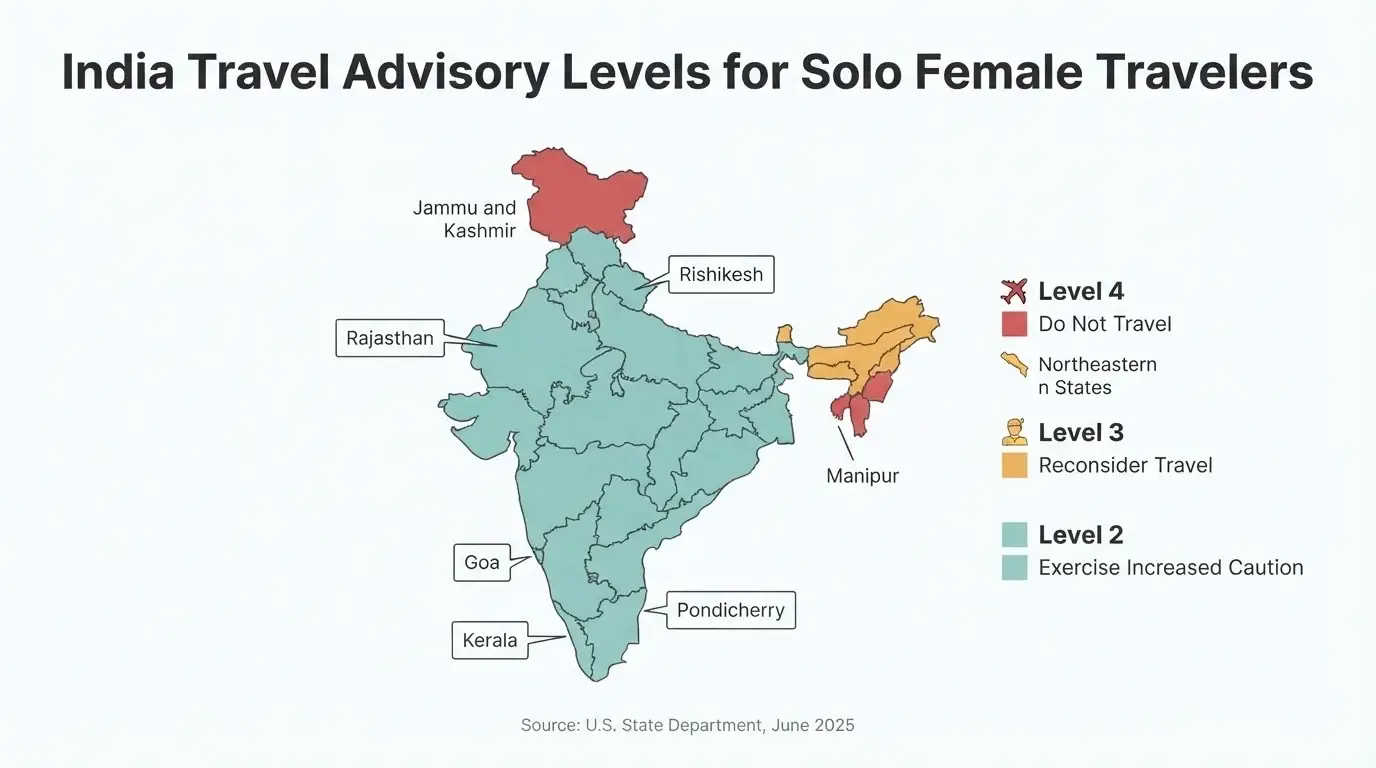
Let’s start with the thing most articles dance around. The U.S. State Department currently rates India as Level 2: Exercise Increased Caution due to crime and terrorism, and its updated June 2025 advisory specifically notes that women should not travel alone. The advisory highlights that rape is one of the fastest-growing crimes in India and that violent crimes, including sexual assault, happen at tourist sites.
Reading that, it is easy to feel like the answer is simply “don’t go.” But context matters enormously. Level 2 is the same rating applied to countries like France, Germany, Belgium, Mexico, and dozens of other destinations that women visit solo every year without anyone batting an eye. The advisory is a genuine risk flag, not a travel ban. What it is actually telling you is this: go prepared, not unaware.
Certain regions carry much steeper warnings. The Union Territory of Jammu and Kashmir is Level 4 “Do Not Travel” due to terrorism and civil unrest, and Manipur is also Level 4 due to ongoing ethnic conflict. The northeastern states are Level 3 “Reconsider Travel.” For a first-time solo female traveler in India, these are regions you simply do not include in your itinerary. Keeping away from these areas removes the highest-risk scenarios immediately.
What that leaves you with is a vast, stunning, incredibly diverse country that millions of women navigate solo each year, many of them reporting it as a trip that changed their lives.
Where to Focus Your Trip: Regions That Work Well for Solo Women
One of the biggest mistakes people make when researching India safety is treating the country as one uniform place. India is enormous. It has 28 states and 8 union territories. The experience of traveling as a solo woman in Kerala is genuinely different from traveling solo in rural Uttar Pradesh. Choosing your regions thoughtfully is one of the most powerful safety decisions you can make before you even book a flight.
Kerala in the south is consistently one of the regions that solo female travelers report feeling most comfortable in. It has high literacy rates, a strong tourism infrastructure, and coastal and backwater landscapes that reward slow travel deeply. The Kerala Tourism official website is worth exploring early in your planning phase because it details everything from houseboat stays on the backwaters to Ayurvedic retreats and hill stations. Cities like Kochi and Thiruvananthapuram have good accommodation options with solid security, and the general culture in Kerala tends to be more accustomed to independent female travelers than some northern regions.
Rajasthan is another popular anchor for solo female itineraries, and rightly so. Cities like Jaipur, Udaipur, Jodhpur, and Jaisalmer are all heavily visited by international tourists, which means their tourist infrastructure is well-developed and local guesthouses are used to welcoming solo women. That said, Rajasthan still requires the cultural awareness and street-smart habits this guide covers below. The official Rajasthan Tourism portal is a reliable starting point for understanding the state’s regions and accommodation hubs.
Rishikesh in Uttarakhand draws yoga practitioners, spiritual seekers, and adventure travelers, and it has a very international, open atmosphere that solo women consistently find welcoming. Dharamshala and McLeod Ganj in Himachal Pradesh have a similar energy, shaped by a large Tibetan Buddhist community and a steady flow of mindful travelers. Pondicherry in Tamil Nadu, with its French colonial architecture and quiet cafe culture, is another city that comes up repeatedly in honest recommendations from women who travel India alone.
Goa is worth a mention because it draws enormous numbers of tourists, which makes it relatively easy to navigate as a solo woman. The caveat is that alcohol, beach culture, and late nights can create a different kind of safety dynamic, so the usual judgment around nighttime behavior applies even more in beach environments.
For a first trip, a sensible anchor itinerary might be something like: Kerala first to ease in, then Rajasthan, with Rishikesh as a possible northern add-on. This keeps you in the regions with the strongest female-friendly track record while still giving you the cultural richness, landscapes, and food that make India so compelling.
Getting There: Visas and What the Process Actually Looks Like
Most international visitors, including U.S. citizens, enter India on an e-Tourist Visa, which you apply for entirely online through the official Indian e-Visa portal. You should apply at least 4 days before your departure, though giving yourself a full week or more is smarter. The 30-day e-Tourist Visa costs USD $25 between July and March, and $10 between April and June. If you are planning a longer or return trip, the 1-year e-Tourist Visa is $40. Processing is typically around 4 days, but can vary. One important note: only use the official government portal. There are numerous convincing fake websites that collect personal data and money without issuing a real visa.
From October 2025 onward, India also accepts an electronic arrival form submitted up to 72 hours before you land, which you can complete through the same official visa website.
Transportation: The Decisions That Matter Most
How you get around in India as a solo woman matters a lot. This is one of the areas where the right choices genuinely reduce risk, and the wrong ones can create unnecessary vulnerability.
For rides within cities, use app-based services like Uber or Ola rather than hailing a cab off the street. Both apps require drivers to register their vehicle details, which creates a level of accountability that street taxis do not. Always share your live trip details with someone you trust before getting in. Sit in the back seat. Keep your phone accessible. These are not paranoid precautions, they are just common sense habits that are easy to build.
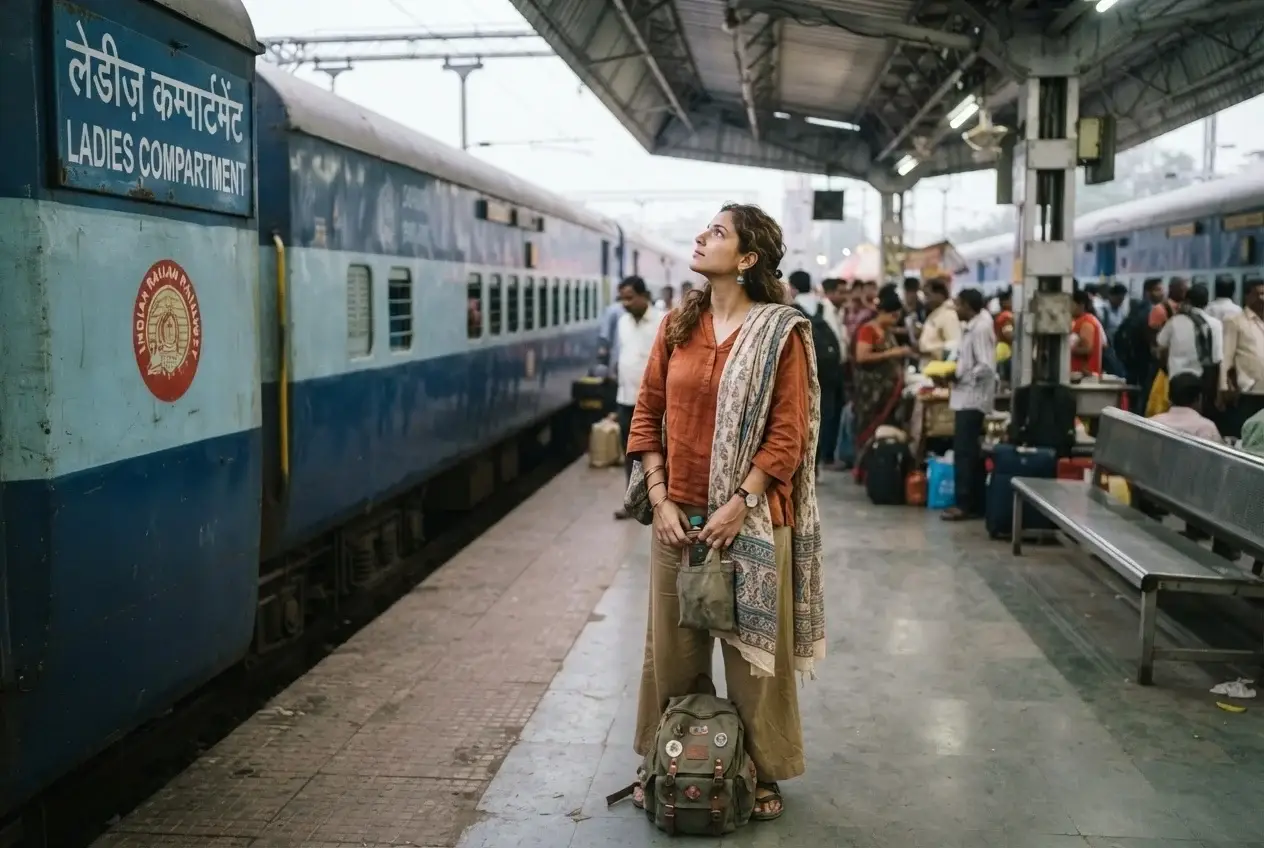
For train travel, Indian Railways has a dedicated women-only berth system called the Ladies Quota (LD quota). Indian Railways earmarks six berths in Sleeper class on most trains exclusively for women, and you can book these through the IRCTC reservation system when selecting your quota at booking. On the Delhi Metro and several other city metro systems, the first coach is designated women-only. Use it. It is less crowded, noticeably more comfortable, and a small but real safety upgrade for solo navigation in busy urban environments.
Avoid arriving at train stations or airports late at night if you can help it. If a late arrival is unavoidable, arrange your accommodation pick-up or pre-book an Uber to your guesthouse before you land rather than figuring it out on the ground at midnight in an unfamiliar city.
Dress Code and Cultural Awareness: Why This Is Worth Taking Seriously
This is not about hiding yourself or performing modesty you do not feel. It is about understanding context and choosing how much friction you want to create in any given environment.
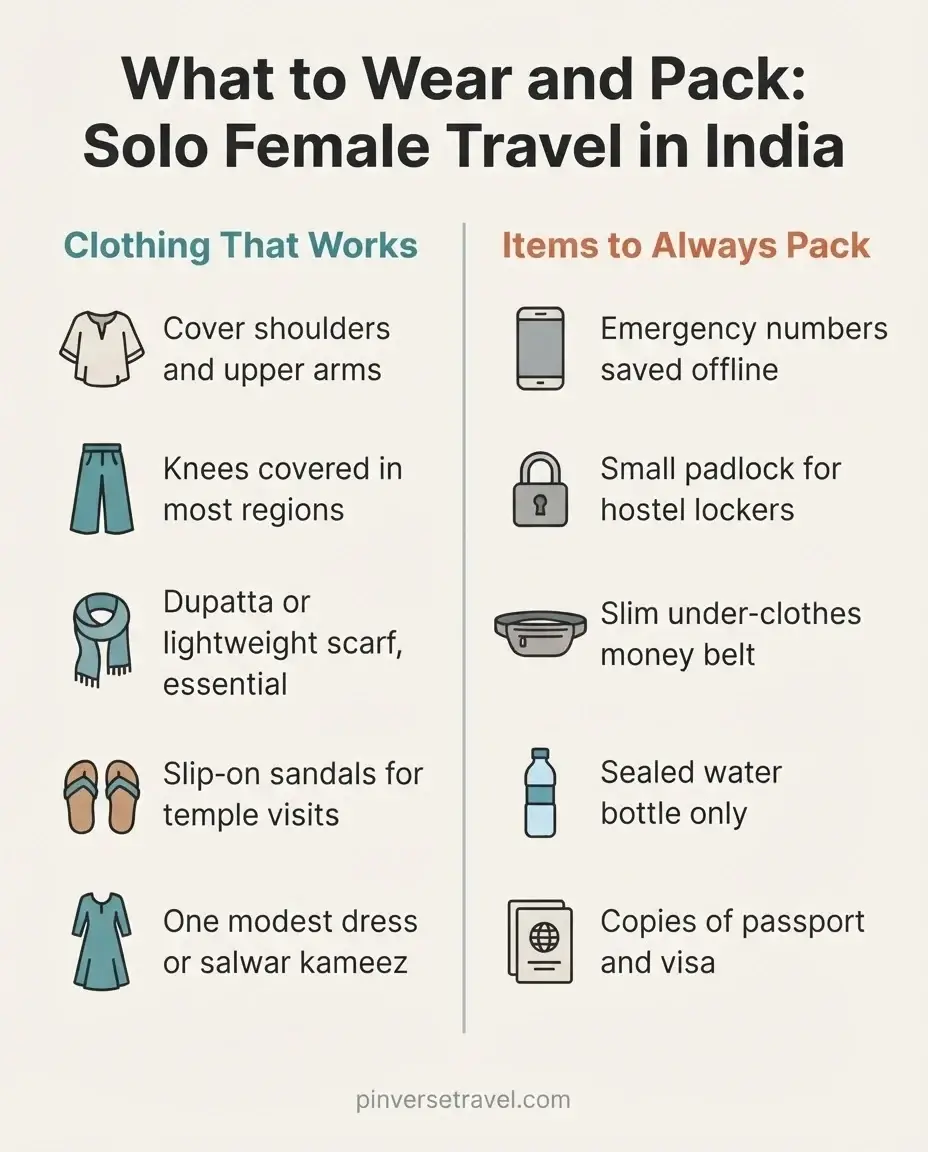
In most of India, dressing conservatively, meaning shoulders and knees covered, will significantly reduce the amount of attention you attract. A lightweight scarf (a dupatta, which is the long scarf worn as part of traditional Indian dress) is the single most useful packing addition for a solo female traveler. It can cover bare shoulders when you walk into a temple, wrap loosely around your chest in crowded markets, and double as a layer when air conditioning gets fierce.
In coastal areas like Goa and beach towns, you will see more relaxed dress standards among tourists. But even there, wearing a cover-up when you leave the beach makes practical sense. In Rajasthan, in temple towns like Varanasi or Pushkar, and in rural areas generally, conservative dress is not just culturally respectful. It actively makes your day smoother and lower-friction.
Understanding and Responding to Harassment
The term “Eve-teasing” is used in India to describe street harassment of women, which can range from staring and comments to following and physical contact. It is a reality that solo female travelers in India encounter to varying degrees depending on where they are, what time it is, and frankly just luck.
What solo travelers consistently report as effective is this: project confidence rather than visible discomfort. Walk with purpose. Avoid making prolonged eye contact with men who seem to be inviting it. If someone follows you or persists with comments, a firm “no” or “stop” said loudly and clearly is more effective than looking flustered. Ducking into a shop, cafe, or finding other women to stand near is a reliable exit strategy in markets and crowded spaces.
At the same time, recognize that genuine warmth and curiosity from local people is also common in India. Not every approach is a threat. Learning to read context, which comes with even a little time on the ground, helps you respond proportionately rather than defensively to everything.
Scam Awareness
Scams in India disproportionately target solo travelers, and solo women in particular. The most common patterns are worth knowing in advance so they do not catch you off guard.
The “closed monument” scam is one where a man (often near a major tourist site) tells you the attraction you are heading to is closed today, but he knows a great alternative and can take you there. The attraction is not closed. The alternative is a store or tour operator he gets a commission from. Another common one near Delhi’s Connaught Place area involves “government tourism offices” that are not government affiliated at all. A third variant is the helpful stranger who insists on accompanying you to your destination and then expects payment.
The pattern to notice is anyone who redirects you from your stated plan to somewhere that benefits them. Trust your instincts. If something feels off, it usually is.
Health Prep: Don’t Skip This Part
Health preparation for India is genuinely important, and it is one of the most overlooked parts of solo travel planning for this destination. The CDC’s India Travelers’ Health page is the most reliable and up-to-date resource for vaccine recommendations, and I strongly encourage you to read it before your appointment with a travel health clinic.
The core vaccines recommended for most India travelers include hepatitis A (food and water risk throughout the country), typhoid (especially relevant if you plan to eat at local restaurants and street stalls, which you absolutely should), and hepatitis B. Malaria prophylaxis is recommended for travel across most of India, including urban centers like Mumbai and Delhi, so talk to your doctor about which prophylactic medication suits your itinerary and health profile. Rabies pre-exposure vaccination is worth discussing if you plan extended travel or time in rural areas, as dogs are a primary transmission risk.
Water safety is straightforward: drink bottled water from sealed branded bottles, use bottled water for brushing teeth in guesthouses where you are not sure of the source, and avoid ice in drinks at low-end establishments. Street food cooked fresh and served piping hot is generally fine and one of the genuine joys of traveling India. Cold prepared foods and salads washed in tap water carry more risk.
Travel insurance with medical evacuation coverage is not optional for a trip like this. Medical care quality in India varies significantly. Major cities like Mumbai, Delhi, Bangalore, and Chennai have private hospitals that meet high standards. Rural areas can be very limited. Knowing you can be evacuated if needed is one of those quiet confidence-builders that makes the whole trip feel more grounded.
If Something Goes Wrong: Resources to Know Before You Go
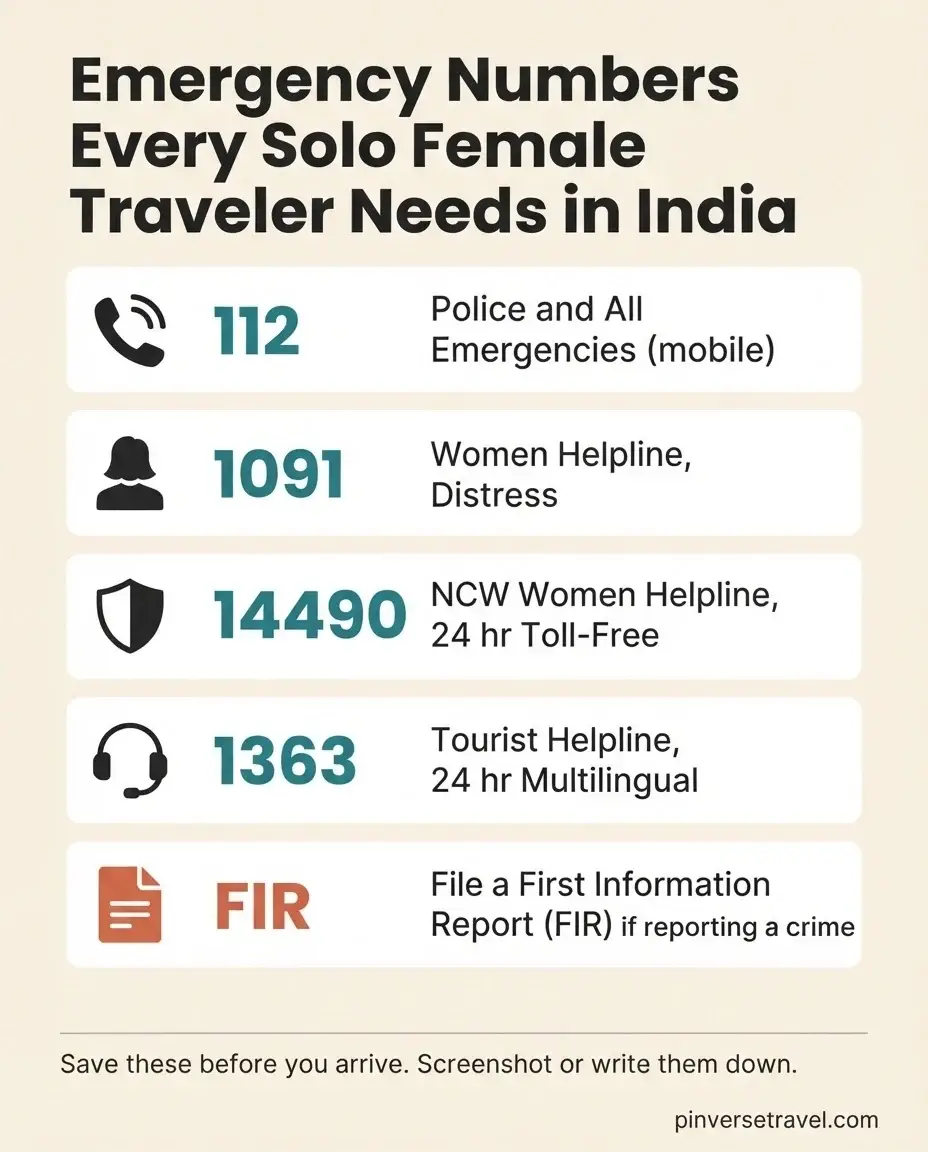
Knowing what to do in a difficult situation before you need to do it is one of the most practically empowering things you can take into any trip. For India specifically, keep these numbers accessible, ideally saved in your phone and written on paper:
The national emergency number in India is 112 (mobile) and 100 (landline for police). The National Commission for Women runs a 24/7 toll-free NCW Women’s Helpline at 14490, which provides immediate assistance and referral for women in distress. The Women Helpline for distress situations is 1091. India’s Ministry of Tourism runs a 24/7 multilingual Tourist Helpline at 1363 (short code) or 1800-111-363 (toll-free), available in 12 languages including English.
If you are a victim of a crime in India and want to pursue it formally, you will need to file what is called a First Information Report (FIR) with the local police. Request this specifically and keep your copy. Indian authorities typically cannot act on a complaint without it, and the U.S. Embassy’s consular services also use it as a reference document in supporting U.S. citizen victims.
Enroll in the U.S. State Department’s Smart Traveler Enrollment Program (STEP) before you leave. It is free, takes five minutes, and ensures the nearest U.S. Embassy can reach you with emergency alerts or assist you if something goes wrong.
Accommodation Tips That Go Beyond “Read the Reviews”
Pick guesthouses and hotels that have 24-hour reception, solid door locks (test the chain lock and deadbolt when you check in), and ideally a reputation for hosting solo female travelers specifically. Many popular guesthouses in Rajasthan, Kerala, and Rishikesh have built a genuine track record with solo women, and that reputation usually shows up clearly in how reviews are written, not just the star rating.
Keep your room number private. When reception staff ask loudly in a lobby “which room for Ms. X?”, it is fine to lower your voice and handle it quietly. Mention to staff that you are expecting a friend later (even if you are not) as a simple way of reducing assumptions about your solo status. These are small habits that experienced solo travelers across many destinations use without thinking twice.
Hostels in India’s backpacker hubs often have female-only dorm options, which give you social connection and built-in network while maintaining privacy. They tend to have lockers and security practices developed specifically for solo travelers.
A Note on Confidence
I spent a lot of my early travel life operating from a place of visible anxiety, and I learned the hard way that visible uncertainty invites attention. Whether I was guiding tours back home in New York or backpacking solo through Europe, the same lesson kept repeating: when you walk and carry yourself like you know where you are going and are completely fine, a remarkable number of problems simply do not materialize.
That does not mean being naive. It means that confidence is a practical skill, not just a feeling. It is how you approach a taxi negotiation, how you enter a market, how you respond to someone who seems to be testing whether you are an easy mark. India will challenge you in ways that will grow that skill faster than almost any other destination. Most women who travel India solo describe it as one of the most rewarding and character-building trips they ever took, precisely because of the navigation it required.
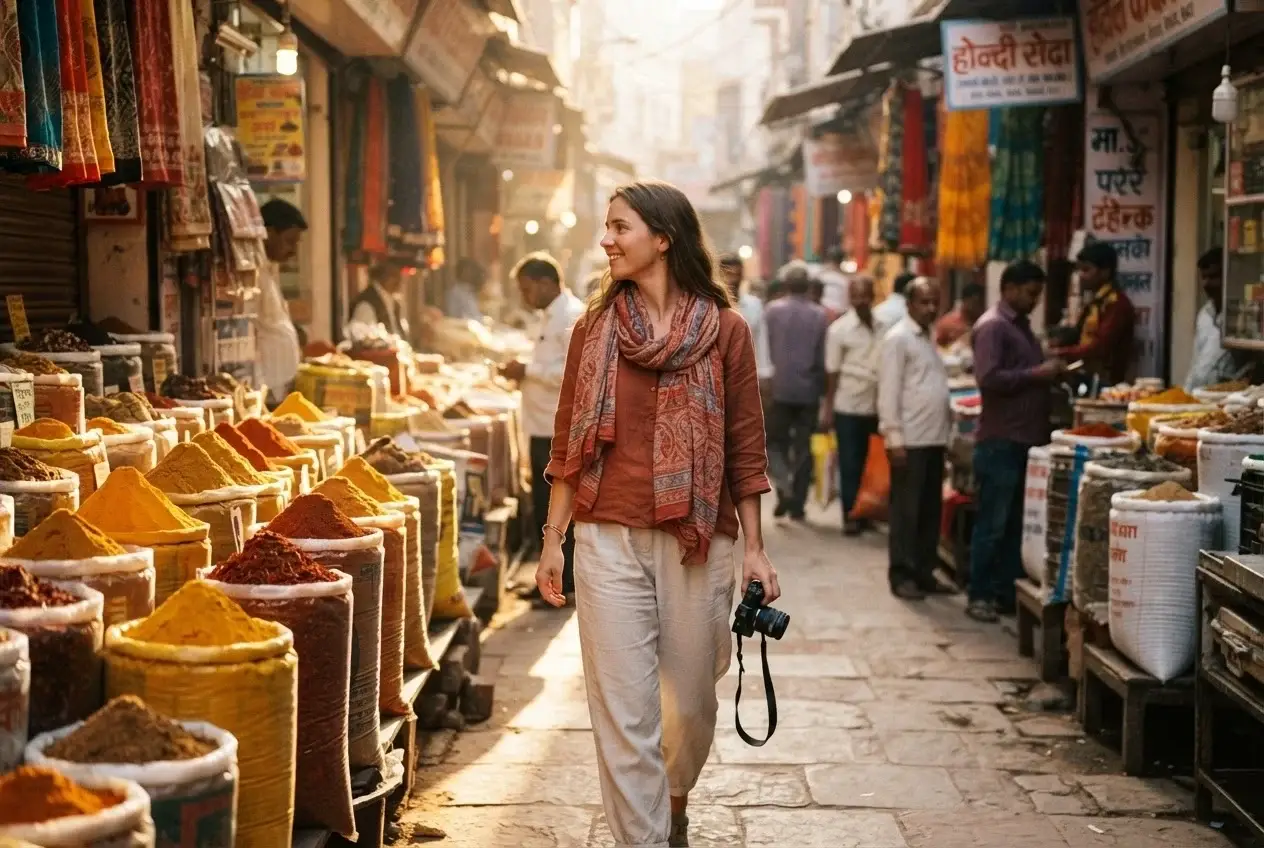
The fear is understandable. The news is genuinely sobering at times. But the answer to that is preparation, not avoidance. Go informed. Go with your eyes open. Go anyway.