Solo Travel for Beginners: 7 Places to Build Confidence

I still remember the feeling the first time I was about to board a flight completely alone. Not just travelling without a companion, but truly going somewhere I had never been, with no one waiting for me on the other side. There was this mix of excitement and sheer panic sitting in my chest like a stone. I had worked as a sightseeing guide in New York for years. I knew how to read a map, navigate a crowd, talk to strangers. And I was still terrified.
If you are in that place right now, staring at your laptop at two in the morning with seventeen browser tabs open, I want you to know that what you are feeling is completely normal. It is also not a sign that you are not ready.
The goal of this article is simple. I want to give you a real, honest shortlist of solo travel destinations for beginners, explain what actually makes them beginner-friendly, and help you figure out which one is right for you. Not just safe countries on a list, but places where your first solo trip will genuinely teach you something about yourself.
Let’s start there.
What Makes a Destination Truly Beginner-Friendly
Before we get into the destinations, it helps to know what you are actually looking for. “Safe” is table stakes. Almost every destination on this list is safe. But beginner-friendly means more than that. Here is what I look for when recommending places to someone taking their first solo trip.
Easy navigation is at the top of the list. If you can get around using public transit without needing to speak the local language, you will spend less mental energy on logistics and more on actually being present. English accessibility matters too, not because you should rely on it, but because having a safety net while you build confidence removes a major source of anxiety. A strong solo traveler community is also a good sign. Destinations with well-established hostel cultures, backpacker districts, and communities of independent travelers mean you are never truly alone even when you are travelling solo. Finally, I think about what I call the forgiveness factor. Beginner-friendly places have visible infrastructure for tourists, multiple options for getting from A to B, and enough other travellers around that one wrong turn is not a crisis.
Now, where does solo travel land globally? The Global Peace Index, published annually by the Institute for Economics and Peace, ranks 163 countries on safety and peacefulness. It is one of the most practical starting points for any solo traveler doing their homework. The 2026 index has Iceland at number one, with New Zealand, Singapore, Austria, and Portugal all in the top tier. That is not a coincidence. Many of the world’s most beginner-friendly solo travel destinations overlap directly with those rankings.
With that framework in mind, here are seven places that consistently stand out.
1. Portugal: The Destination That Makes You Feel Like You Have Done This Before
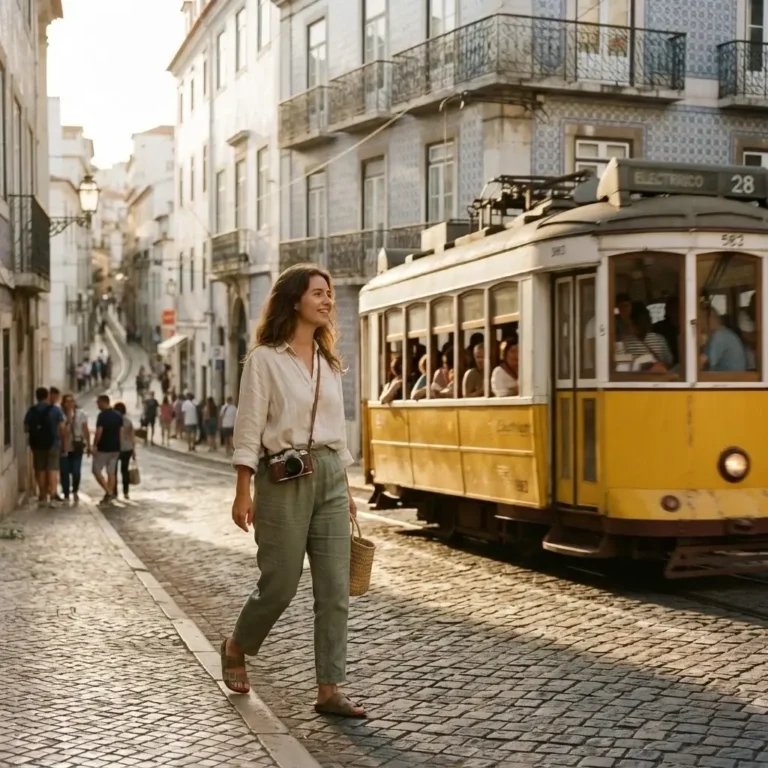
If you are the kind of person who craves slow mornings, interesting food, and genuinely pretty streets that feel unhurried, Portugal is your starting point. Lisbon and Porto are both exceptionally walkable, extremely safe, and run on a pace that suits people who want to absorb a place rather than race through it.
Portugal ranked in the top ten most peaceful countries in the world on the 2026 Global Peace Index. For U.S. citizens, there is no visa required for stays of up to 90 days. Your passport just needs at least three months of validity beyond your departure date. That is it for entry requirements. You land, you go through customs, you start exploring.
What makes Portugal special for beginners is the combination of genuine culture and low logistical stress. English is widely spoken, especially in Lisbon and Porto, but you will still feel like you are somewhere unmistakably foreign. The food alone is worth the trip. Eat pasteis de nata fresh from a bakery in Belem in the morning, have grilled fish and a glass of vinho verde for lunch, and end the day somewhere in Alfama listening to live fado music rise out of the narrow streets. If you are going to Porto, do not skip francesinha, the city’s iconic sandwich that is richer and more layered than anything you will expect.
Getting around Lisbon is straightforward. The Metro is clean and easy to read. The iconic yellow trams (especially Tram 28) are scenic but crowded with tourists; I would suggest taking them once for the experience and using the Metro for actual navigation. Porto is even more walkable and the Andante transit card covers buses, metro, and suburban rail.
For solo travellers who are nervous about eating alone, Portugal is one of the most forgiving places on the planet. Counter seating, tiny neighbourhood tasca restaurants, and a culture that does not treat solo diners as unusual make it easy to settle in, order well, and enjoy your meal without feeling self-conscious.
The official Visit Portugal tourism board has region-by-region guides that are genuinely useful for planning, including information on the Algarve, Alentejo, and the Azores if you want to venture beyond the main cities.
2. Japan: The Solo Traveler’s Dream If You Like Order and Wonder at the Same Time
Japan is, from what solo travelers consistently report, one of the most rewarding first international solo trips you can take, particularly if you want to feel completely immersed in a culture that operates by its own beautiful logic.
Safety is not a worry. Japan has some of the lowest violent crime rates in the world. Solo female travelers who visit Tokyo often describe it as one of the few major cities where they felt genuinely comfortable walking alone at night. The infrastructure is world-class. Tokyo’s train and metro system covers the city comprehensively, and the Japan National Tourism Organization provides maps, trip-planning tools, and English-language resources to help first-timers navigate with confidence.
The key to navigating Japan as a beginner is the Suica card. It is a prepaid IC transit card that you load with cash and tap on and off every train, subway, and bus. You can even use it to buy things at convenience stores. No figuring out fares before each trip. No language barrier at the ticket machine. It turns one of the most complicated transit networks in the world into something manageable on day one.
The food culture in Japan is another thing that makes solo travel there genuinely comfortable. Solo dining is not just accepted, it is built into the architecture of the place. Ramen bars with counter seats facing the wall, standing sushi restaurants, conveyor belt sushi, tiny izakaya pubs where you share the counter with strangers. You will never feel odd eating alone in Japan.
For cultural depth, few cities come close to Kyoto. The historic monuments at Nijo Castle, the Kinkakuji temple, and the Fushimi Inari trail are all recognized as UNESCO World Heritage Sites, and spending time in Kyoto feels less like sightseeing and more like stepping into a living piece of history. The temples are uncrowded early in the morning. Get there before 8 a.m. and you will often have entire pathways to yourself.
Budget note: Japan is not cheap, but it is not as expensive as people assume. Budget accommodation in hostels runs roughly $20 to $40 per night. Convenience store meals (onigiri, sandwiches, hot foods) are excellent quality for around $2 to $5. A mid-range restaurant dinner is usually $10 to $20. Day-to-day spending is very manageable if you lean into the convenience store culture.
3. Thailand: The Classic Starter for a Reason
There is a reason Thailand comes up every single time someone asks where to start with solo travel. It is not hype. Thailand genuinely delivers on almost every criteria a beginner solo traveler needs.
For U.S. citizens, no visa is required for stays under 60 days. However, since May 1, 2025, all foreign nationals entering Thailand by air, land, or sea are required to complete the Thailand Digital Arrival Card (TDAC) online before arrival. This is a straightforward digital form, not a visa, but it must be done ahead of time. The U.S. State Department’s Thailand travel information page covers the current entry requirements in full detail and is worth bookmarking before your trip. Thailand currently holds a Level 1: Exercise Normal Precautions advisory from the U.S. State Department, as of July 2026.
Bangkok is a genuinely excellent starting point for first timers. The BTS Skytrain, the MRT underground, and the Airport Rail Link make the city navigable without taxis, and using Grab (Thailand’s equivalent of Uber) for journeys that require a car is reliable, clearly priced in advance, and removes the risk of taxi fare disputes. For getting to and from the airport, the Airport Rail Link connects Suvarnabhumi directly to central Bangkok in about 30 minutes for around 45 baht.
From Bangkok, solo beginners typically head north to Chiang Mai, which I can speak to from my time teaching English in Thailand. Chiang Mai has a completely different pace. It is slower, greener, and built around temples, night markets, and an enormous community of long-term travellers and expats who are almost unfailingly welcoming. The Old City is a square moat-ringed neighbourhood you can walk across in 20 minutes. Everything you need is within reach.
The food in Thailand is one of the great pleasures of budget travel anywhere in the world. Pad kra pao (basil stir fry with a fried egg) from a street stall costs under a dollar. Khao soi, the rich northern Thai coconut curry noodle soup that is essentially Chiang Mai’s signature dish, is somewhere between $1.50 and $3 depending on where you eat it. The night markets are designed for browsing, snacking, and spending an evening pleasantly without any plan.
One honest note: be aware of common tourist scams in Bangkok. Tuk tuk drivers offering “free” tours to gem stores or temples that are “closed today” are running scams. The Smartraveller guide from the Australian Government’s official solo travel safety page has practical, no-nonsense advice on staying alert without being paranoid. Use metered taxis or Grab, keep copies of your passport separate from the original, and trust your gut if something feels off. Thailand is genuinely safe for first-time solo travelers. These are precautions, not warnings.
The Tourism Authority of Thailand’s official website is a solid resource for checking seasonal events, regional festivals, and destination information across the country.
4. New Zealand: For Beginners Who Want Nature and Ease Together
New Zealand sits comfortably in the top tier of the Global Peace Index every single year and has an infrastructure built almost perfectly for independent travellers. From what solo travelers consistently report, it is one of those rare places where you feel simultaneously adventurous and completely safe.
The country has a deeply embedded backpacker and solo travel culture. The famous Interislander ferry between the North and South Islands, the hop-on hop-off bus network (Naked Bus and Stray Travel both serve routes across the country), and a hostel network that spans even remote areas means getting around is manageable even with no prior experience. English is the primary language. Prices are closer to Western Europe or Australia than Southeast Asia, so budget accordingly.
What makes New Zealand compelling for a first solo trip beyond pure logistics is the scenery. The landscape is genuinely extraordinary in a way that photographs do not fully capture. Fiordland, the Tongariro Alpine Crossing, the Abel Tasman Coast Track, the hot springs of Rotorua. Nature here is accessible, well-marked, and structured around varying levels of fitness and experience. You do not have to be a seasoned hiker to get into the mountains and feel something profound.
For solo beginner travelers specifically, the hostel culture in New Zealand is excellent for naturally meeting people. It is one of those destinations where being alone in a hostel common room for five minutes is usually all it takes before you have plans for the next two days with people you just met.
5. Ireland: Culture, Conversation, and an English-Speaking Country That Still Feels Genuinely Foreign
Ireland is a wonderful option for first-time solo travelers, particularly those who are not yet ready to navigate a language barrier but still want to feel completely immersed in a distinct culture. And Ireland delivers on that. The Irish pub, the storytelling culture, the dramatic coastal landscape, the warmth of the people in small towns well off the tourist trail. It does not feel like a tourist-proof version of Europe. It feels like a real place.
Dublin is an accessible entry point with excellent public transport and a walkable city centre. The DART rail line runs along the coastline connecting Dublin to lovely seaside towns like Howth and Bray, both of which are easy half-day trips. But if you have the time, Ireland opens up dramatically once you get out of the capital. The Wild Atlantic Way, the Aran Islands, the Cliffs of Moher, the Ring of Kerry. These are places that reward slow travel and wandering without a plan.
For first-time solo travelers who worry about loneliness, Ireland is arguably the best cure. The pub culture is not primarily about drinking. It is about community, conversation, and live music. Walking into a traditional session in a small pub in Galway or Doolin as a solo traveller and finding yourself talking to locals and other travellers within the first hour is not an unusual experience. It happens regularly.
U.S. citizens do not need a visa for Ireland for stays of up to 90 days. The weather is famously unpredictable, which is not a deterrent so much as a packing instruction. Bring layers and a waterproof jacket regardless of the season.
6. Iceland: The World’s Safest Country (And It Actually Earns That Title)
Iceland has been named the world’s most peaceful country on the Global Peace Index for 19 consecutive years, including 2026. That is not a statistic that means nothing. It means you can hike to a waterfall alone, drive a remote highland road alone, or walk back to your guesthouse alone at midnight and feel genuinely comfortable.
For beginners who want to combine safety with a sense of real adventure and dramatic natural beauty, Iceland delivers in a way few places can match. The Ring Road (Route 1) circles the entire country and is the most popular solo road trip route in Europe for a reason. It is paved, well-signed, and accessible in a regular rental car outside of the winter months.
Reykjavik is a manageable, walkable capital with a lively restaurant and music scene that punches well above its size. The Northern Lights season runs roughly from September through March. Midnight sun season, where it stays light all night, runs through June and July. Both are genuinely surreal experiences that feel impossible to describe until you have seen them.
Iceland is not cheap. Budget roughly $100 to $150 per day if you are staying in guesthouses, cooking some of your own meals, and renting a small car. It is an investment, but it is also a place that consistently changes people. Solo travelers come back from Iceland describing it as one of the most clarifying trips of their lives. There is something about that much open space and that much silence that does something good to your thinking.
No visa is required for U.S. citizens. The Guide to Iceland website run by the country’s official tourism operators is a genuinely useful planning resource with current road conditions, weather forecasts, and destination guides.
7. Costa Rica: Adventure and Ease for the Nature-Focused Beginner
Costa Rica is a natural fit for solo beginners who are drawn to outdoor adventure, national parks, wildlife, and the kind of trip where no two days look the same. The country has spent decades building an infrastructure around independent travellers and eco-tourism, and that shows in how easy it is to navigate even without much travel experience.
No visa is required for U.S. citizens for stays under 90 days. Spanish is the official language, but in tourist areas, hotels, and national parks, English is widely spoken. The primary safety concerns are petty crime (pickpocketing and bag snatching in busy areas) rather than violent crime, and basic common-sense precautions handle most of that. Don’t leave bags unattended, use hotel safes for valuables, and take licensed taxis or Uber rather than unmarked vehicles.
The draw in Costa Rica is the national parks. The country has set aside more than a quarter of its land for conservation, which means you can travel from jungle to volcano to beach within a single day and feel the genuine abundance of biodiversity that makes Costa Rica one of the most ecologically diverse places on the planet. Manuel Antonio National Park, Arenal Volcano, and the cloud forests of Monteverde are all accessible to independent travellers at a range of budget levels.
For solo travelers, the abundance of small eco-lodges, group tours, and activity operators means it is easy to structure your days around things to do even without a travel companion. Zip-lining, white-water rafting, wildlife night walks. These are inherently social activities where you will naturally meet other travelers.
A Few Things That Apply to Every Destination on This List
Get travel insurance before you leave. I cannot say this strongly enough. Not because anything terrible is going to happen, but because being sick, injured, or stranded abroad without coverage is an expensive and stressful experience that no amount of savings can fully offset. World Nomads, SafetyWing, and similar providers offer coverage specifically designed for independent travellers at reasonable prices. Look for a policy that covers medical evacuation as well as basic cancellation and delay.
Do not over-plan your first trip. This is one of the most common mistakes I see first-time solo travelers make. They build itineraries down to the hour because planning feels like control. What it actually does is remove the space for the unexpected, and the unexpected is where most of the best moments happen. Leave gaps. Give yourself permission to change direction.
Tell someone your itinerary. Leave a copy of your booking confirmations, your accommodation addresses, and your rough plan with someone at home who can reach you if needed. This is just smart travel, not paranoia.
The loneliness question. Almost every first-time solo traveler worries about being lonely. Most find it is either not an issue at all, or a very temporary feeling that fades within the first day or two. Staying in social accommodation, booking a group activity on your first full day, and simply sitting in a cafe with your journal rather than your phone in your room are all genuine remedies. Loneliness tends to show up when you hide. Adventure tends to cure it.
So Where Should You Actually Start?
Here is my honest framework for choosing. If you want culture, food, walkability, and the confidence of a safe Western European city: go to Portugal first. If you want to be completely immersed in a fascinating, orderly, genuinely different culture: go to Japan. If you want a classic, budget-friendly solo travel first trip with a strong community of other solo travelers: Thailand is still the gold standard. If outdoor adventure and extraordinary nature is your priority: New Zealand or Iceland. If you want English-speaking culture with real character and warmth: Ireland. If you want jungle, wildlife, and eco-adventure: Costa Rica.
The right first destination is not the one that sounds the most impressive. It is the one that matches your actual interests and meets you where you are. All seven of these places are forgiving enough to be a first solo trip and meaningful enough to change you.
Pick one. Book the flight. The rest follows.
Did this help? If you are just starting to plan, check out my guide on how to prepare for your first solo trip for the practical step-by-step that comes after you decide where you are going.