For years I believed skiing was something other people did. Wealthier people. People with a chalet friend, a rich uncle, or a job that handed out three weeks of vacation. When I was guiding sightseers around New York City, I’d hear tourists talk about their Alps holidays the way I talked about winning the lottery, like a lovely thing that happened to someone else.
Then I started actually looking at numbers instead of feelings. And what I found is the reason I’m writing this. A week of skiing in Europe can cost less than a long weekend in some big cities, if you know where to point yourself. The catch is that nobody selling you a glossy holiday wants you to know it.
So let’s fix that. This is the honest breakdown I wish someone had handed me: which countries are genuinely cheap, what a real trip costs from your first flight to your last plate of dumplings, and how to do it solo without feeling like the odd one out. No fantasy budgets. No “just skip lunch to afford the lift pass.” Real planning for real people who are a little nervous and a little broke and want to go anyway.
The Money Myth That Keeps People Off the Mountain
Here’s the thing that took me too long to understand. When people say skiing is expensive, they almost always mean skiing in the famous places. Verbier, Zermatt, Courchevel, the postcard Alps. Those resorts really are eye-watering, and they’re the ones plastered across social media, so they set the mental price for everyone.
But Europe is enormous, and the mountains don’t stop at Switzerland. Head east and south and the exact same sport gets dramatically cheaper. Lift passes drop by half or more. Rentals cost pocket change. Lessons that would be a splurge in France become an easy yes. The snow is still cold. The views still make you gasp. You just pay a fraction for them.
The whole trick to budget skiing is refusing to let the influencer version of the sport define what’s possible for you. Once I let go of the idea that “real” skiing meant expensive skiing, the whole thing opened up.
What a Ski Trip Actually Costs (The Full Picture)
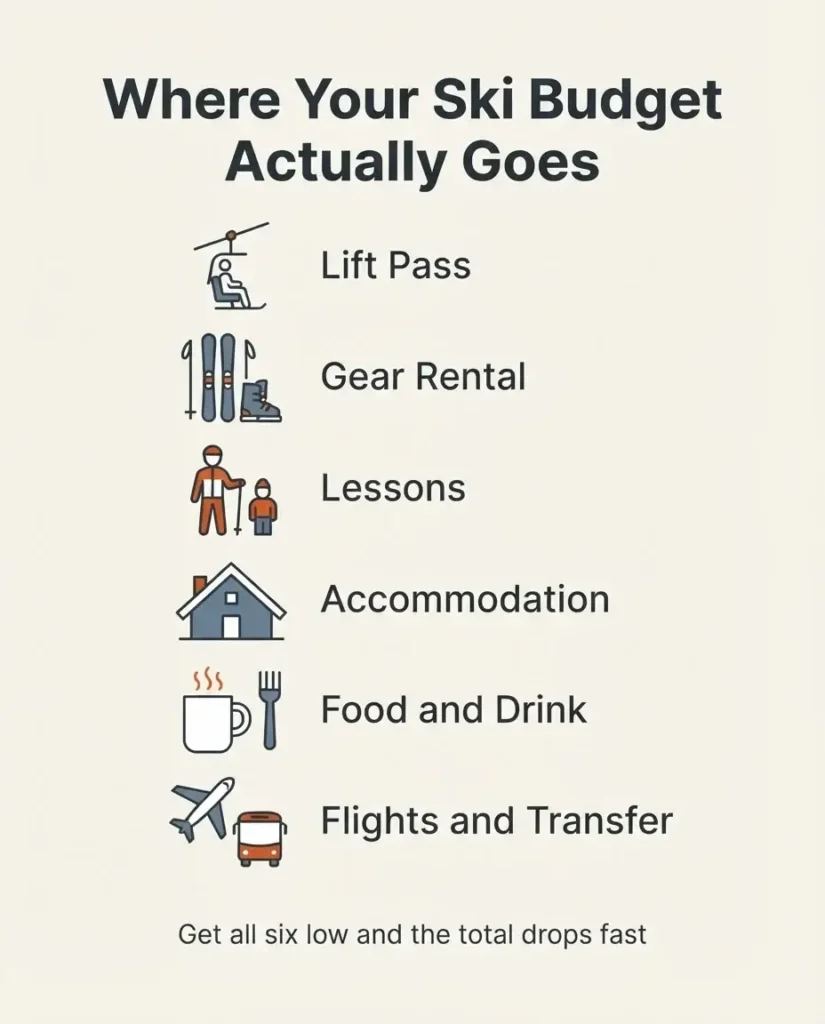
Before I name resorts, let’s talk honestly about where your money goes, because a cheap lift pass means nothing if everything around it drains your wallet. A ski trip has six real costs, and budget destinations win on almost all of them.
There’s the lift pass, which is your daily ticket to ride the lifts. There’s gear rental if you don’t own skis, boots, and poles. There’s lessons if you’re new. There’s accommodation. There’s food and drink. And there are flights plus the transfer from the airport to the mountain. Get all six low at once and the total becomes genuinely affordable.
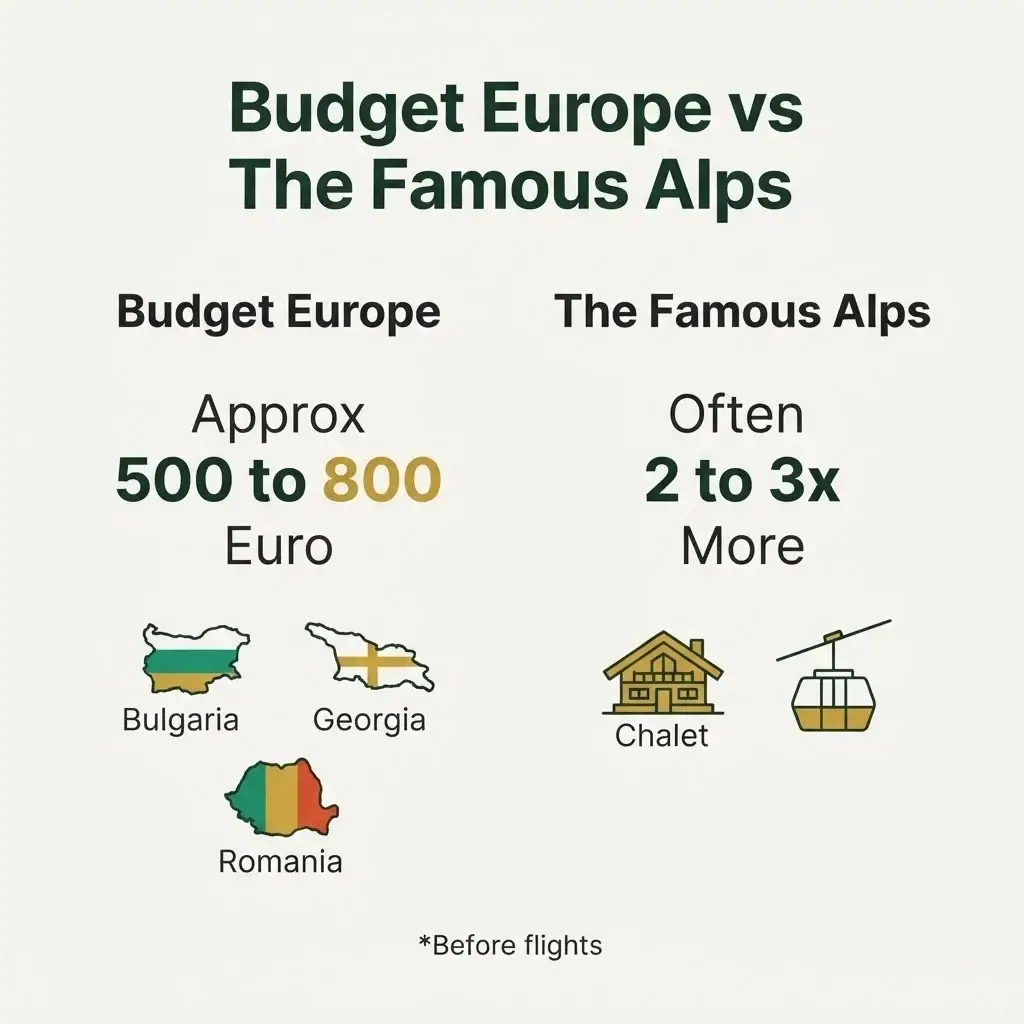
In the budget countries I’ll cover, a full week of skiing, including a mid-range room, rented gear, a lift pass, a few lessons, and food, often lands somewhere around 500 to 800 euros before flights. In the famous Alps, that same week can cost two or three times as much before you’ve bought a single hot chocolate. That gap is the whole story.
Bulgaria: Where Budget Skiing Starts for Most People
If you’ve never skied and you’re watching every euro, Bulgaria is where I’d send you first. It has become the classic starter destination for budget travelers for good reason: low prices across the board, English widely spoken in the resorts, and a beginner-friendly culture.
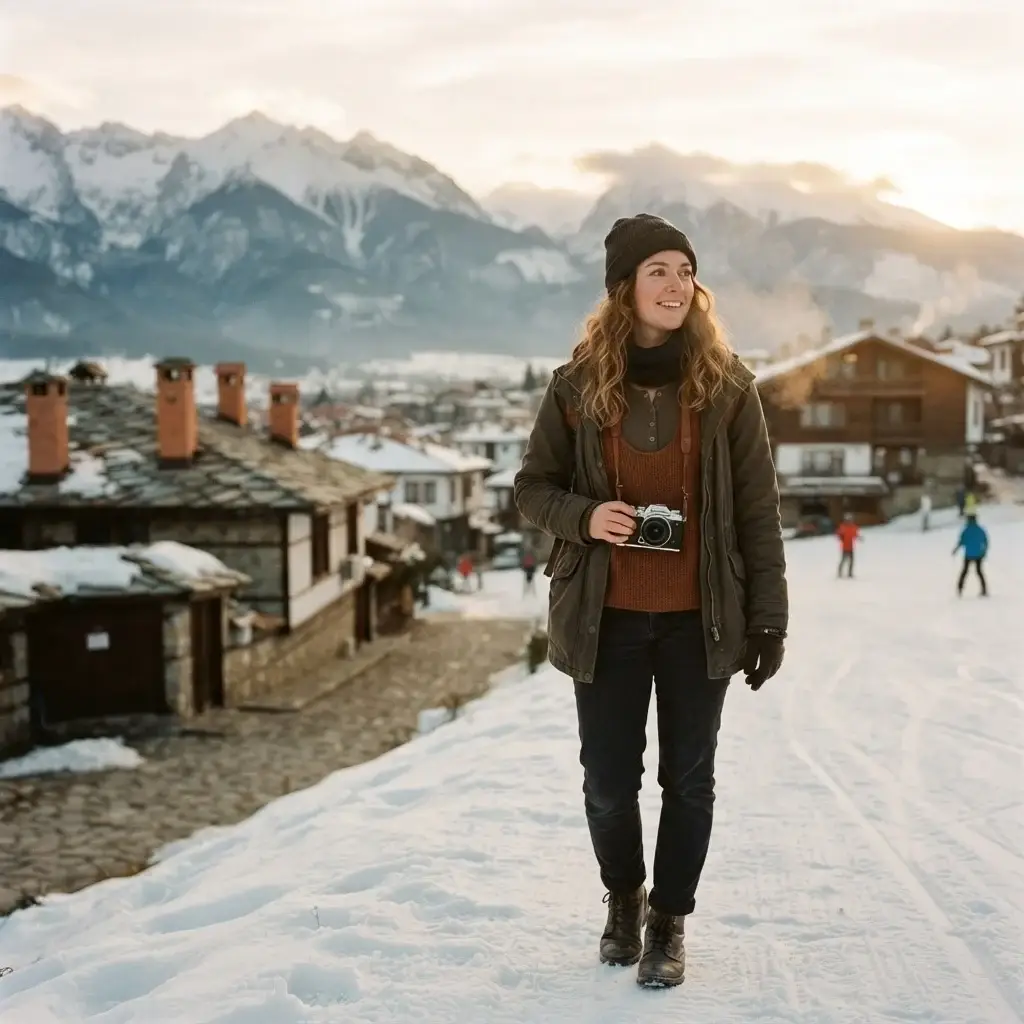
The star is Bansko, a resort town with a genuinely charming old quarter of cobbled lanes and stone houses, tucked below the Pirin mountains. It’s not just a lift station bolted onto a village. There’s actual life here after the skiing stops. The official rates published by the resort operator on the Bansko ski resort’s own pricing page run to roughly 259 euros for a six-day adult pass in the current season, with reduced rates for students and seniors closer to 230. A day pass sits around 79 euros. Compare that to a marquee Alpine resort and you’re often saving half.
One heads-up worth knowing: Bulgaria recently adopted the euro, so older blog posts quoting prices in lev are out of date. Budget accordingly and don’t panic if numbers online look inconsistent.
Bansko’s slopes suit beginners and improvers beautifully, with a long gondola out of town and wide, forgiving pistes higher up. If Bansko feels too busy, Borovets and Pamporovo are Bulgaria’s other two main resorts, both a touch smaller and often a touch cheaper. For the practical stuff like the tourist information centre, transfers, and cultural sites, the official Visit Bulgaria portal’s Bansko page is a reliable, ad-free starting point.
When you come off the mountain, eat like a local and your food budget nearly disappears. Order banitsa, a flaky cheese pastry that’s the national comfort food, a bowl of bob chorba (bean soup), and grilled kebapche with a shopska salad. A hearty tavern dinner with a local beer often costs less than a fast-food combo back home.
Getting there: Fly into Sofia, then it’s roughly a two-and-a-half to three-hour transfer south to Bansko by shuttle or bus. You do not need a car. Prebook a shared shuttle and you’re sorted.
Georgia: The Cheapest Big Mountains I Know Of
If Bulgaria is the sensible starter, Georgia (the country, not the U.S. state) is the wildcard that budget skiers keep whispering about. Gudauri is the standout, a high, wide-open resort in the Caucasus mountains a couple of hours north of the capital, Tbilisi.
The prices here are almost hard to believe. Travelers consistently report five-day passes in the ballpark of 80 pounds, rental gear for the whole trip for around 70, and beginner lessons starting near 7.50 pounds a session. You can check the current lift-pass rates on the Gudauri resort’s official ski-pass page so you’re working from real numbers, not year-old blog figures.
There’s one thing I want you to take seriously here, because it’s the kind of detail budget listicles skip. Gudauri is high. According to the resort profile on skiresort.info’s Gudauri page, the ski area runs between roughly 1,993 and 3,276 meters. That’s real altitude. If you’re flying in from sea level, take your first day gently, drink far more water than feels necessary, and don’t be surprised if you’re a little breathless. Altitude doesn’t care how fit you are.
Georgia’s food is one of the great secret joys of the trip. Order khachapuri, a boat of bread filled with molten cheese and often an egg, and khinkali, fat soup dumplings you eat with your hands. It’s rich, warming, mountain food, and it’s cheap. Tbilisi itself is worth a couple of days on either end of your ski trip, so you’re really getting two holidays in one.
Getting there: Fly into Tbilisi, then a two-hour transfer up the Georgian Military Highway to Gudauri. That road is dramatic and winding, so if you get carsick, sit up front and bring something for it.
Romania, Poland, Slovakia, and Slovenia: The Reliable Middle
Between rock-bottom Georgia and the pricey Alps sits a band of Central and Eastern European countries that offer a lovely balance of low cost and easy access, especially if you’re flying from within Europe.
Poiana Brașov in Romania is a genuine charmer, set in Transylvania near the storybook town of Brașov. Day passes hover around 240 lei, roughly 38 pounds, and the resort is compact and welcoming, which is exactly what a nervous first-timer wants. You can pair skiing with a day exploring Brașov’s medieval square and Bran Castle nearby, so it doubles nicely as a culture trip.
Zakopane in Poland sits at the foot of the Tatra mountains and has a buzzy, atmospheric mountain-town feel. Prices are excellent, and you can see current lift figures on the PKL cable car operator’s official price list for the Kasprowy Wierch area. Eat pierogi and oscypek, the smoked mountain cheese sold from street grills, and you’ll spend almost nothing on food.
Jasná in Slovakia is the biggest, most modern resort of this group, with terrain that genuinely satisfies stronger skiers. Be warned that its prices have crept up in recent years, with day passes now landing around 69 to 79 euros, closer to Austrian territory than the true bargains. It’s still good value for the size, just not the steal it once was. Fuel up on halušky, potato dumplings with sheep’s cheese and bacon.
Vogel in Slovenia is the quiet, scenic pick, perched above the fairytale Lake Bohinj in Triglav National Park. A high-season six-day pass runs around 153 euros. It’s smaller and more relaxed, which some people love and stronger skiers may find limiting.
Andorra: The Budget-Ish Alps
If you want proper big-mountain Alpine skiing but can’t stomach French or Swiss prices, the tiny country of Andorra, wedged between France and Spain, is the compromise. Grandvalira is a large, well-run resort, and while it’s pricier than Bulgaria or Georgia, it undercuts the famous Alps. A day pass runs around 59 to 69 euros, and you can save meaningfully by booking ahead on the Grandvalira resort’s day-pass page rather than paying the gate rate. Andorra also has a duty-free reputation, so gear and gadgets can be cheaper here.
Do You Need a Visa? The 2025 Change Nobody Mentions
Here’s a genuinely useful update that most ski articles haven’t caught up with. As of the start of 2025, the European Commission confirmed that Bulgaria and Romania became full members of the Schengen Area, which lifted internal border checks. For many travelers this simplifies a trip that touches multiple Schengen countries.
For U.S., U.K., Canadian, Australian, and many other passport holders, short tourist stays in these countries remain visa-free, though the EU’s upcoming ETIAS travel authorization is expected to add a small pre-registration step for visa-exempt visitors. Georgia is not in the EU or Schengen at all and offers generous visa-free entry to a long list of nationalities, often up to a year, which is part of why it’s such a friendly budget base. Always confirm the current rules for your specific passport before you book, since these things shift.
The Solo Skiing Question: Can You Actually Do This Alone?
Yes. And I’d argue budget resorts are among the best places to do it.
I’ve done a lot of my most meaningful travel alone, from backpacking across Europe to hiking in China, and the pattern is always the same: the fear beforehand is much bigger than the reality once you arrive. Skiing solo has a built-in advantage that a lot of solo travel doesn’t. Ski school throws you together with other people instantly. Sign up for a group beginner lesson and by lunchtime you’ve got a little crew of equally wobbly strangers, all laughing at each other’s falls. It’s one of the easiest ways I know to meet people while traveling.
The mountains themselves are also more social than you’d think. Shared shuttles, rental shops, mountain restaurants, and the lift queue all put you shoulder to shoulder with other travelers. Budget resorts in particular draw a friendly, international, unpretentious crowd. Nobody there is trying to impress anyone.
A few practical solo notes. Tell your accommodation your rough plans each day. Start on green and blue runs and build up, because there’s no ego in skiing within your limits, only in getting home in one piece. And keep your phone charged and warm, since cold drains batteries fast.
The One Cost You Should Never Cut: Insurance
I’m relentlessly frugal, but this is the line I won’t let you cross. Standard travel insurance often excludes “winter sports,” which means a crash, a torn ligament, or a mountain rescue could land you with a bill that erases every euro you saved. Buy a policy that explicitly covers skiing and snowboarding, including off-piste if you plan to leave the marked runs. It usually costs very little to add, and it turns your whole trip from a gamble into a plan. Skiing is safe, but it’s the one place I treat insurance as non-negotiable.
When to Go, and How to Time It Cheap
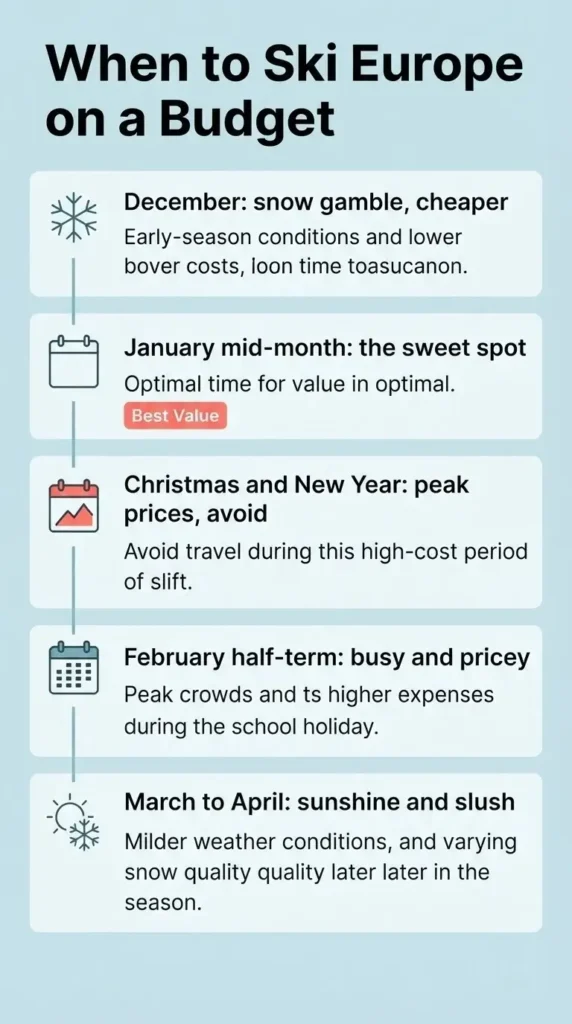
The European ski season generally runs from December to March or early April, with conditions varying by altitude. The trap for budget travelers is the peak weeks: Christmas, New Year, and February half-term send prices soaring and slopes packed.
The sweet spot is mid-January, when the holiday crowds have gone home but the snow is reliable. Prices dip, lift queues shrink, and the whole experience feels calmer. This is also, not coincidentally, the loneliest time of year for a lot of people back home, which makes it a wonderful moment to be on a mountain instead. Early season in December can be a gamble on snow, and late season in spring gives you sunshine and slush in equal measure.
Après-Ski Without the Splurge
The famous ski resorts turned après-ski, the drinking and socializing after the lifts close, into a luxury sport of its own. In budget destinations, it’s refreshingly down to earth. A local beer or a shot of rakia in Bulgaria, mulled wine in Poland, or Georgian wine (the country basically invented the stuff) costs a fraction of an Alpine bar tab.
My honest advice is to lean into the local version rather than chasing the imported party scene. A warm tavern, a plate of something hearty, and strangers who become friends is the whole point. That’s the memory you’ll keep, not an overpriced cocktail with a mountain view.
How I’d Actually Book This If I Were Starting Today
If you’re a total beginner watching your budget, I’d book Bansko in Bulgaria in mid-January, fly into Sofia, take a prebooked shuttle, rent gear locally, and sign up for a couple of group lessons on arrival. That’s the lowest-stress, best-value first ski trip I can think of.
If you’re a little more adventurous and want the cheapest big mountains, I’d point you at Gudauri in Georgia, with a couple of days in Tbilisi bookending the trip and real respect paid to the altitude.
If you’re flying from within Europe and want easy access with a touch more polish, Poiana Brașov, Zakopane, or Andorra’s Grandvalira all make excellent, wallet-friendly choices. For a broad overview of the field as you compare, the Lonely Planet budget ski resorts guide is a solid, non-salesy reference to read alongside this.
The mountain doesn’t check your bank balance at the bottom of the lift. It just gives you the same cold air, the same rush, and the same view whether you paid a fortune or found the clever way. Pick your resort, block out that quiet week in January, and stop waiting for a version of yourself who’s richer or braver or more ready. That person is just you, after you’ve booked. So book it, and I’ll see you on the slopes.