Farm-to-Table in South America: Where to Eat and What to Expect

Something happens when you sit down at a restaurant and the server explains that the potato on your plate grew in soil 3,800 meters above sea level, tended by a farmer whose family has cultivated that exact variety for generations. The food stops being just food. It becomes a story, a place, a reason you flew halfway around the world.
That is what farm-to-table dining feels like in South America. And it is nothing like the brunch-spot version of the term most of us grew up with.
Over the past decade, South America has quietly transformed into one of the most exciting food destinations on the planet, not because of fancy imported ingredients or European-trained chefs chasing trends, but because of the opposite. Chefs here are going deeper into their own land, their own markets, their own mountains, and their own coastlines. The result is a dining movement that is urgent, political, ecological, and extraordinarily delicious, all at once.
If you are planning a food-focused trip to South America, or just wondering whether those world-ranked restaurants are actually worth the hype, this guide is for you. I will take you through the countries and cities leading this movement, the specific restaurants worth knowing, what they actually cost, how to book them, and what to expect if you have never done a tasting menu in your life.
Why South America Is Leading the World in Ingredient-Driven Dining
It helps to understand what makes South America’s farm-to-table movement different from what you might find in, say, a farm-sourced brunch spot in Brooklyn.
Peru alone has over 3,000 native varieties of potato. The Andes produce quinoa, kiwicha, and dozens of grains that barely exist in Western supermarkets. Colombia’s coastline and interior host a biodiversity that most of the world has never tasted. Chile’s Patagonia provides ingredients that have no culinary equivalent elsewhere. Brazil’s Amazon basin is, in many ways, one of the most ingredient-rich places on earth.
What South American chefs have done over the last decade or so is take this extraordinary natural pantry seriously. They stopped looking outward to Europe for culinary validation and started looking inward, into their own geography, their own indigenous knowledge, and their own communities of farmers, foragers, and fishermen.
The results have been recognized globally. According to Latin America’s 50 Best Restaurants, the region’s top tables now regularly outrank European and North American institutions that have held prestige for far longer. This is not a trend anymore. It is a full transformation.
For a solo traveler, this moment matters. You are arriving at a time when South American food culture is genuinely at its peak.

Peru: The Country That Changed What Restaurant Food Could Mean
No conversation about farm-to-table dining in South America starts anywhere except Lima.
Lima has been called the food capital of the world by serious people who have eaten everywhere. That reputation rests largely on the fact that Peruvian cuisine draws on an almost incomprehensible range of climates and ecosystems, from coastal fisheries to high-altitude Andean plateaus to Amazonian rainforest, all within a single country. The chefs who understood this earliest built restaurants that are now benchmarks for the entire global food world.
Central: The Tasting Menu That Rearranges Your Understanding of Food
Central, led by Virgilio Martinez and Pia Leon and located in Lima’s Barranco neighborhood, runs what is arguably the most conceptually ambitious tasting menu in the Western Hemisphere. The Mundo Mater menu takes you through 14 ecosystems across 14 different altitudes, from sea level to 4,100 meters, with each course using ingredients sourced from that precise elevation. You are not just eating Peruvian food. You are eating Peruvian geography.
The menu is priced at approximately S/1,480 per person (around USD $390-400 at current exchange rates), and that includes VAT and a 13 percent service charge. Reservations are online, available for groups of one to six, and bookings are released months in advance, so if this is on your itinerary, check the Central Restaurant reservations page as early as you possibly can. Seats for the most sought-after dates often go within minutes of opening.
A short note for first-timers: a tasting menu at a restaurant like Central is a 3-4 hour experience. You will be paced through courses, explained each dish, and left with time to absorb it. Solo dining is entirely welcome and common. Bring curiosity, leave your rush at the door.
Kjolle: The More Personal Side of Peru’s Food Story
If Central is the grand architectural statement, Kjolle is the intimate conversation.
Pia Leon, who co-leads Central with Virgilio Martinez, runs Kjolle as her own solo expression, a few steps away in the same Barranco compound. Where Central is organized around altitudinal science, Kjolle is organized around color, texture, and emotion. Leon sources from small Peruvian farms and artisan producers, and her nine-course tasting menu has a freedom to it that feels personal and even playful.
Kjolle’s tasting menu starts at around USD $292. Open Tuesday through Saturday for both lunch and dinner, the restaurant is smaller and slightly easier to book than Central, but not by much. Check Kjolle’s reservations page well ahead of your travel dates. The address is Av. Pedro de Osma 301, Barranco, same building complex as Central.
For a solo traveler, Kjolle might actually be the more comfortable starting point. The energy is warm and personal, and the team is genuinely happy to walk you through each dish.
Mil Centro: Eating at 3,568 Meters Above Sea Level Near Cusco
This one deserves its own paragraph just for the setting.
Mil Centro sits next to the Moray Archaeological Complex in the Sacred Valley, roughly 40 kilometers northwest of Cusco, at an altitude of 3,568 meters above sea level. Virgilio Martinez built it as both a restaurant and a research center, working with Mater Iniciativa to study the biodiversity of the Cusco highlands and translate those findings directly into the menu. Every ingredient on your plate comes from within a short radius of the restaurant, from communities that Mater has developed direct partnerships with over years of fieldwork.
The experience at Mil Centro is available for lunch only, Tuesday through Sunday, from 12:00 to 14:30. Getting there from Cusco typically requires hiring a taxi or joining a small group tour, as public transport to Moray is limited. The drive itself is beautiful, passing through highland farming villages and dramatic Andean scenery.

If you are already planning a Sacred Valley itinerary, building a Mil lunch into your day is one of the most seamless ways to connect landscape, archaeology, and food in a single afternoon.
Mater Iniciativa: The Research Center Behind It All
Here is something most articles about Peruvian farm-to-table dining skip entirely.
Behind Central and Mil Centro is Mater Iniciativa, an NGO and research center founded in 2013 by Virgilio Martinez, his wife Pia Leon, and his sister Malena Martinez. Malena is an anthropologist and environmental scientist, and she leads a team that actually goes into the field, collecting, cataloguing, and studying Peru’s megadiversity, plants, animals, algae, insects, and grains that have no culinary name in English.
This is not just background flavor text for restaurant brochures. It is real scientific and cultural work. Understanding that Mater exists helps you understand why the food at Central and Mil feels so different from anything you have had before. These dishes are the results of fieldwork.
Colombia: The Country the Food World Is Watching Right Now
If Peru built the philosophical foundation for South America’s food movement, Colombia is the country that is building on it fastest right now.
El Chato, Bogota: The Best Restaurant in Latin America (2025)
El Chato, run by chef Alvaro Clavijo in Bogota’s Chapinero Alto neighborhood, was named the Best Restaurant in Latin America at the 2025 Latin America’s 50 Best Restaurants ceremony. That is the highest recognition in the region, and Clavijo earned it by running what is essentially a contemporary Colombian bistro with deep roots in local farming relationships.
El Chato is not a flashy fine-dining palace. It is a place where the sourcing is serious, the techniques are confident, and the cooking connects Colombia’s extraordinary range of regional ingredients to the plate without making a performance of it. Solo travelers report feeling comfortable here. The vibe is a warm, modern bistro, not a stiff ceremony. The address is Calle 65 # 4-76, Chapinero Alto, Bogota.
Celele, Cartagena: The Caribbean Colombia You Have Not Tasted Yet
Celele is one of the most singular restaurant experiences in South America, and most food travelers have not heard of it yet.
Founded by chef Jaime David Rodriguez Camacho from his Caribe Lab project, which involved two years of fieldwork surveying the Colombian Caribbean coastline, Celele is built around Caribbean Colombian biodiversity. Camacho and his team catalog native ingredients, partner with fishermen, peasant farming associations, artisans, and local producers, and use the research to develop a seasonal menu that reads like a map of the Colombian Caribbean coast.
It sits in a little blue house in Getsemani, Cartagena’s historic neighborhood, and won the Sustainable Restaurant Award at Latin America’s 50 Best Restaurants 2025. The Celele restaurant website is where to make reservations. The phone is +57 (301) 742 0389. Go for lunch if you want to experience the light pouring into that small colonial dining room.
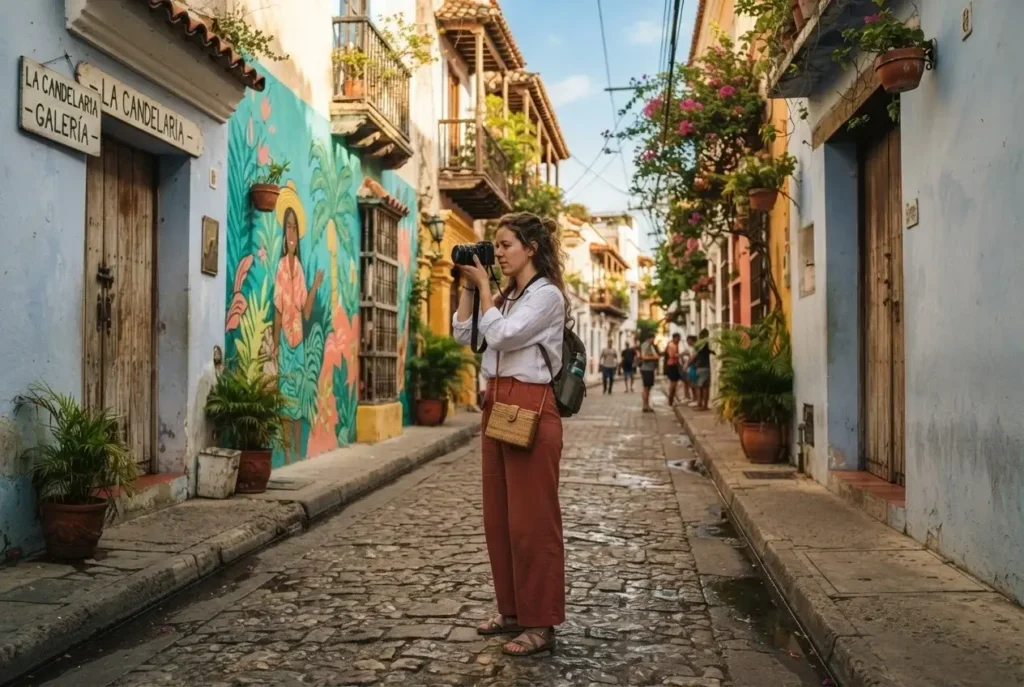
For solo travelers in Cartagena, Celele solves a common problem: where to eat that is genuinely connected to place rather than catering to tourist expectations.
This is that place.
Oda, Bogota: Sustainability as a Living Practice
Oda sits at the top of a tower block in central Bogota, which is not what you picture when you think farm-to-table. But Oda won the Sustainable Restaurant Award at Latin America’s 50 Best Restaurants 2025, and the reasons are fascinating.
The restaurant works with the Botanical Garden of Bogota to cultivate 10 ancestral Andean plant species. It sources nearly all proteins from regenerative or low-impact suppliers, has installed solar panels generating roughly 450 kilowatt-hours per month, and has removed ocean fish from the menu entirely in favor of river or farmed fish for traceability reasons. More than 70 percent of its suppliers are micro or small producers. The kitchen uses trimmings and by-products to build the bar menu, so almost nothing is wasted.
The average price per person at Oda is around USD $30 for lunch, making it significantly more accessible than the high-altitude tasting menus in Lima. Located at Calle 140 #11-45, Bogota.
Argentina: Fire, Grass, and the World’s Most Honest Steak
Buenos Aires often gets framed as South America’s European city, and the comparison is not entirely wrong. But Argentina’s farm-to-table story is its own thing, rooted in land, fire, and an almost devotional relationship with grass-fed beef.
Don Julio: The Parrilla That Takes Sourcing as Seriously as Any Fine-Dining Room
Don Julio is a parrilla (traditional Argentine steakhouse) in the Palermo neighborhood of Buenos Aires, and it holds one Michelin star. What sets it apart from the tourist-facing steakhouses that crowd Buenos Aires is the sourcing.
In 2023, Don Julio launched Comarca Productiva, its own 230-hectare regenerative farming estate, creating a direct and transparent supply chain from land to grill. The cattle are grass-fed and free-range on pristine Argentine pastures. The mushrooms on the menu come from Don Julio’s own farm. This is farm-to-table expressed through the language of fire and meat rather than delicate tasting menus, and it is no less serious for that.
Solo travelers love this restaurant because the setting is convivial and the solo seat at the counter or a small table feels genuinely comfortable. Book ahead. Walk-in waits can be long.
Chile: The Zero-Mile Kitchen at the End of the World
Boragó, Santiago: What It Means to Cook with Zero Food Miles
Boragó, led by chef Rodolfo Guzman in Santiago, runs on what Guzman calls “zero-mile cooking.” He operates a biodynamic farm outside Santiago, forages extensively in Chilean Patagonia and Atacama, and has spent over two decades cataloguing and cooking with endemic Chilean species that most Chilean diners have never encountered on a plate.
The “Endémica” tasting menu at Boragó runs 12 to 18 preparations and is priced at CLP $199,000 per person (roughly USD $210 at current exchange rates), with an optional wine pairing at CLP $99,000. Reservations are available through Boragó’s reservations page. The restaurant is ranked No. 23 in the world at the 2025 World’s 50 Best Restaurants, and it holds the previous Sustainable Restaurant Award from 2021 for exactly this philosophy.
What makes Boragó particularly exciting for a traveler is that many of the ingredients genuinely cannot be found anywhere else. Rodolfo Guzman has built relationships with foragers across Chile, from the far south to the driest desert in the world, and the menu reflects that geography with a directness that is almost confrontational. You will eat things with no English name.
Practical Things to Know Before You Go
On Booking
The world-ranked tasting menu restaurants in Lima, Santiago, and Bogota fill up fast

Central Lima and Kjolle release reservations on a rolling basis and can book out weeks to months in advance. If a specific restaurant is the purpose of your trip, check the reservation system first and then build your travel dates around availability, not the other way around.

On Solo Dining at Tasting Menu Restaurants
Solo travel and tasting menus are a perfectly natural combination throughout South America. These restaurants regularly welcome single diners. A few even seat solo guests at counter spots where you can watch the kitchen. When booking online, simply select a party size of one. If you feel self-conscious about it, know this: the service teams at these restaurants are professionals who are focused on your experience, not your table size.
On Budget
The world-ranked restaurants in this guide are genuine splurges, ranging from around USD $210 at Boragó to USD $390-400 at Central Lima. But the farm-to-table philosophy in South America is not confined to the fine-dining tier. Bogota’s Oda offers serious ingredient-sourcing practice at around USD $30 for lunch. Street markets like Lima’s Mercado de Surquillo give you direct access to the same extraordinary Peruvian ingredients these chefs use, at street prices. Eating well and eating locally does not always mean eating expensively.
On What to Expect from a Tasting Menu
If you have never done a multi-course tasting menu, the idea can feel intimidating. Here is what solo travelers consistently report: the experience is slower and more guided than regular restaurant dining, more like theater than a meal. Servers explain each dish. You can ask questions. Most restaurants that run tasting menus at this level are deeply accustomed to curious, first-time guests. Go with an open appetite, modest expectations about being in control of what you eat, and a willingness to be surprised.
A Note on Why This Food Movement Actually Matters
I spent years working as a sightseeing guide in New York City, helping tourists understand places through the stories behind them. The best moments were never at the famous monuments. They were at the corner bakery where the owner explained how the bread recipe traveled from her grandmother’s village, or the food market stall where a stranger handed you something unfamiliar and watched your face as you tasted it.
South America’s farm-to-table movement gives you exactly that kind of access, just at a restaurant scale. When a plate arrives and a server tells you that the grain came from a community Mater Iniciativa has been working with for three years, you are not just eating dinner. You are sitting inside a conversation between land, tradition, and creativity that has been happening for centuries and is now, somehow, being offered to you.
That is what I think is worth the flight, the reservations, and the planning. Not the awards or the rankings. The story on the plate.