
Free Accommodation While Traveling: 7 Honest, Doable Ways

Let me be upfront with you: when I first heard that people were traveling for months at a time and paying almost nothing for a place to sleep, I thought it was the kind of thing that worked for other people. People with some special skill, or a social ease I didn’t have, or a life situation that gave them more freedom than mine.
I was wrong.
Free accommodation while traveling is genuinely accessible, but it works differently from what most people imagine. It is not a loophole. It is not a scam. It is a real, structured exchange, and understanding that exchange clearly is what separates the travelers who make it work from the ones who try it once, have a strange experience, and give up.
What I want to do in this article is walk you through the seven most reliable ways to get free accommodation while traveling, give you honest numbers and realistic expectations for each one, and help you figure out which option actually fits your life and travel style. By the end, you should know exactly where to start.
What “Free” Really Means (And Why That Matters)
Before we get into platforms and methods, it helps to reset how you’re thinking about “free.” Almost every method of getting free accommodation involves trading something for it, whether that’s your time, your skills, your home, or your social trust. None of them are zero-cost in every sense of the word.
What they do eliminate, or dramatically reduce, is the nightly accommodation bill that is usually the biggest single expense in long-term travel. When you factor in that the average hostel dorm bed in Southeast Asia runs $10 to $15 per night and a private room anywhere in Western Europe often starts at $60 to $80, eliminating that cost for even two or three months is genuinely transformative for your travel budget and your sense of freedom.
Think of free accommodation less like “getting something for nothing” and more like rerouting where your investment goes. Instead of paying money, you’re paying with time, energy, or a reciprocal exchange. Once you accept that, the whole world of options opens up.

1. Workaway: The Work Exchange That Actually Works
Workaway is probably the most well-known work exchange platform in the travel world right now, and for good reason. It connects travelers with hosts in over 170 countries, ranging from families who need childcare help and language exchange to farms, hostels, yoga retreats, surf camps, and social enterprises. In exchange for roughly four to five hours of help per day, five days a week, you get free accommodation and, in most cases, meals included.
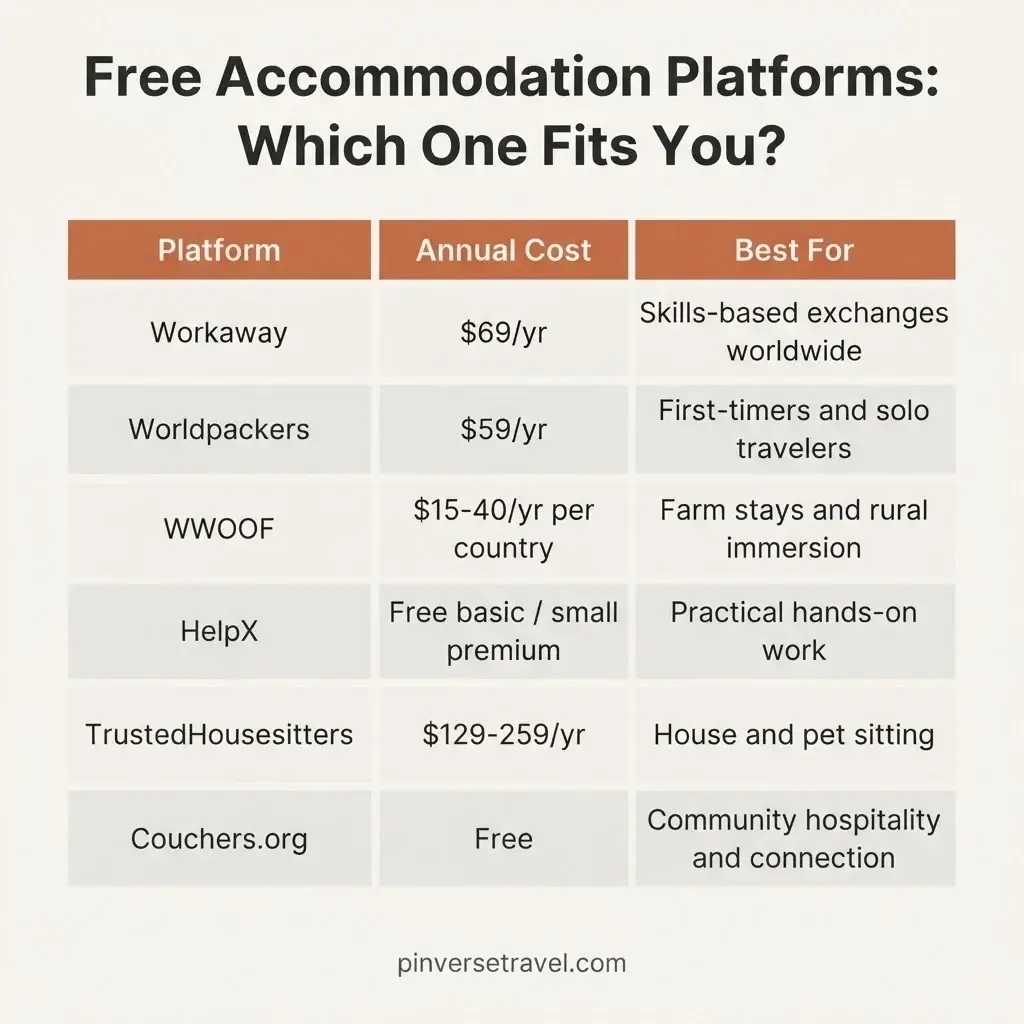
The membership fee is $69 per year for an individual traveler (or $79 for a couple), which is genuinely one of the best investments in budget travel you can make. One week of saved accommodation at a European hostel easily pays back that annual fee. The Workaway membership page breaks down exactly what’s included, and worth noting: they have over 50,000 host opportunities listed globally, with a 99.7% response rate among hosts. That’s not a small community.
The key to making Workaway work is your profile and your outreach. Hosts receive a lot of messages from travelers, and the ones who get accepted are the ones who take time to write a genuine, specific message about why they want to work with that particular host, not a copy-paste template. Mention something specific about the host’s listing that resonates with you. Share a relevant skill. Sound like a real person.
One practical tip: browse listings well before your planned travel dates. Popular hosts in desirable locations fill up weeks or even months in advance.
2. Worldpackers: Great for Beginners and Solo Travelers
Worldpackers operates on a similar model to Workaway and is particularly well-regarded in the solo travel community for its safety features and clear structure. It operates across 140+ countries and has over 490,000 community reviews, which gives you a genuinely useful picture of what staying with any given host is actually like before you commit.
The standard solo membership costs $59 per year. The thing that makes Worldpackers especially confidence-building for first-timers is the WP Safeguard: if your experience with a host doesn’t go as agreed, they will refund you up to $59 for emergency accommodation. It’s a small but meaningful safety net that tells you the platform is invested in your experience going well. You can explore how it works on the Worldpackers membership page.
From what solo travelers consistently report, Worldpackers tends to have a slightly stronger community feel than some other platforms, with the option to connect with other volunteers who’ve stayed with the same hosts. The review system is double-blind, meaning both the traveler and the host submit reviews before either side can see what the other wrote. That system produces more honest reviews, which is exactly what you want when you’re vetting a place to live and work for two to four weeks.
Types of positions you’ll find: hostel helpers, social media assistants, language exchange partners, farm helpers, childcare support, yoga retreat assistants, dive shop crew, and dozens more. You don’t need professional skills. You need a good attitude, a genuine interest in the work, and the willingness to show up reliably.

3. WWOOF: For the Traveler Who Wants to Slow Down on the Land
WWOOF stands for World Wide Opportunities on Organic Farms, and it is exactly what it sounds like. You stay with host families or farm communities and help with organic farming, gardening, or land-based work in exchange for free accommodation and food. It’s older than most of the other platforms on this list and has a dedicated, earthy community built around it.
WWOOF is organized country by country, so membership works differently from Workaway or Worldpackers. You typically buy a membership for the specific country or countries you plan to visit. Fees range from roughly $15 to $40 USD per country per year, depending on the organization. WWOOF International keeps a directory of all national WWOOF organizations where you can find your specific destination.
The lifestyle here is genuinely different from a city-based work exchange. You are often in rural or semi-rural settings, working with your hands, following seasonal rhythms, and living closely with a farming family. That can be an incredibly grounding, culturally rich experience or it can feel isolating if you’re someone who craves city energy and social variety. Know yourself before you sign up.
What WWOOF offers that few other options can match is genuine immersion in the daily life of a place. You’re not a tourist and you’re not just a helper. You’re a temporary member of someone’s household, eating their food, learning their rhythms, and often having conversations about local life that no hotel guest ever gets to have. For solo travelers who care about depth over breadth, WWOOF is extraordinary.
4. HelpX: The Flexible, Low-Cost Alternative
HelpX (Help Exchange) is the quieter sibling in the work exchange family. It works on the same basic model as Workaway and WWOOF but with a broader range of host types: farms, homes, hostels, lodges, B&Bs, horse stables, sailing boats, and more. The platform is genuinely global, and one of its biggest advantages is cost. A basic HelpX membership is free to browse, and a paid “Premium Helper” membership that gives you full contact access to all listings runs a modest annual fee.
HelpX tends to attract a slightly older or more experienced demographic than Worldpackers, and the community has a reputation for straightforwardness. Hosts list exactly what they need and what they offer, and the work tends to be practical and physical rather than skills-based. If you want to paint someone’s fence in rural Portugal in exchange for a bedroom and home-cooked meals, HelpX is where you find that.
One thing to be aware of: HelpX has fewer built-in safety features than Worldpackers or Workaway. The vetting is less formal, and reviews are not as comprehensive. That doesn’t mean it isn’t safe, but it does mean you should do your own due diligence before committing to a host: read every review carefully, ask for a video call, and trust your instincts if something feels off in the messaging.
5. House Sitting: Your Own Home, Rent-Free
House sitting is the method that consistently surprises people when they first learn how it works. The arrangement is simple: homeowners who are traveling need someone trustworthy to look after their property, and often their pets, while they’re away. In exchange, you get to live in their home completely free of charge. No hotel room. No dorm bed. An actual house, often in a neighborhood you’d never otherwise afford, with a kitchen and a laundry machine and a garden.

The most established platform for this is TrustedHousesitters. Sitter memberships range from $129 to $259 per year depending on the tier you choose. You can review the options on the TrustedHousesitters pricing page. This is a higher annual cost than work exchange platforms, but the math still works strongly in your favor: a single house sit in, say, London or Sydney or Barcelona can save you hundreds or even thousands of dollars in accommodation.
The key to success on TrustedHousesitters is building a strong, trustworthy-looking profile before you start applying. Upload clear photos, write a genuine bio, and if you have any prior pet care or home care experience at all, include it specifically. Homeowners are trusting you with their home and their animals. They want to see that you’re a real, reliable person. New sitters often start with shorter sits in less competitive locations to build up reviews, then leverage those reviews to apply for longer or more desirable sits.
A realistic note: popular sits in attractive cities like Paris, Amsterdam, or Lisbon often attract dozens of applicants. Be patient. Apply to more sits than you think you need to, personalize each application, and respond quickly when homeowners reach out. Once you have a handful of good reviews, your acceptance rate climbs noticeably.
6. Home Exchange: Swap Your Space for Someone Else’s
Home exchange is exactly what the name says. You offer your home to another traveler while you’re away, and they offer theirs to you. Nobody pays rent. You’re simply two people who have decided that sharing their spaces makes more travel possible for both of them.
The world’s largest home exchange platform, HomeExchange, operates on an annual membership model that gives you unlimited swaps for the year. The community is global and the platform uses a point-based system so that even when you can’t arrange a direct simultaneous swap, you can still exchange your home and use the points to stay somewhere else later.
The obvious limitation here is that you need to have a home to offer. If you’re renting, you’ll need your landlord’s permission, and not all landlords will give it. If you own your home and travel regularly, home exchange is arguably the smartest accommodation strategy you can adopt. It’s used heavily by families, remote workers, and people who love traveling slowly for two to four weeks at a time rather than rushing through multiple cities.
For solo travelers who don’t own their homes, this is a less accessible option, but worth knowing about for the future, or worth exploring with a roommate who’s open to the idea.
7. Couchers.org: Community Hospitality Without the Awkwardness
Let’s talk about Couchsurfing, because you’ve probably heard of it and the story has changed. Couchsurfing, the original community platform where travelers hosted each other for free, shifted to a paid model in 2020 and has seen a significant drop in community quality and active hosts since then. It’s not dead, but it’s not the same platform it once was.
The community-led alternative that has grown up in its place is Couchers.org, a non-profit platform that is free forever and built specifically around the values the original Couchsurfing community loved: genuine human connection, cultural exchange, and hospitality without commercial transactions. The platform is run by volunteers, focused on safety and trust verification, and growing steadily.
Staying with a host through a platform like Couchers is a fundamentally different experience from all the other options on this list. You are not working. You are not house-sitting. You are a guest in someone’s home, usually sleeping on a couch or in a spare room, in exchange for the kind of authentic local connection that money genuinely cannot buy. Your host shows you their neighborhood, cooks you something local, introduces you to their friends, and gives you an understanding of daily life that no guidebook chapter can replicate.
This is one of the closest things in travel to the experience I had living with a family in Ghana, where I learned more about Ghanaian culture, hospitality, and daily life in a few weeks than I could have in months of solo touring. Community hospitality creates something different. It requires you to show up as a person, be present, and give something of yourself in return, whether that’s a home-cooked meal from your own culture, good conversation, or simply genuine gratitude. That kind of exchange is worth more than any accommodation upgrade.
Safety is the most common concern with community-based stays, especially for solo female travelers. The honest answer is that platform quality matters enormously here. Use platforms with verification systems, read reviews carefully, always arrange a video call before confirming anything, share your itinerary with someone at home, and trust your instincts. A nervous feeling during the pre-stay communication is information. Act on it.
How to Vet Any Host Before You Commit
Regardless of which method or platform you choose, the vetting process is similar and essential. Start by reading every available review from previous travelers, particularly recent ones. Look for consistency: a host with 40 reviews all saying the same positive things is more reliable than a host with 4 reviews, two of which are glowing and one of which is vague. Contact the host directly before committing and pay attention to how they communicate. Do they answer your specific questions or just send generic enthusiasm? Are they clear about what the work involves, what your private space will be, and what the daily routine looks like?
If a platform allows video calls, use them. Seeing a person’s face and home tells you things that a written profile cannot. If any host refuses or evades a video call without a reasonable explanation, that’s a flag worth paying attention to.
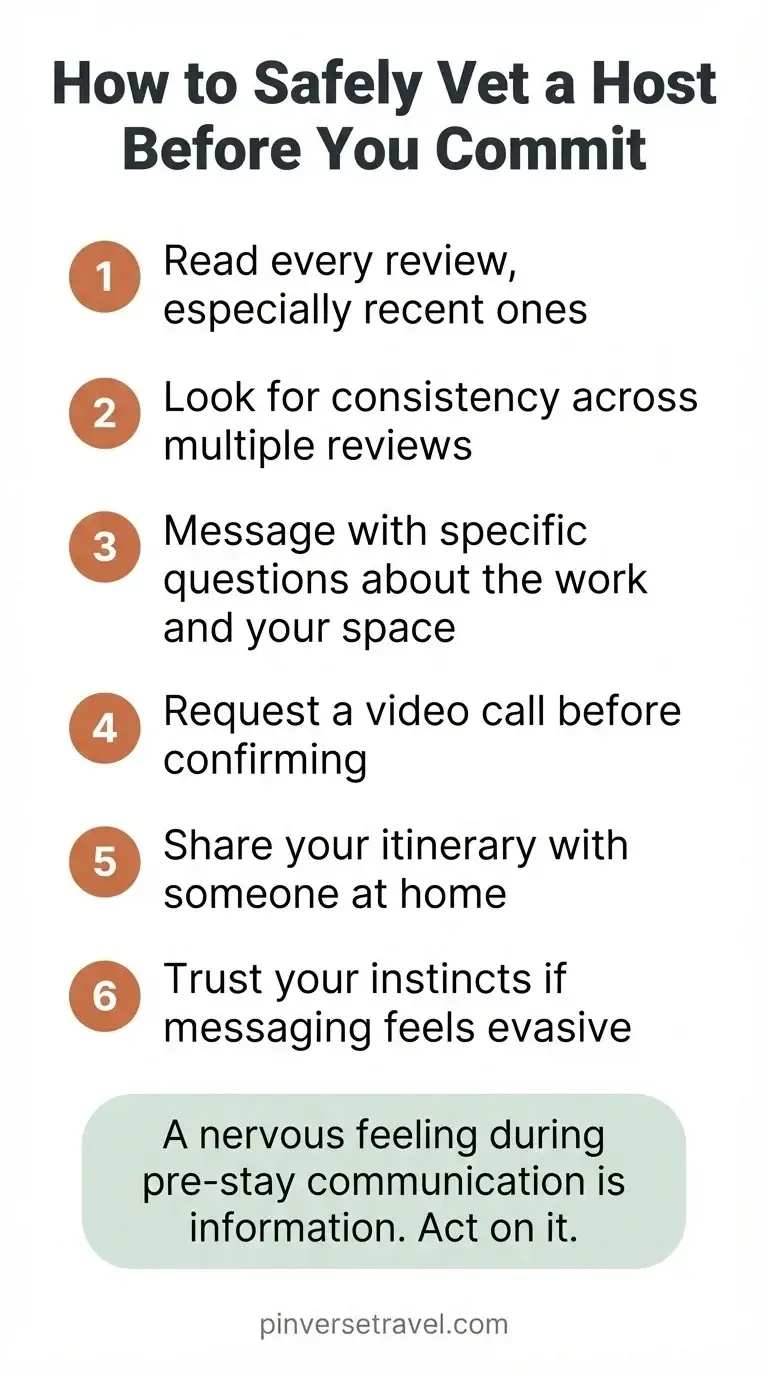
Tell someone you trust exactly where you’re going, who you’ll be staying with, and check in regularly. This is good practice for any solo travel, but especially for accommodation situations that are less structured than a hotel.
A Realistic Word on Expectations
Here is the thing that almost no article about free accommodation tells you: the first time you do it, there will probably be a moment where you feel slightly awkward. You’re living in someone’s home. You’re working for your stay. It’s a different relationship than being a paying guest, and that adjustment can feel odd for a few days.
Push through it. That awkwardness is almost always temporary, and what replaces it is something genuinely valuable: a sense of real belonging in a place. You know the host’s routines, their local shops, the bakery they actually go to in the morning. You stop feeling like a visitor and start feeling like someone who is really there.

That, in my opinion, is what slow travel is actually about. Not just saving money. Earning your place in the world a little more honestly.
Pick one platform from this list that fits your situation, read their getting-started guides, set up a complete profile, and send your first application before the end of this week. The longer you wait, the more the idea stays an idea. Start now, and adjust as you go.