Stop Overpaying: How to Get Real Deals on Vacation Rentals

I still remember the moment I realized I had been overpaying for accommodation without even knowing it. I was planning a trip and had been so focused on the nightly rate that I completely missed what the total actually cost once the service fee, cleaning fee, and local taxes stacked up. The listing said $85 a night. The checkout total said something very different.
That experience taught me something I now share with every traveler I talk to: the listed price is almost never the full story with vacation rentals. But once you understand how the pricing actually works, and where the real leverage points are, you stop feeling like you’re at the mercy of an algorithm and start booking with real confidence.

Whether you’re planning a solo trip, a longer stay while working remotely, or just trying to stretch a limited travel budget further, this guide walks through every strategy worth knowing. Not theory. Actual, actionable steps.
Why Vacation Rentals Can Feel So Confusing to Price
The biggest frustration travelers have with vacation rental platforms isn’t the nightly rate. It’s the total price reveal that happens at checkout, usually after you’ve already fallen in love with a listing.
Here’s how that typically breaks down. Platforms like Airbnb charge guests a service fee that generally runs between 5% and 15% of the booking subtotal. On top of that, individual hosts add cleaning fees that can range from $20 for a small apartment to $250 or more for a large property. Then local occupancy taxes layer on, which vary by city or region. The result is a $90-per-night listing that lands at $145 per night once you divide the total cost by the number of days.
This isn’t unique to Airbnb. VRBO structures its fees differently but they still exist. Knowing this upfront changes how you search. Instead of sorting by nightly rate, always toggle to “total price” view before you start comparing. Most platforms now offer this option, and it’s the single most important setting to turn on before you browse.

The Timing Strategy Most People Get Backwards
There’s a widespread belief that booking vacation rentals as early as possible always gets you the best price. The data tells a more interesting story.
NerdWallet analyzed real Airbnb booking data from AirDNA covering millions of nights between March 2025 and February 2026, and the results were striking. According to their research, booking just three days in advance yielded the lowest median nightly price across the board. For a one-bedroom unit, the median nightly rate was $130 when booked three days out, compared to $149 when booked four weeks out, and $181 when booked nearly a year in advance. For larger properties, the gap was even more dramatic: a five-bedroom booked three days out cost a median of $354 per night, versus $663 when booked 47 weeks ahead.
What’s happening here is that hosts don’t want empty nights. As a check-in date approaches with no booking, many drop their prices to fill the gap. That’s a real opportunity if you can stay flexible.
That said, this strategy has limits. It works best during shoulder seasons and for destinations with plenty of supply. During peak travel periods like summer beach season or major holidays, last-minute availability shrinks fast and prices can spike. And if you have your heart set on a very specific property, waiting is a gamble.
The practical middle ground for most travelers: book early for peak season trips to secure availability, and stay flexible for off-peak trips where waiting often rewards you with a better price.
The Single Best Move: Always Check Total Price Before Comparing Listings
Before any of the strategies below matter, you need to be comparing properties on an apples-to-apples basis. This means accounting for service fees, cleaning fees, and taxes from the start, not after you’ve already committed emotionally to a listing.
A tool that makes this genuinely easy is HiChee, a free price comparison platform that lets you paste in an Airbnb, VRBO, or Booking.com link and instantly see the total all-in price across multiple platforms side by side. It also surfaces direct-booking options for the same property when they exist. It takes about 30 seconds and can reveal savings that would otherwise stay hidden.
The habit of checking a single listing across platforms is one of the simplest changes you can make and one of the highest-leverage ones. The same property listed on both Airbnb and VRBO can have meaningfully different total costs depending on how each platform applies its fees.
Book Direct and Keep the Savings for Yourself
One of the most consistent pieces of advice you’ll find from experienced travelers is to book directly with the host or property manager whenever possible. The reason is straightforward: platform service fees, which Airbnb typically charges guests at 5-15%, go away when you skip the platform entirely.
Kiplinger notes that renting directly through property owners can help you avoid the markups charged by the platform middleman, and that the same property may be listed on multiple sites with different fee structures, making comparison essential.
In practice, here’s how to find direct booking options. When you see a listing you like on any major platform, copy a distinctive phrase from the property description and search it in Google. Many hosts and property managers have their own websites or list on smaller platforms like Houfy, which is specifically designed for fee-free direct bookings. Houfy has more than 98,000 listings across 100+ countries, and both hosts and guests pay zero service fees. Hosts pay a one-time $5.99 verification fee. That’s it. The savings for guests can reach 15-20% compared to booking the same property through a major platform.

One important caution here: when booking direct, pay by credit card or PayPal so you have payment protection. If anyone asks you to wire money, pay via bank transfer, or send a prepaid gift card, walk away. That is a major red flag.
Timing Your Stay: Shoulder Season is Where the Real Value Lives
If you have any flexibility in when you travel, shoulder season is one of the most reliable ways to access better prices on vacation rentals. Shoulder season refers to the period just before or just after a destination’s peak tourist rush, when demand drops but the destination itself is often at its most enjoyable.
Think about a coastal destination in late September or early October versus peak July or August. The weather is often still warm, the crowds have thinned considerably, and property owners, knowing bookings will slow down, are far more willing to reduce their rates or accept a lower offer. The same is true in reverse for cold-weather destinations in late winter.
Midweek stays offer another consistent pricing advantage. Saturday and Sunday check-ins tend to command premium rates on most platforms because most vacation travelers book around weekends. If your schedule allows a Monday or Tuesday check-in, you will often find noticeably lower rates for the same property.
How to Use Last-Minute Platforms to Your Advantage
Beyond the general last-minute approach on Airbnb and VRBO, there’s a category of specialized platforms built specifically around this strategy. One worth knowing is Whimstay, which focuses exclusively on vacation rentals with availability within the next 30 days. Whimstay negotiates directly with property managers before listing, guaranteeing that every stay on their platform within a 30-day window is priced at least 10% below the standard rate, with many properties discounted 20-40%.
This works especially well for slow travelers and anyone with a flexible schedule who doesn’t need to lock in dates weeks in advance. I’ve talked to plenty of solo travelers who have essentially built their entire travel rhythm around this kind of last-minute flexibility, and the savings over a year of travel are significant.
The tradeoff is obvious: you can’t always get the exact property or destination you had in mind. But if your approach to travel is more “I want to be somewhere interesting on the coast next week” than “I must be in this specific city on these exact dates,” last-minute platforms open up a lot of value.
Long Stays: The Most Underused Discount Strategy
Here’s something most short-trip travelers never think about: the longer you stay, the more leverage you have.
Both Airbnb and VRBO have built-in discount structures for weekly and monthly stays, and hosts who know their property might otherwise sit empty will often go further when asked politely. On VRBO, their official weekly and monthly discount program shows average savings of around $213 on stays of seven nights or more, and roughly 19% off for monthly stays of 28 nights or more.
For slow travelers, digital nomads, or anyone who’s thought about spending a real chunk of time somewhere rather than rushing through it in three days, this changes the math dramatically. A month in a self-catering apartment at a 15-20% discount, with a kitchen to cook in instead of eating out every meal, often comes in cheaper than a series of shorter hotel stays or hostel nights.

If you’re planning a longer stay and the listing doesn’t already show a long-stay discount, it’s worth sending a brief, friendly message to the host before booking. Something like: “I’m planning to stay for four weeks and would love to make this work. Is there any flexibility on the rate for a longer booking?” Hosts often prefer the certainty of a guaranteed longer booking over the uncertainty of piecing together multiple shorter ones, and a polite ask for 10-15% off during low demand periods is rarely refused.
How to Negotiate Without Feeling Awkward About It
A lot of travelers never negotiate on vacation rentals because it feels strange or presumptuous. It shouldn’t. Hosts on most platforms expect some negotiation, particularly for longer stays, last-minute bookings, or off-peak periods.
The key is keeping it respectful and specific. Don’t send a generic “can you do better?” message. Instead, acknowledge something you genuinely appreciate about the property, explain your travel context briefly (solo trip, longer stay, flexible dates), and name a specific request. A 10-15% ask is reasonable and rarely offensive. A 40% ask without context will probably just get ignored.
Also, pay attention to listings with recent reviews but a few open nights scattered through the calendar. Those hosts know those nights might go empty. They are often the most receptive to a friendly message.
Vacation Rental Scams: What to Watch For
This section matters more than most listicles acknowledge. As vacation rentals have grown in popularity, so has fraud targeting travelers. The U.S. Federal Trade Commission has reported nearly 65,000 rental scams since 2020, with consumers losing millions of dollars. Their official guide on rental listing scams is a useful reference, and the warning signs are consistent.

Watch for these red flags:
Listings with prices that seem dramatically lower than everything comparable in the area. Pressure to pay quickly, often with a story about another interested party. Any request to pay outside the platform via wire transfer, bank transfer, or prepaid gift card. A “host” who becomes unreachable or vague once payment is requested. Listings where the photos look stock-quality or identical to listings on other sites with different names and owners.
The safest approach is to book through established platforms using credit cards, verify that the property appears on multiple reputable sites consistently, and never move a payment off-platform regardless of what incentive is offered. If you’re booking direct, use a platform like Houfy that has host verification built in, or confirm the property independently before sending any payment.
A Note for Solo Travelers: Reframe the Math
Solo travel and vacation rentals have a complicated relationship. The single-occupancy penalty is real. A studio or one-bedroom rental that would cost $60 per person per night for a couple costs you the full $120 alone. That’s just the reality, and I’m not going to pretend otherwise.
But the framing matters. When I was backpacking through Europe solo, I mostly stayed in hostels and loved them. The social energy, the ease of meeting people, the low cost. But as I’ve traveled more slowly over the years, I’ve come to love having my own kitchen, my own schedule, my own quiet corner. A vacation rental gives you that in a way a hotel room rarely does.
The way to make vacation rentals work financially as a solo traveler is to lean into the strategies that specifically benefit single bookings: last-minute platforms where unsold inventory is priced to move, longer stays where monthly discounts shrink the nightly rate, and direct booking where you cut the service fee out entirely. Combine those three things and the math shifts considerably.
It’s also worth asking yourself what you’re really comparing against. A vacation rental with a kitchen where you cook five out of seven breakfasts and three or four dinners a week often works out cheaper than a cheaper-looking hotel room once you add in what you’d spend eating out every meal.
Quick Reference: The Strategy Checklist
Before you finalize any vacation rental booking, run through this list:
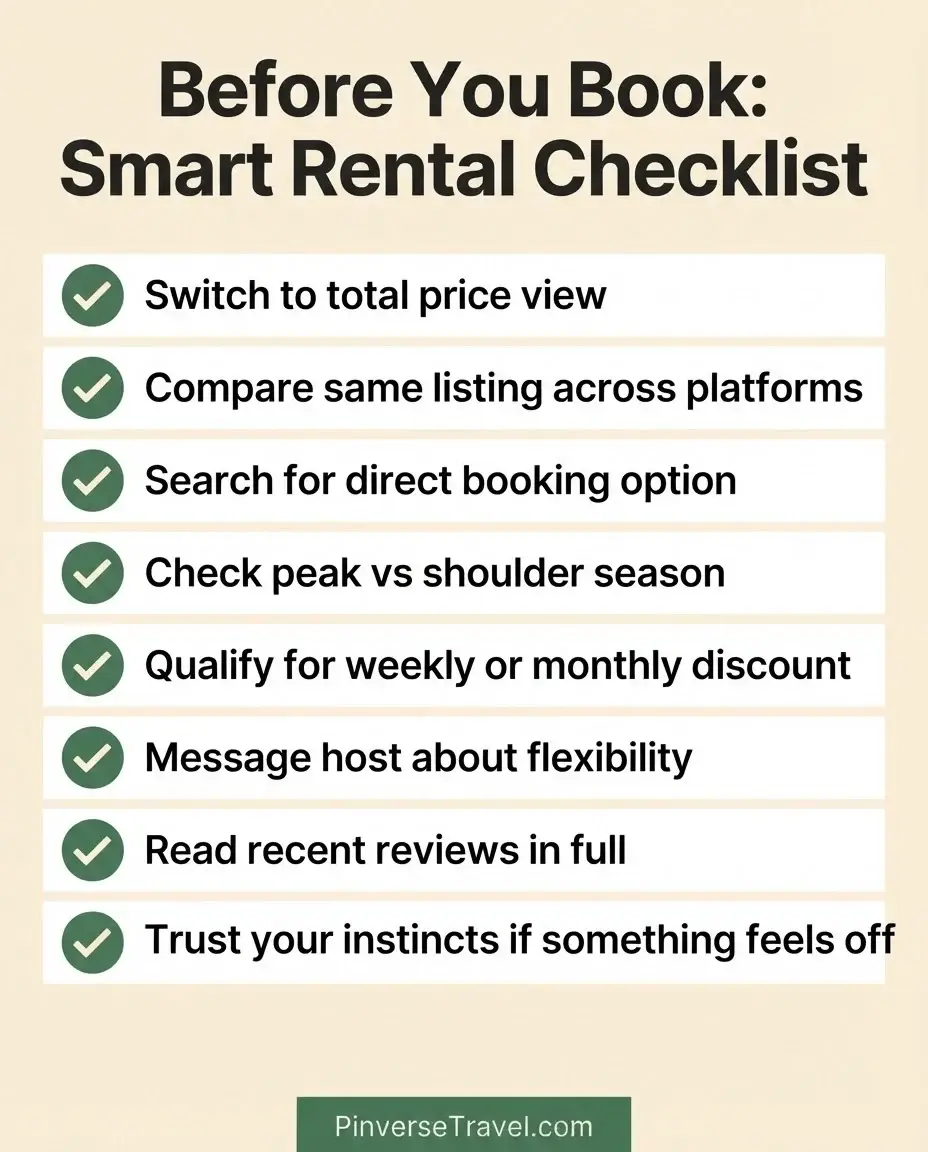
- Have you switched your search view to “total price” rather than nightly rate?
- Have you checked the same listing across at least two platforms (or used HiChee to do it automatically)?
- Have you searched for a direct booking option to avoid service fees?
- Is this a peak or shoulder season trip? If shoulder, have you tried waiting a bit?
- Is your stay long enough to qualify for a weekly or monthly discount?
- Have you sent a polite message to the host asking about flexibility, especially for longer or last-minute stays?
- Have you read recent reviews carefully, not just the star rating?
- Does anything about the listing or host communication feel off? Trust that instinct.
That’s really the full picture. Not one magic trick, but a handful of overlapping moves that, used together, consistently put you in a stronger position than most travelers who just search, click, and pay whatever the checkout screen shows.
Travel is too good to rush through on a budget that’s been eaten alive by fees. Take the extra 20 minutes, compare properly, and book smarter.
Disclosure: This post contains affiliate links. If you book or purchase through certain links, I may earn a small commission at no extra cost to you. I only recommend tools and services I’d genuinely use myself.