
I still remember the day I handed in my two weeks’ notice at my cramped office job in Manhattan. My coworkers thought I was losing my mind. I had a stable salary, a predictable routine, and a retirement plan. But I also had a drawer full of sticky notes covered in sketches of highways, coastal cliffs, and western skylines. I was tired of saving all my living for two weeks of paid vacation a year. To fund my first massive escape, I spent months waitressing late-night shifts and working as a licensed New York City sightseeing guide, shouting historical facts over the roar of double-decker buses. That guide job taught me how to read a city’s true character, how to navigate dense urban grids, and most importantly, how to spot the difference between a superficial tourist trap and a real cultural heartbeat.
When I finally packed a single backpack and flew to the West Coast, California changed everything for me. It proved that you do not need to choose between dramatic natural beauty and vibrant, diverse city life. You can have both in a single week if you plan smartly.
If you are sitting at a desk right now dreaming of open highways, palm trees, and coastal fog, this guide is for you. Planning an ultimate 7-day road trip itinerary for California cities can feel overwhelming. You might worry about the legendary traffic, the cost of gas, or how to safely navigate these massive metro areas as a solo traveler. I get it. Fear thrives on a lack of data. That is why I have built this exhaustive, block-by-block blueprint. We are going to cover three iconic urban hubs: San Francisco, Los Angeles, and San Diego. We will tackle the exact driving routes, public transit secrets, budget eats, and community spaces that make each city special.
Grab a cup of coffee, put away your hesitation, and let’s map out your California adventure together.
The Master Route and Logistics: Setting Expectations
Before we turn the ignition key, we need to talk about reality. California is massive. If it were its own country, it would be the world’s fifth-largest economy. Driving from San Francisco down to San Diego spans roughly 500 miles along the direct inland route, and even longer if you hug the coast. Trying to see every single beach town, national park, and mountain range in seven days is a fast track to burnout.
That is why this specific itinerary focuses heavily on the cities. We want to maximize your time exploring local neighborhoods and minimize the hours your eyes are glued to highway lane markers.
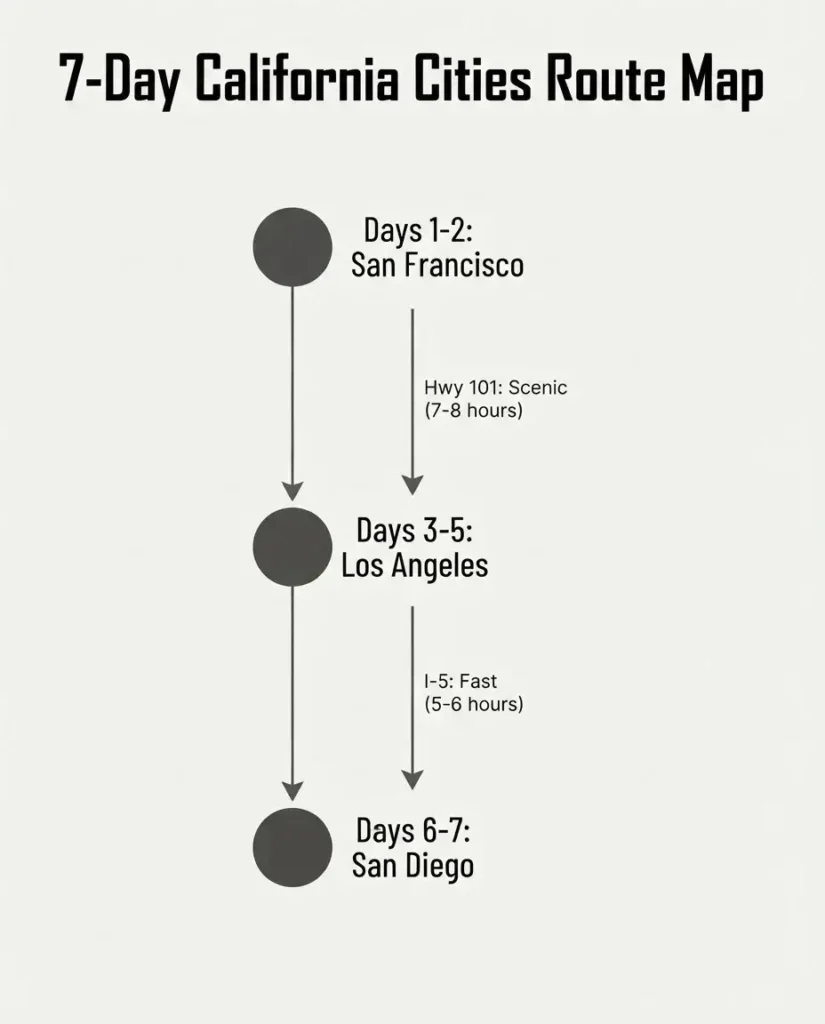
To make this work seamlessly, I highly recommend a “point-to-point” or one-way car rental. Fly into San Francisco International Airport (SFO) on Day 1, pick up your vehicle, and arrange to drop it off at San Diego International Airport (SAN) on Day 7. This saves you an entire day of backtracking up the state.
Driving Etiquette and Safety Strategy
Driving in California cities requires a mix of patience and assertiveness. In San Francisco, the challenge is not speed; it is gravity and parking. The hills are incredibly steep, and you must always turn your wheels toward the curb when parking facing downhill, and away from the curb when parking uphill, to prevent the car from rolling.
In Los Angeles, the challenge is sheer volume. The freeways can expand to six lanes in each direction, and traffic jams can happen at 2:00 PM just as easily as at 5:00 PM. Always use a real-time GPS app like Google Maps or Waze to navigate around sudden accidents and road closures. When solo driving, keep your bags locked in the trunk out of sight whenever you leave the vehicle.
If you ever feel anxious about managing your health or safety while navigating these massive regions alone, you can review the latest health and travel advisories through the CDC Travelers’ Health destination portal to stay updated on local wellness recommendations and regional environmental tips.
Days 1 and 2: San Francisco – Hills, Fog, and Neighborhood Footsteps
San Francisco is a city built on 43 hills, surrounded on three sides by water. It is dense, deeply historical, and best explored on foot or by public transit. When I first stepped off the train here, the crisp, salty air instantly reminded me of my time guiding back east, but the pace was entirely different. It is a place where tech innovation rubs shoulders with old-school maritime history and counter-culture roots.
Day 1: The Classic Core and Maritime History
Start your morning early at the Ferry Building on the Embarcadero. This historic transit hub doubles as a food hall filled with local artisans. Skip the commercial hotel breakfasts and head straight inside to grab a fresh sourdough pastry or a hot bowl of local organic oatmeal.
After breakfast, walk north along the Embarcadero waterfront toward Fisherman’s Wharf. Yes, this area is highly commercialized, but as a former sightseeing guide, I know there are real historical treasures buried under the souvenir shops.
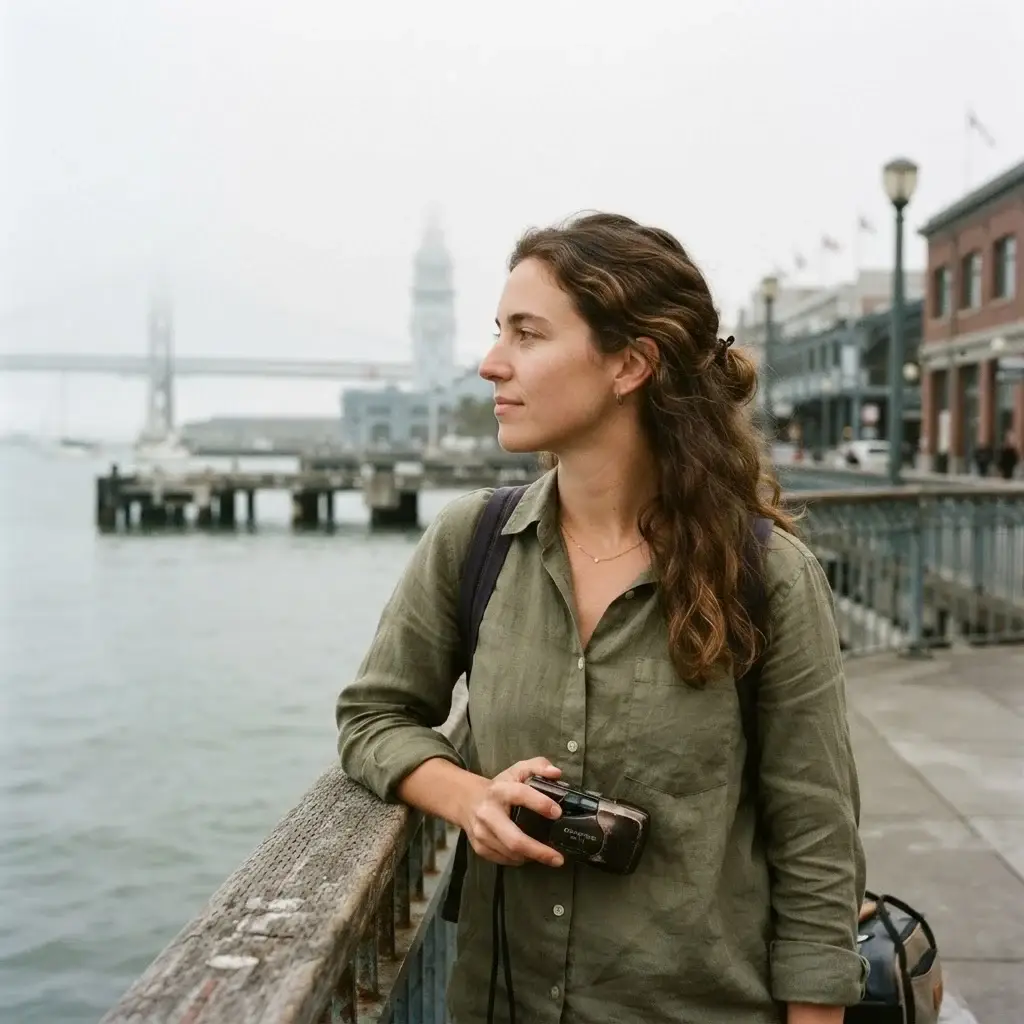
Head straight to Pier 45 and visit the Musee Mecanique. This is a privately owned collection of hundreds of antique, coin-operated mechanical musical instruments and arcade machines. It is free to enter, and you can play with games that date back to the 19th century for just a few quarters. It is loud, quirky, and beautifully authentic.
For lunch, walk over to the nearby neighborhood of North Beach, which is San Francisco’s historic Italian quarter. Walk down Columbus Avenue and look for Mario’s Bohemian Cigar Store Cafe. They do not sell cigars anymore, but they make an incredible hot meatball focaccia sandwich baked in a traditional brick oven. It is tiny, warm, and full of residents talking politics over espresso.
Ferry Building (Morning) —> Pier 45 / Musee Mecanique —> North Beach Italian Quarter (Lunch)
In the afternoon, challenge your legs with a walk up to Coit Tower on top of Telegraph Hill. Inside the base of the tower, you will find stunning, massive murals painted in the 1930s that depict working-class life in California during the Great Depression. The detail is spectacular, and it offers an honest, unvarnished look at the state’s social history.
Insider Navigation Hack
Instead of paying for the expensive, heavily crowded tourist cable cars to get back downtown, look for the local Muni Bus Route 39. It costs a fraction of the price, runs regularly, and carries locals up and down the steep hills of Telegraph Hill and North Beach without the two-hour waiting lines.
Day 2: Cultural Immersion in the Mission and Chinatown
On your second day, skip the standard tourist routes and focus entirely on cultural immersion. Start your morning in Chinatown, entering through the Dragon’s Gate on Bush Street. This is the oldest Chinatown in North America. Walk past the jade shops on Grant Avenue and slip down Stockton Street, where the local community actually does their daily grocery shopping. You will see open-air markets stacked with fresh ginger, bok choy, and live seafood.
For a mid-morning snack, find the Golden Gate Fortune Cookie Factory hidden away in Ross Alley. They have been making fortune cookies by hand on a small rotating griddle since 1962.
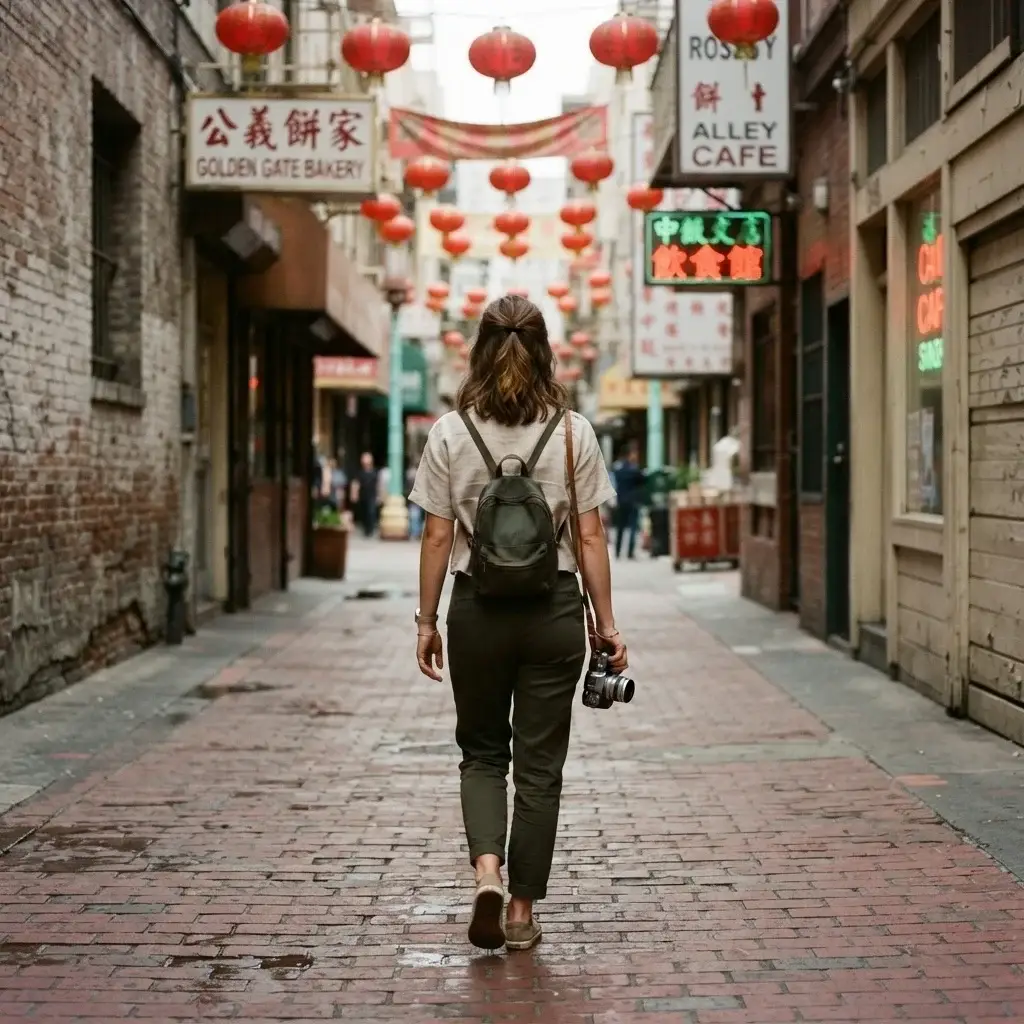
You can watch the workers fold the hot, soft waffles around paper fortunes in real time. The smell of sweet vanilla in the alleyway is something you will never forget.
Dragon’s Gate —> Stockton Street Markets —> Ross Alley Fortune Cookie Factory
By midday, take the BART train south to the Mission District (get off at the 24th Street Station). The Mission is the heart of San Francisco’s Latino community and is famous for its vibrant street art and food culture. Walk down Balmy Alley to see an incredible collection of murals that speak directly to human rights, political struggles, and local community pride.
You cannot visit the Mission without eating a world-famous “Mission-style burrito.” This is not just food; it is a structural masterpiece. Head to Taqueria El Farolito or La Taqueria. A proper Mission burrito features a massive flour tortilla steamed until soft, loaded with carne asada (grilled steak) or pinto beans, Mexican rice, salsa, and fresh avocado, all wrapped tightly in aluminum foil. It is heavy enough to use as a brick, costs very little, and will keep you full for the rest of the day.
Spend your late afternoon sitting on the grassy slopes of Mission Dolores Park. This park offers a panoramic view of the downtown skyline. It is where the city comes together to relax, read, play music, and enjoy the rare afternoon sunshine when the coastal fog clears. It is the perfect place to sit back, journal, and process your first two days on the road.
Day 3: The Great Drive South – Highway 101 vs. Interstate 5
Day 3 is your primary transit day from Northern California down to Southern California. You have two distinct paths to choose from, and your choice depends entirely on your travel goals.
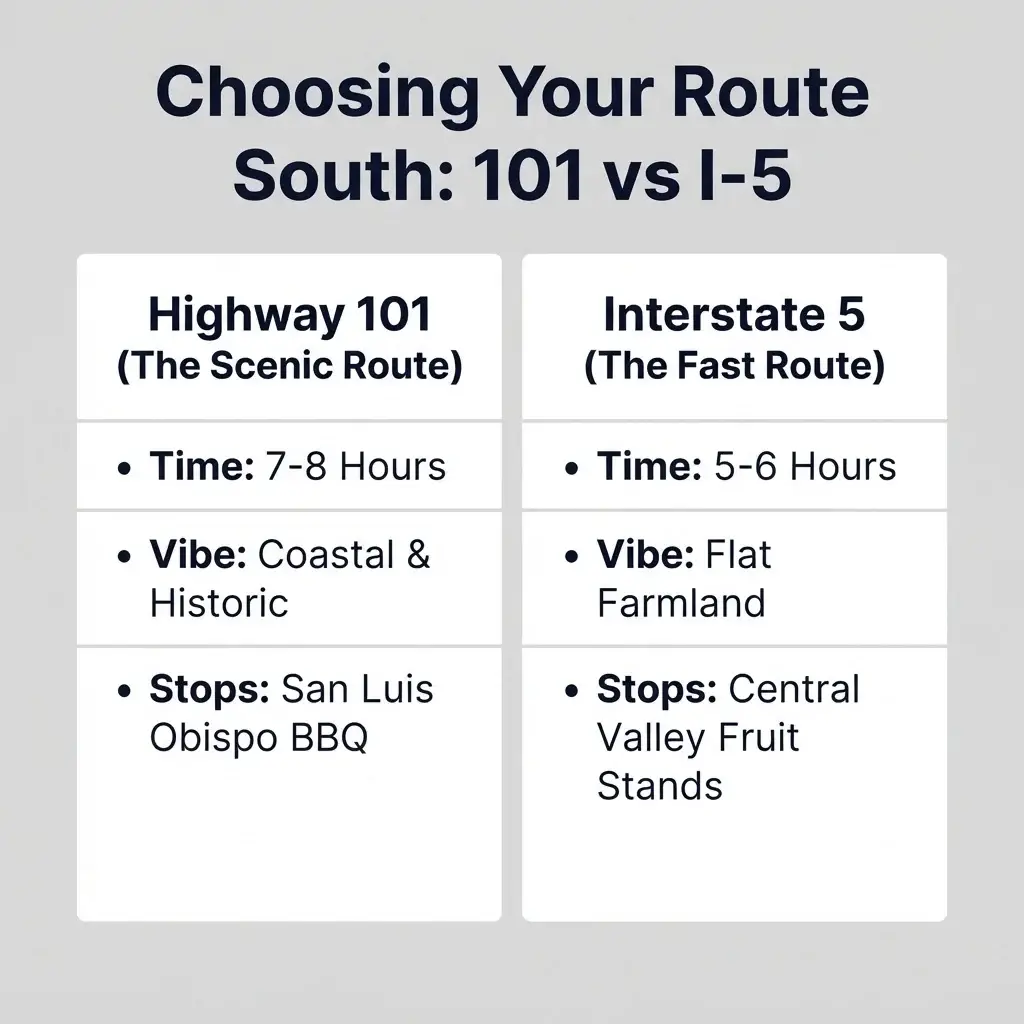
Option A: The Scenic Route (Highway 101)
If you want coastal mountain views, historic Spanish missions, and small-town stops, take Highway 101 South. While the famous Highway 1 (Pacific Coast Highway) is breathtaking, it frequently suffers from winter landslides that cause long-term road closures. Highway 101 is a highly reliable, incredibly beautiful alternative. It takes roughly 7 to 8 hours of driving time to reach Los Angeles this way.
Along the route, stop for lunch in San Luis Obispo. This historic town features a beautifully preserved 1772 Spanish mission right in the center of downtown. Walk down Higuera Street and grab a tri-tip beef sandwich at Firestone Grill. The meat is oak-roasted, smoky, and served on a toasted roll. It is a true taste of Central Coast California barbecue culture.
Option B: The Fast Route (Interstate 5)
If your primary goal is to get to Los Angeles as quickly as possible to maximize your time in the southern cities, take Interstate 5 South through the Central Valley. This route takes about 5 to 6 hours. It is an entirely different side of California that most tourists ignore. You will drive through miles of flat, expansive farmland that produces a massive percentage of the fruits, vegetables, and nuts consumed across the United States.
The air smells faintly of livestock and earth, and the horizon stretches out indefinitely. To break up the drive, stop at one of the massive roadside farm stands like Bravo Farms in Kettleman City. You can stretch your legs, buy a bag of locally grown roasted almonds or fresh pistachios, and grab a cold drink before tackling the steep mountain pass known by locals as “The Grapevine” which leads directly into the Los Angeles basin.
Whichever route you choose, ensure your vehicle is in good working order before you depart. If you are an international traveler organizing this road trip from abroad, it is always wise to review any updated travel advisories or regional logistics via the US Department of State Travel portal to ensure smooth transit and clear knowledge of local highway regulations.
Days 4 and 5: Los Angeles – Neighborhood Complexity Beyond the Screen
Most people approach Los Angeles with a specific set of expectations shaped by television and movies. They expect glitz, glamour, and celebrity sightings. But if you spend your entire time hanging around the Walk of Fame in Hollywood, you are likely going to leave feeling disappointed and disconnected. Los Angeles is not a single cohesive city; it is a vast, beautiful patchwork of dozens of distinct neighborhoods, each with its own cultural identity, culinary history, and community pride. When I first navigated LA, I had to drop my fast-paced New York mindset and learn to slow down and look closely at the details.
Day 4: Historical Downtown and the Fabric of the City
Start your morning in Downtown Los Angeles (DTLA). This area is a stunning mix of historic early-20th-century architecture and modern cultural institutions. Begin at Union Station, a beautiful transit hub built in 1939 that blends Spanish Colonial Revival style with Art Deco design. The high arched ceilings, leather armchairs, and quiet garden courtyards make it feel like a cathedral dedicated to human movement.
Union Station —> Olvera Street (Mexican Heritage) —> Grand Central Market (Lunch)
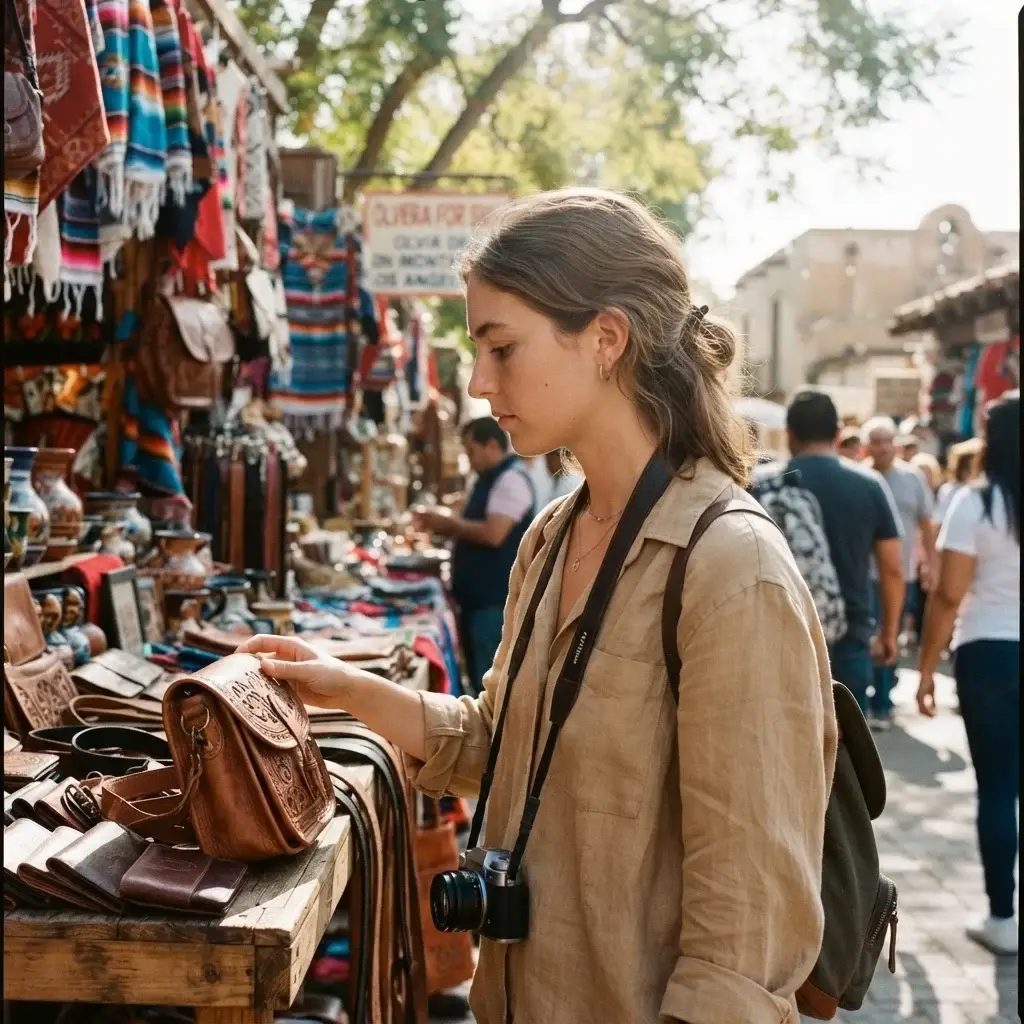
Directly across the street lies Olvera Street, the historic heart of the city’s Mexican heritage. Walk through the narrow, pedestrian-only plaza lined with historic adobe buildings, small stalls selling hand-crafted leather goods, and traditional folk music playing in the morning air.
For lunch, walk south toward the Historic Core and enter Grand Central Market, which has been operating continuously since 1917. This open-air market is a chaotic, beautiful sensory overload. Neon signs flicker above rows of food vendors representing every corner of the globe. Skip the trendy, high-priced lunch spots with long lines and head straight to Sarita’s Pupuseria. Order two traditional Salvadoran pupusas—thick, handmade corn tortillas stuffed with savory pork, melted cheese, and refried beans, grilled on a flat-top until crispy and served with a side of spicy pickled cabbage slaw (curtido). It is incredibly cheap, filling, and an absolute staple of the local community.
In the afternoon, hop on the Metro B Line or drive down to the Los Angeles County Museum of Art (LACMA) on Wilshire Boulevard. Even if you do not go inside the galleries, you can walk through the famous Urban Light installation outside—a breathtaking forest of 202 historic, cast-iron street lamps gathered from all across the LA area. It honors the city’s urban design history and is beautiful to explore just as the sun begins to set.
Day 5: Coastal Air, Skate Culture, and Accessible Art
On your second day in LA, head west toward the coast to explore Santa Monica and Venice Beach. The best way to beat the heavy coastal traffic is to go early. Start at the Santa Monica Pier, which marks the official end of the historic Route 66 highway. Walk along the wooden boardwalk, listen to the crashing waves, and watch the local fishermen casting lines into the Pacific.
From the pier, rent a simple beach cruiser bicycle and ride south along the Marvin Braude Bike Trail directly into Venice Beach. This stretch of sand is legendary for its raw, unfiltered energy. You will pass muscle beach, rows of eccentric street performers, local artists selling paintings, and the iconic Venice Skatepark. Sit on the concrete ledge of the skatepark for half an hour and just watch the local skaters navigate the deep bowls against the backdrop of the ocean. It is an amazing display of local athletic art and community pride.
Santa Monica Pier —> Marvin Braude Bike Trail —> Venice Skatepark & Boardwalk
For a budget-friendly and culturally rich lunch, look for the local taco trucks parked along Lincoln Boulevard, away from the expensive beachfront boardwalk. Order a few simple street tacos topped with cilantro, diced onions, and fresh lime juice.
Spend your late afternoon heading up into the Santa Monica Mountains to visit the Getty Center. Admission to this massive art complex is completely free, though you do need to reserve a timed entry slot online in advance and pay for parking. A futuristic hover-train carries you from the base of the hill up to a spectacular architectural campus built from white travertine stone.
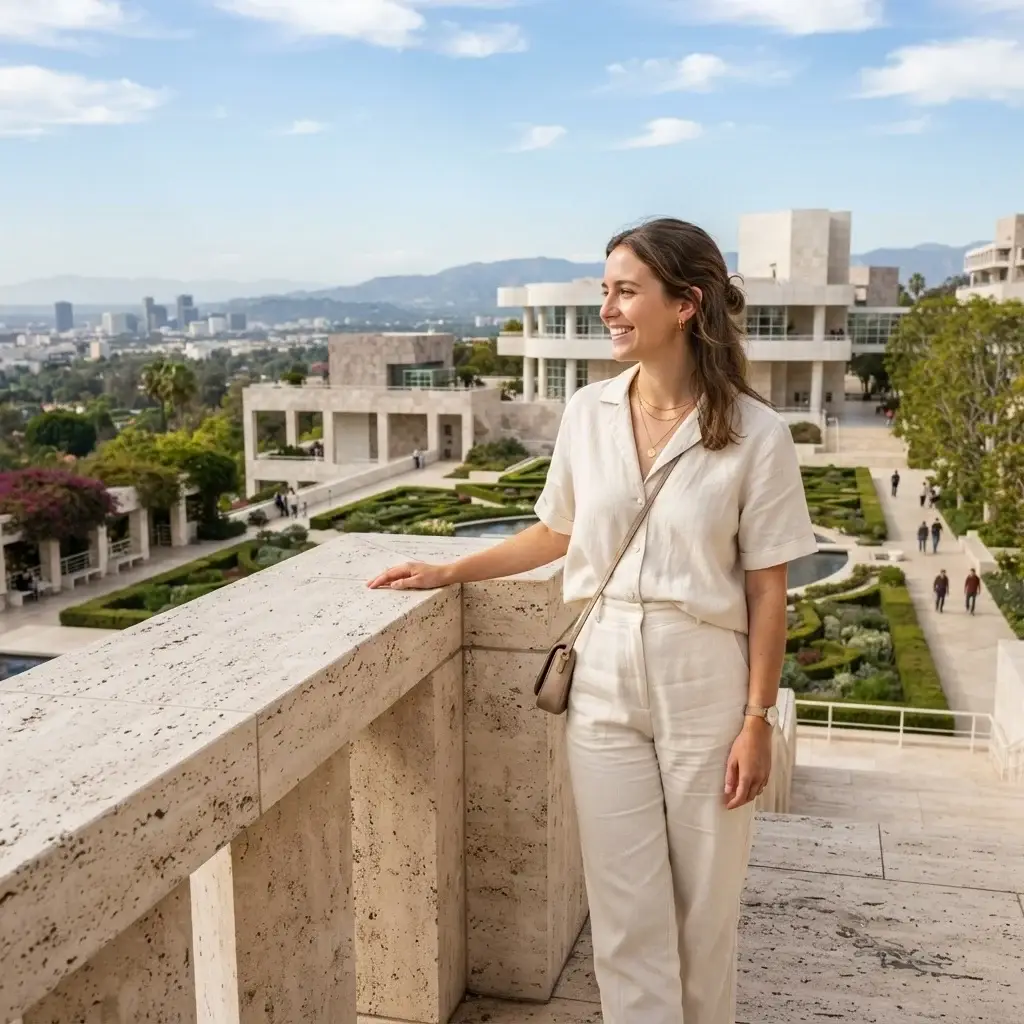
The Getty holds an incredible collection of European paintings and sculptures, but the real masterpiece is the Central Garden designed by artist Robert Irwin, alongside the panoramic views that stretch across the entire city basin all the way to the ocean. It is an inspiring, peaceful space that proves world-class art can be accessible to everyone.
Days 6 and 7: San Diego – Coastal Border Culture and Historic Parks
To conclude your ultimate 7-day road trip itinerary for California cities, drive roughly two hours south along Interstate 5 to San Diego. This city sits directly on the border with Mexico, and that geographic reality shapes its entire identity. It is a place where a relaxed surf-town attitude blends seamlessly with rich binational culture, military history, and expansive green spaces.
Day 6: Balboa Park and Old-World Architecture
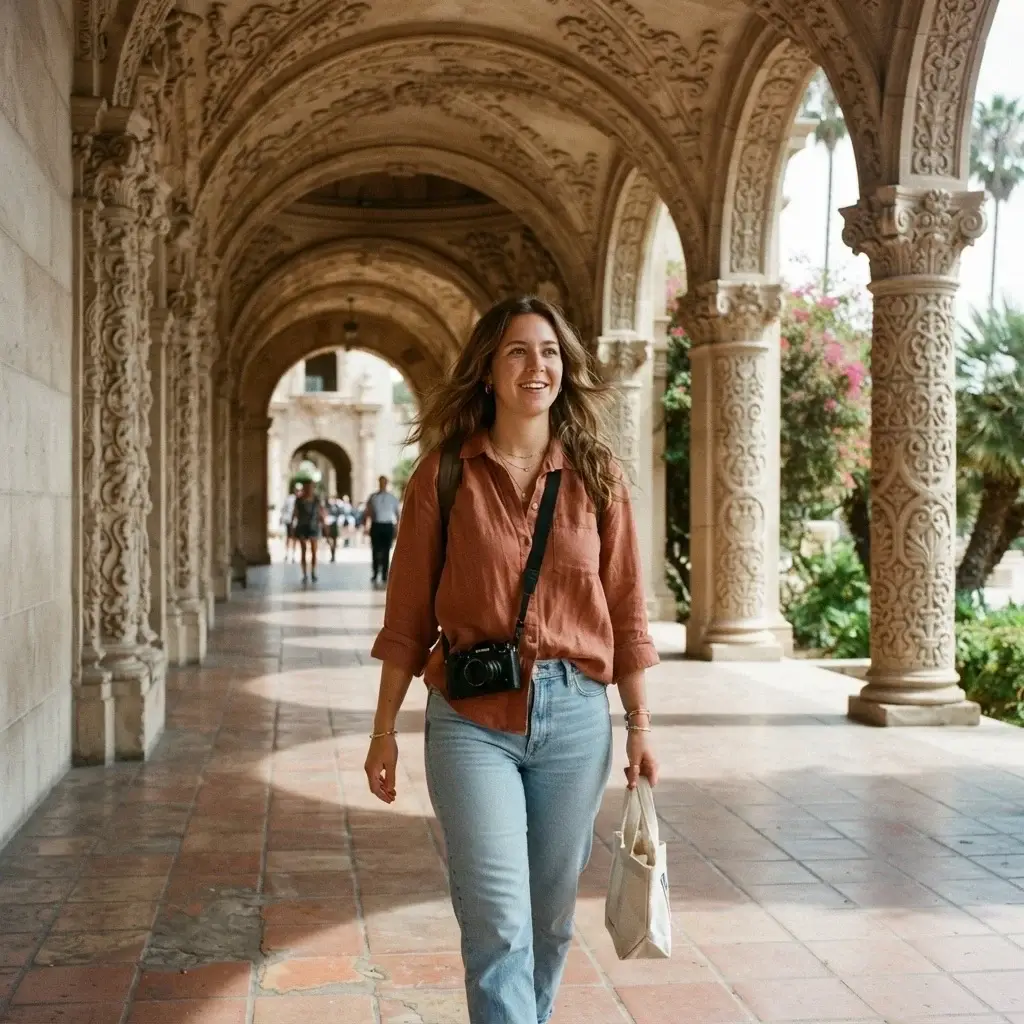
Dedicate your first full day here to exploring Balboa Park. Spanning over 1,200 acres, this urban cultural park is actually larger than New York’s Central Park. It features stunning Spanish Colonial Revival architecture built for the 1915 Panama-California Exposition. Walk along the El Prado pedestrian walkway, pass under the towering arches, and admire the intricate stone carvings on the facades of the museum buildings.
El Prado Walkway (Balboa Park) —> Botanical Building & Lily Pond —> Barrio Logan (Lunch)
Make sure to visit the Botanical Building, one of the largest lath structures in the world, which houses thousands of tropical plants and orchids situated behind a historic lily pond. It is a masterclass in turn-of-the-century engineering and a beautiful, quiet space to walk through alone.
For lunch, leave the main tourist center of the park and drive five minutes south to the neighborhood of Barrio Logan. This area is the historic epicenter of San Diego’s Chicano rights movement. Head directly underneath the Interstate 5 highway overpass to Chicano Park. Here, you will find the largest collection of outdoor counter-culture murals in the United States, painted directly onto the massive concrete pillars of the highway. The artwork tells the story of the community’s fight for their land, their cultural pride, and their visions for the future. It is a powerful example of how art can transform infrastructure into community history.
Right next to the park, step into Las Cuatro Milpas for an authentic local lunch. There is almost always a line of locals stretching out the door, but it moves fast.
Old-world grandmothers cook traditional Mexican food right in front of you. Order the rolled tacos topped with cotija cheese, sour cream, and house-made hot sauce, paired with a side of fresh chorizo beans and a warm, handmade flour tortilla. It is simple, traditional comfort food that has sustained this neighborhood for generations.
Day 7: Maritime Heritage and Coastal Sunset Reflections
On your final day in California, start your morning along the downtown waterfront at the Embarcadero. San Diego has a deep maritime and naval history. You can walk past the historic ships of the Maritime Museum of San Diego, including the Star of India, an 1863 iron-hulled sailing ship that is the oldest active sailing vessel in the world.
For lunch, head over to the historic neighborhood of Little Italy. While it was originally a community of Italian tuna fishermen, it has evolved into a bustling culinary district. Look for Mona Lisa Italian Foods, a family-owned grocery store and deli that has been open since 1956. Walk to the back counter and order a classic Italian sub loaded with salami, mortadella, provolone cheese, and red wine vinaigrette on a crusty roll. Grab your sandwich and walk a few blocks down to the Waterfront Park to eat your lunch looking out over the bay.
San Diego Waterfront —> Little Italy / Mona Lisa Deli —> Sunset Cliffs Natural Park
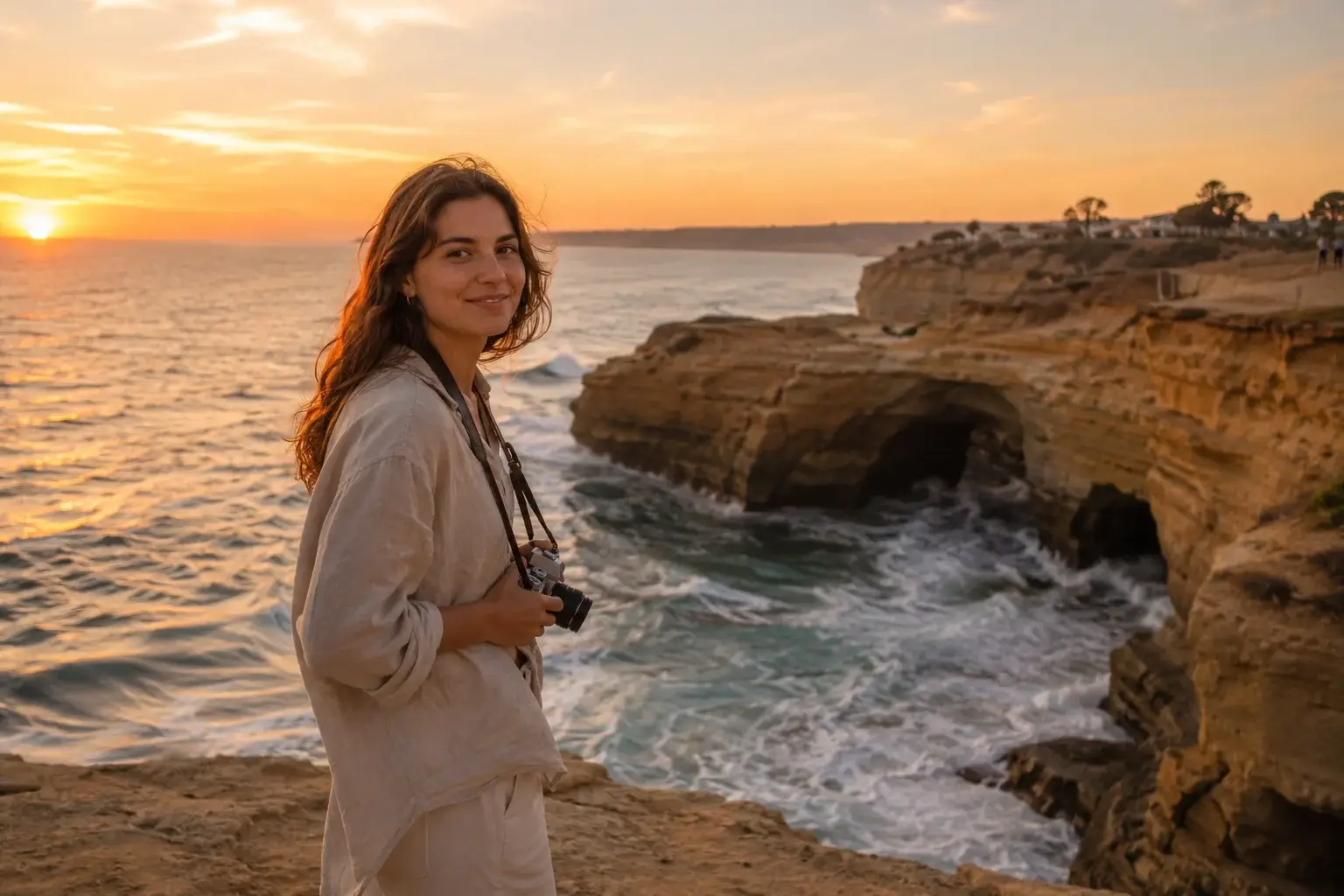
Conclude your entire seven-day road trip by driving west to Sunset Cliffs Natural Park on the Point Loma peninsula. This rugged stretch of coastline features dramatic sandstone cliffs carved out by centuries of ocean erosion. Find a flat rock, sit down, and watch the massive Pacific swells crash into the sea caves below as the sun drops beneath the horizon.
It is the exact kind of raw, expansive moment that made me leave my office job years ago. It reminds you that the world is wide, beautiful, and absolutely worth the courage it takes to explore it.
Practical Packing and Solo Travel Budget Strategies
When packing for a multi-city California road trip, the biggest mistake people make is packing only for warm beach weather. Because of the unique coastal geography and ocean currents, California cities experience intense microclimates. In San Francisco, summer afternoons can drop to 55 degrees Fahrenheit as a thick blanket of fog rolls through the Golden Gate.
In Los Angeles, it can be 70 degrees at the beach and 90 degrees just ten miles inland.
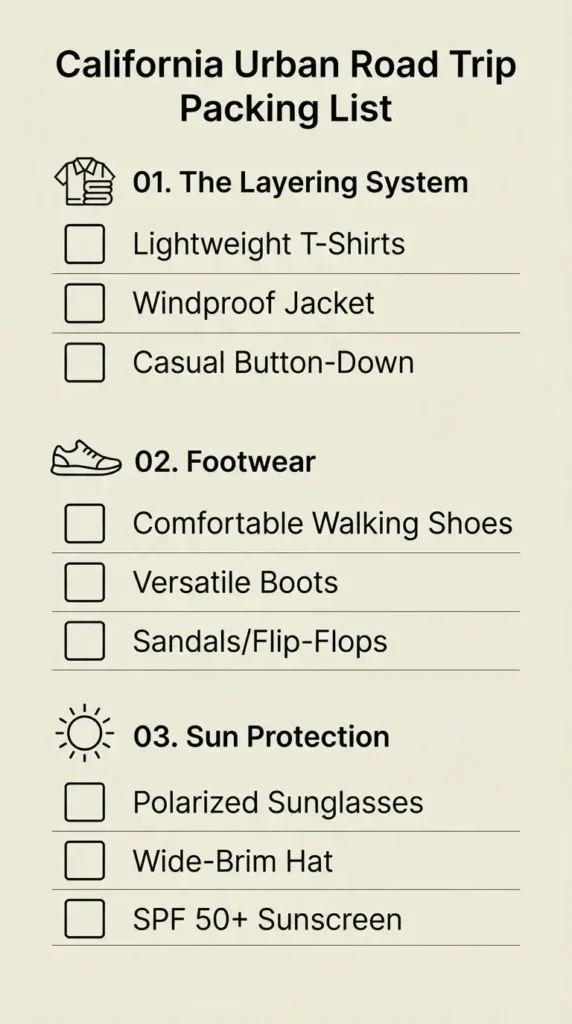
The Essential California City Packing List
- The Layering System: Always carry a lightweight, windproof jacket or a cozy flannel shirt in your daypack, even if the morning starts out perfectly sunny.
- Footwear: Comfortable walking shoes with good grip are non-negotiable for navigating the slick, steep concrete hills of San Francisco and the vast walking trails of Balboa Park.
- Sun Protection: A high-quality sunscreen and polarized sunglasses are essential for protecting your eyes and skin from the intense, direct glare of the California sun during long highway drives.
Smart Solo Budget Strategies
A multi-city road trip can easily get expensive if you are not careful, but there are simple ways to keep your costs down without sacrificing authentic experiences.
Instead of booking expensive boutique hotels in downtown centers, look for highly rated, independently run hostels or budget guesthouses in surrounding neighborhoods like North Beach in San Francisco or Echo Park in Los Angeles. These spaces often include communal kitchens where you can cook your own breakfast, saving your food budget for iconic local neighborhood lunches.
Furthermore, take advantage of “free museum days.” Many world-class cultural institutions across these three cities offer free admission on specific Tuesdays or Wednesdays of the month. Always check their official website calendars before you arrive to plan your route around these cost-saving opportunities.
Moving Beyond Hesitation – Your Adventure Awaits
When I was stuck at my corporate desk, I used to tell myself a thousand stories about why I couldn’t travel. I told myself I didn’t have enough money, that it wasn’t safe to go alone, or that I needed to wait for the “perfect moment” when my career was entirely sorted out. But the truth is, the perfect moment rarely exists. The world does not wait for you to be completely ready; it rewards curiosity, action, and the willingness to take the first step.
This seven-day route through California’s cities is more than just a vacation plan. It is a structured opportunity to build your independence, connect with diverse cultures, and step completely outside of your comfort zone. You will navigate massive freeway systems, walk through historic neighborhoods, taste incredible traditional food, and stand on coastal cliffs looking out at the edge of the continent.
Stop looking at other people’s travel stories on your phone screen. Grab your keys, book your flight, and start building your own adventure today. The highway is open, the cities are waiting, and you are entirely capable of making this journey your own.



