Ethical Wildlife Conservation Travel in Europe, Explained

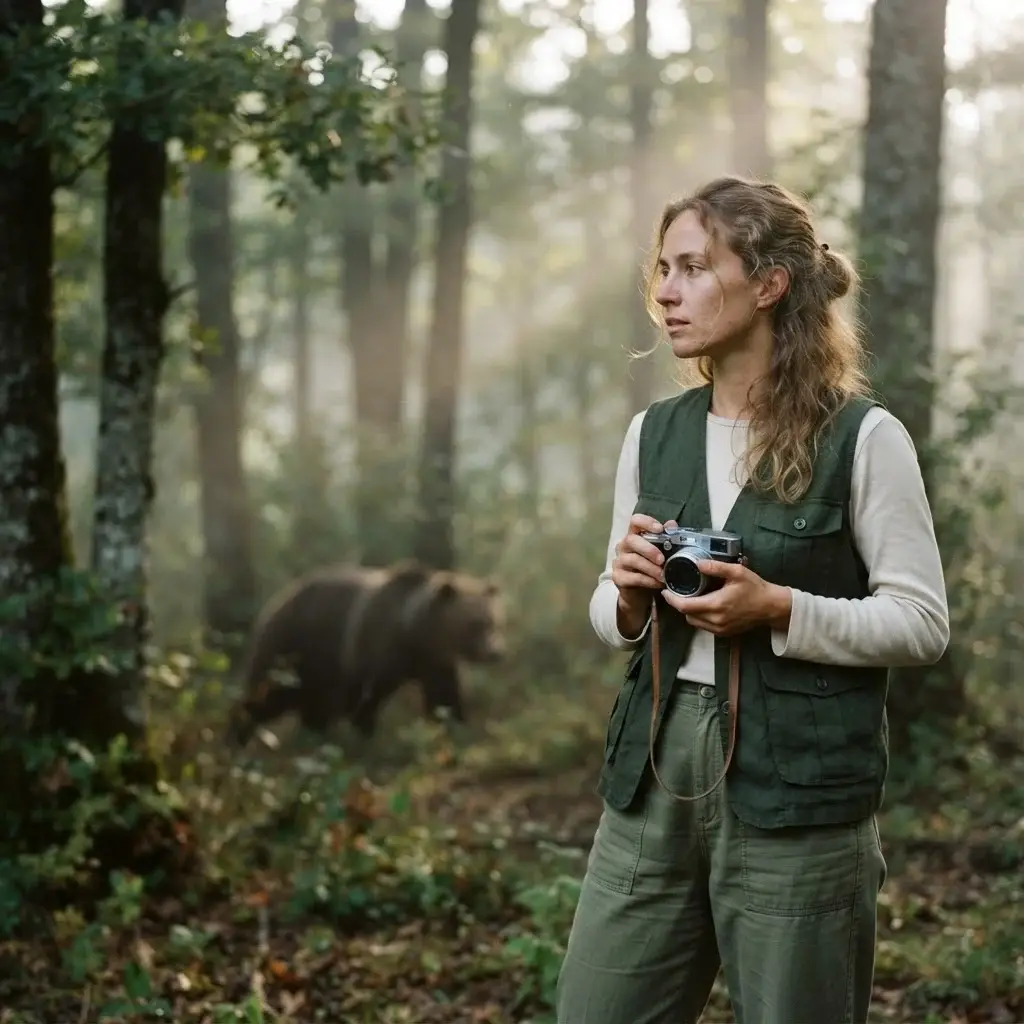
The first time I stood in a forest listening for something wild, I was hiking in China, holding my breath at every rustle, half hoping and half terrified that something big was nearby. I didn’t see much that day. But I remember the feeling. That quiet, alert, alive feeling of being a small guest in a place that did not belong to me. That is the feeling I chase now, and it is the feeling that pulls so many of us toward wildlife conservation travel.
Here is the honest part, and the reason I wanted to write this. When you start searching for wildlife experiences, the internet throws a wall of “sanctuaries” and “safaris” and “volunteer programs” at you, and a lot of them are not what they claim to be. Some are wonderful. Some are quietly cruel. And a first-timer usually cannot tell the difference from a glossy photo.
So this is the guide I wish I’d had. I’ll walk you through what “wildlife conservation experience” actually means, how to spot the ethical ones, and the specific places across Europe where you can watch, support, or work alongside real conservation. No hype. Just what to expect and how to plan it, even if you’re going solo and it’s your first time.
First, Let’s Sort Out What You Actually Want
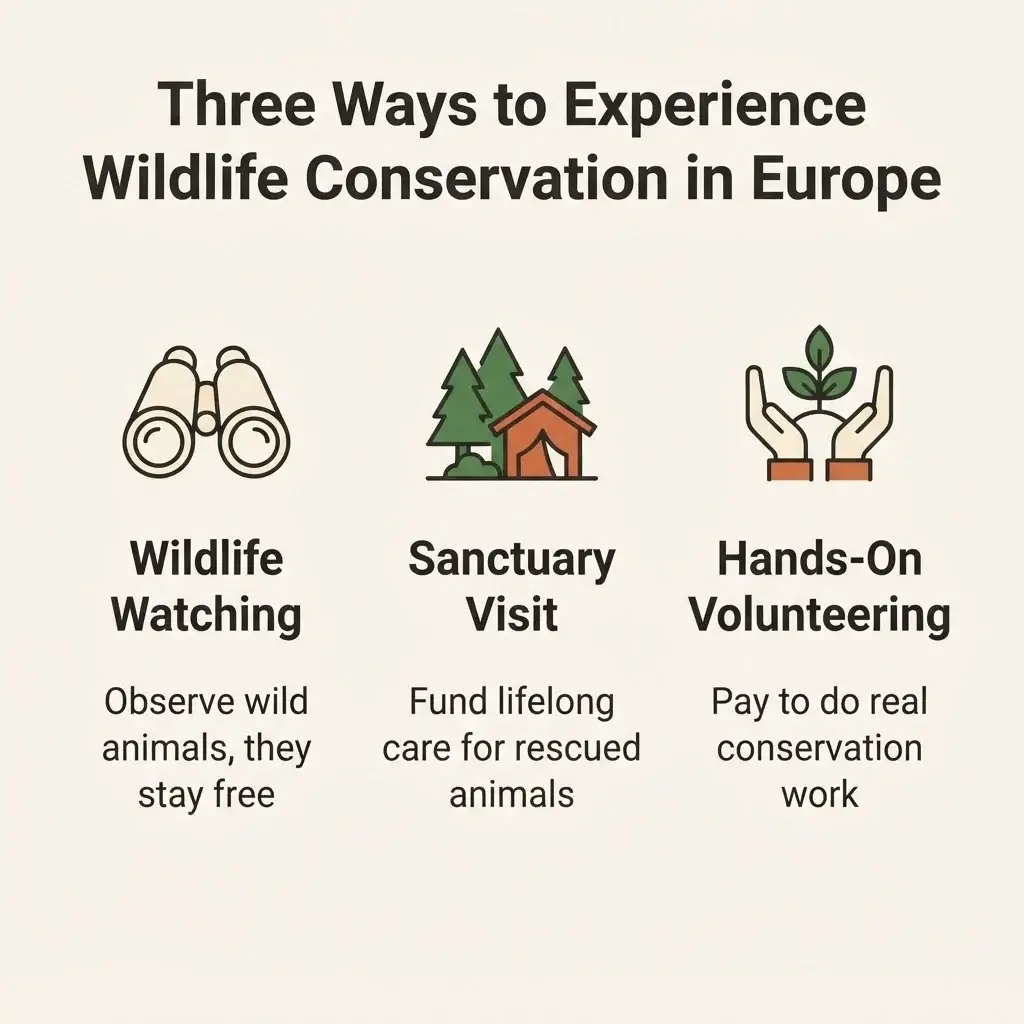
People use “conservation experience” to mean three very different things, and figuring out which one you want will save you money and heartache.
The first is wildlife watching, where you observe animals in the wild, usually from a hide or with a guide. You are a visitor. The animals are free. This is the gentlest entry point and honestly my favorite, because nothing is staged.
The second is visiting a genuine sanctuary, a place that gives lifelong care to animals who cannot return to the wild, often because they were rescued from captivity. You pay an entry fee that funds their care. You do not touch, ride, or pose with the animals.
The third is hands-on volunteering, where you pay to spend a week or more doing real work like habitat restoration, monitoring, or data collection. This asks the most of you and costs the most, and it is the one most likely to be oversold.
If you’re nervous or new, start with watching or a sanctuary visit. You can build up to volunteering once you trust your own footing. Confidence, as I always say, grows through action, and there’s no rule that says the first action has to be the biggest one.
How to Tell a Real Sanctuary From a Selfie Zoo
This is the part I need you to actually read, because it protects animals and it protects you.
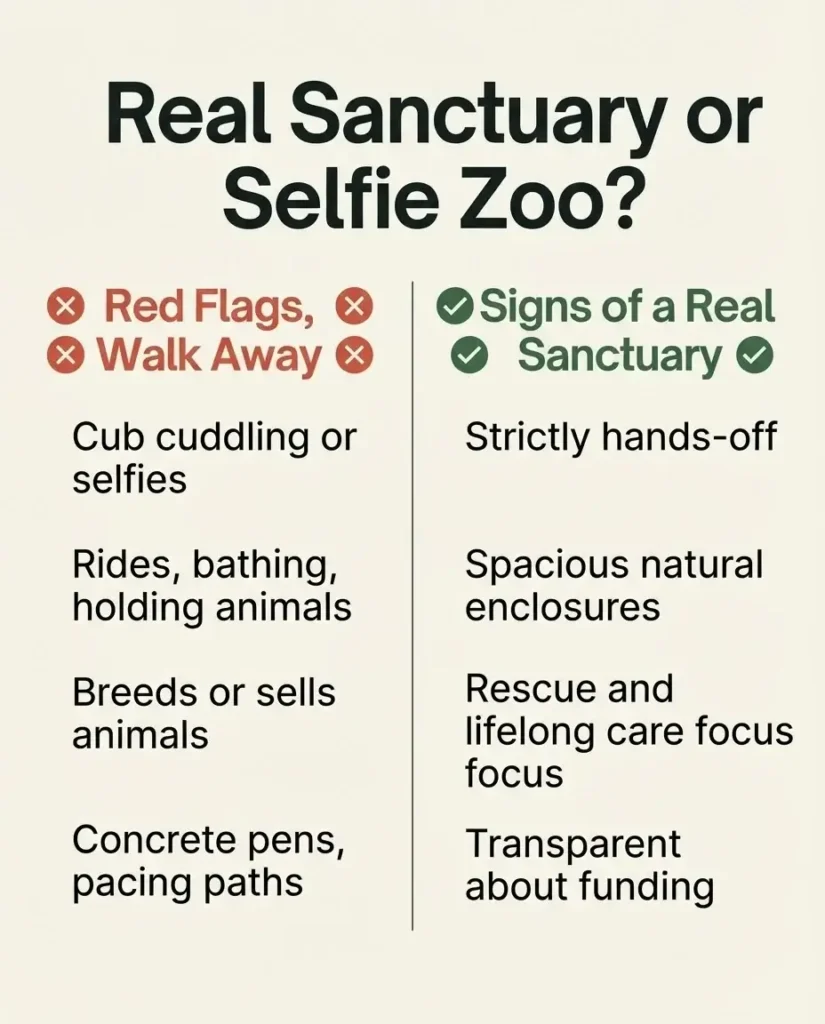
A real sanctuary does not let you cub-cuddle, ride, bathe, or take selfies holding a wild animal. It does not breed animals for profit, and it does not buy or sell them. The enclosures are spacious and species-appropriate, not concrete pens with pacing paths worn into the ground. The focus is the animal’s wellbeing, not your photo. When I’m unsure about a place, I run through the exact checklist that animal welfare groups publish, and the plain-language guide from PETA on how to tell a real sanctuary from a roadside zoo is a good gut check before you ever hand over money. If a place advertises hands-on contact with big cats, bears, or primates as the main attraction, walk away. Real conservation is almost never about touching.
One more quiet red flag: language. Watch for places that use the word “sanctuary” but sell “experiences” that put you physically on or against the animals. The best places are almost boringly hands-off. That’s the point.
The Best Places for Wildlife Conservation Experiences in Europe
Europe surprises people. We think of it as tame and paved, but it is home to bears, wolves, lynx, bison, and some of the largest wetlands and rewilding projects on the planet. Here are the experiences I’d point a friend toward, grouped by what kind of trip you’re after.
Libearty Bear Sanctuary, Romania (Best for First-Timers)
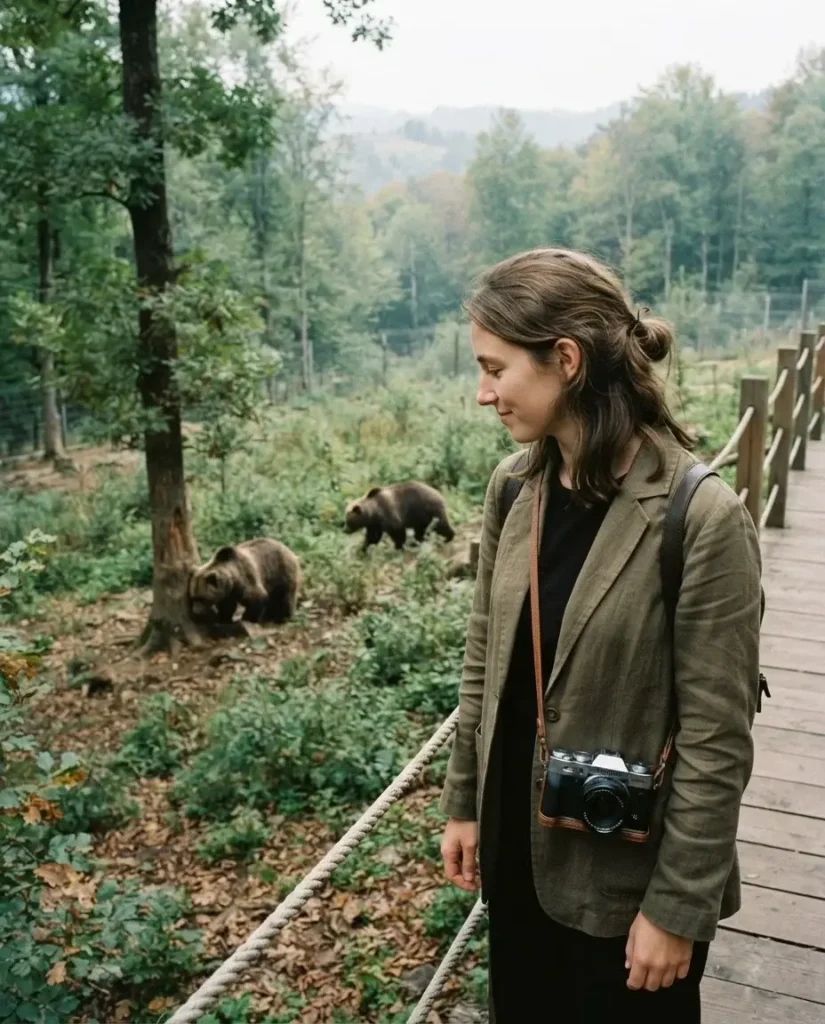
If you only do one of these, and you want something deeply moving that requires no wilderness skills, this is my top suggestion. Near the town of Zarnesti in Transylvania, the Libearty Bear Sanctuary is home to more than 100 brown bears rescued from cages, restaurants, and roadside attractions across Romania, living out their lives on 69 hectares of oak and hazel forest. It’s run by the Millions of Friends Association, which operates the sanctuary and cares for the rescued bears, and visits are by guided walk only, along raised walkways above the forest.
What to expect: this is emotional. Some of these bears spent decades in tiny cages. Seeing them wander real forest hits hard in the best way. Visits must be booked in advance, and hours are seasonal, with a short winter window (roughly 11am to noon from November through April) and longer hours in the warmer months. Bring layers, because the forest holds the chill.
Getting there solo: Zarnesti sits close to Brasov, which is an easy train ride from Bucharest and a lovely base in its own right. From Brasov you can reach the sanctuary by pre-booked transfer or a short taxi. I’d pair this with a couple of nights exploring Brasov’s old town and eating your way through hearty Transylvanian food, think sarmale (cabbage rolls) and a bowl of ciorba, the sour soup that tastes like someone’s grandmother made it.
Iberian Lynx Watching, Andalucia, Spain (Best Conservation Success Story)
This one gives me chills because of what it represents. The Iberian lynx was on the very edge of extinction, and thanks to years of coordinated work, the IUCN reclassified it from Endangered to Vulnerable in July 2024, with the mature population climbing from just 62 animals in 2001 to hundreds today. When you go looking for a lynx in the highlands of Andalucia, you are watching a species that we very nearly lost, walking back from the brink. If you want to understand exactly how fragile and how hopeful that recovery is, the species is tracked in detail on the IUCN Red List’s Iberian lynx assessment.
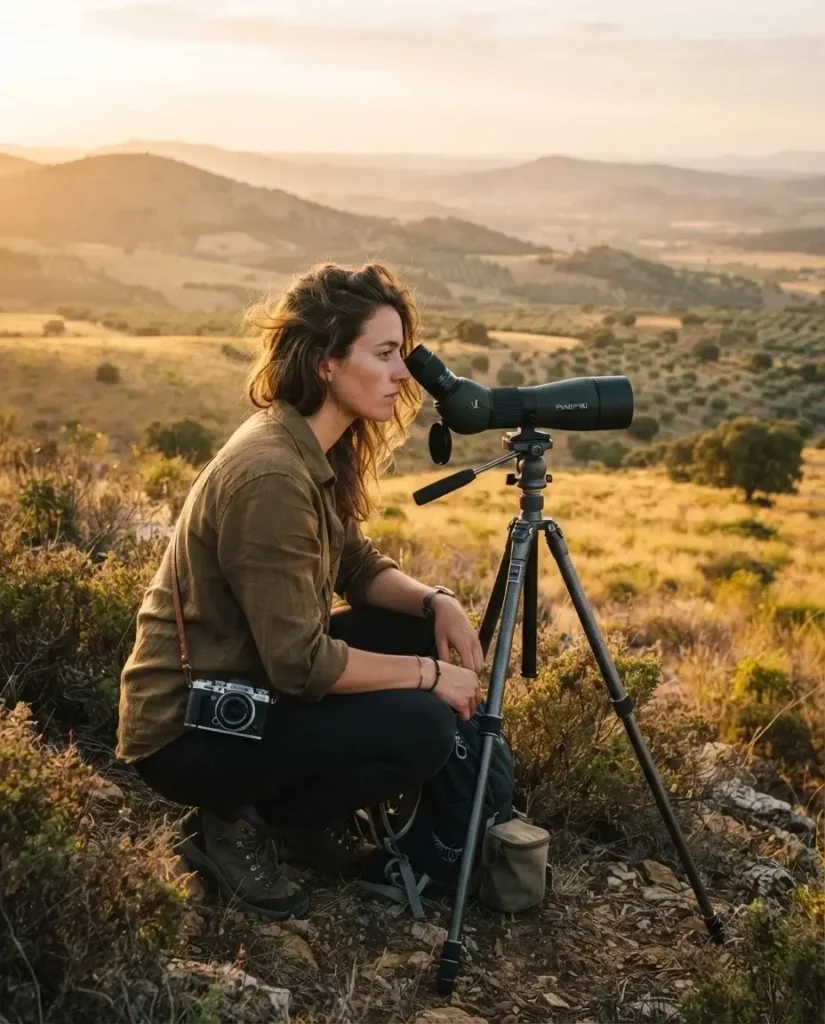
What to expect: patience. Lynx watching means early mornings, a good local guide with a scope, and a lot of scanning quiet hillsides around places like the Sierra de Andujar. From what solo travelers who’ve done it consistently report, the joy is as much in the waiting as the sighting, and the deer, otters, and birds you see along the way are part of the reward.
Getting there solo: the Andujar area is reachable by train to nearby towns in Jaen province, but a guided day trip is far more practical than going alone, since local guides know the territories. Base yourself in a small guesthouse and eat like an Andalusian, which means slow lunches, olive oil on everything (this is the world’s olive-oil heartland), and tapas that come free with your drink in many bars.
Brown Bear Watching, Finland (Best for Wild, Unstaged Encounters)
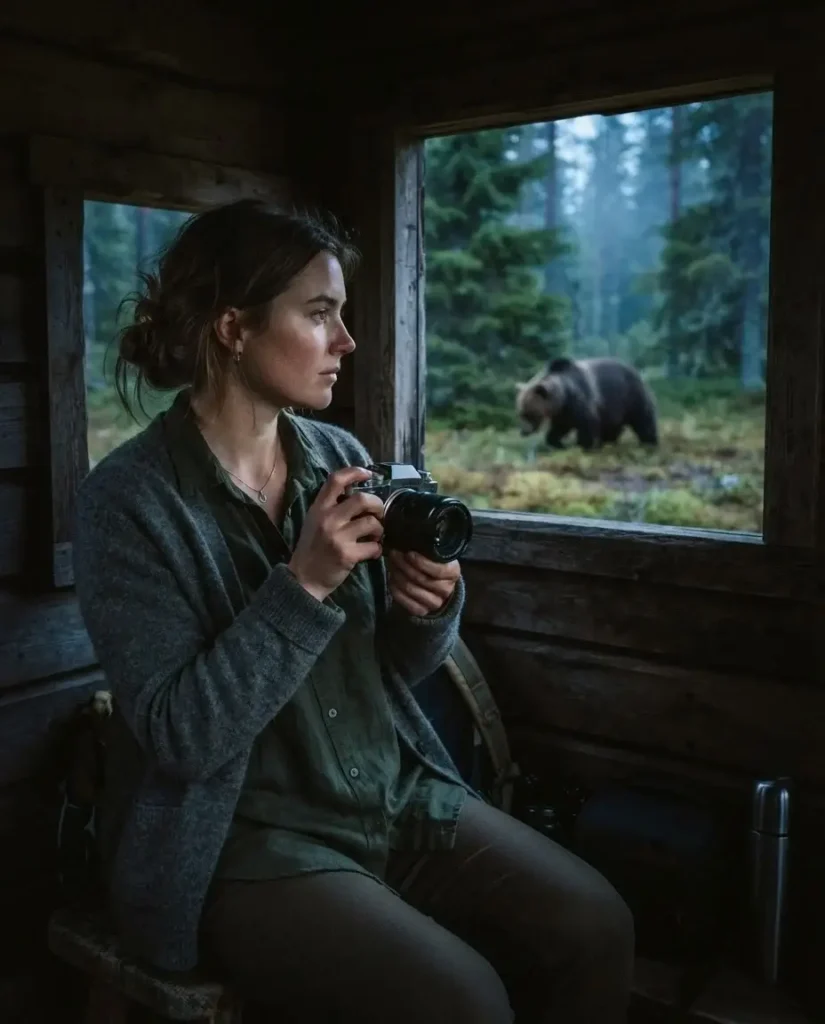
For genuinely wild bears with no fences, Finland is the place, specifically the taiga forests near Kuhmo and Martinselkonen close to the Russian border. Operators here have decades of experience with photography hides, small wooden shelters where you settle in for an evening or overnight and simply watch.
What to expect: stillness and a bit of discomfort, honestly. You’ll sit quietly for hours, sometimes overnight, and phones-off patience is the price of admission. The reward is brown bears behaving naturally in a pristine landscape, sometimes alongside wolverines and eagles. Season runs roughly May to September, with spring being prime time for seeing cubs.
Getting there solo: fly to Kuhmo’s nearest hubs and most hides arrange pickups, since the forests are remote. This is a trip where booking a reputable operator directly is not optional, it’s how you stay safe. Pack a headlamp with a red light, silent snacks, and warm layers even in summer.
European Bison in the Carpathians and Bialowieza (Best for Rewilding)
Europe’s largest land mammal was down to 54 animals, all in captivity, when the last wild one was shot in 1927. The comeback is one of the great rewilding stories of our time. In Poland’s Bialowieza Forest you can join a bison safari to track wild herds, and in Romania’s Southern Carpathians a bold reintroduction has taken hold. Between 2014 and 2021, Rewilding Europe and WWF Romania translocated 105 bison into the Tarcu Mountains, and roughly half the herd is now wild-born. Bison are what ecologists call a keystone species, meaning their grazing shapes whole landscapes, and the WWF explains why the European bison matters so much to these ecosystems if you want to understand what your visit actually supports.
What to expect: in Bialowieza, a guided bison safari runs around three hours and costs roughly 100 euros for two people, often by vehicle at dawn or dusk when the animals move. In the Carpathians, wildlife-watching tourism is newer and more intimate, and your money directly supports local guides and coexistence programs.
Getting there solo: Bialowieza is reachable from Warsaw by a longish bus or car journey, and it’s worth staying a night or two in the village to catch the golden-hour wildlife windows. Try Podlasie region comfort food, potato babka and pierogi, after a cold morning of tracking.
Marsican Brown Bear, Abruzzo, Italy (Best for Hikers)
In the mountains of Abruzzo lives a rare subspecies, the Marsican brown bear, with only around 50 to 60 left. You can join guided bear-watching hikes in and around the national park with expert naturalists who know where the bears feed at dusk.
What to expect: moderate hiking and evening waits, with guided walks running roughly June through September and priced around 35 to 41 euros, booking required the day before. Even without a bear sighting, the Apennine scenery and the villages are worth the trip. If you’re anything like I was on my first solo mountain trips, the walking itself becomes the point, and the wildlife is the bonus.
Getting there solo: base yourself in a village like Pescasseroli inside the park. Buses reach the area from larger Abruzzo towns, though connections are slow, so build in buffer time. Eat the mountain food without apology, meaning pasta alla chitarra, pecorino cheese, and lentils from Santo Stefano.
The Danube Delta, Romania and Ukraine (Best for Birds and Wetlands)
Europe’s largest wetland, the Danube Delta, is a 580,000-hectare mosaic of reed beds, lagoons, and forests that hosts pelicans, herons, white-tailed eagles, and the largest number of fish species anywhere in Europe. It’s also an active rewilding landscape, and you can read how Rewilding Europe describes its restoration work in the Danube Delta, including new wildlife-watching towers and observation hides being built for visitors.
What to expect: slow boat travel, binoculars, and pure calm. This is not adrenaline travel, it’s the meditative kind, gliding through channels while birds erupt from the reeds. Spring and autumn migration seasons are spectacular.
Getting there solo: the Romanian gateway town of Tulcea is reachable from Bucharest, and from there you take boats deeper into the delta. Book a small-boat guide rather than a big tour if you want the quiet version, and eat the fish, because delta carp and pike soup are the local pride.
What About Volunteering? Read This Before You Pay
Volunteering is where good intentions meet the biggest price tags, so let’s be clear-eyed. Genuine conservation volunteering in Europe typically runs anywhere from around 400 to over 1,200 euros per week depending on the country and what’s included, and shorter projects like a couple of weeks of nature conservation in Iceland can start lower. The reputable listings collected in Responsible Travel’s guide to wildlife conservation vacations in Europe are a reasonable starting point for seeing what real projects look like and roughly cost.
Before you pay, ask three blunt questions. Where does my fee actually go? What real conservation outcome does my week produce, beyond making me feel good? And is the organization run by or partnered with local conservationists, not just a middleman? If a program can’t answer clearly, that tells you what you need to know. The best projects are transparent to the point of being unglamorous.
Is This Safe, and Can I Really Do It Alone?
Yes, and yes. Every experience I’ve listed is done by solo travelers regularly, often more comfortably than they expected. Watching happens with guides or from safe hides, sanctuary visits are on structured walkways, and wetland trips are on boats with locals who know the water. The animals are wild, but the setups are built for safety.
The bigger challenge for a first-timer is usually the logistics, the trains, the language, the “am I even in the right place” wobble. I felt that constantly when I first backpacked Europe alone, standing in stations reading signs I couldn’t understand. It passes. You figure it out one small step at a time, and you come out the other side more capable than you went in. That transformation is the real souvenir.
A Few Honest Truths Before You Book
You might not see the animal. Wild things don’t perform on schedule, and a guide who promises a guaranteed sighting is either lucky or lying. Go for the whole experience, the forest, the patience, the people, and treat the sighting as a gift, not a guarantee.
Skip anything that lets you touch, hold, or pose with wild animals. I know the photos are tempting. The kindest thing you can do is refuse to be the reason those setups stay profitable.
And spend your money where it does good. Your entry fee at a real sanctuary, your booking with a local guide, your night in a village guesthouse, all of that is conservation too. It tells communities that living wildlife is worth more than exploited wildlife. That’s a quiet kind of power you carry as a traveler, and it matters more than you think.
The world still has wild places, even here, even in crowded old Europe. Go be a good guest in one of them. Your next adventure, and something genuinely worth protecting, is waiting just beyond the map.