How to Experience European Nature Without Leaving a Footprint

The first time I truly understood what a footprint was, I was hiking in China, watching a stretch of mountain path that had been loved almost to death. Bottle caps in the grass. Names scratched into rock. A trail widened into a scar because everyone had stepped around the muddy bit instead of through it. Nobody there was a villain. They were people like me, thrilled to be somewhere beautiful, not really thinking about what they were leaving behind.
That day stuck with me. Because here is the honest tension at the heart of nature travel: the places we love most are the ones our love can damage fastest. Europe is full of these places, from Scandinavian forests to Alpine meadows to the wild Atlantic coasts. The good news, and the reason I wanted to write this, is that experiencing them gently is not some advanced skill reserved for hardcore backpackers. It is a set of small, learnable choices. Let me walk you through them, roughly in the order you will actually face them on a trip.
Start Before You Pack: What “No Footprint” Really Means
Let’s clear something up first, because the phrase can feel intimidating. “Leaving no footprint” does not mean you become invisible or that your trip has zero impact. That is not possible, and pretending otherwise just makes people give up. What it really means is minimizing the harm you can control and leaving a place as good as, or better than, you found it.
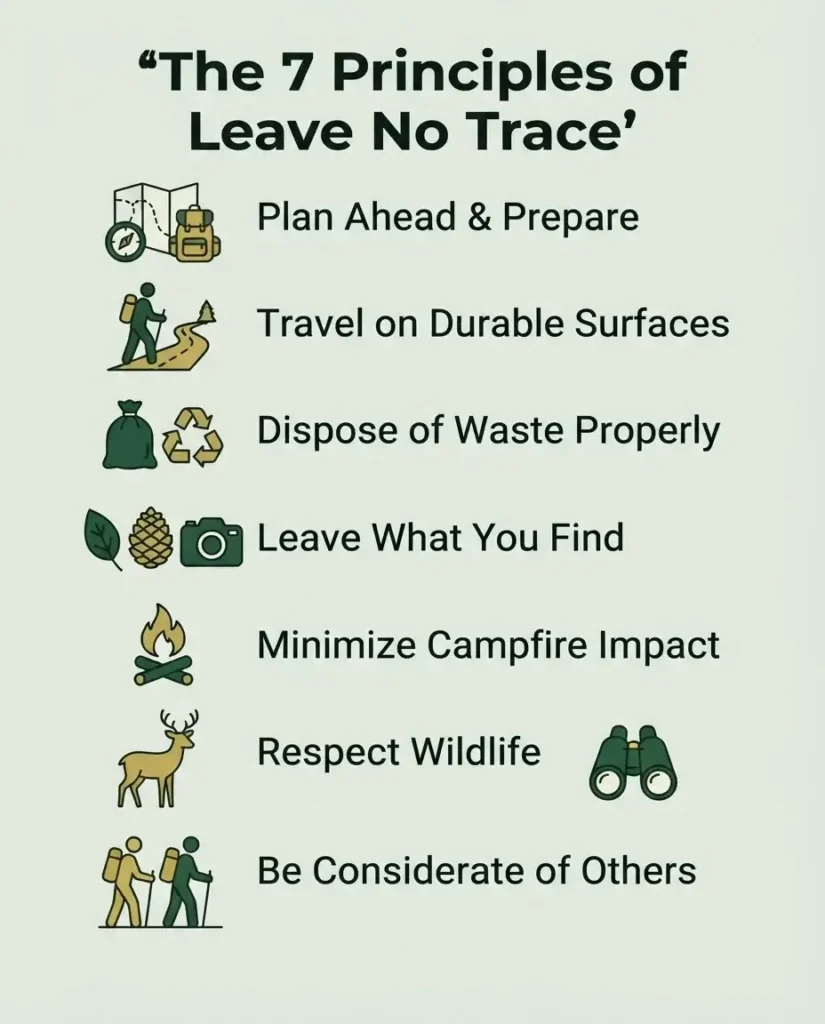
The clearest framework I have ever found for this comes from the folks at Leave No Trace, and their seven principles of responsible outdoor recreation are worth reading in full before any nature trip. They boil down to planning ahead, staying on durable surfaces, packing out everything you bring in, leaving what you find, keeping fires tiny and legal, respecting wildlife, and being considerate of other people. It was written with a US outdoors context in mind, but the thinking travels perfectly to a Norwegian fjord or a Slovenian valley.
Here is the mindset shift I want you to take from it: low-impact travel is mostly decided before you leave home. The way you get there, where you sleep, and what you pack shape your footprint more than anything you do on the trail. So that is where we start.
Getting There: Slow Travel Is the Real Green Travel
If you take one practical thing from this whole article, make it this. The single biggest lever you have is how you move around Europe.
Flying short distances between European cities is convenient and cheap, and it is also the heaviest part of most travelers’ footprint. Transport is responsible for roughly 31% of the EU’s CO2 emissions, and trains produce dramatically less carbon per passenger than planes on the same route. When I dug into the numbers on the Interrail sustainable travel comparisons, the gap was around 90% less CO2 for rail versus flying on popular routes.
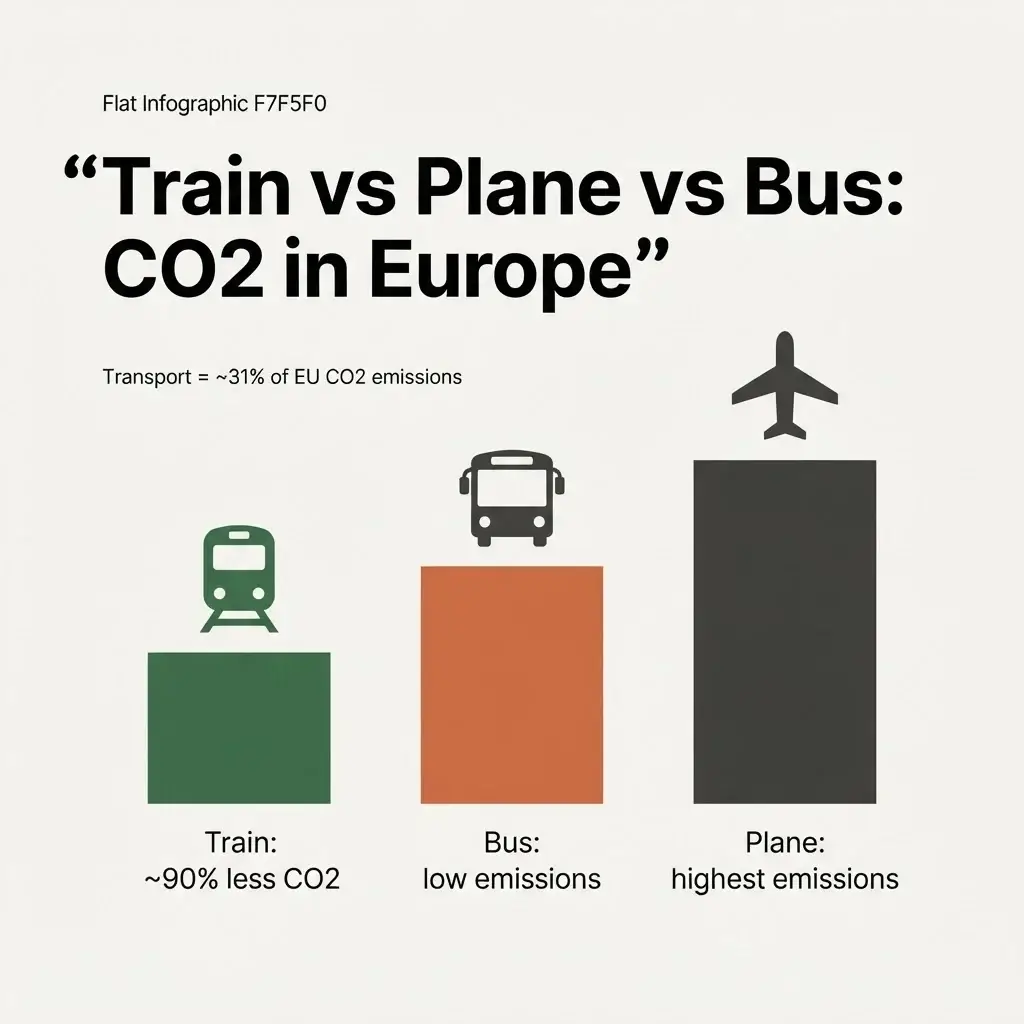
That is not a rounding error. That is the whole ballgame.
And here is what nobody tells you: the train is not a sacrifice, it is an upgrade. Some of my favorite memories from backpacking Europe solo happened on trains, watching the landscape slowly change through a window, talking to a stranger who recommended a village I would never have found. Night trains have quietly made a comeback across the continent, letting you cover a long distance while you sleep and save a night’s accommodation at the same time. Buses cover the gaps where trains do not run.
A few practical notes from experience. Book long-distance and night trains well ahead, because the cheap seats and sleeper berths sell out. Rail passes can be worth it if you are hopping around a lot, but for two or three fixed journeys, individual advance tickets are often cheaper, so do the math for your specific route. And build in buffer time. Slow travel only stays low-stress if you are not sprinting for connections.
Where You Sleep: Reading Past the Greenwashing
Once you land somewhere, your accommodation is your next big footprint decision, and this is where a lot of well-meaning travelers get quietly misled.
“Eco-lodge” and “sustainable stay” are unregulated words. Anyone can print them on a sign. What I have learned to do instead is look for actual certifications and specifics. Recognized ecolabels like Green Key or the EU Ecolabel require properties to meet real standards on water, energy, and waste, so they mean more than a leaf logo the owner invented. Beyond labels, I ask concrete questions. Does the place run on renewable energy? Do they source food locally? Is it small and locally owned, so my money stays in the community rather than flowing out to a distant corporation?
Small, family-run guesthouses in rural areas often win on every front at once. They are lower-impact, they support the local economy directly, and honestly they are where the real cultural exchange happens. When I lived with a family in Ghana, I learned more about a place in a week around their kitchen than I ever could have from a chain hotel. That principle holds everywhere. Staying local is one of the most quietly powerful low-footprint choices you can make.
Know the Rules of the Ground You Walk On
This is the section competitors skip, and it is the one that will save you from an accidental fine or an ugly encounter with a landowner. Europe does not have one single rule for being in nature. It has dozens, and they vary wildly by country.
At one end you have the Nordic tradition of the right to roam. In Sweden, the beautiful old concept of allemansrätten gives everyone the freedom to walk, forage, and even wild camp across most uncultivated land. The official explanation on the VisitSweden right of public access page is the clearest I have found, and the short version is this: you may camp roughly one to two nights on uncultivated land, kept well away from homes and out of sight of them, as long as you do not disturb the land, the wildlife, or the people who live there. Open fires are restricted during the dry months, so a camp stove is your friend. Similar freedoms exist across Norway and Finland.
Scotland is the other great example, with broad statutory access rights. Before you wander the Highlands, read the Scottish Outdoor Access Code, which spells out exactly how to camp, walk, and cycle responsibly, including why you should use a stove rather than light open fires that scar the ground.
Then there is everywhere else. In much of Central and Southern Europe, including large parts of Germany, France, Italy, and Spain, wild camping is restricted or outright banned, especially inside national parks. The penalty for getting it wrong ranges from a polite warning to a real fine. So the rule is simple: never assume. Check the specific country and the specific park before you pitch a tent. When wild camping is not allowed, designated campsites and mountain huts exist for exactly this reason, and using them is itself a low-impact choice.
It also helps to know that a huge share of Europe’s wild places sit inside protected zones. The EU’s Natura 2000 network of protected sites covers more than 27,000 areas and nearly a fifth of Europe’s land, and remarkably, about 65% of Europeans live within five kilometers of one. There is almost certainly a protected natural area near wherever you are headed, which is wonderful, and also a reminder that these places are managed for a reason. Respect the posted rules inside them.
On the Trail: The Habits That Actually Matter
Now you are out there, boots on, air in your lungs. This is where footprint becomes a moment-to-moment practice. None of it is hard once it becomes habit.
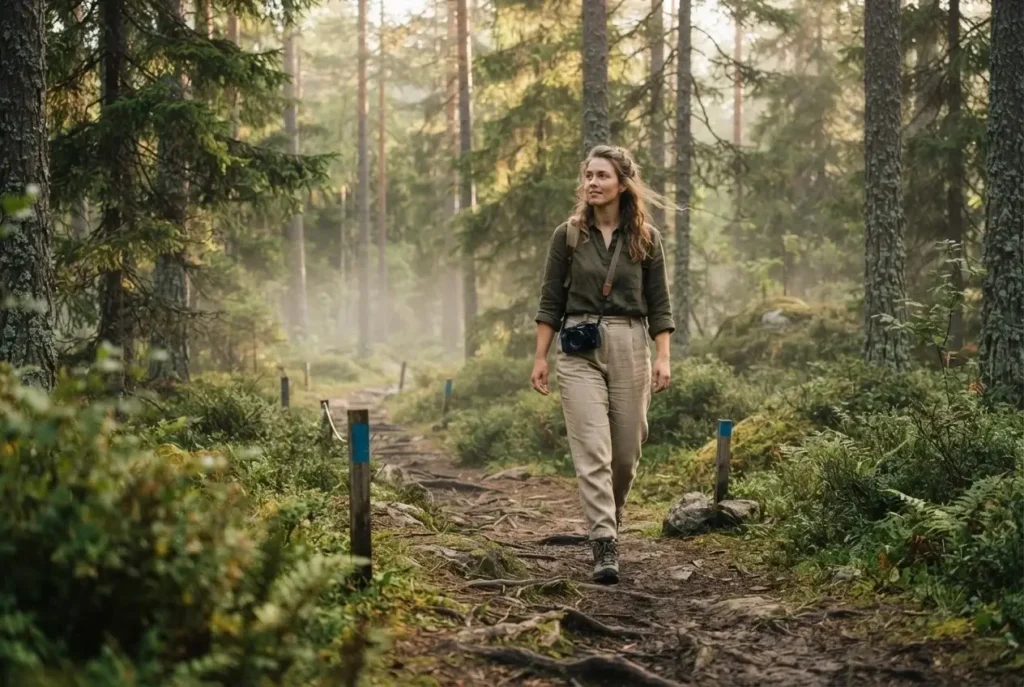
Stay on the marked path, even when it is muddy or crowded. The instinct to step around a puddle is exactly how a single trail becomes three, then a widening scar. Walking straight through, in decent boots, is the low-impact move. On a group of durable surfaces like rock or gravel, you have more freedom to spread out, but on soft meadow or wet ground, single file on the trail protects everything around it.
Pack out everything, and I mean everything. Not just wrappers and bottles, but food scraps too. An apple core or orange peel that you would swear is “natural” can take weeks or months to break down, draws animals toward trails, and changes their behavior. Carry a small dedicated trash bag and treat it as sacred.
Let’s talk about the thing polite guides avoid: going to the bathroom outdoors. If there is no toilet, walk well away from any water source, at least 60 meters or so, dig a small hole for solid waste and bury it, and pack out your toilet paper in a sealable bag rather than leaving it or burying it, because it lingers and blows around. Menstrual products always get packed out too. It feels awkward the first time and completely normal by the third. This one habit prevents an enormous amount of the mess that ruins popular wild spots.
Keep your distance from wildlife and never feed animals, no matter how bold or cute they get. A fed animal becomes a dependent animal, and often a dead one. Watch, photograph from afar, and move on. And leave what you find, whether it is a wildflower, an interesting rock, or an old ruin. If everyone takes “just one,” there is nothing left for the next person.
The Solo Angle: Staying Light and Staying Safe
Because so many of you reading this travel alone, like I do, I want to speak to something the eco-travel guides almost never address: how to be both low-impact and safe when there is no one else to lean on.
The two goals actually support each other more than they conflict. Planning ahead, the very first Leave No Trace principle, is also the single best safety practice for a solo traveler. When I know the route, the weather, the last resupply point, and where I will sleep, I am both lower-impact and far less likely to make a panicked, damaging, or dangerous decision.
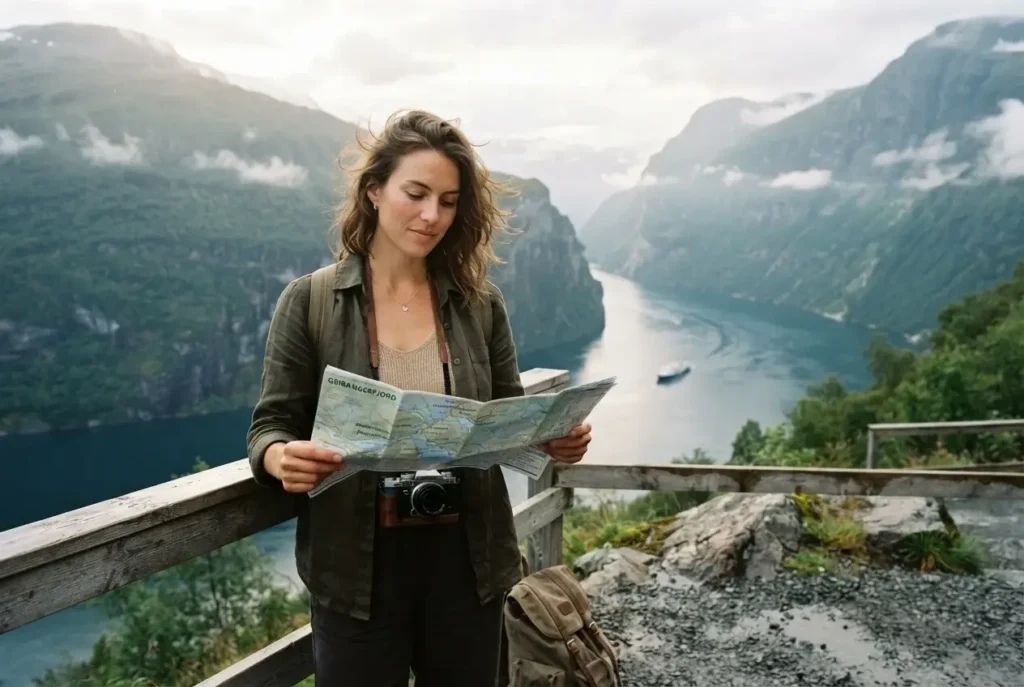
A few solo-specific habits I stand by. Tell someone your route and expected check-in time before you head into anywhere remote. Start conservative with distance and difficulty; there is no group to bail you out, so ego has no place here. Carry a paper map and know how to use it, because phone batteries die and remote signal is unreliable. And trust the quiet confidence that solo nature travel builds in you. I genuinely believe there is no faster way to discover how capable you are than standing alone in a landscape bigger than you and realizing you can handle it. That feeling is the whole reason I fell in love with this life.
Respecting People, Not Just Places
A footprint is not only physical. It is social and economic too, and this is where being a thoughtful traveler goes beyond litter and carbon.
Travel in the shoulder seasons when you can. Spring and autumn are gentler on overcrowded places, kinder to your budget, and often the most beautiful times to see nature anyway. Europe has a serious overtourism problem in its most famous spots, and choosing a quieter valley over the Instagram-famous one spreads the benefit and reduces the strain. Some of the most memorable places I have wandered were ones almost nobody had heard of.
Spend your money locally. Eat at the small family restaurant, buy from the village shop, hire the local guide. When you eat, lean into what the region actually produces rather than what you would order at home. In the Nordic countries that might mean foraged berries, fresh fish, and hearty rye bread. In the Alps, simple mountain cheeses and cured meats that traveled about two feet to your plate. Eating local is lower-footprint and, frankly, just tastes better and tells you more about a place.
And learn a few words of the language, even badly. A clumsy “hello” and “thank you” in the local tongue is a form of respect that costs nothing and changes how you are received everywhere.
What This Actually Costs
Let’s kill the myth that low-impact travel is expensive. In my experience it is usually cheaper, because most of the greenest choices are also the frugal ones.
Trains and buses over flights, once you book ahead, are often comparable or cheaper and save you airport hassle. Wild camping where it is legal, or cheap designated campsites and hostels where it is not, costs a fraction of hotels. Cooking on a small stove and eating local market food beats restaurant prices. Shoulder-season travel means lower prices on nearly everything. The one place you might spend more is good gear that lasts, and a reusable water bottle, a decent pair of boots, and a small stove pay for themselves fast.
I know this because I did not build my travel life on a big salary. I left an office job that felt like a cage, worked flexible jobs to fund the road, and made it work by traveling slowly and cheaply. Slow, gentle travel and budget travel turn out to be the same skill wearing different clothes.
You Don’t Have to Be Perfect, You Just Have to Start
If all of this feels like a lot, take a breath. You will not do every single thing right on your first trip, and that is completely okay. I certainly did not. The point is not purity. The point is paying attention, making better choices where you can, and leaving each place a little better than a careless traveler would.
Europe’s wild places are extraordinary, and they are yours to experience. The forest does not need you to be an expert. It just needs you to be thoughtful, to walk lightly, to take your trash and your memories and leave everything else exactly where it belongs. Do that, and you get the best trade there is: the whole adventure, and a clear conscience to carry home with you.
So pick a place. Book the train. Go gently. The mountains have been waiting for someone exactly like you.