Best European Wellness Retreats for a Real Digital Detox

Here is the strange thing I noticed the first time I really put my phone away for more than a day. My thumb kept reaching for a pocket that was empty. There was nothing to check, and yet I checked anyway. If that tiny detail makes you wince a little in recognition, you are exactly the person I wrote this for.
A digital detox retreat is a trip built around one simple boundary: you step away from your screens on purpose, usually with some help from the place itself. Some retreats lock your phone in a box. Some sit in a valley with no signal at all. Others just build your days so full of quiet, water, walking, and rest that you forget the phone is even there. Europe happens to be one of the best places on earth to do this, because it stacks centuries of wellness tradition on top of forests, thermal springs, and small towns that were designed for slowing down long before Wi-Fi existed.
I want this to be genuinely useful, so I am going to be honest with you about what works, what these trips cost, what the first day actually feels like, and how to choose the right kind for who you are. Let’s get you unplugged.
Wait, does a digital detox retreat actually work?
I know the skeptical voice in your head, because I had it too. Can’t I just turn my phone off at home? Technically yes. In practice, almost nobody does, and there is a real reason for that.
When researchers at the University of Greenwich and the University of East Anglia studied people on tech-free holidays, they found a pattern so consistent it is almost funny. Guests tend to feel restless and even anxious in the first day or so, then something shifts. By around the 48 hour mark most people settle, stop reaching for the phone, and start actually enjoying being unreachable. The reporting on this in the BBC’s coverage of the digital detox boom matches what I have felt myself. The magic is not willpower. It is the boundary. When leaving early or scrolling is simply not an option, you push through the uncomfortable part instead of caving at hour three.
The mental health side holds up too.

Studies gathered by researchers at Georgetown University point to reduced screen time improving sleep, focus, and mood. So no, it is not a gimmick. It is closer to what happens when you finally take a real weekend off after months of saying you will “rest soon.”
Here is the part I care about most, though, and it comes straight from why I left my own office job years ago. This is not really about hating technology. It is about noticing how much of your attention you have quietly handed away, and taking a little of it back. That is a travel goal worth having.
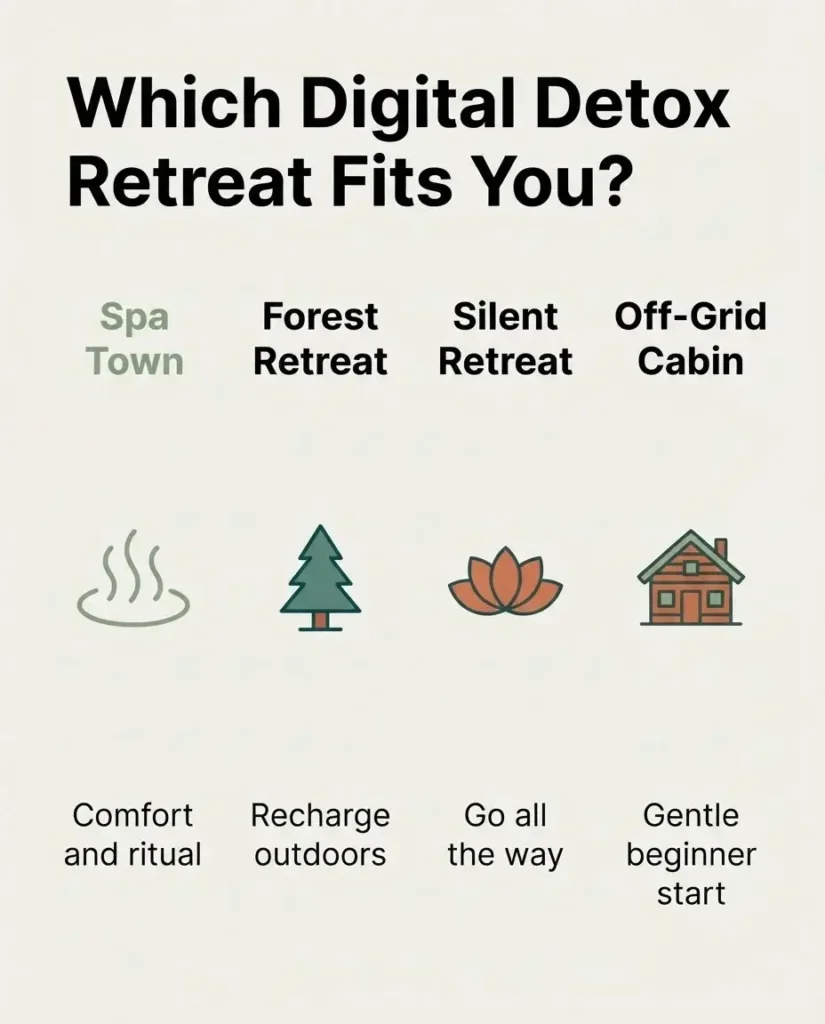
The four main types, and which one fits you
The biggest mistake I see first-timers make is booking the wrong style for their personality, then deciding “detox retreats aren’t for me” when really they just picked the deep end when they needed the shallow end. There are four broad types, so let me walk you through them like a friend who has done the research.
The historic spa town, for people who want comfort with their reset
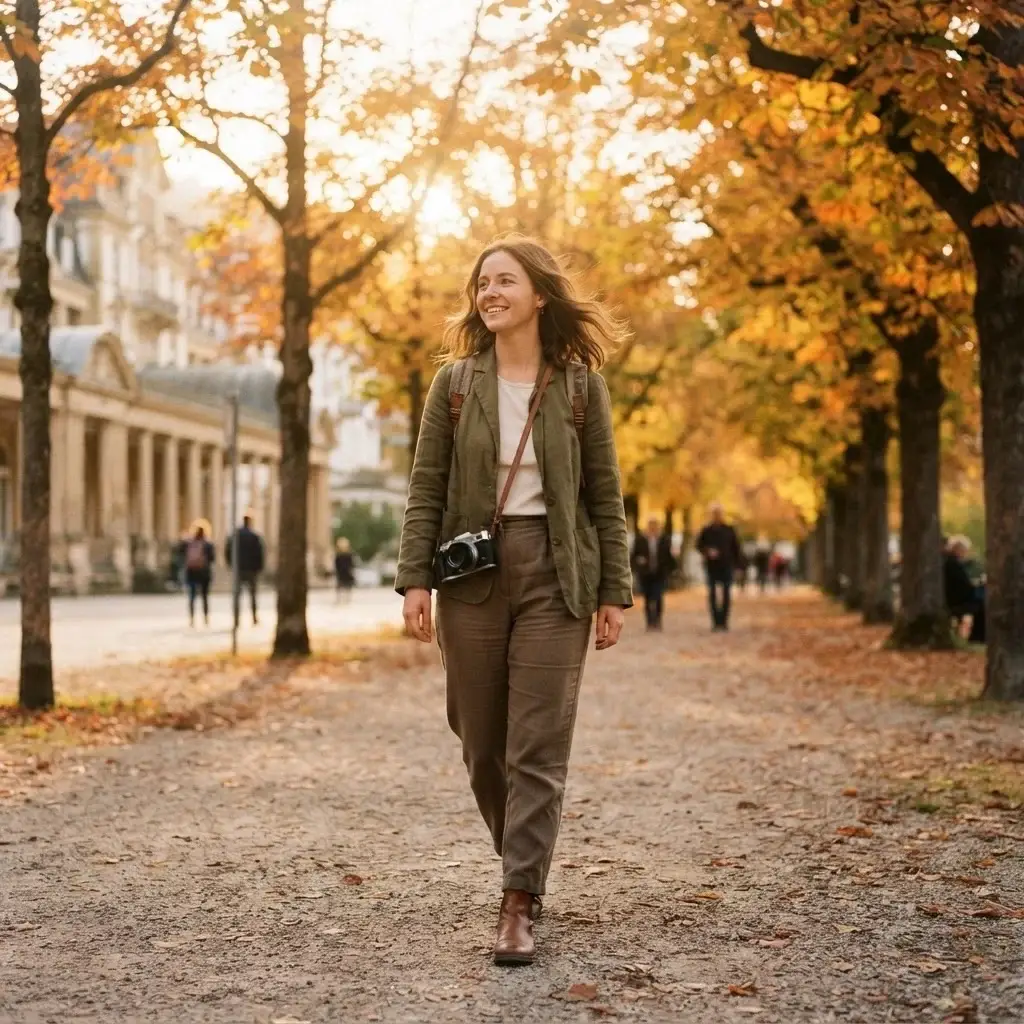
If the words “silent meditation” make you tense up, start here. Europe’s grand old spa towns were built for exactly this rhythm: soak in mineral water, walk in the gardens, read, eat well, sleep hard, repeat. You do not have to surrender your phone by force. You just find yourself using it less because there is somewhere better to be.
Eleven of these towns hold a shared UNESCO World Heritage listing as the Great Spa Towns of Europe, inscribed in 2021 and spread across seven countries, including Baden-Baden and Bad Ems in Germany, Vichy in France, Karlovy Vary in Czechia, and the City of Bath in England. Baden-Baden is my top suggestion for a first timer because it is easy to reach and the bathing culture is welcoming to newcomers. The historic Friedrichsbad Roman-Irish bath is a slow, ritual soak through a series of rooms, and its official page lists admission around 38 euros, which for a first-timer is a wonderful, phone-free half day. The neighboring Caracalla Spa is more modern and casual, with entry starting near 21 euros for a couple of hours.
What to eat: in the German spa towns, lean into the long, unhurried café tradition. A slice of Black Forest cake with a coffee, taken slowly with a book instead of a screen, is more on-theme than it sounds. In Czech spa towns, try the wafer-thin spa wafers (lázeňské oplatky) that locals have nibbled while “taking the waters” for generations.
Navigation tip: these towns are small and walkable by design. From Baden-Baden’s train station, the bath quarter and Lichtentaler Allee promenade are a short bus ride or a flat walk, so you can genuinely leave maps off and follow the signs and the crowds.
The forest and nature retreat, for people who recharge outdoors
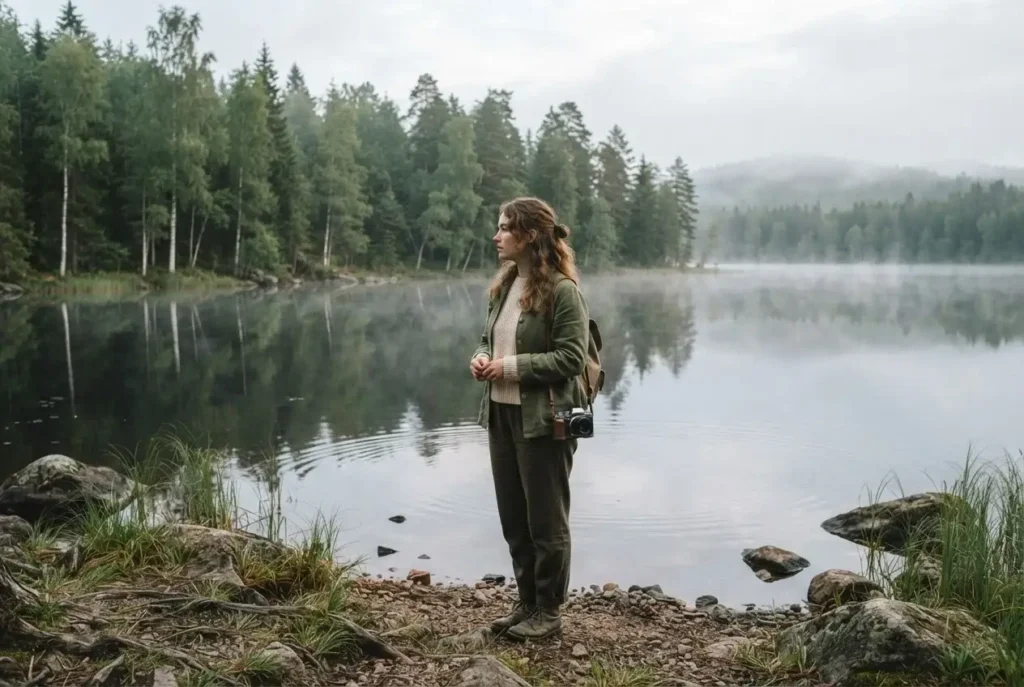
If sitting still sounds like torture but a long walk clears your head, a nature-based detox is your match. The practice at the heart of this is forest bathing, or shinrin-yoku, which is simply slow, sensory time among trees. No hiking goal, no step count, just noticing.
Finland is the standout here, and it comes with a legal superpower. Thanks to Everyman’s Right, or jokamiehenoikeus, anyone can walk, forage, and even camp across most of the Finnish countryside for free. Visit Finland explains the right to roam clearly, and it means a nature detox in Finland can cost as little as your accommodation plus a bus fare. You do not need a fancy program to sit by a lake in silence. That said, Finnish and Nordic nature lodges often pair a cabin with a wood sauna, which is its own centuries-old unplugging ritual.
What to eat: forage responsibly and seasonally. In late summer Finnish forests fill with bilberries and lingonberries, and picking them by hand for an hour is itself a beautiful analog activity. Pair it with rye bread and smoked fish for the most local meal you can put together.
Navigation tip: this is the one place I would keep a downloaded offline map, purely for safety. Northern forests are vast and trails can be faint. Being unplugged from social media does not mean being reckless in the wilderness, and that distinction matters.
The silent retreat, for people ready to go all the way
This is the deep end, and I will be straight with you: it is not the place to start, but for the right person it is transformative. A classic silent retreat means no talking, no reading, no writing, and no devices, often for several days at a time.
The most established and accessible option is the Vipassana tradition, which runs standardized ten-day silent courses around the world on a purely donation basis, meaning there is no set fee and past students fund future ones. You can find the European centres through the official Dhamma directory, with locations in Germany, France, Spain, Italy, Poland, and beyond. Ten days is a serious commitment, so if you are curious but not sure, look for shorter two or three day silent options first.
I have not sat a full Vipassana course myself, so I will not pretend to know the inside of day six. What people consistently report is that the hardest part is not the silence, it is meeting your own unfiltered thoughts without a screen to escape into. That is also, apparently, where the growth lives. If you have ever felt that your phone is a way to avoid sitting with yourself, this format confronts that directly.
The off-grid cabin or short “offline club” stay, for the curious beginner
If a full retreat feels like too big a leap, this is the gentlest on-ramp, and honestly where I would send most nervous first-timers. The idea is simple: a cabin or short organized stay where the Wi-Fi is gone, your phone goes in a box, and the space gives you books, board games, and quiet instead.
Short, structured versions are booming. The Offline Club runs two and five day phone-free retreats in the Netherlands and France, and the whole point is that you show up, hand over your phone, and let the group and the schedule carry you. There is real comfort in doing your first detox alongside other people who are just as twitchy as you are. Off-grid cabin operators across the UK, Spain, Ireland, and Scandinavia offer a more solitary version, often within a short drive of a city so it feels doable rather than extreme.
What to eat: many cabin stays lean into cooking as an activity, not a chore. Bring simple one-pot ingredients and let making dinner slowly become part of the point rather than something you rush so you can get back to a screen.

What a digital detox retreat really costs
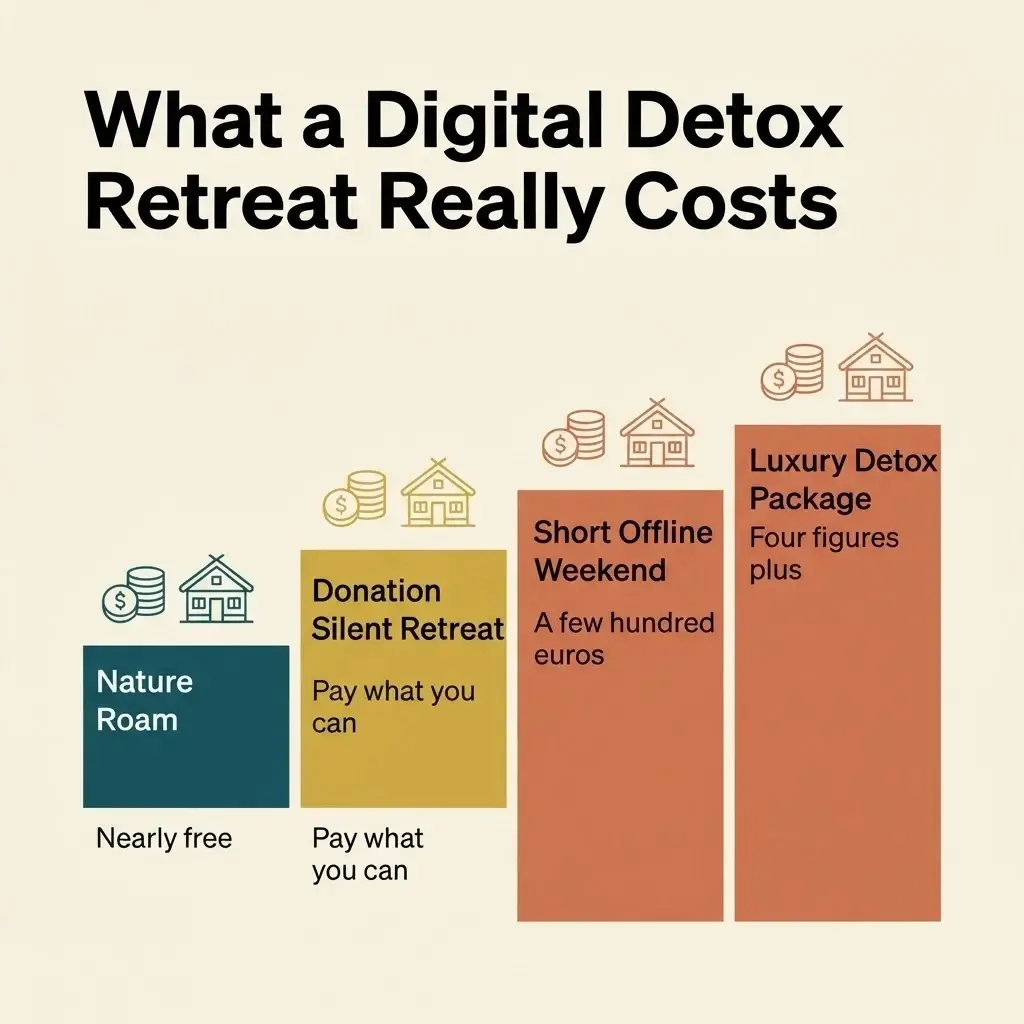
Let me clear up the biggest myth, because the search results make these trips look luxurious and pricey. They can be, but they absolutely do not have to be.
At the free-to-cheap end, a nature detox using Finland’s right to roam or a similar setup costs little more than your bed and transport. A donation-based silent retreat has no fixed fee at all, though it is only fair to contribute what you genuinely can. Short offline-club style weekends and off-grid cabins tend to sit in the moderate range, often a few hundred euros for two or three nights including a bed and some meals. The four-figure “luxury detox” packages you see advertised are real, but they are a choice, not a requirement. When I was saving for my early trips by working flexible jobs, I learned that the experience that changes you is rarely the most expensive one. A quiet cabin and a stack of books can do as much as a spa with a chandelier.
Budget honestly for the small extras too: transport to often-remote locations, a few paid bath entries if you choose a spa town, and travel insurance, which I would not skip on any trip.
Can you do a digital detox retreat solo? Yes, and here is why it is ideal
Solo travel is the heart of what I do, so hear me on this. A detox retreat might be the single best trip to take alone. There is no one to fill the silence for you, no one whose phone you can borrow, no one to renegotiate the plan with when you get twitchy. It is just you, learning that you are perfectly good company.
For safety and comfort as a solo detoxer, I always suggest a few things. Tell one trusted person where you are and roughly when you will resurface, so being unreachable is a choice, not a worry. Choose a retreat that has an emergency phone or landline available, which most reputable ones do, so “no personal phone” never means “no way to reach help.” And for your very first time, a group format like an offline club or a small guided retreat gives you built-in company and structure, which takes the pressure off.
The confidence you build here is the same muscle that got me from a gray New York desk to backpacking Europe alone. It grows through doing the slightly scary thing and discovering you were fine all along.
How to survive the first 48 hours (the honest part)
Nobody tells you this clearly, so I will. The first day is uncomfortable, and that is normal, not a sign you made a mistake.
Expect phantom phone reaches, a weird restlessness, and maybe a flash of “what am I even doing here.” This is the exact stir-crazy window the researchers found. Do not fight it. Bring analog anchors so your hands and mind have somewhere to go: a real book, a journal, a sketchpad, a pair of walking shoes. Plan your days loosely around water, movement, and rest rather than around “activities,” because a detox is not a packed sightseeing tour.
And plan your re-entry, because this is where a lot of people undo the whole thing. When you switch your phone back on, do not stand there absorbing 200 notifications in the parking lot. Wait until you are settled somewhere calm, and consider keeping one small change: no phone for the first hour of your morning, maybe. The retreat is the reset. The tiny habit you keep is what actually changes your life.
Choosing yours, in one honest paragraph
If you want comfort, pick a spa town like Baden-Baden. If you recharge outdoors, go to a Finnish forest. If you are ready to face yourself fully, sit a silent retreat. And if you are a nervous first-timer, book a short offline-club weekend or an off-grid cabin and let the training wheels do their job. There is no wrong door here. There is only the one that fits who you are right now, and the quiet, slightly proud version of you that walks back out.
The perfect moment to unplug will never announce itself. So pick the type that made you nod while reading, and start there. Your attention is worth reclaiming, and the world looks remarkably good when you finally look up from the screen to see it.