Best Coastal Train Journeys in Europe: A Real Solo Guide

There is a specific kind of daydream that keeps showing up in my inbox. Someone has seen a photo of a little train curving along a cliff, the sea impossibly blue below it, and they think, “I want to be on that train.” Then, almost in the same breath, comes the doubt. Which train is that? Do I need to book it? Can I really do this by myself?
I know that feeling well, because I spent years talking myself out of trips before I finally stopped waiting for the perfect moment. When I backpacked solo across Europe, trains were the thread that held everything together. They were how I got from one nervous morning to one unforgettable afternoon. And the coastal routes were always the ones that made me put my book down and just stare out the window.
So this is the honest version of the guide. Not a glossy list of famous names, but a real look at the best coastal train journeys in Europe, which ones are genuinely worth your time, how to plan and board them without stress, and how to do it solo with your shoulders relaxed. Let’s get you from daydreaming to actually going.
First, let’s clear up what “coastal” really means
Here is something the pretty listicles rarely tell you. A lot of famous “scenic” trains barely touch the coast. They are mountain trains, and they are stunning, but if your heart is set on the sea sliding past your window, you want to know the difference before you book.
A true coastal journey runs alongside the water for a meaningful stretch, so you get beaches, harbors, cliffs, and that salt-air feeling. Some of Europe’s most hyped scenic trains, like the Glacier Express and the Bernina Express in Switzerland, are glorious but they are Alpine, not coastal. I will mention where they fit, because plenty of people combine a mountain leg with a coastal one, but I want you planning with clear eyes.
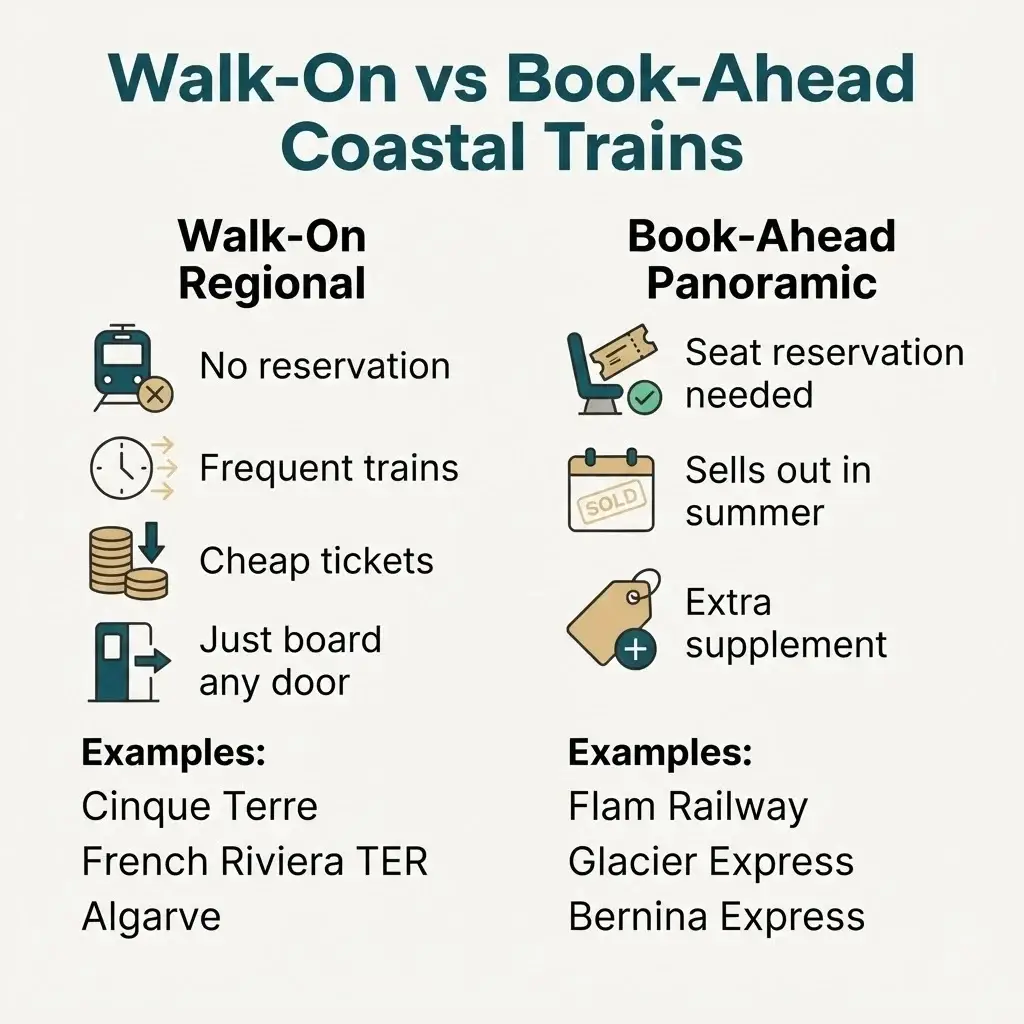
The other thing worth knowing early: coastal routes split into two camps. Some are simple regional trains you walk onto with a cheap ticket, no reservation, no fuss. Others are premium panoramic trains that sell out and need booking. Knowing which is which is honestly half the battle, so I will flag it for every route.
The Cinque Terre Express, Italy: the friendliest place to start
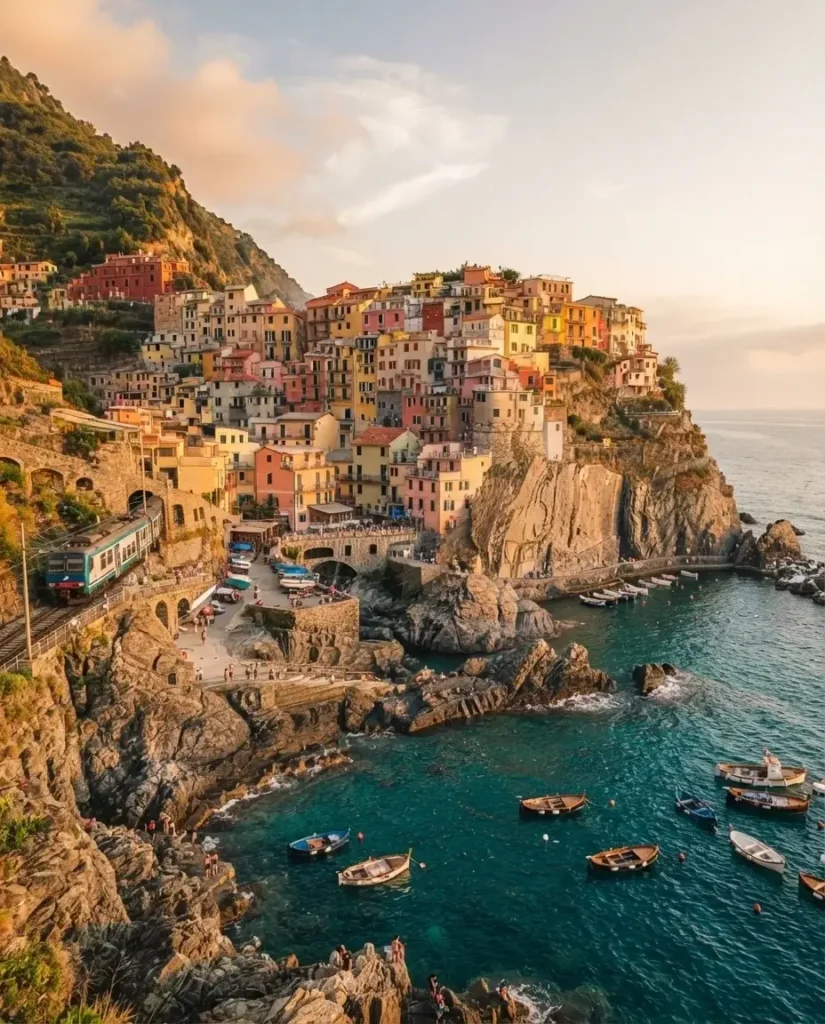
If you are new to all of this, start here. The Cinque Terre Express along Italy’s Ligurian coast is the gentlest, most beginner-friendly coastal train I can point you to. It links five cliffside villages, Riomaggiore, Manarola, Corniglia, Vernazza, and Monterosso, plus Levanto and La Spezia at the ends. The ride between villages is only a few minutes each, often diving through tunnels and then bursting out to a flash of Mediterranean blue.
Here is why it is perfect for a first solo trip. The trains run constantly, roughly every 15 to 20 minutes in peak season, so there is almost no pressure to catch an exact one. You do not need a seat reservation. And the whole thing runs on a simple day card.
That card is the Cinque Terre Treno MS Card sold by Trenitalia, which gives you unlimited regional train hops between Levanto and La Spezia in second class. For up-to-date pricing and what the card covers on the walking trails, I always send people to the official Cinque Terre National Park authority, because the price shifts with the season. As a rough guide, a one day adult card sits around 17 to 20 euro depending on the time of year, with two and three day versions if you want to linger. It also covers the park’s hiking paths, which is a lovely bonus if you want to walk one stretch and train the next.
What to eat: this is Liguria, the home of pesto. Get a paper cone of fried seafood (fritto misto) to eat by the harbor in Vernazza, try farinata, a warm chickpea flatbread, and do not leave without trocoli or focaccia still warm from the oven. Insider tip: the villages are tiny and packed midday. As a solo traveler I love arriving early or staying into the evening, when the day trippers thin out and the light goes golden.
The West Highland Line, Scotland: wild, dramatic, and easier than it looks
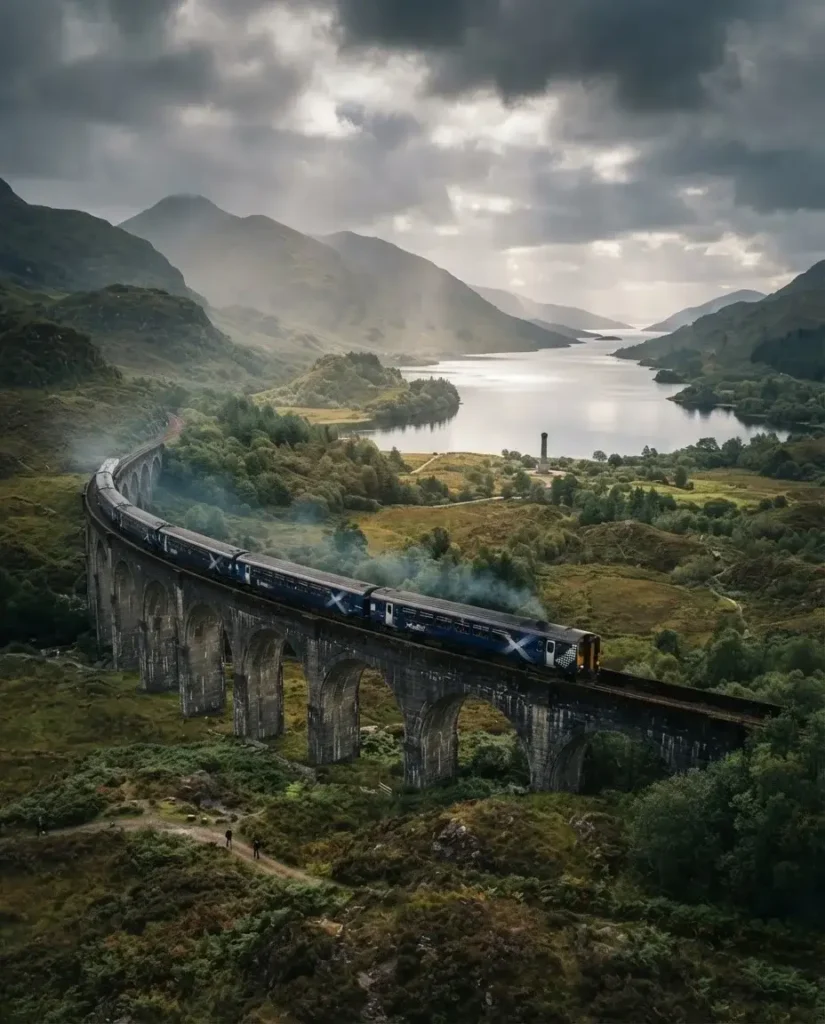
Scotland’s West Highland Line is regularly called one of the most scenic railway journeys in the world, and the coastal payoff comes on the final stretch. The route runs from Glasgow up to Fort William, then on to the little fishing port of Mallaig, and that Fort William to Mallaig leg is where the sea, the islands, and the famous Glenfinnan Viaduct all show up.
Yes, that viaduct is the Harry Potter one. The regular ScotRail service crosses it for the price of a normal ticket, so you do not have to book the pricey steam train to see it. That said, plenty of first-timers get nervous about a route this remote. Do not be. This is a scheduled national rail service with staff on board, and I have found British regional trains to be very manageable solo. Sit on the left side heading toward Mallaig for the best sea and island views.
Because weather in the Highlands is honest about itself, pack layers and do not chase blue skies. Some of my most memorable travel moments have happened in the rain. What to eat: Mallaig is a working fishing harbor, so this is your moment for fresh seafood. Get fish and chips by the water, or find a bowl of Cullen skink, a smoky haddock chowder that tastes exactly right in cool coastal air.
Norway’s Flåm and Bergen Lines: fjords that feel like the sea
Norway is where the line between “coastal” and “fjord” beautifully blurs. The fjords are arms of the sea reaching deep inland, so even though the trains are technically fjord and mountain routes, the water feels oceanic and the drama is off the charts.
The star is the Flåm Railway, or Flåmsbana, a short but jaw-dropping line that climbs from the fjord-side village of Flåm up to Myrdal in about an hour each way, past waterfalls and near-vertical valleys. It connects to the Bergen Line, which many travelers ride between Oslo and Bergen. Unlike the walk-on Italian trains, Flåm is a bookable experience and gets busy, so reserve ahead in summer.
For pulling a full Norway rail trip together, the official Visit Norway train journeys guide is genuinely useful and not trying to upsell you. Norway is not cheap, and I will be honest about that. This is where my old habit of working flexible jobs to save for travel really paid off. If your budget is tight, remember that even one leg of this, done well, is worth more than rushing three destinations you cannot afford to enjoy.
What to eat: keep it simple and local. Grab brown cheese (brunost) on bread, a cinnamon bun (skillingsbolle) in Bergen, and if you are near the coast, fresh shrimp from a harbor stall.
The French Riviera coastal train: glamour on a budget
Here is my favorite well-kept secret for nervous solo travelers who still want that dreamy Mediterranean feeling. The regional TER trains along the Côte d’Azur, now being rebranded as ZOU, run right along the French Riviera coast, linking towns like Cannes, Antibes, Nice, Monaco, and over the Italian border to Ventimiglia.
These are ordinary local trains, which is exactly why I love recommending them. They run frequently, often every 15 to 20 minutes, they need no reservation, and they are cheap. The hop from Nice to Ventimiglia is only around 10 euro and takes roughly 50 minutes, passing Monaco and a string of glittering coves. You get the Riviera fantasy for the price of a sandwich. For schedules and the honest logistics, the official Nice Côte d’Azur tourist office page on regional trains lays it out clearly.
Sit on the right side heading east from Nice for the best sea views. What to eat: in Nice, chase down socca, a warm chickpea pancake sold from street stalls, and a slice of pissaladière, an onion and anchovy tart. This coast is made for a picnic on a train, so grab a baguette and some cheese and treat the journey itself as the destination.
The Devon and Cornwall sea wall, England: the one that runs on the beach
If you want a train that quite literally skims the shoreline, England delivers. The Great Western main line through South Devon runs along the famous sea wall at Dawlish, where the track hugs the beach so closely that on a rough day the waves crash right up against the windows. Continue toward Cornwall and you reach seaside towns like St Ives on branch lines that feel made for slow travel.
This stretch is so exposed to the sea that it has a fascinating recent story. After storms tore the line apart in 2014, a major rebuilding effort followed, and you can read about it on the official Network Rail South West resilience programme page. Knowing that history made the ride mean more to me as a traveler, watching a coastline the engineers fought to keep connected.
Practical notes: these are standard national services, easy to board solo, no reservation needed for the regional legs. Sit on the sea side, which is the left heading toward Penzance along the Dawlish stretch. What to eat: a proper Cornish pasty is non-negotiable, and if you make it to a coastal town in the afternoon, a cream tea with scones, clotted cream, and jam is the correct way to wait for your next train.
Dublin to Rosslare, Ireland: the underrated coastal ride
This one rarely makes the flashy lists, which is exactly why I want you to know about it. The line from Dublin down to Rosslare in the southeast runs along the Irish Sea for long, quiet stretches, past the DART commuter coastline, the seaside town of Bray, and the green edges of Wicklow and Wexford. It is roughly a two and three quarter hour to three hour journey, uses standard tickets with no complicated passes, and an adult single can start from under 10 euro.
You book and check times through the official Irish Rail site, and the whole experience is refreshingly low-stress. This is a great pick if you are building solo confidence, because Ireland is welcoming to solo travelers, English makes logistics easy, and the pace is gentle. What to eat: fresh seafood chowder with brown soda bread is the coastal classic, and a stop in a small-town pub for it is one of the friendliest solo meals you can have anywhere.
Portugal’s Algarve line: sunshine and slow travel
For sun-seekers on a budget, the Linha do Algarve in southern Portugal runs from Lagos in the west across to Vila Real de Santo António near the Spanish border. Be honest with your expectations here: the western part is more countryside than coast. The stretch you want for actual sea views is the eastern side, from Faro through Olhão, Fuzeta, and pretty Tavira, where the line runs close to the lagoons and beaches of the Ria Formosa.
It is inexpensive, walk-on, and unhurried, which suits the Algarve perfectly. What to eat: grilled sardines in summer, cataplana, a shellfish stew cooked in a copper pan, and a warm pastel de nata with your morning coffee before you catch the train.
What about the Glacier Express and Bernina Express?
I promised honesty, so here it is. These two Swiss routes are spectacular but they are Alpine, not coastal, so they are a bonus rather than the main event for a sea-focused trip. They also work very differently from the walk-on regional trains above. The Glacier Express requires a seat reservation supplement of around 54 CHF on top of your ticket, and even the more relaxed Bernina Line asks about 5 CHF per person for a reservation, as the official Rhaetian Railway Bernina reservations page explains. If you dream of pairing mountains and sea, a classic combo is a Swiss panoramic leg followed by a drop down to the Ligurian or Riviera coast. Just budget for the reservations so there are no surprises.
Do you need a rail pass? An honest answer
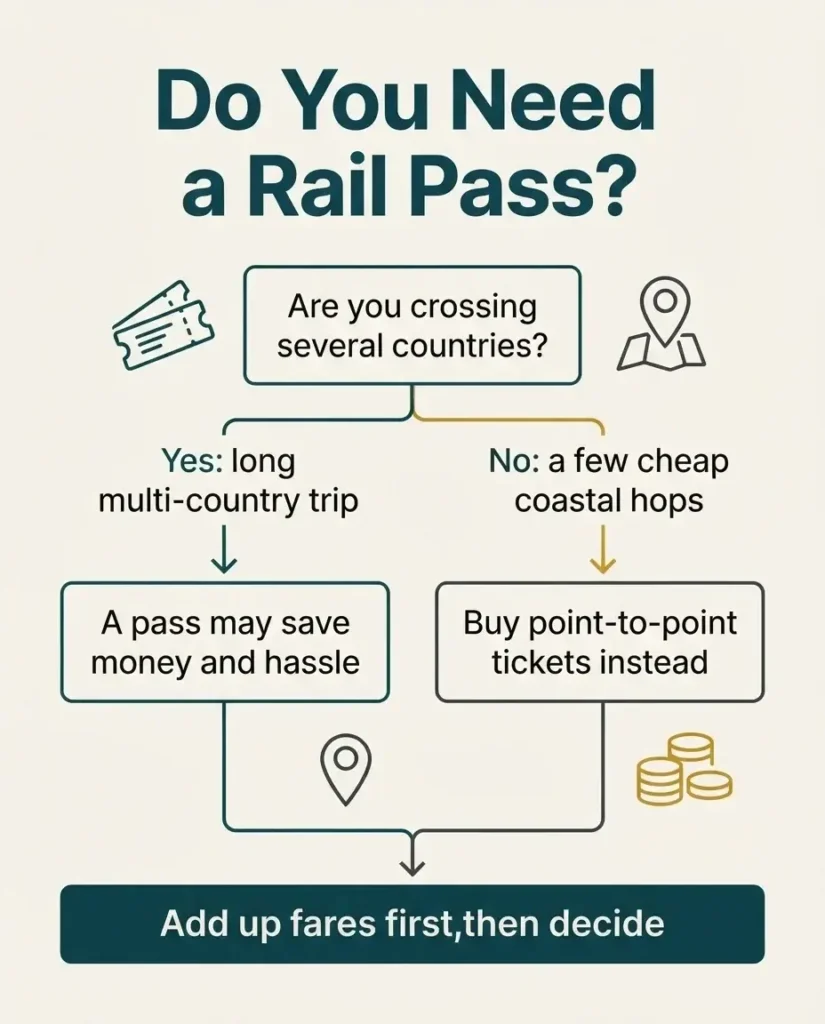
This is the question I get most, and the honest answer is: it depends, and often no. For the cheap regional coastal trains, Cinque Terre, the Riviera TER, the Algarve, Dublin to Rosslare, you usually do not need an Interrail or Eurail pass at all, because point-to-point tickets are so cheap that a pass rarely pays for itself on those alone.
A pass starts making sense when you are stringing together several countries and long-distance trains across a couple of weeks. If that is your plan, it can be great value and reduce decision fatigue. But please do not buy one just because the marketing is pretty. Sketch your rough route first, add up the individual fares, and only then decide. Traveling on a real budget taught me that the smartest trip is the one you can actually afford to enjoy, not the one that looks best on paper.
Solo travel on European coastal trains: what you actually need to know
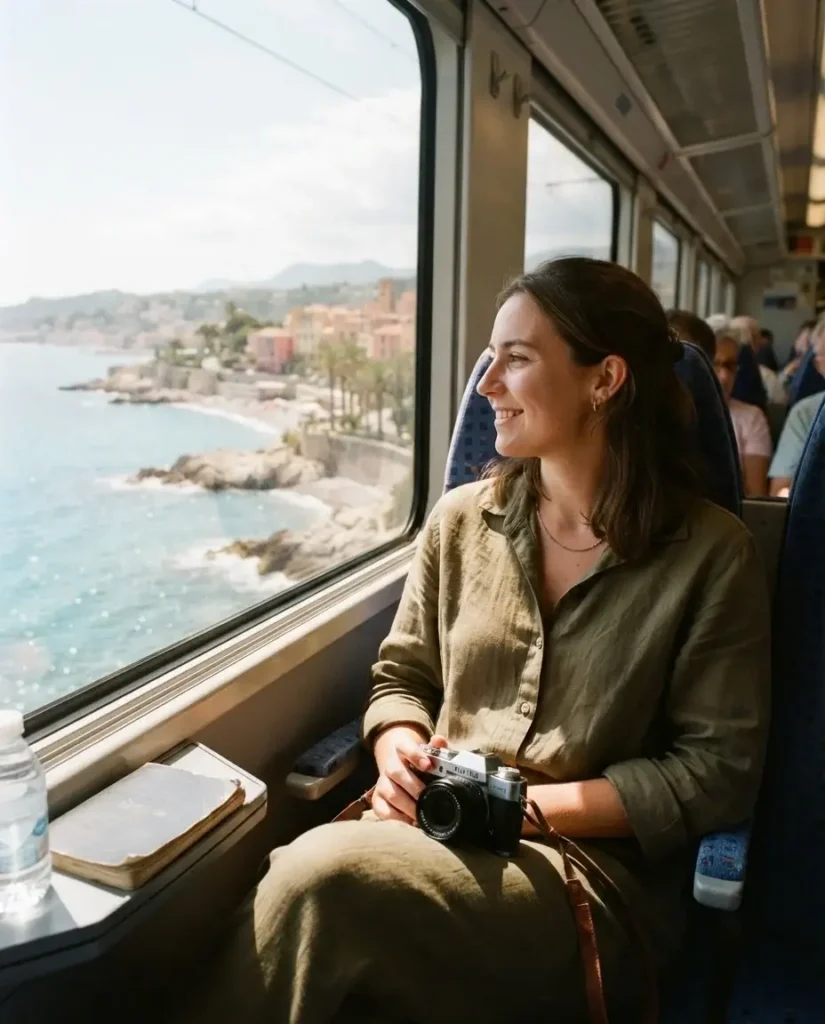
Let me speak directly to the nerves, because I had them too. European regional trains are one of the safest, easiest ways to travel alone. You are in a public space with other passengers and staff, stations are well signed, and most systems have English options on ticket machines and apps.
A few things that genuinely help. Keep your bag light enough to lift onto a rack yourself; a single carry-on backpack changed solo train travel for me. Screenshot your ticket and the timetable in case signal drops in tunnels or the fjords. On regional walk-on trains, just board any open door and find a seat, there is no assigned car unless you booked one. Validate your ticket if the country requires it, which Italy and France sometimes do at platform machines, to avoid a fine. And sit near other people if a late train feels quiet.
The emotional part matters just as much. The first solo train ride feels enormous. By the third, it feels like freedom. That shift, from nervous to capable, is the whole reason I keep encouraging people onto these routes. You are more ready than you think.
When to go, and how to pace it
Summer gives you the warmest sea and the longest light, but also the biggest crowds and highest prices, especially in Cinque Terre and Norway. If you can travel in late spring or early autumn, you get softer crowds, gentler costs, and honestly better photos. Coastal weather is moody by nature, so build in a flexible day and treat a rainy window seat as its own kind of magic rather than a ruined plan.
My biggest pacing advice: pick one or two routes, not six. The reader who tries to ride every train on this list in ten days ends up exhausted and remembers none of it. Slow travel wins every time. Spend an extra night in a fishing village, take the same coastal train twice at different times of day, let a place actually sink in. That is where the growth and the memories live, far more than in any checklist.
You do not need permission to start planning this. You need a route that excites you, a ticket, and a little courage. The sea is already out there waiting past the window. Go meet it.