Best Sleeper Trains in Europe for Budget Travelers (Beginner’s Guide)

The first time I heard about sleeper trains, I did the math in my head and almost couldn’t believe it. You board a train at night, fall asleep in one city, and wake up in another. And the ticket often costs less than a night in a hostel plus a flight would have. When you are watching every euro, that combination feels almost too good to be true.
Here is the honest version, though. Night trains are wonderful, but they are not magic. Some are a genuine bargain and some quietly cost more than a budget flight. The cheapest bed can be a rattly bunk shared with five strangers. And the booking process, with its mandatory reservations and airline-style pricing, trips up almost every first-timer. I want to save you from that confusion.
So let’s walk through this the way I wish someone had walked me through it. Which sleeper trains actually give budget travelers the best value, what a bed really costs in 2026, how to book without overpaying, and how to sleep well and stay comfortable when you are traveling solo. By the end you should feel like the kind of traveler who books the smart, cheap, slightly romantic option and thinks nothing of it.
Why a Night Train Can Be the Cheapest Way to Move Across Europe
The trick to understanding night train value is one simple idea. A sleeper train is transport and accommodation in a single ticket. When I was leaving my old office job and working flexible gigs to fund travel, this was the kind of two-for-one logic that made longer trips possible. Every night I slept on a train was a night I did not pay for a bed somewhere else.
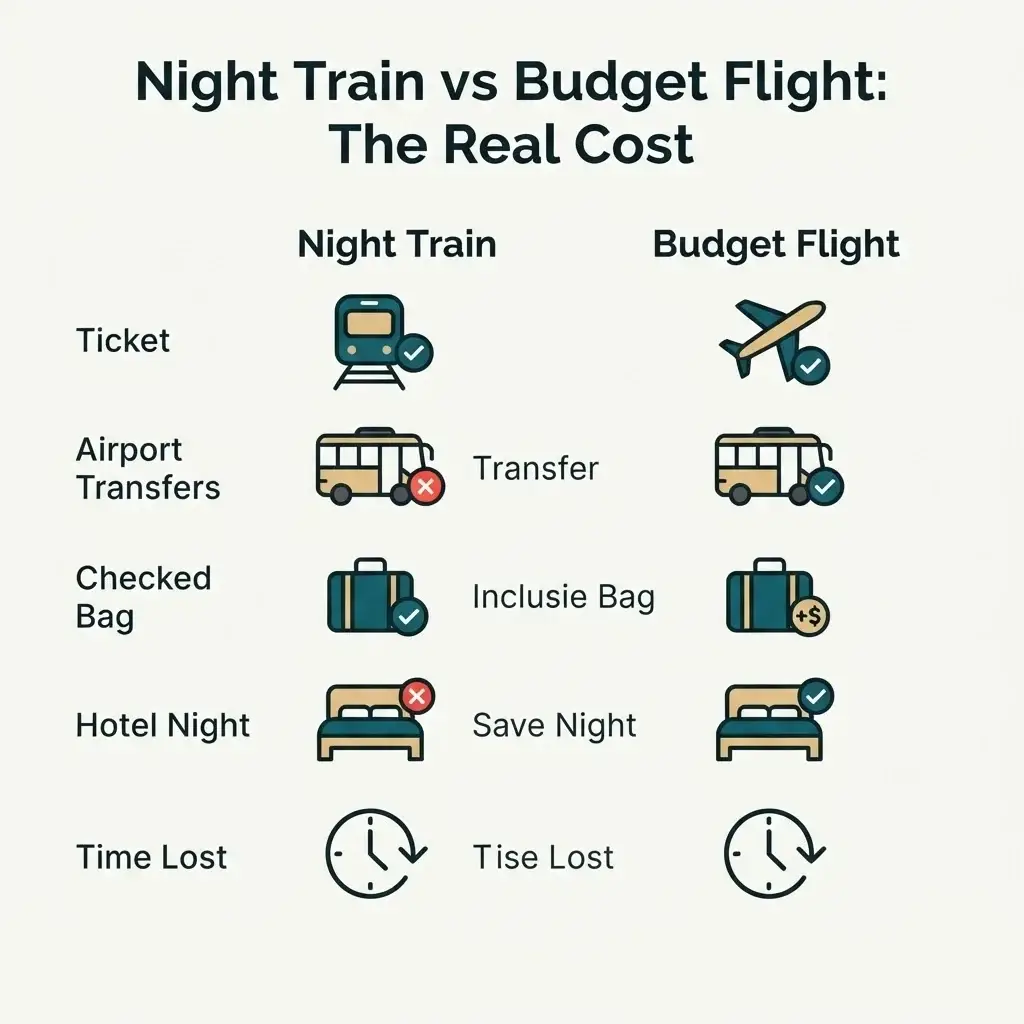
Say you want to get from Brussels to Prague. A cheap flight might look tempting at first glance. But then add the airport transfer at both ends, the checked-bag fee, a night in a hostel because you arrive too late to do anything, and the hours lost waiting in terminals. Suddenly the “cheap” flight is neither cheap nor fast. A night train covers the distance and the bed at once, and drops you in the city center at breakfast time.
That said, budget travel is about being honest with the numbers, not romantic about them. Sometimes a flight genuinely wins. The night train only beats it when you would otherwise be paying for a bed anyway. If you were going to sleep on a friend’s couch for free, the flight might come out ahead. Run the real comparison every time, and count the hidden costs on both sides.
The Best Sleeper Trains in Europe for Budget Travelers
There is no single “best” night train, because best depends on your route and your budget. But a handful of operators consistently deliver strong value, and these are the ones I would point any first-timer toward.
ÖBB Nightjet: The Backbone of the Network
If you only learn one operator name, make it Nightjet. Run by Austria’s national railway, it is the closest thing Europe has to a modern night train network, linking cities like Vienna, Munich, Zurich, Milan, Rome, Hamburg, Amsterdam, and Paris. The route map and live fares live on the official ÖBB Nightjet site, and I would always cross-check prices there before booking anywhere else.
For budget travelers, the key is choosing the right cabin. Nightjet point-to-point fares start around €29.90 for a seat and roughly €49 for a couchette bed in a shared six-berth compartment, though prices climb with demand. The newest Nightjet trains even added tiny private “mini cabins” for solo travelers, which is a lovely touch if you want privacy without paying for a full sleeper.
What to expect on board: a couchette gives you a flat bunk, a pillow, a blanket, and shared space with others. A sleeper cabin adds a proper bed, a washbasin, and sometimes a light breakfast and welcome drink. On a budget, the couchette is the sweet spot.
European Sleeper: The Newcomer Connecting West and East
European Sleeper is a younger, partly crowdfunded operator, and I love that it exists because it proves demand for night trains is roaring back. It now runs overnight between Brussels and Prague, calling at Amsterdam, Berlin, and Dresden, plus a Paris to Berlin line. You can see the current routes on the European Sleeper website, and their fares behave like airline fares, so booking early genuinely matters.
Point-to-point, seats start around €39, couchettes around €69, and a bed in a sleeper cabin from about €109. If you wait until the last minute, expect those numbers to climb fast. This is the single most common budget mistake I see, and I will come back to it.
Snälltåget: Ride It in 2026 While You Still Can
Here is a time-sensitive one. The Swedish operator Snälltåget runs a night train between Berlin, Copenhagen, and Stockholm, and according to the Snälltåget site, that Stockholm connection is scheduled to end around December 2026. So if a Scandinavian night train is on your list, 2026 is essentially your last window. Regular tickets tend to start around €90, which is fair for the distance covered.
Caledonian Sleeper: A Splurge That Can Still Make Budget Sense
The Caledonian Sleeper between London and the Scottish Highlands is a genuine bucket-of-joy experience, and while it is pricier than a couchette on the continent, it can still work on a budget if you think of it as replacing both a flight and a hotel. Per the Caledonian Sleeper site, sole occupancy of a Classic room runs around £165 and a shared twin around £215, so splitting a room with a friend brings the per-person cost right down.
Don’t Forget the National Night Trains
Some of the best value hides inside individual countries. France’s Intercités de Nuit runs from Paris to the Pyrenees and the Alps for very little. Italy’s InterCity Notte covers the whole boot down to Sicily, with couchettes that are a steal. To see the full continent of options in one glance, the advocacy group Back-on-Track maintains an excellent 2026 night train map that plots every line running across Europe. It is the first thing I would open when planning a route.
Understanding the Cabins: Where Your Money Actually Goes
This is where budget travelers win or lose, so let’s slow down. Every night train sells accommodation in tiers, and picking the right tier is the whole game.
A seat is the cheapest option and exactly what it sounds like. You sleep sitting up, or slumped against the window. I would only choose this for a short overnight hop or when I was truly counting coins. It is doable, not comfortable.
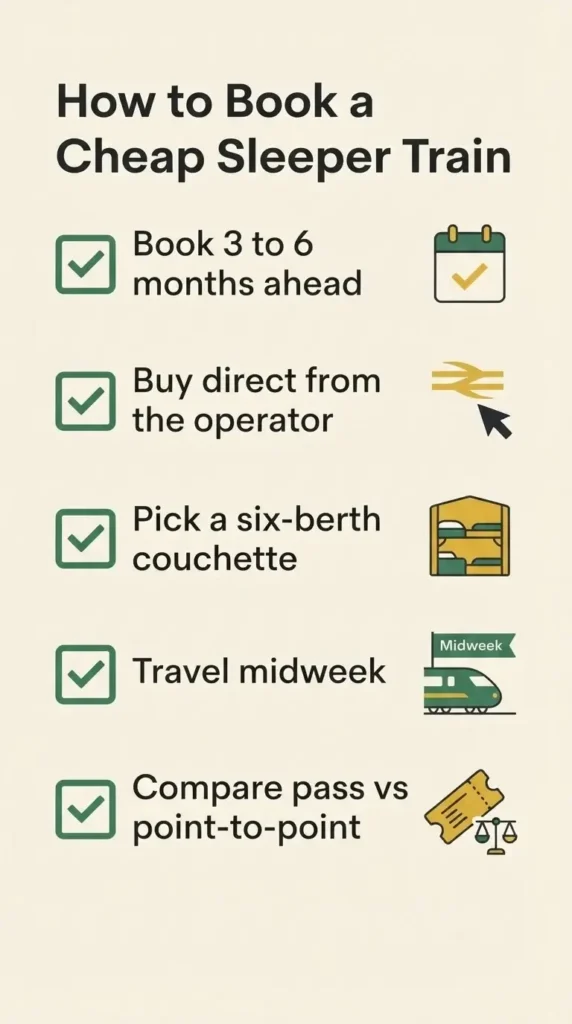
A couchette is the budget traveler’s best friend. It is a simple padded bunk in a shared compartment, usually with four or six berths. You get a pillow, a blanket, and a flat surface to sleep on. Six-berth couchettes are the cheapest; four-berth costs a little more for a little more room. Seat61’s clear explainer on European couchettes and sleepers is the reference I send friends to when they cannot picture the difference, because it lays out exactly what each berth looks like.
A sleeper cabin is the comfortable step up: real beds, a washbasin, more privacy, sometimes an en-suite and breakfast. Lovely, but it can double or triple your cost. For most budget trips I skip it.
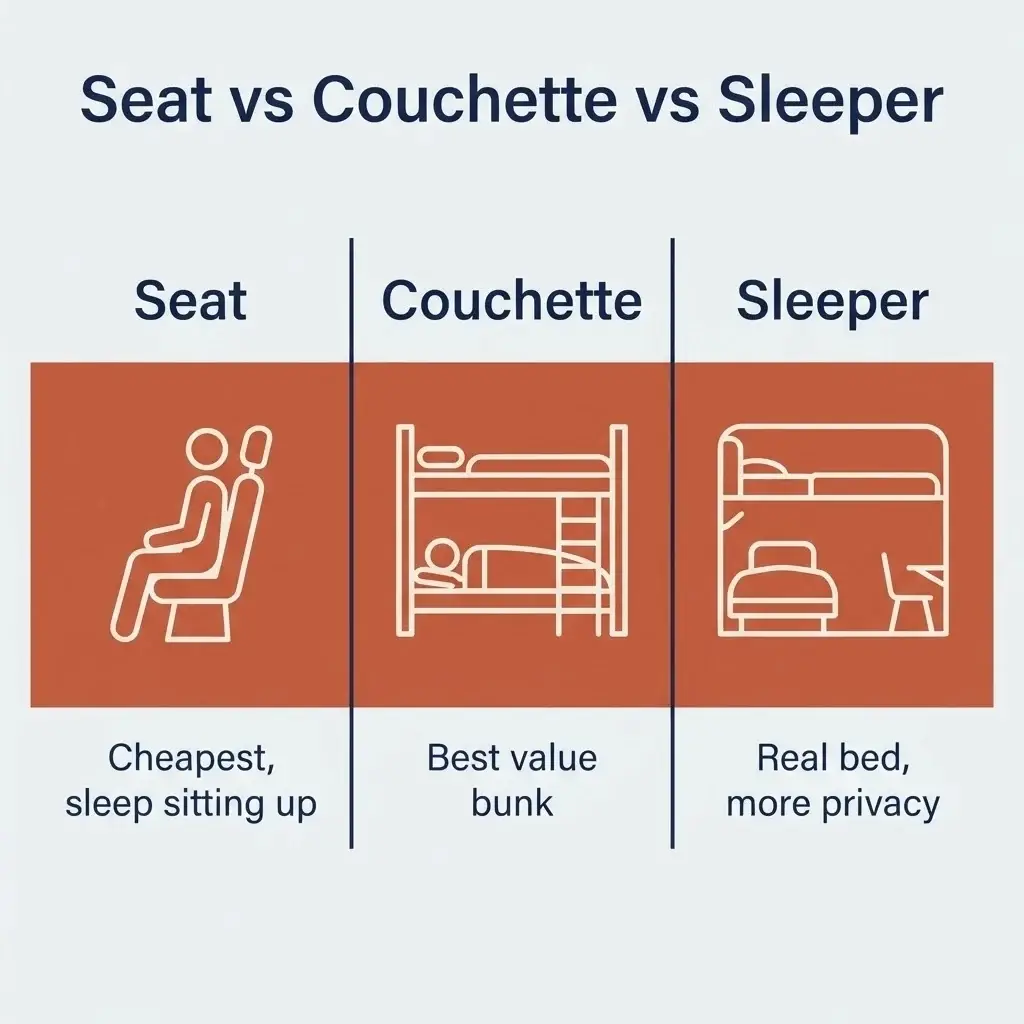
My honest rule of thumb: pick a six-berth couchette by default, upgrade to a four-berth if you want a bit more calm, and only book a full sleeper for a special occasion or a very long haul.
Passes vs Point-to-Point: The Decision That Confuses Everyone
Here is the question I get most. Do I need an Interrail or Eurail pass, or should I just buy tickets one by one?
The catch that surprises people is that a rail pass does not make night trains free. Even with a pass, night trains require a compulsory reservation, and you pay a separate fee for your bed. The full breakdown lives on the official Interrail night train reservation fees page, and as of mid-2026 a Nightjet six-berth couchette reservation on top of a pass starts around €19.90, a four-berth around €29.90, and a three-bed sleeper from about €59.90. European Sleeper passholder fees run from €11 for a budget seat up to well over €100 for a comfortable sleeper.
So the honest answer is: a pass pays off if you are taking many trains across several weeks, because the day-trains you take between night trains are where the pass earns its keep. If you are only doing one or two overnight journeys, buying point-to-point tickets directly from the operator is usually cheaper. Do the math for your specific trip rather than assuming the pass is automatically the budget choice.
How to Book Cheaply: Timing Is Everything
Night train pricing works like airfare. The cheapest beds sell first, and prices rise as the train fills. This one fact matters more than any other budget tip I can give you.
Booking windows typically open a few months ahead, often around three to six months before departure. That is when the cheapest couchettes and seats are sitting there waiting. I would set a reminder for the day booking opens on a popular route, because those lowest fares genuinely vanish. Waiting until the week before is how a €49 couchette quietly becomes a €90 one.
Book directly with the operator whenever you can, rather than through a third-party reseller that tacks on fees. And be flexible with your night if you can, since a Tuesday departure often costs less than a Friday one, exactly like flights.
Is It Safe and Comfortable to Sleep on a Train Solo?
I would not send you off without talking about this honestly, because it is the quiet worry behind a lot of night train searches, especially for women traveling alone.
The reassuring truth is that European night trains are generally very safe. Compartments lock from the inside, conductors check tickets and keep an eye on the carriage, and you are surrounded by ordinary travelers doing exactly what you are doing. From what solo travelers consistently report, the experience feels far more secure than, say, a late-night bus station.
That said, small habits make a big difference. Keep your valuables, passport, and phone in a small bag tucked into your bunk with you, not on the luggage rack. Sleep in comfortable clothes. If you are a woman traveling alone and it is offered, some operators let you request a female-only couchette compartment, which is worth asking about when you book. Trust your instincts, and if a compartment ever feels off, a conductor can usually help you move.
Comfort comes down to preparation. The cheapest berths are firm and a little noisy, so I always pack a few small things that punch above their weight: earplugs, an eye mask, a phone charger, a light layer for warmth, and a bottle of water and some snacks since onboard food is limited and pricey. Do that, and even a budget couchette can give you a genuinely decent night’s sleep.

Which Route Should a First-Timer Pick?
If you are staring at the map feeling overwhelmed, here is how I would choose. Pick a route where you actually want to be in both cities, where the distance is long enough that the train truly replaces a hotel night, and where the timing lets you sleep most of the way rather than arriving at 4 a.m.
For a confidence-building first trip, a well-established Nightjet route through the Alps region is hard to beat, because the network is reliable and the scenery at either end rewards you. If you want the thrill of a brand-new line, European Sleeper’s Brussels to Prague run is a beautiful east-meets-west journey. And if Scandinavia is calling, remember the Snälltåget clock is ticking on that Stockholm connection.
The real secret, the one that took me years and a lot of solo miles to fully believe, is that you do not need to have it all figured out before you go. You need one route, one booking, and a little courage. The confidence comes from doing it, not from waiting until you feel ready. Book the couchette, pack your earplugs, and let Europe rearrange itself outside your window while you sleep. Your next city is closer than you think.