
How to Find Cheap Flights and Hotels Without the Stress

I still remember sitting at my old office desk in New York, twelve browser tabs open, comparing the same flight so many times that the price actually went up while I was staring at it. I wasn’t planning a trip. I was just daydreaming, terrified I’d either overpay or miss some secret deal everyone else seemed to know about.
Here’s what I wish someone had told me back then: finding cheap flights and hotels is not about luck, and it is definitely not about a magic trick. It’s about a handful of habits, a couple of free tools, and knowing when to stop refreshing and just book. Once travel became my full life instead of a nervous fantasy, this stuff stopped being stressful and started being kind of fun.
So let me walk you through exactly how I do it, in the order I actually do it. No fluff, no “ultimate secrets,” just what works.
First, Change How You Think About the Money
Most people treat flights and hotels as two separate battles. I want you to treat them as one budget.
A flight that’s fifty dollars cheaper but lands you at a far-away airport at 1 a.m., forcing a pricey taxi and an extra hotel night, is not cheaper. A gorgeous hotel deal in a neighborhood where you’ll spend a fortune getting around every day is not a deal either. The real number that matters is the total cost of getting there, sleeping, and moving around, not the headline fare.
When I was saving for my early trips, working flexible jobs between adventures, this shift saved me more money than any single hack ever did. I stopped chasing the lowest possible line item and started protecting the total.
The second mindset shift is about flexibility. The more flexible you are on when and where you go, the cheaper everything becomes. If you can move your dates by a few days or stay open about the destination, the whole game changes in your favor. I’ll show you how to use that flexibility in a second.
The Truth About “Best Time to Book” (and the Myth You Can Ignore)
Let’s clear up the two questions everyone asks first.
When should you buy? For domestic flights, aim to book roughly one to two months before your trip. For international flights, give yourself more runway, usually three to five months out. Recent data reported by travel researchers keeps pointing the same direction, and if you want the current numbers, the yearly breakdown at The Points Guy is a genuinely useful place to sanity-check timing before you commit.
When should you fly? Early to midweek, Monday through Wednesday, tends to run around 13% cheaper than leaving on a Friday, Saturday, or Sunday. Tuesday is a perennial favorite for the cheapest departures. If your schedule lets you fly midweek, that one choice alone can save more than most “hacks” combined.
Now the myth. You’ve probably heard that you should search flights in incognito mode so airlines can’t track you and jack up the price. I believed this for years. It isn’t true. Airlines are not quietly raising your fare because you looked twice, and the folks at Thrifty Traveler lay out clearly why this hack doesn’t hold up. Incognito mode is fine for privacy, but it is not a money-saving tool. Prices move because of demand and timing, not because your browser remembered you. Let that worry go. It’s one less thing to stress about.

Set Up Price Alerts and Let the Deals Come to You
This is the single habit that changed everything for me. Instead of obsessively checking fares, I let the tools watch the prices while I live my life.
Start with Google Flights. You punch in your route and dates, then turn on price tracking, and it emails you when the fare moves. If your dates are flexible, you can even track “Any dates” and get told when a route drops. The official Google Flights price tracking guide walks through the toggle in about a minute, and it’s completely free. I keep alerts running on two or three trips I’m daydreaming about at any given time, which means I’m not booking on impulse, I’m booking on information.
If you want a second opinion on timing, apps that predict price movement can help. Hopper is the well-known one, and its price prediction feature tells you whether to buy now or wait. Treat these predictions as a helpful nudge, not gospel. No app can see the future perfectly. But when Google Flights and a prediction tool both say “prices are likely to rise,” I stop hesitating.
Here’s the honest part. Alerts remove the emotion. Half the reason people overpay is panic, that fear that if they don’t book right this second they’ll lose out. When a tool is watching for you, you can breathe.

Be Flexible, and Let the Cheapest Place Choose You
Some of my favorite trips happened because I didn’t care exactly where I was going. I just knew I had time and wanted to be somewhere new.
If that sounds like you, use a “search everywhere” approach. Skyscanner has a feature where you type your home airport and set the destination to “Everywhere,” and it lists every place you can fly, sorted cheapest first. The Skyscanner Everywhere search is a joy for the open-minded. Pick “Cheapest month” too, and you might discover a fare to somewhere you never considered. This is how curious, flexible travelers find those “wait, I can go there for how much?” deals.
A few more flexibility moves that stack up:
Check nearby airports. Flying into a slightly less convenient airport can cut the fare noticeably, just remember my rule about total cost. Factor in how you’ll get from that airport to where you’re staying.
Shift your dates. Even a day or two on either side can change the price a lot. Google Flights shows a calendar and a date grid so you can see the cheap days at a glance.
Travel in shoulder season. That’s the sweet window right before or after peak tourist season. Prices drop, crowds thin, and honestly the experience is often better. I’ve almost always preferred a place in its quieter months.
Know Your Rights Before You Click “Buy”
This section might be the most important one, and almost no travel guide mentions it.
In the United States, airlines are required to let you cancel a ticket within 24 hours of booking for a full refund, or hold the price, as long as you bought it at least seven days before departure. That means when you find a fare you love, you can lock it in and still have a full day to double-check your dates, your plans, and your budget. The official rules are spelled out on the US Department of Transportation refunds page, and I genuinely wish I’d known this on my first nervous booking.
One catch worth remembering: this 24-hour protection applies to airlines directly. It does not automatically apply when you book through a third-party site unless that site chooses to match it. So if the peace of mind matters to you, booking straight with the airline can be the safer move even when a booking site shows a similar price.
It’s also worth knowing what happens if things go wrong later. If an airline cancels your flight or makes a significant schedule change, you’re entitled to a refund no matter what kind of ticket you bought, and the DOT’s Fly Rights overview explains what you can and can’t expect for delays and cancellations. Knowing this ahead of time turns a stressful airport moment into a “I know my options” moment.

The Cheap Fares That Aren’t Actually Cheap
Not every low price is a win, and learning to spot the traps is part of finding real deals.
Basic economy looks fabulous until you read the fine print. It often means no seat selection, strict carry-on limits, no changes, and last to board. If you’re a light-packing solo traveler, sometimes it’s perfectly fine. But if you’ll need a bag or any flexibility, the “cheap” fare can cost more once you add everything back.
Budget airlines work the same way. The base fare is tiny, then you pay for the carry-on, the seat, the printed boarding pass, sometimes even water. Before you celebrate, add up the fees for what you actually need and compare that real total to a normal airline.
Brutal layovers and remote airports are the third trap. A twelve-hour layover or a fare into an airport two hours from the city can eat your savings in hotel nights and transfers. Sometimes the slightly pricier flight is the smarter buy. Again, protect the total.
Now Let’s Talk Hotels
Flights get all the attention, but where you sleep is where flexible travelers save serious money.
My first move is always to compare on a search site to see the range of prices, then check the hotel’s own website directly. Here’s why that matters. Many hotels quietly offer their best rate, or perks like free breakfast or free cancellation, only to people who book direct or join their free loyalty program. Booking sites are great for scanning options fast, but the actual cheapest rate often lives on the hotel’s own page. The honest reality, as several travel researchers have found, is that the cheapest platform genuinely shifts from hotel to hotel, so a two-minute comparison pays off. Check both, then book wherever wins.
Always look for the free-cancellation rate, even if it’s a few dollars more. Plans change, and the flexibility is worth it. I’ve rebooked more than once when a better deal appeared later.
For solo travelers especially, price is only half the decision. The other half is location and safety. A cheaper hotel in a far-out or poorly-connected area can cost you more in taxis and stress, and as a woman traveling alone I will always pay a little more to stay somewhere central, well-reviewed, and easy to get back to at night. Read recent reviews, look at the map, and picture yourself arriving there alone after dark. That mental test has never steered me wrong.
Don’t overlook hostels and guesthouses either. Modern hostels are nothing like the stereotype. Many have private rooms that cost far less than a hotel, and they’re one of the easiest places on earth to meet other solo travelers. Some of the best friendships of my backpacking days across Europe started in a hostel common room over a shared pot of pasta.

A Simple Beginner’s Booking Sequence
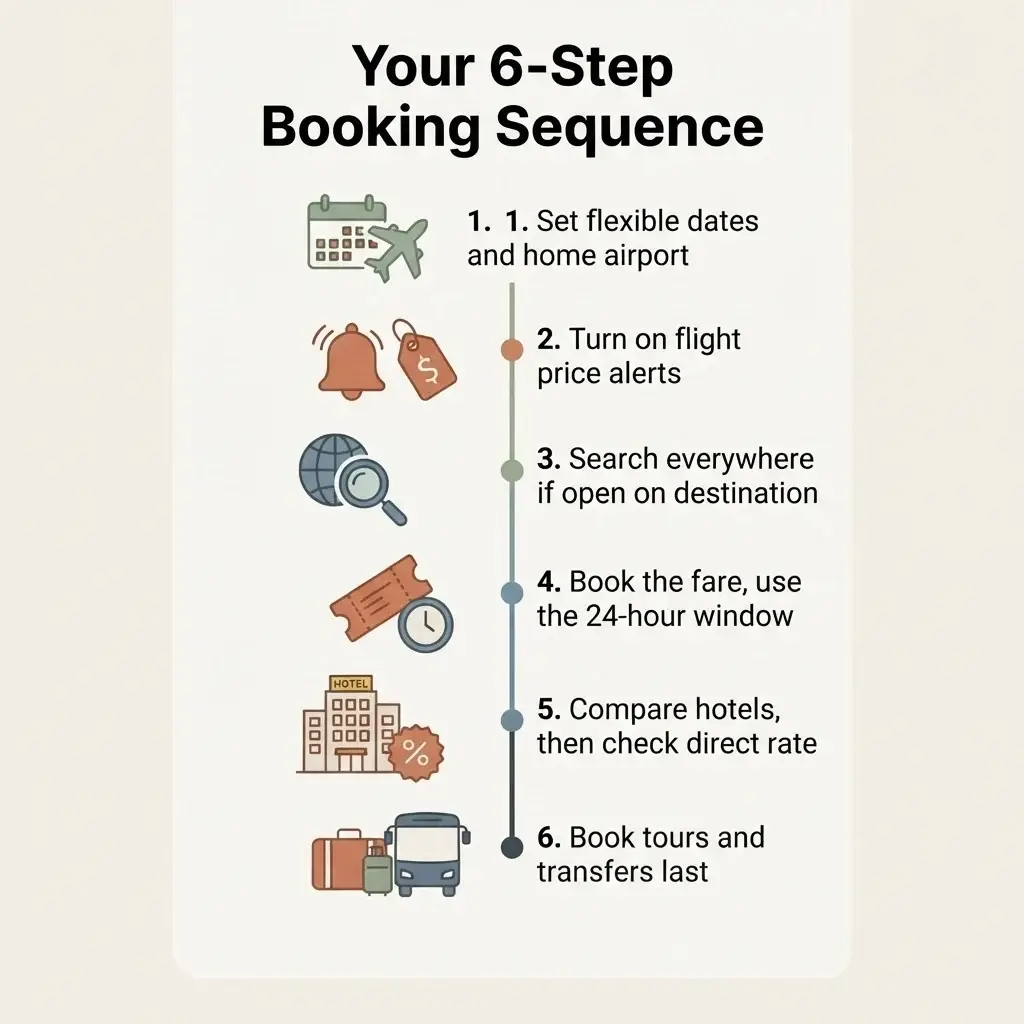
If all of this feels like a lot, here’s the exact order I’d give a nervous first-timer. Follow it top to bottom.
- Set your rough dates and pick a home airport, staying as flexible as you can.
- Turn on Google Flights price alerts for your route so the watching is automatic.
- If you’re open on destination, run a “search everywhere” to spot the cheapest options.
- When a fare hits a price you’re happy with, book it, using the 24-hour cancellation window as your safety net.
- Compare hotels on a search site, then check the hotel’s direct rate, and choose the free-cancellation option in a safe, central spot.
- Book any tours or transfers last, once your flight and hotel are locked.
That’s it. Six steps, mostly free tools, no magic required.
What About Points and Rewards?
You don’t need to master travel points to travel affordably. I want to be clear about that, because the internet makes it sound like everyone’s flying free on secret miles. Most of us aren’t, and you can find great deals with cash alone.
That said, if you travel from the US even a few times a year and you pay off your balance every month, a beginner travel rewards card with a sign-up bonus can genuinely offset a flight or a few hotel nights. The category is competitive, and current beginner-friendly options are rounded up well by NerdWallet if you want to compare. Just promise me you’ll never carry a balance chasing points. Interest wipes out any reward instantly, and that’s the opposite of saving money.
One Last Thing: Stop Waiting to Feel “Ready”
I’ll be honest with you, the way I always try to be. The biggest thing standing between most people and a cheaper trip isn’t money. It’s hesitation. We wait for the perfect fare, the perfect week, the perfect version of ourselves who has it all figured out.
That person doesn’t arrive. What arrives is a decent fare, a free weekend, and a little courage. Everything in this guide exists to lower the risk of clicking “book” so that you finally do. The alerts, the 24-hour rule, the free-cancellation rooms, they’re all just guardrails that let you say yes.
You don’t need to be an expert. You need a route, a date you can bend a little, and the willingness to begin. The savings are real, but the trip is the point. Go find it.