
Travel Booking Hacks to Save Money and Book With Confidence

The first time I ever booked a flight completely on my own, I sat with my cursor hovering over the purchase button for what felt like an hour. I was still working a job I didn’t love back in New York, saving up coins for a trip that felt way too big for someone like me. I kept refreshing the page. I kept thinking the price would drop if I just waited one more day. I was scared of two things at once: paying too much, and messing it up in some way I couldn’t take back.
If that feeling sounds familiar, you’re exactly who I’m writing this for.
Here’s what I’ve learned after years of booking my own trips, from backpacking across Europe solo to flying out to teach English in Thailand. Saving money on travel is real and very doable. But most of the “hacks” floating around online are either outdated, half-true, or written for people chasing luxury upgrades rather than regular travelers trying to make a dream fit a budget. So let’s clear the fog. I want you to finish this article knowing not just how to spend less, but how to click “book” without that knot in your stomach.
Let’s kill the biggest myth first: there is no magic day to book
You’ve heard it. Tuesday at midnight. Wednesday afternoon. Some secret window when airlines “release cheap seats.” I believed it too for years, and I wasted a lot of energy waiting for a day that doesn’t exist.
Flight prices change constantly, all day, every day, based on demand and how many seats are left. Airlines don’t restock deals like a grocery store putting out fresh bread on the same morning each week. According to the data that finance site NerdWallet pulled from Expedia’s 2026 Air Hacks Report, the day you book matters far less than how far ahead you book. That single sentence saved me so much stress. Stop hunting for the perfect day of the week. Start thinking about your booking window instead.

What the data does show is more useful. For cash fares, the general sweet spot is roughly one to three months ahead for domestic trips, and two to eight months ahead for international ones. Book too early and you may pay a premium. Wait until the last two weeks and you’ll usually get punished with high prices. There’s a comfortable middle, and that’s where you want to live.
When you fly matters more than most people realize
If you have any flexibility at all, this is where real money hides.
The same 2026 data ranks the days of the week to actually fly. Friday tends to be the cheapest departure day overall, while Sunday and Monday are the most expensive. Tuesday is often the cheapest by raw average cost, coming in around 14% under a Sunday departure. That’s not pocket change. On a bigger international ticket, shifting your departure by a day or two can be the difference of a hundred dollars or more.
Months matter too. August, September, and January tend to be the cheapest months to fly, because demand drops after the summer rush and the holidays. December, June, and July are the priciest, for the obvious reasons. This is the whole logic behind shoulder season, the stretch just before or after peak, when I do most of my own trips. You get softer prices, thinner crowds, and a version of a place that feels more like real life than a postcard. I hiked in China well outside peak season, and honestly, having the trails quieter made the whole experience better, not worse.
The move here is simple. Before you commit to exact dates, play with them. Slide your trip a few days earlier or later and watch what happens to the price.
The tools that do the waiting for you
You don’t need to check flight prices every morning like it’s your job. I used to do that, and it just made me anxious.
Instead, set a price alert and let the tool watch for you. Google Flights is my starting point for almost every trip, mostly because of two features. First, the calendar view shows you prices across a whole month at a glance, so you can spot the cheap dates instantly. Second, if you leave the destination blank and just enter your home airport, it’ll show you where you can afford to go, which is genuinely one of my favorite ways to daydream on a budget. Skyscanner, Kayak, and Hopper all offer similar alerts, so pick whichever feels friendliest and let it ping you when a price drops.

One caution I want to save you from: those tools are for research and comparison. Once you’ve found your fare, there’s a real argument for booking directly with the airline rather than through a third-party site, and I’ll explain exactly why in a moment, because it affects your safety net if anything goes wrong.
The incognito “hack” you can stop bothering with
Let me put this one to rest, because it comes up constantly. The idea that airlines spy on your cookies and jack up the price because you searched twice, and that browsing in incognito mode gets you a secret discount, is mostly a myth. Prices fluctuate on their own from ordinary supply and demand, not because a website is personally punishing you for looking. Do it if it makes you feel better, it costs nothing, but don’t count on it, and definitely don’t let it become another reason to delay booking. I’d rather you spend that energy on flexible dates, which actually work.
Your secret weapon for booking without fear: the 24-hour rule
This is the single fact that changed how I book, and hardly anyone talks about it.
In the United States, airlines are legally required to let you cancel a booking for a full refund within 24 hours, as long as you booked at least seven days before departure. The US Department of Transportation lays this out plainly on its official refunds page, and it also confirms that credit-card refunds have to be processed within seven business days. Read that again if you’re a nervous booker like I was. You are not locked in the instant you click. You have a full day to breathe, double-check your dates, and confirm you spelled your name right.
This is exactly why the fear of “messing it up” shouldn’t freeze you. Book the good fare when you see it, then use your 24-hour window to sanity-check everything. It flips the whole emotional equation. Instead of “what if I’m wrong,” it becomes “I can fix this if I’m wrong.”
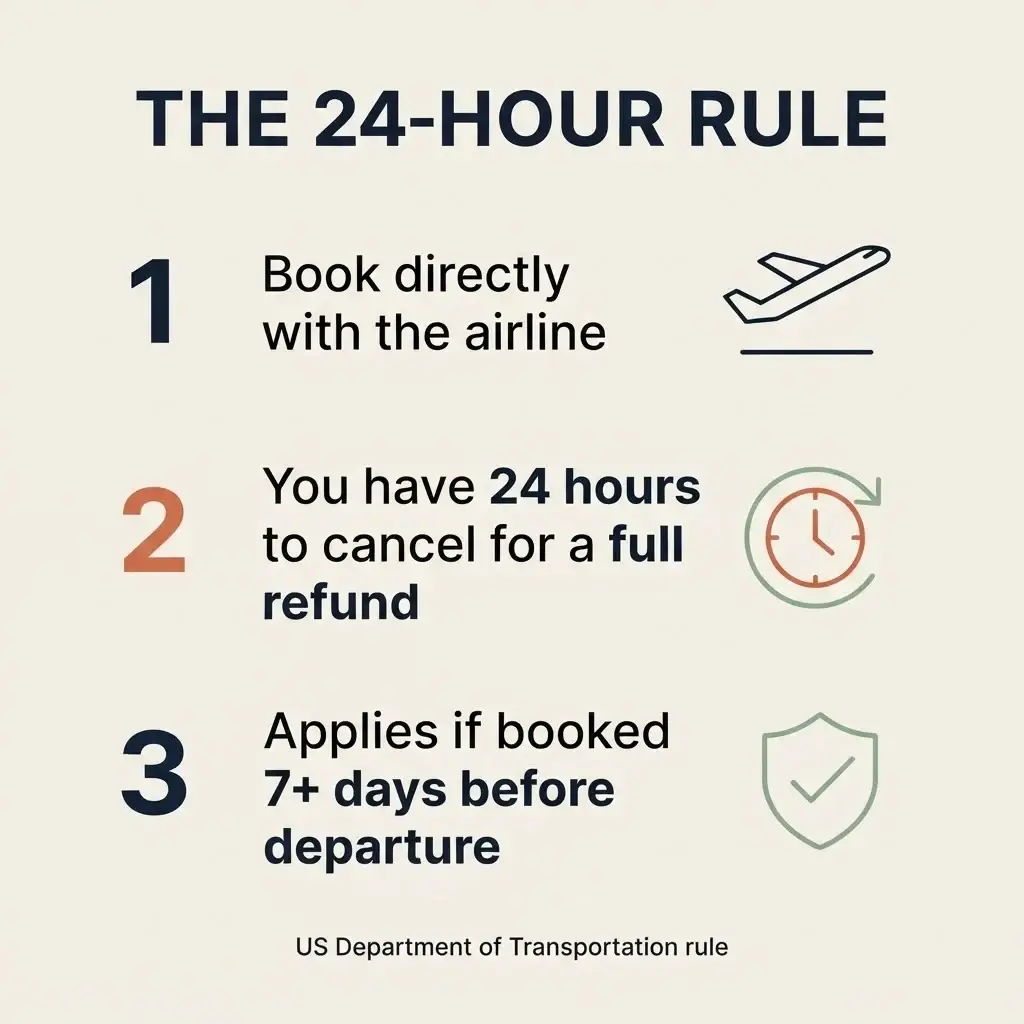
One important detail: this protection applies to bookings made directly with the airline. It does not legally cover tickets bought through third-party sites, though some of them choose to offer a similar courtesy. That’s a big part of why I lean toward booking direct.
Book direct, and know your rights
When something goes sideways, and travel this eventually does, being the airline’s direct customer makes your life so much easier. If a flight gets cancelled or seriously delayed and you choose not to travel, you’re entitled to a refund. If you book through a middleman, you often have to chase them first, and they don’t always move fast.
It’s worth spending ten quiet minutes knowing what you’re actually owed before a trip. The DOT keeps a plain-language guide to air travelers’ rights that I think every traveler should skim once. And if an airline ever refuses a refund you’re clearly entitled to, you can file a complaint directly through the government’s air travel complaint portal. I know that’s not the fun, glamorous part of travel. But knowing your rights is its own kind of confidence, and confidence is the whole point.
The trendy hack I want you to be careful with
You may have heard of “skiplagging,” or hidden-city ticketing. The idea is you book a flight with a layover in the city you actually want, then just walk out at the layover and skip the final leg, because that routing was somehow cheaper than a direct ticket.
I’m not going to pretend it doesn’t sometimes save money. But I’d be doing you a disservice if I sold it as a free lunch. It’s not illegal, but airlines strongly dislike it and are within their rights to push back. They can cancel your return leg, penalize your frequent flyer account, or even ban you. It made big news when American Airlines won a multimillion-dollar jury verdict against the site Skiplagged. It also falls apart if you checked a bag, since your luggage flies to the final destination without you.
My honest take: for a new traveler trying to build confidence, this is a headache you don’t need. There are gentler ways to save that won’t risk your account or your peace of mind.
Hotels and stays: where quiet money leaks out
Flights get all the attention, but I’ve probably saved more over the years by being smart about where I sleep.
A few things that reliably work for me. Compare on the big platforms to learn the going rate, then check the hotel’s own website, because direct rates sometimes beat the third-party price or come with perks like free breakfast or free cancellation. Filter hard for free cancellation whenever you book early, so a shift in plans doesn’t cost you. And widen your idea of “a place to stay.” When I lived with a family in Ghana, that homestay taught me something no hotel ever could, and it cost a fraction of one. Guesthouses, hostels with private rooms, and homestays aren’t just cheaper. They’re often where the real cultural connection happens, which is the whole reason I travel in the first place.
For longer or slower trips, look at weekly and monthly rates, which are frequently discounted in ways nightly bookings never advertise. Slow travel isn’t only richer. It’s usually cheaper per day.
Pack smart so you don’t pay to check a bag
This one is unglamorous and saves real money on nearly every trip. Airline bag fees add up fast, and the cheapest way around them is to travel with a carry-on.
The trick is knowing what you can actually bring in the cabin so you’re not surprised at security. The TSA keeps a searchable what-can-I-bring list that I still check before packing anything I’m unsure about, especially liquids and anything electronic. Fewer surprises at the airport means a calmer, cheaper trip. When I backpacked across Europe, learning to live out of one bag didn’t just save me money on fees, it made every train connection and every last-minute plan change dramatically easier.

Points and rewards, the beginner-friendly version
I know rewards cards can feel like a whole intimidating universe, so let me keep this simple and honest. If you already pay your bills and can pay a card off in full every month, a travel rewards card with a solid welcome bonus can effectively hand you a free flight for spending you were doing anyway. That’s it. That’s the core magic.
What I don’t want is for you to chase points into debt, because interest wipes out every reward instantly. Rewards are a tool for people who already have their spending under control, not a shortcut around a tight budget. If that’s you, great, start with one beginner-friendly card and learn it well. If it’s not you yet, skip this entirely and lean on the flexible-date and shoulder-season tricks above. Those cost nothing and work for everyone.
Don’t let connectivity quietly wreck your budget
Here’s a money leak nobody warns first-timers about: coming home to a phone bill full of roaming charges. It stings, and it’s completely avoidable.
Before I land somewhere new, I sort out data ahead of time, usually with a travel eSIM I can set up from home in a few minutes, or a cheap local SIM once I arrive. A travel eSIM often costs a small fraction of what your home carrier charges for international roaming, and having maps and translation in your pocket the moment you step off the plane is a genuine confidence boost when you’re navigating a new city alone. Sort this out before departure so you’re not standing in an unfamiliar airport with no data, making a panicked expensive decision.
The mindset that ties it all together
If you take one thing from all of this, let it be this: saving money on travel isn’t about being the sharpest deal hunter alive. It’s about a handful of steady habits. Be flexible with your dates. Book within the sweet spot, not too early, not too late. Let alerts do your waiting. Book direct so you’re protected. Know the 24-hour rule so you can commit without fear. Pack light. And handle the small stuff, like data and cancellation policies, before they become expensive surprises.

None of these require you to be rich, experienced, or fearless. They just require you to start. That cursor hovering over the purchase button, the one I froze on years ago, isn’t a trap. With these habits, it’s a doorway. The perfect moment to book was never going to arrive on its own. So find your fair fare, use your 24 hours, and go build the trip you keep daydreaming about. I promise the version of you on the other side of that click is really glad you did.