Free Hotel Nights Are Real: The Cards That Make It Happen

Let me be honest with you about something. For a long time, I thought “free hotel nights from credit cards” was the kind of thing that only happened for people who traveled constantly for work, racked up corporate expenses, and had a dedicated points accountant on speed dial. Not for someone like me, who left an office job, picked up flexible work, and built a travel life from scratch on a modest budget.
Then I actually looked into it. And I realized the math makes sense for regular travelers too, especially solo travelers who are already paying for every expense out of pocket and have every reason to find legitimate ways to reduce accommodation costs.

This is not a post telling you that travel is free and money doesn’t exist. It is a genuinely practical guide to understanding which credit cards offer free hotel stays, how those free nights actually work, and how to figure out which card, if any, fits the way you travel. No hype, no promises I can’t back up.
First: What Does “Free Hotel Night” Actually Mean?
Before comparing any cards, it helps to understand the two different ways credit cards deliver free hotel nights, because they work very differently.
The first is a free night certificate. This is a voucher, essentially, that some hotel credit cards issue automatically every year after you pay your annual fee. You use it to book one night at a qualifying property, usually with some category or point-value cap. The night itself costs you nothing beyond what you already paid for the card.
The second is points redemption. You earn points through spending, and you can exchange those points for hotel nights. The catch is that points values vary enormously across programs, and it takes real spending to accumulate enough points for a meaningful stay. As a reference point, free hotel nights across major programs can require anywhere from 5,000 to over 95,000 points depending on the brand, the property, and the time of year, according to Bankrate’s breakdown of how many points you need for a free hotel night.
Most of the cards covered in this guide offer both: an annual free night certificate (which is the guaranteed, predictable benefit) plus points you accumulate on top. The certificate is what makes the annual fee calculation simple. If the free night is worth more than the annual fee, you are already ahead before you earn a single point.
Now let’s look at the programs and the specific cards worth knowing.

The Big Four Hotel Loyalty Programs (And Why They Matter)
Hotel credit cards are almost always tied to a specific loyalty program. Which card you get determines which hotel brand’s ecosystem you are in. So before picking a card, it helps to know the major programs.
Hyatt (World of Hyatt): Smaller network than Marriott or Hilton, but the points are generally considered more valuable, and the program is beloved by travel enthusiasts for its straightforward award chart and genuine value at the top end. Hyatt properties range from boutique to high-end, and their Category 1-4 range includes some genuinely beautiful hotels globally.
Marriott Bonvoy: The largest hotel portfolio in the world, with over 30 brands and 9,000+ properties. This is the program that gives you the widest geographical coverage. Brands include everything from Courtyard to W Hotels to Ritz-Carlton. More properties usually means more flexibility, but the program moved away from a fixed award chart, which makes it harder to predict redemption values.
Hilton Honors: Massive global footprint and accessible for everyday travelers. Hilton points are generally earned more easily but tend to be worth slightly less individually. The big upside is that the Hilton Aspire card’s free night certificate carries no category cap, meaning you can use it at any participating Hilton property.
IHG One Rewards: Covers brands like Holiday Inn, Kimpton, InterContinental, and Crowne Plaza, with over 6,000 properties. A solid option for travelers who prioritize budget-friendly stays and like the idea of staying in the same ecosystem across different trip types.
The Cards Worth Knowing About
World of Hyatt Credit Card
Annual fee: $95. This card earns you one free night at any Category 1-4 Hyatt property each anniversary year, automatically issued after you renew. Spend $15,000 in a calendar year and you can earn a second free night certificate. The World of Hyatt Credit Card is widely regarded as one of the best value hotel cards at the $95 price point.
The honest caveat: Category 1-4 excludes some of Hyatt’s most luxurious or most popular properties (Park Hyatt, for example, often sits at Category 7 or 8). But Category 1-4 still includes hundreds of genuinely appealing hotels globally, including Hyatt Place and Hyatt House properties in cities many solo travelers actually visit. The $95 annual fee is almost laughably easy to justify. A single night at even a mid-range city hotel rarely costs less than $95 in most destinations.

Marriott Bonvoy Boundless Credit Card
Annual fee: $95. One free night certificate each anniversary year, redeemable at properties with a redemption level up to 35,000 points. NerdWallet named this their Best Hotel Credit Card of 2026, largely because Marriott’s enormous network makes the certificate easy to use. With over 9,000 properties across more than 30 brands globally, the chance of finding a property you actually want to stay at with that certificate is very high. You can also review the full range of Marriott’s card options directly on Marriott’s official credit cards page.
The honest caveat: Since Marriott moved to dynamic pricing without a fixed award chart, the value of that 35,000-point certificate fluctuates depending on when and where you want to book. A 35,000-point night at a Fairfield by Marriott in a mid-size city might cost you next to nothing in real dollars. At a Westin during peak season in a major city, that ceiling might not stretch far enough for the property you actually want.
IHG One Rewards Premier Credit Card
Annual fee: $99. A free night certificate each anniversary year, redeemable at properties up to 40,000 points. What makes this card slightly different is the ability to top up: if your target property costs 55,000 points, you can use the 40,000-point certificate and add 15,000 of your own points to make it work. There’s also an excellent deal built in: book four consecutive nights using points and get the fourth night free. You can review the full details on the IHG One Rewards Premier Credit Card page.
For solo travelers who tend to stay in mid-range, reliable hotels (and IHG’s Holiday Inn and Kimpton brands serve that traveler well), this card delivers solid value with a manageable fee.
Hilton Honors American Express Aspire Card
Annual fee: $550. This sits in a different tier entirely. The reason it belongs on this list is the free night certificate, which comes with no category cap, meaning you can use it at any participating Hilton property regardless of how expensive it is. The Hilton portfolio includes properties across the entire spectrum, from Hampton Inn to Conrad to Waldorf Astoria. That flexibility, combined with a $200 semi-annual Hilton resort credit and other perks, is what justifies the fee for frequent Hilton guests. You can see the full breakdown of Hilton’s card options on the Hilton Honors official credit cards page.
This is not the right entry point if you are new to hotel credit cards or if you travel two or three times a year. But for the traveler who already books Hilton regularly, the math can absolutely work out. You essentially get an uncapped free night you can use at a $400 property, which alone might offset the fee.
Hilton Honors American Express Surpass Card
Annual fee: $0 intro for the first year, then $150. Unlike the Aspire, this card does not give you a free night automatically. You earn it by spending $15,000 on the card in a calendar year. That spend threshold is meaningful for many travelers. If you are not using this as your primary everyday card, reaching $15,000 in a year takes real effort.
Marriott Bonvoy Brilliant American Express Card
Annual fee: $650. This is the premium Marriott card, offering an annual free night worth up to 85,000 points (which reaches much further into Marriott’s portfolio than the Boundless certificate), automatic Platinum Elite status, and up to $300 in annual restaurant credits worldwide. For a serious Marriott loyalist, the value stacks up. For a first-timer, start lower.
Hotel Cards vs. General Travel Cards: A Distinction That Matters
Here is something the comparison roundups don’t explain well enough: if you travel across many different destinations and don’t consistently stay within one hotel brand, a general travel card may actually serve you better than a hotel-specific card.
Cards like the Chase Sapphire Preferred or Capital One Venture earn flexible points you can transfer to multiple hotel and airline programs or redeem directly for travel. Chase, for example, allows you to transfer Ultimate Rewards points to World of Hyatt at a 4:3 ratio (as of June 2026), which can be a smart way to top up a Hyatt balance for a specific redemption.
The tradeoff is that general travel cards rarely include automatic annual free night certificates. You are building toward free nights through point accumulation rather than receiving a guaranteed certificate each year. For a planner who is disciplined about where they earn and redeem, it works well. For someone who wants the simplicity of “pay my annual fee and get a free night,” a hotel-branded card is cleaner.
What Nobody Warns You About (The Real Pitfalls)
If you spend time in Reddit travel communities or finance forums, you will hear people frustrated with reward programs more often than the glossy card comparison sites suggest. The US Consumer Financial Protection Bureau published a detailed Issue Spotlight on credit card rewards identifying four recurring problems consumers experience: unexpected promotional conditions, devaluation of points, redemption problems, and flat-out revocation of earned rewards.
That does not mean these programs are not worth using. They absolutely are, in most cases. But it does mean you need to go in with open eyes.
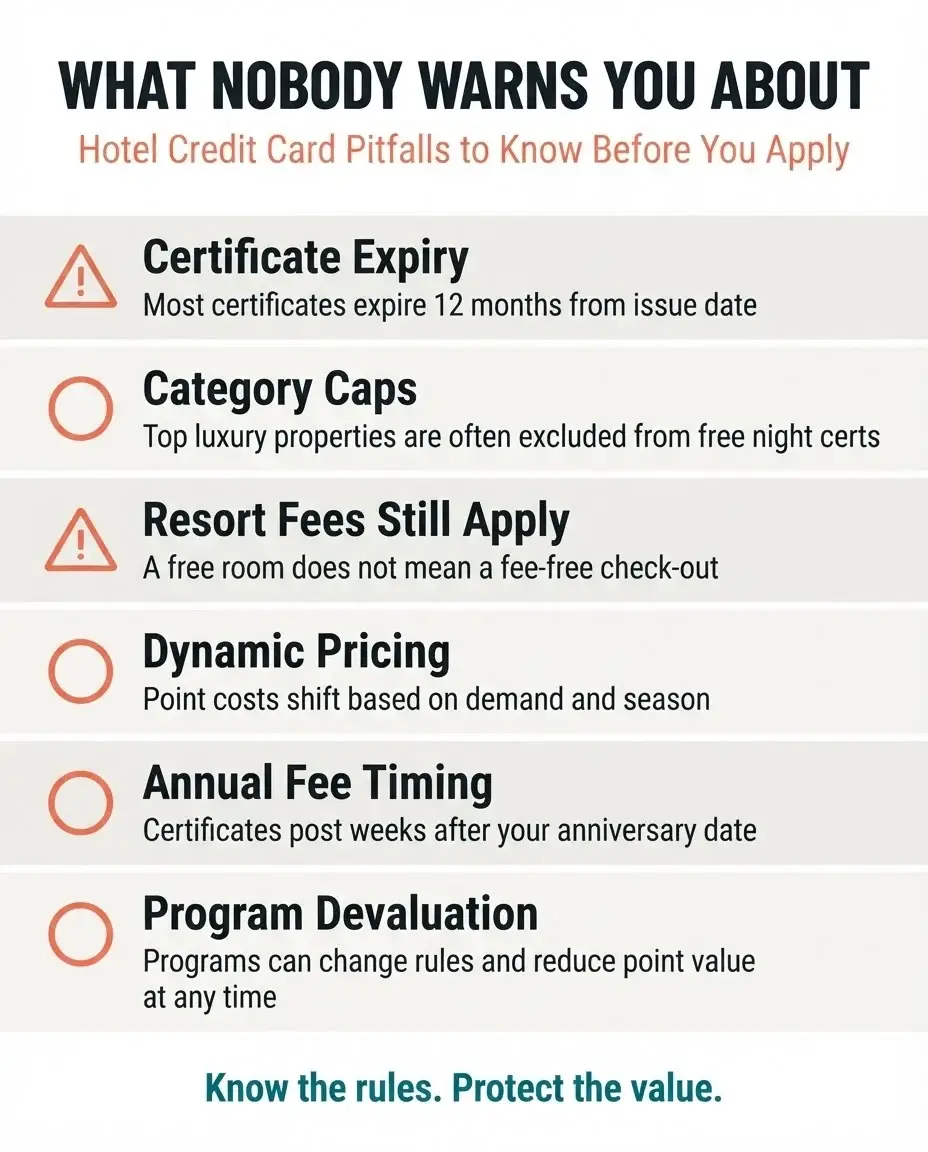
Certificate expiry. Most free night certificates are valid for 12 months from issuance. If you pay your annual fee in March and receive your certificate in April, you typically need to use it by the following April. Life gets busy. Travel plans change. More people let these expire than the card companies would like you to know.
Category caps are real limitations. A Hyatt Category 1-4 certificate will not get you into a Park Hyatt in Tokyo or Paris. A Marriott 35,000-point certificate may not stretch to a full-service urban Marriott during a peak weekend. Understanding the ceiling of your certificate before you commit to a card matters.
Resort fees still apply. A free night certificate covers the room rate. At many resort properties, resort fees of $30 to $75 per night are charged separately and are not waived by the certificate. Always check before booking.
Dynamic pricing is now the norm. Marriott abandoned its fixed award chart. Without a chart, the point cost of a room can shift based on demand, season, and availability, which makes it harder to plan redemptions predictably.
Annual fee timing. Your free night certificate posts to your account after your anniversary date, and usually a few weeks after that. If you are counting on using it for an upcoming trip, confirm the timing before you book.
How to Decide Which Card (If Any) Is Right for You
Start with three honest questions.

First, which hotel brand do you actually stay with? Or do you stay wherever the location and price makes sense? If you have genuine loyalty to one brand, a co-branded card in that ecosystem makes sense. If you pick hotels pragmatically, a general travel card with transfer flexibility may serve you better.
Second, will you realistically use the free night certificate in a 12-month window? If your travel plans are unpredictable or infrequent, a certificate that expires unused is money wasted. Some people travel in bursts and a 12-month window is plenty. Others get life in the way.
Third, can you pay the balance in full each month? This applies to any credit card, but it bears repeating especially here. The interest charges on a balance more than wipe out the value of any free night benefit. These cards only make mathematical sense for people who pay the statement balance in full every month.
If all three answers are yes, the $95 annual fee tier (Hyatt, Marriott Boundless, IHG Premier) is a genuinely smart place to start for most travelers. The free night alone covers the annual fee almost anywhere in the world, and you are earning points on every dollar you spend.
A Few Practical Tips for Getting More From These Programs
Use your certificate off-peak when possible. A Category 4 Hyatt certificate covers the room cost regardless of the nightly cash rate. Using it during a high-demand weekend or festival period maximizes the value you extract from it.
Stack your benefits where you can. The IHG Premier card lets you add your own points to the 40,000-point certificate to unlock a more expensive property. This “top up” flexibility means you are not limited to exactly what the certificate covers if you have accumulated points alongside it.
Book direct. Hotel loyalty programs almost always require direct booking to earn points and to have your status recognized. Third-party booking sites like Expedia or Hotels.com may offer a lower upfront rate but typically cost you points and status credit. Over time, the points forfeited by booking through third-party sites add up significantly.
Pay attention to new card welcome bonuses. Most hotel cards offer substantial welcome bonuses for new cardholders after meeting a spending threshold in the first three months. The IHG One Rewards Premier, for example, currently offers 140,000 bonus points after $3,000 in spend in the first three months. That is worth several free nights depending on the property. Welcome bonuses are usually the fastest route to your first meaningful hotel redemption.
The Solo Traveler Angle
Most hotel points and free night benefits are designed for one room, which works perfectly for solo travelers. You are not navigating a companion requirement, a joint booking, or a family that all needs to stay in the same place. The free night is yours, the certificate is yours, and the points accumulate from your spending.
From what solo travelers consistently report, the Hyatt and Marriott programs tend to be the most useful for independent travelers who mix city stays with more boutique experiences. Hyatt’s smaller network punches above its weight because the points are genuinely valuable and the program has excellent transfer partnerships. Marriott’s sheer size means there is almost always a property available in the destination you want.
The real advantage of building hotel points as a solo traveler is the cumulative effect. One free night a year from an annual certificate sounds modest. But combine it with a solid welcome bonus, consistent everyday spending on a card you would use anyway, and strategic off-peak redemptions, and your accommodation costs across a year of travel can drop meaningfully.
Where to Start If You Are New to This
If you have never held a travel rewards card before, start simple. Pick one program. Look at the $95 annual fee hotel cards, specifically the World of Hyatt card, the Marriott Bonvoy Boundless, or the IHG One Rewards Premier. Look at which hotel brand you have stayed with in the past or which brand has properties in the places you are planning to visit. Then read the full terms on whichever card interests you.
The system rewards consistency. Scattered points across five programs adds up to free nights in none of them. Pick one, use it, understand it, and let the points accumulate. A single well-chosen hotel credit card, used deliberately for a couple of years, can absolutely produce free accommodation nights that feel genuinely meaningful for your travel budget.
Free hotel nights are not a myth. They are not reserved for road warriors with expense accounts. They are a practical benefit, with real rules, real limits, and real value, available to travelers willing to understand how the system works. That understanding, not any flashy welcome bonus, is what actually turns a card into a travel asset.