Solo in Bali: Where to Go Depending on What You’re After

The conversation always starts the same way. Someone tells me they are thinking about going to Bali solo for the first time, and almost immediately their voice shifts from excited to slightly anxious. “But where do I even start? There’s Ubud, and Seminyak, and Canggu, and then people keep saying Nusa Penida, and I don’t know if they’re all close together or totally separate, and I’m not sure how long I actually need…”
I get it. Bali is one of those destinations that sounds straightforward until you start reading about it, and then suddenly it feels like a puzzle with too many pieces. Every article you find gives you a list of areas and tells you they are all amazing, which is technically true and also completely unhelpful.
So let me try something different. Rather than giving you a list of places and leaving you to figure out what any of it means for you personally, I want to walk you through Bali’s areas the way I would explain it to a friend sitting across from me, with context, honesty, and a clear framework for actually making your decision.
Before I do that, though, there are two things every solo traveler needs to understand about Bali before they start planning. Get these wrong and the rest of the planning falls apart.
The Two Things Nobody Warns You About
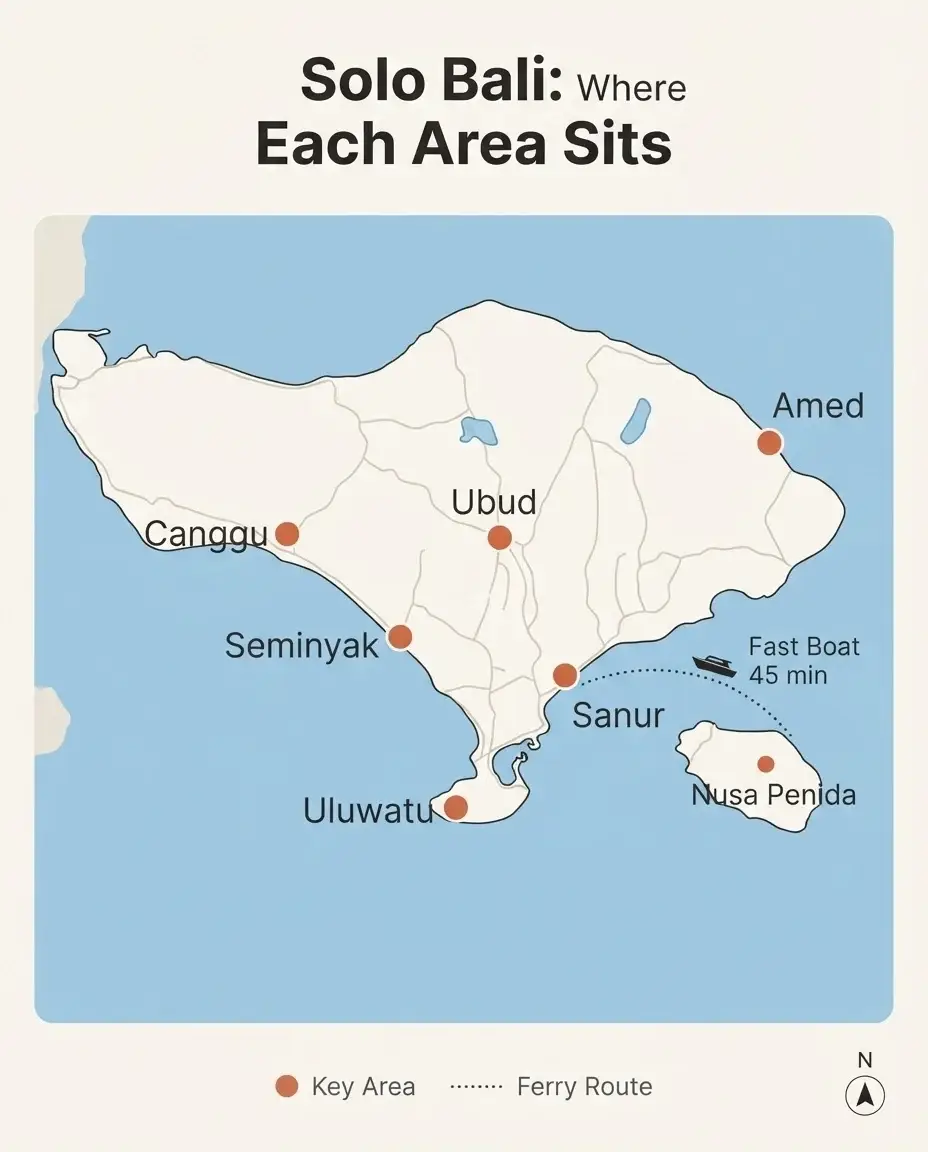
Bali is bigger than it looks on a map. This is the mistake I hear about most often from solo travelers who have already been. A 25-kilometer drive can take you 90 minutes when traffic is bad, and traffic in South Bali is frequently bad. If you look at a map and think you can base yourself in Seminyak and easily do Ubud as a day trip on a whim, you technically can, but you will spend a large portion of that day sitting in a car. Bali rewards people who pick a base and stay in it for a few days. The scattered, try-everywhere approach leaves you exhausted and feeling like you barely scratched the surface anywhere. This is good news for slow travelers, and I have always been one of those.
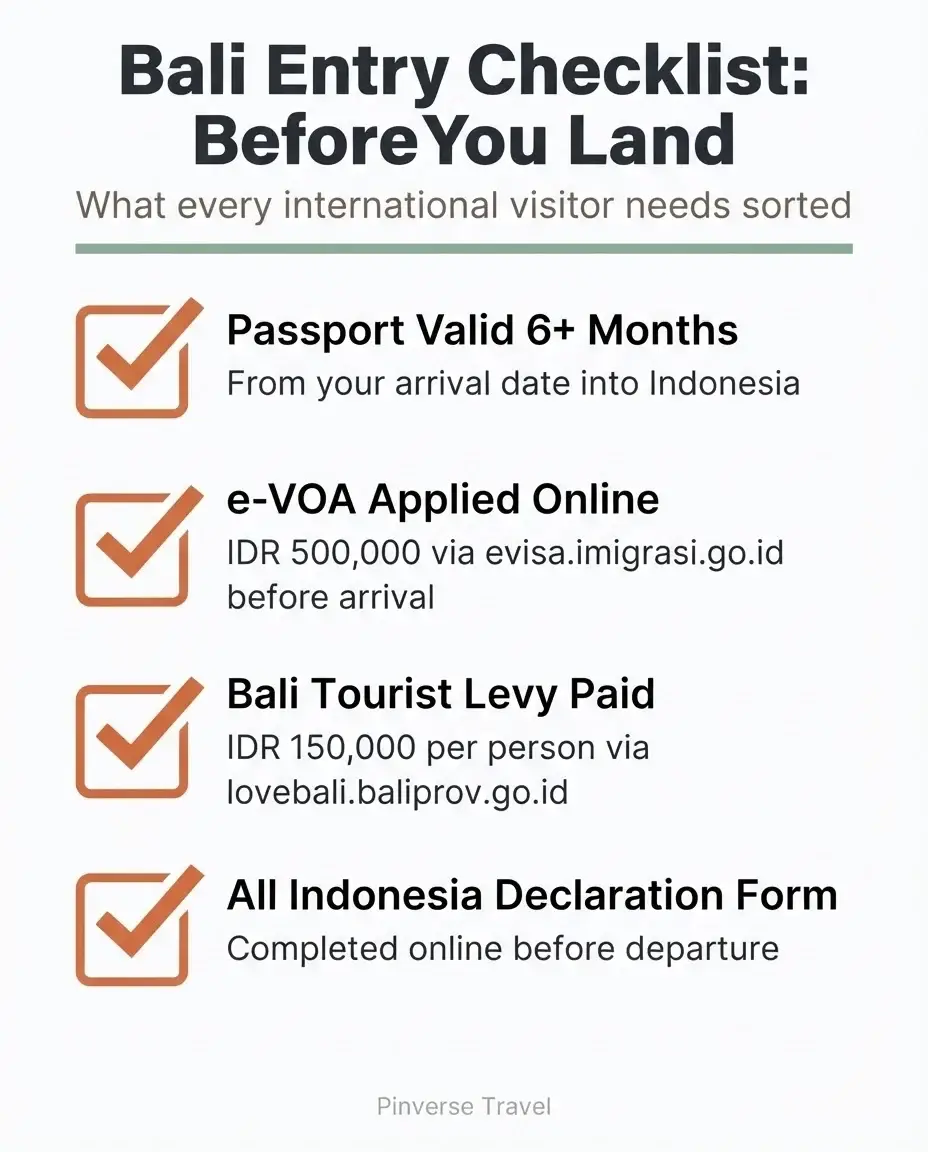
Entry paperwork now involves two separate steps. As of the time of writing, international visitors need both a visa and a tourism levy sorted before or on arrival. Most visitors from the US, UK, Australia, and a long list of other countries can apply for an electronic Visa on Arrival through Indonesia’s official immigration portal, which costs IDR 500,000 and gives you a 30-day stay. Your passport needs at least 6 months of validity from your arrival date. Separately, Bali charges all international tourists a tourism levy of IDR 150,000 per person, paid cashless through the official Love Bali platform before or on arrival. These are two separate transactions. Don’t conflate them, and don’t leave either one until you’re standing at the immigration counter.
Now, let’s talk about where to actually go.
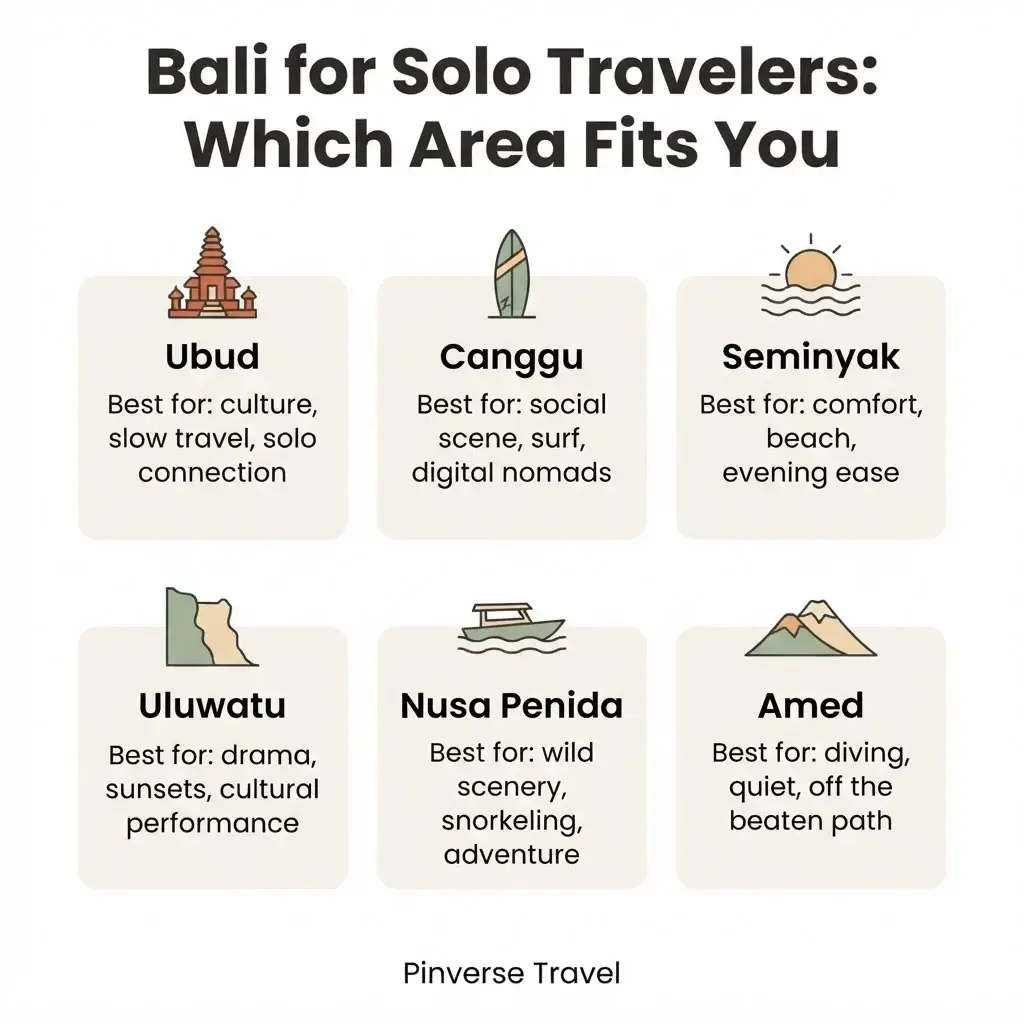
Ubud: For the Solo Traveler Who Wants to Feel Something
If you are the kind of person who reads this and thinks “I want to come back from Bali different somehow,” Ubud is probably where you need to spend the most time. It is Bali’s cultural heart, nestled in the interior hills, surrounded by rice terraces and river valleys, and full of temples, offerings, cooking classes, yoga studios, and an energy that pulls you inward in the best possible way.
From what solo travelers consistently report, Ubud has one of the best social atmospheres on the island for people traveling alone. The accommodation is heavy on small boutique guesthouses and hostels with shared common areas, there are group cooking classes and day hikes that naturally create conversation, and the restaurant culture is built around lingering. You are not likely to eat dinner alone for long in Ubud without someone nearby striking up a conversation.
The Tegalalang rice terraces sit just north of town and are genuinely spectacular, though they do attract crowds in the late morning. Go early, around 7am, and you will have a completely different experience. The Monkey Forest is fun but treat it with respect and keep your belongings close. Sacred monkey territory is real monkey territory.
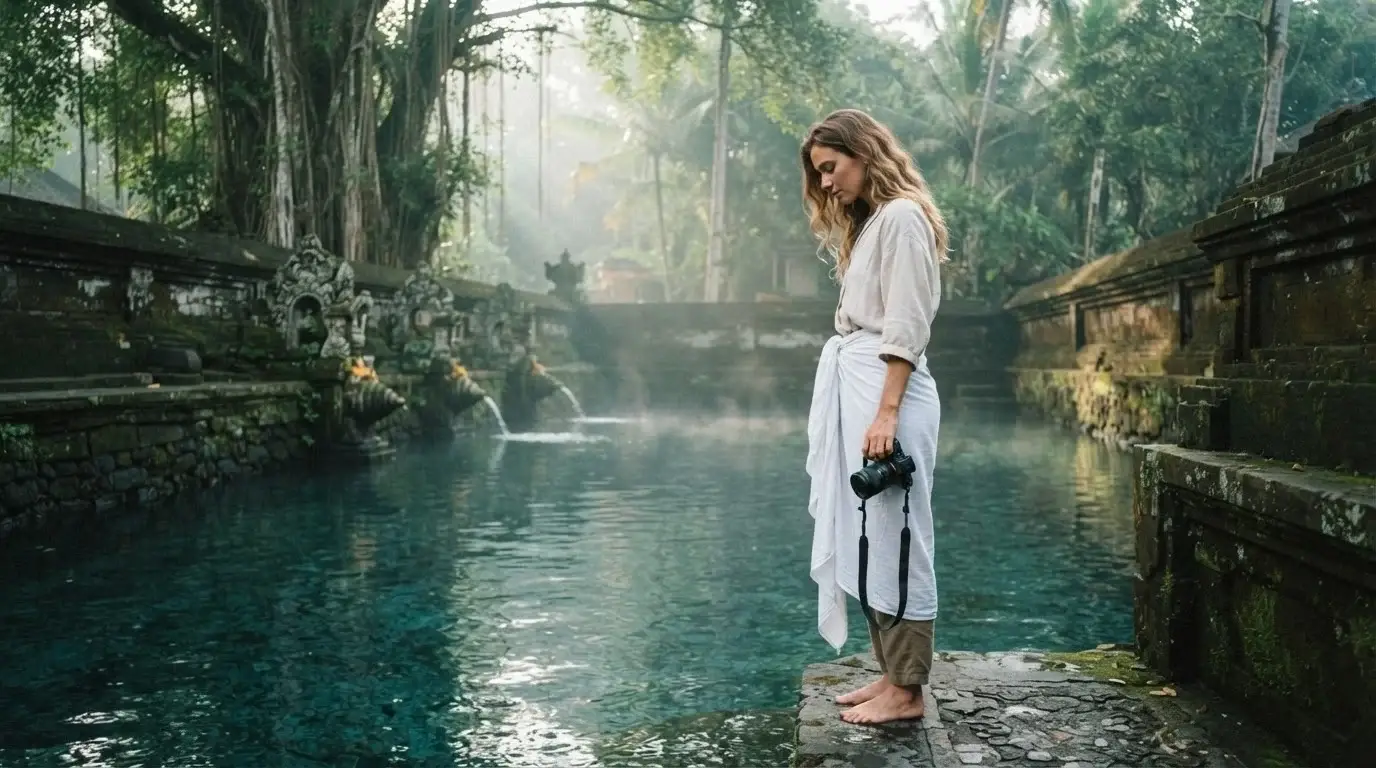
The spiritual experience I would not skip is Tirta Empul, the water temple in Tampaksiring about 15 kilometers north of central Ubud. Dating back to 962 AD, it is dedicated to Vishnu as the god of water, and visitors can observe or participate in the Melukat purification ceremony in the sacred spring pools. According to the Tirta Empul Temple’s official site, the temple is open daily from 8am to 6pm, with adult entry now IDR 75,000 as of January 2025. Note that the general entry ticket does not include participation in the purification ceremony. If you want to take part rather than observe, arrange that separately. Wear modest clothing and bring or rent a sarong.
Ubud is also where slow travel makes the most sense. The kind of day where you wake up without a plan, walk somewhere you have never been, find yourself watching a ceremony spill out of a temple gate, then sit with a local family’s grandmother over rice and coffee while trying to explain where New York is, that is the kind of day Ubud offers if you stay long enough and stop trying to tick things off a list.
Canggu: For the Solo Traveler Who Wants a Social Scene Without the Party
Canggu has become the digital nomad capital of Bali, and that shapes everything about it. The streets are full of coworking cafes, yoga studios, surf schools, and restaurants run by people from all over the world who decided to stay a while. For a solo traveler, this environment is genuinely ideal for meeting people without it being forced or awkward.
The surf is accessible for beginners, with plenty of schools offering lessons on the black sand beach at Echo Beach and Batu Bolong. You do not need to surf to enjoy Canggu, but taking a lesson is one of the best ways to spend a morning alone and come back to town having already bonded with four strangers over falling off a board together repeatedly.
What Canggu is not is deeply cultural. This is the version of Bali that has been shaped significantly by the international community that moved in, and that is something to go in knowing. If cultural immersion is your primary goal, Canggu should be a secondary destination on your trip, not your home base. But as a place to decompress, meet people, surf, eat extraordinarily well, and charge your batteries between more intensive cultural exploration, it is excellent.
Seminyak: For the Solo Traveler Who Wants Comfort and Coast
Seminyak sits south of Canggu along the coast and has a more polished, settled feel. The restaurants are slightly more upscale, the shops are more curated, and the beach clubs are genuinely beautiful. It is not a budget destination, but it is also not as expensive as its reputation sometimes suggests if you stay away from the resort-style accommodation and eat at local warungs rather than beachfront restaurants every night.
As a solo traveler, Seminyak works well if you want a comfortable, easy base with excellent food and beach access. It is not as strong for meeting other travelers as Canggu, and it does not offer the cultural depth of Ubud. Think of it as the middle ground: more refined than Kuta (which most solo travelers who have done any research correctly avoid as a base), less gritty than Canggu, and a reasonable option if you want your evenings to involve a good meal and a slow beach walk.
Solo female travelers consistently rate Seminyak as one of the more comfortable areas in terms of feeling safe and unstressed in the evenings. That said, it is worth knowing the basics before you go. The US State Department’s Indonesia travel advisory currently rates Indonesia at Level 2 (Exercise Increased Caution), which is fairly standard for the region, and petty theft is the most commonly cited concern, not violent crime. Use common sense, keep valuables off the beach and out of sight, and you will be fine.
Uluwatu: For the Solo Traveler Who Wants Drama, Cliffs, and Culture
Uluwatu sits on the southern tip of Bali’s Bukit Peninsula, and it operates at a different frequency from the rest of the island. The landscape is dramatic: white limestone cliffs dropping into turquoise water, world-class surf breaking far below, and at the top of it all, the thousand-year-old sea temple Pura Luhur Uluwatu clinging to the cliff edge.
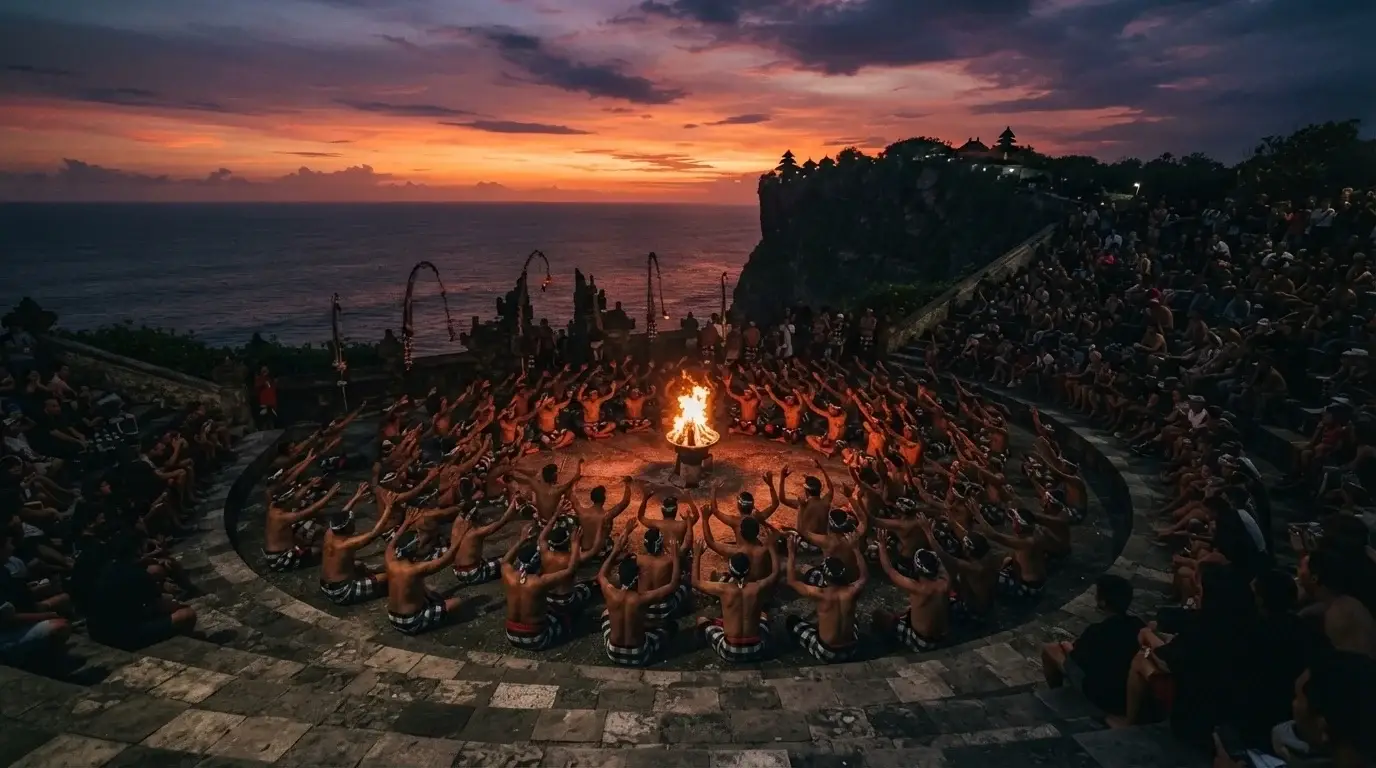
The temple visit is excellent but brief. What turns a trip to Uluwatu into something genuinely memorable is staying for the Kecak fire dance performance in the open-air amphitheater built right into the cliffs at sunset. The show runs twice daily at 6pm and 7pm according to the official Uluwatu Kecak Dance schedule, and it draws from the Ramayana epic in a performance driven entirely by male voice chanting rather than instruments. As the sun drops into the Indian Ocean behind the performers and the fire comes out, it is the kind of moment that earns every cliche ever written about it. Book in advance. Shows sell out.
Uluwatu is also home to some of the best surf breaks in Bali, including Padang Padang, Impossibles, and Bingin. If you do not surf, the beaches themselves are worth the trip: long white stretches tucked below the cliffs, accessible by steep stone staircases, with small warungs selling cold drinks at the bottom.
As a base, Uluwatu is quiet and relatively removed from the bustle of south Bali. Solo travelers who want peace, incredible sunsets, and a slower pace without losing beach access tend to love it. Those who want a social scene may find it a touch isolated.
Nusa Penida: For the Solo Traveler Who Wants Wild and Untamed
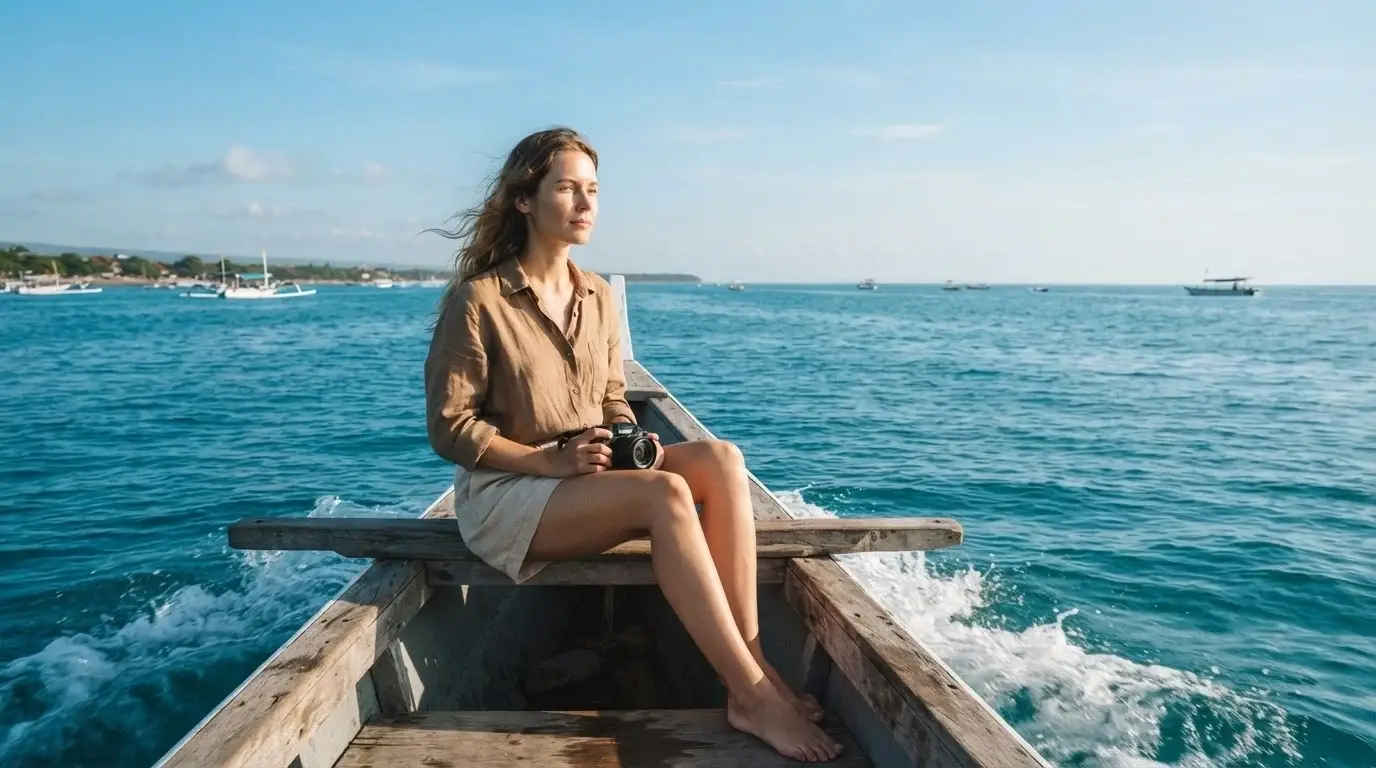
Nusa Penida is not technically part of Bali’s main island. It sits across a strait to the southeast, and getting there means a fast boat from Sanur. The crossing takes about 45 minutes and costs between IDR 150,000 and IDR 250,000 each way. The full logistics, including schedules, operators, and port advice, are covered in detail on Nusa Penida’s expert boat guide, and I strongly recommend reading it before you book because the different departure and arrival ports matter depending on where you are staying.
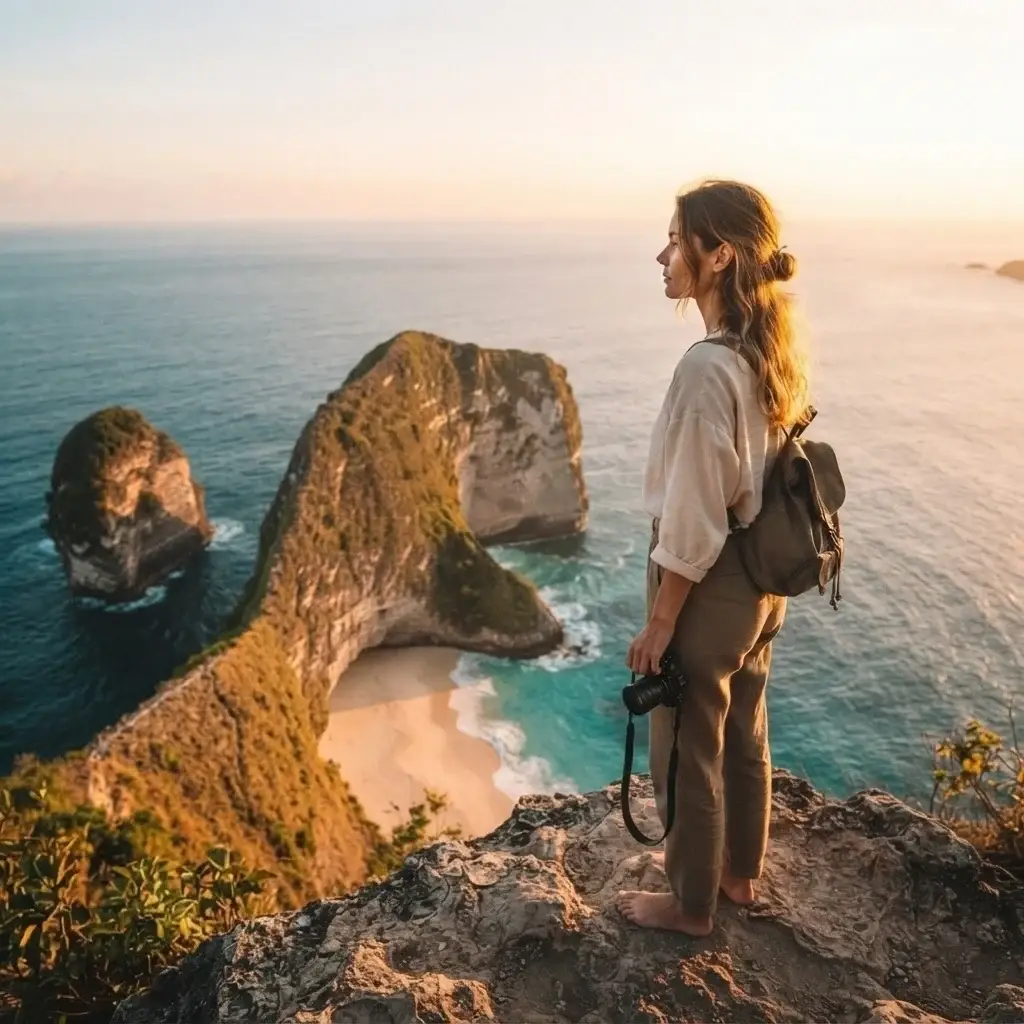
Nusa Penida rewards solo travelers who are comfortable being a little more independent. The roads are steep and rough, ride-hailing apps do not operate on the island the way they do in south Bali, and the infrastructure is rawer than the main island. But what you get in exchange is some of the most dramatic scenery in all of Indonesia: the T-rex dinosaur head silhouette of Kelingking Beach viewed from above, the natural arch of Broken Beach, the crystal-clear water at Crystal Bay, and snorkeling or diving with manta rays at Manta Point.
The question everyone asks is: day trip or overnight? If you want to see the highlights without rushing, staying one or two nights is genuinely worth it. Day trips are doable but involve a lot of driving between viewpoints on roads that do not forgive a relaxed timeline. An overnight gives you sunset and sunrise on the island, which changes the experience entirely.
Pack motion sickness tablets if your stomach is sensitive. The boat crossing can be choppy, especially from December through March.
East Bali (Amed and Sidemen): For the Solo Traveler Who Wants to Go Deeper
This is the part of Bali that most first-time visitors skip entirely, and it is the part that experienced travelers keep coming back to. The road east from Ubud takes you through landscapes that feel increasingly rural, past rice fields and clove plantations, with Mount Agung (currently calm at normal alert status) rising over everything.
Amed is a long, strung-out coastal area of fishing villages that has become a quiet hub for divers and snorkelers. The Japanese WWII shipwreck just offshore is accessible to snorkelers in good conditions, not just certified divers, and the reef along the Jemeluk Bay shoreline is walkable directly from the beach. There are no crowds. There is no nightlife to speak of. There is very good food at small local restaurants, excellent accommodation for reasonable prices, and the kind of slow morning pace that makes you forget what day it is.
Sidemen sits inland before you reach the coast, a valley of rice terraces and traditional weaving communities that moves at a pace the rest of Bali has largely left behind. If you are spending 10 or more days in Bali and you want at least one place that feels like a world apart from the cafes and surf schools and beach clubs, build in two or three nights here.
How to Actually Decide Where to Go
Here is the honest framework. If you have 7 to 10 days, a strong structure looks like this: base yourself in Ubud for 3 to 4 days at the start, when your energy for cultural depth is highest and you are still oriented. Then move to Canggu or Seminyak for 2 to 3 days if you want beach time and social energy. Build in a trip to Nusa Penida (overnight if possible) and an afternoon or evening at Uluwatu for the Kecak dance. If you have more time, use the extra days in Amed or Sidemen rather than trying to revisit everything you already saw more quickly.
The most common mistake is trying to sample everything in short doses and ending up feeling like you saw none of it properly. When I worked as a sightseeing guide back in New York, I watched tourists do this constantly. They would spend 20 minutes in places that deserved 2 hours. They would leave feeling like they had been somewhere without ever really arriving. Travel is not a greatest-hits album. The best experiences come from staying long enough for things to slow down and get interesting.
Pick a structure. Give each place room to breathe. And when you feel the urge to add one more stop to your itinerary, ask yourself: is this addition making the trip better, or just longer?
The official Visit Indonesia tourism website has destination overviews for each region if you want to read up on the cultural and geographic context for areas beyond the main tourist corridor, including Amed and the regency of Karangasem, which covers much of east Bali.
Getting Around: The Practical Side
For getting between neighborhoods and to attractions, Grab and Gojek are your best friends. Both operate in the main tourist areas of south Bali and Ubud. Gojek tends to have better coverage in some of the smaller roads around Ubud’s outskirts. In Amed or Sidemen, these apps do not work reliably, and private car hire arranged through your accommodation is the standard.
Scooters are everywhere and many solo travelers rent them, but this is worth thinking through honestly. If you have not ridden a scooter regularly before, Bali traffic is not the place to learn. The roads are busier and more chaotic than they look, and hospital visits from scooter accidents are a real part of the expat and tourist experience here. If you do rent, you need an International Driving Permit and should wear a helmet every single time.
For longer journeys between regions, private driver hire for a full day runs roughly IDR 400,000 to IDR 600,000 and is one of the most practical investments a solo traveler can make. A good driver doubles as a guide and can suggest stops you would not have found on your own.
A Note on Cultural Respect
Bali is a deeply Hindu island in a predominantly Muslim country, and the spiritual life here is not a backdrop for tourist photos. It is a living, breathing daily practice. You will see offerings (canang sari) placed on the ground, on temple steps, on motorbike handlebars. Walk around them, not through them.
At temples, you must wear a sarong and a sash around your waist. Many temples provide them at the entrance, but having your own shows more intention. Shoulders should be covered. Enter and exit respectfully, speak quietly, and follow the direction of temple staff. If you are menstruating, most Balinese Hindu temples ask that you do not enter, and this is a sincere religious practice, not an arbitrary rule.
The people you meet in Bali, from your guesthouse host to the woman selling fruit outside the temple, are not part of your travel experience. They are living their lives. Approach every interaction with genuine curiosity and humility, and Bali will reward you in ways no itinerary can plan for.
The Thing About Bali That Everyone Gets Right
For all the planning and all the logistics and all the area comparisons, the thing that consistently comes through from solo travelers who have been to Bali is simpler than any of it. They went expecting a tropical holiday and came back with something they did not expect: a quieter version of themselves. A version that felt more capable, more curious, more present.
That is what slow travel does. That is what going somewhere alone and being responsible for every decision, every morning, every wrong turn and every perfect moment does. Bali is genuinely one of the best places in the world to experience that for the first time, or the tenth time.
You do not need to have it perfectly planned. You need to go.