Best Solo Travel Cities in South Korea for First-Timers

There is a moment most solo travelers recognize, that feeling you get when you step off a long-haul flight, walk into a subway station in a country where you don’t speak the language, and realize with a rush of something between panic and joy that you have absolutely no one to ask for help but yourself. That moment is terrifying and it is also exactly where so much real growth starts.
South Korea has a way of making that moment feel much less terrifying than you’d expect.
I haven’t been to South Korea myself, but I know the feeling of arriving somewhere disorienting and figuring it out alone. I felt it when I first landed in Thailand before I settled in to teach English there. I felt it backpacking through Europe on my own, reading maps at bus stations, making decisions on the fly. And when I look at everything solo travelers report about South Korea, from how easy the transit is to how safe the streets feel to how deeply the food culture rewards the solo eater, I see a country that was practically built for people who love to explore independently.
If you’ve been dreaming about South Korea and wondering whether you can handle it solo and which cities are actually worth your time, this guide is written for you.
Why South Korea Works So Well for Solo Travel
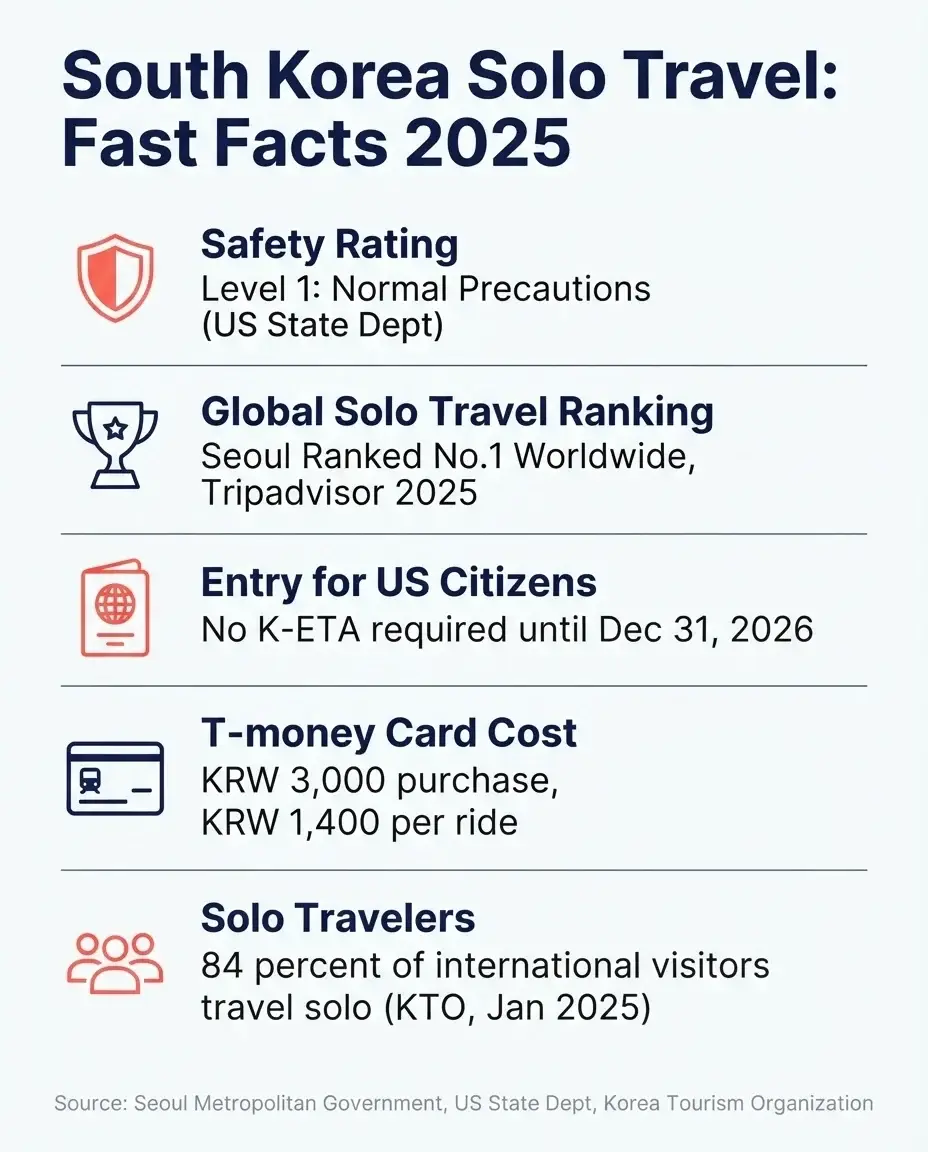
Let’s start with the big picture before we get city-specific. South Korea is consistently ranked among the best countries in the world for solo travelers. In fact, Seoul was named the number one best city for solo travel in the world by Tripadvisor in their 2025 Travelers’ Choice Awards, beating out Kathmandu, Cusco, Bangkok, and Osaka. The Korea Tourism Organization also found in early 2025 that 84% of international visitors to Korea traveled without a guide, meaning solo travel is the norm here, not the exception.
The reasons for this come down to a few key factors. The public transportation infrastructure is excellent and widely explained in English. Digital payments are everywhere, so navigating daily life doesn’t require carrying a lot of cash or haggling. The food culture, and this is something solo travelers consistently rave about, makes eating alone completely comfortable and culturally normal. There’s even a word for it: honbap, which literally means “eating alone,” and it carries no social stigma. Street food is abundant, affordable, and social in the best way. Night markets, convenience store dining, and small noodle shops are all places where a solo person fits in perfectly.
Safety is another genuine strength. The US State Department rates South Korea at Level 1: Exercise Normal Precautions, which is their lowest and safest advisory level. Violent crime against foreign visitors is rare. The country has extensive CCTV coverage and a strong culture of public safety. That said, this doesn’t mean you should be careless, especially at night in entertainment districts where alcohol is flowing. Solo female travelers in particular should be aware that the US Embassy does receive some reports of assault in nightlife areas, often involving people met through social media or dating apps. Standard common-sense precautions, staying aware of your surroundings, keeping location shared with someone you trust, and not accepting drinks from strangers, apply here just as they would anywhere.
One more thing worth knowing right now: if you hold a US passport, you do not need to apply for any pre-authorization to visit South Korea for tourism for up to 90 days. The K-ETA (Korean Electronic Travel Authorization) exemption is in effect through December 31, 2026, meaning you can simply show up with your passport. Starting January 1, 2027, the K-ETA will be required, so check current rules if you’re planning ahead.
Now, let’s talk cities.
Seoul: The City That Makes Solo Travel Easy
I want to be honest with you about Seoul. When most people think about solo travel in South Korea, they go straight to Seoul, and there’s a reason for that. The city is massive, modern, endlessly stimulating, and genuinely easy to navigate alone. But it’s also the kind of city where first-timers can feel overwhelmed if they don’t have a rough plan.
Seoul is built for independent movement. The subway system covers the entire city with 23 lines and hundreds of stations, all signed in Korean, English, and Chinese. Trains run from around 5:30 AM until midnight, and a night bus system covers the late hours after that. To ride, you’ll want a T-money card, which you can pick up at any convenience store or subway station kiosk for KRW 3,000 (about $2.20). Load it with money and tap in and out. Each subway ride costs KRW 1,400 with the card, and transfers between buses and subway lines are free within 30 minutes. For a longer stay where you’re moving around a lot, Seoul also offers the Climate Card, a short-term unlimited transit pass that’s become popular with international visitors. The official Seoul tourism transportation guide lays out all your options with current pricing.
Getting from Incheon International Airport into the city is straightforward. The AREX (Airport Express) runs directly to Seoul Station. The all-stop train costs around KRW 4,150-4,750 and takes about 55 minutes. The express train costs KRW 9,500 and cuts the journey to 43 minutes. Both are clean, reliable, and easy.
For solo travelers who are new to Seoul, a practical approach is to anchor yourself in one of these neighborhoods and let the city expand outward from there. Hongdae is lively and full of young energy, with street performances, indie cafes, and a hostel scene that makes it easy to meet other travelers. Insadong is quieter and more traditional, good for independent travelers who want to wander tea houses, galleries, and craft shops at their own pace. Jongno-gu, which contains Gyeongbokgung Palace and Bukchon Hanok Village, is the historical heart of the city and genuinely beautiful for solo explorers who like to walk.
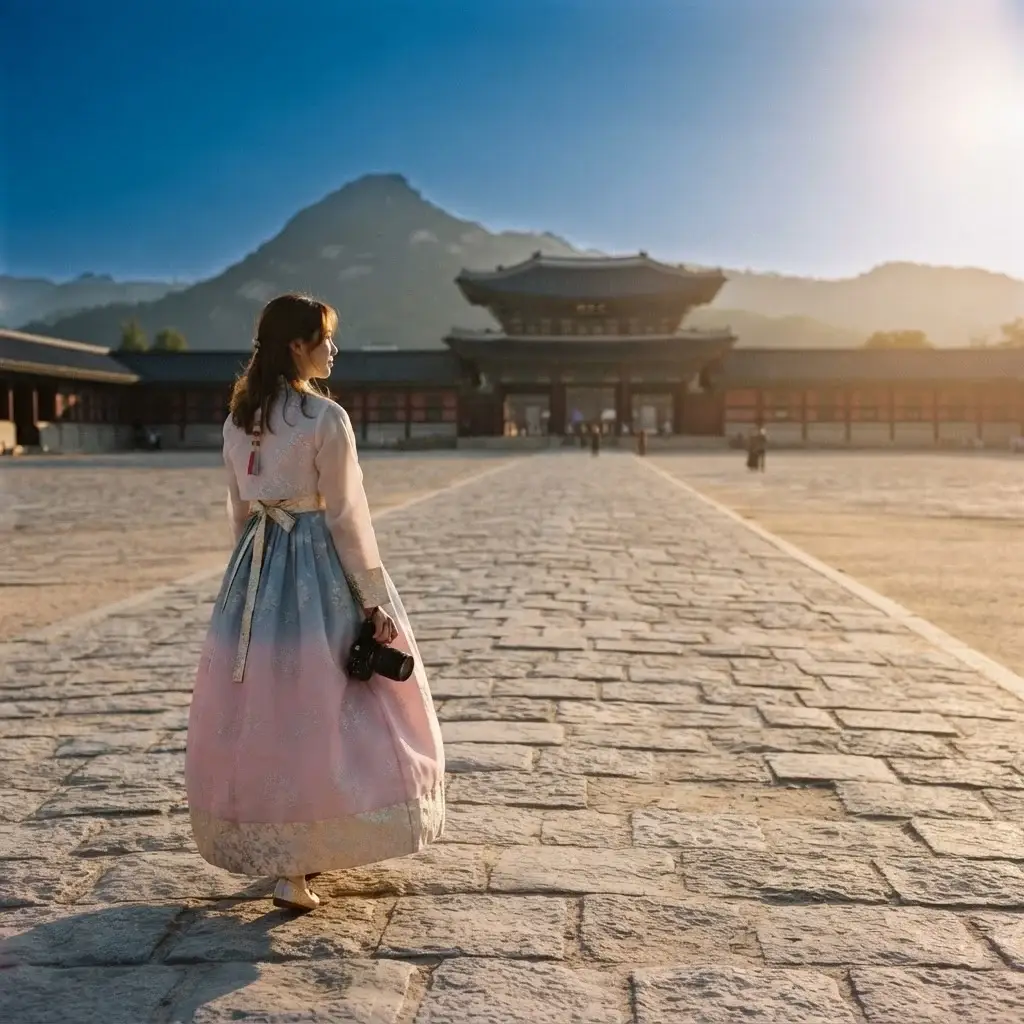
Speaking of Gyeongbokgung, this is one of those places that rewards slowing down. The palace complex opens at 9:00 AM and runs to 6:00 PM from March through May, 6:30 PM from June through August, and 6:00 PM from September through October, with reduced hours in winter. It’s closed on Tuesdays. Admission is KRW 3,000. If you visit wearing a hanbok (traditional Korean dress), which you can rent from the many stalls just outside the palace gates, you get in free. It’s a small touch that many solo travelers love because it gives you something playful and low-pressure to do on your own.
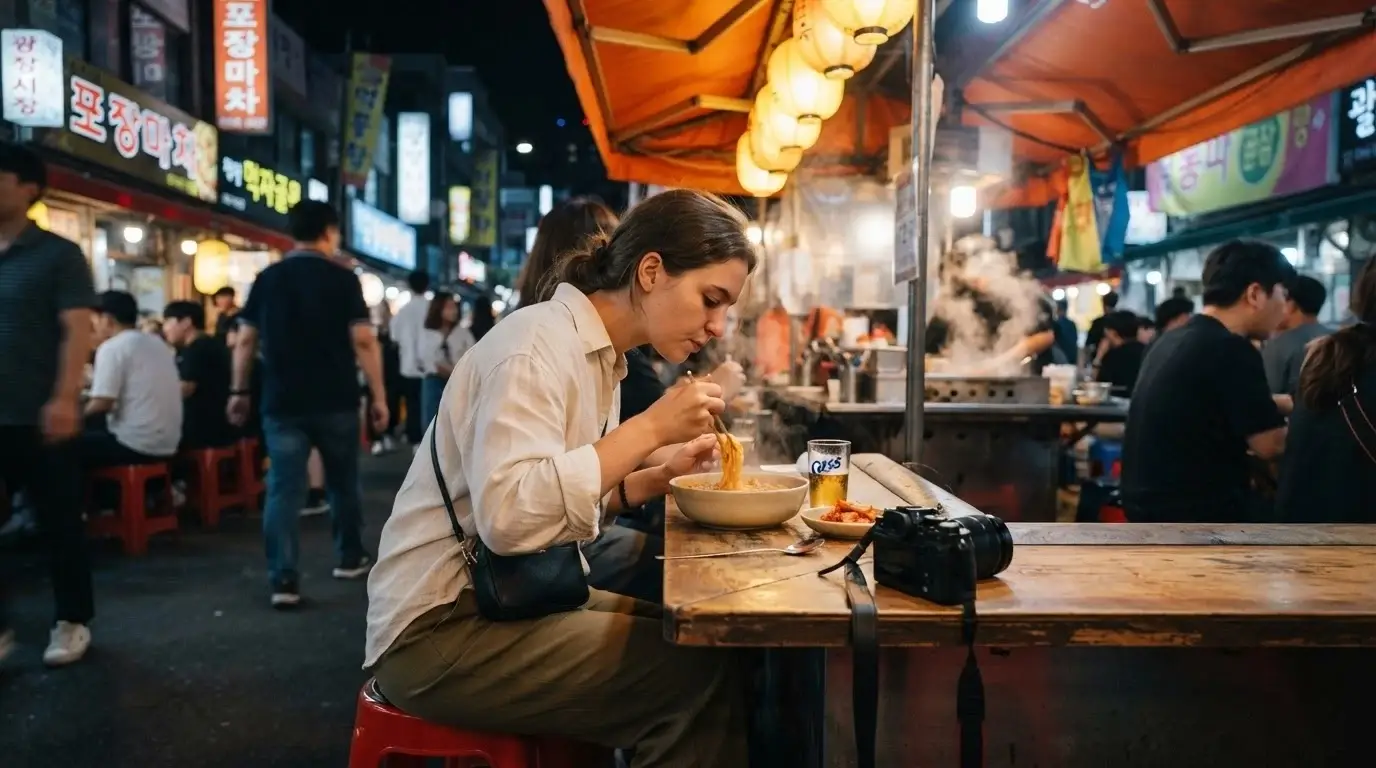
Eating solo in Seoul is genuinely one of the pleasures of the trip. A bowl of bibimbap or a plate of Korean fried chicken at a pojangmacha (street food tent) costs almost nothing. Dongdaemun night market runs through the late hours. Gwangjang Market, one of Seoul’s oldest, is a sensory experience with vendors selling bindaetteok (mung bean pancakes), mayak kimbap (tiny seaweed rice rolls), and mounds of fresh vegetables. Nobody will bat an eye at a solo person pulling up a stool and eating their way through.
One cultural note worth absorbing before you arrive: Koreans in general are polite but not always openly chatty with strangers in public spaces the way people can be in some other countries. This isn’t coldness, it’s just cultural norms around personal space. Younger Koreans, especially in areas like Hongdae or Itaewon, tend to be more outgoing and English-comfortable. Go in curious and patient, and you’ll have real interactions.
Busan: South Korea’s Coastal Soul
If Seoul is South Korea’s brain, Busan is its beating heart. The country’s second-largest city sits on the southeastern coast, stacked between mountains and the sea, and it has a character that’s simultaneously gritty, beautiful, and deeply local.
Solo travelers who want something beyond the capital, or who want to add a second city to a longer trip, consistently come back from Busan raving. The city is smaller and more walkable than Seoul in key neighborhoods, but it requires slightly more navigation since its attractions are spread further apart. The subway covers the main areas well, though buses are sometimes necessary for reaching spots that aren’t near a station.
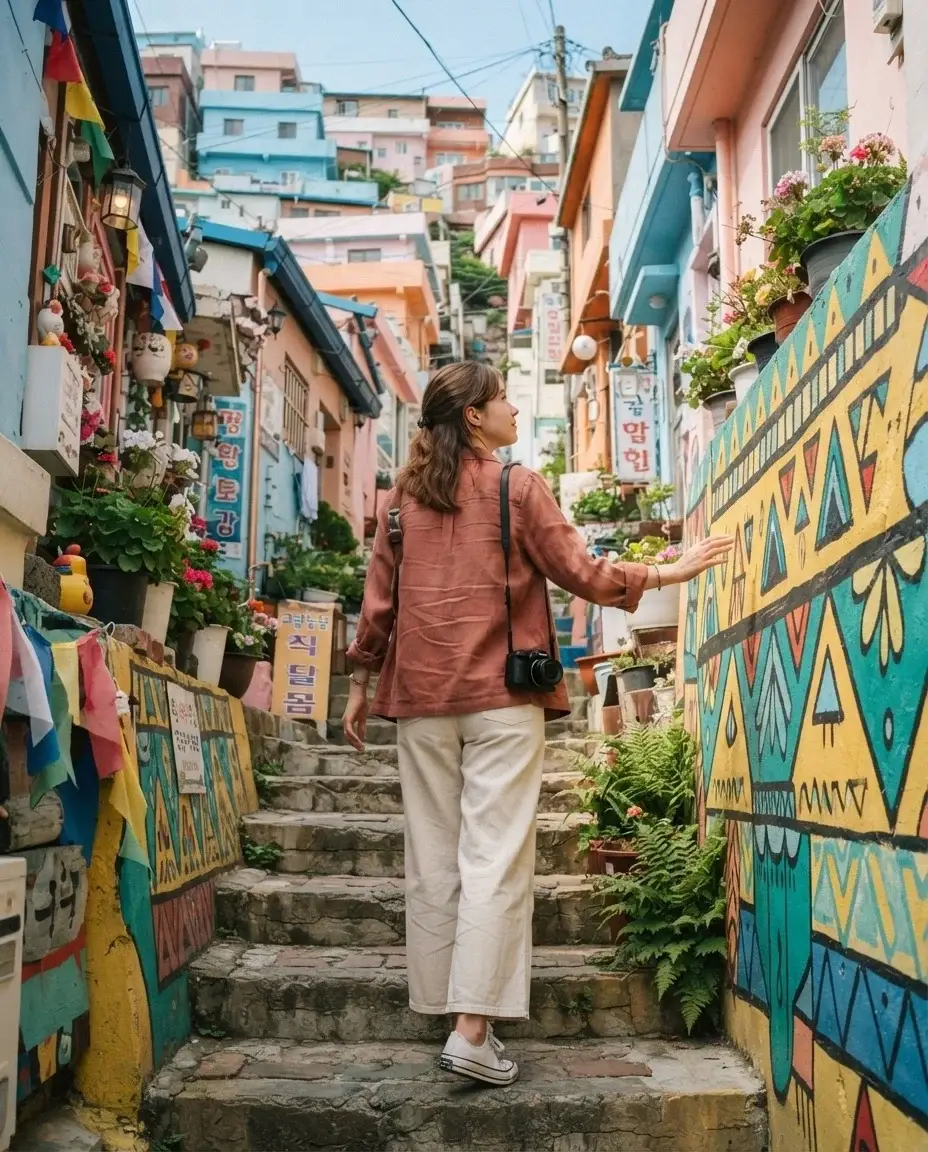
The single most iconic thing to do in Busan is visit Gamcheon Culture Village, a hillside neighborhood in the Saha district that once sheltered Korean War refugees and was transformed by a 2009 community art project into a maze of colorful alleyways, murals, and small galleries. The official Visit Busan tourism page for Gamcheon confirms the village is open daily, March through October from 9:00 AM to 6:00 PM, and November through February from 9:00 AM to 5:00 PM, with free admission. To get there via subway, take Line 1 to Toseong Station or Goejeong Station and catch the village bus (Saha 1-1 or Seo-gu 2). It’s a little adventure in itself.
Haeundae Beach is Busan’s most famous stretch of coast, lively and beautiful, with seafood restaurants and tents lining the waterfront. For solo travelers who love fresh fish, Jagalchi Fish Market near Nampo Station is an unmissable experience. It’s one of Korea’s largest seafood markets, and you can buy fresh shellfish or grilled fish from vendors right at the stalls. Eating alone here feels completely natural because everything is casual and the energy is communal.
What solo travelers don’t always hear is that Busan’s Seomyeon neighborhood, the commercial center, has an excellent concentration of affordable guesthouses, street food streets, and an underground shopping mall, and it puts you close to multiple subway lines. It’s a smart base if you want to move around the city efficiently.
Food in Busan has its own personality distinct from Seoul. Milmyeon (wheat noodles in cold broth) is a Busan specialty, and the city’s dwaeji gukbap (pork and rice soup) is legendary. Portions are generous and prices at market eateries are genuinely budget-friendly.
Gyeongju: The Slowest, Richest Solo Travel Experience in Korea
This is the city I want every solo history lover and slow traveler to know about, because it almost never gets the attention it deserves in mainstream South Korea content.
Gyeongju was the capital of the Silla dynasty for nearly 1,000 years, from 57 BCE to 935 CE. The city has more history buried per square meter than almost anywhere in Korea, and in 2000, the Gyeongju Historic Areas were designated a UNESCO World Heritage Site in recognition of the exceptional concentration of Buddhist art, royal tombs, temple remains, and Silla dynasty monuments found there. UNESCO specifically called out the Gyeongju complex for its “outstanding testimony” to nearly a thousand years of cultural achievement, encompassing everything from stone pagodas and carved reliefs to the ruins of what was once Korea’s largest Buddhist temple.
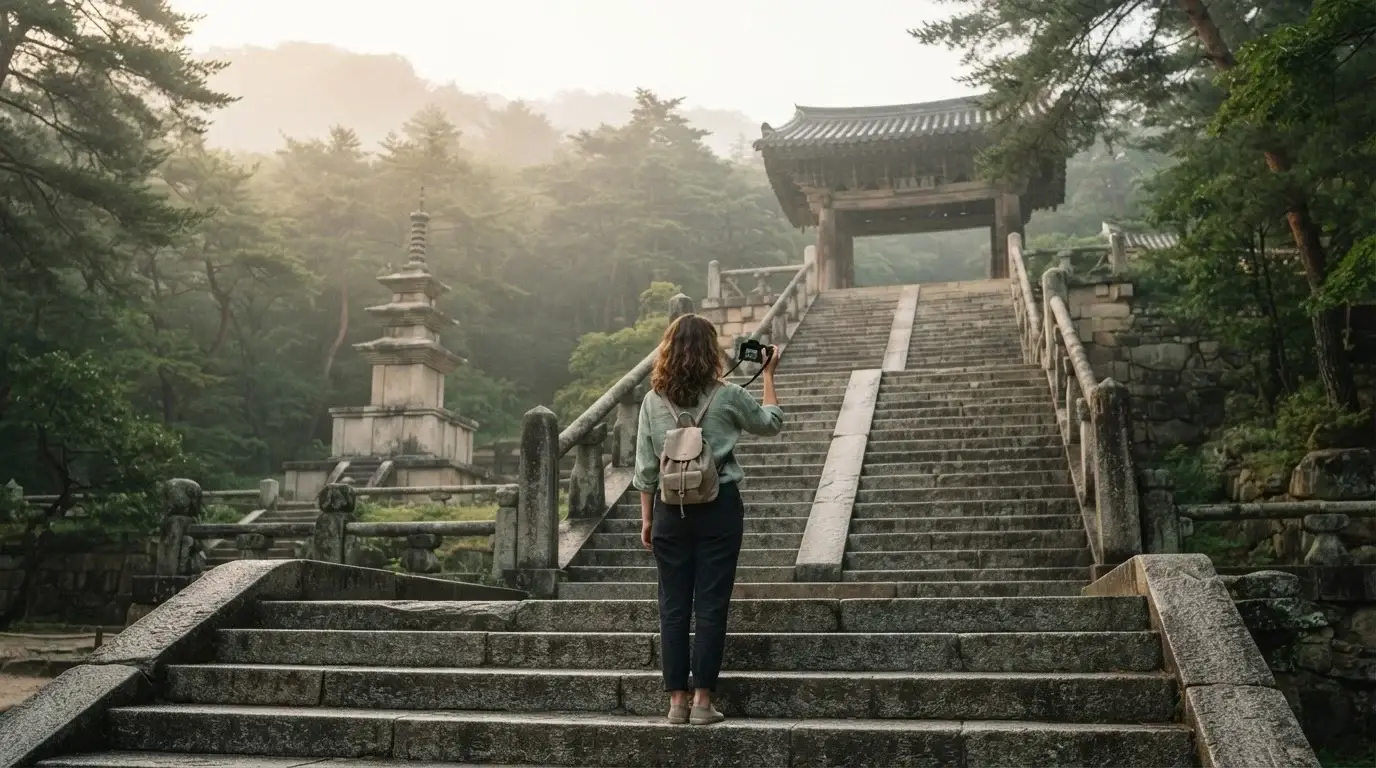
For solo travelers, Gyeongju is exceptional because it’s a city that rewards exactly the kind of slow, wandering, self-directed exploration that solo travel does best. You can rent a bicycle and spend an entire afternoon cycling between burial mounds in Tumuli Park, past Anapji Pond (a reconstructed Silla palace garden that glows beautifully at night), and up to Bulguksa Temple and Seokguram Grotto on the mountainside. Bulguksa is genuinely stunning, a 6th-century temple complex that still feels active and alive, not just preserved. Seokguram Grotto, a short walk above it, houses a stone-carved Buddha facing out to sea from inside a granite dome that engineers still marvel at.
From solo travelers who have done this route consistently report spending two full days in Gyeongju and still wanting more. The city is best used as a two-to-three night stop, not a rushed day trip, though many people do visit on a day trip from Busan. If you have the time, stay overnight. Gyeongju has a good selection of guesthouses and hanok-style accommodation that suits solo budgets, and the evenings are quiet and genuinely beautiful.
Jeonju: South Korea’s Best Solo Food Destination
I’ll be direct: if food is your primary way of connecting with a culture, then Jeonju belongs at the top of your South Korea list.
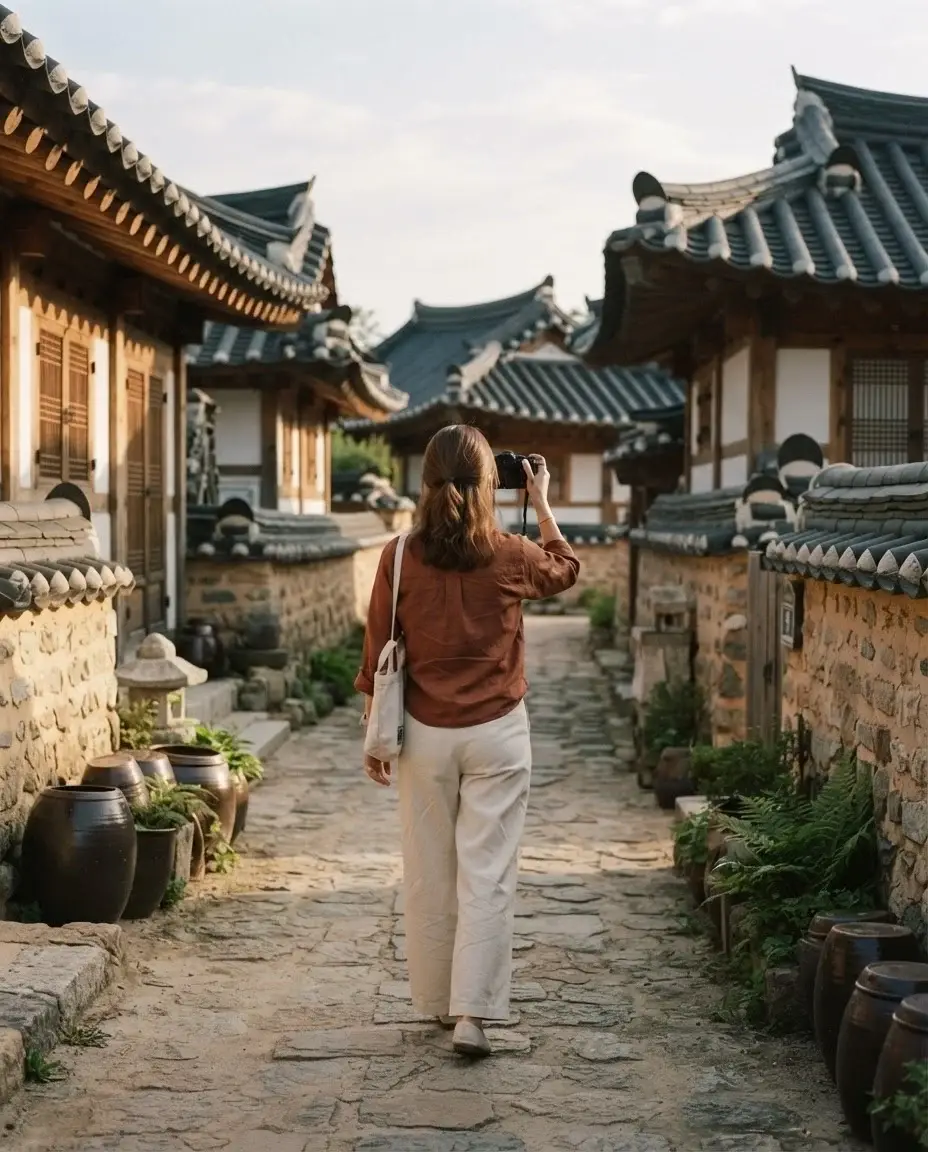
Jeonju is best known for two things: its extraordinarily preserved Hanok Village and its food culture, which is considered the finest in Korea by Koreans themselves. The Jeonju Hanok Village is the country’s largest and only urban traditional hanok village, comprising around 700 traditional Korean wooden buildings arranged along winding lanes. Visiting here alone is genuinely one of the better experiences solo travel can offer because you can move at whatever pace you want, duck into traditional craft shops, rent a hanbok for a couple of hours and walk around the village lanes in it, and nobody is rushing you.
But the food is the real reason to come. Jeonju is the birthplace of bibimbap, and what you get here is a different dish entirely from the versions found elsewhere. The local version uses bean sprouts grown in Jeonju’s mineral-rich water, gochujang paste made in the region, and a clay pot that keeps the rice sizzling at the bottom. The crispy scorched rice at the bottom of a dolsot bibimbap bowl is something you’ll remember. Beyond bibimbap, the city is famous for its makgeolli (ferky milky rice wine) culture and its tradition of serving an extraordinary number of banchan (side dishes) with every meal. Some restaurants bring 20 or more small plates alongside a main dish, and the price for all of it can be under 15,000 KRW.
Solo dining in Jeonju is comfortable and encouraged by the city’s entire food culture. Street vendors, market stalls, and small family-run restaurants all feel welcoming to a single person. The pace of Jeonju is slower and more contemplative than Seoul or Busan, which many solo travelers find deeply restorative after a few intense city days.
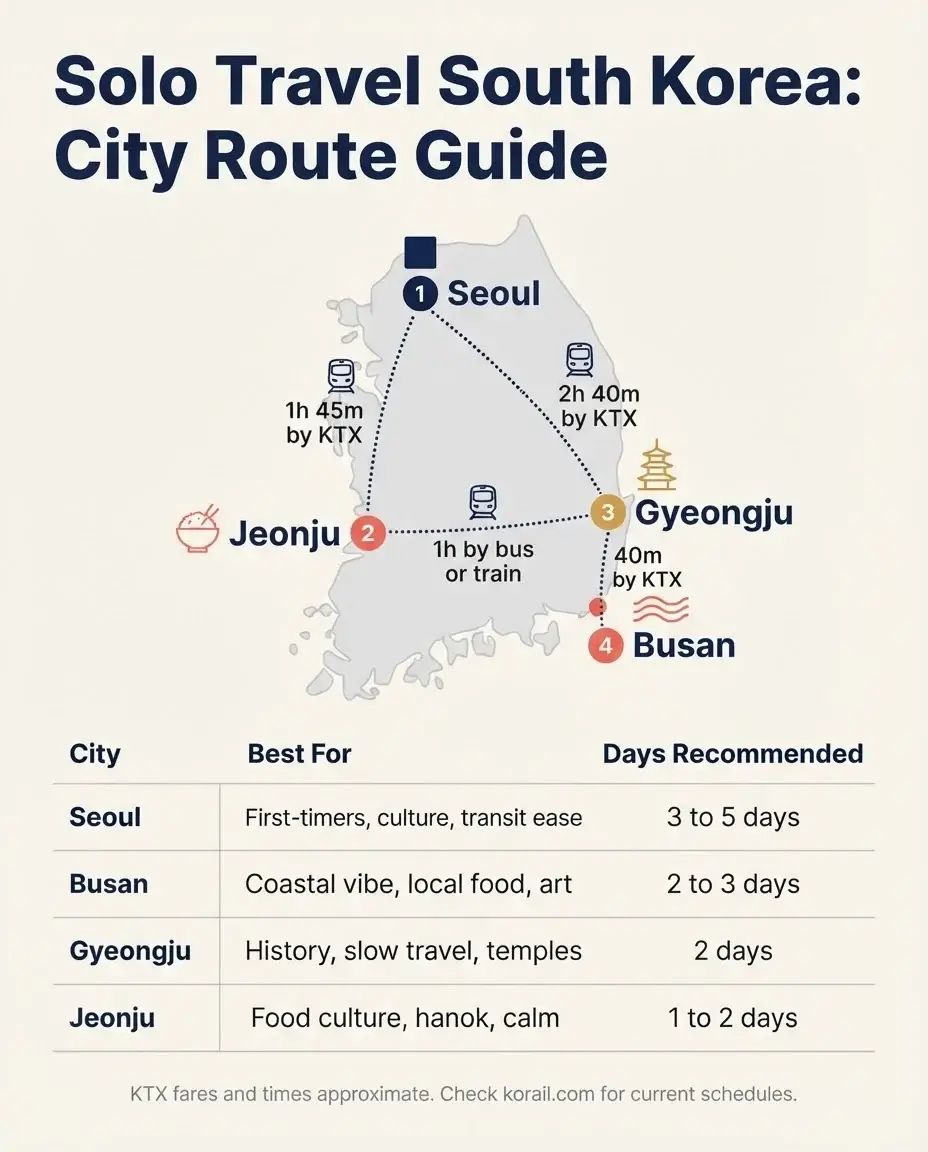
Jeonju is most easily reached from Seoul by KTX bullet train (around two hours) or from other cities by intercity bus.
Getting Between Cities: The KTX and Your Best Transport Options
One of the smartest things you can do as a solo traveler in South Korea is understand the train system before you arrive, because it makes multi-city travel feel almost effortless.
The KTX (Korea Train Express) is South Korea’s bullet train network, operated by KORAIL. It connects Seoul to Busan in roughly two hours and 40 minutes, Seoul to Gyeongju (Singyeongju Station) in around two hours, and Seoul to Jeonju in about an hour and 45 minutes on the KTX-Isan line. Standard adult KTX fares between Seoul and Busan run around KRW 59,800 one-way at full price, though booking in advance or traveling at off-peak times can reduce this.
If you’re planning to visit multiple cities across a week or more, it’s worth looking at the KORAIL Pass for foreign visitors. A 2-day select pass costs KRW 131,000, a 3-day consecutive pass costs KRW 165,000, and a 5-day select pass costs KRW 275,000. These are available to foreigners only and can save you meaningful money if you’re moving around frequently. Purchase is available online or at major stations upon arrival.
One thing that makes solo travel logistics in South Korea especially smooth is Kakao Maps, which is free, available in English, and works reliably for both transit directions and walking navigation. Download it before you leave. It will be your most-used app.
For connectivity, pick up a local SIM card or eSIM at Incheon Airport on arrival. Data is fast, affordable, and essential for navigation and translation apps. Most convenience stores also sell pocket WiFi rental vouchers if you prefer.
Practical Tips for Your First Solo Trip to South Korea
A few things that solo travelers consistently flag as game-changers, and that I want to make sure you know before you go.
First, Naver Papago is a better translation app for Korean than Google Translate in many situations. Download both and use Papago for reading menus, signs, or anything in Korean script. The photo translation feature, where you point your camera at Korean text and it overlays the translation, is extremely useful.
Second, tap-to-pay and QR code payments are widely accepted across South Korea, but carry some cash too, especially for smaller street food vendors and traditional market stalls.
Third, your shoes will come off at many restaurants, guesthouses, and traditional spaces. Wear shoes that slip on and off easily, and socks you’re not embarrassed by.
Fourth, speaking of guesthouses, hostel culture in Korea is strong and social, particularly in Seoul’s Hongdae and Mapo districts and in Busan’s Seomyeon and Haeundae areas. If you’re traveling solo and want to meet people, a hostel with a common kitchen is usually more effective than a private apartment rental for making connections.
Fifth, the best times to visit South Korea for first-timers are spring (late March through May, when cherry blossoms bloom) and autumn (September through November, when the foliage is extraordinary). Summer (June through August) is hot, humid, and sees a monsoon period in July. Winter is cold but manageable, and Seoul’s winter festivals are genuinely lovely.
What I Love Most About South Korea as a Solo Destination
Here’s the thing about South Korea that I think gets buried under all the practical logistics and ranking debates: it’s a country where being alone doesn’t feel lonely. The food culture, the transit culture, the fact that solo travelers genuinely make up the majority of international visitors here, all of it creates an environment where you’re never made to feel like you’re missing something by not having a travel companion.
After years of solo travel in different forms, including solo backpacking across Europe and long solo stays in different countries, what I’ve found is that the countries that work best for solo travelers are the ones where daily life accommodates the individual naturally. South Korea, from everything its solo visitors consistently describe, is exactly that kind of place.
You don’t need to speak Korean to have meaningful interactions. You don’t need to be fearless. You need a T-money card, a downloaded offline map, a little curiosity about the food, and the willingness to step off a plane and see what happens.
Start with Seoul if you want maximum ease. Add Busan if you want the sea and something grittier and more local. Fold in Gyeongju if history and quiet reflection are part of why you travel. Stop in Jeonju if your soul is moved by really exceptional food and a city that encourages you to slow all the way down.
Any of these cities, on their own or strung together, will give you the kind of trip you’ll still be talking about years from now. Book it.