I still remember sitting at my old office desk a few years ago, staring blankly at a spreadsheet. The gray cubicle walls felt like they were closing in on me. I had exactly two weeks of vacation time for the entire year, and I was terrified of wasting a single day of it. I wanted real adventures, deep history, and the thrill of exploring places that felt completely different from my hometown of New York.
If you are currently sitting at a desk dreaming of an escape, feeling unsure if you can handle a trip to Asia on your own, I want you to take a deep breath. You can absolutely do this.
Hong Kong and Macau can seem intimidating from afar. They look like hyper-modern neon mazes filled with millions of people, fast trains, and unfamiliar languages. But beneath the flashing lights, these two cities are incredibly safe, welcoming, and easy to navigate if you have the right plan.
This guide is the exact map I wish I had when I first stepped off the plane. We are going to break down the best 7-day itinerary for Hong Kong & Macau so you can skip the stress, avoid the massive tourist crowds, and build the confidence to explore these incredible streets like a seasoned traveler.
Essential Pre-Trip Logistics for First-Timers
Before you pack your bags and head to the airport, a little bit of preparation will save you hours of frustration on the ground. When I worked as a certified sightseeing guide in New York, I always told travelers that a smooth trip starts before you leave your front door.
Visas and Entry Rules
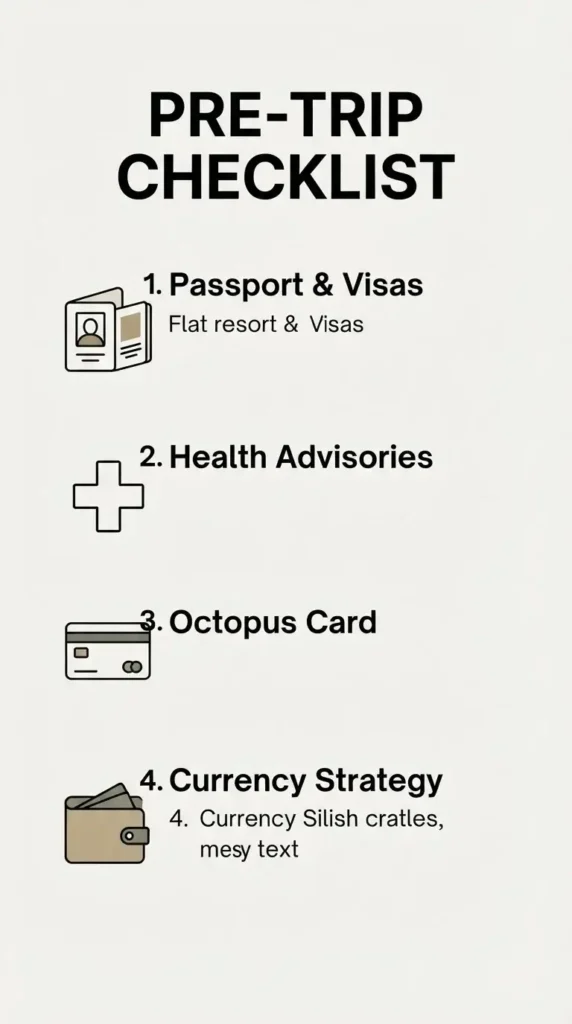
First things first: you need to make sure your paperwork is completely ready. Most travelers from Western countries do not need a visa for short tourist stays in either Hong Kong or Macau, but the two regions have separate borders. You will actually go through passport control when moving between them. I always double-check the official US Department of State travel guidelines for international destinations to ensure entry rules or passport validity requirements have not changed before I fly. Make sure your passport has at least six months of validity left from the date you plan to arrive.
Staying Healthy and Safe
Both cities have world-class medical facilities and exceptionally low crime rates. However, the summer heat and humidity can catch you off guard, and trying dozens of new street food stalls means you want to keep your stomach happy. I always review the CDC travelers health recommendations and vaccine checklists to see if there are any specific health alerts for the region before my departure. Pack a small first-aid kit with basic medicines for headaches and upset stomachs, and always carry a reusable water bottle.
Cash, Cards, and the Magic Octopus Card
As soon as you land at Hong Kong International Airport, walk straight to the MTR (Mass Transit Railway) customer service counter. Do not pass go, do not look for a taxi. You need to buy a physical Octopus Card.
The Octopus Card is the lifeblood of Hong Kong. It is a reusable contactless stored-value card that you tap to ride the trains, buses, trams, and ferries. You can also use it to buy snacks at 7-Eleven, pay for your dim sum, or buy a bottle of water at a vending machine. Put at least 300 Hong Kong Dollars (HKD) on it to start. You can load more cash onto it at any transit station or convenience store using local paper bills.
While Hong Kong is highly digital, Macau uses its own currency called the Macanese Pataca (MOP). The great news is that Hong Kong Dollars are widely accepted in Macau at a 1:1 rate, so you do not need to exchange your cash twice. Just keep in mind that if you pay in HKD in Macau, you will often get your change back in MOP, which cannot be spent easily back in Hong Kong.
Day 1: Conquering Hong Kong Island’s Iconic Heights and Historic Streets
Welcome to your first official day on the ground. Today is all about getting your bearings, seeing the famous skyline, and learning how the city moves. We are focusing entirely on Hong Kong Island, which is the historic and financial heart of the city.
Morning: The View From Victoria Peak
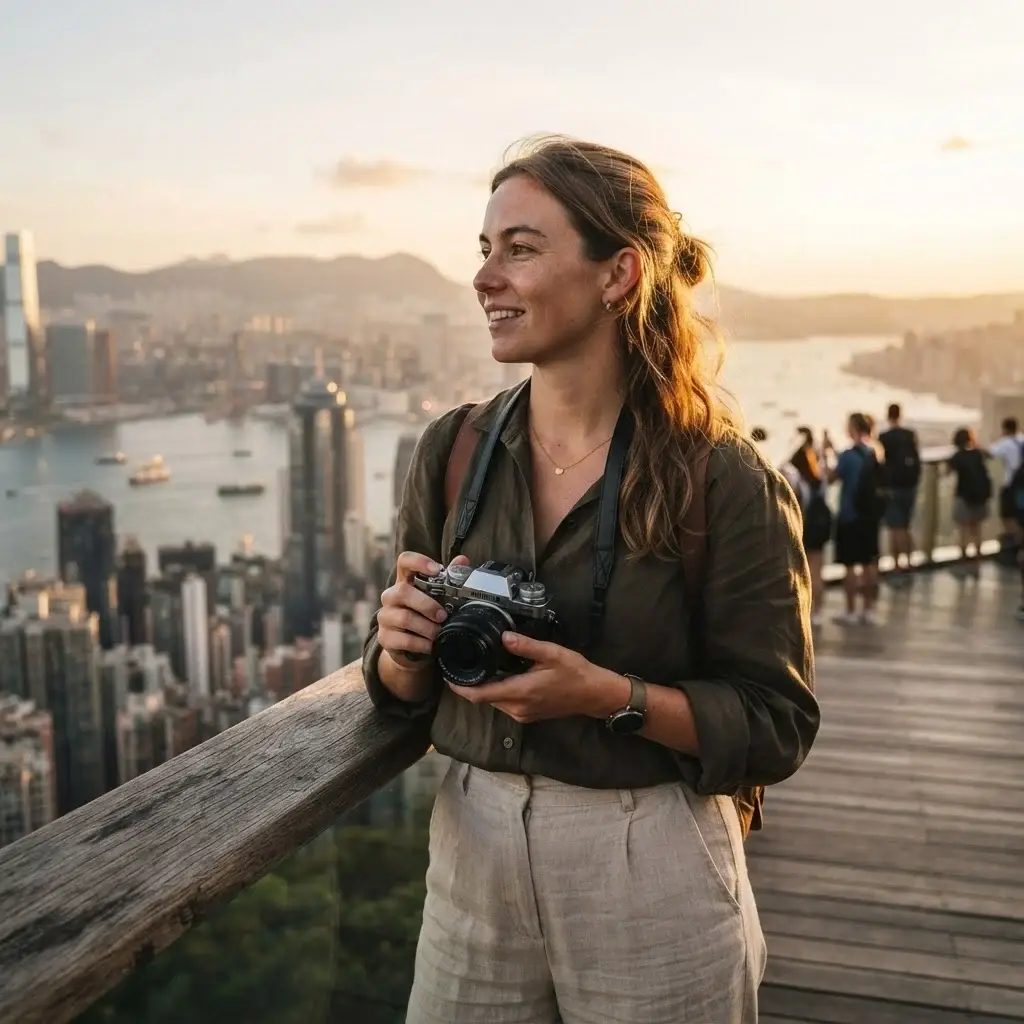
Start your morning early to beat the massive tour buses. Your destination is Victoria Peak, the highest point on Hong Kong Island. It offers a classic view of the skyscrapers stretching down to the blue water of Victoria Harbour.
- How to get there: Take the MTR to Central Station and take Exit J2. Follow the clear signs along the sidewalk up the hill to the Peak Tram Lower Terminus on Garden Road. Skip the expensive sky terrace tickets at the top; the view from the free public viewing decks and the Lugard Road walking trail is actually better and completely free.
- Insider Secret: If the tram line is incredibly long, do what the locals do. Walk over to the Central Ferry Piers or Exchange Square bus terminus and hop on Bus 15. It costs a fraction of the tram ticket, has no lines, and winds up the steep mountain roads, giving you great views through the upper windows of the double-decker bus.
- What to eat: Grab a quick breakfast of pineapple buns (bo lo bao) at a local bakery near the station. Despite the name, these sweet, fluffy buns do not contain fruit. They get their name from the crunchy, checkered sugar crust on top that looks like a pineapple. Order it with a thick slab of cold butter stuffed inside.
Afternoon: Central-Mid-Levels Escalators and Old Central
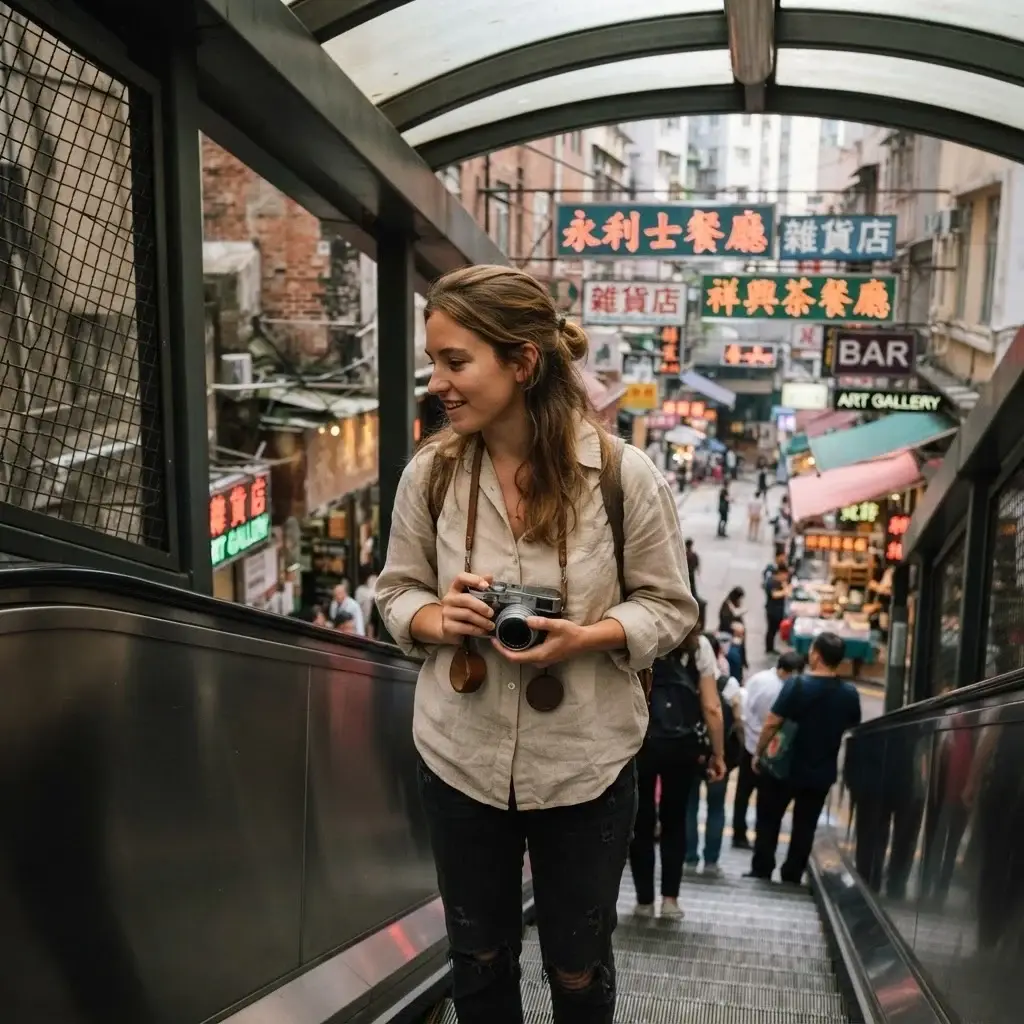
After riding back down the mountain, make your way over to the Central-Mid-Levels Escalator. This is the longest outdoor covered escalator system in the entire world. It was built to help commuters move up and down the steep hillsides between the residential Mid-Levels and the financial district down below.
- How to get there: From the bottom of the Peak Tram, walk west along Queen’s Road Central until you hit Cochrane Street. You will see the elevated escalators running right above the road.
- What to do: Step onto the escalator and let it carry you uphill through the changing neighborhoods. You can hop off at different levels to explore SoHo (South of Hollywood Road), which is packed with small art galleries, historic brick buildings, and cool cafes. Stop by the Tai Kwun Centre for Heritage and Arts, a beautifully restored old police station and prison complex that hosts free cultural exhibits.
Evening: Tram Rides and a Dim Sum Feast
As the sun starts to set, head back down to the main main road on Hong Kong Island to experience the historic double-decker trams, affectionately called “Ding Dings” by the local residents because of the sound of their warning bells.
- How to get there: Find any tram stop in the middle of Des Voeux Road Central. Step on through the rotating gate at the back of the tram, grab a seat on the top deck next to an open window, and watch the neon signs slide past. You pay a flat, very cheap fee using your Octopus Card at the front door only when you step off the tram.
- What to eat: Take the tram east toward the Wan Chai neighborhood for dinner. Look for a traditional, no-nonsense dim sum restaurant. Point to the menu to order steamed pork dumplings (siu mai), barbecue pork buns (char siu bao), and crispy spring rolls. Pour yourself hot tea from the ceramic pot on your table; it is custom to rinse your chopsticks and bowl with the first pour of hot tea into a large plastic scrap bowl provided by the staff.
Day 2: Deep Cultural Immersion in the Heart of Kowloon
Today we are crossing Victoria Harbour over to Kowloon, the peninsula located directly north of Hong Kong Island. If the island is the financial brain of the city, Kowloon is its beating cultural heart. It is crowded, loud, historic, and completely thrilling.
Morning: Tsim Sha Tsui Promenade and Heritage Walks
Begin your day at the southern tip of Kowloon in an area called Tsim Sha Tsui. This waterfront area offers a panoramic view looking back at the skyscrapers of Hong Kong Island.
- How to get there: Go to the Central Ferry Pier on Hong Kong Island and board the historic Star Ferry. This green and white ferry boat has been carrying passengers across the harbor since the late 1800s. Tap your Octopus Card at the turnstile. Sitting on the wooden benches while the sea breeze hits your face is one of the greatest travel experiences on earth, and it costs less than a dollar.
- What to see: Step off the ferry at Tsim Sha Tsui and walk along the Avenue of Stars, which honors the famous icons of Hong Kong cinema, including a large bronze statue of Bruce Lee. Take a moment to view the historic Clock Tower, a beautiful red-brick remnant of the old railway station that once connected this harbor all the way to Europe via the Trans-Siberian railway.
Afternoon: The Sensory Overload of Mong Kok Markets
Next, we are heading north into Mong Kok, one of the most densely populated places on the planet. This area is a wonderland of street markets, neon signs, and local specialty shops.
- How to get there: Hop on the MTR red line from Tsim Sha Tsui Station and ride it north to Mong Kok Station. Take Exit E2.
- What to explore: Walk down Tung Choi Street, better known to travelers as the Ladies’ Market. This crowded pedestrian street is packed with hundreds of outdoor stalls selling clothes, souvenirs, bags, and fun trinkets. Remember to smile and bargain politely if you want to buy something; the vendors expect it. Just a few blocks away, you can find the Goldfish Market on another section of Tung Choi Street, where beautiful tropical fish hang in clear plastic bags beneath bright lights, waiting for locals to buy them for good luck.
- Culinary tip: Keep your eyes peeled for a shop with a long line of locals waiting on the sidewalk. This is where you try authentic street snacks. Order curry fish balls on a bamboo skewer or a warm, bubble-shaped egg waffle (gai daan zai) that is crispy on the outside and wonderfully soft on the inside.
Evening: Temple Street Night Market and Claypot Rice
As night falls, the energy shifts south toward the Jordan neighborhood, where the famous Temple Street Night Market comes to life under strings of bright lights.
- How to get there: Walk south from Mong Kok along Nathan Road for about fifteen minutes, or take the MTR down to Jordan Station and use Exit A.
- What to do: Temple Street is famous for its lively outdoor atmosphere. You will pass rows of market stalls, open-air fortune tellers, and street musicians singing traditional Chinese opera melodies. It is the perfect place to sit down on a plastic stool right on the sidewalk at an outdoor food stall, known locally as a dai pai dong.
- What to eat: Order a steaming bowl of claypot rice (zaa sye fan). The chef cooks rice, marinated chicken, and savory Chinese sausage inside a traditional clay vessel over an open flame. Pour the sweet soy sauce over the top when it arrives, put the lid back on for two minutes to let it steam, and then scrape up the crunchy, caramelized rice layer at the very bottom of the pot. It is pure comfort food.
Day 3: Lantau Island—Giant Buddhas and Slow Fishing Villages
After two intense days of neon signs, crowded trains, and towering concrete skyscrapers, you are probably craving some open green space. Today we are headed west to Lantau Island, a massive island covered in rugged green mountains, quiet sandy beaches, and ancient monasteries.
Morning: Soaring Over Mountains on the Ngong Ping 360
Our first stop on Lantau is the mountain village of Ngong Ping, home to the famous Po Lin Monastery and the majestic Tian Tan Buddha statue.
- How to get there: Take the MTR Tung Chung Line all the way to its final stop at Tung Chung Station. Take Exit B. From there, walk two minutes to the Ngong Ping 360 Cable Car terminal.
- The Experience: Book your cable car ticket online in advance to skip the massive morning ticket lines. If you are feeling adventurous, pay a little extra for the “Crystal Cabin,” which features a thick, completely clear glass floor. The 25-minute cable car ride glides high over the blue waters of the bay, skims past the green peaks of Lantau North Country Park, and offers a beautiful view of the massive Hong Kong-Zhuhai-Macau Bridge stretching across the ocean.
- What to see: Step out of the cable car at Ngong Ping Village and walk up the 268 stone steps to the base of the Tian Tan Buddha. This massive bronze statue sits quietly facing north, watching over the people. Afterward, walk across the plaza to explore the Po Lin Monastery. The main prayer halls are filled with colorful wood carvings, golden statues, and the fragrant scent of burning incense coils hanging from the ceiling.
Afternoon: Stilt Houses and Street Food in Tai O Village
Instead of heading straight back down to the city after your mountain walk, take a short bus ride from the Ngong Ping terminal down to the coast to visit Tai O, an ancient fishing village built completely on stilts over the tidal mudflats.
- How to get there: Walk to the Ngong Ping Bus Terminus located right next to the cable car exit. Board Bus 21, which winds down the mountain roads directly to the Tai O bus terminus in about twenty minutes.
- What to explore: Tai O feels like a portal into a completely different era of history. The local Tanka fishing community has lived in these wooden stilt houses for generations. Walk along the narrow pedestrian pathways and cross the small iron drawbridges.

- You will smell salted fish drying on bamboo mats under the warm sun. Take a cheap, fifteen-minute boat ride from the local pier; the operators will steer you through the stilt canals and out into the open bay, where you might catch a rare glimpse of the local pink dolphins playing in the water.
- What to eat: Tai O is a paradise for adventurous food lovers. Look for the small street stalls selling giant, bouncy squid stewed in a rich orange curry sauce, or large sweet taro balls fried right in front of you. Do not leave without trying a hot Chinese sugar donut (saat kei ma) or a giant egg waffle cooked over real charcoal flames for a smoky flavor you cannot find in the city center.
- Getting back: When you are done exploring, walk back to the main Tai O bus terminus and board Bus 11. This bus will take you directly back to Tung Chung MTR Station, where you can hop on the train back to Kowloon or Hong Kong Island.
Day 4: Finding Calm on the Quiet Coast of Hong Kong
Today is all about slow travel. Many first-time visitors rush through the city center and assume Hong Kong is nothing but concrete. Today we are exploring the rugged southern coast of Hong Kong Island to see how the locals relax.
Morning: Chasing History in Aberdeen Harbour
Start your morning by traveling to Aberdeen, a historic harbor area located on the south side of Hong Kong Island that was once a primary port for local fishing fleets.
- How to get there: Take the MTR South Island Line to Wong Chuk Hang Station. From Exit B, it is a short, ten-minute walk down to the Aberdeen Promenade waterfront.
- The Experience: Walk along the harbor walls to see traditional wooden junk boats floating next to modern luxury yachts. Find one of the local boat captains offering tours on a traditional sampan water taxi. For a small fee, they will steer you through the floating village community, giving you an up-close look at the houseboats where some families still live full-time on the water.
Afternoon: Repulse Bay and Stanley Market
After your harbor cruise, continue your journey east along the coast toward the seaside village of Stanley.
- How to get there: From the Aberdeen Promenade, walk to the main bus stop on Aberdeen Main Road and board Bus 73 or 973 heading east. The bus route winds along coastal cliffs, offering beautiful views of the South China Sea.
- Where to stop: Get off the bus early at Repulse Bay to feel the soft sand between your toes. This wide, crescent-shaped beach is a popular weekend escape for locals. Walk to the eastern end of the beach to explore the colorful Kwun Yam Temple, which features large, mosaic-tiled statues of Taoist deities protecting the local fishermen.
- Exploring Stanley: Hop back on the bus and continue to the final stop at Stanley. Walk through the narrow alleys of Stanley Market, which is famous for its relaxed shopping environment selling linen clothes, hand-painted artwork, and local souvenirs. Afterward, walk down the historic Stanley Waterfront Promenade, find a quiet outdoor table at a seaside cafe, and enjoy a cold glass of iced milk tea while watching the waves crash against Blake Pier.
Day 5: Crossing the Pearl River to Historical Macau
Pack a small overnight bag, because today we are leaving Hong Kong behind and catching a high-speed ferry across the wide Pearl River Delta to Macau. Long known as a global gaming center, Macau is actually a beautiful cultural tapestry where old Portuguese architecture sits directly alongside traditional Chinese temples.
Morning: Mastering the High-Speed Ferry
The journey to Macau is smooth, fast, and incredibly scenic if you know the right steps to take.
- How to get there: Take the MTR to Sheung Wan Station on Hong Kong Island and take Exit D straight into the Shun Tak Centre. Go to the upper floors to find the Hong Kong-Macau Ferry Terminal. Buy a ticket for the red TurboJET ferry or the blue Cotai Water Jet ferry. The boats run roughly every thirty minutes, and the journey across the open ocean takes just about one hour.
- Border Controls: Remember that you are technically exiting Hong Kong and entering a different administrative region. You will go through passport control before boarding the ferry in Hong Kong, and you will clear customs again when you step off the boat at the Macau Outer Harbour or Taipa Ferry Terminal. Keep your passport out and ready.
Afternoon: Walking Through Portuguese-Chinese History at Senado Square
Welcome to Macau. Step out of the ferry terminal and hop on one of the free hotel shuttle buses heading to the city center, or take a local taxi straight to Senado Square, the historic heart of the city.
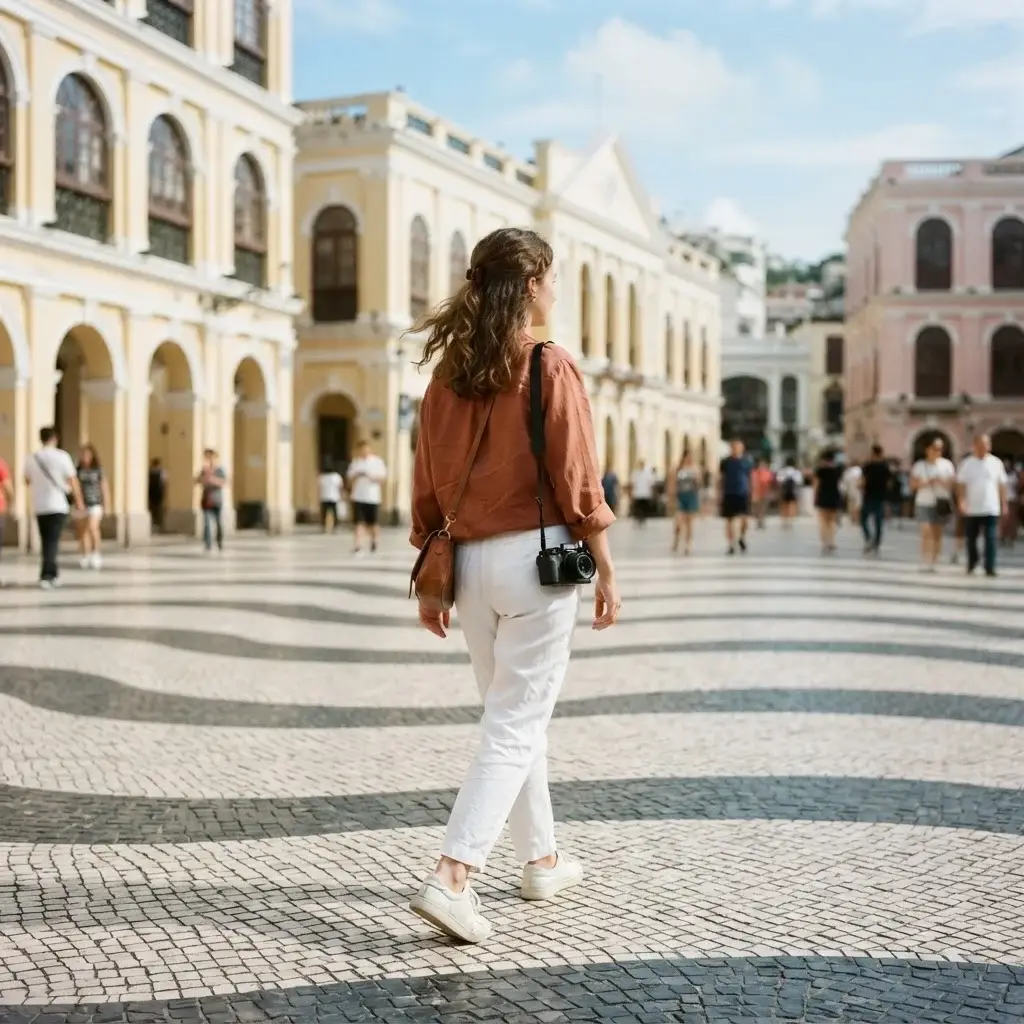
- The Experience: Senado Square will make you feel like you have suddenly dropped out of Asia and landed directly in southern Europe. The ground is paved with beautiful, wave-patterned stone mosaics created by Portuguese artisans, and the square is surrounded by bright yellow and pink colonial buildings.
- The Historic Route: Walk through the pedestrian zone from Senado Square up the hill. You are walking through a recognized world heritage area. If you want to dive deeper into the preservation of these unique colonial structures and global monuments, you can read more about the architecture on the UNESCO World Heritage Centre cultural properties registry.
- The Ruins of St. Paul’s: Follow the pedestrian signs up the stone paths to the iconic Ruins of St. Paul’s. Built in the early 1600s by Jesuit missionaries, the church caught fire during a massive typhoon in 1835. Today, only the beautiful, intricately carved stone front facade remains standing on top of a grand stone staircase. Walk around to the back of the facade to look down into the original foundations and visit the quiet crypt down below.
- What to eat: The alleys leading up to the ruins are lined with local shops offering free samples of fresh Macau almond cookies and warm, savory sheets of dried meat jerky. For lunch, look for a small bakery selling authentic Portuguese egg tarts (pastel de nata). These tarts feature a flaky, puff-pastry crust filled with rich, creamy egg custard that is baked until the top is beautifully blistered and caramelized. Eat them while they are burning hot.
Day 6: Taipa and Coloane—The Side of Macau Most People Miss
Most day-trippers only see the main historic square before heading back to Hong Kong. Today, we are exploring the southern islands of Macau—Taipa and Coloane—to experience a completely different, relaxed side of local life.
Morning: Pastel Buildings and Food Trails in Old Taipa
Start your morning by traveling south across the long concrete bridge to Taipa Village, a beautifully preserved neighborhood where traditional Chinese temples sit on the same narrow streets as pastel-colored Portuguese villas.
- How to get there: From your hotel in the city center, take local Bus 11, 22, or 33 straight to the Taipa Village bus stop.
- What to see: Walk along the narrow pedestrian path of Rua do Cunha. This street is a dream for food lovers, packed with historic bakeries and small stalls. Walk over to the Taipa Houses-Museum, a row of five beautiful, mint-green colonial houses built along the water in the early 1900s that once housed high-ranking local officials. They have been fully restored to show what daily life looked like during the colonial era.
- What to eat: Try a famous Macau pork chop bun (chu pa bao). Local chefs marinate a tender pork chop in garlic and five-spice powder, fry it until crispy, and stuff it inside a freshly baked, crusty Portuguese roll with no vegetables or sauces. It is simple, crunchy, and packed with flavor.
Afternoon: The Quiet Fishing Vibe of Coloane Village
From Taipa, travel further south to Coloane Village, the southernmost point of Macau. This area has completely escaped modern development and retains the quiet charm of an old coastal village.
- How to get there: Hop on Bus 21A, 25, or 26A from Taipa and ride it south to the final stops in Coloane Village.
- What to explore: Walk along the waterfront Avenue de Cinco de Outubro, looking across the narrow channel to the hills of mainland China just a few hundred yards away. Visit the Chapel of St. Francis Xavier, a bright yellow church built in 1928 that sits behind a quiet stone monument celebrating a historic victory over local pirates.
- The Ultimate Tart Pilgrimage: Coloane is the birthplace of Macau’s famous egg tart revolution. Walk to the original Lord Stow’s Bakery located right near the village square. Lord Stow opened this small shop in 1989, and it is where the famous recipe was perfected. Buy a box of six tarts, walk down to the stone seawall, and enjoy them while watching the fishing boats float past in the breeze.
Day 7: Sham Shui Po and Finding the True Local Soul
Catch an early morning ferry back across the river to Hong Kong. For your final day, we are bypassing the glossy shopping malls and financial towers to visit Sham Shui Po, a working-class neighborhood in northern Kowloon that shows you exactly what everyday life looks like for local residents.
Morning: Electronic Havens and Vintage Finds
Sham Shui Po is famous for its incredible street markets, electronics shops, and historic residential buildings. It feels completely authentic, unpolished, and intensely alive.
- How to get there: From the ferry terminal, take the MTR straight to Sham Shui Po Station and take Exit C2 to step right into the middle of the street markets.
- Where to walk: Explore the Appliancce Street market on Apliu Street. This outdoor street market is packed with stalls selling every electronic component, vintage camera lens, power cable, and unique mechanical tool you could ever imagine. It is a dream for anyone who loves diagnostics or seeing how things work behind the scenes. Just a few blocks away, you can explore Fuk Wing Street, which is lined with colorful toy shops and local stationery stores.
Afternoon: Final Pastries and Departure Reflection
Use your last afternoon to soak in the smells and sounds of the city, and to enjoy one final, legendary local meal before heading to the airport.
- What to eat: Sham Shui Po is home to some of the cheapest Michelin-recommended food on earth. Find the local Tim Ho Wan restaurant on Fuk Wing Street or hop into a traditional local bakery. Order steamed rice rolls (cheong fun) doused in sweet soy sauce, sesame sauce, and sweet roasted peanut paste. Wash it down with a final cup of hot milk tea.
- Final Reflection: As you pack up your bags and take the high-speed Airport Express train back to the terminal, look out the window at the green mountains and blue water sliding past. Remember how you felt a week ago before you boarded the plane—the worry, the hesitation, the uncertainty. You just navigated one of the most dynamic transit systems and complex urban environments on earth completely on your own. That confidence is yours to keep, and it will stay with you long after your passport stamps begin to fade.
Essential Tips for the Solo First-Timer
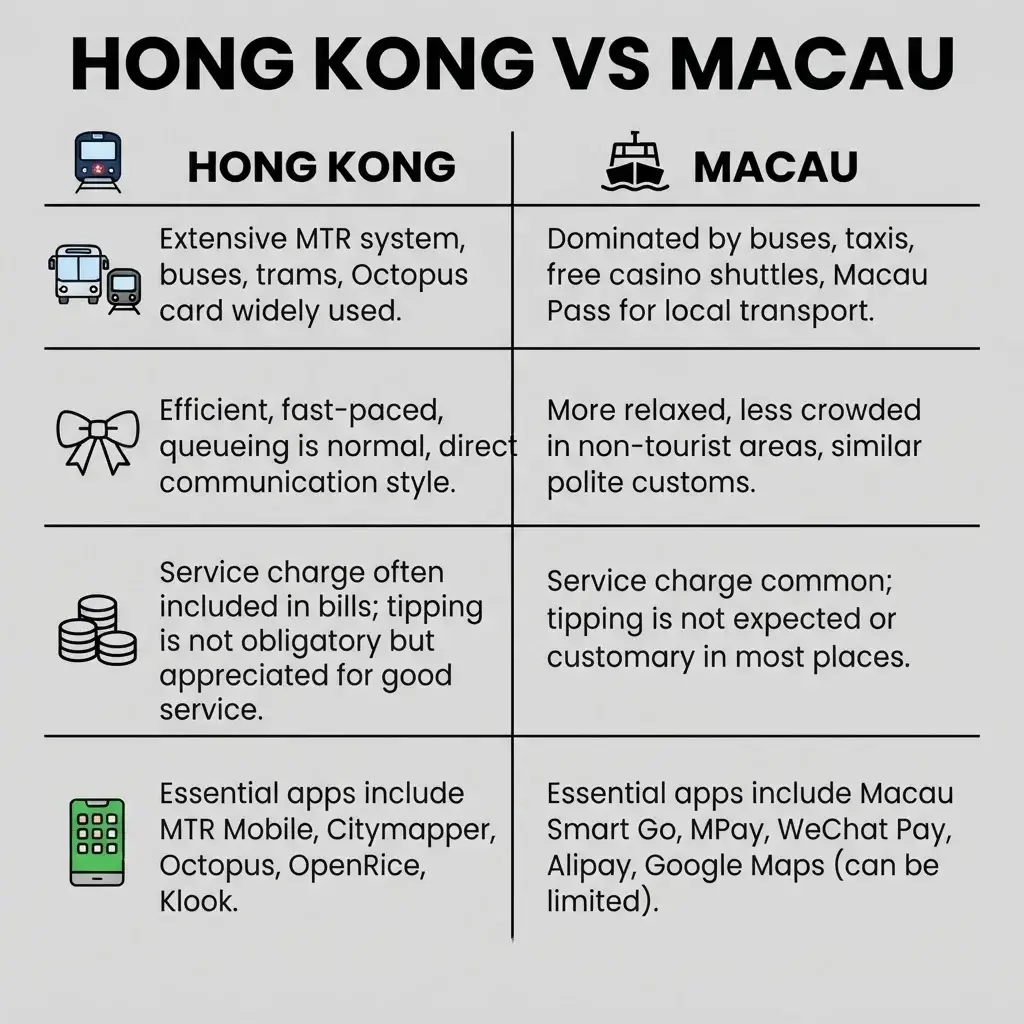
To make sure your adventure goes off completely without a hitch, here is a quick, practical cheat sheet of insider rules that I live by whenever I am on the ground in these two cities:
| Topic | Hong Kong Advice | Macau Advice |
| Primary Transit | Use the MTR subway trains; they are fast, spotless, and clearly labeled in English. | Use the public buses or the free hotel shuttle buses parked outside the ferry terminals. |
| Escalator Rules | Always stand firmly on the right side of the escalator; leave the left side open for people rushing past. | Same as Hong Kong, but the overall pace of walking is much slower and more relaxed. |
| Tipping Custom | Tipping is not expected at local street stalls; high-end restaurants will add a automatic 10% service charge. | Tipping is not expected; small change left behind at local cafes is always appreciated. |
| Best Mobile App | Download Citymapper or Google Maps for live public transit routing and platform exits. | Download the Macau Bus traveling app or use Google Maps to track local bus numbers. |
Before you step out into any new country, it is always a smart idea to read up on basic safety mindset strategies. For a fantastic foundation on how to prepare for your first independent international trip, I always suggest checking out the general trip planning advice and country overviews on Lonely Planet to get a feel for local customs.
If you ever feel nervous while walking down a busy street, just remember my favorite travel rule: confidence grows through action. The world rewards curiosity and courage. Stop waiting for a hypothetical perfect moment in the future. Pack your bags, buy your tickets, and step out into the adventure.