When I first left my office job in New York, the thought of being sick in a foreign country was one of my biggest fears. I remember sitting at my desk, staring at a spreadsheet, wondering how I would manage if I suddenly felt unwell in the middle of a trip. Would I know where to find a pharmacy? Would I be able to explain my symptoms in a language I didn’t speak? Would I be stranded in my hostel room for days?
Those fears were loud. They kept me from booking my first solo flight for months.
Then, I started to change how I viewed travel. I realized that the “perfect” time to travel doesn’t exist, and the same goes for a perfect, risk-free trip. I wasn’t going to find safety in an office cubicle, but I could find it in preparation. Once I learned the art of packing a travel first-aid kit, my mindset shifted. I stopped seeing sickness as a terrifying, unpredictable “what if” and started seeing it as a manageable part of life on the road.
If you are currently feeling that same nervous flutter in your stomach, know that you aren’t alone. You don’t need to be a doctor or carry an entire hospital in your luggage to feel secure. You just need a thoughtful, practical system.
The Philosophy of Being Prepared
Travel is about growth and stepping beyond your comfort zone. But there is a fine line between stepping out of your comfort zone and being reckless. For me, confidence is built through action. When I pack my medical bag, I’m not planning for the worst; I am preparing to handle the little bumps in the road so that they don’t turn into trip-ending disasters.
My philosophy is simple: keep it light, keep it organized, and focus on the basics. I have learned the hard way that when you are moving from a train in Europe to a bus in Southeast Asia, you don’t want to be dragging heavy, oversized containers of medicine.
Before you start tossing things into a bag, take a moment to look at the CDC Travelers’ Health portal. It is an incredible resource for understanding the specific health risks and vaccination requirements for the regions you plan to visit, which should be the very first step in deciding what actually needs to go into your kit.
The Foundation: Your Personal “Must-Haves”
The core of your kit should be based on your personal health needs. If you take daily medications, this is non-negotiable. I always keep my prescription meds in their original packaging with the pharmacy label clearly visible. I also carry a copy of my prescription with the generic drug name—not just the brand name—because brand names change across borders.
Beyond your daily needs, consider these staples that have saved me on more than one occasion:
- Pain and Fever Relief: Pack a mix of acetaminophen (Tylenol) and ibuprofen (Advil). They handle different types of pain, and having both is a lifesaver.
- Antihistamines: Whether it is seasonal allergies or an unexpected reaction to a local plant, a standard antihistamine like diphenhydramine (Benadryl) or loratadine (Claritin) is essential.
- The “Tummy” Toolkit: Travel—especially when you are eating adventurous local street food—can be hard on your digestion. I always carry loperamide (Imodium) for emergencies, and rehydration salts. If you are heading somewhere with a high risk of foodborne illness, the US Department of State Travel website offers excellent general advice on safety and local conditions that can help you gauge the level of caution you need to take when choosing where and what to eat.
Beyond Medicine: The Practical Gear
A first-aid kit is more than just pills. It is also about addressing the physical cuts, scrapes, and blisters that happen when you are walking 15,000 steps a day to see a city.
I once spent three days in Thailand teaching English, and I made the mistake of wearing brand-new shoes. By the end of the first day, I had blisters that made walking nearly impossible. Now, I never travel without high-quality blister pads. They aren’t just bandages; they provide a cushion that lets you keep exploring rather than being sidelined.
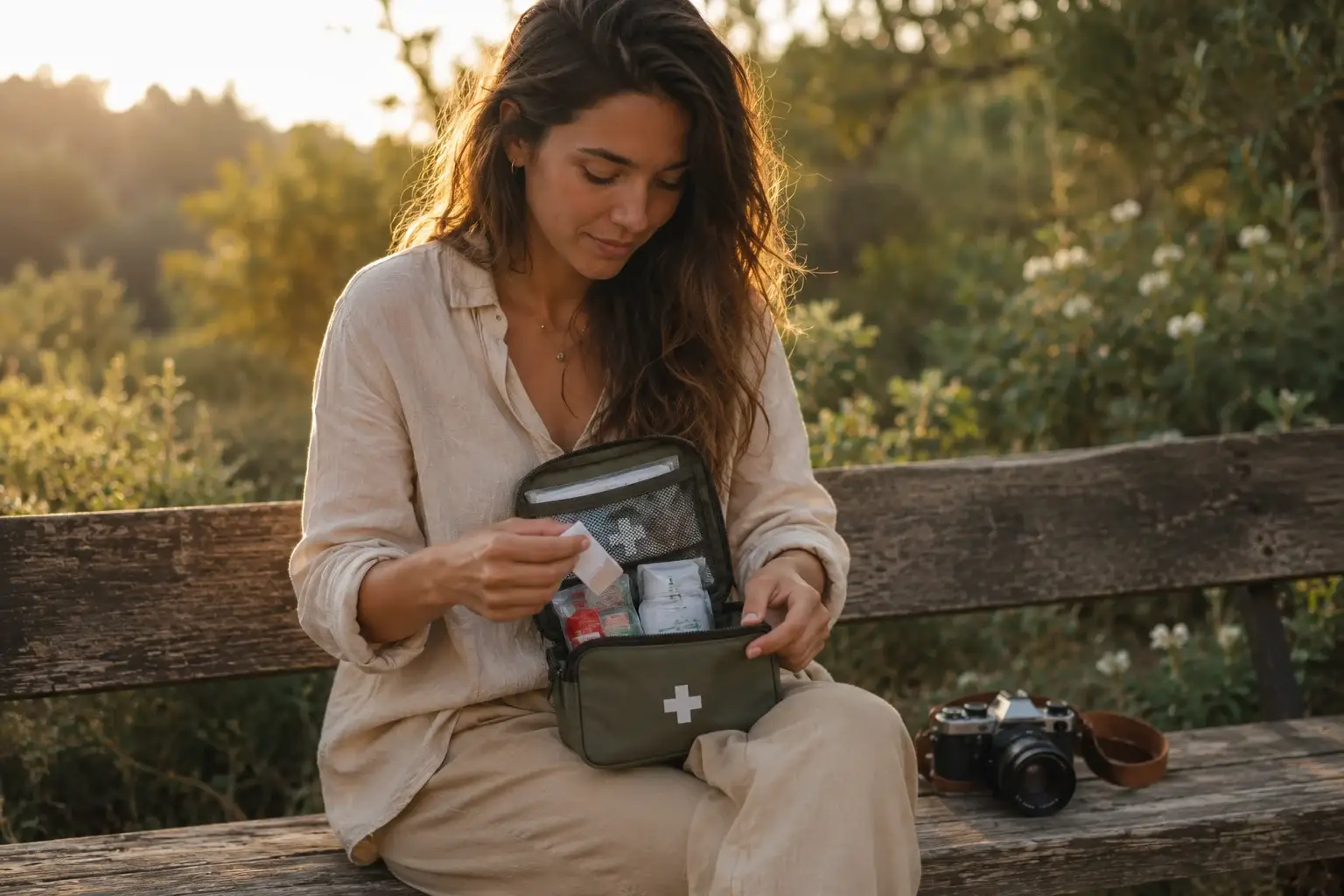
Here is what I always keep in my “physical care” pouch:
- Adhesive bandages: A variety of sizes for small nicks.
- Antiseptic wipes: For cleaning minor scrapes before bandaging them.
- Medical tape and gauze: For anything that needs a bit more coverage.
- Tweezers: These are surprisingly useful for everything from splinters to ticks.
Whenever I am planning to visit a place with a lot of outdoor activity or hiking, I check out the Lonely Planet destination guides to get a feel for the terrain. Knowing whether I am going to be walking on paved city streets or trekking through rugged, dusty paths helps me decide how many bandages to pack.
Organizing for the Road
The best first-aid kit is the one you actually use. If it is buried at the bottom of your backpack in a tangled mess, it is useless. I use a small, clear, zippered pouch. Being able to see what is inside without dumping everything out is a massive time-saver.
I also label everything. Even if I know what the bottle says, when I am tired or feeling under the weather, I don’t want to play a guessing game. Use a permanent marker to write the expiration date on the outside of each package. Medicine does expire, and it is a good habit to rotate your stock every few months.
If you ever feel overwhelmed by the process, remember that most major cities have pharmacies that are just as well-stocked as the ones back home. You don’t need a three-year supply. You just need enough to get you through 48 hours, which gives you plenty of time to find a local shop if you need a refill.
Dealing with Challenges: A Part of the Journey
One of the biggest lessons I learned from my time as a sightseeing guide in New York is that things rarely go exactly to plan. People get dehydrated, they trip, they lose their hats, and sometimes they get a bit of a stomach bug. It happened to my tourists constantly.
When you are solo, you have to be your own guide, which means taking care of your health with the same attention you give to your itinerary.
For example, when I lived in Thailand, I found that the heat was my biggest enemy. I had to learn how to keep my energy levels up and my body hydrated. If you are exploring the Tourism Authority of Thailand sites for travel tips, you will see a lot of emphasis on the culture of care and hospitality, which also applies to how you should treat yourself on the road. Drinking plenty of water is the best first-aid you can ever have.
Sometimes, despite your best efforts, you might get sick. That is okay. It doesn’t mean you failed as a traveler. It means you are human. Allow yourself the grace to rest. Sometimes a day in bed with a book is just as much a part of a “real” travel experience as a day hiking a mountain.
Safety and Insurance: The Ultimate Safety Net
Packing a kit is proactive, but having a safety net is the final piece of the puzzle. I never leave home without travel insurance. It isn’t just about covering costs; it is about having a number to call when you are confused, scared, or in pain.
I recommend looking at the World Nomads Travel Insurance guides to understand what kind of medical coverage makes sense for your specific trip style. Knowing that there is a professional team who can help coordinate care if you need a hospital or a doctor’s visit can take a massive amount of weight off your shoulders. It transforms travel from something that feels dangerous into something you can manage.
Managing Your Energy and Expectations
I often talk to people who are terrified of getting sick because they think it will ruin their trip. They want everything to be perfect. But I have found that some of my most memorable moments came after things didn’t go according to plan.
When I was backpacking in Europe, I got a terrible cold in a small, beautiful village. I had to stay in my room for two days. I spent those days drinking tea, writing in my journal, and talking to the local family who ran the guesthouse. I learned so much about their life, their history, and their traditions in those two days of “stuck” time than I would have if I had been out rushing to see museums.
Your first-aid kit is there to help you recover faster, but it is also a sign that you are a resilient traveler. It is a tool for self-reliance. When you know you can handle a headache, a blister, or a stomach ache on your own, your world gets a lot bigger. You become less dependent on finding the perfect, sanitized environment and more confident in your ability to survive and thrive anywhere.
The “Just in Case” Mindset
Some travelers feel like they need to be prepared for every single medical scenario. They pack antibiotics, heavy-duty pain killers, and surgical supplies. While it is good to be prepared, don’t let the “what ifs” paralyze you.
Your goal is to be self-sufficient for basic needs. For everything else, the world is full of people. Most people are kind and helpful. If you have an emergency that your kit cannot handle, ask for help. Go to the front desk of your hotel, ask your host, or flag down someone. The humanity of travel is one of the things I love most—people want to help others who are struggling.
A Final Thought on Your Journey
As you finish reading this and start gathering your supplies, take a breath. You are doing something brave. You are planning to step out into the world, to see new things, and to grow as a person.
The process of packing a travel first-aid kit is just the first step in that growth. It is a sign that you are taking responsibility for your own well-being. It is a small, practical act that builds a massive amount of confidence.
So, pack your kit. Include the essentials. Keep it light. And then, stop worrying about what might go wrong and start getting excited about everything that is going to go right. The world is waiting for you, and you are ready.