I still remember the feeling of standing in a tiny electronics shop in Bangkok, sweat dripping down my neck, completely overwhelmed by a wall of cameras I didn’t understand.
I had just left my teaching job in Thailand. I had a backpack, a budget, and a burning desire to document everything around me. But I had no idea what I was doing when it came to cameras. I asked the shop owner for help, pointed at something that looked small and friendly, handed over more cash than I should have, and walked out proud of myself.
That camera broke on day three. The lens jammed. I missed the most spectacular sunrise I have ever seen over the Chao Phraya River because I was fumbling with a piece of equipment that was never built for the kind of travel I was doing.
That mistake cost me money, memories, and a whole lot of frustration.
If you are standing at the edge of a trip — maybe your first solo adventure, maybe a long-dreamed-of journey — and you are trying to figure out which compact camera to bring, I want you to learn from what I got wrong before I eventually got it right.
This is not a product-ranking list. This is an honest, experience-first breakdown of the mistakes most travelers make when choosing compact cameras, what you actually need to think about, and how to walk away with something you will genuinely love using on the road.
Why Compact Cameras Still Matter in a Smartphone World
Before anything else, let’s talk about the elephant in the room.
Your phone takes great photos. I know. Mine does too. But when I guide readers through this question, I always say: your phone is a convenience, not a camera.
Compact cameras — the ones travelers actually carry — give you something your phone cannot easily replicate: a real optical zoom that does not destroy the image, a dedicated sensor designed for varying light conditions, and a physical control experience that slows you down just enough to notice what you are photographing.
When I was working as a sightseeing guide in New York, I watched hundreds of tourists snap photos of the Brooklyn Bridge and move on in seconds. They got the shot. But the people who raised a proper camera — even a simple compact — spent an extra minute. They framed the shot. They waited for the light. They actually looked at what they were capturing.
That is what a good compact camera gives you. It gives you presence.
It also gives you significantly better performance in low light, at zoom distances, and in fast-moving situations — like trying to catch a tuk-tuk weaving through a night market, or a child laughing in a village square in Ghana. These are the moments that define a trip. A blurry, grainy phone photo does not do them justice.
So yes, compact cameras still matter deeply. Especially for travelers who care about remembering what they actually saw.
Mistake #1: Choosing Based on Megapixels Alone
This is the single most common mistake I see travelers make, and camera marketing is almost entirely to blame for it.
Here is the truth: megapixels measure how large you can print a photo, not how good the photo looks.
A 20-megapixel camera with a tiny sensor will take a worse photo in a dim restaurant in Rome than a 12-megapixel camera with a larger, more light-sensitive sensor. Full stop.
What actually matters for travel photography is sensor size and aperture.
Sensor size determines how much light the camera collects. Larger sensors produce cleaner, richer images — especially in the low-light environments you constantly encounter while traveling: candlelit temples, cloudy afternoons, indoor markets, evening street scenes.
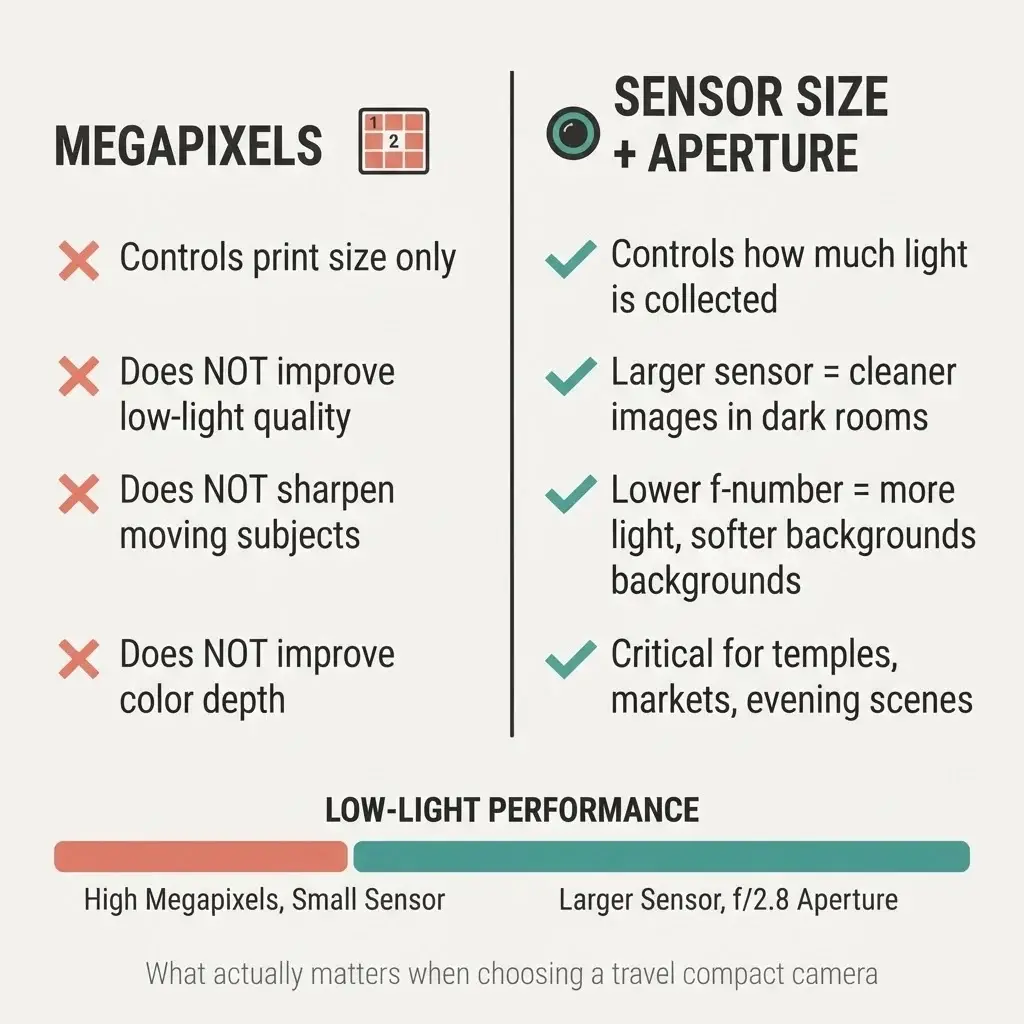
Aperture (the f-number) controls how much light enters the lens. A lens with an aperture of f/1.8 lets in dramatically more light than one at f/3.5. This difference is the reason one camera produces a beautifully sharp subject against a soft background at dusk, and another produces a murky mess.
When you are shopping, look at sensor size and maximum aperture first. Megapixels should be almost your last concern.
The cameras that consistently earn strong reputations among real travelers — not tech reviewers, but people actually carrying gear across continents — tend to have 1-inch sensors or larger and maximum apertures at or below f/2.8. Those two specs, more than anything else, separate genuinely useful travel cameras from attractive disappointments.
Mistake #2: Underestimating How Much Size and Weight Matter
I have carried cameras I loved in theory but hated by day five of a long trip.
A camera that feels light in a shop feels very different after eight hours of walking through cobblestone streets in Lisbon with it banging against your hip. Or after trying to fit it into a slim daypack alongside a water bottle, a phrasebook, and a rain jacket.
Travel cameras need to be genuinely pocketable or at minimum wristlet-sized. Not “small for a camera.” Actually small.
The best compact cameras for travel are ones you will actually take out of your bag. The moment a camera feels like a burden — too heavy, too conspicuous, too awkward — you stop reaching for it. And a camera you leave at the hotel is a camera that changes nothing about your travel experience.
When I backpacked through Europe in my early twenties, I carried a mid-range mirrorless camera that I absolutely loved. It also weighed over 700 grams with the lens. By week three, I was leaving it in my hostel locker and relying on my phone because my shoulders were done. I came home with beautiful photos of the first week and phone snapshots of the rest.
The lesson: honest travel photography happens with a camera you forget you are carrying.
Look for compact cameras that weigh 300 grams or under. Check the actual dimensions against your jacket pocket or your smallest bag compartment. If it does not fit comfortably there, reconsider.
Mistake #3: Ignoring Weather and Durability
Most compact cameras are not waterproof. Most compact cameras are not particularly rugged. And travel, by its nature, involves unexpected rain, sandy beaches, humid jungles, dusty markets, and the occasional accidental coffee spill.
I once watched a fellow traveler in Thailand — during Songkran, the Thai water festival — lose a camera to a bucket of water thrown in celebration.
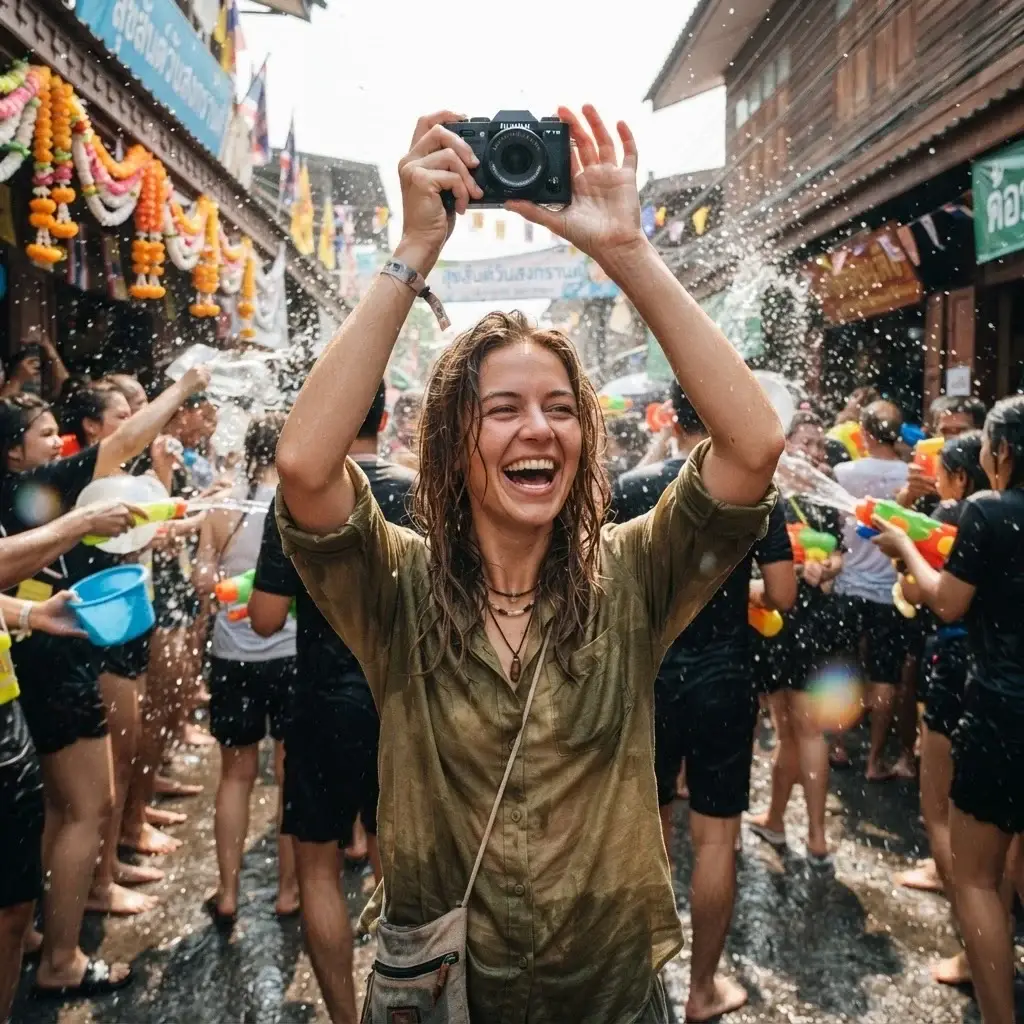
It was nobody’s fault. It was just a wet festival and a camera that was not built for it. If you want to see what Songkran is actually like before you decide what gear to bring, the Tourism Authority of Thailand’s official festival guide gives you a genuinely honest picture of what you are walking into.
If your travels involve beaches, boats, monsoon destinations, or any kind of active adventure — hiking, cycling, kayaking — look for cameras with at least some level of weather sealing, or invest in a purpose-built waterproof compact.
Weather-sealed cameras can handle splashes, light rain, and the general chaos of outdoor travel without complaint. Fully waterproof compacts can be submerged — useful for snorkeling destinations, river crossings, or any trip where you simply cannot predict what you will encounter.
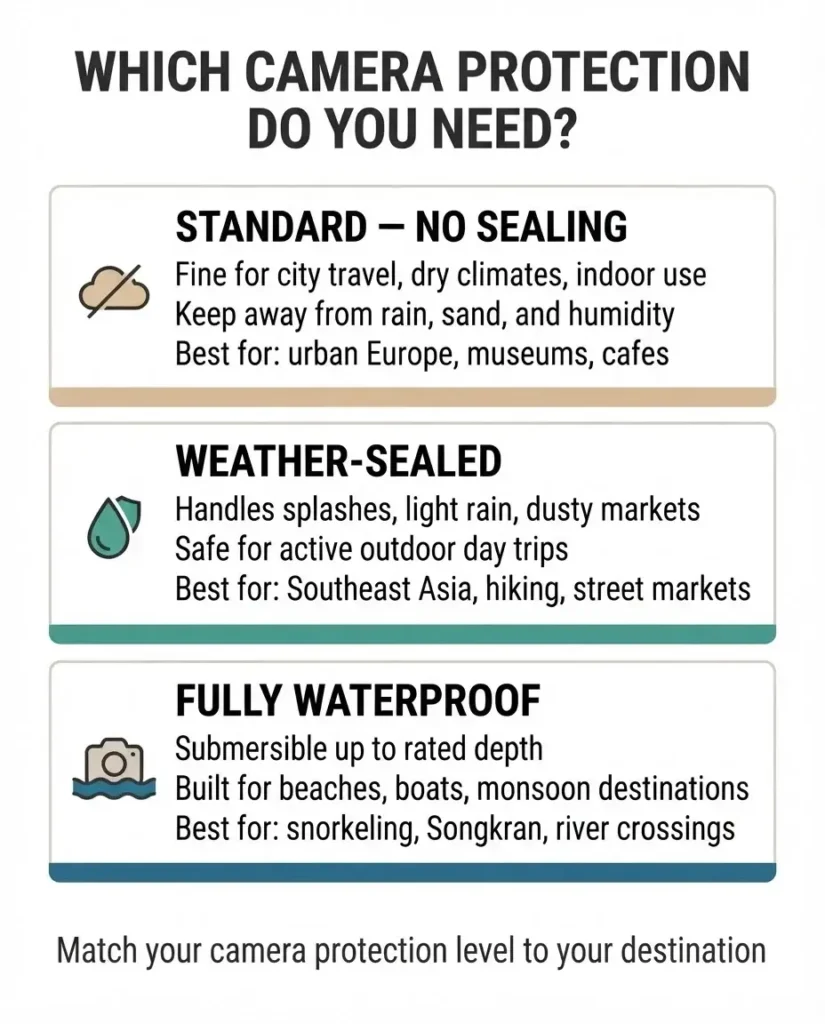
A camera that survives the whole trip is always better than a slightly better camera that does not.
Mistake #4: Forgetting to Think About Battery Life
Battery life on compact cameras varies enormously, and it almost never gets the attention it deserves until you are in the middle of nowhere watching your battery hit 10%.
Most compact cameras will give you somewhere between 200 and 400 shots per charge. That sounds like a lot until you are on a nine-hour day trip through Kyoto’s temples, taking photos every twenty minutes,

and you realize you have burned through a full charge by noon.
Before you buy, research the specific battery life rating for your camera. Then assume you will get somewhat less than that in real-world use — cold weather drains batteries faster, as does using the LCD screen heavily or reviewing photos constantly.
The solution is simple but often overlooked: always travel with at least one fully charged spare battery. Buy official or high-quality third-party batteries before you leave home. Finding the right battery in a small town in rural Vietnam or a village market in Ghana is not a reliable strategy.
Also check whether your camera charges via USB-C. This has become increasingly common among modern compacts, and it is genuinely wonderful — it means you can charge your camera from the same portable power bank you use for your phone, without carrying a separate wall adapter. On long travel days, this kind of flexibility is worth a lot.
Mistake #5: Buying a Zoom-Heavy Camera When You Do Not Need It
Optical zoom is genuinely useful. Being able to pull a distant mosque or a mountain peak closer without moving is a real travel advantage. But there is a significant difference between sensible zoom and the kind of megazoom that compromises everything else about the camera.
Ultra-zoom cameras — sometimes called bridge cameras — can reach 30x, 40x, even 60x optical zoom. They are impressive on paper. In practice, they tend to have smaller sensors that struggle in low light, they are larger and heavier than true compacts, and the extreme zoom range is genuinely useful only in specific circumstances.
Most travel photographers use zoom in the 3x to 10x range for the vast majority of their photos. Anything beyond that starts delivering diminishing returns in day-to-day travel shooting.
If you are going on a wildlife safari, a super-zoom camera might make real sense. If you are doing cultural travel, city exploration, food photography, landscapes, and street scenes — which describes the majority of what most travelers actually do — a camera with a 3x or 4x optical zoom and a better sensor will serve you more than a 30x zoom with a compromised image quality.
Match the zoom to your actual trip, not to your imagination of a future trip where you photograph distant leopards.
Mistake #6: Overlooking the Importance of Autofocus
Fast, accurate autofocus is one of those camera specs that only becomes obvious once you have experienced it failing you.
Slow autofocus means missed moments. A child running through a market. A bird lifting off a branch. A performer mid-motion at a festival. If your camera hunts for focus for two seconds before firing, those moments are gone.
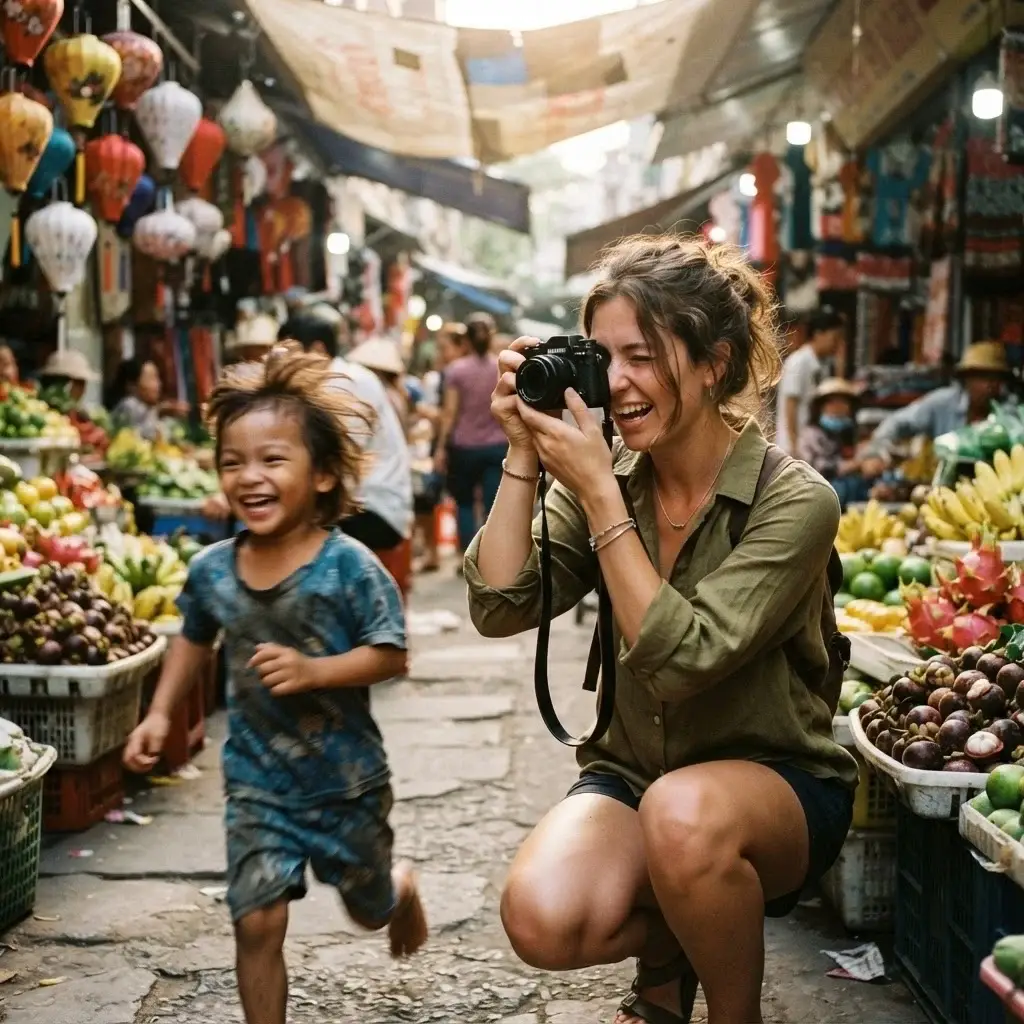
Modern compact cameras vary widely in autofocus performance. Budget models often use contrast-detect autofocus, which is reliable in good light but struggles in low light and with moving subjects. Better compact cameras use phase-detect or hybrid autofocus systems, which lock on faster and track moving subjects more reliably.
For travel photography specifically, look for cameras that offer face and eye detection — a feature that has become standard on even mid-range compacts in recent years. This makes portrait photography, candid shots of locals (with their permission), and street photography dramatically more consistent, because the camera automatically finds and locks onto human faces even as subjects move.
If you plan on photographing people, markets, festivals, or any kind of real-life travel action, autofocus quality is not a nice-to-have. It is essential.
Mistake #7: Skipping Research on Video Capabilities
Even if you think of yourself as a photo traveler, you will almost certainly wish you had recorded video at some point during your trip.
The way a coastal town sounds at dawn. The call to prayer echoing across the rooftops. A street musician playing something you have never heard before. These are experiences that photos cannot fully capture, and if your camera shoots poor video, you will regret not having it.
Most modern compact cameras shoot 4K video, which gives you beautiful, detailed footage with plenty of room to crop or stabilize in post-production. But resolution is only part of the story. Look for cameras that offer in-body image stabilization (IBIS) or lens-based optical stabilization for video — this is what separates smooth, watchable handheld footage from shaky, nauseating clips.
Also consider whether you want to shoot vertical video for social sharing. Some cameras now offer explicit vertical shooting modes, which is a genuinely practical feature if you document your travels on Instagram or TikTok.
You do not need cinematic capabilities. You need something that captures real moments smoothly and clearly. A compact camera with solid 4K video, good stabilization, and reliable autofocus in video mode will give you travel memories you can actually watch and share.
Mistake #8: Not Checking Connectivity Before You Buy
You took an incredible photo in a fog-covered mountain village. You want to share it. Your camera is sitting in your bag and your phone is in your hand, but getting that photo from one to the other feels like a technical puzzle.
This is a frustrating reality with some compact cameras, and it is entirely avoidable if you check connectivity features before you buy.
Look for cameras that offer built-in Wi-Fi and Bluetooth. Wi-Fi allows you to transfer photos to your phone wirelessly. Bluetooth allows the camera to maintain a low-power connection so transfers happen quickly without needing to go through a full Wi-Fi pairing process each time.
The best compact cameras for travel pair seamlessly with manufacturer apps — Sony’s Imaging Edge Mobile, Canon’s Camera Connect, Fujifilm’s XApp — which allow you to transfer specific photos, control the camera remotely, and back up your images without needing a cable or computer.
Before your trip, download and test your camera’s companion app at home. Make sure it works reliably with your specific phone model. A connectivity feature you have never tested is one you will not be able to troubleshoot when you are standing in a guesthouse in Chiang Mai with a two-hour transfer window before your flight.
Mistake #9: Ignoring the Total Cost of Ownership
The camera price is not the full price.
When I first started traveling seriously and began actually investing in photography, I made the mistake of budgeting only for the camera body.
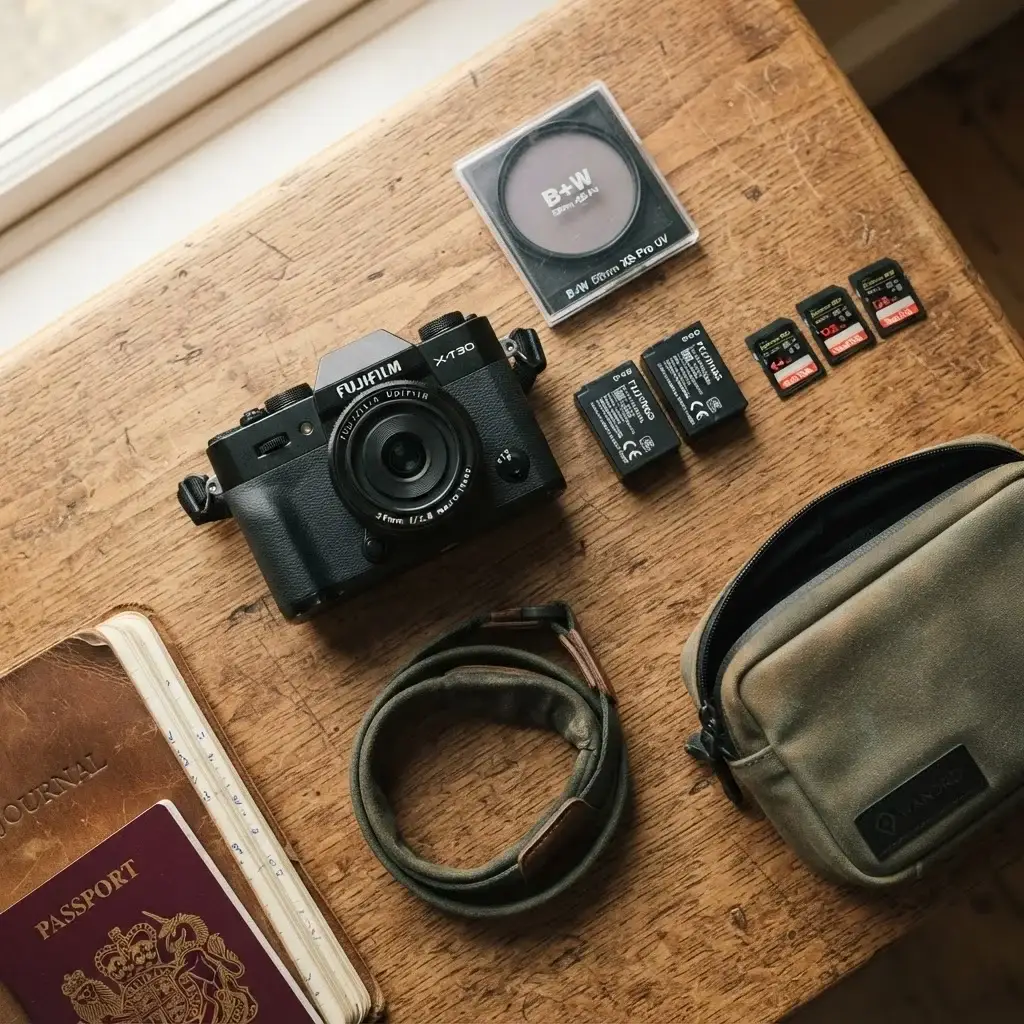
I did not account for:
Memory cards. Fast, reliable memory cards are not cheap. For travel, you want cards with high write speeds — at least 90MB/s — to handle bursts of photos and video recording. Buy two. Carry both. Losing a single card to corruption is devastating if it holds your only copies of a two-week trip.
Cases and protection. A camera without a case is a camera waiting to get scratched, cracked, or wet. Budget for a proper padded case or a weather-resistant pouch that fits your specific model.
Extra batteries. As discussed above, one battery is not enough. Budget for at least one spare, ideally two.
Lens filters. If your camera uses filter threads, a UV filter adds a layer of scratch and moisture protection to your lens for a very small cost. A polarizing filter is worth its weight in gold for outdoor photography — it cuts glare on water, deepens blue skies, and generally makes landscape photos dramatically more vivid.
Travel insurance that covers gear. This is something I feel strongly about. Your camera can be stolen, lost, or damaged in transit. Standard travel insurance does not always cover electronics specifically. Policies from providers like World Nomads, which cater explicitly to travelers and adventurers, often include gear coverage as part of their plans — and knowing your equipment is protected means you carry it more freely and stress less about the places you take it.
Add these costs to your camera budget before you finalize your purchase. The real cost of a great travel camera setup is usually $100–$200 more than the camera body alone.
Mistake #10: Buying Without Reading Your Destination’s Entry or Safety Context
This one sounds disconnected from cameras, but stay with me.
I have seen travelers arrive at a destination they researched poorly, realize the cultural or political context requires more caution than expected, and spend their whole trip anxious about pulling out their camera at all.
In some destinations, photographing military installations, government buildings, or religious sites without permission can lead to real trouble. In others, pointing a camera at local people without asking first is considered deeply disrespectful. In a few places, expensive visible camera equipment marks you as a target for opportunistic theft.
Before you travel anywhere, I always recommend checking the U.S. Department of State’s travel advisories for current safety context, entry requirements, and specific cultural guidance. For health-related travel preparation — including what vaccinations you need and any food or water safety concerns — the CDC Travelers’ Health page is one of the most reliable resources available.
Knowing your destination properly means you know how to carry your camera, when to put it away, and how to photograph with the kind of cultural sensitivity that earns you real access rather than closed doors.
What to Actually Look For: A Practical Buying Framework
Rather than recommending specific models — which change faster than I can update articles — here is the framework I use when evaluating any compact camera for travel:
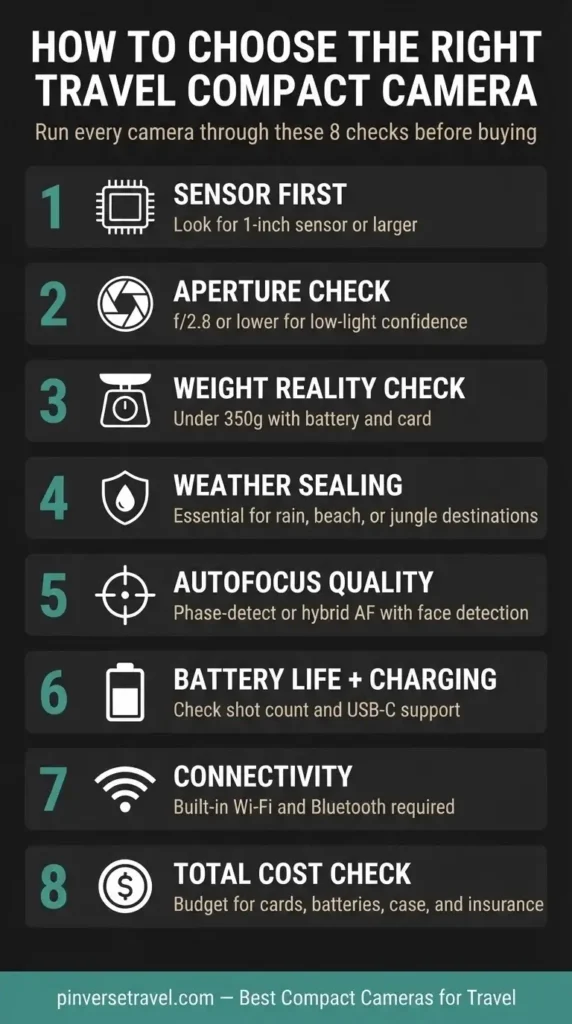
Step 1: Sensor first. Is it 1-inch or larger? If yes, you are starting from a strong foundation.
Step 2: Aperture check. Does the widest aperture reach f/2.8 or better? If yes, you will manage low-light situations confidently.
Step 3: Weight reality check. Does it weigh under 350 grams with the battery and card inserted? Will it fit in your smallest everyday bag without taking over?
Step 4: Weather sealing? If your destination involves rain, water, or dust, this moves from optional to essential.
Step 5: Autofocus quality. Does it have phase-detect or hybrid AF? Does it offer face or eye detection?
Step 6: Battery life and charging. How many shots per charge? Does it support USB-C charging? How easy is it to find spare batteries?
Step 7: Connectivity. Does it have Wi-Fi and Bluetooth? Does the companion app work reliably on your phone?
Step 8: Total cost check. Have you budgeted for memory cards, spare batteries, case, and insurance?
Run any camera you are considering through these eight checkpoints before you hand over a single dollar. If it clears all eight — or clears the ones that matter most for your specific trip — you have found your camera.
A Word About Budget
You do not need to spend a fortune to get an excellent travel compact.
The market right now is genuinely good for travelers at multiple price points. There are capable, well-reviewed compact cameras available in the $300–$500 range that will handle the vast majority of travel photography beautifully. There are also exceptional options in the $600–$900 range with larger sensors, better low-light performance, and superior build quality for travelers who shoot frequently or plan to use photos professionally.
What matters is that you buy the right camera for your travel style and destination, not the most impressive-sounding one or the one with the highest price tag.
I spent years making gear mistakes before I developed real clarity about what I actually needed. A camera that fits in your pocket, charges from your power bank, survives unexpected rain, and focuses fast enough to catch real moments will serve you better on the road than a technically superior camera you leave at the hotel because it is too heavy or too precious to risk.
The best compact cameras for travel are not the ones reviewed in tech magazines. They are the ones you actually have with you when the light turns golden and something extraordinary happens.
Before You Leave Home: Three Things to Do With Any New Camera
No matter which compact camera you choose, do these three things before your trip:
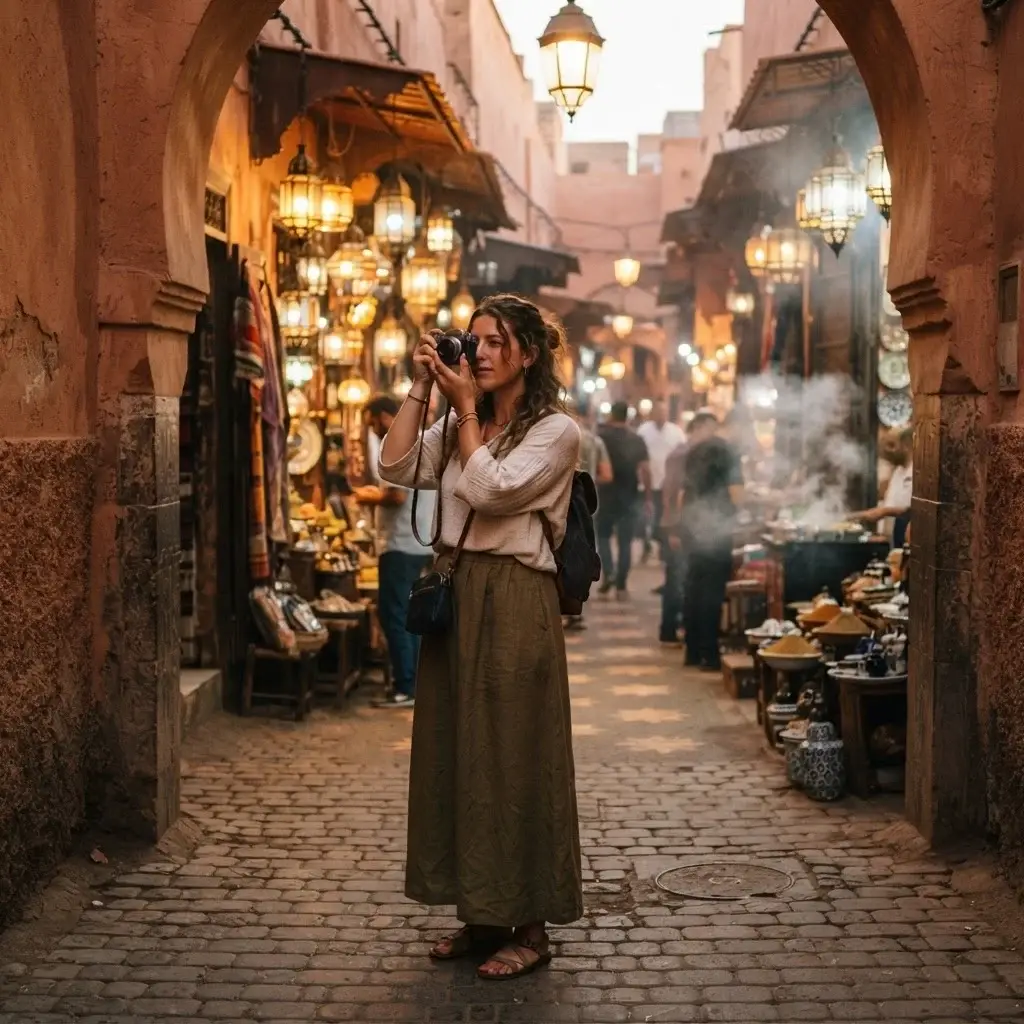
1. Shoot a full battery’s worth of photos at home. Walk around your neighborhood. Photograph people (with permission), moving subjects, indoor scenes, bright outdoor scenes. Get comfortable with the controls before you are standing in a market in Marrakech trying to figure out the menu system.
2. Test your memory cards. Format them inside the camera, not on your computer. Take photos, review them, delete them. Make sure the cards and the camera talk to each other correctly. Card errors discovered at home are annoying. Card errors discovered on day one of a trip are catastrophic.
3. Set up your companion app and test a transfer.
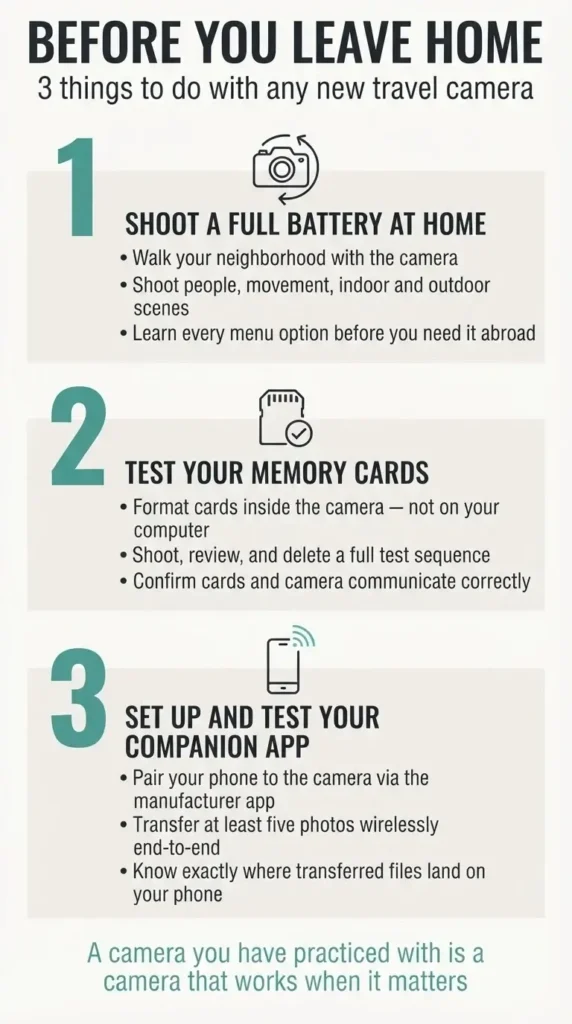
Pair your phone. Transfer five photos wirelessly. Make sure the process is smooth and intuitive. Know where the transferred files live on your phone. This five-minute test at home will save you real stress on the road.
Travel photography does not require perfection. It requires preparedness. Show up with the right gear, know how to use it, and the rest takes care of itself.
The world is full of extraordinary images waiting for someone curious enough to look for them. Go find yours.