I remember the exact moment I realized my office job was slowly killing my spirit.
It was a Tuesday. Grey sky outside my New York office window. I was staring at a spreadsheet that had nothing to do with my actual life, counting down the minutes until 5pm. I had two weeks of vacation that year. Two weeks. For 52 weeks of showing up.
I’d already taught English in Thailand by then. I’d already backpacked solo across Europe, lived with a family in Ghana, and hiked through China. I knew what was waiting out there. And I was choosing a spreadsheet instead.
So I quit. Saved every dollar I made waitressing. And I went back.
Southeast Asia was the first place that felt like home when I had no permanent address. It’s cheap enough that a tight budget feels like luxury. It’s warm when everywhere else is cold. And it is, without question, the best region in the world for a first solo trip.
If you’re sitting where I was — daydreaming, a little scared, thinking “maybe someday” — this guide is for you. I’m going to take you through the best places to visit in Southeast Asia. Not just the highlights, but the real stuff. What to eat, where to go, how to get there, and what nobody puts in the guidebooks.
Let’s go.
Why Southeast Asia Is Still the World’s Best Solo Travel Destination
Before we get into specific places, let me tell you why this region keeps pulling people back.
When I was a sightseeing guide in New York City, I’d tell tourists: “The best place to see a city is from the street.” That’s even more true in Southeast Asia. This is a part of the world that lives outside. Markets spill onto the road. Cooking happens on the sidewalk. Conversations start on the bus.
Southeast Asia is also genuinely affordable. Street food meals cost $1–3. A clean guesthouse bed runs $10–20 a night. You can travel well here on $30–50 a day total. That’s not roughing it — that’s living.
Most of the region also has strong backpacker infrastructure. Buses between major cities, overnight trains, short-haul flights, ferries between islands. Getting around is not complicated. And English is spoken widely enough in tourist zones that communication rarely becomes a wall.
Safety? It’s not perfect anywhere. But I’ve traveled as a solo woman through most of these countries and never felt truly in danger. Use your street sense, trust your gut, and you’ll be fine.
Now, the places.
1. Bangkok, Thailand — The City That Has No Chill (In the Best Way)
Bangkok was the first Southeast Asian city I ever landed in. I stepped out of Suvarnabhumi Airport at midnight, the air thick and warm, the highways lit up like a fever dream. I thought: this is it.
Bangkok does not ease you in gently. It just grabs you.
What Makes Bangkok Special
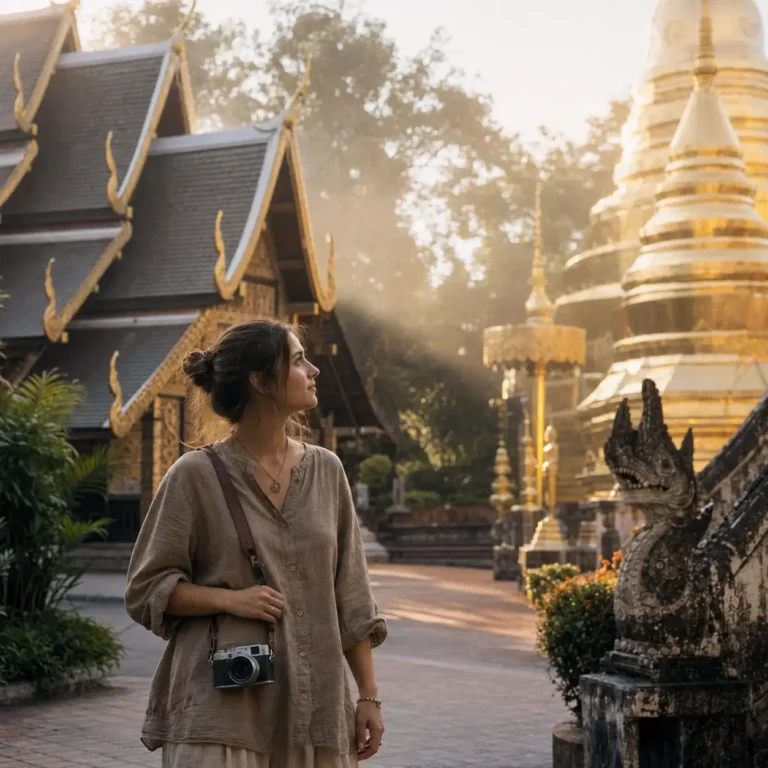
This city has everything working at full volume all the time. Ancient golden temples stand next to neon-lit street food stalls. Monks in saffron robes walk past luxury malls. Tuk-tuks weave through traffic that moves like water finding its way through rocks.
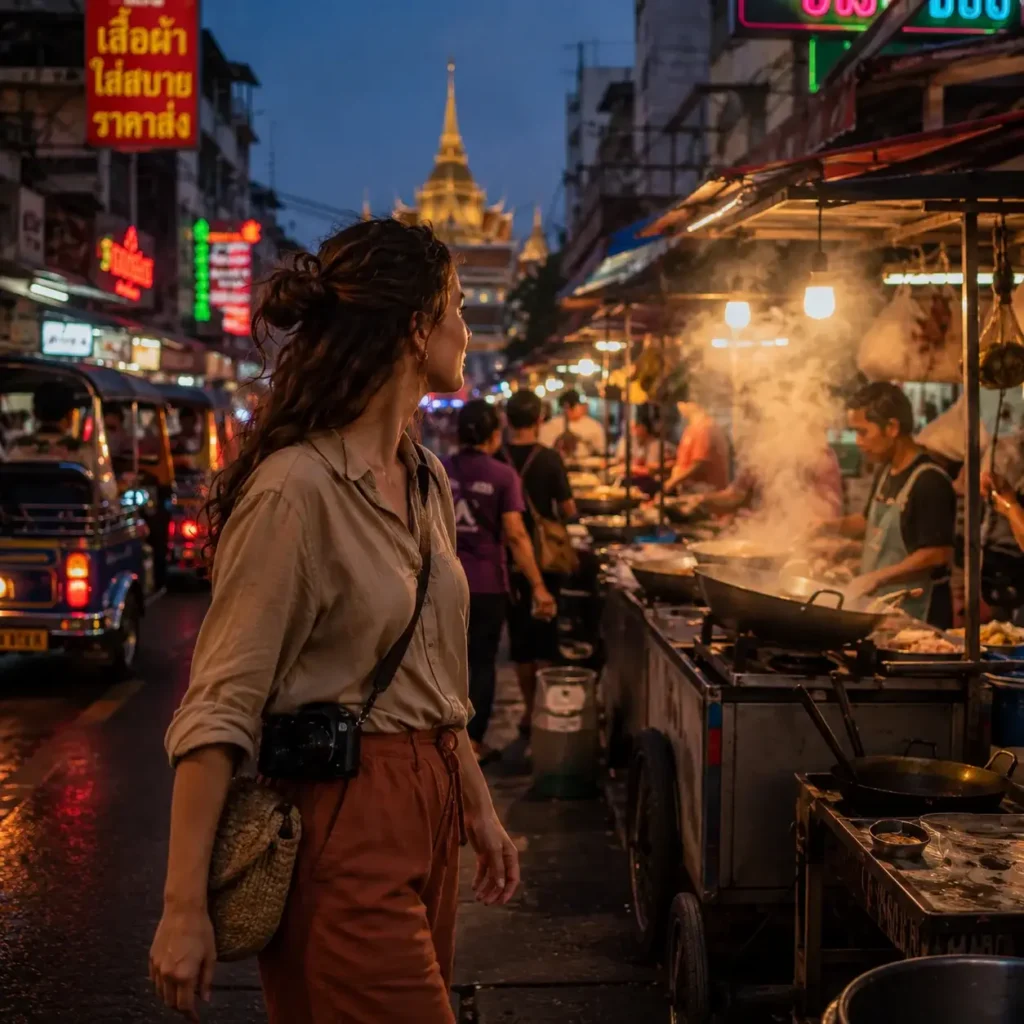
It’s chaotic. It’s completely alive.
The best thing I ever did in Bangkok was slow down and walk. Not the tourist version of walking — just actually wandering into random streets and alleys. That’s when you find the real Bangkok.
What to Eat in Bangkok
Bangkok has one of the greatest street food scenes on earth. I am not being dramatic.
Start with Pad Thai — but skip the tourist restaurants. Find a cart with a smoking wok on the street. The version you get there, with thin rice noodles, dried shrimp, egg, bean sprouts, and a squeeze of lime, is nothing like what gets served in plastic plates at airport-adjacent restaurants.
Try khao man gai for breakfast — poached chicken over fragrant rice, served with a thin broth and a dark, gingery dipping sauce. It is simple and perfect. You’ll find it at stalls from about 7am for around 50 baht (roughly $1.40).
Don’t miss mango sticky rice for dessert. Ripe yellow mango, sweet coconut sticky rice, a drizzle of coconut cream. I ate this every single day I was in Thailand. No regrets.
For a full evening food experience, go to Yaowarat Road, Bangkok’s Chinatown. It transforms at night into a wall-to-wall street food festival. Get there around 7–8pm and just walk and eat your way through it. The crispy pork belly noodle soup from the stalls along the main drag is spectacular.
Must-Do in Bangkok
Wat Pho is the Temple of the Reclining Buddha and it is genuinely jaw-dropping. The gold Buddha is 46 meters long. Admission is about 200 baht. Go early morning before the heat and the tour groups arrive.
The Grand Palace is right next door and worth the entrance fee (around 500 baht), but it gets overwhelmingly crowded by mid-morning. Get there when it opens at 8:30am.
For something off the tourist circuit, take a longtail boat through Thonburi’s canals (khlongs). This is the Bangkok that existed before the highways. Still-house communities line the water. Monks receive alms by boat. Kids wave at passing boats. You can negotiate a private canal tour with a driver near the Chao Phraya River piers for about 1,500 baht per hour.
Getting Around Bangkok
The BTS Skytrain and MRT metro are clean, cool, and fast. Use them. Grab (the Southeast Asia version of Uber) is reliable and safe — always use it instead of negotiating with street tuk-tuks, which charge tourist prices. The express boat on the Chao Phraya River is only 15–30 baht and one of the best ways to see the city.
2. Chiang Mai, Thailand — Mountain Culture and Night Markets
When Bangkok starts to feel like too much — and for some people it does, fast — Chiang Mai is the reset you need.
I came here after teaching English in Bangkok and it felt like stepping out of a concert into a quiet garden. Chiang Mai is cooler, slower, and full of mountains. It sits in the north of Thailand, surrounded by green hills and old temple walls. The old city is compact, walkable, and genuinely beautiful.
What Makes Chiang Mai Special
Chiang Mai has roughly 300 temples within its borders. That number sounds exhausting but it’s actually magical — you turn a corner and there’s another one. Most are not famous, not crowded, and completely free to enter.
The city also has a strong creative, expat, and digital nomad community. You’ll find excellent coffee shops, cooking schools, yoga studios, and art galleries. It has this rare quality of feeling simultaneously ancient and very much alive.
What to Eat in Chiang Mai
Khao Soi is the dish you must have in Chiang Mai. It’s a northern Thai curry noodle soup — creamy, slightly spicy coconut-based broth with egg noodles, crispy fried noodles on top, and your choice of chicken or beef.
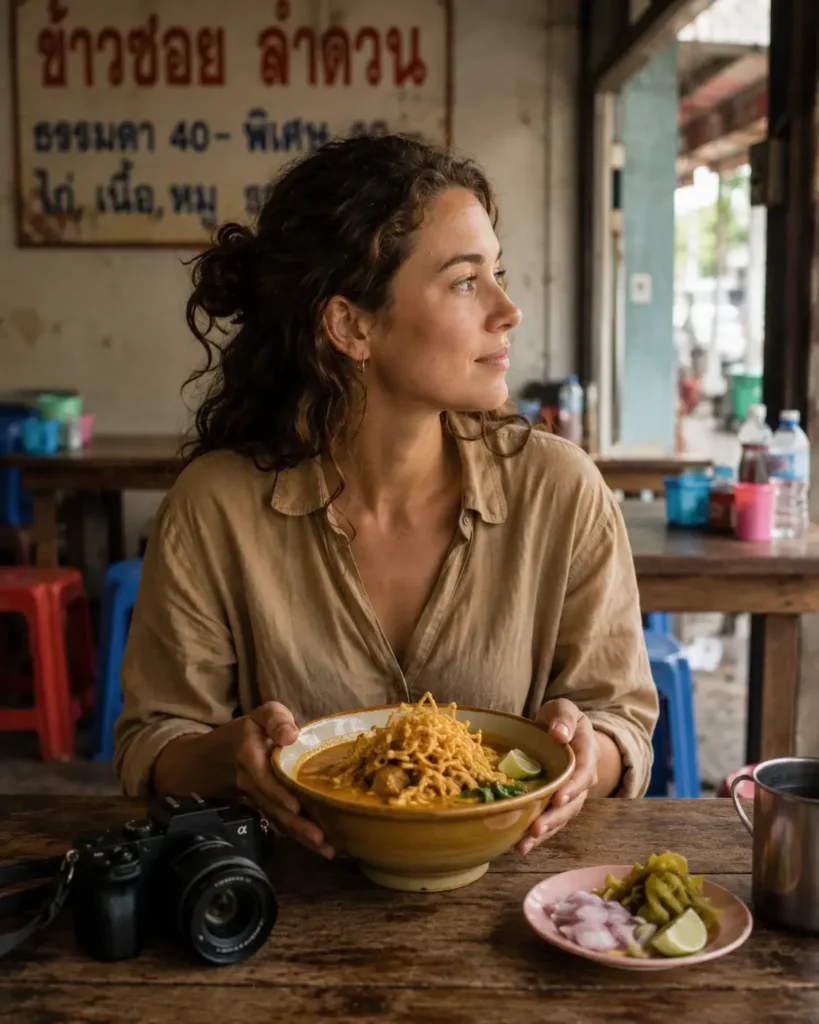
It tastes like nothing else in Thailand. The versions in Chiang Mai are different from anything you’ll find elsewhere — this is where the dish belongs. Try it at Khao Soi Khun Yai on Charoen Rat Road for a local, no-frills version.
The Chiang Mai Night Bazaar and the Saturday and Sunday Walking Street markets are primarily for shopping, but there’s great food at the edges — grilled corn, fresh fruit, crispy spring rolls, coconut pancakes. Walk slowly and graze.
For breakfast, find a local market and order jok — a thick rice congee with ginger, soft-boiled egg, and a drizzle of soy sauce. Warm, filling, and about 40 baht.
Must-Do in Chiang Mai
Doi Suthep is the golden temple on the mountain overlooking the city. Take a red songthaew (shared truck) from the city center for about 80 baht each way. Climb the 309 naga-flanked steps to the top — or take the funicular if you prefer. The views from the top at dusk are unforgettable.
If you want to see elephants, please do your homework first. Many “elephant experiences” involve animals that have been kept in cruel conditions. Elephant Nature Park outside the city operates as a genuine rescue sanctuary where elephants roam freely. You observe and feed, not ride. It costs more than the tourist “camps” but it’s the right choice.
Take a Thai cooking class here. Seriously. They’re affordable ($30–50 including a market tour), you spend the morning at a local market choosing ingredients, and you go home knowing how to cook five dishes from scratch. One of the most practical souvenirs I’ve ever brought home.
3. Bali, Indonesia — The Island That Gets Under Your Skin
I know what you’re thinking. “Bali? Isn’t it overrun with tourists?” Yes, parts of it are. But here’s what I’ve learned: Bali is so big and so varied that you can almost always find a version of it that matches what you need.
Bali is not just one beach resort. It’s a Hindu island in a Muslim-majority country. It has rice terraces, sacred volcanoes, traditional dance performances, and a spiritual depth that you feel even if you don’t know exactly why.
What Makes Bali Special
Bali has atmosphere. There are small shrines on virtually every street corner. Every day, Balinese women make hand-woven offerings of flowers and incense and place them on the ground, in doorways, on car dashboards. You walk through clouds of frangipani and incense wherever you go.
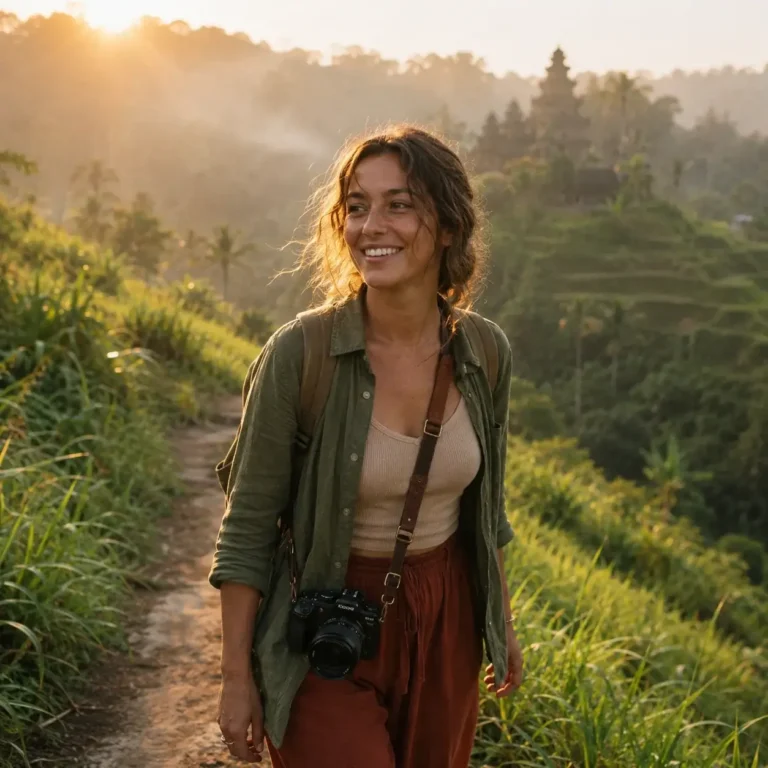
The landscape alone is extraordinary. Green rice terraces step down hillsides in geometric formations. Volcanic peaks rise above the clouds. Black-sand beaches line the south, grey-sand beaches in the east, white sand up north.
What to Eat in Bali
Nasi goreng — Indonesian fried rice — is the comfort food of the island. Served everywhere, at every price point, with a fried egg on top and prawn crackers on the side. At a local warung (small food stall), you’ll pay about 20,000–30,000 IDR (roughly $1.20–$1.80).
Babi guling is Bali’s famous spit-roasted suckling pig, traditionally made for ceremonies and now available at specialized restaurants. The skin is crackling-crisp, the meat is spiced with turmeric and lemongrass. Ibu Oka in Ubud is the most famous spot — arrive by 11am before they sell out.
Gado-gado is a vegetarian peanut sauce salad with steamed vegetables, tofu, tempeh, and a hard-boiled egg. Deeply satisfying and incredibly cheap.
For something sweet, try klepon — small green rice balls filled with palm sugar and rolled in coconut. You bite through the soft rice and the warm sugar syrup floods your mouth. Find them at traditional markets in the morning.
Must-Do in Bali
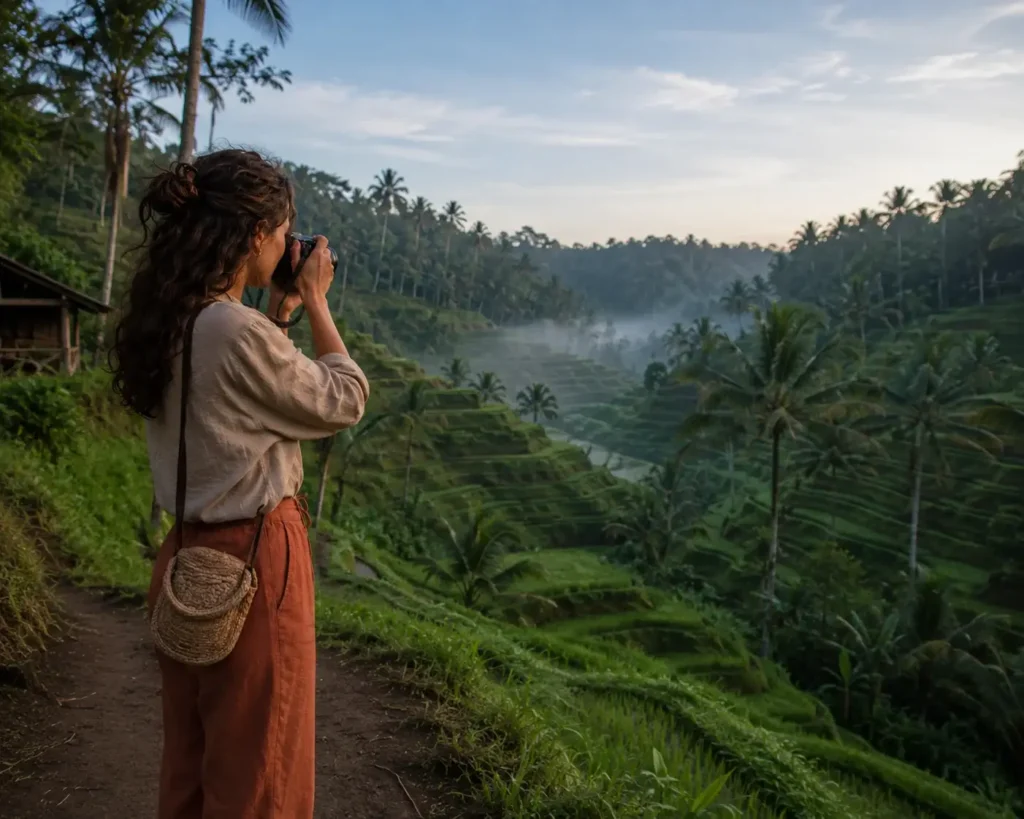
Ubud is the cultural heart of the island. Visit the Sacred Monkey Forest Sanctuary (yes, the monkeys will steal your sunglasses — hold them tight), watch a Kecak fire dance performance at sunset at Uluwatu Temple, and take a morning bicycle ride down through the Tegallalang Rice Terraces before the tour groups arrive.
Seminyak and Canggu are the beach areas — Seminyak is polished and fashionable, Canggu is more surf-focused and laid-back with a strong café culture. If you’re spending a few days doing nothing but eating well and watching sunsets, Canggu is your place.
In the north, Munduk is a mountain village almost nobody visits. Hiking trails through clove and coffee plantations, waterfall walks, morning mist. Accommodation is basic and beautiful. It feels like Bali did twenty years ago.
Getting Around Bali
Grab works in southern Bali. In Ubud and more rural areas, hire a private driver for the day — typically 350,000–500,000 IDR ($20–30) for eight hours, which is genuinely great value and lets you pack in multiple spots efficiently.
4. Hanoi, Vietnam — Ancient Streets and the World’s Best Noodle Soup
Vietnam surprised me more than almost anywhere I’ve traveled. I arrived expecting chaos and found something more complicated and more beautiful than I had prepared myself for.
Hanoi is Vietnam’s northern capital. It’s older, more traditional, and far more atmospheric than the country’s southern hub, Ho Chi Minh City. The Old Quarter — the original 36-street merchant district — has been operating since the 13th century. The names of the streets still reflect what was sold there: Silk Street, Paper Street, Tin Street.
What Makes Hanoi Special
Hanoi moves differently from Bangkok or Bali. It’s quieter in some ways — less in-your-face about tourism. You need to walk deeper into it before it opens up to you. When it does, you find a city of lakes, tree-lined French colonial boulevards, tiny coffee shops the size of closets, and one of the most incredible food cultures on earth.
What to Eat in Hanoi
Pho (pronounced more like “fuh” than “foe”) is Vietnam’s most famous dish and Hanoi does it differently from the south. Northern pho is cleaner and more restrained — a deeply flavored beef broth, rice noodles, thin slices of beef, fresh herbs, and a squeeze of lime. No hoisin sauce, no bean sprouts — purists will tell you that’s the southern way. Find a small, local place where they serve it from 6–9am (many pho spots only do breakfast). A bowl costs about 40,000–60,000 VND ($1.60–$2.50).
Bun cha is a Hanoi specialty — grilled pork patties and pork belly served in a bowl of slightly sweet, slightly tangy broth, with rice noodles and a pile of fresh herbs on the side. Dip and mix as you eat. It’s incredibly good. Bun Cha Huong Lien became famous because Barack Obama ate there with Anthony Bourdain. It’s still worth the visit, but any local spot works.
Banh mi — the Vietnamese sandwich — is technically best in the central and southern regions, but Hanoi still does a good version. Crusty French baguette, pâté, pickled vegetables, cilantro, chili, and your choice of filling. A full banh mi runs about 25,000–35,000 VND (around $1).
Ca phe trung (egg coffee) is a Hanoi invention. Thick, sweet beaten egg yolk whisked with condensed milk and coffee, served either hot or cold. It sounds strange. It tastes like a dessert and a pick-me-up in one. Giang Café in the Old Quarter is said to be where it was invented, though you’ll pay slightly more there for the story.
Must-Do in Hanoi
Walk the Old Quarter at night when the streets are lit and the hawkers are out. Rent a bicycle for the morning — the old district is compact and riding slowly is the best way to see it.
Hoan Kiem Lake in the center of the city is where locals come to do Tai Chi at dawn and walk in the evenings. It’s beautiful and calm in a way that the rest of Hanoi isn’t. The small red Ngoc Son Temple on the island in the middle of the lake costs about 30,000 VND to enter.
Take a day trip to the Ha Long Bay or nearby Ninh Binh — Ninh Binh is actually closer and less crowded. The landscape of limestone karsts rising from rice paddies and rivers is extraordinary, and you can explore by rowboat with a local guide for around $30–40.
5. Hoi An, Vietnam — The Lantern Town That Steals Your Heart
If Hanoi is Vietnam’s brain, Hoi An is its heart.
This ancient port town in central Vietnam is unlike anywhere else I’ve been. It’s small, manageable, and genuinely stunning. The old town is a UNESCO World Heritage Site — a mix of Vietnamese, Japanese, and French architecture that has been preserved almost intact for centuries.
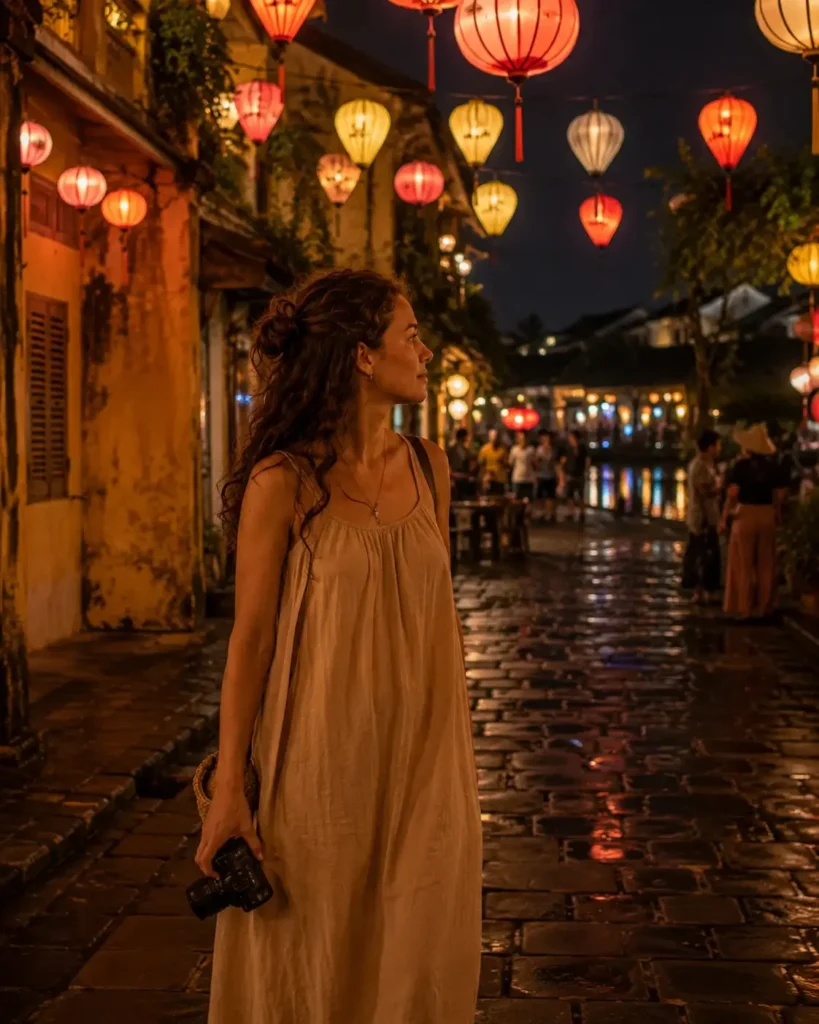
At night, they hang lanterns everywhere. Silk lanterns in every color, strung across narrow yellow-painted streets, reflected in the Thu Bon River. It looks like a dream.
What Makes Hoi An Special
Hoi An was once one of the most important trading ports in Southeast Asia. Merchants from Japan, China, and Europe all passed through here. You can see it in the architecture — the Japanese Covered Bridge, the Chinese merchant houses, the French colonial facades. History is not in a museum here. It’s the street you walk down.
Hoi An is also famous for tailor shops. You can have custom clothes made in 24–48 hours at very reasonable prices. I’ve had dresses, linen trousers, and a silk shirt made here. Just allow time for at least one fitting.
What to Eat in Hoi An
Cao lau is a Hoi An exclusive. Thick, slightly chewy wheat noodles (historically made with water drawn from a specific local well) with slices of pork, fresh herbs, and crispy rice crackers. You won’t find the real version outside this town.
White rose dumplings (banh bao vac) are translucent steamed rice dumplings shaped like flowers, filled with shrimp and topped with crispy shallots. Delicate and beautiful. Every restaurant in the old town serves them.
Banh mi Phuong is a street food institution. Owner Madam Phuong has been making banh mi here for decades. Anthony Bourdain called it a remarkable sandwich. The line is sometimes long. It moves fast. It’s worth it. Look for the stall near the market.
For dinner, sit by the river and order a whole grilled fish from one of the riverside restaurants. It comes with rice paper, fresh herbs, and dipping sauce — you wrap your own little parcels at the table.
Must-Do in Hoi An
Rent a bicycle ($2–3/day) and ride out to An Bang Beach, about 4km from the old town. It’s calm, much quieter than the more hyped Cua Dai Beach, and lined with simple restaurants where you can eat fresh seafood with your feet near the sand.
Take a cooking class here, same as Chiang Mai. Hoi An cooking schools often start with a morning boat ride to the market, then you cook 6–8 dishes, then eat everything you made. About $30–45 for the full experience.
In the evening, walk through the old town as the lanterns come on — around 5:30–6pm. It is one of the most beautiful things you will see anywhere.
6. Siem Reap, Cambodia — Where History Stops You Cold
Cambodia is different. That needs to be said honestly.
Cambodia has a recent history of immense tragedy — the Khmer Rouge genocide in the 1970s took the lives of approximately one-third of the country’s entire population. Walking through this country, visiting the memorials, talking to older Cambodians — it asks something of you as a traveler. It asks you to witness.
I went to the Killing Fields at Choeung Ek outside Phnom Penh and the Tuol Sleng Genocide Museum in the capital city. It was one of the most emotionally heavy days of my life. I also think it’s one of the most important things I’ve ever done as a traveler. Go.
But Siem Reap, the northern gateway to the temples of Angkor, is also one of the most extraordinary destinations in Southeast Asia. And the Cambodian people I’ve met are some of the warmest, most resilient, most welcoming people anywhere on earth.
What Makes Siem Reap Special
Angkor Wat is the reason most people come to Cambodia and it absolutely delivers. It is the largest religious monument ever built. The scale and detail of the stone carvings — the thousands of meters of bas-reliefs depicting mythology, battle, everyday life — are beyond what photographs prepare you for.
But the temples of Angkor extend far beyond the main complex. The entire Angkor Archaeological Park covers about 400 square kilometers and contains hundreds of temples, many still partially reclaimed by jungle.
What to Eat in Siem Reap
Amok is Cambodia’s most iconic dish — a coconut curry steamed in banana leaves, typically made with fish or chicken, thickened with egg, and flavored with kroeung (a paste of galangal, lemongrass, and kaffir lime). The flavor is gentle, fragrant, slightly sweet. Very different from Thai curry.
Lok lak is stir-fried beef cubed and served on a bed of lettuce and tomatoes with a dipping sauce of lime juice, salt, and the famed Kampot black pepper. Simple, deeply satisfying, everywhere.
Nom banh chok — Khmer noodles — is the local breakfast. Cold rice vermicelli with a fish-based green sauce, fresh cucumbers, banana flower, and bean sprouts. You’ll see women selling it from baskets at the sides of roads from around 6am. About 2,000–3,000 KHR (50–75 cents).
The Pub Street area in Siem Reap town has plenty of tourist restaurants, but for actual good local food, head to the Old Market (Psar Chas) area and the streets around it.
Must-Do in Siem Reap
Buy a 3-day Angkor pass ($62) rather than a 1-day pass. The temples reward slow exploration.
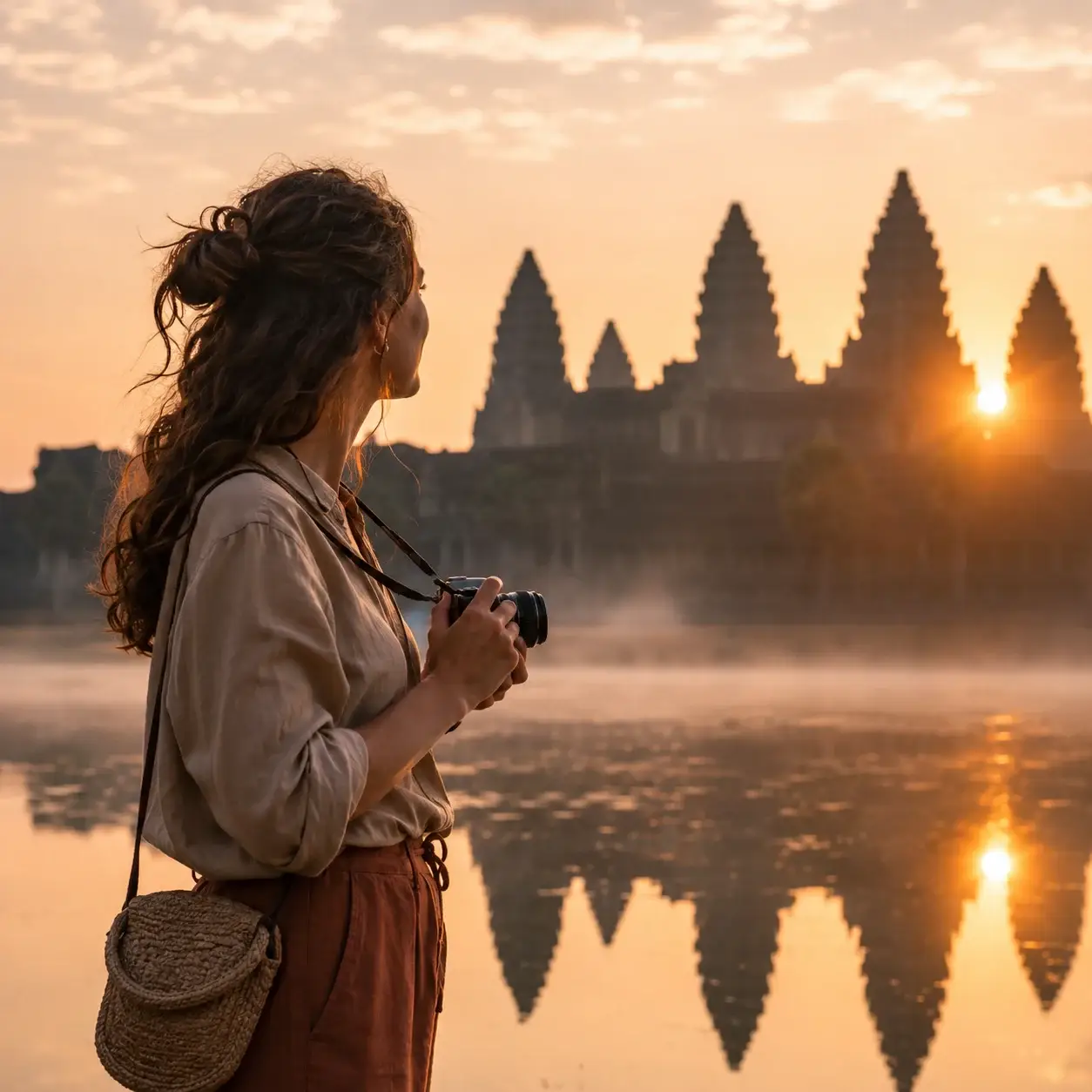
Wake up at 4:30am and take a tuk-tuk to Angkor Wat for sunrise. Yes, it will be crowded. Go anyway. The light on the stone as the sun comes up over the towers is worth every early alarm.
Come back to Angkor Wat at dusk on a different day — fewer people, golden light, a completely different mood.
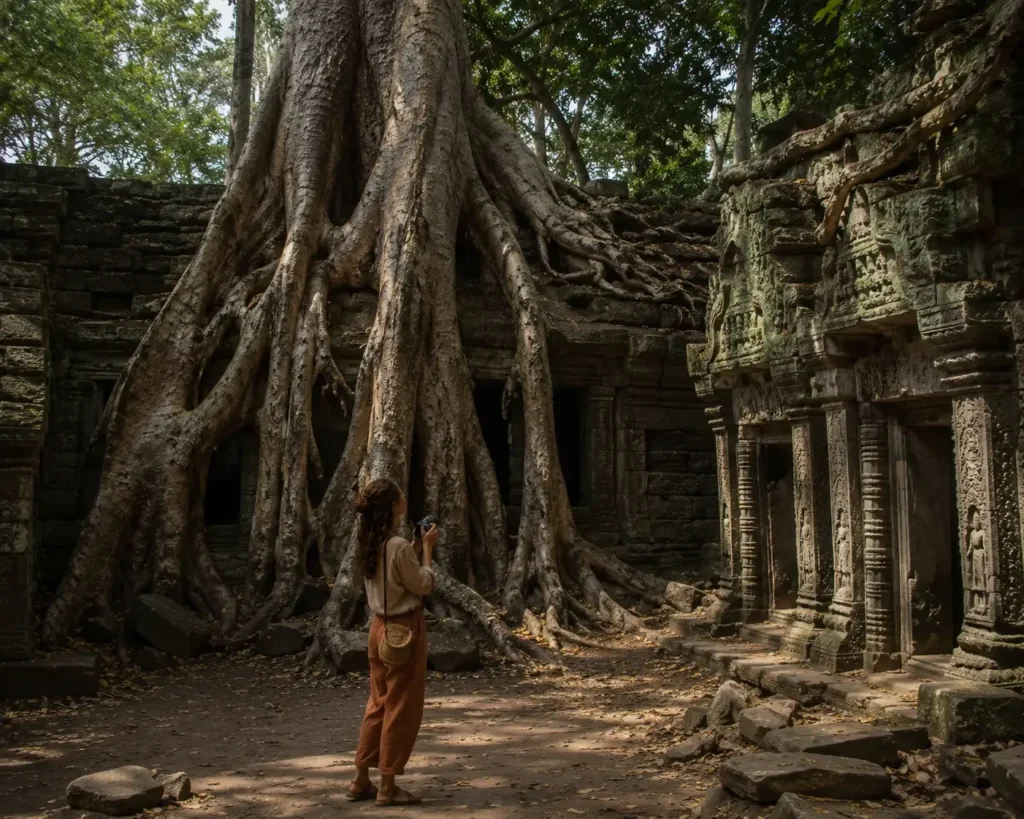
Ta Prohm is the temple where trees have grown through the stone structures, roots weaving over walls and doorways. Go early in the morning or late afternoon to have it more to yourself.
Banteay Srei is a smaller temple about 25km north of the main complex, made of pink sandstone and covered in some of the most detailed carvings in all of Angkor. Most day-trippers don’t make it this far. You should.
Getting around the temples: rent a bicycle ($5/day) for the smaller outer temples, or hire a tuk-tuk driver for the day (about $15–20). Many tuk-tuk drivers are excellent guides who know the temples deeply.
7. Luang Prabang, Laos — The World’s Most Peaceful Town
If there is a single place in Southeast Asia that makes you exhale completely, it is Luang Prabang.
This small town sits at the junction of the Mekong and Nam Khan rivers in northern Laos, surrounded by mountains and forest. It has fewer than 60,000 people. It has 33 Buddhist temples. It moves slowly, deliberately, and beautifully.
UNESCO declared the entire town a World Heritage Site in 1995 because of its remarkable preservation — the blend of traditional Lao wooden architecture and French colonial buildings is intact in a way you simply don’t see elsewhere.
What Makes Luang Prabang Special
The spiritual centerpiece of daily life here is the tak bat — the alms-giving ceremony that happens every morning at dawn. Monks in saffron robes walk single file through the streets in silence. Local residents and Buddhist followers line the roads, offering sticky rice and small foods into the monks’ alms bowls.
If you watch this, please watch respectfully. Stand back, don’t use flash photography, don’t get in the monks’ way. This is a religious ceremony for the people who live here, not a performance. Watching quietly from a distance, as the orange robes move through the early mist — it is one of the most moving things I have seen anywhere.
What to Eat in Luang Prabang
Khao niao — sticky rice — is the staple of Lao life. It comes in small woven baskets and you eat it with your fingers, pinching off small pieces and dipping them in sauces and curries. It’s part of every meal.
Mok pa is a Lao dish similar to Cambodian amok — fish steamed in banana leaves with herbs. Delicate and fragrant.
Or lam is a Lao stew with vegetables, wood ear mushrooms, dried buffalo meat or pork, and fresh dill. It has a thick, earthy, deeply savory quality unlike anything else I’ve eaten in Southeast Asia.
The Night Market on Sisavangvong Road has great food stalls in the early evening. The spring rolls here — fried and fresh — are exceptional.
Must-Do in Luang Prabang
Kuang Si Waterfall, about 29km south of town, is one of the most beautiful natural sites in Southeast Asia. Turquoise-blue water cascades down tiered limestone formations into pools perfect for swimming. Arrive when it opens at 8am before the day-trippers come. The walk up through the forest to the source is quiet and gorgeous.
Pak Ou Caves — two caves in a limestone cliff above the Mekong, filled with thousands of Buddha statues left by pilgrims over centuries — are reached by a one-hour boat ride up the river. The boat trip itself is the best part.
Rent a bicycle (about 20,000 KIP / $1 per day) and cycle to the pottery village of Ban Chan across the river, or up into the surrounding hills. The roads are quiet and the scenery is extraordinary.
Getting there: Most people fly into Luang Prabang International Airport from Bangkok or Vientiane. There’s also the Laos–China high-speed railway that connects Vientiane to Luang Prabang in under 2 hours — a scenic and genuinely enjoyable way to travel.
8. Penang, Malaysia — Asia’s Street Food Capital on an Island
Penang might be the biggest surprise on this list for first-time visitors to Southeast Asia. It doesn’t have the ancient temples of Angkor or the spiritual weight of Luang Prabang. What it has is food. Extraordinary, world-class, nobody-does-it-better food.
George Town, the capital of Penang island, is a UNESCO World Heritage city — a remarkable preservation of Chinese, Malay, Indian, and British colonial architecture that tells the story of the Straits of Malacca as a trading crossroads. Walking its streets is walking through living layers of history.
What Makes Penang Special
Malaysia as a whole is a melting pot of cultures — ethnic Malay, Chinese, Indian, and indigenous communities have coexisted here for centuries. In Penang, that mixture reaches its most concentrated and delicious expression.
The street food here is the direct result of communities influencing each other’s cooking over generations. You get Malay curries with Chinese noodles. Indian-influenced flatbreads with Chinese fillings. The combination is completely unique and nearly impossible to replicate anywhere else.
What to Eat in Penang
Char kway teow is Penang’s most famous dish — flat rice noodles wok-fried with shrimp, Chinese lap cheong sausage, egg, bean sprouts, and dark soy sauce over intense charcoal heat. The smoky, slightly caramelized depth is what makes it special. Go to a hawker center and look for the stalls with the longest lines.
Assam laksa is Penang’s sour fish noodle soup — flavorful, slightly fermented, complex. It is an acquired taste for some people on first encounter, but if you let it in, it’s unlike anything else.
Penang hokkien mee is a prawn noodle soup — rich, deeply orange broth made from prawn shells and pork bones, served with thick yellow noodles, rice vermicelli, prawns, pork, hard-boiled egg, and crispy shallots.
Roti canai is the Malaysian flatbread — flaky, layered, stretched thin and cooked on a griddle. Served with dal (lentil curry) and curry sauce for dipping. Breakfast and snack of champions. Costs about 1–2 MYR (25–50 cents).
The Gurney Drive Hawker Centre and the hawker stalls around Jalan Penang in George Town are excellent starting points. But honestly, anywhere you see locals queuing, join the queue.
Must-Do in Penang
Spend an afternoon walking the Armenian Street and Lebuh Chulia area in George Town, where you’ll find the famous Penang street art — large murals painted on colonial walls, iron rod sculptures, and painted tiles telling local stories.
Khoo Kongsi, the ornate Chinese clan house in George Town, is one of the most beautifully decorated buildings I’ve seen in any country. It was built by a powerful Chinese clan in the 19th century and is open to visitors. About 10 MYR to enter.
The funicular up Penang Hill (Bukit Bendera) takes you to a forested peak above the city. The views are wonderful at dusk. The cooler air at the top is welcome relief from the lowland heat.
9. Palawan, Philippines — The Last Frontier
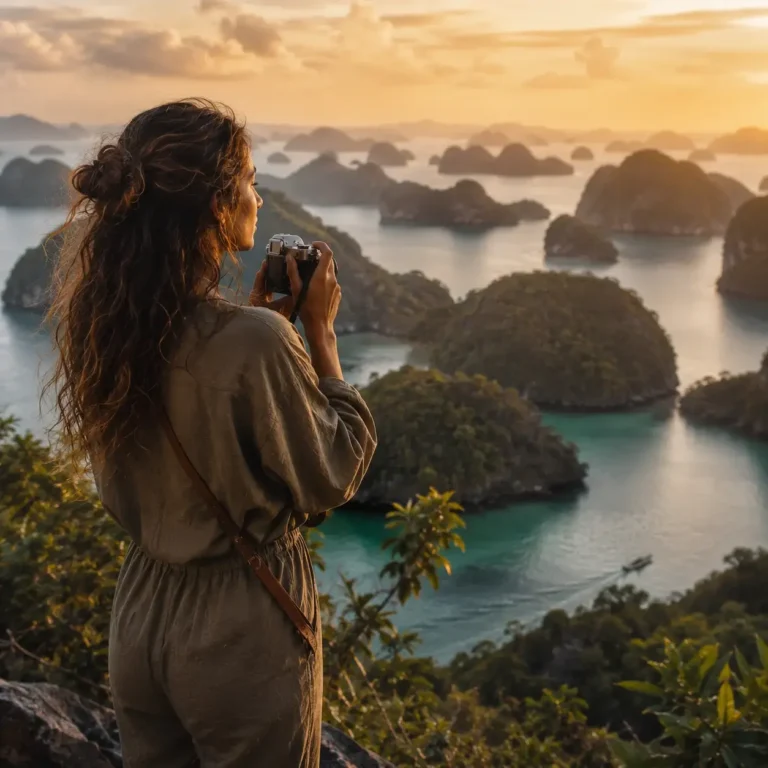
The Philippines is made up of over 7,600 islands. Most of them are barely visited. And Palawan — the long, narrow island in the western part of the archipelago — is what people imagine when they dream of an untouched tropical paradise.
I arrived by plane into Puerto Princesa, hired a van north, and spent a week island-hopping between turquoise lagoons and white-sand beaches so quiet that the loudest sound was the wind through the palms.
What Makes Palawan Special
Palawan is called the Philippines’ “Last Frontier” because large parts of it remain undeveloped and ecologically intact. The waters are a deep, brilliant blue-green. The limestone cliffs rise vertically from the sea. The coral reefs are among the healthiest remaining in Southeast Asia.
El Nido, in the north, is the main base for island-hopping in the Bacuit Archipelago. Coron, to the northeast, is a world-famous wreck diving destination — the bay was the site of a Japanese fleet bombing in 1944 and the sunken ships have become enormous artificial reefs.
What to Eat in Palawan
Filipino food is genuinely underrated by the wider world. In Palawan, fresh seafood is everywhere and extraordinarily affordable.
Kinilaw — the Filipino version of ceviche — is fresh fish or seafood “cooked” in vinegar and calamansi lime, with ginger, onion, and chili. Bright, sharp, and clean.
Lechon (roasted suckling pig) is the centerpiece of Filipino celebrations, but you’ll find smaller portions served at restaurants throughout the island. The skin is glass-crisp. The flavor is deeply porky and wonderful.
Sinigang is a sour, tamarind-based soup with pork or seafood and vegetables. It is sour in the way that makes you keep coming back for more — sour and savory and somehow comforting.
For fresh seafood grills, go to any beachside spot in Coron or El Nido where they display the day’s catch on ice and cook it simply on charcoal.
Must-Do in Palawan
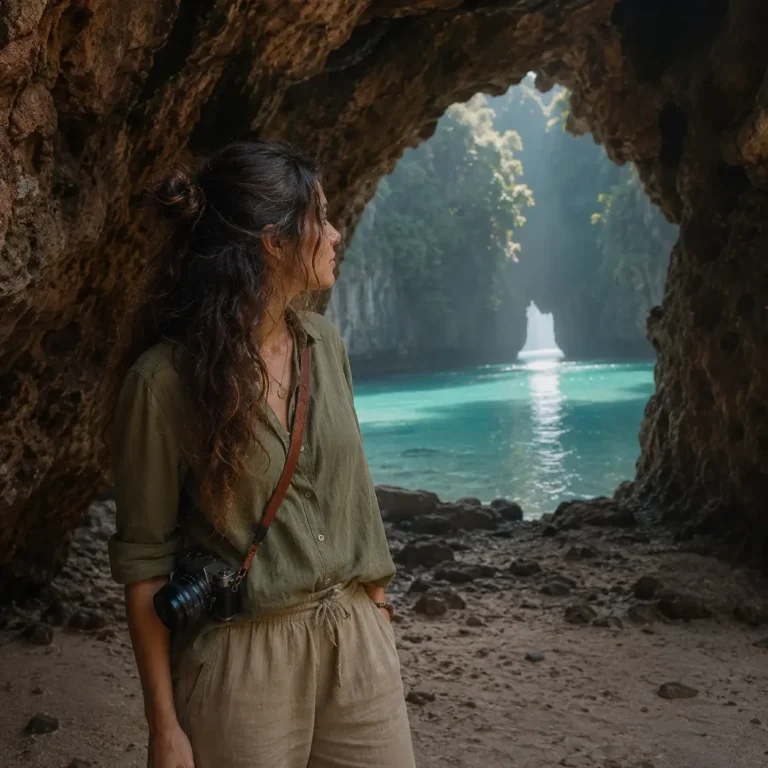
Book an island-hopping tour (Tour A, B, C, and D around El Nido — typically $15–30 each including lunch). Tour A covers the famous Big Lagoon and Small Lagoon. Arrive by kayak into the Big Lagoon at low tide, when you can just barely squeeze through the entrance gap in the cliff. It opens into a calm, enclosed emerald lake. Completely silent. The kind of place that changes what you thought the world could look like.
Puerto Princesa Subterranean River National Park is one of the world’s longest navigable underground rivers — about 5km of cave you explore by small paddle boat, flashlights pointing at enormous stalactite formations. UNESCO World Heritage Site. Book your permit in advance online.
If you can swing it, do at least one sunrise kayak. El Nido organizes sunset tours, but early morning — before any boats are moving — the water is flat and still and the limestone cliffs are pink and gold. It is extraordinary.
10. Singapore — The Perfect Entry Point (Or One Last Stop)
Singapore is not cheap. Let me be completely upfront about that. It’s the most expensive city in Southeast Asia by a wide margin. A night in a basic hotel here costs more than a week in Chiang Mai.
But Singapore earns its place on this list for two reasons.
First, it’s the easiest entry point into Southeast Asia for many travelers. The airport is world-class. The city is meticulously organized, entirely English-speaking, and entirely safe. If you’re nervous about solo travel and you want to build your confidence on this trip, starting in Singapore and moving outward from there is a smart move.
Second, the food. Singapore’s hawker centers — large, open-air food courts with dozens of stalls, each specializing in one dish — are some of the best places to eat anywhere on earth. UNESCO recognized hawker culture here as an Intangible Cultural Heritage. It’s not just tourism branding.
What to Eat in Singapore
Hainanese chicken rice is the national dish. Perfectly poached white or roasted golden chicken, sliced over fragrant rice cooked in chicken fat and stock, with ginger sauce, chili sauce, and dark soy on the side. Simple, balanced, completely satisfying. Try it at Tian Tian at Maxwell Food Centre.
Laksa — a coconut-curry noodle soup with prawns and fish cake — is rich and aromatic. The version at 328 Katong Laksa is famous because the noodles are cut short so you eat everything with a spoon.
Chili crab is Singapore’s most famous dish. A whole mud crab cooked in a tangy, slightly spicy tomato-egg sauce, served with deep-fried mantou buns for dipping. It’s a messy, glorious meal. It’s not cheap (expect S$80–120 for a crab at established places). Worth it once.
At any hawker center — Lau Pa Sat, Newton Food Centre, Old Airport Road — eat your way through the stalls.
Must-Do in Singapore
Gardens by the Bay is genuinely worth it, especially the Supertree light show at 7:45pm (free) and the Cloud Forest dome ($28 SGD) — a mountain inside a glass structure, covered in over 200 species of tropical plants, with a waterfall running down the center.
Little India (Tekka Centre area) and Chinatown (Smith Street) are vibrant, atmospheric, and full of excellent food. Walk them in the morning when the markets are active.
For a single afternoon of quiet, the Southern Ridges trail connects several parks in the south of the island on a forested ridge walk — free, beautiful, completely different from the city below.
Practical: How to Plan Your Southeast Asia Trip
You’ve read about ten incredible places. Now here’s how to actually get yourself there.
Where to Start
Bangkok is the hub. More flights connect to Bangkok than any other Southeast Asian city. Most itineraries work outward from here.
A classic first trip: Bangkok → Chiang Mai → Bangkok → fly to Siem Reap or Hanoi. Spend 3–4 days per place. That gives you two weeks of serious travel.
If you have more time, add Hoi An and Luang Prabang to the Vietnam/Laos section. They’re close enough geographically to combine.
Bali and Palawan are best done as dedicated island trips — fly in, spend 7–10 days, fly out. Trying to combine them with a mainland Southeast Asia circuit usually means rushing everything.
Singapore and Penang work brilliantly as 2–3 day stopovers at the beginning or end of a longer trip.
Budget Reality Check
For budget travelers, $30–45 per day is realistic across Thailand, Vietnam, Cambodia, and Laos — covering dorm or basic private room, street food for all meals, local transport, and some activities.
$50–70 per day gets you a private ensuite room, a mix of restaurant meals and street food, and comfortable travel.
In Bali and Palawan, budget slightly more — $40–60 for a tight budget. Singapore and Penang cost more: $80–120 minimum for Singapore, $50–70 for Penang.
Flights between countries are cheapest booked 3–6 weeks out on AirAsia, Vietjet, Lion Air, Cebu Pacific, and similar regional low-cost carriers.
Best Time to Go
Southeast Asia is large enough that there’s always somewhere dry. Here’s the general guide:
November to March is the best time for Thailand, Laos, Cambodia, and northern Vietnam. Dry, not too hot, festivals like Loy Krathong in Thailand.
April to June is shoulder season for most of the region — hotter and occasional rain, but fewer crowds and lower prices.
July to October is rainy season for much of Thailand and Cambodia, but this is actually a lovely time for Vietnam and for Bali’s rice terraces, which are brilliantly green with the rains.
October to January is the best time for Palawan and the Philippines generally — the western Philippine coast is calm and sunny.
Safety as a Solo Traveler
I have traveled alone as a woman through all of the places on this list. Here is what I actually do:
Tell someone — a friend, a family member, anyone — your basic itinerary. Not because you’ll need rescuing, but because it creates accountability and peace of mind for the people who love you.
Use Grab for rides everywhere it operates (Thailand, Vietnam, Malaysia, Philippines, Singapore). It has in-app tracking, your driver’s details, and fixed pricing. Far safer than negotiating with unknown taxis at night.
Trust your instincts before you trust politeness. If something feels wrong, leave. You don’t owe anyone an explanation.
Keep a photocopy of your passport pages and your travel insurance document in your phone’s photos and in your email. If your bag gets stolen, this saves hours.
Have travel insurance that covers medical evacuation. Not optional.
Keep most of your cash in your accommodation safe, carry just what you need for the day in a small crossbody bag or money belt.
And honestly? Just go. You will figure out most things as they come. That’s the whole point.
The One Thing I Want You to Remember
I spent years telling myself “maybe next year.” Next year when I have more money. Next year when I’m less scared. Next year when everything lines up perfectly.
The year I finally just went? Everything changed.
Not because Southeast Asia is magic — though it genuinely is. But because the act of choosing yourself, booking that ticket, stepping onto that plane — it rewrites something fundamental in your story. You discover that you are more capable than the cautious version of yourself believed.
The best places to visit in Southeast Asia aren’t the temples or the beaches or the food, as incredible as all of those are. The best place is wherever you are when you finally decide to stop waiting.
Go soon.
— Emma