Best Stargazing Spots Without Light Pollution for Solo Travelers

There is a moment that changes you. You are standing somewhere far from any city, the air is cold and still, and then you look up. Not the usual glance at a few scattered stars above a suburban glow. I mean actually looking up at a sky so dense with light that your brain takes a second to process what it is seeing. The Milky Way stretches from horizon to horizon like someone spilled a river of sugar across black velvet. You can make out galaxies. You can see why ancient civilizations built entire mythologies around this view.
I had a version of that moment during my time hiking in China, standing above the treeline in the early hours when the valley below had gone completely dark. It stopped me cold. And since then, chasing dark skies has been one of my quiet obsessions on the road.
Here is the thing: most people never experience genuine darkness because they simply do not know where to go or how to plan it. This guide is going to fix that.
Why Light Pollution Is the Only Real Problem
Light pollution is not just an annoyance for astronomers. It is the reason that two-thirds of people on Earth cannot see the Milky Way from where they live. Every street lamp, shopping center, and illuminated billboard sends light scattering upward into the atmosphere, creating a glow that washes out all but the brightest stars. In a major city, you might see 50 stars on a clear night. Under a truly dark sky, that number jumps to 2,500 or more, and the Milky Way becomes visible to the naked eye.
The good news is that escaping light pollution is entirely achievable with the right planning. You do not need expensive equipment. You do not need an astronomy degree. You just need to know where to look.
The Two Tools Every Stargazing Traveler Should Know
Before you book anything, spend 20 minutes with two free resources that will change how you plan.
The first is a light pollution map. The interactive tool at lightpollutionmap.info uses NASA satellite data to show you, on a color-coded world map, exactly how much artificial sky glow exists at any location. Black and dark grey zones are where you want to be. Blue and green are workable. Anything yellow, orange, or red is a city sky, and you will be disappointed.
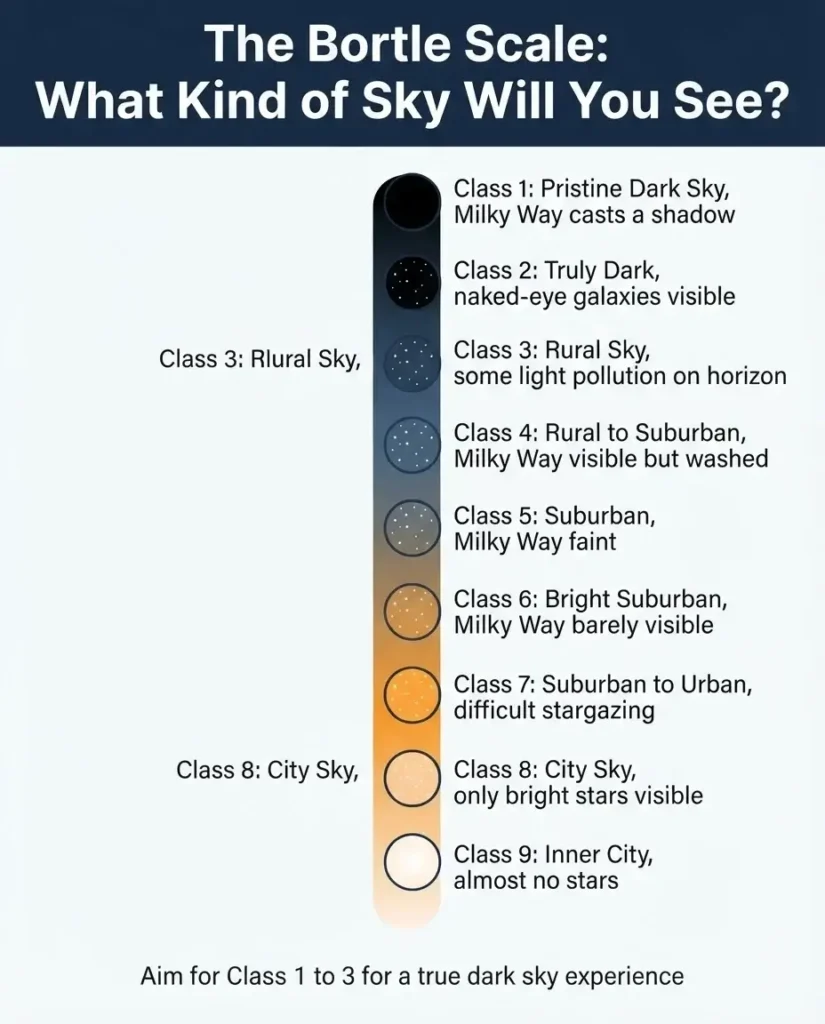
The second thing to understand is the Bortle scale. It is a nine-point system that measures night sky darkness, where Class 1 is a pristine sky with absolutely no artificial influence (you can see the Milky Way casting a faint shadow on the ground) and Class 9 is the center of a bright city. Most certified dark sky destinations sit at Class 2 or 3. Sky and Telescope has a clear breakdown of what each class looks like in practice, and it is worth reading before your first trip so you know what to actually expect when you arrive.
One more thing: go during a new moon. The full moon is roughly 400,000 times brighter than the faintest stars and will wash out the Milky Way almost completely. Aim for the few days on either side of the new moon, when the moon sets early or rises late and leaves the sky genuinely dark. Most serious stargazers plan trips around these windows.
Finding Certified Dark Sky Destinations Near You
Since 2001, an organization called DarkSky International has been certifying places around the world that actively protect their night skies from light pollution. These certified spots, which include national parks, nature reserves, rural communities, and private sanctuaries, are required to use responsible outdoor lighting, enforce sky protection policies, and maintain ongoing monitoring.
There are now more than 200 certified International Dark Sky Places spread across 22 countries and 6 continents. The full searchable list lives at darksky.org/what-we-do/international-dark-sky-places/all-places/, and I genuinely recommend bookmarking it. It is one of the most useful trip-planning tools you did not know you needed. You can filter by country, and the chances are good that there is a certified dark sky location within a reasonable drive or short flight from wherever you are.
The Best Stargazing Spots Around the World (And What You Actually Need to Know)
Solo travelers have a particular advantage when it comes to dark sky travel: you can make last-minute decisions around weather and moon phases without coordinating with anyone else. Here are the destinations that consistently top the list for pure sky quality, accessibility, and the kind of experience worth building a trip around.
Atacama Desert, Chile: The Clearest Skies on Earth
The Atacama is where the world’s most powerful telescopes live, and for a very good reason. Situated at high altitude in northern Chile, this desert receives almost no rainfall, has minimal cloud cover, and sits far from any significant human population. The air is thin and dry, which means minimal atmospheric distortion. Astronomers consistently rate its skies among the clearest on Earth.
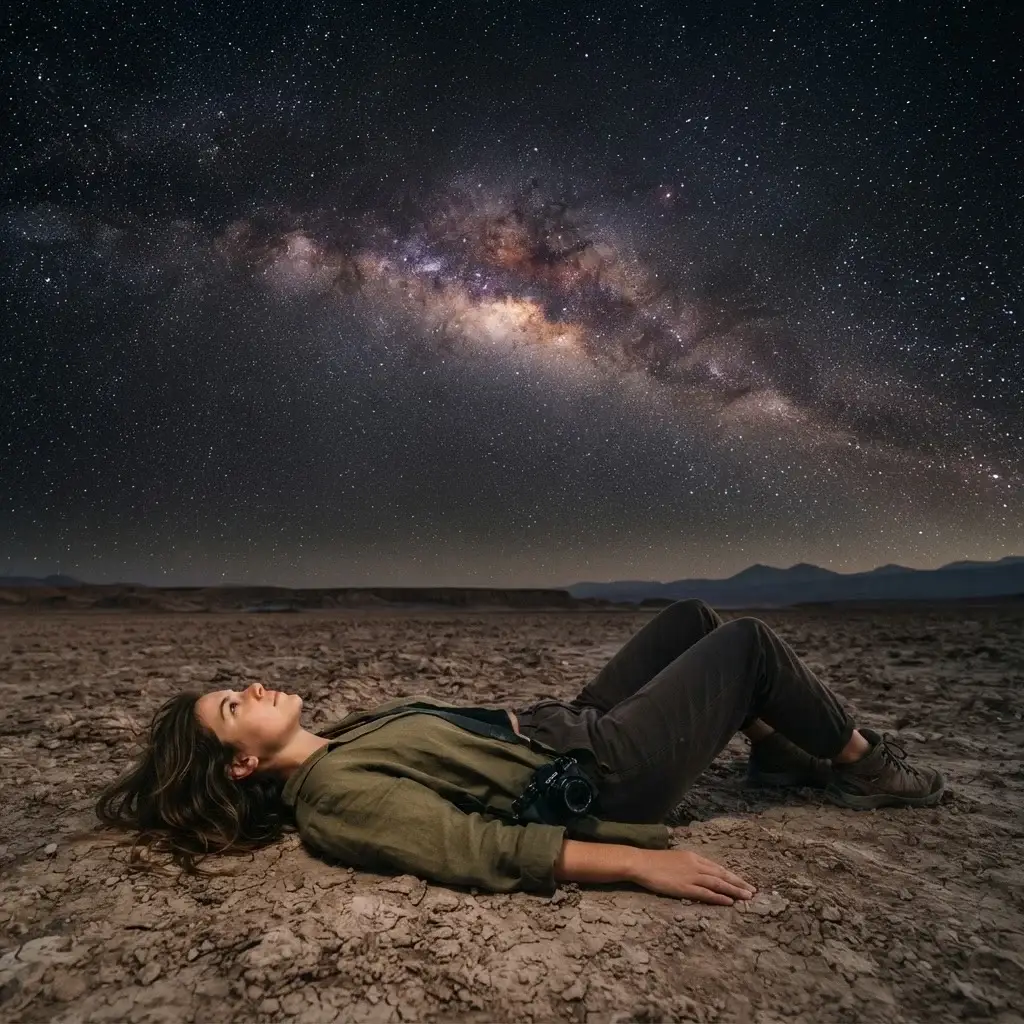
For solo travelers, the base town is San Pedro de Atacama, a small, walkable desert village with a solid range of hostels and small guesthouses. From here, you have two options. The first is joining one of the excellent guided stargazing tours that run most nights (except February, when weather gets unpredictable). These tours use quality telescopes, are led in multiple languages, and give you context for what you are seeing, including the Magellanic Clouds, which are satellite galaxies to our Milky Way only visible from the Southern Hemisphere. The second option is simply walking a few minutes outside of town, lying down on the desert floor, and staring upward. No telescope required.
The altitude in San Pedro sits at around 2,400 meters (about 7,900 feet), so take a day or two to acclimatize before your first late night out. Dress in serious layers regardless of the daytime heat. Desert nights drop fast, and spending two hours on your back in the cold without the right jacket will cut your night short.
Aoraki Mackenzie, New Zealand: The Largest Gold-Status Reserve on the Planet
New Zealand’s South Island is already a stunning destination, but what draws serious dark sky travelers specifically is the Aoraki Mackenzie International Dark Sky Reserve, which is the largest Gold Tier certified reserve in the world. It encompasses Aoraki/Mount Cook National Park and the Mackenzie Basin, a vast high-country landscape of glacial lakes, tussock grasslands, and mountain peaks.
The main base for stargazing here is the small lakeside town of Lake Tekapo (also known as Takapo). From here you have access to Mount John Observatory, run by the Dark Sky Project, which offers nightly guided tours with professional telescopes that include views of the Southern Cross, the Large and Small Magellanic Clouds, and star clusters invisible from the Northern Hemisphere. Tours typically run around NZD 99 per person.
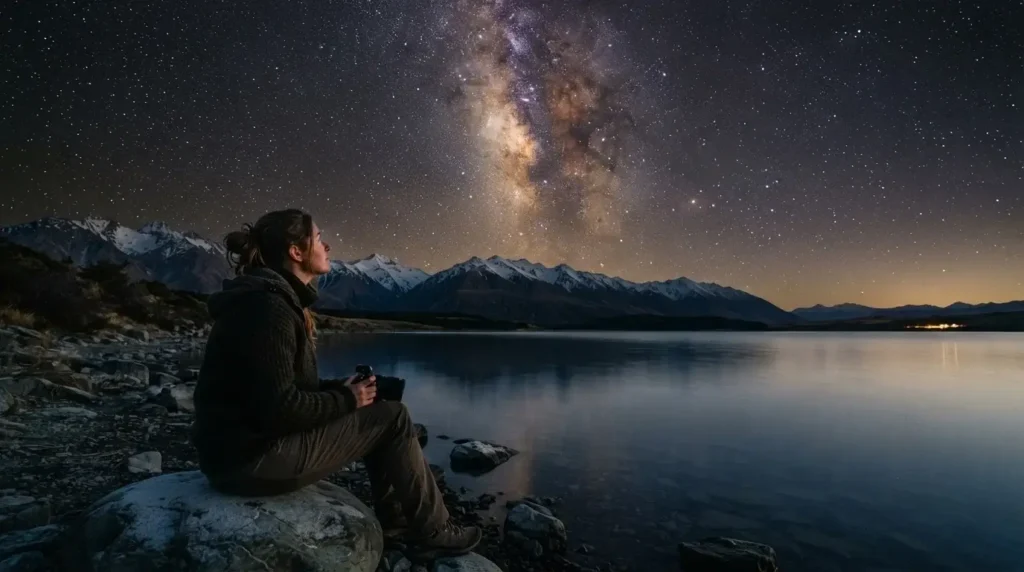
Here is what solo travelers consistently report: the unpaid experience of simply sitting by Lake Tekapo at midnight, with the mountains reflected in the water and the Milky Way directly overhead, is equal to any guided tour. Bring a warm sleeping bag or heavy blanket, find a flat patch of ground away from town lights, and just stay still for an hour. Let your eyes adjust. The Southern Hemisphere sky is genuinely different from anything you see in the north, and this is one of the most accessible places to experience it.
Getting there: buses run from Christchurch to Lake Tekapo (around 3-4 hours), making it feasible as a solo trip without a rental car, though having your own vehicle opens up the wider reserve.
NamibRand Nature Reserve, Namibia: Africa’s Darkest Sky
Namibia is not on most people’s first or second trip list, but if you are building a serious dark sky trip, it belongs on your radar. NamibRand Nature Reserve holds Africa’s first and only Gold Tier designation from DarkSky International, and the official DarkSky listing for NamibRand makes clear why: the reserve sits in one of the least light-polluted regions on Earth, an immense private reserve of over 172,000 hectares in southern Namibia’s Namib Desert.
This is not a budget destination. Accommodation inside the reserve is in the form of private lodges and camps, and the experience is deliberately intimate and slow. What you gain is a sky where the Milky Way is so bright it creates visible contrast on the ground at its peak, and complete, absolute silence. Solo travelers who value a more contemplative, immersive experience consistently describe NamibRand as unlike anywhere else.
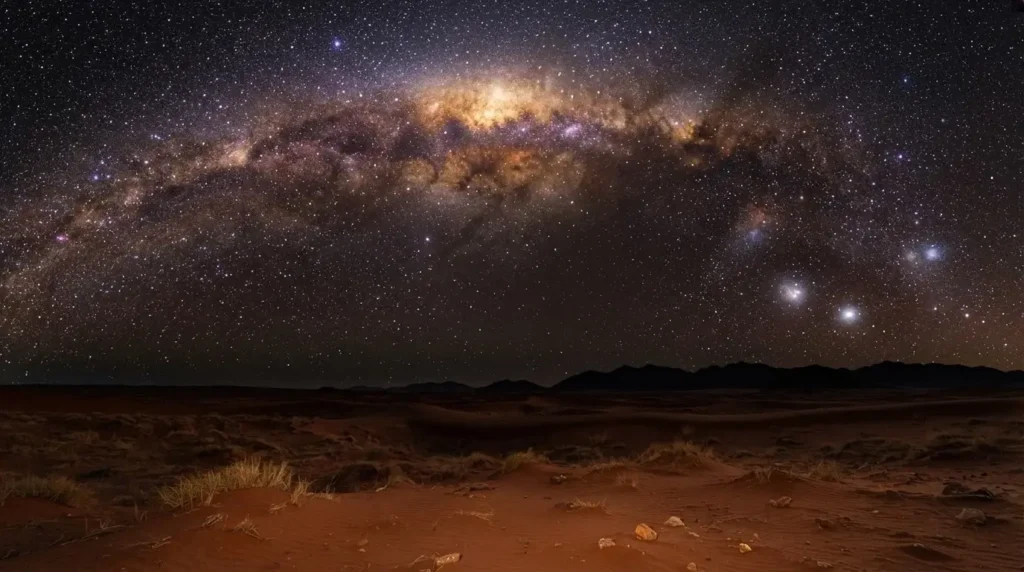
If budget is a concern, the town of Sesriem (near Sossusvlei, a famous red-dune landscape) sits at the reserve’s edge and offers more accessible guesthouse accommodation while still being far enough from any city to deliver extraordinary skies.
Big Bend National Park, Texas: The Darkest Skies in the Lower 48
If you are based in the United States and want a legitimate world-class dark sky experience without leaving the country, Big Bend is your answer. The National Park Service confirms that Big Bend has the darkest night skies of any national park in the lower 48 states, and the Greater Big Bend International Dark Sky Reserve, which spans over 15,000 square miles across both Texas and northern Mexico, is the largest dark sky certified place on Earth.
The sheer remoteness of Big Bend is both its greatest asset and its main logistical challenge. There is no nearby city, which is exactly why the skies are this good. The closest commercial airports are Midland (roughly 3 hours away) or El Paso (around 3.5 hours), and you will need a rental car. Once you are there, the park itself offers campgrounds at various price points, from basic tent sites to a lodge at the Chisos Mountains Basin. Solo travelers consistently point out that the park’s ranger-led night sky programs (check the schedule at the park’s official site) are excellent for beginners who want guidance without paying for a private tour.
The best months for Big Bend stargazing are October through March, when humidity drops and skies become most stable. Summer is hot and occasionally stormy, though the park does see more visitors in the spring shoulder season.
Cherry Springs State Park, Pennsylvania: The East Coast’s Best-Kept Secret
For anyone on the eastern seaboard of the US, the default assumption is that genuinely dark skies require flying halfway around the world. Cherry Springs flips that assumption. Located in the Pennsylvania Wilds, a remote stretch of northcentral Pennsylvania, this small state park holds a Gold Level certification from DarkSky International and is recognized as one of the best stargazing sites on the entire eastern seaboard, which is extraordinary given how built-up the region is.
The Pennsylvania DCNR park page explains that the park is open year-round and typically sees 60 to 85 ideal observing nights annually. There is a public Night Sky Viewing Area for casual visitors and a separate Overnight Astronomy Observation Field that requires reservation and is designed for people bringing telescopes or serious equipment. Two major star parties are held each year, drawing amateur astronomers from across the northeast.
For solo travelers, Cherry Springs is an unusually accessible dark sky experience. It is a manageable drive from cities like Pittsburgh, Philadelphia, or even New York (roughly 4-5 hours from the city), making it a viable long weekend. Accommodation options include on-site camping and small motels in nearby towns. It is a genuinely good first dark sky trip if you have never experienced a Class 2 sky before and want to before committing to an international journey.
What to Bring: The Honest Packing List
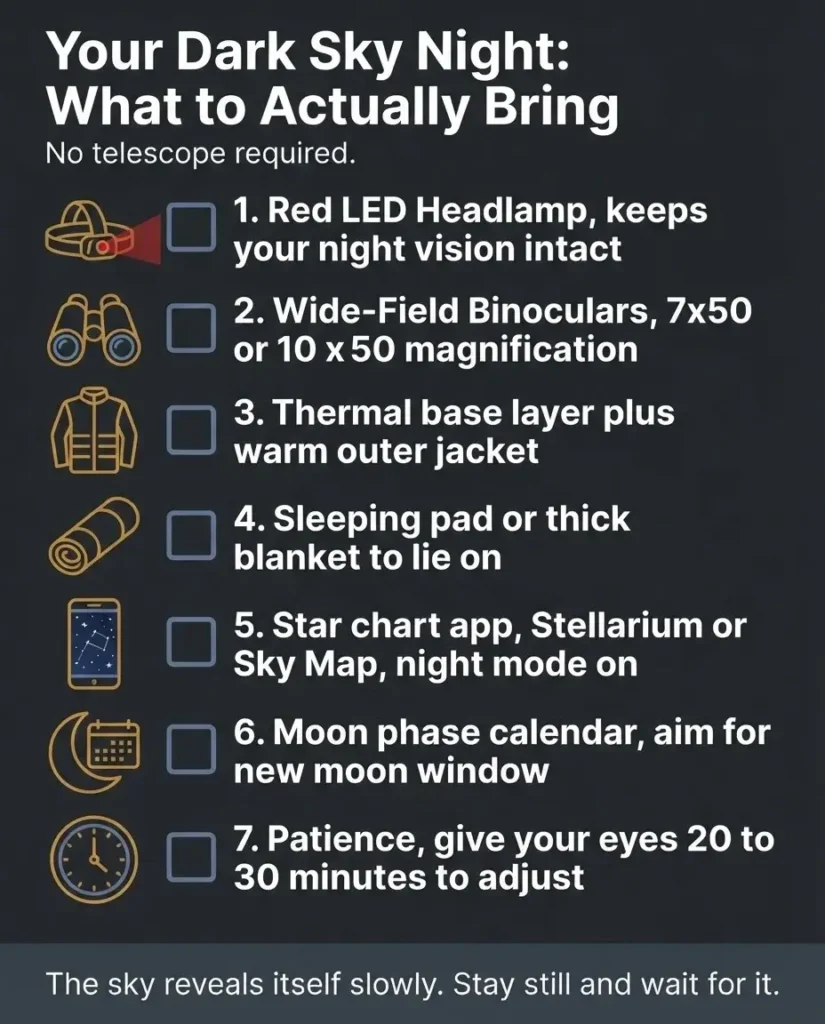
You do not need a telescope. Seriously. The naked eye can see more stars, more galaxies, and more of the Milky Way than most people realize if the sky is dark enough. If you want a visual aid, a pair of standard binoculars (7×50 or 10×50 magnification) will show you star clusters, the moons of Jupiter, and the texture of the Milky Way in a way that is quietly astonishing.
What you genuinely do need: a red headlamp (white light destroys your night vision; red light does not), warm layers even in warm climates because desert nights drop dramatically, a blanket or sleeping pad to lie on, a free star chart app on your phone set to night mode (apps like Stellarium or Sky Map work beautifully), and patience. Give your eyes a full 20-30 minutes to adjust to the dark. That first five minutes where you see nothing special is normal. Hold your ground.
One more honest note: if this is your first time under a truly dark sky, lower the screen brightness on your phone to almost nothing and resist the urge to photograph everything for the first hour. Just look. The photographs can come later. The feeling of your eyes adjusting and the sky slowly revealing itself is an experience worth having fully present.
Planning Your Trip: A Few Things That Make the Difference
The single most common mistake solo travelers make with dark sky trips is choosing the right location but the wrong timing. Even the darkest certified reserve in the world will disappoint you if you arrive during a full moon, an overcast week, or peak tourist season when the public viewing areas are crowded with white flashlights.
Plan around the new moon. There are free moon phase calendars on every astronomy app and a quick search will show you the new moon dates for any month you are planning. Aim to arrive two nights before or two nights after the new moon for maximum darkness.
Check the weather window. This sounds obvious but it is worth repeating. Most dark sky destinations that are serious about the experience (like the Atacama or Cherry Springs) have historical weather data showing their best months. The Atacama is reliable almost year-round outside of February. Aoraki Mackenzie is often clearest in winter (June to August), though that means cold and mountain-specific prep. Big Bend peaks in winter and early spring.

Finally, go alone if you can. I know that sounds counterintuitive, but solo travelers consistently describe dark sky experiences as among the most naturally meditative of any trip they have taken. There is something about being alone under 2,500 stars with no obligation to make conversation that does something productive to the part of your brain that is usually running through to-do lists. It is quiet in the best possible way.
A Final Thought on Why This Trip Is Worth It
I grew up in New York. I worked as a sightseeing guide pointing people at the skyline, at buildings, at the horizontal world of a city that never looked up. I love New York genuinely and deeply. But there is something it cannot give you, which is the awareness that you are on a rock spinning through a galaxy that contains somewhere around 400 billion stars, and on clear nights in dark places, you can actually see some of them.
That awareness does something. It does not solve anything practical. It does not make your inbox smaller or your rent cheaper. But it has a way of putting things in correct proportion, and I have found, over and over, in every dark corner of the world I have found my way to, that proportion is exactly what most of us need more of.
Pick one place from this list. Check the moon phase calendar. Book the trip.