Hidden Nature Escapes That Changed How I Think About Travel

There is a specific kind of disappointment that every traveler eventually hits. You finally reach a place you have been dreaming about for months, only to find a queue of two hundred people waiting to take the same photo you have already seen a thousand times online. You shuffle forward. You take the photo. And something about the whole thing feels hollow.
I know that feeling well from my time backpacking solo across Europe. I hit every major landmark I thought I was supposed to hit, and more than a few of them left me cold. Not because the places weren’t beautiful. They were extraordinary. But something about sharing them with thousands of people moving at the same pace, pointing at the same things, created a sense of distance between me and the experience itself.
The trips that actually changed me were the ones where I had to work a little harder to get somewhere. Where the landscape felt indifferent to my presence, not designed for it. Where the silence was real.
This is what I want to talk about in this article: what hidden nature escapes actually are, how to find your own, and six real destinations that have earned a place on any curious traveler’s radar. Not as a checklist, but as proof that this kind of travel is more accessible than you think.
What Makes a Nature Escape Actually “Hidden”
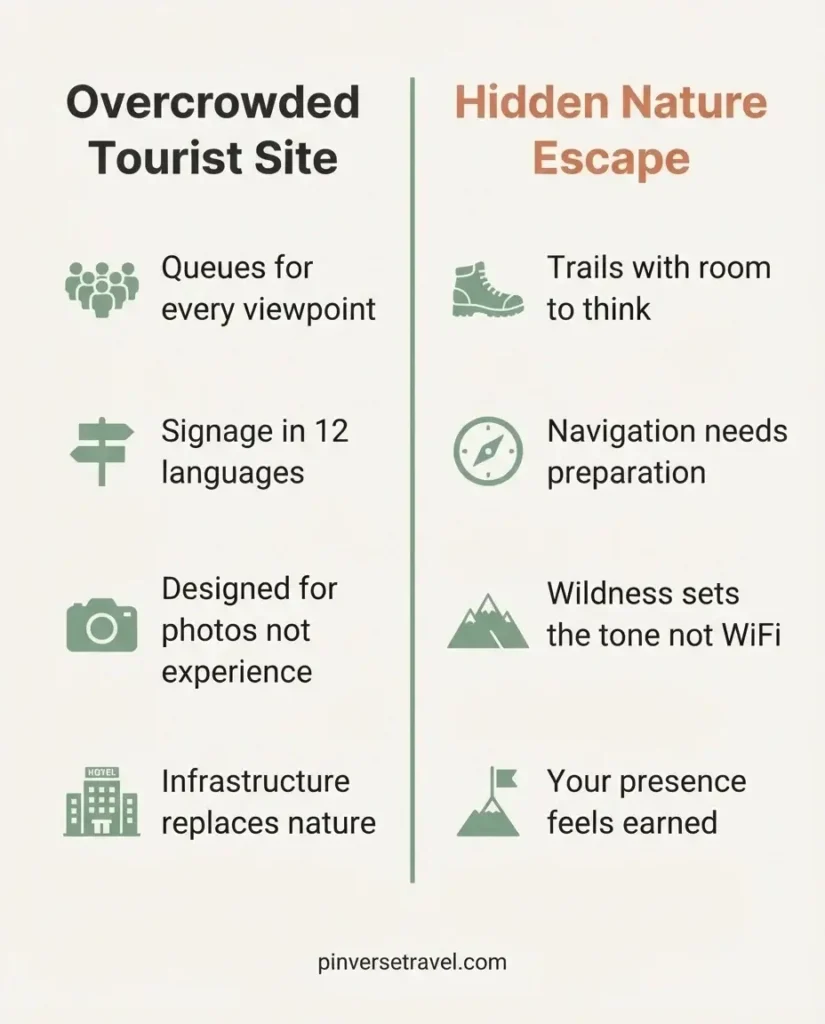
Let me be honest about the word “hidden.” Almost nowhere on earth is truly undiscovered. What I mean by hidden is this: destinations that don’t appear on the first page of every travel magazine, places where the infrastructure serves the landscape rather than replacing it, and spots where the number of visitors is low enough that nature still sets the tone.
Hidden nature travel is less about geography and more about the ratio between tourist footprint and genuine wildness.
A hidden escape could be a national park that gets a fraction of the visitors of its famous neighbor. It could be a small island that most people can’t find on a map. It could be a trail in a country that tourists overlook entirely.
The good news is that finding these places is a skill you can learn. And once you learn it, your relationship with travel changes permanently.
How to Actually Find These Places (Before Everyone Else Does)
Most people find travel inspiration through Instagram, travel magazines, or the same ten articles Google surfaces for every destination. That method is fine, but it feeds on itself. The more a place gets written about, the more it gets visited, the more it gets written about.
Here is what works better.
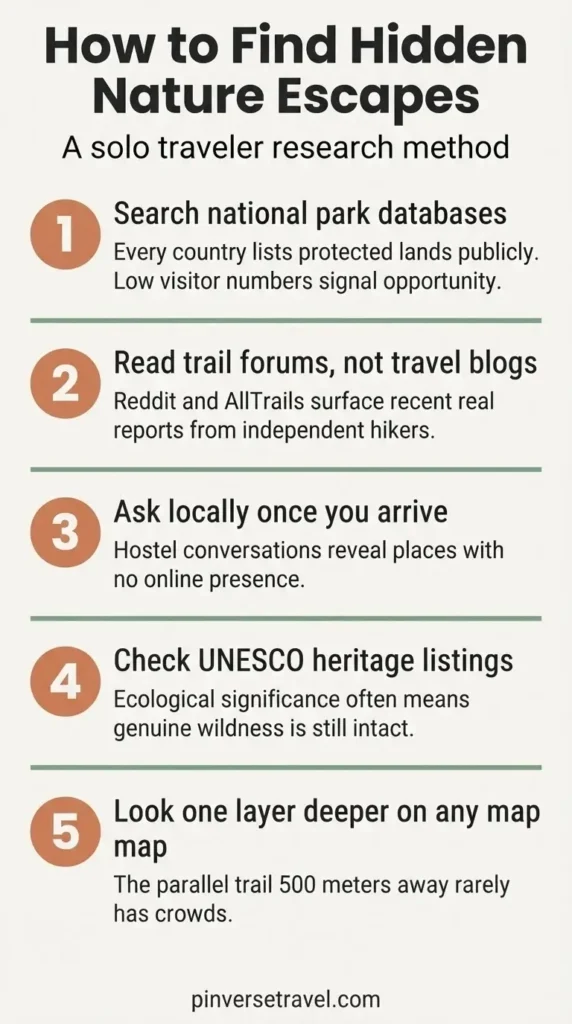
Start with national park and protected land databases. Every country manages its own system, and most of it is publicly available. In the US, the National Park Service website lists every unit in the system, and some of them receive fewer than 100,000 visitors per year compared to over four million at the most popular parks. Internationally, UNESCO World Heritage Sites are a useful filter because the listing signals genuine ecological or cultural significance, not just aesthetic popularity.
Read local trail and outdoor forums, not travel blogs. Reddit communities like r/hiking and r/travel surface real first-person reports from people who have recently been somewhere. The signal-to-noise is high once you learn to sort for it. AllTrails is also underrated for exploring less-documented trail networks in new countries.
Ask locally once you arrive anywhere near your destination. Some of my most unexpected discoveries on my solo backpacking trip across Europe came from hostel conversations with locals who mentioned a forest, a lake, or a coastline that had no online presence. These tips were almost always worth following.
Finally, learn to look one layer deeper on any map. The famous viewpoint has a trail that gets visited constantly. The trail that starts 500 meters away and goes to the same ridge from a different angle rarely does.
Six Hidden Nature Escapes Worth Your Serious Attention
What follows is not a ranked list. These are six places that consistently come up when you talk to travelers who prioritize authentic nature over convenience, solo explorers who like solitude over spectacle, and adventurers who want to feel like they earned the view.
The Faroe Islands, Denmark
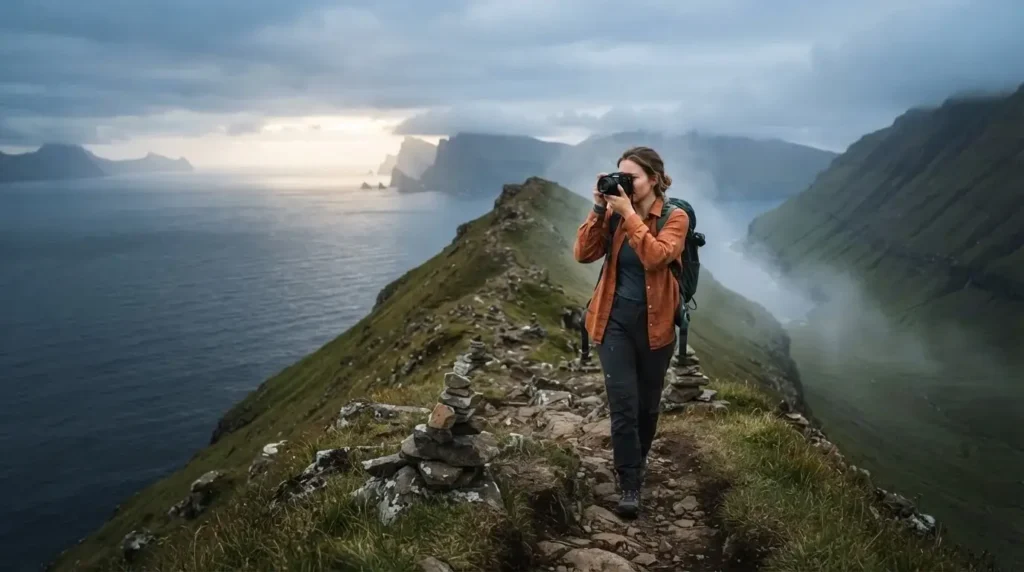
Halfway between Norway and Iceland, the Faroe Islands sit in the North Atlantic like a landscape from a dream you almost remember. Eighteen islands, roughly 54,000 people, and a combination of cliffs, waterfalls, and sea stacks that doesn’t quite fit any category you’ve seen before.
What solo travelers consistently report about the Faroes is that the scale of it is disorienting in the best way. The villages are tiny, the roads are narrow, and the hiking trails take you to ledges overlooking the ocean with nothing between you and the horizon. The official tourism board has mapped out over 23 marked routes at visitfaroeislands.com/hiking, ranging from short introductory walks to full-day ridge traversals. The rules are genuinely important here: hiking is permitted only on designated cairn routes, and some trails charge a small access fee that goes directly to landowner and conservation funds.
Getting there means flying into Vagar Airport (FAO), usually with a connection via Copenhagen, Reykjavik, or Edinburgh. Renting a car is the most practical approach because the island network is connected by road and tunnel. The best time to go is May through September, when the puffins are nesting and the daylight hours are almost absurdly long.
For food, lamb is the centerpiece of Faroese cooking. Skerpikjot (wind-dried mutton) is as Faroese as it gets. Find it in a small restaurant in Torshavn, which is the capital but still tiny enough that you can explore the entire old town on foot in a morning. The harbor area has excellent fish, obviously, and the local Foroya Bjor beer is worth trying at a bar in the old town.
The Faroes reward patience. The weather changes fast and dramatically, and fog is a constant companion. If you plan a trail and the weather rolls in, adjust. The islands will give you something extraordinary; it just might not be on the schedule you wrote at home.
Plitvice Lakes National Park, Croatia
Most people who visit Croatia head for the Dalmatian coast: Dubrovnik, Split, the islands. Plitvice is technically well-known among travelers who research Croatia deeply, but it sits in a completely different part of the country (inland, central Croatia) and represents a very different kind of experience than the sea.
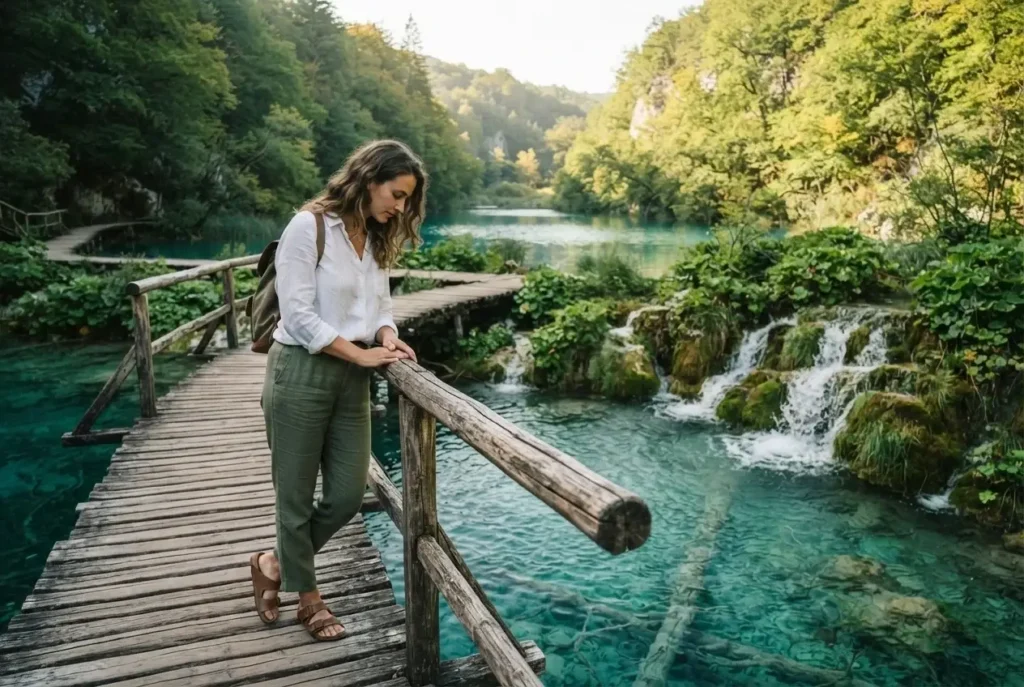
Sixteen terraced lakes connected by waterfalls, surrounded by forest, all formed by the slow, patient work of travertine deposits over thousands of years. UNESCO recognized it in 1979, and the UNESCO World Heritage listing describes the park as one of the most aesthetically exceptional karst lake systems on earth, home to bears, wolves, and rare bird species in its forested interior.
The practical planning detail that matters most is booking your ticket in advance. Entrance fees run from approximately 22 euros per adult in low season (January through May and October through December) to 33 euros per adult in peak summer (June through September), according to the official Plitvice Lakes National Park price list. The park limits daily visitors, and in summer it sells out. Book directly through their official site.
There are eight marked routes through the park ranging from roughly two to six hours. Route H is the longest and takes you through both the upper and lower lakes. If you want any semblance of solitude, arrive at opening time (7 am in summer) and start from Entrance 2 rather than Entrance 1, which attracts the first wave of tour groups. By midday, the boardwalks over the lower lakes can feel genuinely crowded. By late afternoon, the light turns golden and the groups thin out considerably.
The park itself has no traditional food scene inside it, but the village of Rastoke, about 20 kilometers away, is worth an hour. It sits at the confluence of two rivers, watermills still intact, and the local trout is something people come back for specifically.
Great Basin National Park, Nevada, USA
If you ask most Americans to name a national park in Nevada, very few will get to Great Basin. They’ll say Vegas, maybe Red Rock Canyon. Great Basin sits in the very east of Nevada near the Utah border, roughly five hours from Las Vegas and four and a half hours from Salt Lake City. It received around 131,000 visitors in 2024. For context, Zion National Park received nearly five million.
That visitor gap is your opportunity.
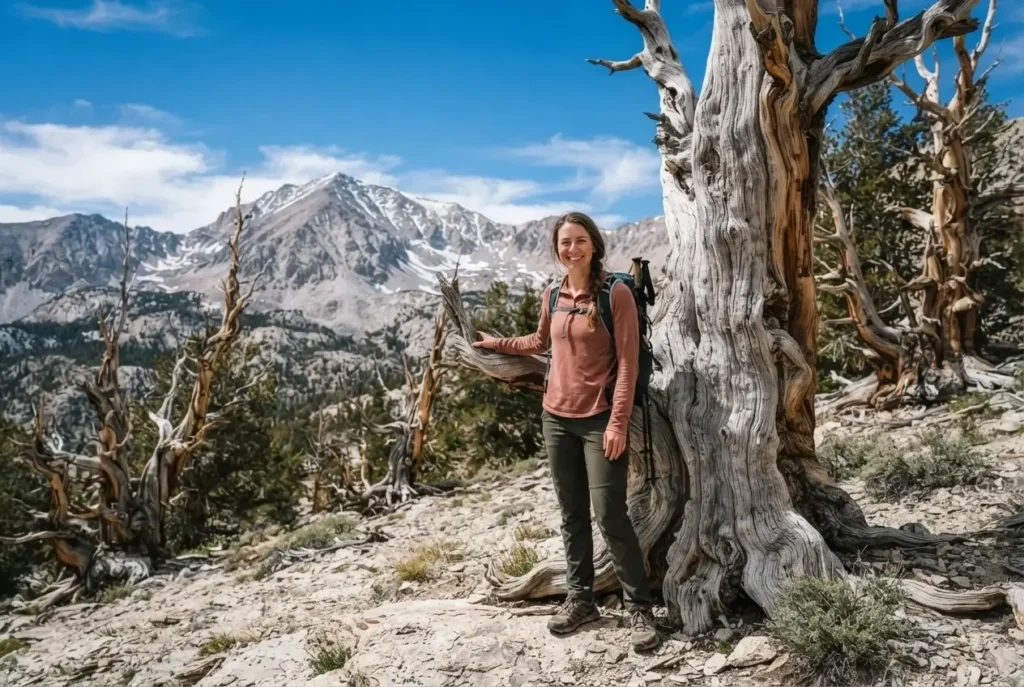
The National Park Service page for Great Basin describes a landscape that rises from sagebrush desert at the base to glacier-carved alpine terrain near the 13,063-foot summit of Wheeler Peak. There are ancient bristlecone pine trees in this park that are over 5,000 years old. Let that sink in for a moment. These trees were alive when the Egyptian pyramids were being built, and you can walk among them on a relatively accessible trail with almost no one else around.
Lehman Caves, located inside the park, offers ranger-guided tours through an exceptionally decorated marble cave full of stalactites, cave shields, and formations found almost nowhere else. Tours are ticketed separately through recreation.gov and are worth reserving ahead, particularly in summer. There is no entrance fee for the park itself.
For a solo traveler, Great Basin has five front-country campgrounds and a backcountry permit system that gives you genuine solitude if you want it. The closest town, Baker (population approximately 50 people), has a small number of lodging options and a gas station. Bring your own food. The night sky is one of the darkest in the continental US, and the park is internationally recognized as a Dark Sky site. Spending one night here changes your sense of scale in a way that is hard to explain and easy to feel.
Triglav National Park, Slovenia
Slovenia sits between Austria, Italy, Hungary, and Croatia, and most travelers treat it as a transit country or a one-night stop on the way to somewhere else. That is a mistake with real consequences for the quality of your trip, because Triglav National Park is one of the most extraordinary mountain landscapes in Europe.
The park covers the Julian Alps in the northwest corner of Slovenia and is named after Mount Triglav, the country’s highest peak at 2,864 meters. It is Slovenia’s only national park, first protected in 1924 and formally established in its modern boundaries in 1981. The park’s official visitor site outlines everything from trail conditions to hut reservations.
The hut-to-hut hiking network is the best entry point for solo travelers who want to cover serious terrain without camping gear. Alpine huts (planinska koca) are scattered throughout the park, managed by the Alpine Association of Slovenia, and they provide meals, dormitory accommodation, and the particular pleasure of shared evenings with other hikers from across Europe. Book huts in advance for July and August because they fill up weeks ahead. In June and September, the trails are quieter and the weather is often perfect.
The Soča River valley, which runs along the western edge of the park, deserves a full day of your time. The water is a shade of blue-green that looks digitally altered but is entirely real, caused by glacial minerals in the riverbed. Swimming in the Soča is cold, bracing, and one of the finest simple pleasures in European nature travel. The town of Bovec at the river’s northern end is a small adventure hub with good goulash, local Lasko beer, and guides who run kayaking and canyoning trips.
Lake Bled, which you’ve almost certainly seen in photographs, sits just outside the park boundary. It is genuinely beautiful and also genuinely crowded. If you’re based in Bled, take half a day for the lake and then go into Triglav. The ratio of beauty to crowds inside the park compared to Bled itself is extraordinary.
North Cascades National Park, Washington, USA
Less than three hours from Seattle, North Cascades is one of the least-visited parks in the continental US despite being one of the most geologically dramatic. The NPS North Cascades page describes it plainly: jagged peaks, deep forested valleys, cascading waterfalls, and over 300 glaciers. That is more glaciers than any other park in the lower 48 states.
The reason it stays quiet is access. There is no destination town at the center of it in the way that Yosemite Valley functions. State Route 20, which bisects the park, is the main artery, and the trailheads are spread along it without the kind of visitor infrastructure that shepherds tour groups in. That keeps the day-tripper volume low and the serious hiker volume high.
For a solo first visit, the Cascade Pass Trail is the most iconic and approachable. It’s 7.4 miles round trip with about 1,800 feet of elevation gain, and the views at the top, of hanging glaciers and jagged ridgelines going in every direction, are legitimately extraordinary. Start early. The parking lot at the trailhead fills up by 8 am on summer weekends.
For something quieter, the Trail of the Cedars near Newhalem is a 0.3-mile loop through old-growth western red cedar and Douglas fir that most casual visitors walk past without stopping. It takes 15 minutes and feels like walking into a different century.
Backcountry permits are required for overnight trips and can be reserved through recreation.gov. The permit system was formalized specifically to protect the park’s wilderness character, and it works. If you want several consecutive days alone among peaks, this park delivers it.
Bring layers regardless of the forecast. North Cascades weather changes quickly, and even in July, summit trails can get cold and wet with very little warning.
The Azores, Portugal
Nine volcanic islands rising from the mid-Atlantic, roughly 1,500 kilometers west of Lisbon. The Azores sits in a geographic and cultural space that is technically Portugal but feels like its own distinct world. The terrain is a result of ongoing volcanic activity: calderas, crater lakes, hot springs, lush hydrangea-lined roads, and a coastline that goes from dramatic basalt cliffs to calm blue bays within a single afternoon.
For a solo nature traveler, the Azores are worth serious attention not just for what they offer but for how they have chosen to manage that offering. The archipelago consistently ranks as Europe’s top sustainable destination, and the official Visit Azores tourism site reflects a genuine commitment to protecting the landscape rather than selling it.
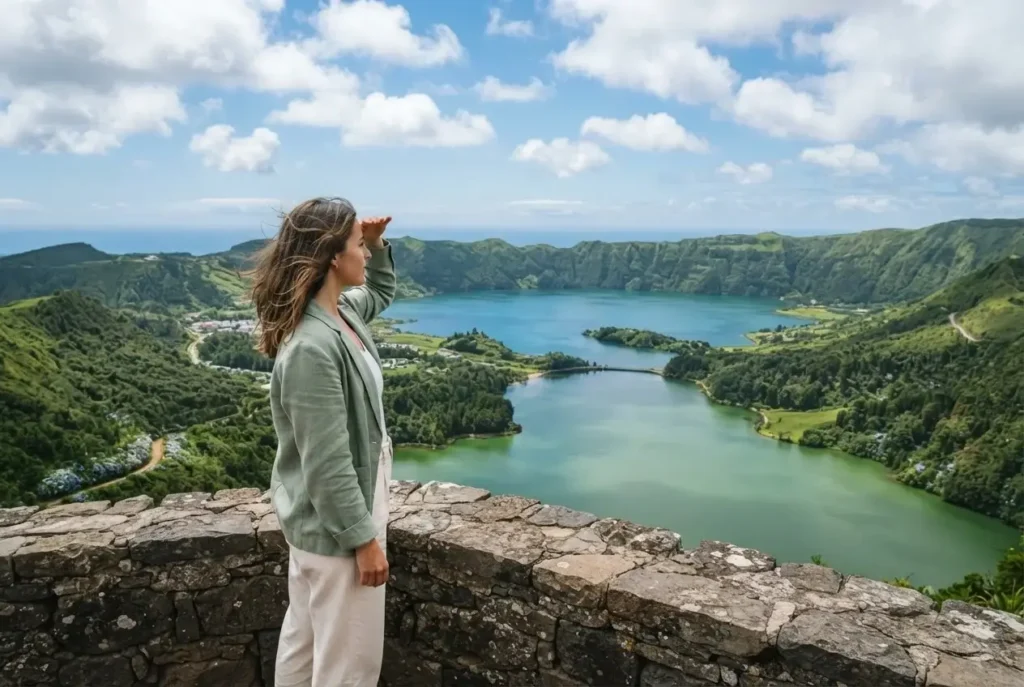
Sao Miguel is the largest island and the logical first stop. The Sete Cidades twin lakes, one blue and one green, sitting inside an ancient volcanic caldera, are among the most otherworldly landscapes you’ll find anywhere in the Atlantic. The morning hike around the crater rim takes about three hours and is best done independently with the AllTrails map downloaded before you go. The views are worth every step but change completely in fog, which is common, and still beautiful when it happens.
Furnas, on the eastern side of Sao Miguel, has hot springs and geothermal cooking that you genuinely won’t find anywhere else. Local restaurants slow-cook Cozido das Furnas, a meat and vegetable stew, underground in volcanic heat for six or more hours. Eating it in the village after hiking the caldeira is one of those quiet moments of pleasure that travel produces. No tour. No queue. Just good food in a small place that earns it.
Whale watching in the Azores is among the best in the world, and unlike some destinations where the marine wildlife encounters are engineered, here you are genuinely in open ocean looking for animals in their habitat. Several operators run trips from Pico Island, which is also home to a distinctive wine culture grown in UNESCO-listed vineyards made of black lava rock. If you have the time, take the ferry between islands rather than flying. The inter-island ferries are reasonably priced, and the ocean crossings give you a sense of the real Atlantic scale that no flight replicates.
The Part Nobody Tells You About Planning a Remote Nature Trip
Here is the honest thing about hidden nature travel: the planning is more demanding, not less.
With a trip to a major tourist city, the infrastructure does a lot of the work for you. Signage is in multiple languages. Transportation is frequent. There are a hundred restaurants within walking distance. If something goes wrong, help is nearby.
With remote nature travel, you carry more of that responsibility yourself. I think about the solo hiking I did through parts of Europe, and the times things didn’t go to plan, a missed bus connection, a trail that ended unexpectedly, a hostel that turned out not to exist at its listed address. Those moments were stressful in the moment. They were also, without exception, the stories I tell most often and the experiences that built the most confidence.
Remote nature travel rewards preparation. That means downloading offline maps before you lose signal. It means researching the nearest town with medical facilities before you need them. It means packing for weather that is a tier worse than the forecast promises. It means telling someone your itinerary, particularly if you’re hiking alone.
It also means accepting that you won’t control everything, and learning to find the value in that.
A Note on Responsible Visiting
The places in this article are worth protecting. Some of them, like the Faroes and the Azores, have implemented formal systems for managing visitor impact: trail fees, permit systems, designated routes. Respect these systems. They exist because enough careless visitors can damage an ecosystem in ways that take decades to repair.
Beyond the formal rules, the principles are simple: stay on marked trails, carry out everything you carry in, and spend money locally when you can. The small guesthouse, the family-run restaurant, the local guide, these people are the reason a place remains genuine rather than becoming a theme park version of itself.
Travel light on the land. Leave it better than you found it.
The Real Reason to Go
I left a conventional career because I couldn’t make peace with the idea of reducing the world to two weeks per year. What I found through years of travel, across Europe solo, living with a family in Ghana, teaching in Thailand, hiking through the landscape of China, was that the most transformative moments almost never happened at the famous landmarks. They happened in the unexpected silences. On the trails nobody else was on. In the small towns where no one expected a tourist and people treated you like a person instead of a transaction.
Hidden nature escapes are not the alternative to good travel. They are the point of it. They are what travel looks like when you stop trying to collect destinations and start trying to understand places.
The question isn’t whether you’re the kind of person who can do this. You are. The question is when you’re going to decide that the right moment is now.