Underrated Beach Destinations Every Solo Traveler Should Know

There is a particular feeling that hits when you have been scrolling Pinterest for twenty minutes and realize you have saved the same five beaches under different names. Santorini again. Bali again. The Maldives, which you will never actually afford, again. The images are beautiful. They are also everywhere. And somewhere between the fourth save and the fifth, you start to wonder: is there anything left that has not already been turned into a backdrop for someone else’s content?
The honest answer is yes. A lot, actually.
The beaches on this list are genuinely beautiful, genuinely worth your time, and genuinely less visited than the ones you keep seeing in your feed. Some are growing in popularity but still have years before they hit peak saturation. Others are structurally harder to reach, which is exactly what keeps them special. All of them reward the kind of traveler who is willing to do a little homework and step slightly off the obvious path.
I will not pretend I have been to every single one of these. What I will give you is honest, thoroughly researched context for each place, drawn from what solo travelers consistently report, what official sources confirm, and the kind of practical information that actually helps you make a decision. Because pinning a photo is easy. Knowing how to actually get there is the part that turns a dream into a trip.
Why “Underrated” Beaches Work So Well for Solo Travelers
Before the list, it is worth saying this clearly: less-visited destinations are not just more photogenic for your feed. They are genuinely better for solo travel in several important ways.
When a beach is not overrun with tourism infrastructure, you end up interacting more directly with the people who actually live there. You eat at family-run places instead of tourist restaurants. You get better directions from a local who has time to talk because they are not serving forty other visitors. You feel less like a consumer and more like a guest. That shift changes the whole texture of a trip.
I felt this most when I lived with a family in Ghana. There were no tour buses, no curated experiences, and no one performing their culture for my benefit. It was just life, and I was allowed to be part of it for a while. Some of the most underrated beach regions in the world offer that same quality, if you know where to look.
These are the ones worth knowing about.
The Albanian Riviera: Europe’s Best-Kept Coastal Secret
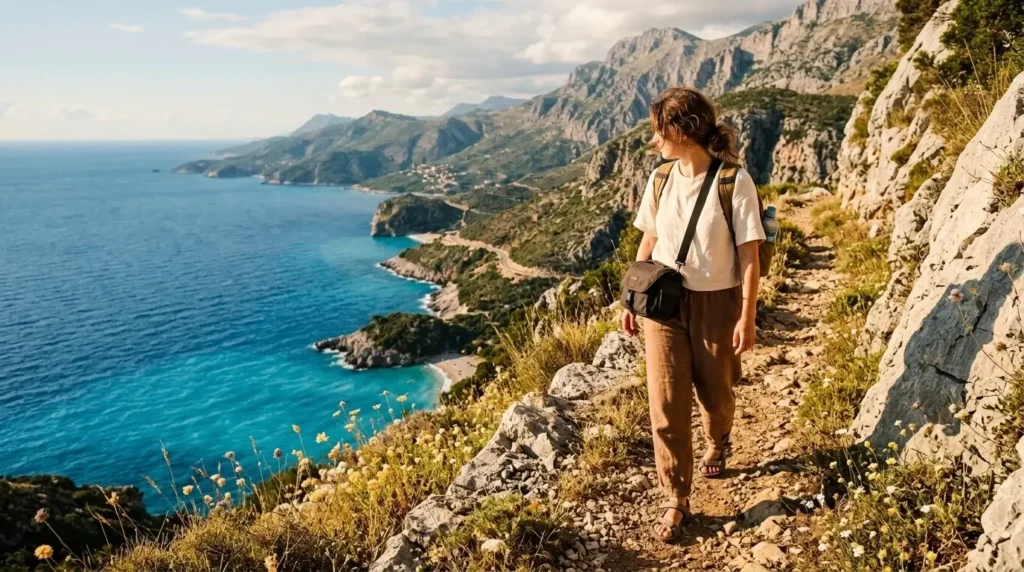
If you have not already seen photos of the Albanian Riviera on Pinterest, you are about to start. The coastline along southern Albania, running between Dhërmi in the north and Ksamil near the Greek border, has some of the clearest blue water in Europe, backed by dramatic limestone mountains, and it costs a fraction of what you would spend in Greece or Croatia.
The practical entry news is very good for American travelers. According to the U.S. Department of State’s Albania travel page, U.S. citizens can enter Albania as tourists without a visa and stay for up to one year without needing a residency permit. Most Western passport holders from the UK, Canada, Australia, and EU countries have similar visa-free access. You simply arrive, and you are in.
The key to getting the most out of the Riviera is avoiding the most Instagrammed towns and going slightly further. Sarandë and Ksamil now see decent crowds in peak summer. If you base yourself in Himarë or Dhërmi instead, you get the same extraordinary water and half the people. The beaches there are a mix of pebble and sand, the water is breathtakingly clear, and the pace is genuinely slow.
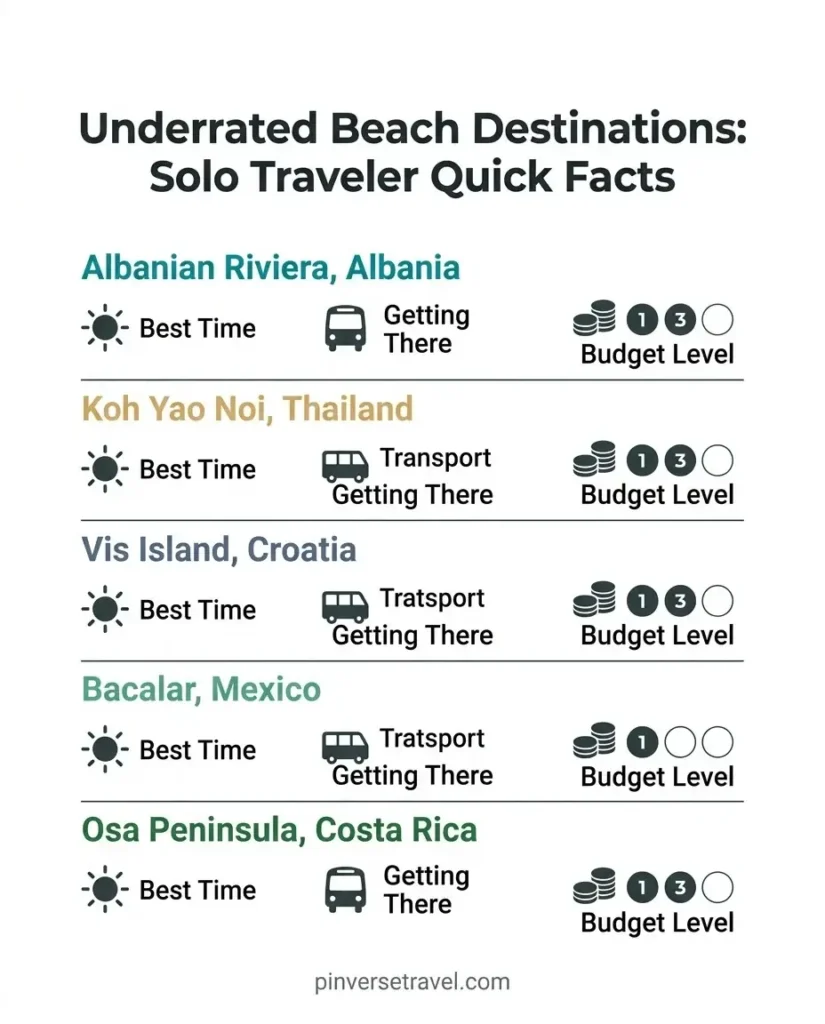
Getting there is straightforward. Fly into Tirana (the capital), then take a furgon, which is a shared minibus, south along the coast road. The journey takes around four hours and costs very little. Albania is primarily a cash economy, so arrive with local lek ready, though ATMs are available in the main towns.
The best time to visit is June or September. July and August bring the most visitors and the highest prices. June offers warm water, empty beaches, and wildflowers still on the hillsides. September is arguably even better: the crowds thin out, the sea is at its warmest from a full summer of sun, and accommodation prices drop noticeably.
What to eat: fresh grilled fish is the obvious answer, and it is excellent. But the thing I keep hearing solo travelers rave about is the byrek, a flaky savory pastry filled with spinach and feta that you will find at almost every corner bakery for almost nothing. Start your mornings there.
Koh Yao Noi, Thailand: The Island That Phuket Forgot
Most people flying into Phuket stay in Phuket or catch a boat to Koh Phi Phi. A much smaller number of travelers take the thirty-minute speedboat from Bang Rong Pier to Koh Yao Noi, which is arguably one of the most peaceful islands in all of Thailand.
Koh Yao Noi sits in Phang Nga Bay, surrounded by the same limestone karst scenery that makes this region so spectacular, but without the development or noise of its more famous neighbors. There are no full-moon parties here. No beach clubs with DJs. The island runs on a rhythm set by the local Muslim fishing community, and the atmosphere is calm, respectful, and genuinely warm.
The beaches on the island, particularly Pasai Beach and Long Beach on the southwest side, are not the white-sand postcard variety you see in Phuket brochures. They are quieter, simpler, and framed by extraordinary views of the bay. Longtail boats dot the shoreline. Water buffalos wander the rice fields behind the beach road. It feels like a Thailand that still belongs to the people who live there.
Getting there is easy once you know how. From Bang Rong Pier in Phuket, speedboats run regularly throughout the day for around THB 400 per person (roughly $11 USD). You can check current departure schedules directly through Siam Tickets’ Phuket to Koh Yao Noi ferry schedule, which lists multiple operators and pricing options. The crossing takes about 30 minutes.
Accommodation is mostly family-run guesthouses and small boutique resorts. Budget options exist but book them early if you are visiting between December and March, when the island sees its highest demand from travelers who have figured out this secret.

For food, look for the small local restaurants serving massaman curry and fresh seafood near the pier village. Eating where the locals eat is easy here because there are very few places designed purely for tourists. That is a feature, not a bug.
Solo travel safety context: Thailand overall is considered one of the safer countries in Southeast Asia for solo travelers. Koh Yao Noi specifically is extremely low-key and has a reputation among the solo travel community for being friendly and hassle-free. The local Muslim community is conservative, so modest dress is appreciated when you step away from the beach.
Vis Island, Croatia: The Dalmatian Coast Without the Crowds
Croatia’s Dalmatian coast is not exactly a secret. Split and Dubrovnik are two of Europe’s most visited cities in summer. But Croatia’s outer islands are a different story, and Vis sits at the end of the ferry line in every meaningful sense.
Vis was a closed military zone during the Yugoslav era and only opened to foreign visitors in 1989. That late start to tourism has permanently shaped its character. It is quieter, more agricultural, and more authentically Croatian than the busier islands closer to the mainland. The wine is excellent. The fishing is still serious. The beaches, particularly Stiniva (a stunning pebble cove enclosed by near-vertical cliffs) and the sandy shores near Milna, are some of the most beautiful in the Adriatic.
The ferry from Split to Vis is operated by Jadrolinija, Croatia’s official state ferry company, running line 602 year-round. In peak summer the crossing runs up to five or six times daily; in shoulder season you get one to three departures. The crossing takes about two hours and the views of the open Adriatic are gorgeous on their own.
What solo travelers consistently appreciate about Vis is that it is genuinely walkable and cyclable. You do not need a car. Rent a bicycle from the town of Vis or Komiža and explore the interior, which is covered in vineyards and dotted with stone-walled villages. The island’s vugava white wine is only produced here, and sipping a glass at a konoba (traditional Croatian tavern) while watching the fishing boats come in is the kind of afternoon that makes you forget you were ever stressed about anything.
Best time to visit: May, June, and September. July and August are beautiful but increasingly busy, even on Vis. Coming in late May means the lavender is blooming, the water is still quiet, and you can almost always get a table at the best restaurants without a reservation.
Bacalar, Mexico: The Lagoon That Rewrites Your Idea of a Beach Trip
Bacalar is technically a lagoon, not an ocean beach. But I am including it here because it genuinely belongs on this list, and because the distinction barely matters once you are floating in water that shifts between seven distinct shades of blue and green depending on depth, light, and your angle of view. It is one of the most visually striking bodies of water anywhere in the Americas.
It sits in the southern Yucatan Peninsula, about four to five hours south of Cancun by bus, near the Belize border. This distance is actually what protects it. Most tourists flying into Cancun stay within easy reach of the coast and never make the journey south. That is changing slowly, but Bacalar still feels genuinely unhurried compared to Tulum or Playa del Carmen.
For getting there without a car, the ADO bus is the standard and reliable option. Direct buses from Cancun run the journey in roughly five to six hours for about $20 to $35 USD one way. Hello Bacalar’s travel guide has current bus schedules and useful logistics for planning the journey.
Once you arrive, the town itself is small and walkable. The best way to experience the lagoon is on a lancha (small motorboat) tour, which takes you to the natural swimming areas called cenotes and to Los Rapidos, a section of the lagoon where underground freshwater springs create a natural current you can float along. Entry to Los Rapidos is around 100 MXN (about $5 USD). The public dock in town also offers free access to the water, which is a good option for quiet early mornings.

Solo travel note: Bacalar has a growing community of slow travelers and digital nomads, which means you will almost certainly meet other solo travelers at the hammock cafes and sunset spots along the lagoon. It is the kind of place that draws introspective, curious people, and conversations happen naturally.
What to eat: fresh fish tacos from the market stalls near the center of town, and marquesitas, which are a crispy rolled crepe filled with Edam cheese and your choice of sweet filling. Order one at dusk and eat it while you watch the lagoon change color.
The Osa Peninsula, Costa Rica: Where Wildlife Meets the Water
The Osa Peninsula is the kind of place that National Geographic writes about and almost nobody actually visits. It sits in the far southwest of Costa Rica, jutting into the Pacific, and it contains Corcovado National Park, which scientists have called one of the most biologically intense places on Earth. Over a quarter of all Costa Rica’s bird species live here. Tapirs walk the beaches at dawn. Scarlet macaws fly in pairs overhead.
The beaches around the Osa, particularly near Drake Bay and the town of Puerto Jimenez, are dark sand, wild, and backed by dense primary rainforest. You do not come here for a manicured resort experience. You come here because you want to feel genuinely small in the presence of an ecosystem that operates entirely without your input.
Corcovado National Park is managed by SINAC, Costa Rica’s official national parks authority. The official SINAC park page lists the entry fee at $15 USD per day for international adult visitors. The park is open daily from 7am to 4pm, though the Sirena sector closes in October. Importantly, you are required to enter with a licensed local guide, which is both a conservation measure and genuinely practical in terrain this dense.
Getting to the Osa requires intention. From San Jose, you can take a small domestic flight to Puerto Jimenez (about 45 minutes) or take a long bus journey followed by a ferry. The effort is the point. The peninsula rewards travelers who actually want to get somewhere, not just be somewhere.
For solo travelers, the guided-entry requirement for Corcovado actually makes it easier to meet people. Day tours run from the main towns and typically mix small groups together.

The area around Puerto Jimenez has a laid-back, ecologically minded traveler community that skews heavily toward people who are here because they care about what they are doing, not just where they are going.
What to eat: casados, the traditional Costa Rican lunch plate of rice, beans, salad, and your choice of protein, are available at the simple local sodas (small family restaurants) for a few dollars. Fresh ceviche at the dock in Puerto Jimenez is also a non-negotiable.
The Practical Truth About “Underrated” Beaches
Before you close this tab and go add all five to a new Pinterest board, I want to say one more honest thing: underrated does not mean problem-free. It means trade-offs.
Albania’s roads can be rough and ATMs are not always reliable outside the main towns. Koh Yao Noi has limited nightlife and very patchy Wi-Fi, which will either delight or frustrate you depending on why you travel. Vis has a slower ferry schedule in low season, and the best restaurants close early. Bacalar is four-plus hours from any major airport, and the journey south requires planning. The Osa Peninsula demands physical effort and bug spray and a certain comfort with humidity.
None of these are reasons not to go. They are reasons to prepare, which is a different thing entirely.
The solo travelers who consistently have the best experiences at places like these are not the ones who researched every detail perfectly. They are the ones who arrived with realistic expectations, a flexible mindset, and genuine curiosity about the place they were visiting. That combination is more valuable than any packing list.
I left a comfortable office job in New York because I knew there was a version of life that felt more alive than anything a rigid schedule could offer. Every single beach on this list represents that version. Not because they are perfect. Because they are real, and they are waiting.
Save them. Then book them.