From Pinned to Planned: Building Unique Travel Experiences

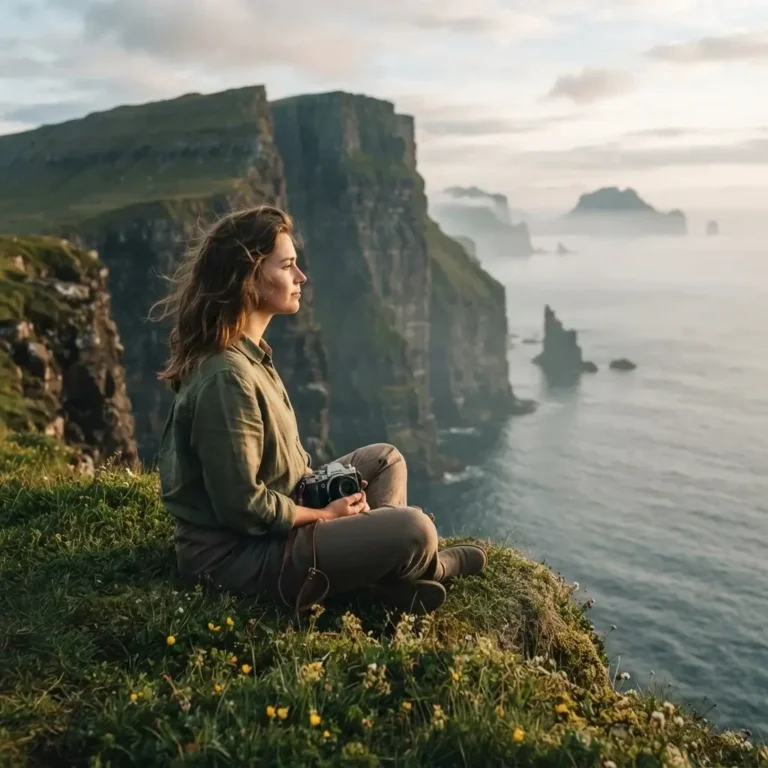
You probably have a Pinterest board somewhere with a name like “Places I Need to Go” or “Dream Trips” or just “Travel.” And it’s full. Sunrise photos over rice terraces. A market in Marrakech packed with color. Someone sitting alone at the edge of a cliff in Norway. A night train cutting through mist in the mountains.
You save them, and it feels like progress. Like you’re one step closer.
But months pass. The board grows. And the trips don’t happen.
Here’s the thing, and I say this with genuine affection because I have been exactly that person: Pinterest is one of the most powerful travel planning tools available, but most of us are using only about ten percent of its actual potential. We use it as a mood board when we could be using it as a launching pad. We collect images when we could be collecting plans.
This article is about the shift from one to the other. It’s about how to use Pinterest intentionally to find travel experiences that feel genuinely yours, not just tourist-trail highlights that look good in someone else’s photos. And it’s about the kinds of experiences worth looking for in the first place.
Why Pinterest Is Actually a Serious Travel Research Tool
Let’s start with some numbers that might surprise you.
According to Pinterest’s own 2024 Travel Report, there were over one billion travel-related searches and more than ten billion travel saves on the platform in a single year. Eight in ten weekly Pinterest users turn to the platform when planning their trips. And solo travel searches grew 35% year over year. That is not a passive scrolling community. That is a planning community.
What’s interesting about how people search on Pinterest is that they tend to lead with passion rather than destination. They don’t always search “things to do in Peru.” They search “ancient cities,” “train journeys,” “village vibes,” “quiet places.” They’re looking for a feeling, an experience type, before they’ve even committed to a country. That means Pinterest can actually surface ideas you wouldn’t have thought to look for, which is either wonderful or dangerous depending on how you use it.
The wonderful version is what this article is about.
How to Search Pinterest Like You Mean It
Most people use Pinterest the way they use Instagram: they scroll, they double-tap, they move on. But Pinterest’s search function is genuinely sophisticated, and if you know how to use it, you can move from vague inspiration to specific, real-world possibilities faster than you’d expect.
Here’s what works for solo travelers looking for unique experiences. Instead of searching for a destination name, try leading with the experience type first. “Cooking class cultural immersion,” “homestay village,” “local festival solo travel,” “craft workshop traditional,” “night train solo.” These search strings pull results from actual travel writers and bloggers who have done the thing, not just photographed it from a distance.
Once you find a pin that genuinely interests you, follow it to its source. This is the step most people skip. The pin is just the door. The article, itinerary, or booking page behind it is the room where the real information lives. Pinterest is a search engine with a visual interface. Treat it like one.
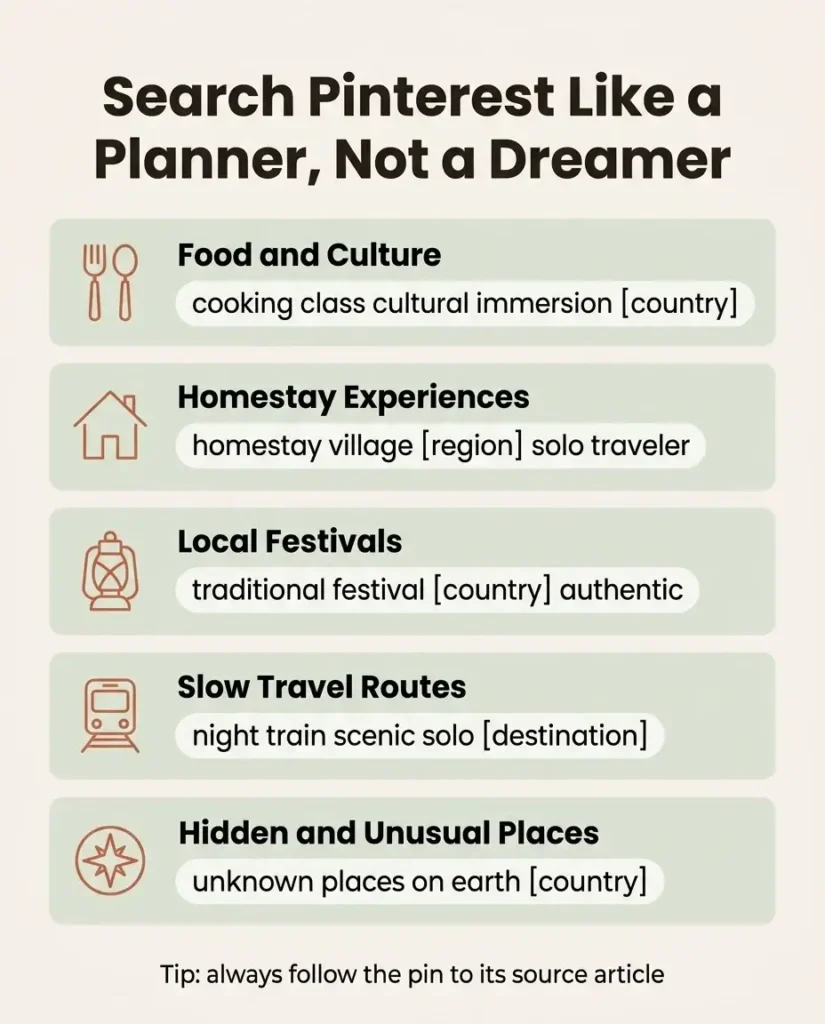
For staying organized, the most useful habit is to build destination-specific boards rather than one giant dream board. If you’re seriously considering a trip to Southeast Asia, make a board called “Thailand Solo Plan” and start pinning specifically to that. When you do that, the algorithm begins pulling related, increasingly specific content your way. A practical walkthrough on building boards that actually work as planning tools is outlined well at Adventures Around Asia’s guide to Pinterest travel planning, and it’s worth five minutes of your time.
The Trap: Aesthetic vs. Authentic
There is one thing I want to name clearly before we go further, because Pinterest makes it easy to fall into.
Not everything that looks beautiful in a pin will feel meaningful when you’re actually standing there.
Some of the most visually stunning travel images you’ll save are from places that, in reality, have been optimized almost entirely for the photo moment. They’re beautiful, organized, and designed for the image. The experience of being there is sometimes less about discovery and more about waiting your turn in the queue.
That’s not necessarily a problem. Sometimes you want the postcard view. But if what you’re actually chasing is the feeling that photo seems to promise, which is something like wonder, connection, discovery, or belonging somewhere unfamiliar, then the image and the experience can diverge quite sharply.
I learned this in a useful way when I was backpacking solo through Europe. Some of the places that ended up mattering most to me were spots I stumbled into rather than ones I’d planned for. A small church in a village where someone was practicing organ. A market where I bought two things I couldn’t name and ended up eating the best meal of the week. A conversation on a train that lasted four hours. None of those had Pinterest boards dedicated to them.
The question worth asking when you save a pin is not just “does this look amazing?” but “what is this actually offering me as an experience?
Is it solitude in nature? Learning something old and specific to that place? Tasting food I’ve never encountered? Sharing space with a community celebrating something? When you can name what draws you to an image, you can search more specifically for it.
What Pinterest’s Own Data Is Telling Us Right Now
This is where it gets genuinely useful for planning, because Pinterest publishes trend data, and that data tells you something real about what travelers are craving collectively.
The 2025 Pinterest Summer Trend Report was striking in one particular direction: digital detox and nature immersion dominated. Searches for “digital detox vision boards” rose 273%. “Nature retreat” was up 72%. “Book retreats” as a travel category grew 103%. People are actively seeking experiences that remove them from screens and place them back inside the physical world.
What this tells me as a traveler is something I think a lot of people are feeling but haven’t quite articulated: the most unique travel experience available to you right now might simply be the one that fully absorbs your attention. Not the rarest destination. Not the most complicated itinerary. The experience that pulls you out of half-presence and into full presence.
That might be a week-long hiking route without cell service. A cooking retreat in a farmhouse. A homestay in a village where the rhythm of the day has nothing to do with your phone. A slow train ride where you sit and watch the landscape change for hours. These aren’t extraordinary in the flashy sense. But they are, by the measure of actual memory and impact, among the most significant things you can do.
The Types of Unique Experiences Worth Actually Planning
Let’s get practical. Here are the categories of experience that solo travelers consistently describe as the most memorable, and that Pinterest can help you research and find, if you know what to look for.
Skill-based cultural encounters. Cooking classes are the obvious version of this, but the deeper version is any experience where you learn something locally specific and hands-on. A traditional weaving workshop in Guatemala. A pottery class in a Japanese ceramics town. A bread-baking morning with a local family in Portugal. The reason these land so hard is that you leave with something you made, a skill, a product, a feeling of competency in a new tradition. Look for these on Pinterest by searching “[destination] traditional craft workshop” or “[destination] cooking class local.”
Homestays and cultural exchange stays. This is the category I find most consistently undervalued by travelers who think they want unique experiences. Living with a local family, even for a few days, changes the entire texture of a trip. When I lived with a family in Ghana, I understood more about daily life, family structure, food traditions, and community in those few weeks than I could have gathered from any number of museum visits. Platforms like Worldpackers connect travelers to hosts in over 100 countries where the exchange is built around genuine cultural connection, often in exchange for a few hours of help each day.
Local festivals and living traditions. This is one of the areas where Pinterest can be genuinely revelatory if you search well. Type “traditional festival [country]” or “local celebration [region]” and you’ll start finding content about events that exist entirely outside the tourist infrastructure: harvest festivals, religious celebrations, community markets, oral history gatherings, seasonal ceremonies. Many of these are listed at UNESCO’s Intangible Cultural Heritage lists, which is one of the most under-used travel planning resources in existence. It catalogs living traditions, performing arts, festive events, and cultural practices across dozens of countries, complete with information on where and when to witness them.
Slow-travel stays that let a place accumulate meaning. This is something I feel strongly about based on my own experience. The solo traveler’s secret weapon is time. Unlike a group tour that has to see twelve things in four days, you can stay somewhere for two weeks and get to know it properly. The benefits of doing this are well-documented: lower costs, deeper connections, less stress, and the kind of specific local knowledge that only comes from becoming a semi-regular at the coffee shop around the corner. A useful framework for approaching slow travel intentionally is laid out at Worldpackers’ guide to slow travel, especially for first-timers who feel guilty “wasting time” in one place.
Strange, specific, and unexpected places. For the purely curious traveler who loves discovery over itinerary, Atlas Obscura is the website that Pinterest should be for this kind of thing. It catalogues over 24,000 unusual, overlooked, and genuinely singular places around the world, everything from the oldest surviving hedge maze in Barcelona to a Soviet-era monument in the Bulgarian mountains that nobody talks about. You can use Atlas Obscura alongside Pinterest, using Pinterest for the visual mood and Atlas Obscura for the specific, researched location that delivers on it.
How to Move a Pin Into an Actual Plan
This is the part most people never reach, and it is where the entire value of your Pinterest research pays off. The process is simpler than most people think.
Start with a saved pin you keep returning to. The fact that you keep coming back to it means something. Follow it to its source article. Read it. Note the specific location, region, or platform where the experience is offered. Then open a new tab and search for that experience outside Pinterest: the local tourism board, an activities platform, a relevant Facebook group for solo travelers in that region, or a travel forum thread where people discuss that exact type of experience. The Pinterest pin is a pointer, not a plan. The plan lives in those secondary sources.
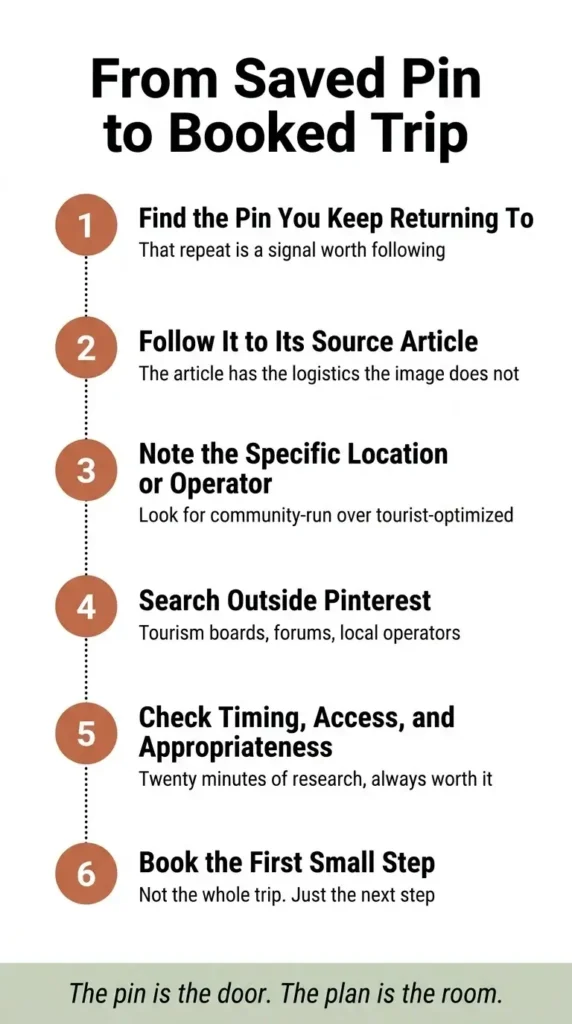
For experiences that involve booking, things like cooking classes, guided nature treks, or craft workshops, platforms like local cultural centers, small group tour operators, or official heritage sites are usually the best booking source. Always check whether the experience is run by the community it represents rather than by an outside operator, because that distinction changes the quality of the exchange significantly.
For experiences that are more about being somewhere, a slow food market, a religious ceremony open to visitors, a folk music evening in a small town, your research should focus on timing, access, and whether your presence as a visitor is appropriate and welcome. This takes about twenty minutes of additional reading and it is always worth doing.
The Confidence Part
I want to say something about what often goes unspoken in this kind of article.
A lot of people save travel content on Pinterest for years without going anywhere. Not because they don’t want to travel, not because they can’t afford it, but because the gap between the image and the actual departure feels enormous. There’s the logistics, yes. But there’s also the quieter fear that when you actually get there, the experience won’t match the feeling the image promised. Or that you’re not the kind of person who does things like this.
When I left my office job to pursue travel and writing, I was genuinely unsure whether I was capable of doing the things I’d been pinning. Hiking through China taught me I was tougher than I thought. Teaching English in Thailand taught me I could be useful in a context that had nothing to do with my training. Backpacking solo across Europe taught me that I was better company for myself than I’d assumed.
None of those lessons came from saving pins. They came from going.
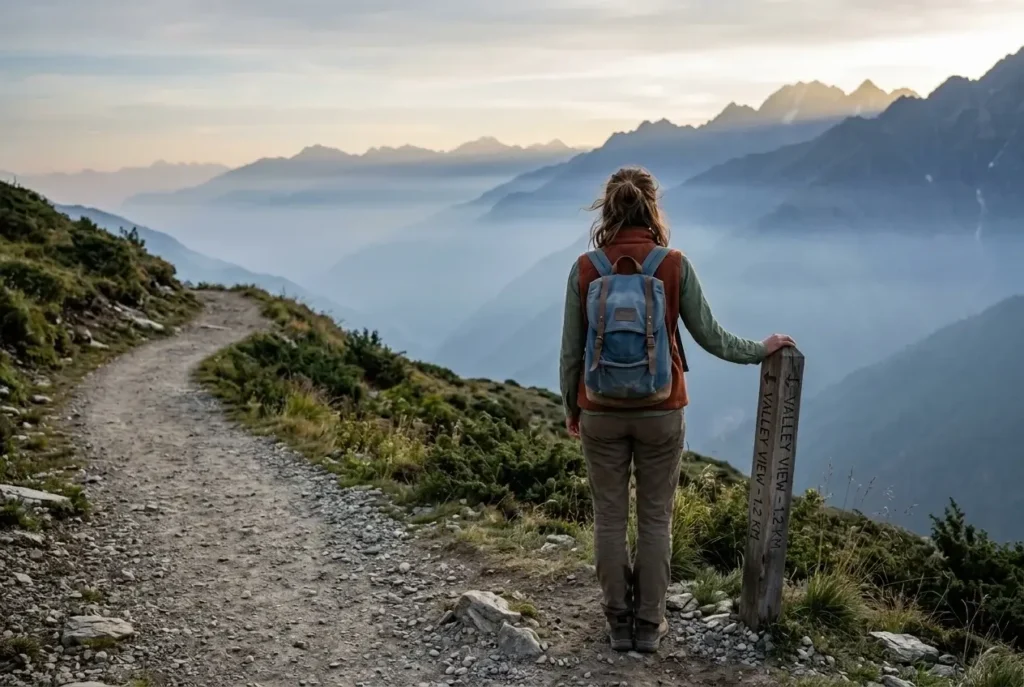
The pins gave me direction. The going gave me everything else.
If you’ve been building boards for a while and the trips haven’t materialized yet, ask yourself one honest question: what is the smallest, most specific step between where you are and the first experience on your board? Not the whole trip. One step. Research a flight. Check a visa requirement. Read three articles about the region. That step exists, and it’s smaller than the image on your board makes it look.
Making Your Pinterest Boards Work Harder
A few specific habits that turn Pinterest from a dreaming tool into a planning tool:
Create one board per trip or region you’re seriously considering, not a general “someday” catch-all. The more specific your board, the more relevant the algorithm’s suggestions become, and the faster you accumulate genuinely useful information rather than just more inspiration.
Pin articles as well as images. A well-written itinerary, a safety guide for solo travelers in a specific country, a budget breakdown, a packing list for a specific climate: these are more valuable to your actual planning than a hundred beautiful photographs.
Use the “Notes” feature on individual pins to add your own commentary: whether you’ve confirmed this place still operates, how it connects to other things on your itinerary, what questions you still need to answer. Pinterest becomes a live planning document when you treat it that way.
Follow accounts run by solo travelers who are actually doing the things, not just photographing them. The difference in the content is immediately visible. Their pins lead to articles with real logistics, real costs, real transport tips, and honest assessments of whether an experience lived up to its reputation.
What Makes an Experience Genuinely Unique
I want to end on this, because I think it matters more than any specific list of destinations or activities.
The most unique travel experience you can have is one that changes something in how you see yourself or the world. That’s a higher bar than “visually stunning” or “off the beaten path” or “something most people haven’t done.” It’s also a more generous bar, because it means the experience doesn’t have to be expensive, remote, or extreme.
A conversation with a fisherman about his daily route. A morning spent watching how bread is made in a village bakery. Hiking through landscape that removes all the noise of your usual life and replaces it with physical effort and open sky. A cooking class where you realize that a dish you’ve eaten your whole life has a backstory that stretches back centuries.
These are the experiences that end up in the stories you tell for years. They’re not the ones that photograph perfectly. They’re the ones that stay with you.
Pinterest can help you find the door to all of them. But only you can walk through it.
Start building that board differently. Start following those pins to their sources. Start treating your saved content as a draft itinerary waiting to be confirmed.
Then book the flight.