I want to tell you something about Pinterest that most travel articles skip right over: the problem is not the platform. The problem is how most of us use it.
We open Pinterest, type in “travel,” and immediately get flooded with the same forty images that have been circulating since 2018. Santorini. Bali rice terraces. That pastel street in Lisbon everyone has photographed from the exact same angle. We savethese boards valuable. a few things, maybe create a board called “Dream Trips,” and then we close the app and feel vaguely uninspired.
But here is what I have learned after years of planning trips and genuinely researching the world: Pinterest is actually one of the best tools available for finding destinations that are not on everyone else’s radar yet. The catch is that you have to use it differently. You need to stop scrolling passively and start searching and following boards with intention.
This guide is about exactly that. Not a generic list of “boards to follow.” A real approach to using Pinterest as a discovery and planning tool for the kind of travel that actually changes how you see the world.
Why Pinterest Works Differently for Off-Path Discovery
When you search Google for travel destinations, you mostly get the same well-optimized articles from the same big travel publishers. The algorithm rewards what’s already popular. Pinterest works differently. It is a visual search engine where images surface from an enormous range of creators: travel bloggers in small niches, local tourism accounts from countries you have never heard pitch themselves, solo travelers who never intended to go viral, and community boards where real people from all over the world pin what they are actually doing and planning.
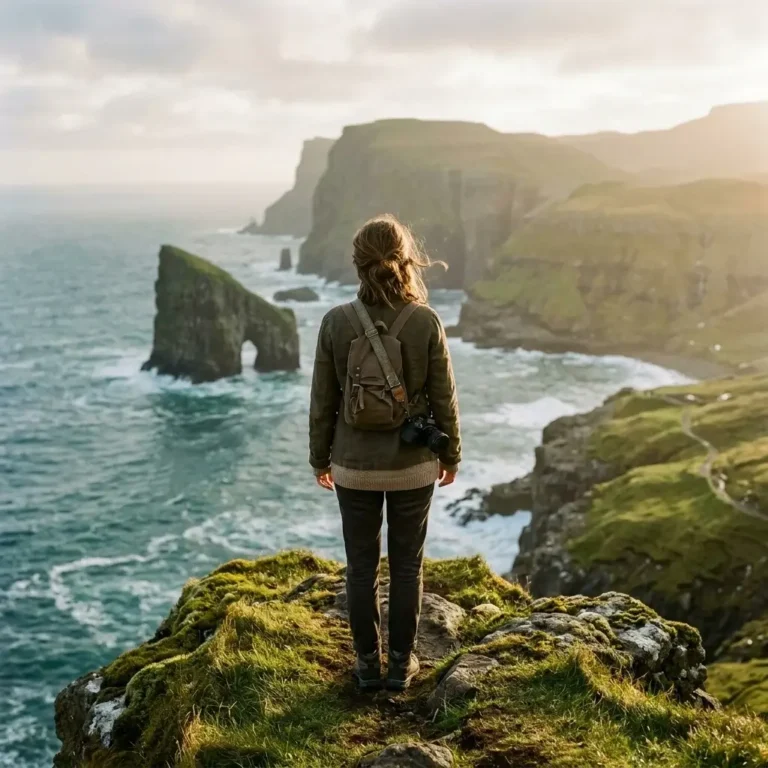
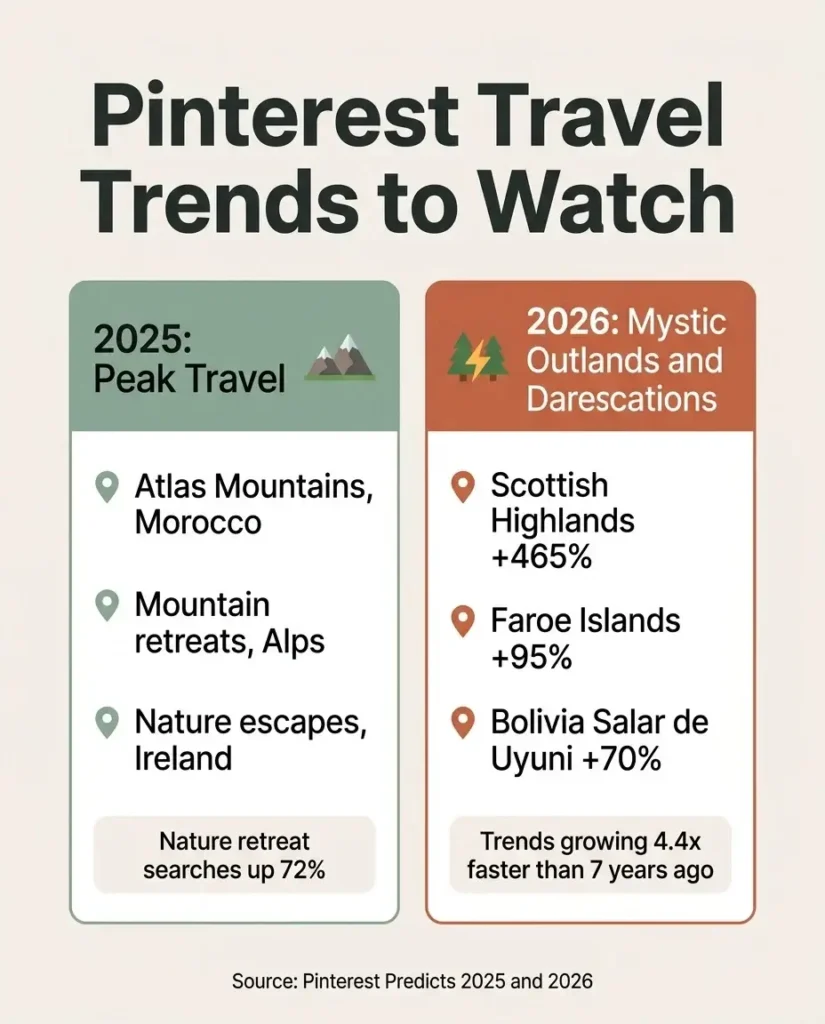
Pinterest has over 600 million monthly users, and the platform’s own data shows that travel trends on Pinterest are growing 4.4 times faster than they were just seven years ago. That pace creates something useful: because content spreads and gets saved so quickly, destinations can surface on Pinterest boards months or even years before they show up in mainstream travel media. The person who pinned that photo of the Faroe Islands three years ago was not famous. They just went there and came back wanting to share it.
The other thing worth understanding is that Pinterest is built for saving and organizing, not for broadcasting to followers. That means a lot of what lives on boards there is genuinely personal, not performance. When someone builds a board called “Off the Beaten Track Travel Inspiration,” they are usually building it for themselves first. That authenticity, that personal curation, is exactly what makes these boards valuable.

How to Search Smarter (Before You Even Think About Following Anyone)
Before you start following boards, there is a searching skill worth building. Most people type one or two words into Pinterest and take whatever the algorithm decides to surface first. That approach will give you the popular stuff every time.
Instead, try layering your keywords. Rather than searching “travel Europe,” try “underrated Europe destinations solo,” or “slow travel Balkans,” or “off-path Eastern Europe itinerary.” The more specific and the less commercial your phrasing, the more likely Pinterest is to show you content from individual travelers rather than tourism boards and paid promotions. Phrases like “less visited,” “not crowded,” “local tips,” and “alternative to” tend to surface a different category of content than the big destination names alone.
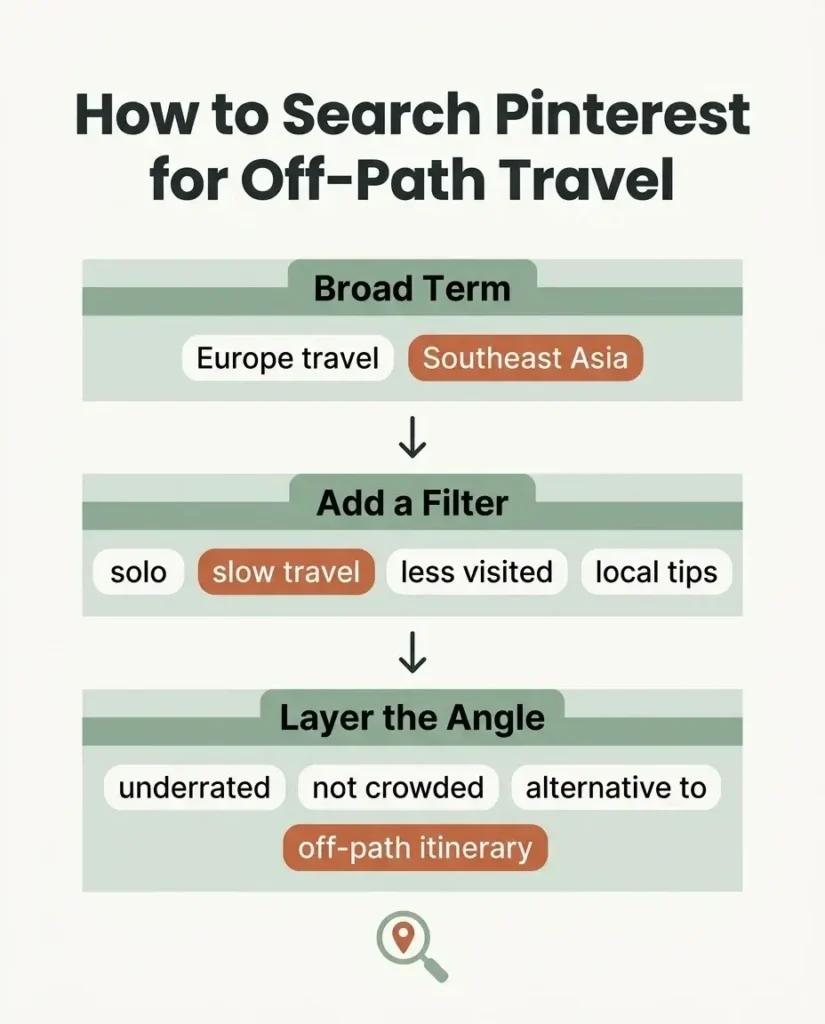
You can also search by aesthetic or vibe rather than geography. “Misty forest travel,” “ancient ruins not crowded,” or “countryside solo travel” often lead to visual content from places you might never have thought to research. If an image stops you mid-scroll, click through to the original pin source rather than just saving it. That source, whether it is a personal blog, a local tourism page, or a fellow traveler’s board, is often where the genuinely useful planning information lives.
The Types of Boards That Actually Help You Plan
Not all Pinterest boards are created equal, and this distinction matters more than most guides admit. There are two categories of boards you will encounter: aesthetic boards and planning boards. Knowing the difference will save you a lot of time.
Aesthetic boards are beautiful. They are full of photographs of places that look otherworldly, pulled from all over the internet and saved together because they share a visual mood. They are great for initial inspiration and for getting a sense of what a destination looks or feels like. But they often link back to images with no destination label, no practical information, and no way to figure out where that waterfall actually is.
Planning boards are different. These are boards where the curator has done the work. Each pin leads somewhere real: an article about getting from one city to the next, a local guide to a specific neighborhood, a tourism board’s official page for a national park, or a traveler’s honest breakdown of what worked and what did not. These boards feel less polished but they are far more useful.
When you are browsing, look for boards where the pins have specific titles like “Kotor solo travel guide” or “hiking in Kyrgyzstan what to expect,” rather than just the country name or a single evocative word. The specificity of the pin titles is one of the clearest signals that the board’s curator is thinking like a planner, not just an image collector.
A good example of this kind of thoughtful, curated resource is the Off the Beaten Track Travel Inspiration board on Pinterest, which pulls together genuinely less-touristed destinations with a mix of inspiration and practical content. It is the kind of board worth studying not just for the destinations it covers but for how it is structured.
Using Pinterest’s Own Trend Data as a Discovery Tool
Here is something most travel articles on this topic completely miss, and I think it is one of the most powerful things you can do as a curious, forward-thinking traveler: Pinterest publishes its own annual trend reports, and those reports tell you, with remarkable specificity, which destinations are gaining momentum before they become mainstream.
The Pinterest Predicts 2025 Peak Travel trend called out the shift from city tourism to mountain travel, noting that Gen Z and Gen X were increasingly searching for mountain destinations, with searches for “Atlas mountains Morocco” up 30% and aesthetic hiking content surging broadly. Morocco’s Atlas Mountains and the Appalachian highlands of the American Southeast were both named as rising areas of interest. This kind of signal is worth paying attention to. When a destination starts trending on Pinterest before it trends on Instagram or in major travel publications, you have a real window to visit while it is still quiet.
The 2026 Pinterest Predicts report went even further with two specific travel trends that point directly to the kind of off-path exploration this article is about. The Mystic Outlands trend describes travelers seeking out misty, whimsical, and atmospheric destinations: distant ruins, moody forests, naturally-occurring spirals. Searches for “Scotland Highlands aesthetic” are up 465%, “Faroe Islands aesthetic” up 95%, and “Bolivia Salar de Uyuni” up 70%. None of these are unknown destinations, but all of them are still dramatically less-visited than the usual European circuit, and they are getting fresh attention from people who are specifically seeking something that feels otherworldly rather than merely picturesque.
The companion 2026 trend, Darecations, covers adrenaline-led off-path travel: river rafting, canyoneering, and travel built around active experiences rather than sightseeing. Adventure tourism searches are up 75%. If that is your travel style, boards tagged with keywords like “adventure travel off-path” or “adrenaline travel 2026” are going to start surfacing some genuinely excellent planning content.
Reading these reports before you even open Pinterest gives you a vocabulary.
You start searching for destinations that are trending upward but haven’t peaked yet, rather than destinations that are already everywhere.
Building a Board System That Turns Inspiration into a Real Trip
Discovering great content is only half the equation. The reason most people’s Pinterest travel boards never translate into actual trips is that they save things without organizing them into anything actionable.
Here is the system I’d suggest, whether you are planning a specific trip or building a long-term discovery library.
Start with one board per destination or region you are genuinely considering. Keep your naming specific: “Albania solo travel” or “Kyrgyzstan hiking” rather than “Europe” or “adventures.” The more specific the board, the easier it is to scroll back through it later and find something useful rather than getting lost in hundreds of unrelated pins.
Inside each board, use Pinterest’s built-in sections feature. The OneTravel guide to using Pinterest for trip planning explains this well: you can divide a single destination board into sections for food, accommodation, transportation, day trips, and practical logistics. This transforms a visual mood board into something that functions almost like a living itinerary.
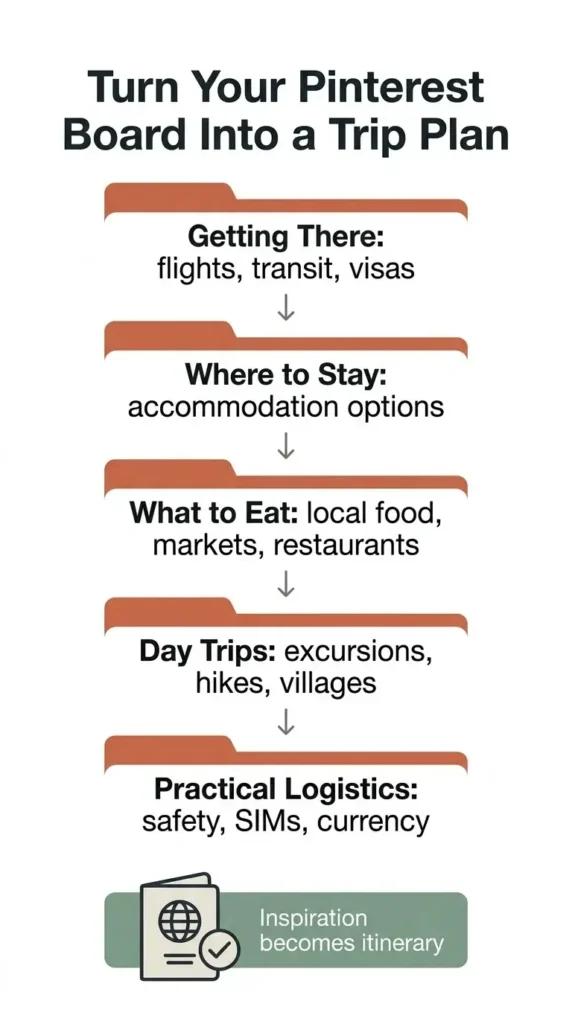
When you are sitting down to actually plan the trip, you are not sifting through 200 unsorted images; you are working through organized categories.
The other habit worth building is clicking through pins rather than just saving them. Pinterest is a gateway. The real information almost always lives on the page behind the image, whether that is a traveler’s blog, an official tourism resource, or a UNESCO destination guide. If you only ever save the image, you lose the context that makes it useful.
What the 2024 and 2025 Trend Data Tells Us About What’s Coming
It is worth looking at where Pinterest users have been directing their attention over the last year, because the pattern points clearly toward the kind of off-path travel that makes for genuinely memorable trips.
The Pinterest Summer 2024 Travel Report documented a measurable shift away from crowded cities and toward quieter, more self-directed travel experiences. That shift has continued and deepened. The 2025 Summer Travel Report showed searches for “nature retreat” up 72%, “beautiful view nature” up 207%, and “breath taking views nature” up 27%. Searches for “Irish forest” were quietly climbing. “Switzerland countryside” was growing at 177%. These are not the search terms of someone planning a city break. They are the terms of someone looking for space, quiet, and genuine contact with a place.
This matters for how you use Pinterest boards because it tells you what kinds of keywords are generating real, fresh content right now. Boards tagged around nature retreats, slow travel, and countryside exploration are being actively populated by people who are out there doing exactly this kind of travel. Following those boards in real time, rather than just searching once and forgetting, means you get a steady stream of ideas from travelers who are currently discovering places that most of the internet has not written about yet.
Evaluating a Board Before You Commit to Following It
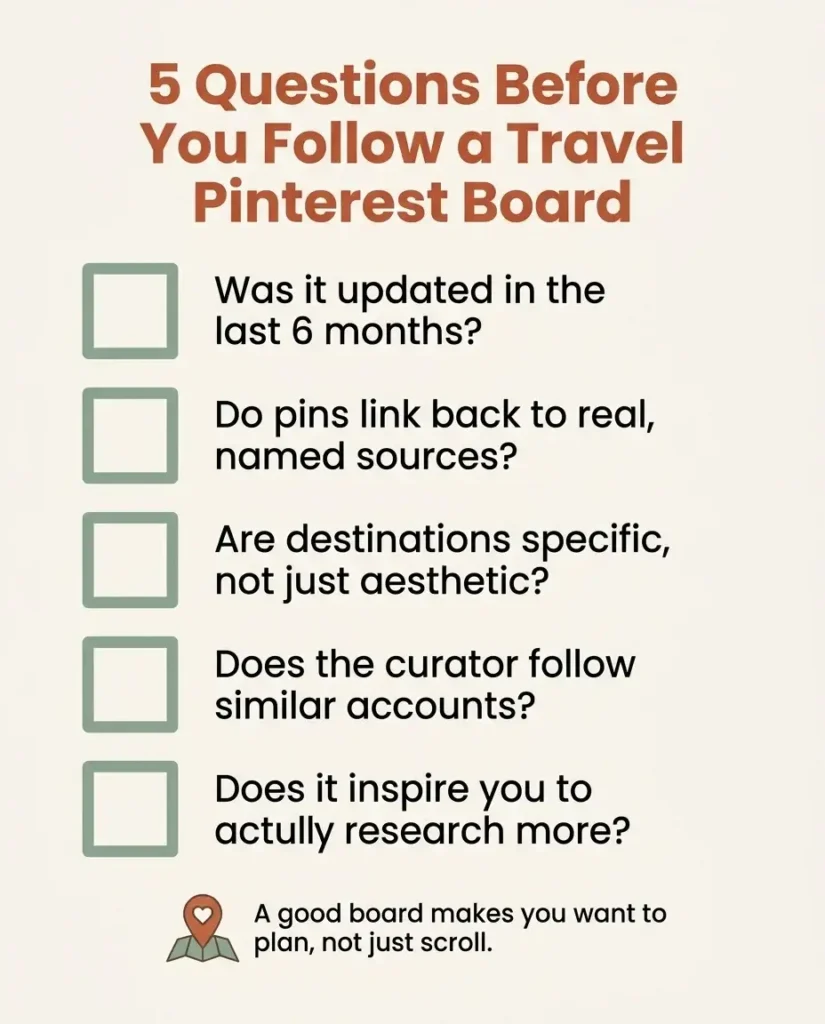
There is a quick five-question check I use before deciding whether a board is worth following:
First, when was it last updated? A board that hasn’t had a new pin in two years might have some timeless content but it is not going to surface anything fresh for you. For off-path discovery specifically, you want boards that are actively curated.
Second, do the pins have descriptive titles and link back to real sources? If every pin just says “travel” or “beautiful place” with no location or context, it is an aesthetic board, and while beautiful, it is not going to help you plan.
Third, does the curator follow and engage with other accounts in the same niche? The best curators on Pinterest are part of a community of similar travelers. You can see this by checking who else they follow and what boards they have contributed to.
Fourth, is the content genuinely varied, or does it keep returning to the same five or six ultra-popular destinations? A board that claims to cover “off-path travel” but is mostly filled with Santorini sunsets and Tuscany vineyards is not actually off-path travel.
Fifth, does following this board feel energizing? This is subjective, but it matters. The boards worth your ongoing attention are the ones where you open them and immediately want to start researching something.
A Few Board Categories Worth Seeking Out
Rather than a prescriptive list of specific accounts that may change, I want to point you toward board types, because these will serve you across different interests and destinations.
Slow travel boards are consistently excellent for off-path discovery. Slow travelers tend to stay longer in fewer places, which means their content goes deeper. They are writing about the market on a Tuesday morning in a small Portuguese town, not just the famous viewpoint.
Solo female travel boards have exploded in quality over the last few years, and many of them combine safety-conscious practical advice with genuinely adventurous destination choices. Women who travel solo and document it tend to prioritize cultural depth and authenticity in a way that maps closely onto what most off-path travelers are actually looking for.
Local and expat-run boards for specific countries or regions are often the most practically useful of all. When a board is maintained by someone who lives in or has spent extended time in a place, the content reflects local knowledge that tourists rarely access. These boards are worth seeking out specifically for countries where mainstream travel coverage is thin.
Sustainable and responsible travel boards increasingly overlap with off-path travel because the places most focused on low-impact tourism tend to be the ones that haven’t been mass-marketed yet.
The Mindset Shift That Makes All of This Work
I want to close this section on something that applies just as much to using Pinterest as it does to planning any trip. When I was working as a sightseeing guide in New York, I watched hundreds of tourists visit the same ten landmarks in the same order every single day. Some of them loved it. But the ones who came back glowing were almost always the ones who had wandered off the map at some point: who had ended up in a neighborhood nobody recommended, eaten somewhere with no English on the menu, and come back with a story nobody else was telling.
Pinterest boards work the same way. If you only follow what the algorithm pushes to the top, you will get the popular stuff. The discovery happens when you go deeper, search with more specific terms, follow the accounts that link to real sources, and treat the platform as a starting point for real research rather than an endpoint in itself.
The goal is not to curate the most beautiful travel board on your profile. The goal is to actually go somewhere that surprises you. Pinterest, used this way, is genuinely one of the better tools available for making that happen.