The Ghost Towns No One Talks About Are Worth the Trip

There is a particular kind of quiet you only find in abandoned places. Not peaceful quiet, not the kind you get on an empty beach. This is a heavier silence. Doors left open to nothing. A coat still hanging on a hook. A town that simply stopped one day and never started again.
I think about this a lot when I travel. I spent years as a sightseeing guide in New York City, pointing at buildings and telling tourists the stories behind them. What I learned from that job was that people don’t really want to look at famous things. They want to feel connected to something real. Ghost towns do that in a way that almost nothing else can.
Most articles on this topic give you the same five names: Chernobyl’s Pripyat, Bodie in California, and a couple of others you’ve already seen in a screensaver. I want to talk about the ones that don’t get enough attention. The ones with complicated histories, surprising beauty, and a quietness that stays with you long after you leave.
These six places are not secret. Some have entry fees and guided tours. But they are consistently underwritten, undervisited, and genuinely worth the effort to reach.
Why Ghost Towns Are Different From Other Historical Sites:
A museum curates history. It decides what you see, how you interpret it, and what the takeaway should be. A ghost town does none of those things. It just sits there, incomplete and honest, and lets you figure out what it means.
From what solo travelers consistently report, that unguided confrontation with the past is exactly what makes these places so affecting. When I guide others in a new place, I can shape the narrative. In a ghost town, there is no narrator. You are walking through someone else’s interrupted life and drawing your own conclusions.
That’s the experience I want to talk about here. Not the spooky angle, not the photography opportunity (though both are real). The human story of places that used to hold entire communities, and what they still have to teach.
Craco, Italy: The Town Time Stepped Over:
If you are planning a trip through the Basilicata region in southern Italy, the majority of visitors make a beeline for Matera and never look further south. That is a mistake.
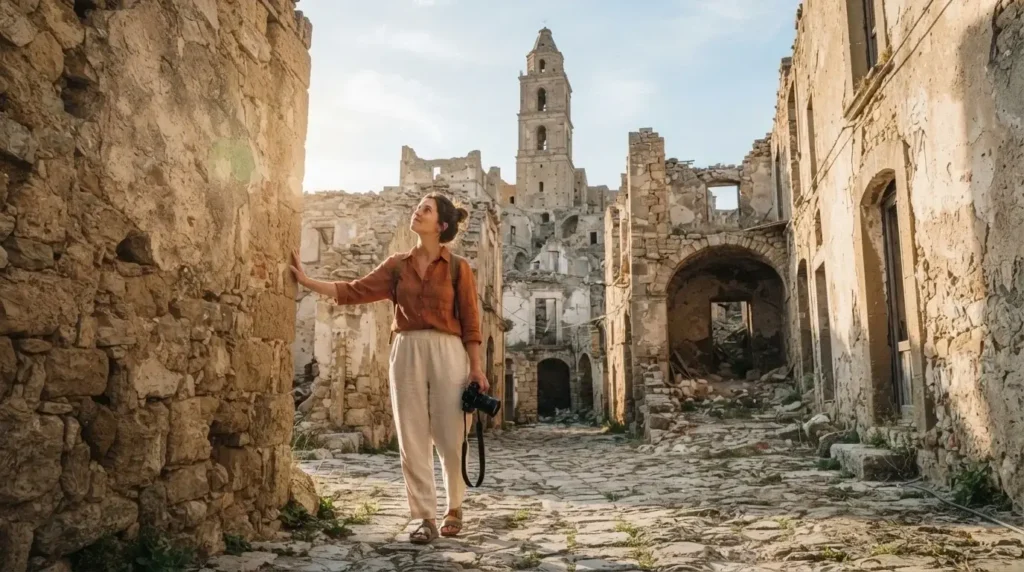
About 35 kilometers from Matera, perched on a clay ridgeline with the kind of dramatic backdrop that most filmmakers can only dream of, sits Craco Vecchia. This medieval village was steadily abandoned between 1963 and 1974 after a series of landslides made the hilltop unstable. The residents relocated to a new town in the valley below, but the old village was left almost exactly as it was. Stone streets, a Norman tower built in the 11th century, a cathedral, palazzo facades going pale in the Basilicata sun.
Craco shows up in more films than most people realize. Mel Gibson shot parts of The Passion of the Christ here. James Bond drove through these streets in Quantum of Solace. Alberto Lattuada, Francesco Rosi, and the Taviani brothers all used it as a backdrop. There is something about its combination of austere beauty and structural vulnerability that filmmakers seem drawn to.
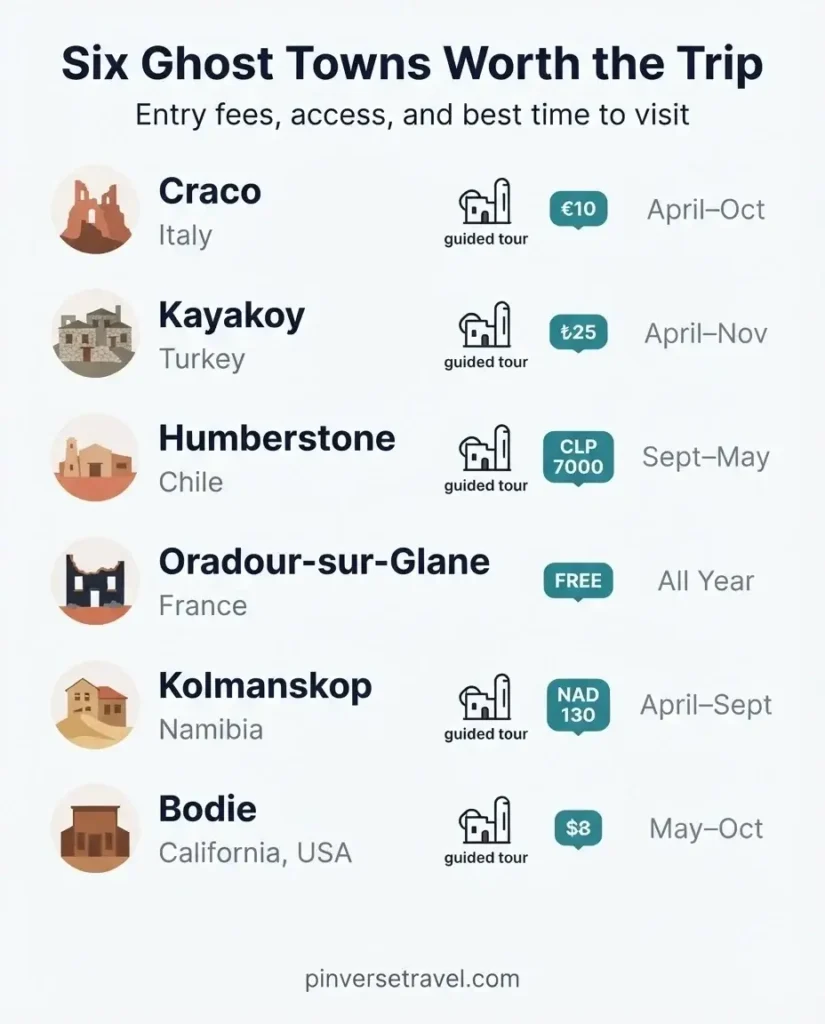
You cannot wander freely. The site is only accessible on a guided tour due to structural instability, which honestly makes the experience better. Tours run from approximately 10am to 3pm and cost around 10-13 euros per person. Booking is handled through Oltre l’Arte Craco, the organization that manages and conserves the site. Book in advance, especially in summer, because group sizes are limited.
The nearest base is Matera, about 40 minutes by car. Craco is not easily reachable by public transit, so if you don’t drive, a day tour from Matera is the most practical option. While you’re in the area, eat at any of the rustic trattorias in Matera’s Sassi district and try the local lamb dishes or the thick, bread-based peasant soups that Basilicata is known for. This whole corner of southern Italy is massively undervisited compared to Tuscany or the Amalfi Coast, which means the food, the people, and the atmosphere are all exactly what Italy used to feel like before Instagram found it.
Kayakoy, Turkey: A Town Emptied by Politics, Not Disaster:
Most ghost towns are created by something sudden: a mine running dry, a fire, a flood. Kayakoy, on the Mediterranean coast of Turkey about 10 kilometers south of Fethiye, was emptied by something more deliberate and far more complicated.
In 1923, the Greek and Turkish governments signed an agreement that resulted in a compulsory exchange of populations. Greek Orthodox Christians living in Turkey were relocated to Greece. Muslims living in Greece were relocated to Turkey. It was one of the largest forced population transfers in modern history, affecting over 1.5 million people, and you can read the full context in the Wikipedia overview of the 1923 population exchange. In Kayakoy, which the Greek community called Livissi, approximately 3,500 people packed up and left their homes, their churches, and their neighborhood forever.
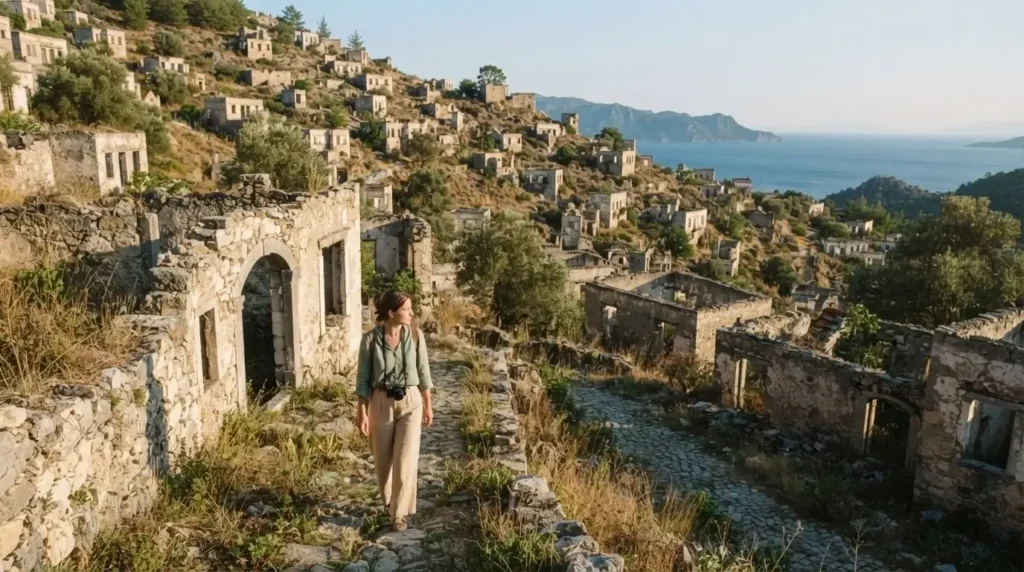
What they left behind is astonishing. More than 350 stone houses cover the hillside, many still structurally intact but roofless, their interiors open to the sky. Two Greek Orthodox churches stand at the top of the hill, their frescoes still faintly visible. Walking through on a quiet morning, before the day-trippers arrive from Fethiye or Olüdeniz, it is genuinely one of the most emotionally layered places I’ve come across in any research or conversation with travelers.
Entry is straightforward. The site is open daily from 8:30am to 8pm in summer and charges the lira equivalent of approximately €3 at the ticket booth. It’s an easy dolmus (minibus) ride from Fethiye, or you can walk the scenic valley path in about 45 minutes from Olüdeniz. There is a small cluster of cafes and a restaurant at the base of the site that serve standard Turkish breakfasts and grilled mezes. Fethiye itself has excellent fish restaurants on its seafront, and the twice-weekly market there is one of the best in the region for fresh produce and local goods.
Kayakoy works beautifully as a half-day trip, but the best way to experience it is to arrive early, before 9am, when you’ll often have long stretches of it completely to yourself.
Humberstone, Chile: A Company Town Swallowed by the Atacama:
Chile’s Atacama Desert is the driest place on earth, and in the middle of it, about 45 kilometers east of the port city of Iquique, the desert has spent decades slowly reclaiming an entire industrial city.
Humberstone was a saltpeter processing town. From the mid-19th century through the mid-20th century, thousands of workers from Chile, Peru, and Bolivia came here to extract and process sodium nitrate, a fertilizer that fueled agricultural revolutions across Europe and the Americas. The workers built a full town around the industry: housing blocks, a theater, a swimming pool fed by ocean water, a railway, shops, a market square. They created an entirely distinct culture with its own language, labor traditions, and collective identity, a community the Chileans call the Pampinos.
When synthetic fertilizers made saltpeter economically obsolete, Humberstone was abandoned in the 1960s. Since 2005, it has been recognized as a UNESCO World Heritage Site, designated for its outstanding testimony to the social and industrial history of the saltpeter era and the pioneering labor movements that originated here.
Walking through today, the theater still has seats. The hotel lobby still has its original furniture. The swimming pool’s white tiles catch the desert light in a way that is almost impossible to photograph badly. There is a surreal stillness to Humberstone that even Pripyat, which tends to dominate ghost town conversations, doesn’t quite match. Part of that is the desert itself. Part of it is the sense of a community that actually thrived here, not just survived.
Entry is inexpensive, approximately 4,000 CLP for adults (around USD 4). Most visitors come on a day trip from Iquique, either by organized tour or by booking a taxi for the return journey since public buses drop you at the highway junction about 1km from the site. The nearby town of Pica is famous for its citrus fruits and a hot spring pool that makes for a perfect add-on day. In Iquique itself, the food market near the port is excellent for fresh ceviche and the local speciality, machas a la parmesana (clams baked with parmesan), which is far better than it sounds.
Oradour-sur-Glane, France: A Memorial Made of Stone:
This one is different from all the others. Oradour-sur-Glane, in the Haute-Vienne department of central France, is not abandoned in the conventional sense. It is deliberately preserved. In June 1944, German SS troops entered this quiet village and killed 643 of its 666 residents in a single afternoon. After the war, General Charles de Gaulle ordered that the ruins be left exactly as they were, as a permanent witness.
The French government has kept that promise for over 80 years. The burned-out cars are still on the streets.
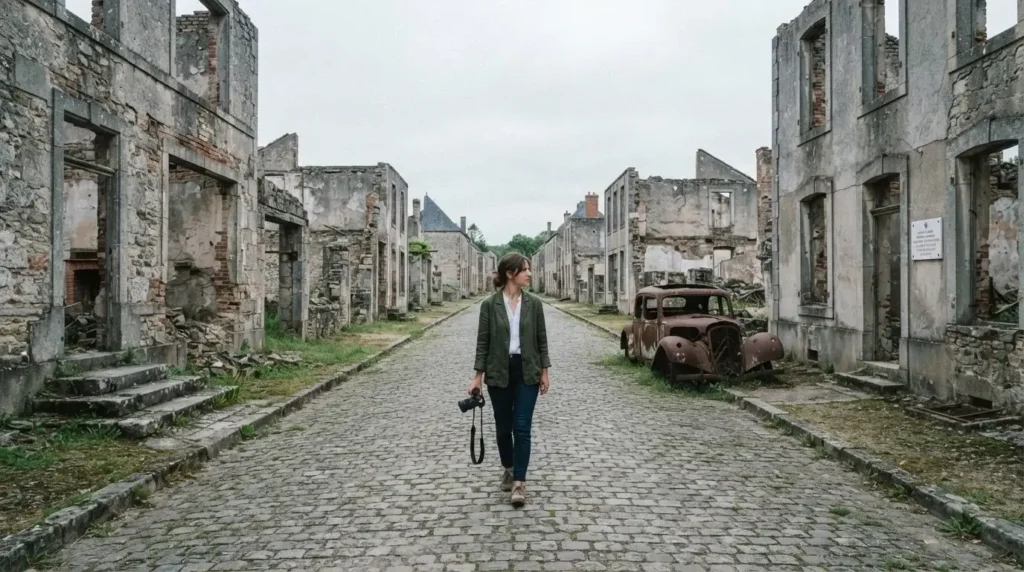
The sewing machines are still inside the homes. The church where most of the women and children were killed still stands without its roof. Walking through it is not a ghost town experience in the usual sense. It’s closer to walking through an open-air memorial that happens to be an entire village.
The ruined village is free to enter and open from 7am to 9pm for most of the year. The adjacent Centre de la Mémoire charges approximately €5.80 for adult entry (2025 rates) and provides essential historical context before you walk through the ruins. Do not skip it. Going in without that context means you won’t fully understand what you’re looking at, and this is a place that deserves to be understood.
Oradour-sur-Glane is about 25 kilometers northwest of Limoges, easily accessible by bus or taxi from the city. It is not on the main tourist route between Paris and the south of France, which means most visitors drive past without stopping. That oversight is a real loss. Limoges has excellent restaurants and is famous for its porcelain; the Musée de l’Evêché in the city center has a strong collection of Limoges enamelwork that makes a good afternoon before or after the visit.
Kolmanskop, Namibia: Where the Desert Moved In:
This one has become better known in photography circles over the past decade, but most general travel articles still overlook it. Kolmanskop, in the Namib Desert of southern Namibia near the port town of Lüderitz, is a former diamond mining town built by German colonists in the early 1900s. At its peak, it had a hospital, a bowling alley, a casino, a school, and a theater. When richer diamond fields were found further south around 1930, the town emptied quickly, and the Namib Desert began moving in through the windows.
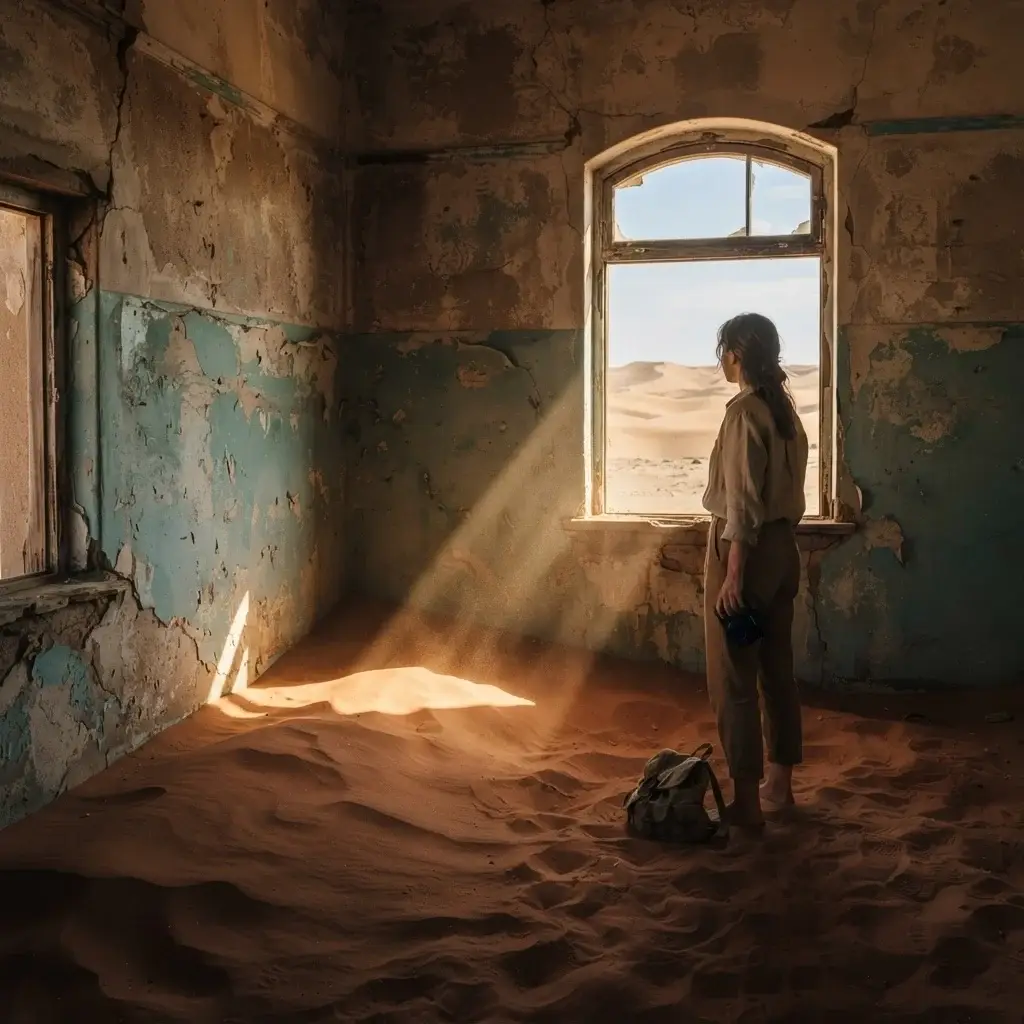
Today, the sand dunes have filled the lower halves of several houses. You walk in and the floor is a gentle slope of rust-colored sand reaching toward what used to be the ceiling. It’s extraordinary. The light in late morning, when the sun angles through broken windows onto sand that has no right to be inside a room, makes Kolmanskop one of the most photogenic places in the world.
Entry requires a permit. The official Kolmanskop permit and tour booking is managed by Ghost Town Tours, which operates from the main building on-site. As of 2026/2027, a standard guided tour costs N$230 per adult (roughly USD 12). Tours run Monday through Saturday at 9:30am and 11am, and on Sundays at 10am. An amateur photography permit (N$480) gives you access from sunrise to sunset, which is worth it if you want that iconic early morning light. The site is inside the Sperrgebiet, a restricted diamond mining area, so entry without a valid permit is not possible.
Lüderitz itself is a fascinating place, a remote German colonial town on the edge of one of the world’s most severe deserts. The architecture is surreal, art nouveau buildings painted in bold colors against a backdrop of barren rock and cold Atlantic fog. The local oysters from Lüderitz are genuinely some of the best I’ve heard solo travelers rave about from anywhere in southern Africa. Namibia in general is an extraordinary destination for solo travelers who are comfortable in remote, vast landscapes.
Bodie, California: The One You’ve Heard Of, Done Right:
I know. You’ve probably seen Bodie on a list before. But most people who mention it have either never been or give you three sentences of history and nothing practical. Here’s why it deserves a place here: Bodie is perhaps the best-executed ghost town in the world, and most visitors rush through it in under an hour without understanding what they’re actually looking at.
Bodie sits at 8,375 feet in the Eastern Sierra Nevada, about 13 miles east of Highway 395 on an unpaved road. At its peak in the late 1870s, after a major gold vein was discovered, Bodie had a population of around 8,000 people. It was a genuinely rough frontier town: dozens of saloons, a notorious red-light district, and a documented murder rate that made it famous as far away as San Francisco. By 1942, mining had stopped entirely. By the 1960s, it was designated a California State Historic Park and placed in a policy of “arrested decay,” meaning it is preserved but not restored.
Walking through Bodie is not like walking through a museum. The interiors of the buildings are left as they were found. The general store has canned goods on the shelves. The Methodist church still has its pulpit. There are approximately 200 structures remaining from what was once 2,000. According to the California State Parks official page for Bodie, entry is $8 per adult and $5 for youth (ages 4-17). The park opens at 9am, and the last mile of road to the entrance is unpaved and rough; a regular car handles it fine in summer and fall, but winter access requires snowshoes or skis.
Come early in the morning when the light is low and the crowds have not arrived.
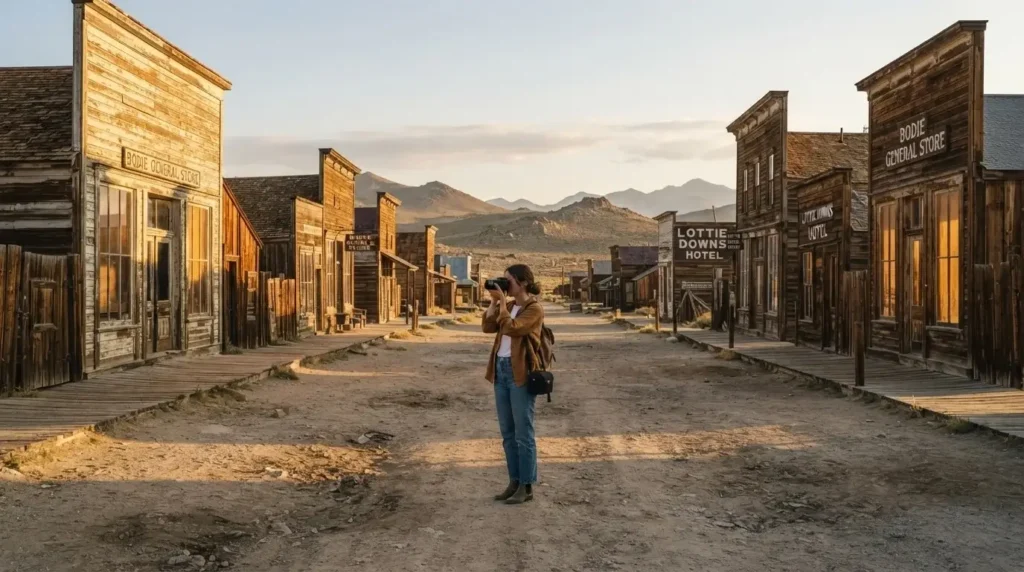
There are no restaurants or gas stations at Bodie, so bring food, water, and a full tank. The nearest town with proper services is Bridgeport, about 25 miles away, which has a handful of good diners. If you are combining this with a broader Eastern Sierra road trip, Mono Lake, Mammoth Lakes, and the Bishop area are all within striking distance and make Bodie a logical part of a longer drive rather than a standalone destination.
How to Approach a Ghost Town as a Solo Traveler:
A few things I’ve picked up from extensive reading and conversations with solo travelers who’ve done these trips:
The morning arrival advantage is real everywhere. Most ghost town day-trippers arrive between 10am and 2pm. Getting to a site at opening, or just after, often means you have long stretches completely to yourself, and the low-angle morning light is better for both photography and atmosphere.
Respect the site. These places hold real human stories, sometimes traumatic ones like Oradour-sur-Glane. Walking through them the way you might walk through a theme park misses the point entirely. Go slowly. Read the context before you arrive. Let the place work on you.
Solo women traveling to these sites: all six listed here are safe and commonly visited. None of them require you to go far off-road alone. Craco and Kayakoy are fully guided or day-trip accessible. Bodie and Humberstone have regular visitor traffic. Kolmanskop has on-site staff and guided tours. Oradour-sur-Glane is in rural France. Use the same common-sense precautions you’d apply anywhere, and you’ll be fine.
Consider your exit. Some of these sites (Bodie, Humberstone, Craco) are not on public transit routes. Plan your return journey before you go, especially if you’re not driving.
The Real Reason Ghost Towns Stay With You:
Here is what I think happens when you visit a place like this. You walk through a town that was once full of people going about their lives, worrying about the same things we worry about: money, neighbors, the weather, what to eat. And then, for whatever reason, the town stopped. And the things those people left behind are still there, quietly insisting that they existed.
That insistence is what travel is really about, at least for me. It’s not ticking off a postcard. It’s finding yourself standing somewhere that shifts how you understand the world, even slightly, even just for an afternoon.
Any one of these six places will do exactly that.