Still Wild: The Best Untouched Forests to Visit in 2026

There is a particular kind of silence that only exists in old forests. Not the quiet of an empty room or a slow morning. Something deeper, something that has been building for hundreds, sometimes thousands of years. It is the sound of a world that is not waiting for you. It was here long before you arrived, and it will be here long after you leave. Finding that feeling is one of the most powerful reasons I travel.
When I talk to people about forest travel, I notice the same hesitation every time. They think these wild, untouched places are too remote, too expensive, or too physically demanding to be realistic. They imagine machetes and survival training and a six-figure budget. I want to dismantle that myth right now, because the truth is that some of the most extraordinary old-growth forests on Earth are genuinely accessible to independent travelers, including solo travelers, without any specialist skills.
The world still has wild forests. And in 2026, more of them are open to visitors than most people realize. Here is where to find them, how to get there, what to expect, and what they will cost you.
What “Untouched” Actually Means (And Why It Matters)
Before we get into specifics, it helps to understand what we are actually talking about. “Primary forest” or “old-growth forest” refers to forest that has never been cleared or significantly disturbed by humans. These are ecosystems that developed over centuries without logging, agriculture, or development. They are not just scenic forests. They are entire living systems: complex root networks, multi-layered canopies, ancient trees, and biodiversity that simply cannot exist in replanted or managed forests.
Why does this matter to a traveler? Because the experience is fundamentally different. When you walk into primary forest, you are walking into something that has its own logic, its own rhythms, its own density of life. Trees that are 500 years old. Fungi that connect root systems across acres. Animals that exist nowhere else on Earth. It is not a backdrop for a photo. It is a world.
Less than 10 percent of the Earth’s original forest cover remains in primary condition. So yes, there is urgency here. But there is also genuine, accessible beauty waiting for anyone willing to show up.
Daintree Rainforest, Australia: The Oldest Surviving Tropical Forest on Earth
When I studied abroad in Australia, I heard people talk about the Daintree with a reverence that did not quite compute until I started researching it properly. The Daintree Rainforest in Tropical North Queensland is estimated to be 180 million years old, making it the oldest continually surviving tropical rainforest on the planet. For context, it predates the Amazon by over 100 million years. That number is almost impossible to hold in your mind, and that is exactly the point.
The forest is part of the Wet Tropics of Queensland, a UNESCO World Heritage Site, and it protects over 663 species of animals, including a staggering number found nowhere else. The Daintree is also one of the only places in the world where two World Heritage-listed ecosystems meet at the same place: the rainforest and the Great Barrier Reef both share the same coastline around Cape Tribulation.
The practical gateway for most travelers is Cairns, which has an international airport with good connections across Australia and Southeast Asia. From Cairns, it is roughly two hours north to Mossman, then you cross the Daintree River by ferry. Ferry tickets (as of late 2025) run around AUD $31 one-way for a car. Once across, you are in the forest.
The best single investment of your time is the Daintree Discovery Centre, which gives you access to a canopy tower, aerial walkway, and a self-guided audio tour in eight languages.
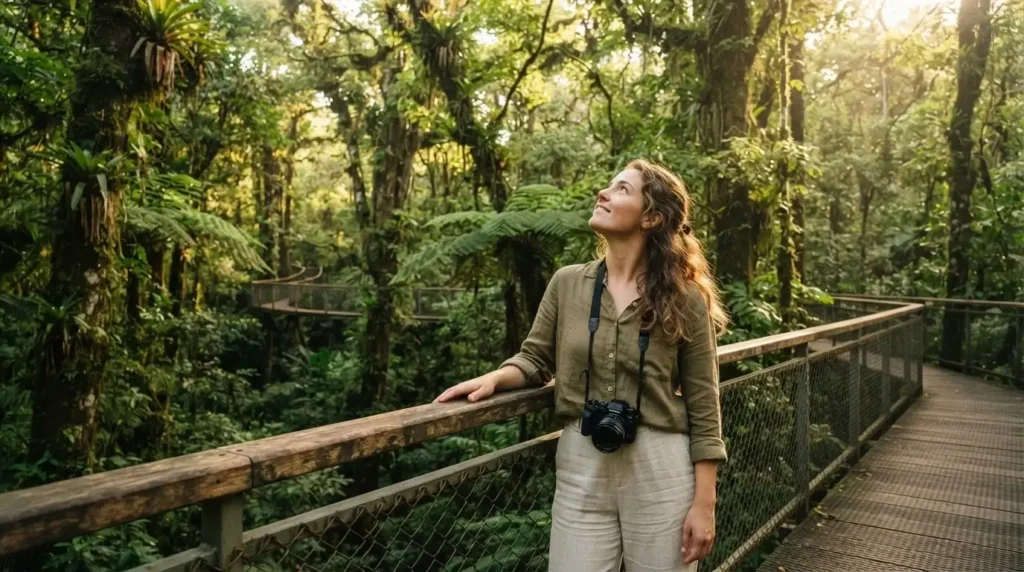
Entry is AUD $41 for adults, AUD $19 for children, and AUD $100 for families. The centre is open daily 9am to 5pm (closed Christmas Day), and your ticket includes seven days of re-entry.
For food, the Daintree Ice Cream Company near Cow Bay is legendary. They make small-batch ice cream from tropical fruits grown on site: black sapote, wattleseed, jackfruit, and Davidson plum. It sounds simple and it is genuinely wonderful. The town of Mossman has good cafes and a local market if you want a heartier meal before heading into the forest.
The best time to visit is the dry season, May through October. The wet season (November to April) brings intense rain and occasional road closures, so plan accordingly. You can base yourself in Port Douglas, a small coastal town about 25 minutes south of the ferry crossing, which has good budget accommodation options and a far more relaxed feel than Cairns.
Bialowieza Forest, Poland: The Last Primeval Forest of the European Lowlands
This one tends to surprise people. When I backpacked solo through Europe, Poland was one of those countries that kept exceeding every expectation I had set, and the Bialowieza Forest is a perfect example of why. Sitting on the border between Poland and Belarus, this is the last and largest remnant of the primeval forest that once stretched across the entire European lowland. It has never been logged in the conventional sense. Trees here die naturally, fall naturally, and decompose naturally. That might sound unremarkable until you understand how extraordinarily rare that process is in Europe today.
The forest is a UNESCO World Heritage Site and a designated Biosphere Reserve. It is home to over 800 European bison, the continent’s heaviest land animal, which were rescued from near extinction in the 20th century and now roam freely through the forest.
The biodiversity is extraordinary: more than 12,000 species have been recorded here, including 4,000 species of fungi.
Getting there independently is straightforward. Fly into Warsaw, then take a train to Hajnowka (about 3.5 hours), and from there it is a short bus or taxi ride to the village of Bialowieza, which sits right at the edge of the park. The village has good guesthouses and is genuinely charming in a quiet, end-of-the-road kind of way.
Here is something important to understand before you go: the forest has different zones with different access rules. The Strict Protection Area, which contains the most ancient and undisturbed sections of the forest, requires a licensed guide and groups are limited to 10 people. Individual travelers can explore the Hwona Protective District without a guide, and this section alone offers beautiful walking and cycling trails. If you want to go deep into the primeval core, book a guided tour through a licensed local operator in advance.
The bison enclosure and Nature and Forest Museum are accessible without a guide and are well worth a few hours. The museum has a good English-language audio tour. Try the local zurek (sour rye soup) and bigos (hunter’s stew) in the village restaurants. They are hearty, warming, and deeply regional.
Spring (May and June) and early autumn (September and October) are the best windows for visiting. Summer can be crowded, and the forest in winter is beautiful but access to some trails may be limited.
Monteverde Cloud Forest Preserve, Costa Rica: Where the Clouds Never Leave
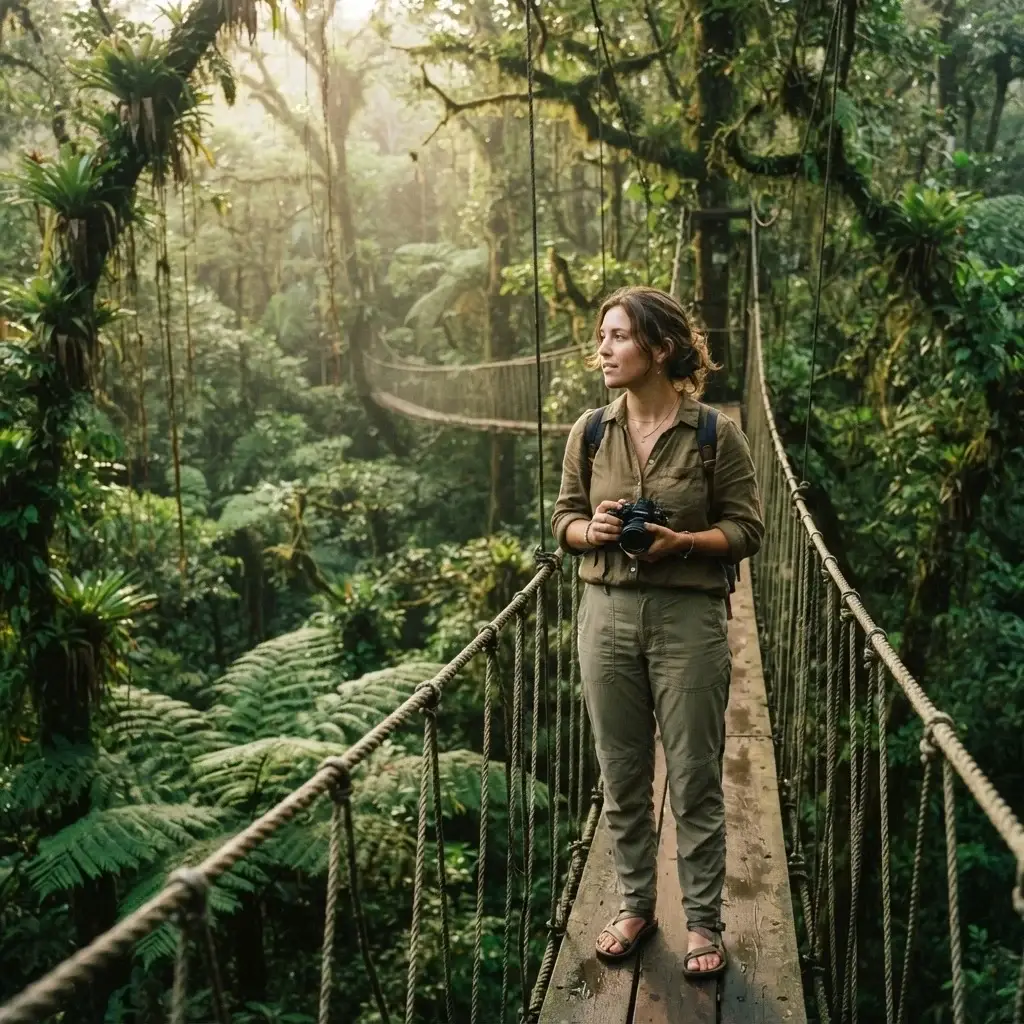
Cloud forests are a different thing entirely from tropical rainforests. They exist at elevation, shrouded in near-permanent mist, and the moisture that clings to every surface creates an ecosystem of extraordinary lushness and strangeness. Bromeliads, orchids, and mosses cover every branch. The light is soft and diffused. Everything drips.
The Monteverde Cloud Forest Preserve in Costa Rica is one of the most studied cloud forest ecosystems on Earth. It protects 10,193 acres and has supported more than 1,200 scientific publications since its founding. It was included in the IUCN Green List of best-managed protected areas in 2025. From what solo travelers consistently report, this is a place that slows you down in the best possible way. The trails are well-maintained and clearly marked, and it is entirely manageable for independent travelers.
The official Monteverde Cloud Forest Preserve offers both self-guided walks and guided natural history tours, as well as a night walk that reveals a completely different face of the forest after dark. The preserve is open daily from 7am to 4pm. Entry for adults is $29 USD per circuit, with children 6-11 at $16 USD and children under 5 free.

Online booking is strongly recommended, and the preserve asks you to arrive 15 minutes before your scheduled shuttle departure time as late arrivals cannot be guaranteed entry.
Getting to Monteverde requires a little planning but is not difficult. The nearest major hub is San Jose, and you can reach Monteverde by bus (around 4.5 hours) or by a faster combination of a short domestic boat or bus transfer. There is no major airport nearby, which is honestly part of the charm: the journey in is winding and slow and beautiful.
Where to eat in Monteverde: the town of Santa Elena, a short walk from the preserve, has a small but genuinely good food scene. Soda Viquez is a beloved local comedor serving casado (a traditional Costa Rican plate of rice, beans, meat, and salad) for a few dollars. For something lighter, the cafes near the butterfly garden serve local coffee that is worth building your morning around.
The best time to visit is December through April, the dry season. The forest is misty year-round by nature, but the rainy season (May through November) can make trails muddy and difficult, and trail closures are possible.
Tambopata National Reserve, Peru: The Amazon at Its Most Accessible
The Amazon is one of those places that lives very large in the imagination. It is the word you attach to “biggest” and “wildest” and “most biodiverse” in almost any natural context. And it is right: the Tambopata National Reserve in Peru’s Madre de Dios region contains forest that supports 600 species of birds, 169 species of mammals, 103 species of amphibians, and one of the most famous spectacles in nature, the clay lick at Chuncho, where hundreds of macaws and parrots descend every morning to consume mineral-rich clay.
What makes Tambopata particularly good for solo travelers is that it has a well-organized ecotourism infrastructure centered on the town of Puerto Maldonado. You are not hacking through wilderness solo. You are traveling with licensed, experienced guides through one of the most protected ecosystems in South America. Peru’s National Service of Protected Areas (SERNANP) maintains the Tambopata National Reserve official visitor information with current entry fees and authorized operators.
Entry fees for foreign visitors are S/.30 for a single day, S/.60 for two to three days, and S/.150 for four to thirty days.
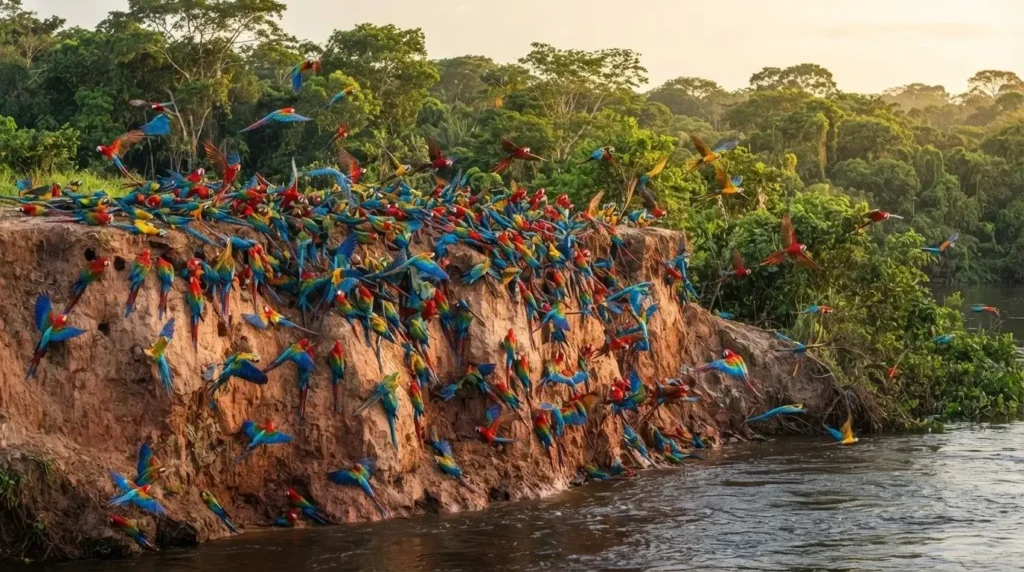
You must use an authorized tour operator to enter the reserve proper, and this is genuinely not a regulation to work around: the forest is large, the trails are unmarked in most areas, and the guides are the experience. They know which trees to stop at, which sounds to listen for, and how to read the forest in ways that take decades to develop.
Getting to Puerto Maldonado is simple: there is a direct 1-hour 20-minute flight from Lima, or a 10-hour overland route from Cusco if you want to turn the journey into part of the adventure. The recommended visiting season is May through October. December through March is the rainy season and some trails and river routes are inaccessible.
For food in Puerto Maldonado, inchicapi (chicken and peanut soup) and juane (rice and chicken wrapped in bijao leaves) are the local dishes to seek out. The market near the main plaza serves fresh regional food from early morning and is the best place to eat like a local before or after your time in the reserve.
Tongass National Forest, Alaska: The Largest National Forest in the United States
If the idea of ancient forest travel within the United States surprises you, the Tongass will change your framework entirely. At 16.7 million acres, the Tongass National Forest in Southeast Alaska is the largest national forest in the country, and it contains some of the most ecologically intact old-growth temperate rainforest anywhere in the world. Think Sitka spruce and western hemlock standing 200 feet tall, salmon-filled streams, bears, eagles, and an ocean-adjacent wilderness that feels like nowhere else in North America.
The USDA Forest Service Tongass hiking page lists over 700 miles of trails suitable for a range of experience levels, including ADA-accessible boardwalks for those who want a gentler introduction to the forest. Guided hiking tours operate from May through September, starting around $175 for a 2-3 hour session, with longer backcountry options available.
The most practical entry points are the towns of Ketchikan, Sitka, and Juneau, all of which are served by Alaska Airlines and accessible by Alaska Marine Highway ferries if you want the scenic overland and sea route. The forest surrounds these towns so literally that you can be walking under old-growth canopy within minutes of your hotel.
For food, fresh Alaskan salmon and Dungeness crab are the definitive local experiences. In Ketchikan, the small waterfront diners serve fish and chips made from halibut caught the same morning. It is unpretentious and excellent.
Visit in late May through August for the best combination of daylight, trail access, and wildlife activity. The shoulder weeks in late May and early September are often the sweet spot: lighter crowds and still clear enough for views.
A Note on Responsible Forest Travel
One of the things I feel strongly about, having spent time in environments where the impact of visitors is very visible, is that going to these places comes with a responsibility to leave them unchanged. The Leave No Trace Center’s 7 Principles are the clearest and most practical framework I know for forest travel: stay on marked trails, take all waste with you, avoid disturbing wildlife, minimize campfire impact, and leave everything you find exactly where it is.
In practice this means a few specific things for forest travel: bring a reusable water bottle and a small bag for any waste you generate. Do not pick plants, collect seeds, or remove anything from the forest floor. Keep your voice low; the wildlife you are hoping to see will disappear long before it reaches you if it hears noise from a distance. And if the forest you are visiting requires a licensed guide, use one. Not just because it is a regulation, but because the guides in these ecosystems are usually extraordinary people with genuine expertise, and they will show you things you would walk right past on your own.
Not Sure Where to Start? Begin at Home
If an international forest trip feels like a big leap right now, the United States has remarkable old-growth resources worth knowing about. The Old-Growth Forest Network’s searchable map lists over 317 protected forests in 290 counties across 40 states, all open to the public and chosen because they represent the oldest known forests in their area. It is a genuinely useful tool for building your forest travel instincts before committing to a bigger trip.
Starting locally is not a consolation prize. It is good practice. The skills you develop reading a trail, moving quietly, and sitting still long enough for the forest to trust you again are the same ones that will make a trip to Tambopata or the Daintree richer and more meaningful.
What to Pack for Forest Travel
Preparation is not about having expensive gear. It is about not being uncomfortable enough to cut your time in the forest short.
The essentials that consistently matter: lightweight waterproof jacket (forest weather changes fast), moisture-wicking long-sleeve shirts (sun and insects), long lightweight trousers (same reason), sturdy trail shoes or hiking boots with ankle support, a small daypack, a refillable water bottle or filter bottle, insect repellent with DEET or a plant-based equivalent, and a headlamp with a fresh battery. In tropical forests, add rubber boots if you have them as mud is serious business in the wet season. In Alaska and the temperate rainforests, layers and waterproofing are your primary tools.
One thing people often forget: a small first aid kit with blister treatment, rehydration salts, and basic antihistamine.
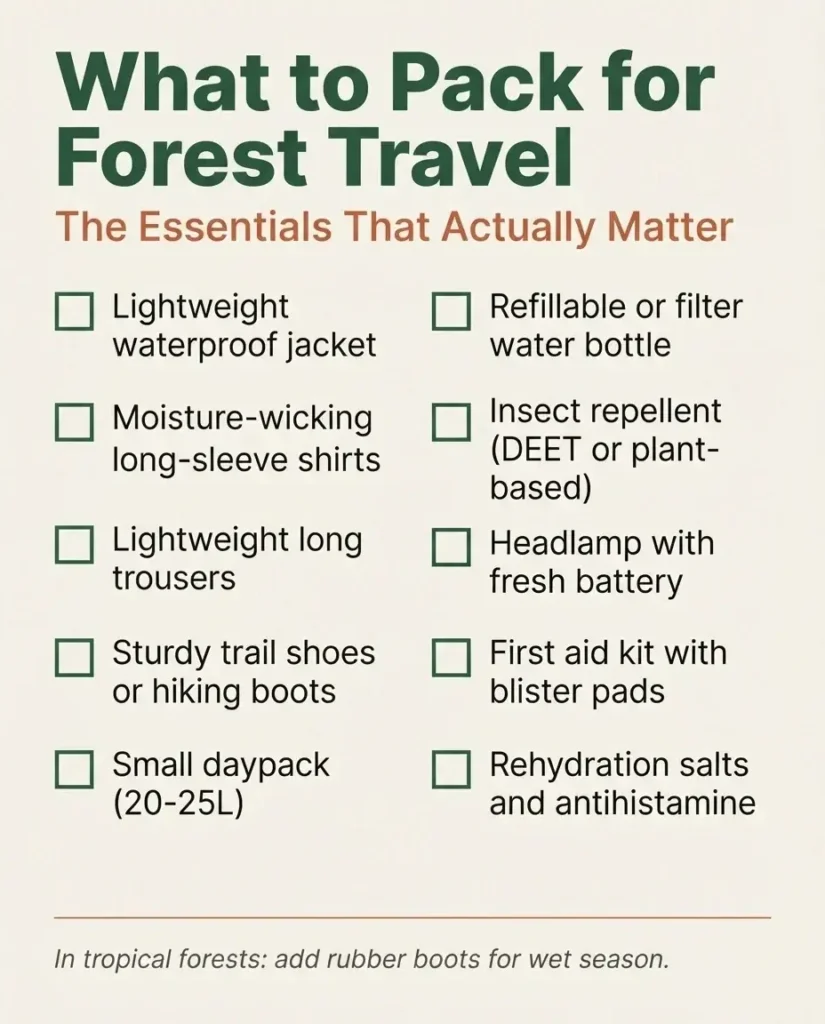
Even in well-managed parks, you may be hours from the nearest town.
The Part Nobody Talks About
Here is what I keep coming back to every time I think about forest travel. There is a specific moment that solo travelers describe almost universally when they talk about time spent in old-growth forest. It usually comes on the second or third day. The noise in your head starts to quiet. The pace you have been carrying, all the small urgencies and digital background static, drops away. You start noticing things you would normally walk past: the way light changes through a canopy, the specific sound a heavy leaf makes when it falls, the way the air smells different every hundred meters.
That is not romance. That is biology. There is a reason people report lower cortisol levels after time in forest environments, and it is not complicated: forests predate us. They have their own rhythms and those rhythms are steadier than ours.
When I left my office job and started building a life around travel and writing, I was chasing something I could not name clearly at the time. I understand it better now. I was chasing places that reminded me that the world is larger and older and wilder than my daily routine had let me believe. Old-growth forests do that faster than almost anything else I have found.
You do not need a perfect plan. You just need to pick one of these places and start moving toward it.