

I remember sitting at my desk in my old New York office job, staring blankly at a glowing spreadsheet. I was daydreaming about eating street tacos in Mexico City or hiking through the misty hills of northern Thailand. I wanted out of the 9-to-5 grind. I wanted to see the world.
But I was also terrified.
When you are planning your first big solo trip, the fears pile up fast. What if I get lost? What if I cannot speak the language? What if I run out of money? We worry about the big things. But once you actually hit the road, you quickly realize that the small, boring details are what make or break your trip.
One of those boring details? Keeping your phone and camera charged.
When your phone battery dies in an unfamiliar city, panic sets in. You cannot check your map to find your hostel. You cannot use your translation app to order food. You cannot look up the local train schedule. Your lifeline to the world is suddenly gone.
I learned this the hard way. When I quit my job and moved to teach English in Thailand, I brought a cheap, flimsy plug I bought at a dollar store. On my third day in Bangkok, I plugged in my laptop. I heard a loud pop, saw a flash of blue light, and smelled burning plastic. My laptop was dead. My plug was melted. And I was completely cut off from my family back home.
That expensive mistake taught me a lesson I will never forget. You cannot cut corners on travel gear that keeps you safe and connected. That is why finding the best universal travel adapters is one of the first things I tell new travelers to do.
In this massive guide, I am going to walk you through everything you need to know about charging your devices abroad. I will share my biggest mistakes, explain confusing voltage rules in simple terms, and help you pick the exact right gear for your trip. We will also talk about how to find power in remote places, what to eat while you wait for your phone to charge in local cafes, and how to travel with total confidence.
Take a deep breath. Your dream trip is possible. Let’s get your gear sorted out so you can focus on the adventure.
Why Power Matters More Than You Think
Before we look at the specific features of the best universal travel adapters, we need to talk about why power is so critical for modern travel.
A decade ago, you could travel the world with just a paper map and a phrasebook. I used to work as a sightseeing guide in New York City, handing out printed maps to tourists every single day. But the world has changed. Today, our phones are our boarding passes, our bank cards, our cameras, and our emergency safety devices.
The Fear of the Dead Battery
Imagine this. You just arrived in Hanoi, Vietnam, after a 15-hour flight. You are exhausted. The air is thick with humidity and the smell of roasting pork from street vendors. You need to find your guesthouse. You reach for your phone to load the walking directions, but the screen is black. It died on the plane.
You try to find a cafe to plug in, but you realize your home charger does not fit into the holes in the Vietnamese wall sockets. You cannot speak Vietnamese. You cannot call a taxi. You are stuck.
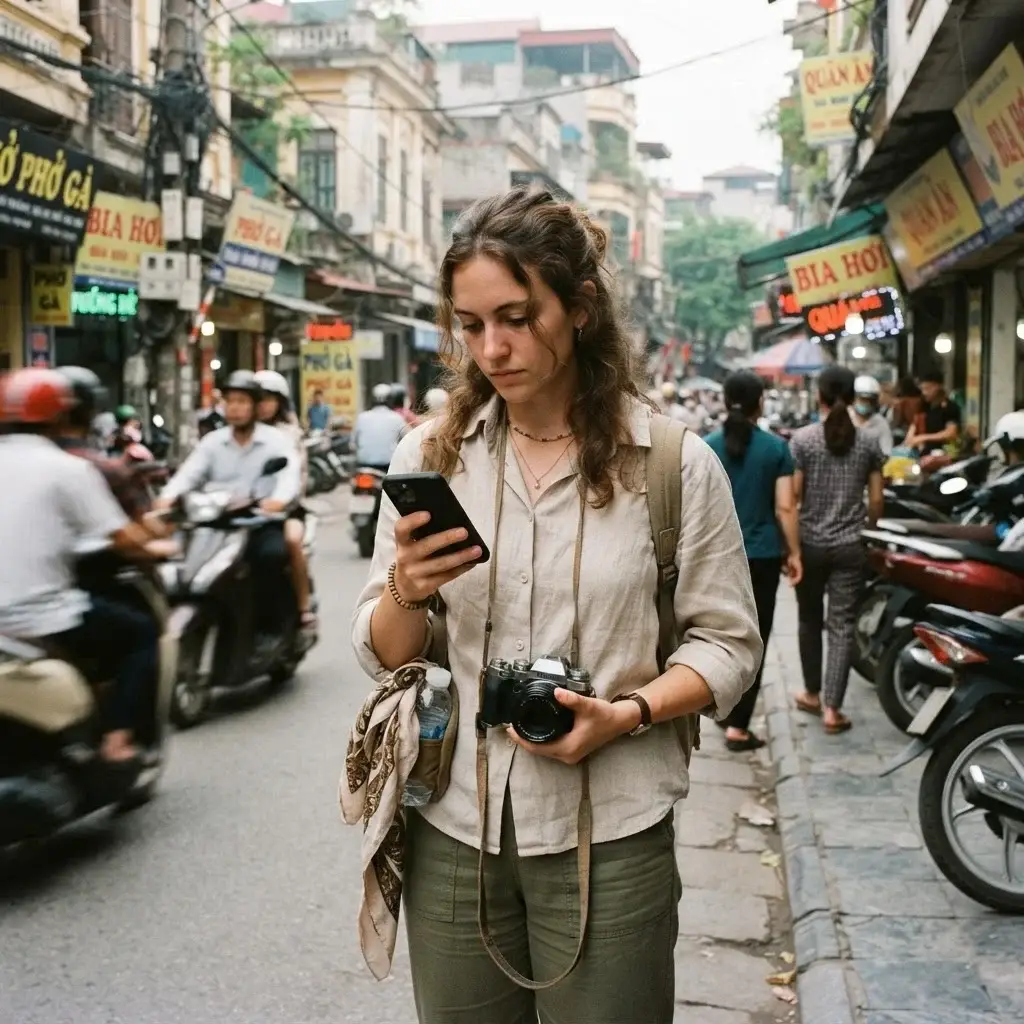
This is exactly the type of stressful situation we want to avoid. Travel should be about growth, curiosity, and cultural connection. It should not be about stressing over a dead battery. By packing one of the best universal travel adapters, you carry a tiny cube of peace of mind in your backpack.
Navigation and Food: A Traveler’s Daily Needs
When your phone has power, you have freedom. You can wander off the main tourist streets and find those tiny, hidden local restaurants. For example, when you are in Southeast Asia, knowing how the local digital systems work can change your whole trip. You can skip the overpriced tourist taxis entirely if you just download the local apps. I highly recommend taking a few minutes to read up on how Grab works for travelers so you can safely and cheaply navigate cities like Chiang Mai, Ho Chi Minh, or Bali. But you can only use those cheap local rides if your phone stays on.
When your phone is charged, you can also confidently look up local food spots. Instead of eating a generic burger near your hotel, you can use your maps to track down a spicy bowl of Khao Soi hidden down a dark alley. Power equals access to authentic culture.
The Basics of Global Power: Plugs, Adapters, and Converters
Let’s clear up the biggest point of confusion right now. What is the difference between an adapter and a converter? And what do you actually need?
I used to be so confused by this. I thought I needed to buy massive, heavy boxes to make my hair straightener work in Europe. The truth is much simpler.
What is a Travel Adapter?
A travel adapter simply changes the shape of the prongs on your plug. It allows a flat American plug to fit into a round European hole. It does not change the electricity flowing through the wall. It only changes the physical shape of the connection. The best universal travel adapters give you multiple prong shapes in one single block, so you do not have to buy a new adapter for every country you visit.
What is a Voltage Converter?
A voltage converter actually changes the electrical current coming out of the wall.
Different parts of the world use different electrical voltages. The United States and Canada use 110-120 volts. Most of the rest of the world, including Europe, Asia, Africa, and Australia, uses 220-240 volts.
If you plug a 110V device into a 220V outlet without a converter, the higher power will force its way into your device and fry it instantly. This is exactly what happened to my laptop in Thailand.
Do You Need a Converter Today?
Here is the great news. For almost all modern electronics, you do not need a converter anymore.
Most modern devices have “dual voltage” capability built right in. Look at the tiny, almost unreadable print on your laptop charger or phone plug. If it says “Input: 100-240V”, you are safe.
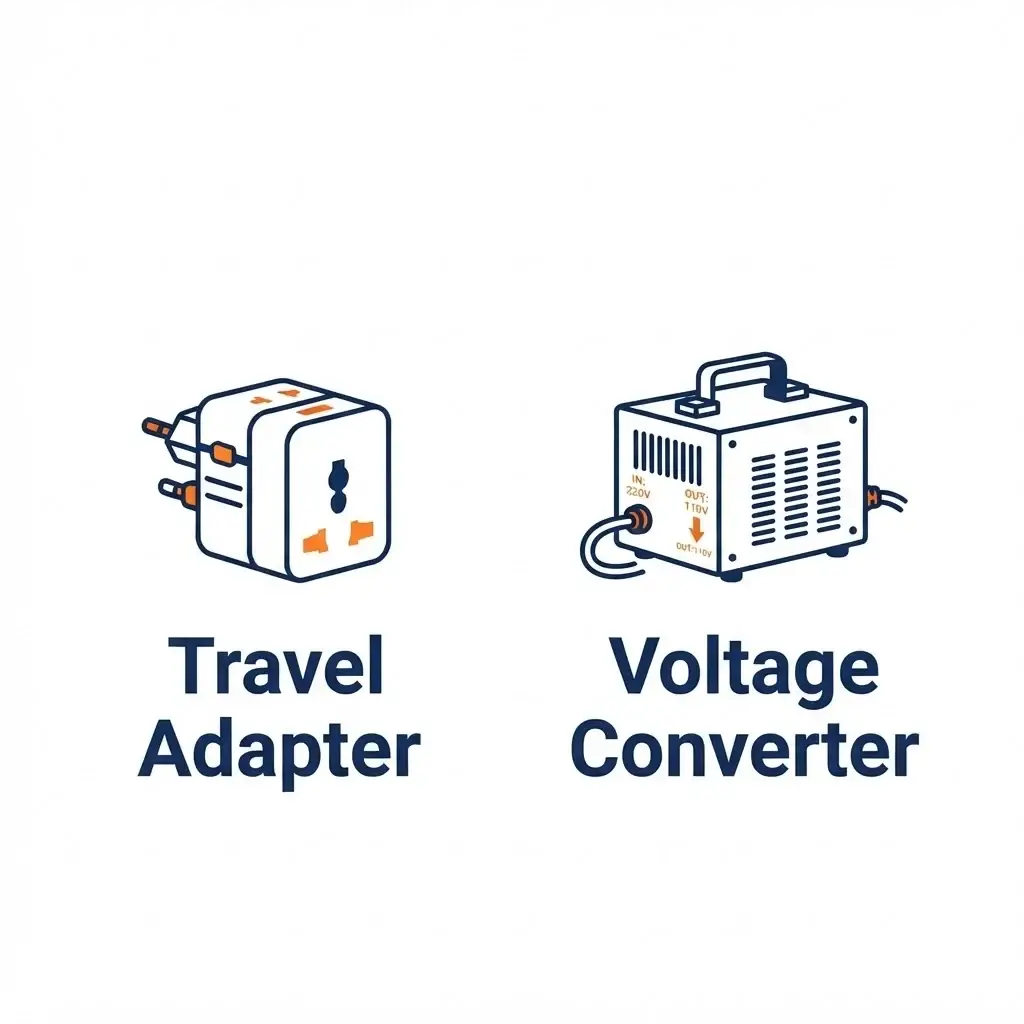
This means the device will automatically adapt to any voltage in the world. Apple products, modern laptops, camera chargers, and most e-readers are dual voltage.
For these items, you only need to change the physical shape of the plug. That is why the best universal travel adapters are all you really need to pack.
However, items with heating elements—like cheap hair dryers, curling irons, or clothing irons—are rarely dual voltage. If you plug a 110V American hair dryer into a European 220V wall, it will catch fire. My advice? Leave the hair tools at home. Embrace the messy travel hair. It is part of the journey!
Exploring the World’s Plug Types
The world could not agree on one single plug shape. Instead, there are 15 different plug types used around the globe, named with letters from A to O.
When you carry the best universal travel adapters, you usually get coverage for the four most common plug families. Let’s break down where these plugs are used, and what you can expect when you travel there.
The Type A and B Plugs (The Americas)
These are the plugs used in the United States, Canada, Mexico, and much of Central America. Type A has two flat parallel pins. Type B has the same two flat pins plus a round grounding pin.
When I was traveling slowly through Mexico, waiting tables to save up for my next big flight, I realized how lucky Americans are that our plugs work in so many neighboring countries. You won’t need to change your plug shape to explore the ancient ruins of Teotihuacan or eat street corn in Oaxaca. But you should always double-check entry rules before crossing borders. I always suggest travelers review official country entry requirements and safety alerts when mapping out a route through Central America.
The Type C Plug (Europe and Beyond)
Type C is the standard “Europlug.” It has two round pins. This plug type is used in almost every country in Europe, as well as parts of South America, Asia, and Africa.
If you are backpacking solo across Europe like I did after college, this is the plug you will use every single day. I spent months wandering from cheap hostels in Spain to tiny farmhouses in Italy.
Insider Tip for Europe: European wall sockets are often deeply recessed into the wall. Some cheap, bulky adapters are too fat to reach the holes inside the circular dip in the wall. The best universal travel adapters are designed with a slightly extended plug section specifically to fit into these tricky European sockets.
While in Italy, charge your devices while standing at a local coffee bar. Do not sit at the table—it costs extra! Order a simple espresso, stand at the counter with the locals, and plug your phone into the wall near the register. It is the cheapest and most culturally authentic way to power up.
The Type G Plug (UK, Ireland, and Former Colonies)
Type G is a massive, chunky plug with three large rectangular pins arranged in a triangle. It is used in the United Kingdom, Ireland, Singapore, Malaysia, Hong Kong, and several other places.
This plug is incredibly safe. It has built-in fuses and protective shutters in the wall sockets.
Insider Tip for Type G Countries: The wall outlets in the UK and Singapore almost always have a tiny on/off switch right next to the plug holes. You can plug your adapter in perfectly, but if you do not flip that tiny wall switch so the red marker shows, no power will flow. I once woke up to a dead phone in London because I forgot to flip the switch!
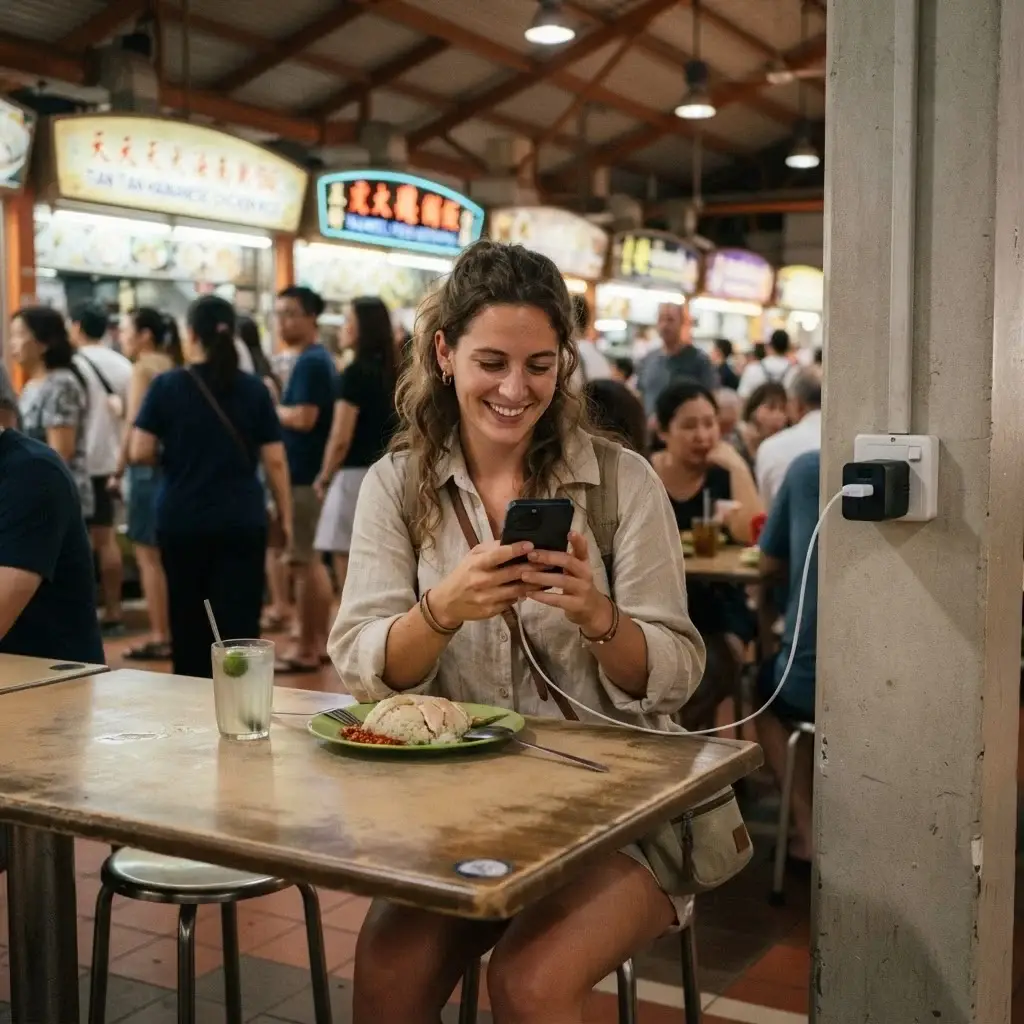
In Singapore, the best place to charge your gear and fill your stomach is a local Hawker Centre. These massive open-air food courts are incredible. Find a table near a pillar, which often has Type G outlets. Order a plate of Hainanese Chicken Rice or spicy Laksa, plug in your adapter, and watch the beautiful chaos of the city around you.
The Type I Plug (Australia, New Zealand, China)
Type I has two flat pins arranged in an upside-down V shape. Some versions have a third grounding pin below them.
When I studied abroad in Australia, I fell in love with their laid-back culture. But I was totally unprepared for their plugs. Luckily, the best universal travel adapters simply allow you to twist or angle the flat American pins until they form the Australian V shape.
In Australia, look for charging spots in local public libraries or coastal cafes. Order a “Flat White” coffee and a slice of banana bread. Australians take their coffee culture very seriously. You will rarely find a bad cup, and cafe owners are usually very friendly about letting travelers charge up while they plan their next hike.
Key Features to Look For in a Universal Adapter
Not all adapters are created equal. If you buy a generic plastic cube at the airport out of desperation, you will likely overpay for a product that breaks in a week. When you are shopping for the best universal travel adapters, you need to look for specific, modern features.
1. Built-in USB and USB-C Ports
Ten years ago, travelers had to carry a bulky charging block for every single device. You would plug your adapter into the wall, plug your phone block into the adapter, and plug your cable into the block. It was a messy tower of plastic that often fell out of the wall.
Today, the best universal travel adapters have multiple USB-A and USB-C ports built directly into the base of the unit. This is a total game-changer.
You can plug the adapter into the wall in Paris, and then plug your phone cable, your camera cable, and your Kindle cable directly into the bottom of the adapter at the same time. You only take up one wall outlet, but you can charge four devices at once. In crowded hostel dorm rooms where eight people are fighting over two wall outlets, this makes you the most popular person in the room.
2. High-Speed Power Delivery (GaN Technology)
If you travel with a modern laptop, like a MacBook, you need an adapter that can push enough power to charge it. Older adapters output very slow currents. If you plug a laptop into a weak USB port, it might take 12 hours to charge, or it might actually lose battery while you use it.
Look for adapters that mention “GaN” (Gallium Nitride) technology or high-wattage Power Delivery (PD). GaN technology allows the internal components of the charger to be packed closer together safely.
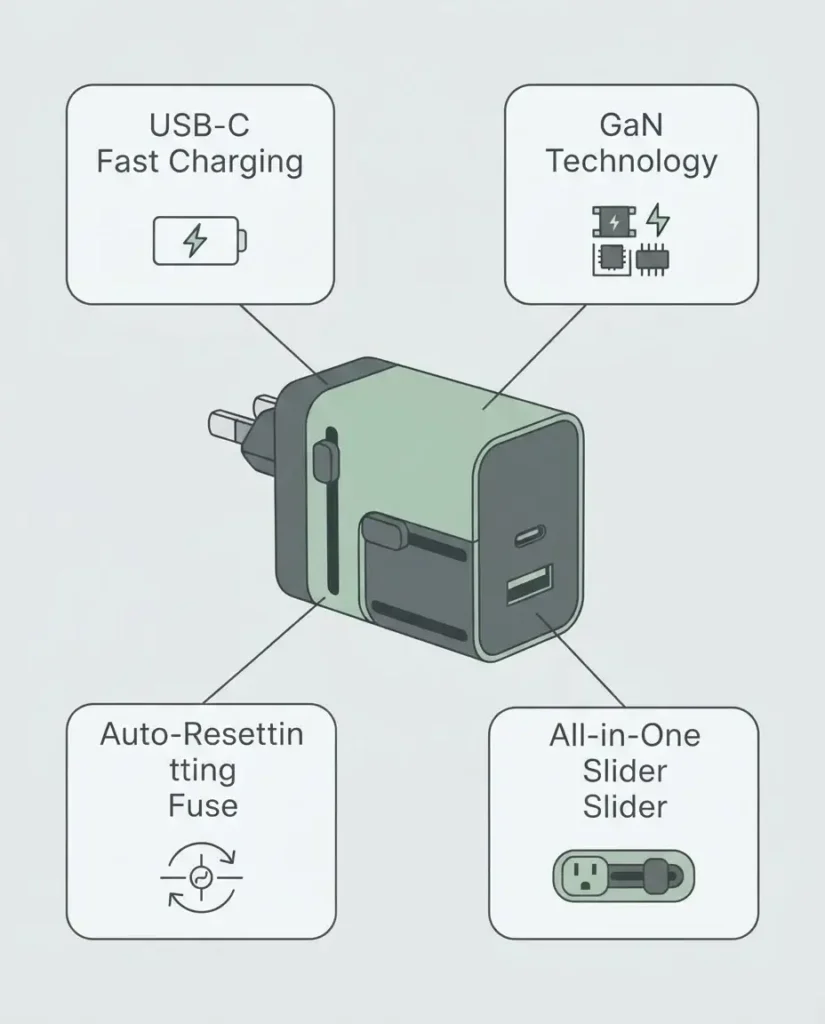
This means you get massive amounts of power—often up to 65W or 100W—in a tiny, lightweight box. A 65W universal adapter can fast-charge your laptop and your phone simultaneously while you sip mint tea in a Moroccan market.
3. Auto-Resetting Fuses
Electrical grids in many parts of the world can be unstable. Power surges happen suddenly.
If a surge hits a cheap adapter, it will fry the adapter and possibly the phone connected to it. Good adapters have built-in fuses that blow during a surge, protecting your gear. But traditional fuses have to be physically removed and replaced with tiny glass tubes. Who carries spare glass fuses in their backpack? No one.
The best universal travel adapters feature “auto-resetting fuses.” If a surge hits, the fuse trips and shuts down the power. You simply unplug the adapter, wait a few minutes for it to cool down, and the fuse resets itself. It is brilliant, easy, and provides massive peace of mind.
4. Slider Mechanisms vs. Snap-on Pieces
Avoid adapters that come in multiple loose pieces. If your adapter requires you to snap different country heads onto a base, you will inevitably lose the European head in the bottom of your backpack right when you need it most.
Instead, buy an all-in-one cube with sliding levers on the side. You push a button, slide the lever down, and the correct prongs pop out of the top. When you leave the country, you retract the prongs back into the cube. It stays compact, and you never lose any pieces.
Charging Safely in Developing Nations
I want to talk openly about traveling in places where the infrastructure is a bit unpredictable.
When I lived with a host family in Ghana, it changed my entire worldview. The warmth of the people, the rich culture, and the incredible food opened my eyes. But the electrical grid was tough to manage. We experienced “dumsor”—a local term for persistent, rolling power outages.
Handling Power Surges and Brownouts
In many developing countries in Africa, South America, and parts of Asia, power does not flow evenly. You will experience spikes (too much power) and brownouts (drops in power). Both are terrible for delicate microchips in phones and cameras.
If you are traveling in regions with unstable power, do not leave your devices plugged into the wall unattended while you sleep. A middle-of-the-night power surge can ruin your gear. Instead, charge your devices during the day while you are in the room.

Insider Secret: If the lights in your room start flickering wildly, or the fan suddenly speeds up and slows down, unplug your electronics immediately. That is a sign of an unstable grid. Wait until the power stabilizes before plugging back in.
Because power grids can be wild, I never travel with expensive gear without a safety net. Replacing a fried laptop out of pocket can ruin your travel budget for months. I always strongly advise checking detailed insurance guidance for lost or damaged tech gear before you fly, so you know exactly what is covered if a surge destroys your camera.
The Portable Power Bank: Your Best Friend
Because you might face rolling blackouts or long bus rides with no outlets, a universal wall adapter is only half of the power equation. You absolutely must carry a portable power bank.
I carry a 10,000mAh battery pack in my daybag every single day. If I am wandering through the chaotic streets of Kathmandu or taking a 12-hour overnight bus through the Andes mountains, I do not have to worry about wall outlets. I can charge my phone in my pocket.
Your power strategy should be a two-step process:
- At night in your room, use one of the best universal travel adapters to charge your portable power bank and your laptop.
- During the day, leave the adapter in your room and use the portable power bank to keep your phone charged on the go.
Coffee Shop Culture: Finding Power on the Road
Sometimes, you arrive in a city before your hotel room is ready. You have a dead phone and a heavy backpack. Your best move is to find a local coffee shop, buy a drink, and plug in.
But coffee shop etiquette varies wildly around the world. Understanding how to navigate these spaces helps you respect the local culture while getting the juice you need.
The unspoken rules of cafe charging
In North America, we treat coffee shops like our personal offices. We buy one small coffee, claim a massive table near an outlet, and sit there for six hours.
In many other cultures, this is considered incredibly rude.
In places like France or Italy, cafes are social spaces. If you pull out a laptop and a mess of cords, people will look at you strangely. If you must charge your phone, look for small outlets near the baseboards, ask the waiter politely (“Puis-je charger mon téléphone, s’il vous plaît?”), and put the phone out of sight while you drink your coffee and watch the world go by.

If you want to spend hours working or charging multiple devices, you need to find modern, nomad-friendly cafes. When researching a new city, I often spend time reading deep destination overviews written by travel experts to find out which neighborhoods cater to digital nomads and remote workers. These neighborhoods will have cafes designed with power outlets at every table and fast, reliable Wi-Fi.
What to eat while you wait
Since you have to sit near an outlet for an hour anyway, you might as well eat something amazing! Here are some of my favorite local cafe snacks to order while testing out the best universal travel adapters around the world:
- Vietnam: Order a Cà phê sữa đá (iced coffee with sweetened condensed milk). It is thick, incredibly strong, and intensely sweet. Pair it with a fresh Banh Mi sandwich.
- Argentina: Find a local cafe in Buenos Aires and order a Cortado with two Medialunas (sweet, sticky local croissants). The power outlets are usually under the small wooden tables.
- Morocco: Sit on a cushioned bench, plug your adapter into the wall, and order a pot of fresh mint tea. It is poured from high above the glass to create a perfect foam. Eat it with dates or almond cookies.
The Best Universal Travel Adapters: How to Pack Them
You have done the research. You bought a great adapter with sliding prongs, GaN fast-charging, and built-in USB-C ports. Now, how do you pack it?
Packing tech gear can become a tangled, frustrating mess if you are not careful. When you are a solo traveler living out of a backpack, organization equals sanity.
The Tech Pouch Strategy
Never let your cables and adapters float freely in your main backpack. They will get crushed, tangled, and dirty.
Buy a dedicated, padded tech pouch. I use a small zippered bag. Inside, I keep:
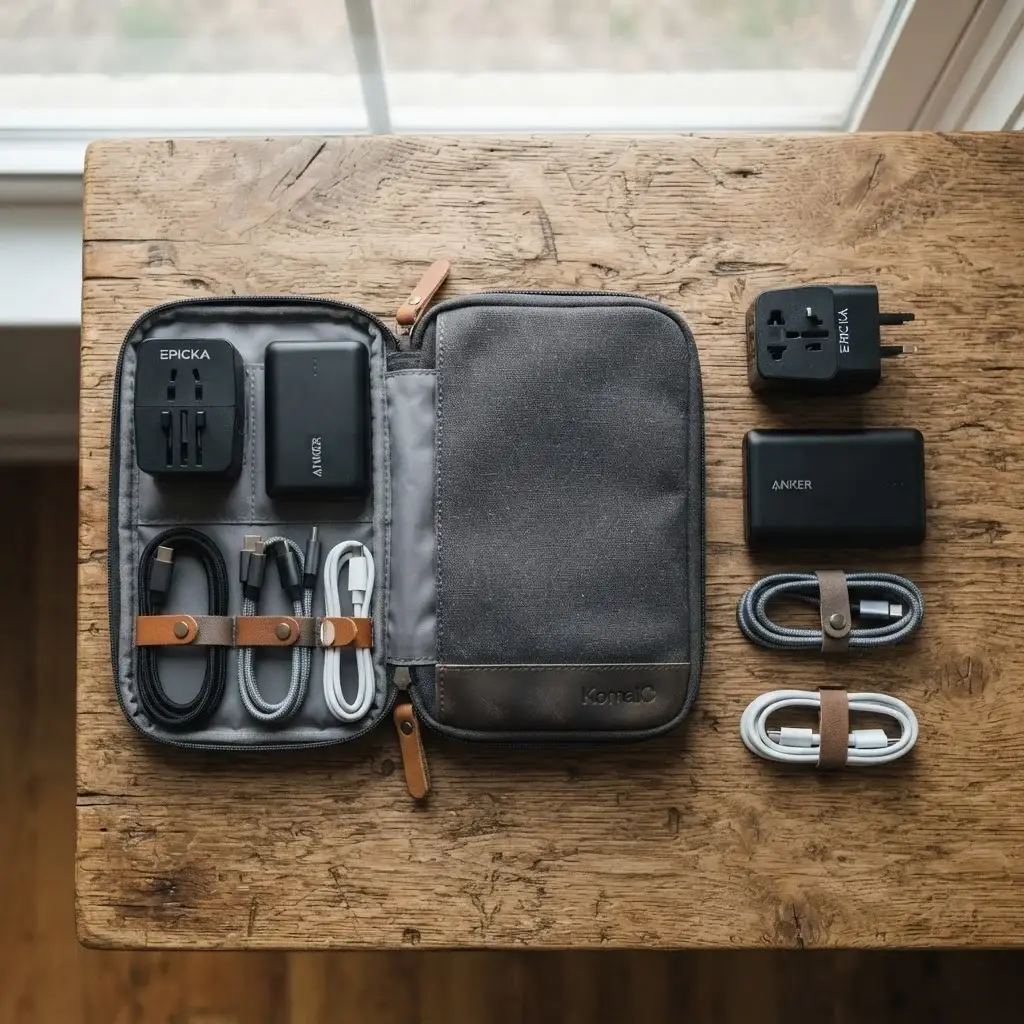
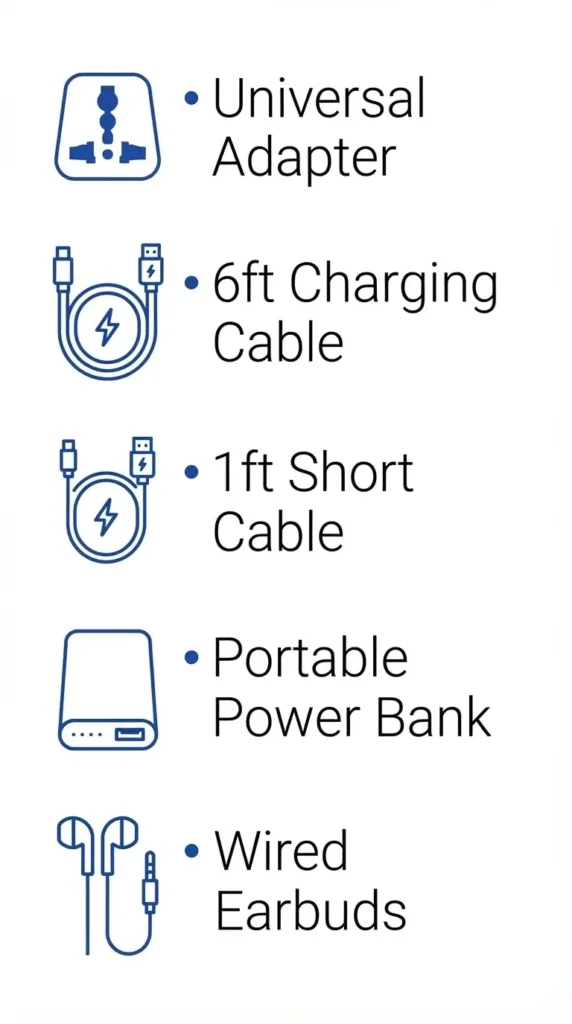
- My universal adapter.
- One long (6-foot) charging cable. (Hotels frequently hide outlets behind heavy beds; a long cable is a lifesaver).
- One short (1-foot) cable for charging from my power bank.
- My portable battery pack.
- A spare set of wired earbuds (for when the Bluetooth ones die).
By keeping all power-related items in one single pouch, I always know exactly where to reach when my battery turns red. I can pull the pouch out on an airplane or a dark bus without having to turn on the overhead light and dig through my clothes.
Staying Healthy and Safe
It might seem strange to talk about health in an article about power adapters, but everything in travel is connected.
When you travel solo, your safety relies on your ability to access information. If you get sick from eating bad street food or drinking unfiltered water, you need your phone to translate symptoms to a pharmacist or to look up the nearest clinic.
You cannot afford to lose power when you are ill. This is why I treat my charging gear as part of my safety and first aid kit. Before I travel to remote areas, I always review official destination health advisories regarding local water safety and necessary vaccines. I make sure my phone has off-line maps downloaded, emergency numbers saved, and a full battery, so if I do feel unwell, I can get help instantly.
A reliable adapter is not just a convenience; it is a vital tool for your independence and security.
Stepping Out the Door
I know planning a trip can feel overwhelming. There are so many blogs telling you what to buy, where to go, and what to fear.
But I promise you, the world is much more welcoming and accessible than it seems from behind a desk. People are generally kind. Problems are usually solvable. And mistakes—like frying a laptop in Thailand—just become funny stories you tell later.
Do not wait for the perfect moment to travel. Do not wait until you have the perfect itinerary or the perfect travel companion. The perfect time rarely exists. Confidence does not come before you buy the ticket; confidence grows through the action of traveling.
Take it one step at a time. Buy your backpack. Sort out your passport. Grab one of the best universal travel adapters so you know you can stay connected. Then, take a deep breath, step out of your comfort zone, and go see this beautiful, messy, incredible world.
Your next great adventure is waiting. You just have to make sure you have the power to capture it.