7 Destinations for Learning About Indigenous History in the Americas

There is a moment that happens at certain places. You are standing somewhere old, genuinely old, and the scale of what was here before you finally lands. Not “before the Europeans arrived” old. Before most of what we call history was written down at all. The Americas are full of those moments, and most travelers rush past them without ever knowing what they missed.
I think about this a lot when I am planning a trip. Back when I was working as a sightseeing guide in New York City, I spent my days helping visitors see a city I knew deeply. What I learned was that the difference between a meaningful experience and a forgettable one almost always comes down to context. Someone who understands what they are looking at, who built it, what it meant, and what happened to it, walks away changed. Someone who takes a photo and moves on does not.
This guide is for the person who wants to be changed. If you are curious about the civilizations that built this hemisphere long before it was carved into the nations we know today, these seven destinations will give you the kind of depth you are looking for. I have organized them from North America down through Latin America, and I have included practical logistics, cultural notes, and honest tips on visiting respectfully, because how you show up at these places matters.
Before You Go: A Word on Visiting Responsibly
This kind of travel comes with real responsibility. Indigenous communities across the Americas have a long and complicated relationship with outside visitors. Some sites are fully open to the public. Others are living communities where people still make their homes, pray, and carry on centuries of tradition. In both cases, your presence is a guest relationship, not a consumer one.
The American Indigenous Tourism Association’s Know Before You Go guides are genuinely worth reading before you visit any Native American site in the US. They outline cultural protocols, what to ask, and how to be a respectful visitor rather than an intrusive one. It takes about fifteen minutes to read and makes a real difference.
In general: ask before photographing people or ceremonies, stay on marked paths, purchase directly from community artisans when given the opportunity, and choose indigenous-led tours over generic operators whenever possible. Your entrance fee and spending at local businesses is one of the most direct ways travel can support rather than extract.

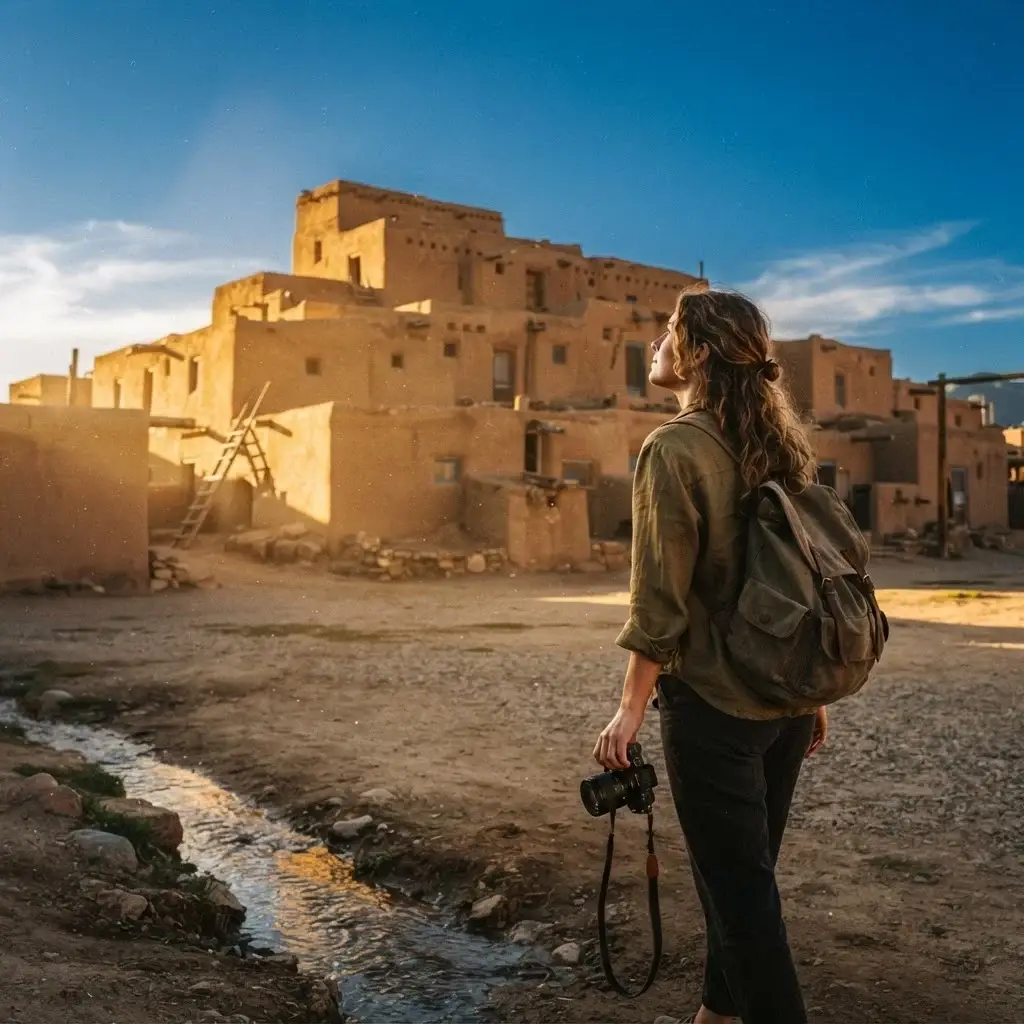
Taos Pueblo, New Mexico, USA
Why it belongs on this list
Taos Pueblo is unlike any other place on this list. Every other site here is archaeological, meaning you are visiting what remains of a civilization. Taos Pueblo is a living community. People have lived continuously in these multi-story adobe structures for over 1,000 years, making it one of the oldest continuously inhabited communities in the United States.
It is the only site in North America that holds both UNESCO World Heritage status and National Historic Landmark designation simultaneously. The UNESCO listing for Taos Pueblo describes the multi-story adobe dwellings at the foot of the Sangre de Cristo Mountains in northern New Mexico as one of the most outstanding examples of a Pueblo Indian settlement.
What you will actually learn here
A visit gives you direct access to Tiwa-speaking Pueblo culture in a way that no museum can replicate. Guided tours led by Taos Pueblo community members walk you through the architecture, explain the significance of the Taos mountain to the north (considered sacred and not open to visitors), and give context for how the community has preserved its traditions through centuries of outside pressure, including Spanish colonization and US government policies.
The Red Willow Creek that runs through the center of the pueblo is the community’s only water source, and tribal members still collect water from it in traditional ways. That single detail, told by a community guide, will stay with you.
Practical details
Taos Pueblo is open Sunday through Saturday, 9AM to 4PM. Adult admission is $25, with reduced rates of $22 for seniors, students, and military. Children 10 and under enter free. Photography requires a separate permit, and there are specific zones and ceremonies where photography is not permitted. Always ask.
The pueblo is located about 70 miles north of Santa Fe and about 20 minutes from downtown Taos. If you are traveling solo by car, the drive north from Santa Fe on US-285 and then NM-68 is beautiful and easy to navigate. Plan at least half a day.
What to eat nearby
Downtown Taos has excellent New Mexican food. Look for places serving green chile stew, fry bread, or blue corn dishes. The Taos Plaza area has several locally owned restaurants. If you happen to be there during a feast day when the community hosts public dances, you may be invited to share food, which is a genuinely special experience if extended.
Mesa Verde National Park, Colorado, USA
Why it belongs on this list
If you want to understand just how sophisticated the Ancestral Pueblo people were, Mesa Verde is where you feel it most. The cliff dwellings tucked into the sandstone alcoves of southwestern Colorado were built between the 6th and 13th centuries. Cliff Palace alone contains 150 rooms and 23 kivas (ceremonial spaces). The Ancestral Pueblo people were not primitive. They were architects, farmers, astronomers, and community organizers who built an interconnected civilization across the entire Four Corners region.
What makes Mesa Verde distinctive is the combination of walking access to the structures and the quality of interpretation available. Mesa Verde National Park is one of the most well-managed cultural heritage sites in the US park system, and the ranger-led tours actually deliver on content.
What you will actually learn here
The big question the site explores honestly is why the Ancestral Pueblo people left. Around 1300 CE, the entire population of Mesa Verde migrated south. Scientists and Pueblo descendants still discuss this. It was almost certainly a combination of severe drought, social stress, and resource depletion, and the ranger programs engage with this seriously rather than pretending it was mysterious or unexplained. Understanding that even complex, successful civilizations face collapse from climate and environmental pressure makes this site feel startlingly relevant.
Practical details
Entrance fees run $30 per vehicle from May 1 through October 22, and $20 per vehicle from October 23 through April 30. Per-person fees are $15. Guided tours of Cliff Palace and Balcony House require timed tickets that sell out in peak season, so book ahead on the park website. The park is in Montezuma County in southwestern Colorado, about 35 miles east of Cortez. There is no public transit to Mesa Verde, so you need a car.
Solo travelers: the self-guided Chapin Mesa Archeological Museum is free with park admission and is one of the better small museums in the Southwest for understanding Ancestral Pueblo culture before you walk the sites.
Chaco Culture National Historical Park, New Mexico, USA
Why it belongs on this list
Chaco Canyon is the one that tends to stop travelers cold. It is remote, deliberately hard to reach, and the scale of what was built here is not immediately obvious until you understand the context. Between roughly 900 and 1150 CE, Chaco was the cultural and ceremonial center of a civilization that spanned 60,000 square miles. The great houses, including Pueblo Bonito with its 800 rooms, were planned structures aligned with solar and lunar cycles with engineering precision that still impresses archaeologists.
Chaco Culture National Historical Park is a UNESCO World Heritage Site and one of the most significant pre-Columbian sites in North America. It is also one of the most undervisited, largely because getting there requires driving 20 miles of unpaved road.
What you will actually learn here
Chaco challenges you to reconsider who gets counted in the story of North American history. The scale of the road system radiating out from Chaco, the precision of the astronomical alignments, and the evidence of long-distance trade networks stretching to Mexico all point to a society that was genuinely complex. A ranger-led tour of Pueblo Bonito is the most informative way to take it in.
The park also runs evening astronomy programs during certain seasons because Chaco is designated as an International Dark Sky Park, and the connection between the site’s astronomical alignments and the night sky is one of the most memorable things you can experience here.
Practical details
Entrance fees are $25 per vehicle, $20 per motorcycle, and $15 per person. Trails are open from 7AM to sunset. There is a small campground at Gallo Canyon that allows you to stay overnight inside the park, which I would strongly recommend if the logistics work for you. An overnight stay means you can visit at dawn and dusk when the light on the canyon walls is extraordinary and crowds are nonexistent.

The nearest services are in Bloomfield or Nageezi, both about an hour away. Bring your own water, snacks, and a full tank of gas before turning onto the dirt road.
Cahokia Mounds State Historic Site, Illinois, USA
Why it belongs on this list
Cahokia is the most overlooked site on this entire list, and that is a genuine shame because what was built here is extraordinary. Between 900 and 1400 CE, Cahokia was the largest pre-Columbian city north of Mexico. At its peak, around 1100 CE, it had a population estimated at 10,000 to 20,000 people, making it larger than London was at the same time.
It sits just across the Mississippi River from modern St. Louis, Illinois, which means you can reach it easily from a major city, yet most people have never heard of it. The Mississippian civilization that built Cahokia constructed over 100 earthen mounds, and Monks Mound at the center covers more ground at its base than the Great Pyramid of Giza.
What you will actually learn here
The Cahokia Mounds State Historic Site covers over 4,000 acres and contains 80 surviving mounds. The interpretive center walks you through Mississippian culture, trade networks, agricultural systems, and the fascinating (and still debated) question of what caused Cahokia’s eventual decline. The exhibit handles the complexity honestly, including the fact that archaeologists do not fully agree on the social structure of Cahokia or why the city was eventually abandoned.
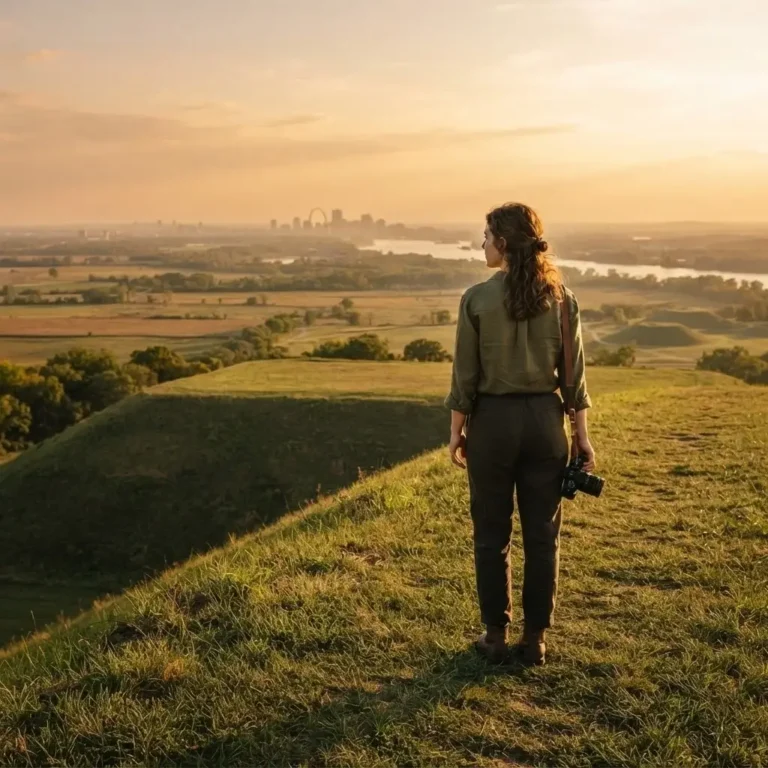
Walking to the top of Monks Mound and looking out at the flat river valley, imagining 20,000 people living, trading, and building here 1,000 years ago, is one of those perspective-shifting experiences that remind you how selective our popular history really is.

Practical details
There is no admission fee to visit Cahokia. A suggested donation of $7 for adults, $5 for seniors, and $2 for students is welcomed. The grounds are open daily from dawn to dusk. The interpretive center is open Wednesday through Sunday, 9AM to 3PM. From downtown St. Louis, the drive takes about 20 minutes. This makes Cahokia unusually accessible, especially for solo travelers working with a budget.
Chichen Itza, Yucatan, Mexico
Why it belongs on this list
Chichen Itza is the most visited indigenous historical site in the Americas, and that popularity is both its strength and its biggest challenge for curious travelers. The fame comes with crowds, hawkers, and a constant temptation to snap a photo of El Castillo (the main pyramid) and leave. That would be a mistake.
The UNESCO World Heritage designation for Chichen Itza recognizes it as one of the greatest Maya centers of the Yucatan Peninsula, with nearly 1,000 years of history and layers of cultural influence from multiple Mesoamerican peoples. The site contains far more than El Castillo: the Great Ball Court is the largest in the Americas and still stuns visitors who give it proper attention, the Sacred Cenote is a natural sinkhole where offerings and human remains have been found, and the astronomical precision of El Castillo’s equinox shadow display reflects a deep understanding of celestial cycles.
What you will actually learn here
From what solo travelers and historians consistently report, the key to getting depth out of Chichen Itza is hiring a licensed guide at the entrance rather than relying on the audio tour or printed materials alone. The layered nature of the site, where Toltec influence overlaps with earlier Maya construction, is much easier to understand with a knowledgeable guide walking you through the architectural differences.
The Maya civilization did not end. There are approximately seven million Maya people living in Mexico and Central America today. A good guide will make this clear and help you see Chichen Itza as part of a living cultural tradition, not a dead one.
Practical details
Chichen Itza is open daily from 8AM to 5PM, with last entry at 4PM. The site charges a federal entrance fee for the archaeological zone, with foreign visitors paying a combined state and federal fee. Arrive when the gates open. By 10AM the site is significantly more crowded and the heat on the Yucatan is serious.

Bring water, sunscreen, and a hat you will actually wear. Cenote Ik Kil, a short drive from the site, is a popular swimming stop after a morning visit and gives a chance to experience the cenote landscape that shaped Maya settlement patterns.
The nearest base towns are Valladolid (about 45 minutes away and far more interesting than the resort zone) and Merida (about 1.5 hours). Valladolid makes an excellent solo traveler base: affordable, walkable, with excellent local food.
What to eat nearby
Valladolid’s market serves cochinita pibil (slow-roasted pork with achiote and sour orange), papadzules (egg-filled tortillas in pumpkin seed sauce), and sopa de lima. These are dishes with deep pre-Columbian roots that connect directly to the culinary traditions of the region you are exploring historically.
The Sacred Valley and Cusco Region, Peru
Why it belongs on this list
Most people plan a trip to Peru and put Machu Picchu at the center of it. That makes sense. Machu Picchu is extraordinary. But if what you are after is genuine immersion in Inca and Andean indigenous history, the Sacred Valley and Cusco together offer far more depth than Machu Picchu alone.
Cusco was the capital of the Inca Empire, the largest empire in pre-Columbian American history. At its peak in the 15th and 16th centuries, the Inca Empire stretched 4,000 miles from modern Colombia to central Chile. Walking through Cusco’s streets, you can see where colonial Spanish buildings were literally built on top of massive Inca stone walls, using Inca craftsmanship as their foundation. That overlap tells you a great deal about both civilizations.
What you will actually learn here
The Sacred Valley, the stretch of Andean landscape between Cusco and Machu Picchu, is dotted with smaller Inca sites that the crowds largely skip. Ollantaytambo is one of the most remarkable, with its military terracing, intricate water channels, and the temple complex on the hill above the town. Pisac market is one of the best places in Peru to buy directly from indigenous Quechua artisans, and connecting that market visit to the archaeological site above it gives a sense of how Andean cultures have maintained continuity from the Inca period to today.
From what historians and cultural travelers consistently report, the most meaningful experiences in the Sacred Valley come from community tourism programs in villages like Chinchero and Maras, where Quechua-speaking families share traditional textile weaving, agricultural practices, and cooking. These are genuine cultural exchanges, not staged performances, and the income goes directly to the community.

Practical details
Cusco is the hub and has a well-developed solo travel infrastructure. Flights connect to Lima, the nearest major international hub. Altitude is a real consideration: Cusco sits at about 11,200 feet. Spend at least two days in Cusco before heading further into the valley to acclimatize. Coca tea is genuinely helpful and freely available everywhere. Most hotels in the valley have it waiting in the lobby.
The Boleto Turistico del Cusco (the regional tourist ticket) covers entry to most archaeological sites in the valley and is the most cost-effective way to manage admissions. Purchase it in Cusco before you head out.
What to eat
Cusco and the valley have an exceptional food culture. Cuy (roasted guinea pig) is the traditional dish and a genuinely important part of Andean culinary heritage. If you are open to it, trying cuy at a local restaurant in the valley, rather than a tourist-facing restaurant in Cusco’s Plaza de Armas, is the more authentic experience. Also look for quinoa soup, chicha morada (purple corn drink), and lomo saltado, which shows the later blending of Chinese and Andean culinary traditions.
Ocmulgee Mounds National Historical Park, Georgia, USA
Why it belongs on this list
Ocmulgee is the surprise on this list, the one that most people outside the southeastern US have never heard of, and one of the most underappreciated indigenous historical sites in the country. Located in Macon, Georgia, Ocmulgee contains evidence of continuous human occupation spanning over 17,000 years, making it one of the longest records of human settlement anywhere in the Americas.
The South Appalachian Mississippian culture, closely related to the builders of Cahokia, constructed massive earthen mounds here starting around 900 CE. The site also contains a reconstructed Earth Lodge, a ceremonial building with an original clay floor dating back over 1,000 years that you can actually walk into.
What you will actually learn here
The Muscogee (Creek) Nation maintains a deep connection to Ocmulgee, and the site’s interpretation reflects that relationship honestly. What makes the visitor experience here unusual is that it engages with the full span of indigenous history at this location, from Paleo-Indian hunter-gatherers through the mound builders to the Muscogee people who were forcibly removed from this land during the Trail of Tears era. That fuller story is harder to find at most sites.
The park is a unit of the National Park Service, with the Visitor Center open daily 9AM to 5PM. There is no entrance fee, which makes it accessible to anyone. The NPS page at nps.gov/ocmu has current hours and directions. Macon itself is easy to reach by car from Atlanta (about 85 miles south) and makes a logical stop on a broader southeastern road trip.
How to Build an Itinerary Around This Kind of Travel
You do not need to visit all seven of these to have a genuinely transformative experience. In fact, trying to hit every site on a single trip almost guarantees you will surface-skim all of them. I always recommend choosing two or three that speak to you most, giving yourself enough time at each one, and going slowly.
A natural North America pairing would be Taos Pueblo with Chaco Canyon or Mesa Verde, all reachable within a week of driving through New Mexico and Colorado.

Cahokia pairs well with a broader Mississippi River Valley road trip. Chichen Itza can anchor a week in the Yucatan. The Sacred Valley deserves at least five to seven days on its own.
The question I get most often about this kind of travel is whether you need to know a lot before you go. My honest answer is no. You do not need to be a history expert. You just need to arrive curious, read the interpretive materials carefully, hire indigenous guides when available, and resist the urge to rush. The sites will do the rest.
The Americas are not a backdrop for your travel story. They are a story themselves, one that started tens of thousands of years before any of us arrived, and one that is still being written by the communities who have maintained these connections across every disruption history has thrown at them. Show up to learn, give those communities your attention and your spending, and you will leave with something that no passport stamp can replicate.