Street Art Across the Americas: A Solo Traveler’s City Guide

There is something that happens when you turn a corner and suddenly find yourself face to face with a mural that takes up an entire building. It stops you. You forget you were heading somewhere. You just stand there and look.
I felt that the first time I wandered into an unexpected art neighborhood in Europe during my solo backpacking days, and it has never stopped happening. Street art has this way of making a place feel alive and specific and human in a way that no museum ever quite manages. It belongs to everyone. It is out in the open, and it is free for anyone who shows up and pays attention.
The Americas have some of the most powerful, politically charged, and visually stunning street art scenes on the planet. North and South America together form a kind of open-air gallery that stretches from Brooklyn to Buenos Aires, from Miami warehouses to Chilean hillsides. And the best part? Most of it costs you nothing but time and curiosity.
This guide is for you if you want to go deeper than just Googling “murals in [city]” and wandering around hoping for the best. I am going to walk you through seven cities that genuinely earn the label “vibrant street art scene,” tell you which neighborhoods to explore, what to eat while you are there, and how to approach each one in a way that actually feels meaningful rather than rushed.
North America: Where Urban Art Found Its Voice
Brooklyn, New York: The Bushwick Collective and a Neighborhood That Rewrote Itself
I grew up in New York, and I spent years as a sightseeing guide pointing tourists toward the famous landmarks. What I will tell you now is that some of the most honest, energetic art in this city does not live in a museum. It lives in Bushwick, Brooklyn, and it changes every few months.
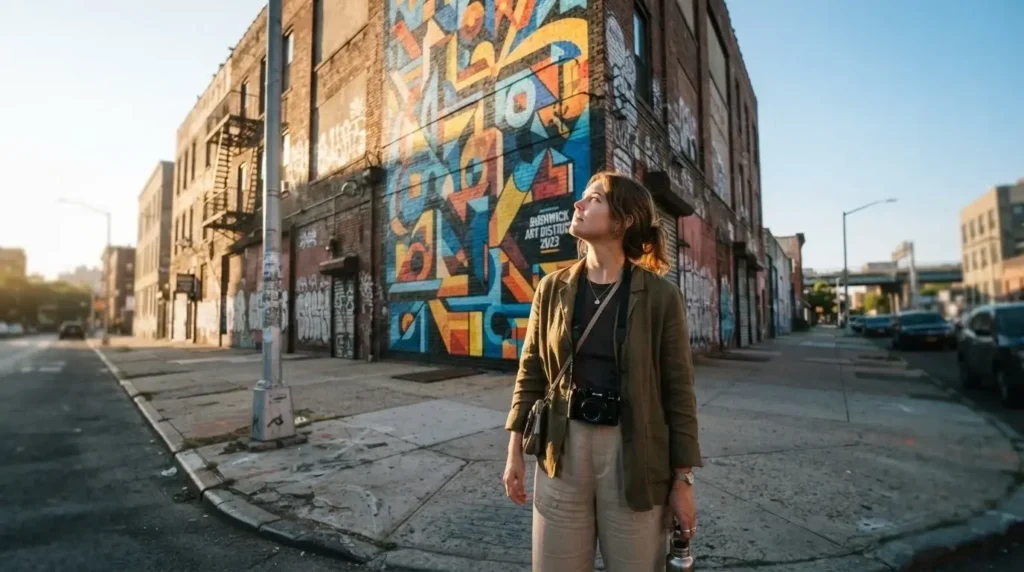
The Bushwick Collective is a roughly eight-block stretch in East Brooklyn where building owners have opened their walls to artists from all over the world. What started as a grassroots initiative after Hurricane Sandy, when founder Joe Ficalora wanted to bring something positive to a struggling neighborhood, has grown into one of the most respected open-air street art destinations in North America. The murals here are large, technically impressive, and constantly rotating, which means return visits always show you something new.
Getting there is easy. Take the L train to Jefferson Street or Morgan Avenue, walk a block or two, and the murals appear immediately around Troutman Street and St. Nicholas Avenue. It is completely free and open around the clock. For a self-guided experience with a detailed neighborhood map, Brooklyn Unplugged Tours has a practical free resource that helps you navigate the area without missing key pieces.
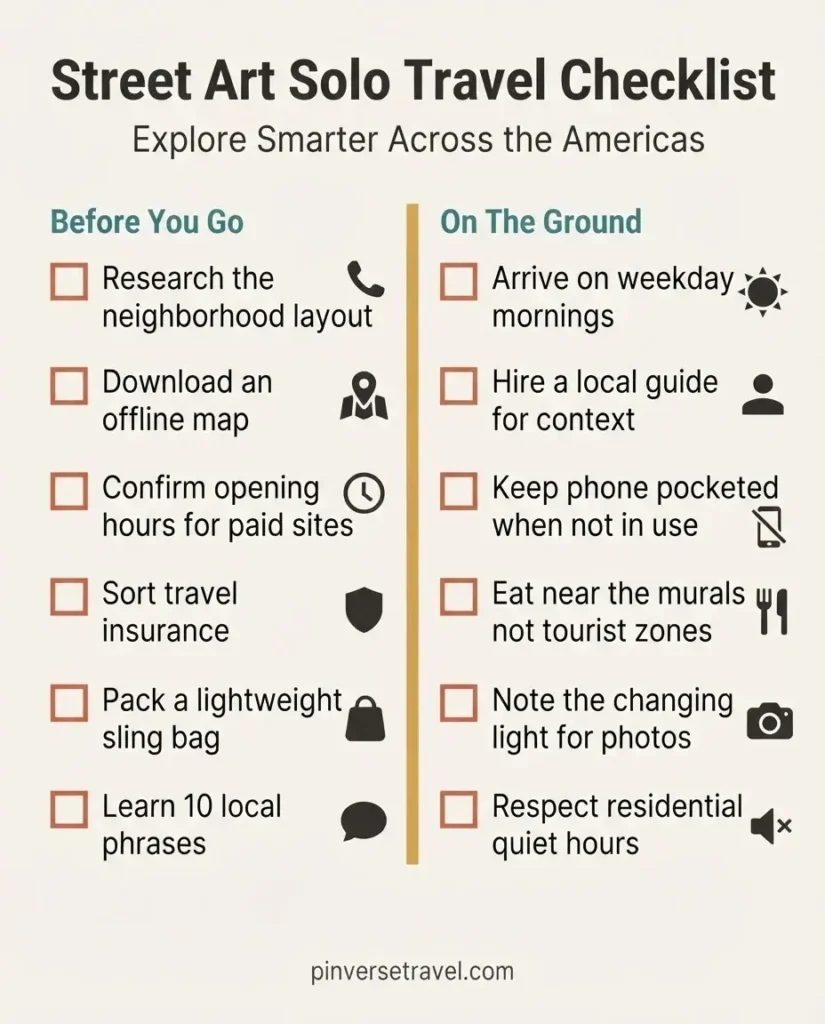
Solo tip: Go on a weekday morning. Weekends bring crowds and photo sessions. Weekday mornings give you the streets mostly to yourself, better light, and the chance to actually stand in front of something and think.
Eat: Head to Roberta’s on Moore Street for some of the best pizza in New York. It fits the neighborhood’s gritty-creative vibe perfectly and is walking distance from the main murals.
Miami, Florida: Wynwood and the Warehouse District That Reinvented Itself
What is now one of the most photographed neighborhoods in Miami was, not long ago, a run-down warehouse district with very little going on. In 2009, developer Tony Goldman commissioned some of the world’s most prominent street artists to paint the exterior walls of those warehouses, and the Wynwood Walls were born.
The result is genuinely impressive. More than 40 murals by artists from over 21 countries sit within a two-acre complex that also includes sculpture installations and three fine art galleries. It is polished in a way Bushwick is not, and that is both a compliment and a caveat. Wynwood has become a tourist attraction, and in some ways it shows. But the quality of the work is real, and it remains one of the most concentrated displays of international street art talent anywhere in the hemisphere.
The official Wynwood Walls site has up-to-date hours (currently open daily 10:30am to 6:30pm) and tickets. General admission runs around $13, though children under five get in free. Beyond the Walls complex, the surrounding Wynwood Arts District stretches for several blocks with free murals painted on nearly every surface, so you can spend an entire day here without paying a cent if the main complex does not call to you.
Eat: La Latina on NW 2nd Avenue is a short walk from the Walls. The arepas and empanadas are good, inexpensive, and satisfying if you have been walking for a few hours.
Solo note: Wynwood is busy, well-lit, and very safe for solo exploration. It is also one of those rare places where arriving alone actually enhances the experience, because you move at your own pace and notice things groups tend to walk right past.
Philadelphia, Pennsylvania: 4,000 Murals and a Program That Changed a City
Philadelphia does not always make the international street art conversation, and that is a genuine oversight. Since 1984, Mural Arts Philadelphia has produced nearly 4,000 publicly commissioned artworks across the city, making it the largest public art program in the United States and one of the largest in the world. The program was born out of an anti-graffiti initiative and transformed into something much richer, a civic art movement that engages communities, documents history, and turns neighborhoods into galleries.
What makes Philadelphia different from Wynwood or Bushwick is the scale and intentionality. These murals are not clustered in one hip district. They are spread across the entire city, in neighborhoods that tourists rarely enter, telling the stories of the people who actually live there. A mural in North Philly about a local civil rights hero sits alongside community portraits in West Philadelphia and massive commemorations of figures like Tina Turner and Nelson Mandela.
The best way to approach it is through a walking or trolley tour run by Mural Arts directly. Tours run through the year and cover different thematic routes. If you prefer to explore solo, Mural Arts offers downloadable walking routes on their site.
Eat: Reading Terminal Market in Center City is worth your time before or after a mural walk. It is a covered market full of local vendors, and the Amish baked goods alongside the Philly cheesesteaks make it one of the best food stops in the city.
South America: Street Art With Weight, Story, and Soul
Bogota, Colombia: Legal Walls, Political Murals, and a Story Worth Understanding
Bogota’s street art scene is extraordinary, and it is impossible to fully understand it without knowing what happened on the night of August 19, 2011. Diego Felipe Becerra, a 16-year-old artist who painted under the tag “Tripido,” was shot and killed by police while painting his signature Felix the Cat stencil under a bridge on Avenida El Dorado. The public outrage that followed forced a national conversation, and within months, Bogota’s government effectively decriminalized graffiti, acknowledging it as legitimate artistic expression in public space. The full account is documented at Bogota Walls, a site dedicated to the city’s mural culture and its history.
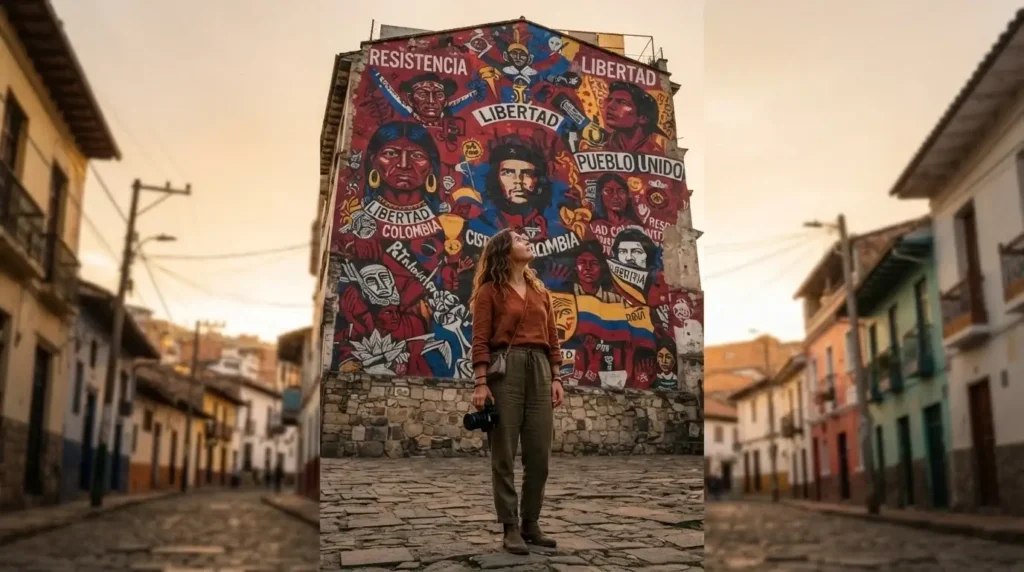
That story matters because it explains the energy you feel walking through La Candelaria and the surrounding streets today. The art here carries weight. Walls six and seven stories high carry murals that address inequality, politics, memory, and identity in a direct and unflinching way. Bogota has become one of the most art-hospitable cities on earth as a result of that tragedy, and the artists who paint here know it.
La Candelaria is the historic center and the natural starting point. Walk from Calle 7 upward toward the hills and you will encounter piece after piece. The free graffiti walking tours that depart near Parque de los Periodistas are genuinely some of the best free walking experiences in South America. The guides are young local artists who explain the political and social context behind what you are looking at, which transforms the experience entirely.
From what solo travelers consistently report, Bogota’s street art neighborhoods are safest during daylight hours. La Candelaria is a working neighborhood that gets busy and lively during the day. Stay aware, keep your phone out of sight when you are not actively using it, and you will be fine.
Eat: Seek out a bandeja paisa in one of the local restaurants near Calle 10. It is Colombia’s most iconic plate: rice, beans, ground meat, chicharron, plantain, avocado, and a fried egg. It is generous, cheap, and exactly what you need after three hours of walking hills.
Medellin, Colombia: A Neighborhood That Painted Its Way Forward
No city in the Americas tells a more powerful story through its street art than Medellin. In the 1990s, Medellin was considered one of the most dangerous cities in the world. Two decades of community investment, urban innovation, and cultural programming transformed it dramatically, and nowhere is that transformation more visible than in Comuna 13.
Once one of the most dangerous neighborhoods in Medellin, Comuna 13 became a focus of urban renewal efforts including outdoor escalators, improved transit, and a community mural project that has filled its staircases and hillside walls with enormous, colorful work. The murals here tell the story of the community’s own trauma and resilience. They are made by local artists, many of whom grew up in the neighborhood, and they speak directly to the people who live there rather than to passing tourists.
You can ride the public Metrocable from San Javier station up toward the neighborhood, which gives you a sweeping aerial view of the hillside murals as you ascend. Many visitors combine the cable car with a guided graffiti tour, which runs at around $28 USD per person and includes a local guide, some street food, and context you genuinely cannot get by wandering alone.
Eat: Grab an arepa de choclo from one of the street vendors near the escalators. The sweet corn arepa with cheese is a Medellin staple, and eating it while looking out over the painted hillside is one of those simple, perfect travel moments.
Buenos Aires, Argentina: South America’s Outdoor Art Capital
Buenos Aires has one of the most relaxed and artist-friendly environments for street art anywhere in South America. Property owners have relatively open attitudes toward murals, the city government itself commissions pieces, and the result is a sprawling, ever-changing collection that stretches across multiple neighborhoods.
The place to start is Palermo, particularly the streets around Palermo Soho and Palermo Hollywood. The official Buenos Aires tourism site offers self-guided street art itineraries covering the best routes through the northern neighborhoods including Colegiales, Chacarita, and Villa Crespo, all of which are walkable and connected by the city’s efficient Subte (subway) system.
For something less visited and more raw, head south to Barracas. This neighborhood is home to Calle Lanin, a residential street where local artist Marino Santa Maria has covered the facades of dozens of houses in colorful geometric patterns and mosaic tiles. It looks unlike anything else in the city. Barracas is also where you will find what is claimed to be the world’s longest mural painted by a single artist, El Regreso de Quinquela, a 2,000 square metre piece by Alfredo Segatori on the streets of Lavadero and San Antonio.
Eat: Eat a choripan from one of the street carts near Parque Centenario in Caballito, roughly halfway between Palermo and Barracas. Grilled chorizo in a crusty bread roll with chimichurri is the working city’s snack of choice and costs almost nothing.
Valparaiso, Chile: UNESCO World Heritage City, Painted From Hill to Harbor
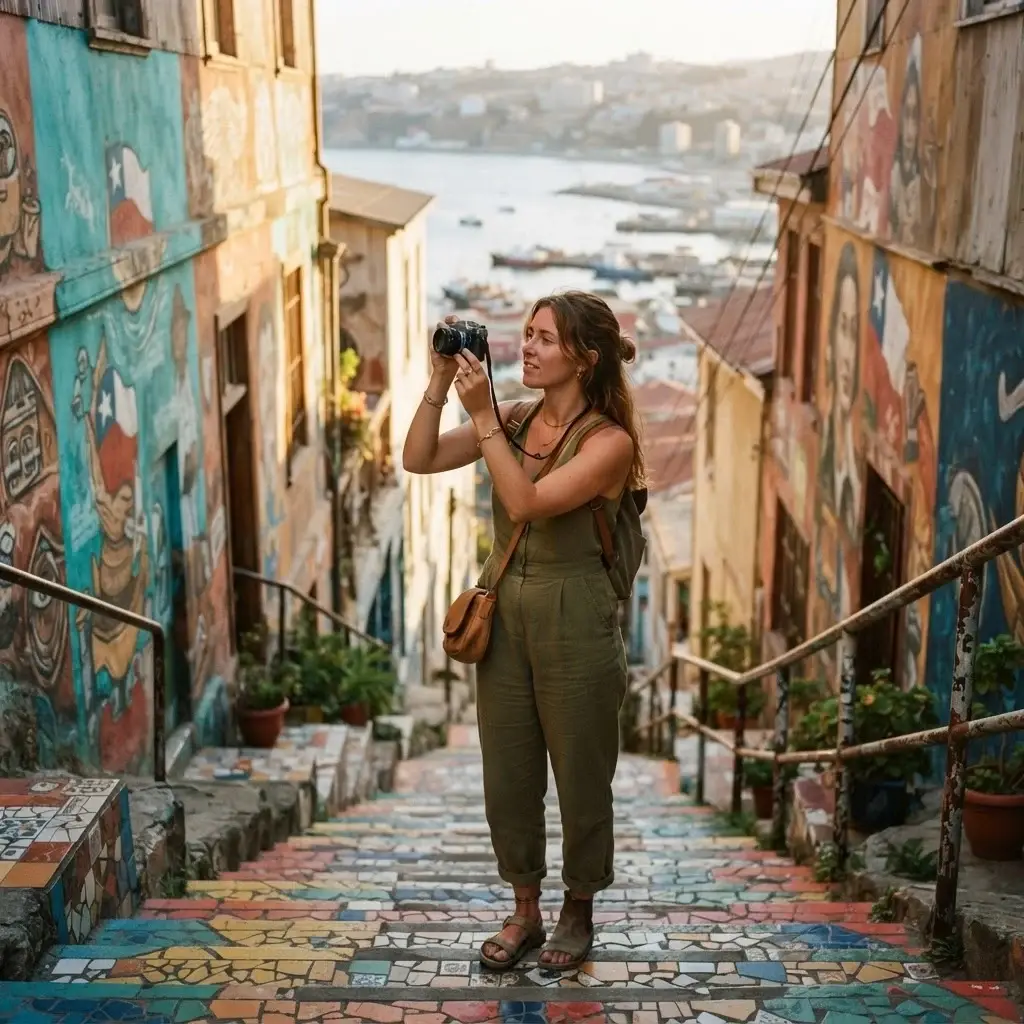
Valparaiso is unlike any other city on this list. Built across 42 steep hills called cerros, tumbling down to a Pacific harbor, it has a geography that makes it feel like a painting before a single mural artist ever shows up. Then the murals appear on every surface, steep staircases, crumbling retaining walls, rooftops, elevator machinery houses, and suddenly the entire city feels like one enormous collaborative artwork.
The UNESCO World Heritage listing for Valparaiso’s historic quarter was granted in 2003, recognizing the city’s extraordinary urban fabric and its role as the leading 19th century port on South America’s Pacific coast. The street art that has covered its walls in the decades since is not a conflict with that heritage but an extension of it: Valparaiso has always been a place where the world arrives and leaves its mark.
Cerro Alegre and Cerro Concepcion are the two hills where the art is most dense and most polished. You reach them by riding the historic funicular elevators from the Plano (the flat lower city) or by climbing the painted staircases on foot, which is absolutely the better option if your legs will allow it. Each staircase is its own discovery. Artists come from across Latin America and Europe to paint here, and the range of styles, from hyper-realist portraiture to abstract geometric work to overtly political imagery, is genuinely staggering.
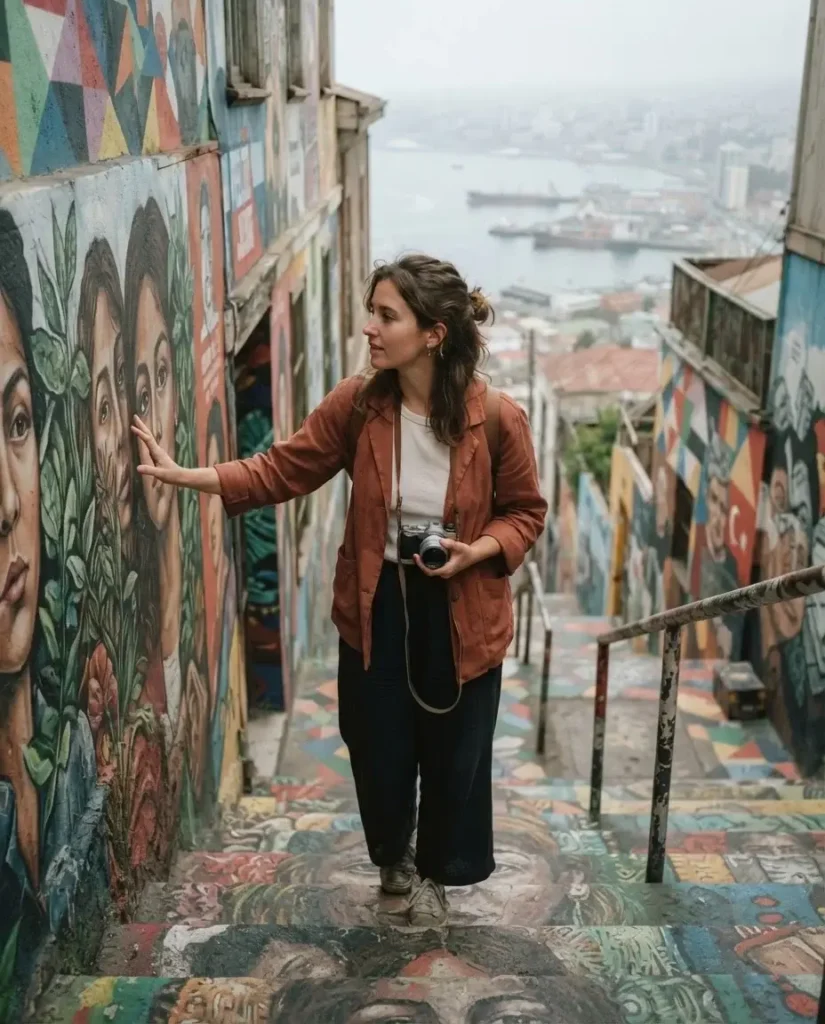
Valparaiso is an easy day trip from Santiago, about 90 minutes by bus. But honestly, it deserves at least a night. The city transforms at dusk, the harbor lights come on, and the painted hills glow in a way that photographs do not capture.
Eat: Eat at one of the small restaurants on Cerro Alegre’s Pasaje Dimalow. The chorrillana, a Chilean dish of fries topped with caramelized onions, beef strips, and fried eggs, is filling, cheap, and deeply local.
Sao Paulo, Brazil: Vila Madalena and the Alley That Started Everything
Sao Paulo is the largest city in South America and home to one of the longest-running street art cultures on the continent. The city’s relationship with urban muralism goes back decades and has produced internationally recognized artists, most notably Os Gemeos, the twin brothers from Cambuci whose giant yellow-skinned characters appear on walls around the world.
For a first visit, Vila Madalena is the natural entry point. Beco do Batman (Batman’s Alley) is a narrow pedestrian lane off Rua Gonçalo Afonso where every square centimeter of wall has been covered in layered murals since the 1980s. As documented by Buenos Aires Street Art’s comprehensive guide to Beco do Batman, the alley operates as a kind of rolling, collective canvas. Pieces are painted over and replaced constantly, which means no two visits are ever quite the same.
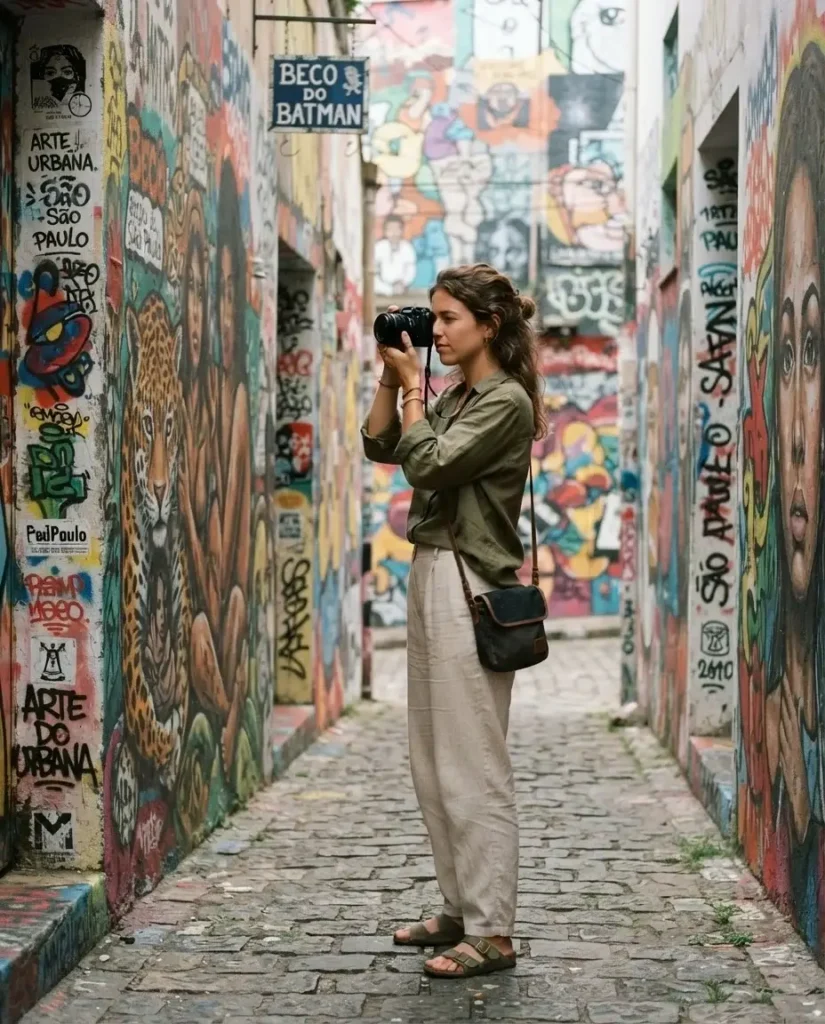
Beyond the alley, Vila Madalena’s surrounding streets in the Pinheiros district contain another dense concentration of murals, many of which are much larger and more ambitious than the work inside Batman’s Alley itself. The neighborhood is also full of good independent cafes, vinyl shops, and small restaurants that make it a genuinely enjoyable place to spend half a day.
Eat: Try a pastel de queijo, a deep-fried pastry filled with melted cheese, from one of the market stalls near Benedito Calixto square on a Saturday morning. The weekend fair brings out food vendors, antiques traders, and local musicians, and it is one of the most pleasurable ways to spend a Saturday morning in any city I know.
Practical Notes for Solo Travelers
Getting the most out of each city: The single biggest mistake I see travelers make with street art neighborhoods is treating them like a checklist. Show up, take a photo of the big wall, keep moving. The richer experience comes from slowing down, reading the walls, noticing the small throw-ups in the alley corners alongside the enormous commissioned pieces, and talking to people in the neighborhood if you can.
Safety and timing: For Latin American cities, daytime exploration is almost universally safer and more enjoyable. Late afternoon light is ideal for photography. In North American cities like New York and Philadelphia, timing matters less for safety and more for crowd levels. Weekday mornings are quieter and more personal.
Free vs. paid: Bushwick Collective, Philadelphia’s mural routes, Buenos Aires, Valparaiso, Bogota, and Medellin’s public murals are all free to see. Wynwood Walls charges a modest admission. If budget is a concern, every city on this list offers a completely rich, free experience. The paid tours in Bogota and Medellin are worth it not for access but for context, because a good local guide turns murals from decoration into storytelling.
A word on cultural respect: Street art exists in neighborhoods where real people live and work. When you show up as a traveler, you are a guest. Move respectfully, keep noise down in residential areas, and if a business near a mural is open, consider stepping in and supporting it. The art brought you there. The community made it possible.
The Americas stretch across an enormous range of cultures, histories, climates, and economic realities, and all of that shows up on the walls. From the politically charged murals of Bogota to the UNESCO-recognized hillsides of Valparaiso to the Brooklyn blocks where artists from around the world paint side by side, this is a continent that takes its public art seriously. You do not need a gallery ticket or an art degree to participate in it. You just need to show up, slow down, and look.