The Honest Traveler’s Guide to Indigenous Tourism in the Americas

There’s a moment a lot of travelers have, somewhere between buying a ticket and boarding a plane, when a quiet question surfaces. It’s something like: Is this okay? Am I going to do this right?
If you’re planning a trip through the Americas and you want to genuinely support the indigenous communities you encounter, that question is a good sign. It means you’re already thinking beyond the selfie and the souvenir. It means you’re the kind of traveler who cares about what happens after you leave.
This guide is for you.
Across North, Central, and South America, there are hundreds of distinct indigenous nations, each with their own languages, histories, governance structures, and ways of life. When tourism works well in these communities, it creates real economic opportunities, it helps fund language preservation programs, and it gives travelers something no luxury resort can offer: an honest encounter with the world as it actually is. When tourism goes wrong, it extracts, exploits, and reinforces harmful stereotypes while the money flows to people who have no connection to the culture being sold.
The difference between those two outcomes often comes down to the choices individual travelers make. Here’s how to make the right ones.
Start Before You Pack: Do the Homework That Actually Matters
Most travel research looks like: top restaurants, best hotels, what to see in three days. When you’re planning to visit or travel through indigenous territories, the most important research happens before any of that.
Before any trip in the Americas, I now make a habit of checking Native Land Digital, a free interactive map that shows you whose ancestral territory you’ll be traveling through, which languages were and are spoken there, and which treaties were signed on that land. You type in a city or region and the map shows you the indigenous nations connected to that place.

It doesn’t tell you everything, but it tells you something, and that something changes how you show up.
Knowing you’re traveling through Quechua-speaking territory in Peru, or through lands belonging to the Anishinaabe in the Great Lakes region, or through the traditional lands of the Maya in southern Mexico, shifts your awareness. You start noticing what’s missing from the museums, what’s being performed for tourists versus what’s actually practiced, and whose story is being told in the places you’re visiting.
This is what I mean by slow travel. It’s not just about spending more time somewhere. It’s about taking the time to understand where you actually are. When I was teaching English in Thailand, what made my time there meaningful wasn’t the temples I visited. It was the weeks of context I built around them, getting to know the rhythms of a place before I presumed to understand it. The same principle applies here.
Beyond the map, spend an hour reading about the specific nations connected to your destination. Look for resources produced by those communities themselves, not by tourism boards or travel magazines. Many indigenous nations have their own websites and cultural organizations that explain their protocols for visitors. Reading them in advance shows respect before you’ve even landed.
How to Tell the Difference Between Genuine and Performative Indigenous Tourism
This is the question most travel guides skip, and it’s the one that matters most.
Not everything marketed as “indigenous” or “authentic native experience” actually supports indigenous people. In some of the Americas’ most visited destinations, non-indigenous operators have built entire tourism businesses around indigenous aesthetics and culture while the communities those cultures belong to see little or none of the revenue.
Here’s a simple framework for vetting any experience before you book.
Ask who owns and operates it. A community-owned or community-managed operation is fundamentally different from a third-party tour company that “features” indigenous culture. Look for tours where the guides are community members, where profits return to the community, and where the community itself makes decisions about what is shared with visitors.
Ask whether indigenous voices control the storytelling. When you’re on a tour or visiting a cultural site, who is doing the explaining? A community elder or cultural ambassador telling you about their own traditions is a very different experience from a non-indigenous guide interpreting those traditions for you.
Look for transparency about community consent and benefit. Legitimate community-based tourism operations are usually proud to explain how they work and where the money goes. If that information isn’t available or an operator deflects when you ask, that’s a signal.
In the United States, the American Indigenous Tourism Association (AIANTA) is one of the most reliable starting points for finding vetted, genuinely indigenous-run experiences across all regions of the country. AIANTA serves as the national center for indigenous tourism training and certification, and its platform connects travelers with member operators who are held to clear standards. Their annual Top Indigenous Experiences list is a useful shortcut when you’re trying to plan a trip and don’t know where to start.
In South America, look for programs explicitly built around community management. The RUTAS program developed by CAF, the Development Bank of Latin America, is a strong example of what ethical indigenous tourism infrastructure looks like at scale. RUTAS has supported community-managed tour packages in Peru, Bolivia, and Ecuador, directly benefiting over 3,300 indigenous people living in poverty. It isn’t a tourism operator you book through directly, but it represents a model. When you encounter tourism programs in Andean communities that describe themselves as “community-managed” or “community-led,” RUTAS-style programs are what gave many of them their foundation. Ask your operator whether they work with or are certified by any national or regional indigenous tourism body.
Across the full hemisphere, the Indigenous Tourism Collaborative of the Americas (ITCA), an active advisory network backed by the Organization of American States, works to connect indigenous tourism leaders across North, Central, and South America and the Caribbean. It’s a hemispheric effort to ensure that indigenous communities, not outside operators, define and control their own tourism futures. Keeping this broader framework in mind helps you understand that when you choose a community-run tour in Oaxaca or a Kichwa-led experience in Ecuador, you’re participating in something larger than a single transaction.
Specific Places Doing It Right: What to Look For
Let me give you some concrete examples of what genuine, community-centered indigenous tourism looks like, because it helps to see it before you go looking for it.
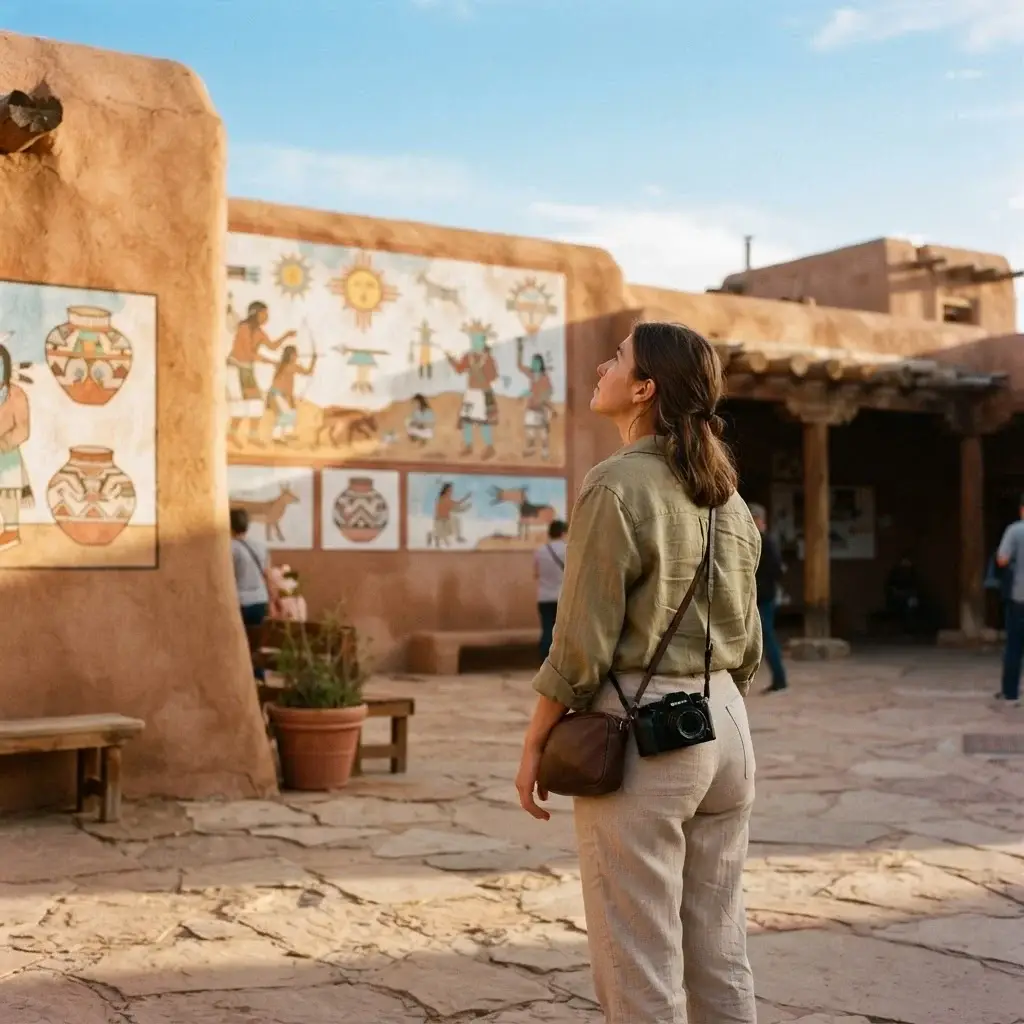
In Albuquerque, New Mexico, the Indian Pueblo Cultural Center is owned and operated by the 19 Pueblos of New Mexico. This is a fundamental distinction. It is not a museum about Pueblo people built by the state or a private organization. It is a space where Pueblo people tell their own stories, on their own terms. The center is open seven days a week from 9:00 AM to 5:00 PM. Admission runs $12 for adults Monday through Thursday and $15 Friday through Sunday, with discounts for New Mexico residents, seniors, students, and military. On Tuesdays, they offer two admissions for the price of one. Every dollar you spend there goes directly back into the Cultural Dance Program and the Daily Artists Program, keeping living traditions alive rather than preserving them under glass.
What you can experience there includes rotating exhibitions, weekend cultural dances, artists working in the courtyard, museum and mural tours, and the Indian Pueblo Kitchen, where the food itself is a form of cultural expression. This is the kind of experience that warrants slowing down for. Give it a full day, not an hour.

For the broader US, Destination Native America organizes indigenous tourism experiences across twelve distinct cultural regions, from the Pacific Northwest to the Southeast to Alaska. It’s an excellent planning resource for identifying region-specific experiences that are community-supported and culturally grounded.
For travelers heading to the Pacific Northwest specifically, Eighth Generation in Seattle offers a model worth understanding. Owned by the Snoqualmie Tribe, it’s the first Native-owned brand to produce wool blankets and represents what happens when indigenous communities take ownership of their own cultural production rather than watching non-Native companies profit from “Native-inspired” designs.
Shopping Ethically: The Craft and Art Question
This is where a lot of well-meaning travelers get it wrong, not out of bad intentions but out of not knowing what to look for.
Throughout the Americas, there’s a massive market for goods that appear to be indigenous-made but are not. Mass-produced “native” jewelry, textiles, and crafts from overseas manufacturers get sold in tourist markets alongside genuine handmade work, often at similar price points. Buying the counterfeit version doesn’t just feel bad in retrospect. It actively undercuts the income of the artisan whose living depends on the real thing.
Here’s how to shop with intention. Buy directly from the maker when possible. Ask where the piece was made and who made it. Ask whether the artist is from the community whose aesthetic tradition the piece represents. If you’re buying in a market or shop rather than directly from an artisan, ask the seller to connect you with that information. A seller who represents genuine indigenous artisans will be able to answer these questions and often happy to.
In the US, it’s also worth knowing that it’s actually illegal under the Indian Arts and Crafts Act to misrepresent a product as Native American-made when it is not. That law has teeth, but enforcement is uneven. Knowing it exists helps you understand why asking questions isn’t rude; it’s appropriate.
The Eighth Generation team has written a clear and specific guide on how to ethically purchase Native American jewelry that is worth reading before any shopping trip in indigenous territories. Their core point is important: native artists will not sell you regalia, sacred items, or ceremonial pieces, so if a vendor is offering those things, that’s a signal something is wrong.
In South America, where weaving traditions in communities from the Andes to the Amazon represent complex knowledge systems passed across generations, the same principle applies. Buy from cooperatives or collectives that are indigenous-led. Pay the asking price without heavy bargaining. A handwoven textile that took days to complete is not a commodity to be negotiated down.

The price reflects skilled labor and cultural knowledge.
Photography, Permission, and the Respect That Goes Without Saying
I want to be direct about this because I’ve seen it go wrong even when travelers had the best intentions.
Photography in indigenous spaces is not automatically your right as a visitor. Many communities have specific protocols about what can and cannot be photographed, and those protocols exist for real reasons, cultural, spiritual, and otherwise. At cultural events and ceremonies that are open to visitors, always ask before you point a camera at a person. If a sign says no photography, that applies to you too, even for a quick phone photo.
The Indian Pueblo Cultural Center, for example, has a clear photography policy: non-commercial photography is permitted in general areas, but all artwork on the grounds is copyrighted, and flash photography and tripods are restricted in the South Gallery. This is a place that has clearly communicated what they’re comfortable with. Respecting that is the baseline, not a special effort.
Beyond formal policies, there’s a simpler practice. If you wouldn’t photograph a stranger in your own city without asking, extend that same standard here. Better yet, raise it. These are not performers for your social media. They are people living their lives and sharing elements of their culture by choice.

When you’re genuinely unsure whether something is appropriate, the most respectful thing you can do is ask. “Is it okay to photograph here?” or “Are there parts of this space I should not enter?” These are not intrusive questions. They are the questions of a guest who understands they are a guest.
Land Acknowledgment as a Practice, Not a Performance
You may have heard the phrase “land acknowledgment” and wondered what it means in a practical travel context. It’s a statement that recognizes the indigenous peoples who are the traditional stewards of the land you’re on. Increasingly, these acknowledgments happen at the start of public events, in institutional spaces, and in tourism contexts.
As a traveler, your version of a land acknowledgment is more personal and ongoing. It means going into each place you visit knowing something about whose territory it is and carrying that knowledge through your trip. It means, when you recommend a destination to a friend or write about it on your blog, naming the indigenous nations connected to that land, not just the country or city.
It also means making choices about where you spend money that reflect this awareness. Booking a community-run tour, eating at a restaurant owned by indigenous community members, staying in indigenous-owned accommodations where they exist: these are the active, material forms of acknowledgment that actually move resources toward the communities you’re visiting.
South America: Specific Considerations for the Andes and Beyond
Travelers heading to Peru, Bolivia, Ecuador, and Colombia will find themselves in regions with extraordinarily high indigenous cultural diversity. The challenge in many of these areas is that tourism around indigenous communities has grown faster than the infrastructure for ensuring that growth benefits those communities.
From what solo travelers and researchers consistently report in Andean communities, the most meaningful and ethical experiences tend to come through smaller operators based in the communities themselves, or through established community-run programs. In the Cusco region of Peru, for example, there are a number of community-based tourism programs in the Sacred Valley that offer homestays, weaving demonstrations, and guided walks led by community members. These are vastly different from the bus tours that bring a hundred visitors to a “demonstration village” for forty minutes and return to the hotel.
When planning in these regions, look for operators who can tell you the name of the community you’ll be visiting, the name of your guide, and what percentage of the tour fee returns to the community. A transparent, ethical operator will have these answers immediately. If they can’t name the community or the guide, reconsider.

Also be aware of the difference between a curated cultural show staged for tourists and a real community visit. Both can be legitimate depending on context, but the first is often designed to compress culture into something digestible and photogenic rather than to offer real exchange. Ask what a visit actually involves and what it asks of you as a visitor, not just what it offers.
The Bigger Picture: Why This All Matters
Indigenous communities across the Americas face ongoing pressures including land rights disputes, language loss, climate impacts on traditional territories, and the slow erosion of cultural practices that aren’t passed on because economic survival demands other priorities. Tourism, done right, can actually push against some of these forces.
Revenue from indigenous-controlled tourism funds language schools, cultural centers, and craft cooperatives. It keeps young people in their communities because there are dignified livelihoods available. It creates the economic conditions for communities to make their own decisions about how they share their culture and on what terms.
When I was living in Ghana, what I understood more deeply than I ever had before was how much knowledge exists in communities that the mainstream world has never paid attention to, and how fragile that knowledge is when economic pressure pulls younger generations away from it. You don’t need to have that specific experience to understand the stakes. You just need to make the connections: the tour you book, the artisan you buy from, the guesthouse you choose, these choices add up.
You don’t have to be an activist or an expert to be a good guest. You just have to be curious, humble, and willing to let the communities you visit set the terms of the encounter.
That is, honestly, what travel at its best has always been.
A Few Practical Things to Keep in Hand
Before you go, bookmark Native Land Digital on your phone so you can check it in real time as you move through a new region. Before you book any cultural experience, spend five minutes searching for the operator’s name alongside the phrase “community-owned” or “indigenous-run” to see what comes up. When you’re shopping for crafts or art, budget a little more than you think you need so you can pay fairly without flinching. And when you’re not sure about something, ask the person in front of you.

The goal isn’t perfection. The goal is showing up with intention, spending your money in ways that create real benefit, and leaving a place a little more respected than when you found it.
That’s something every traveler can do, whatever their budget, wherever they’re going.