Solo on the Rails: Most Scenic Train Rides Across the Americas

There is a certain kind of slow magic that only a train can give you. Not a plane, not a highway, not a guided bus. A train moves at the pace of the land it crosses, and the land keeps changing outside your window like a story that refuses to rush itself.
I have always believed that how you travel matters as much as where you go. That idea took root in me long before I left my desk job in New York and before I started guiding tourists past skyscrapers. It solidified the first time I boarded a train alone and realized I could just sit there, watch the world pass, and think.
Across North and South America, there are train routes that will genuinely stop your breath. Not because they are famous, but because they pass through places that roads never reach and that planes fly over too fast to see. This guide is for anyone who has been scrolling through photos of mountain trains and wondering, “Could I actually do that?” You can. Here is what you need to know.
A Quick Note Before We Dive In
This is not a luxury travel list. A couple of these routes are genuinely premium experiences, but most are accessible to travelers on real budgets. I am going to give you honest costs, practical tips on what seat to book, when to go, what to eat, and what solo travel on each route actually looks like. No fluff, no filler.
The California Zephyr: The Long One That Earns Every Hour
If there is one train ride that solo travelers in North America talk about most, it is this one. The California Zephyr runs 2,438 miles from Chicago to San Francisco (technically Emeryville, with a connecting bus to the city), crossing seven states over roughly 51 hours. Yes, two full days and nights on a train. And yes, it is worth every hour.
The scenery builds gradually, which is part of what makes it so satisfying. The flat Midwest plains give you time to settle in, breathe, read, and meet the people around you. Then Colorado hits and the landscape transforms completely. You pass through the Rocky Mountains, emerge into Glenwood Canyon (one of the most dramatic stretches of rail travel anywhere in North America), push over the Continental Divide, and eventually wind through the Sierra Nevada before the Pacific Coast comes into view.
The Sightseer Lounge car is your best friend on this train. It is a dome-roofed car with wraparound windows and no reserved seating. Solo travelers especially love it because it is naturally social and constantly filling with people pointing at the same view. Go there before the Colorado stretch begins and stay a while.

Seat and class advice: Coach seats start around $100 one way and are perfectly comfortable for daytime legs, but for a two-night journey, the roomette upgrade (around $400 and up, depending on when you book) is genuinely worth considering. Sleeper class includes all meals in the dining car, which matters on a 51-hour trip. The dining car serves proper hot meals including a flat iron steak dinner and a surprisingly decent breakfast. If you are in coach, you can still purchase food from the cafe car, though the menu is more limited.
Solo travel note: This train has a very relaxed, community feel. Strangers share dining car tables with you (Amtrak traditionally seats guests together), and long-distance conversations happen naturally. I have heard from solo travelers who made genuine friends on this route. Go in expecting that, and you will enjoy it enormously.
Best time to go: Late September through October for golden-hour colors in Colorado. Late May and June for wildflowers in the Sierra Nevada. Avoid peak summer if you can, as roomettes book out months ahead.
Book early. Sleeper rooms sell out far in advance, especially in summer and fall.
Rocky Mountaineer: Canada’s Most Beautiful Day Train
If the California Zephyr is a solo traveler’s adventure, the Rocky Mountaineer is a special-occasion splurge that delivers on every promise it makes. This is a day-only train, meaning you never sleep on board, and that is a deliberate choice. Every mile of the Canadian Rockies is too beautiful to miss in the dark.
The Rocky Mountaineer’s signature route is First Passage to the West, running two days from Vancouver to Banff or Lake Louise with an overnight hotel stop in Kamloops. The scenery is genuinely staggering: Hells Gate Gorge, the Fraser River Canyon, mountain goats on rock faces, and the full theatre of the Canadian Rockies opening up on day two.
Service levels: SilverLeaf starts from around CAD $2,289 (roughly $1,700 USD) and seats you in a single-level panoramic coach with meals served at your seat. GoldLeaf starts from CAD $2,969 and puts you in a bi-level dome coach where the upper level is pure glass-ceiling viewing and the lower level is a private dining room with gourmet meals prepared by executive chefs. For solo travelers, SilverLeaf is the more sociable option because seating is at tables for four.
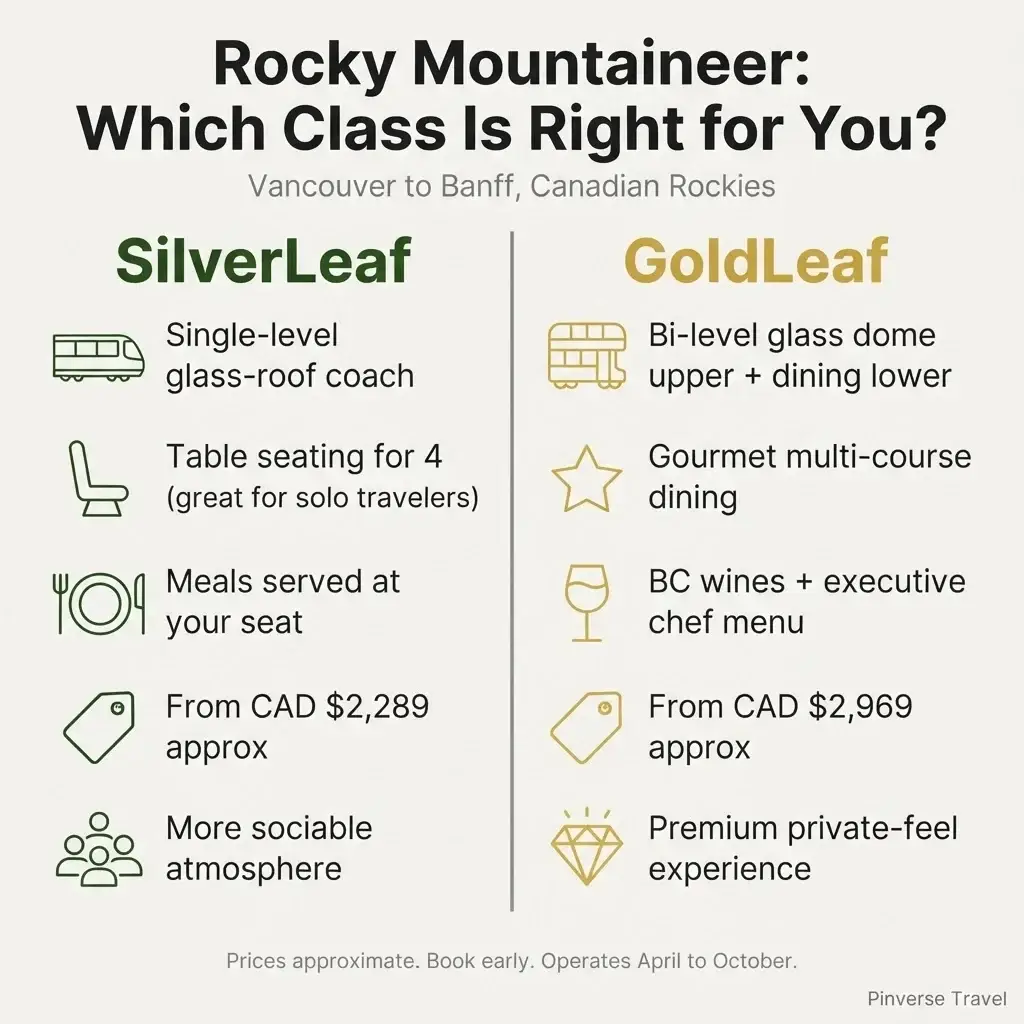
What to eat: The Rocky Mountaineer dining experience is genuinely part of the appeal. GoldLeaf menus feature regionally inspired dishes like wild salmon and Alberta beef, paired with BC wines. Even in SilverLeaf, the food is thoughtful and plentiful, and snacks arrive regularly so you never feel stuck.
Practical note: The Rocky Mountaineer runs from late April to mid-October. It does not operate in winter. Book as far in advance as possible because this train sells out, particularly for GoldLeaf in July and August. Solo supplements apply, so budget accordingly.
Who this is for: Honestly, this is one for the traveler who wants to treat themselves. It is not budget travel. But if you have been saving for a meaningful solo journey, this is a strong candidate. The Canadian Rockies seen from a glass-domed coach at 7,000 feet is not something you forget quickly.
El Chepe Through Copper Canyon: Mexico’s Rail Masterpiece
Most people have heard of the Grand Canyon. Fewer people know that Mexico has its own canyon system that is roughly four times larger. The Copper Canyon (Barrancas del Cobre) is a network of six canyons in the Sierra Madre Occidental in Chihuahua, and the only way to see it properly is by train.
The Chepe Express runs 350 kilometers from Los Mochis on the Pacific Coast to Creel in the mountains, passing through tunnels, over bridges, and along canyon edges that will have you pressing your face against the glass. The journey takes around nine hours and 40 minutes, stopping at five towns along the route including Divisadero, where the train pauses long enough for you to step out and stand on the canyon rim.
According to National Geographic, the Chepe Express travels through one of the most compelling landscapes in all of slow travel, a fact that veteran long-distance train riders consistently confirm.
Costs: First class tickets run approximately 4,820 MXN one way (around $250 USD). Tourist class is cheaper at approximately 2,598 MXN (around $143 USD) but still offers the views, since the scenery is the same regardless of class. The train also has a terrace car that is open to all passengers and is the best place to be when the canyon opens up.
The cultural dimension: This is what most travel articles miss about the Chepe. The Sierra Tarahumara is home to the Tarahumara (Rarámuri) people, an Indigenous community known for their extraordinary long-distance running ability and their deep connection to this mountain landscape. At stops like Creel and Divisadero, you will see Tarahumara artisans selling handmade crafts including baskets, dolls, and carved wooden figures. Slow down. Buy something. Talk if you can. This is exactly the kind of cultural encounter that makes train travel so different from driving through in a rental car.

Solo traveler tip: Most solo travelers choose to ride the Chepe as a one-way journey and then return a different way (usually by bus or a combination route). Consider stopping in Creel for two or three nights to hike into the canyon before or after your ride. The town is small, very safe, and has good budget accommodation.
Best time: October to April for clearer weather and cooler canyon temperatures. The summer months bring rain and humidity.
PeruRail Vistadome: The Sacred Valley to Machu Picchu
This is one of the most iconic train journeys on earth, and it earns that description without any exaggeration. The PeruRail Vistadome runs from Cusco (or more commonly from Ollantaytambo, after a bus transfer) down through the Sacred Valley to Aguas Calientes, the town at the base of Machu Picchu. The train descends from high Andean plateau through increasingly lush cloud forest, with the Urubamba River rushing alongside for much of the journey.
The Vistadome carriages have panoramic windows that extend up into the ceiling, allowing you to look straight up at the canyon walls and cloud forest canopy as you descend. On the return journey, there is traditional Andean music, a local dance performance, and an alpaca fashion showcase that sounds kitsch but is actually charming. Standard Vistadome tickets run approximately $70-$90 one way. The Vistadome Observatory upgrade (which adds an observation bar car and live music) runs approximately $120-$150 one way.
Critical booking note: Machu Picchu itself requires a separate timed-entry ticket purchased through the Peruvian Ministry of Culture’s official portal. As of 2025, tickets sell out weeks and sometimes months ahead, particularly for the peak season of June through August. Get your Machu Picchu entry ticket before you book your train.

Book your train at least two to four weeks out in off-peak times and much earlier in high season.
What to eat: Aguas Calientes itself has a main street lined with restaurants serving excellent Peruvian food. Order the lomo saltado (stir-fried beef with tomatoes, peppers, and french fries over rice) or a bowl of causa (a cold potato dish layered with tuna or chicken). The town exists almost entirely for Machu Picchu visitors, but the food is genuinely good and not as overpriced as you might fear.
Altitude note: Cusco sits at approximately 3,400 meters (11,150 feet) above sea level. Take your first day or two there slowly. Drink coca tea, which is widely available and genuinely helps with acclimatization, and avoid alcohol on your first night. The train journey itself descends significantly, so by the time you reach Aguas Calientes you will be feeling much better.
Solo travel safety: The Vistadome route is extremely well-traveled and considered very safe. The train station in Aguas Calientes is busy and well-organized. Solo female travelers consistently report feeling comfortable and secure on this route.
White Pass and Yukon Route: Alaska’s Gold Rush Railway
Not every incredible train ride has to take a full day. The White Pass and Yukon Route in Skagway, Alaska is a narrow-gauge heritage railway built in 1898 during the Klondike Gold Rush, and it climbs from sea level to White Pass Summit (2,865 feet) in just 20 miles. The grade is so steep that it was once considered one of the most difficult feats of railroad engineering ever attempted.
The White Pass Summit Excursion is the most popular option: a 40-mile round trip taking about 2.5 to 2.75 hours and costing $155 per adult. You cross the international border into Canada, look out over glaciers, waterfalls, and dead vertical canyon walls, and hear the genuinely fascinating history of the gold rush stampeders who walked this same route in the winter of 1898. The railway also offers the Bennett Scenic Journey, an 8-hour, 120-mile excursion for $289 per adult, which goes all the way to the historic gold rush town of Bennett.
When to go: The railway operates from late April through early October, with the season ending around October 7. Summer weeks in July and August are extremely busy because cruise ships stop in Skagway and passengers pour onto this train. If you are visiting independently (not on a cruise), earlier or later in the season will be far quieter and more personal. Book ahead regardless.
Solo experience: The history narration on this train is excellent and genuinely moving. The story of the gold rush, told with the canyon falling away beside you, lands differently than it does in a museum. This is one of those routes where even solo travelers who consider themselves non-train people come away raving.
Serra Verde Express: Brazil’s Hidden Atlantic Forest Line
This is the one that most travel articles skip, and it is a mistake.

The Serra Verde Express runs from Curitiba, the capital of Parana state in southern Brazil, down through the Serra do Mar to the colonial town of Morretes. The journey covers a dramatic descent from the high plateau through dense Atlantic Forest, across old stone viaducts, through tunnels carved into the rock, and into increasingly tropical greenery as you lose altitude.
The trip takes approximately three to four hours and tickets start from around R$206 (roughly $40 USD), making this the most affordable train ride on this entire list relative to the scenery it delivers.
What to eat in Morretes: This is important. Morretes is famous throughout Brazil for barreado, a slow-cooked beef stew prepared inside a sealed clay pot for up to 18 hours. It is rich, deeply savory, and traditionally served with cassava flour and banana. You can find it at virtually every restaurant in town. Order it. Then take the return bus (most travelers take the faster bus back to Curitiba rather than the train) through the mountain roads and feel completely satisfied.
Best time: The Atlantic Forest is beautiful year-round, but avoid weekends if possible as the train fills with day-trippers from Curitiba. A Tuesday or Wednesday ride gives you a much calmer experience.
Solo note: This is an extremely approachable route for first-time solo travelers and for anyone who finds the idea of a 51-hour train slightly daunting. It is short, inexpensive, safe, and delivers disproportionate beauty for the time and cost involved.
Practical Things Nobody Tells You (But Should)
Sit on the right side. On the California Zephyr heading westbound, the most dramatic Colorado canyon views are on the left side of the train (river side). On the Chepe heading from Los Mochis toward Creel, the canyon opens up most dramatically on the right side as you climb.
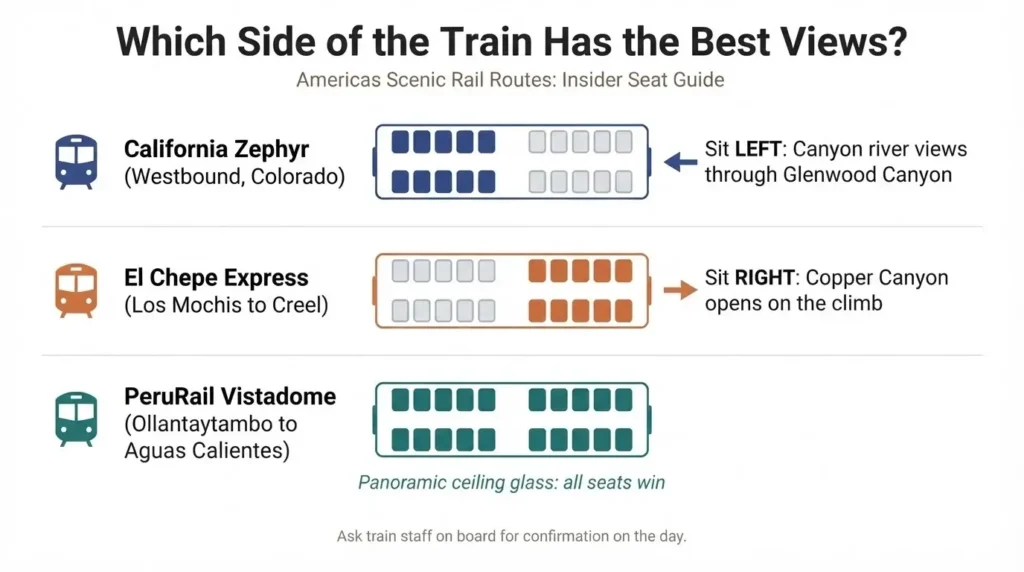
PeruRail staff are often happy to suggest the best window if you ask when boarding.
Book sleeper cars for long overnight routes early. Amtrak roomettes on the California Zephyr sell out weeks or months ahead in peak season. Do not assume you can grab one at the last minute.
Dress in layers. Train cabins can swing dramatically in temperature, especially as you gain and lose altitude. The observation car is often colder than the regular coaches. A light packable jacket is always useful.
Download something before you board. Cell service disappears for long stretches on every single route on this list. Download podcasts, playlists, a book, and whatever films you want before you get to the station.
Carry local snacks. On the Chepe, at Divisadero, vendors walk along the platform selling fresh fruit, gorditas, and Tarahumara food. Have some pesos ready. On the Vistadome, a small snack is included but it is light. On the California Zephyr in coach, the cafe car is fine but pricey. Pack some real food.
Building Your Own Americas Rail Trip
Here is something worth knowing: these routes are not mutually exclusive. Solo travelers with flexible schedules sometimes build longer journeys by combining them. A common approach is to connect the California Zephyr (US) with a flight down to Cusco for the Vistadome (Peru), then continue to Curitiba for the Serra Verde Express (Brazil). Each of those three trains is a completely different experience, landscape, culture, and price point. Together they give you a cross-continental rail journey that covers the Rockies, the Andes, and the Atlantic Forest.
If you have been wanting to travel more meaningfully and more slowly, rail travel in the Americas is one of the most satisfying ways to do it. You are never just in transit. You are always somewhere.
The hardest part is usually just making the decision to go. Once you have done that, the train takes care of the rest.