How to Travel Cheaply in Central & South America (Real Tips)

There is a version of this trip that costs $10,000 and a version that costs $2,500. The route might be nearly identical. The difference is not luck — it is knowing where to put your money and where to skip the tourist-priced version entirely.
I did not grow up wealthy. When I left my office job and started building a travel life, I had to figure out, fast, how to stretch money across weeks and months on the road. Backpacking solo through Europe taught me that cheap travel is not the same as miserable travel. It just requires a different set of instincts. Central and South America take that same principle and crank it up a notch. The region is genuinely one of the most affordable on earth for travelers — if you know how to move through it.
This guide is for anyone who keeps googling “is South America expensive” and then closing the tab because the numbers feel confusing. I want to make those numbers concrete. By the end of this, you will have a clear picture of what budget travel in this region actually looks like, which countries to prioritize, and how to pull off big experiences without spending big money.
Know Your Budget Baseline Before You Go
The single biggest mistake first-time travelers make is not having a realistic daily number in mind before they arrive. Central and South America are not one price point. They are a patchwork of wildly different economies, and picking the wrong countries for your budget can blow your savings in a week.
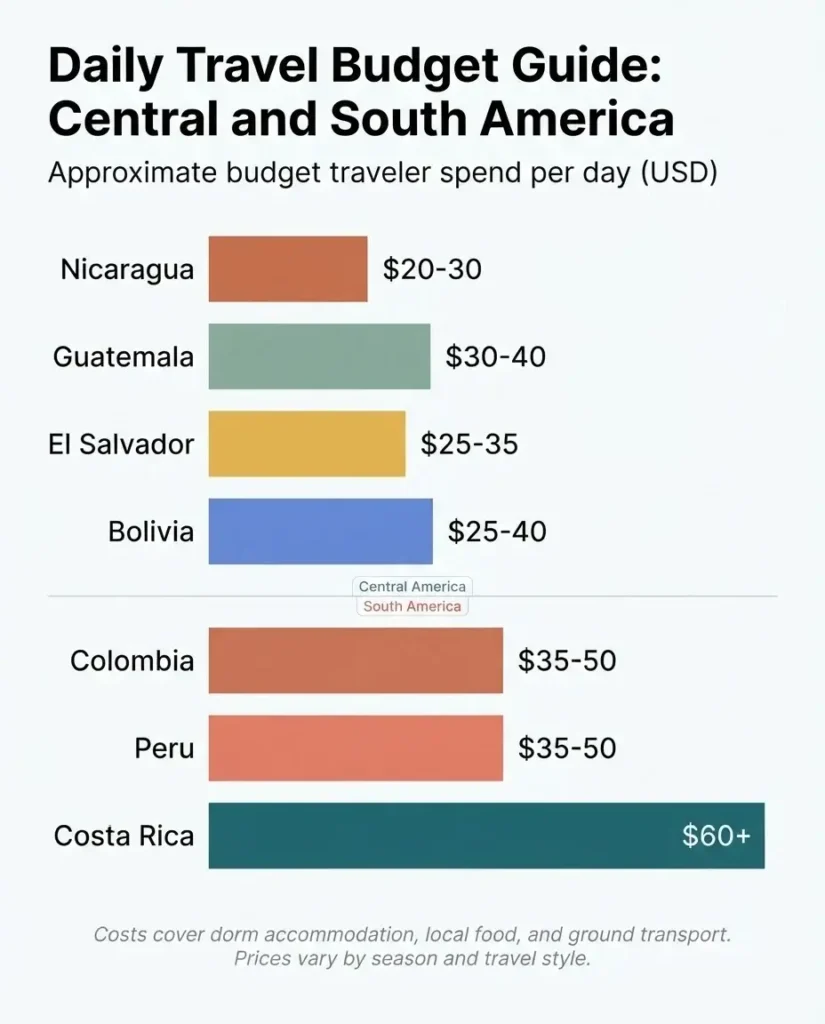
Here is a rough but honest breakdown to frame your planning:
In Central America, Guatemala and Nicaragua consistently rank among the cheapest places to travel anywhere in the world. In Guatemala, budget travelers can comfortably get by on around $30-40 a day — covering a dorm bed, three meals, local transport, and the occasional activity. Nicaragua is even cheaper, with daily totals of $20-30 very achievable. El Salvador lands in a similar range. Honduras is comparable, with the added bonus of some of the cheapest scuba diving certifications on the planet. Costa Rica is the outlier — budget $60 or more per day, closer to double what you would spend in its neighbors. Panama sits somewhere in the middle.
For a detailed, country-by-country breakdown of what things actually cost in Central America — accommodation, food, transport, and activities — Indie Traveller’s Central America cost guide is one of the most thorough and regularly updated resources I have come across, and it is worth bookmarking before your trip.
In South America, Bolivia and Peru are the standard budget anchors. Bolivia regularly lands on “cheapest countries in the world” lists, with budget travelers spending $25-40 per day even while doing activities. Colombia surprises many people — Medellin and Cartagena have boomed as tourist destinations, and while they are not as cheap as they were five years ago, a budget of $35-50 a day still keeps you comfortable. Ecuador is another strong budget pick. The Indie Traveller South America cost guide covers current daily estimates for Brazil, Argentina, Colombia, Peru, Ecuador, Bolivia, and more, which is genuinely useful for building a multi-country budget.
The rule of thumb: the further from the tourist-industrial complex and the more local your choices, the further your money goes.
This holds true across every country in the region.
Build Your Route Around Budget Hotspots
Not every trip through this part of the world needs to include every country. If budget is a priority, building your route strategically makes an enormous difference.
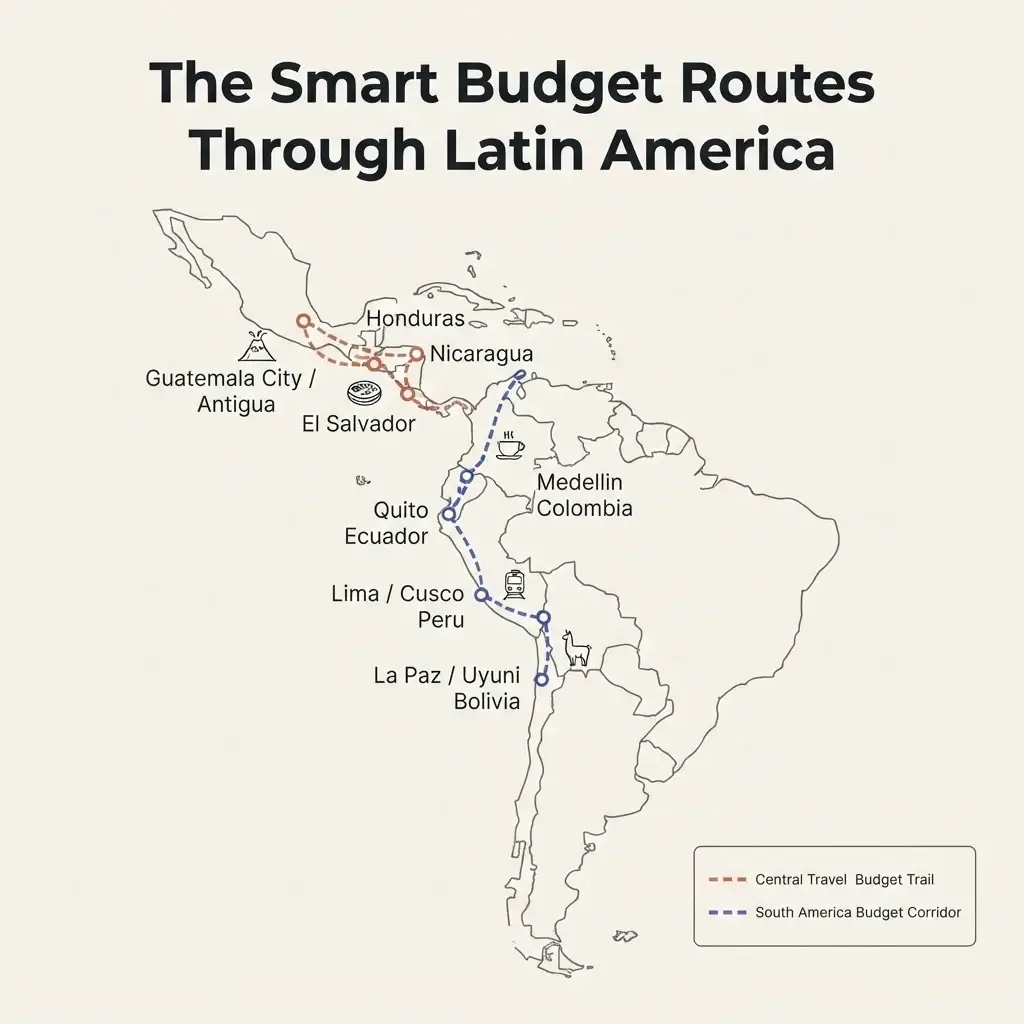
In Central America, the classic budget trail runs Guatemala, El Salvador, Honduras, and Nicaragua. These four countries form one of the most affordable travel corridors on earth. Costa Rica and Panama are worth visiting but budget significantly more for both. If you are on a shoestring, spend the bulk of your time in the northern four and use Costa Rica as a transit point rather than a month-long base.
In South America, the reliable budget corridor runs Colombia, Ecuador, Peru, and Bolivia. These four countries deliver staggering diversity — colonial cities, Amazon rainforest, mountain villages, salt flats — at a fraction of what you would spend in Brazil or Argentina (where currency volatility and higher costs add complexity). Note that as of April 2025, US citizens need a visa to enter Brazil, so factor that into your planning if Brazil is on your list.
The best budget routes also favor overland movement over flying. Every time you choose a bus over a plane within the region, you are potentially saving $100-200 and adding an experience — the landscape of the Andes, the changing vegetation as you move between climates, the human texture of border crossings.
The Chicken Bus Is Your Friend (Really)
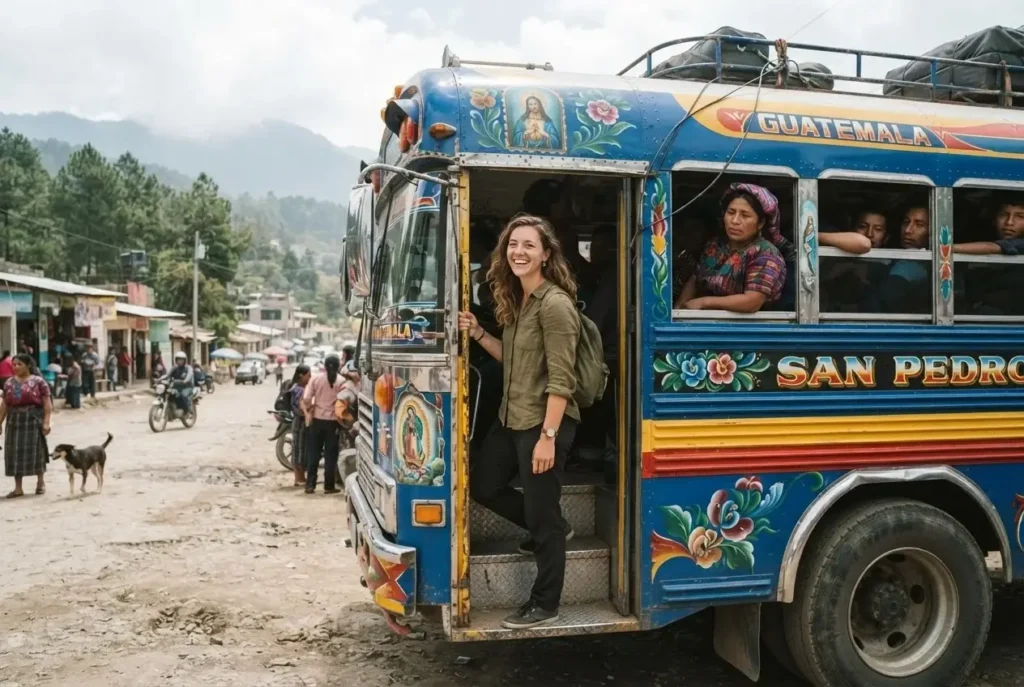
If there is one symbol of budget travel in Central America, it is the chicken bus. These are retired US school buses that have been repainted in vivid colors, often decorated with religious imagery and blasting reggaeton, packed to capacity with locals, produce, and the occasional live animal. They are extraordinarily cheap — in Guatemala, a ride on a chicken bus typically costs a fraction of a dollar per hour of travel. Tourist shuttle vans cover the same routes for five to ten times the price.
From what solo travelers consistently report, riding chicken buses is one of the best decisions you can make for both your budget and your cultural immersion. You sit next to the people who actually live in the places you are visiting. You see the country at ground level. You figure out how to communicate in broken Spanish with a grandmother who is carrying six bags of vegetables. It is not always comfortable, but it is real.
In South America, the equivalent is the intercity bus network, which is extensive and relatively well-developed. Peru, Bolivia, Ecuador, and Colombia all have reputable long-haul bus companies running comfortable semi-cama (reclining seat) or cama (full flat-bed) buses between major cities. Companies like Cruz del Sur in Peru are reliable and a legitimate alternative to flying.
Overnight buses deserve a special mention. Taking an overnight bus between cities means you travel while you sleep and wake up at your next destination — no accommodation cost for that night. Over a three-month trip, this trick alone can save hundreds of dollars. Pack a good travel pillow, bring layers (overnight buses are often aggressively air-conditioned), and keep your daypack with your valuables on your lap or overhead where you can see it.
Slash Accommodation Costs Without Sleeping Terribly
Hostel dorms are the obvious starting point, and they remain reliable across this region. In Guatemala, Nicaragua, and Bolivia, you can find clean, social dorm beds for $6-12 a night. Colombia and Peru run a bit higher, around $10-18 for a decent dorm in a well-located hostel. These are not prison cells. Many of the best budget hostels have rooftop bars, communal kitchens, hammocks, and a social energy that private hotels cannot replicate.
But the real game-changer for long-term budget travel is the work exchange model. Platforms like Worldpackers connect travelers with hostels, farms, schools, and community projects across Central and South America. In exchange for a few hours of work per day — think front desk shifts, social media help, teaching English, gardening — you get free accommodation and sometimes meals. The annual membership fee is small compared to even a week of hostel stays. This is not just a budget hack. It is a genuinely different way of experiencing a place, building relationships with locals and other travelers over weeks rather than a rushed few nights.
If Worldpackers is more Central America-focused for your needs, you can also browse work exchange listings across South America on the same platform, where opportunities range from Patagonia eco-lodges to Ecuadorian community farms. Workaway is a similar platform worth comparing.
Couchsurfing is another option if you are comfortable with it. The community is especially active in larger cities like Medellin, Lima, and Mexico City. The value is not just free accommodation — it is getting to know a local who can point you toward the food market they actually shop at and the neighborhood bar where nobody speaks English.
Eat Like You Mean It: The Menú del Día Strategy
Food is where budget travelers either succeed or quietly blow their savings. The difference is knowing what to look for.
In almost every country across Central and South America, there is a tradition of the “menú del día” — the set lunch menu. For a single low price (often $2-5 depending on the country), you get a full meal: typically a soup, a main course with rice, beans, and protein, a small salad, and sometimes a drink. These meals are served in local restaurants called “comedores” in Central America or “huariques” and “cevicherías” in Peru, and they are exactly what the working population eats every day.
A $3 lunch that fills you completely is not a compromise. It is how you eat authentically. Compare that to the $12 avocado toast at the café next to the hostel, and the math becomes obvious fast.
Street food follows the same logic. In El Salvador, pupusas (thick corn tortillas stuffed with cheese, beans, or chicharrón) cost around 50 cents to a dollar each. In Guatemala, a plate of rice, black beans, fried plantains, and chicken from a market stall might run you $1.50. In Colombia, arepas and empanadas are everywhere and cheap. In Peru, a bowl of caldo (broth soup) from a market can cost less than a dollar. The rule is simple: eat where the locals eat, at the times they eat.
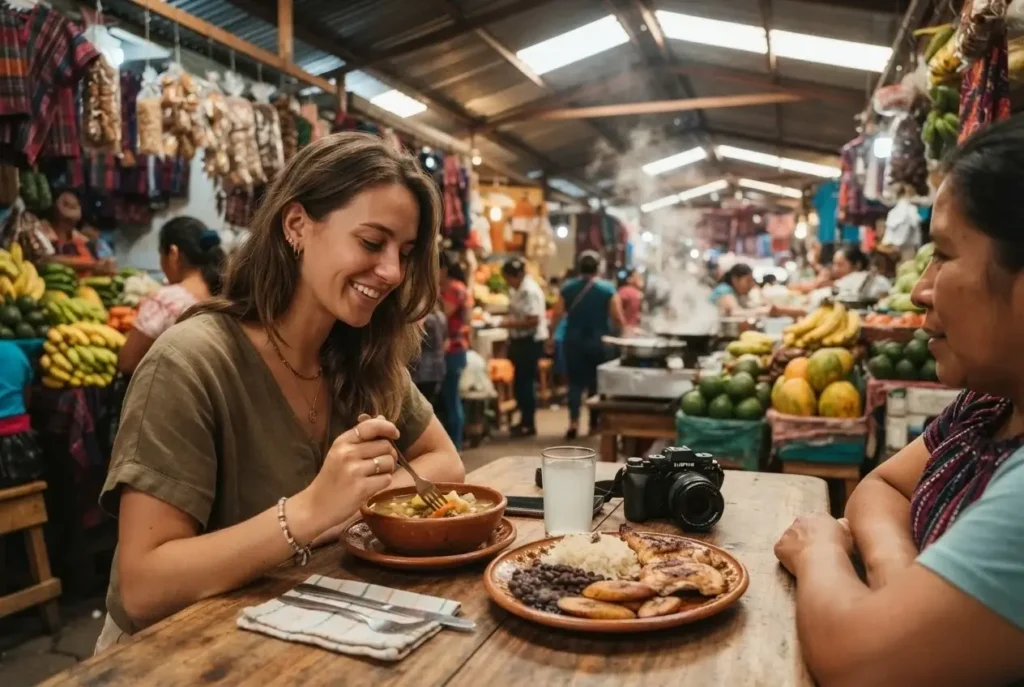
Markets at lunchtime, street stalls in the late afternoon, the comedores on side streets rather than the main plaza.
Cook occasionally when your accommodation has a kitchen. Buying produce from a local market, making simple meals, and saving restaurant eating for one special meal a day is a practical rhythm that extends your budget significantly.
Big Experiences on a Budget: Machu Picchu, Uyuni, and Beyond
Here is what many budget guides get wrong: they tell you to skip the iconic experiences because they cost more. I disagree. Some experiences are worth building your whole budget around. The key is getting there efficiently and not overpaying for the experience itself.
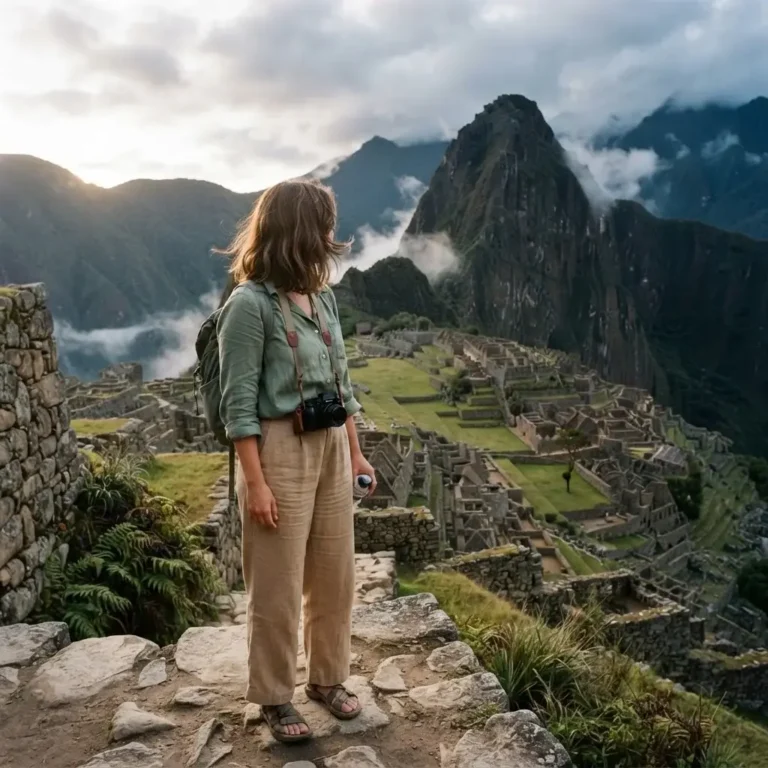
Machu Picchu is the obvious example. Solo travelers consistently report that the biggest money-wasters on the Machu Picchu route are unnecessary travel agents and booking through middlemen. The entrance tickets are government-controlled and sold through the official platform — you can buy them directly at the official Machu Picchu government ticketing site, which removes the middleman markup entirely. The real cost savings come from taking the train from Ollantaytambo rather than Cusco (significantly shorter and cheaper), and staying in Aguas Calientes rather than Cusco the night before. Budget travelers who plan ahead spend a fraction of what tour-package visitors pay for the exact same view.
In Bolivia, the Salar de Uyuni salt flats are one of the most visually surreal places on earth. Budget 1-day tours from Uyuni town start around $59 with local operators, while 3-day tours that cover the flats, colored lagoons, and geysers run approximately $189-239. According to the official Salar de Uyuni information site, booking directly in town rather than through online intermediaries often gets you a better rate. The trick is to arrive in Uyuni, spend an afternoon comparing a few operators in person, and book for the next morning.
Colombia’s coffee region, Ecuador’s colonial Quito, Guatemala’s Lake Atitlan, Nicaragua’s volcano boarding near Leon — these are all world-class experiences with surprisingly accessible price tags when you approach them on local terms.
Money Management Across Multiple Countries
Carrying cash in local currency and minimizing ATM fees is a skill that takes a little setup but pays dividends across a long trip. ATM fees in Latin America can run $5-10 per withdrawal if you are using the wrong card. Over a three-month trip, that adds up fast.
Before you leave home, get a bank account that reimburses international ATM fees. Charles Schwab in the US is the most widely recommended option for American travelers for exactly this reason. Many European travelers use Wise or Revolut for the same purpose.
Withdraw larger amounts less frequently to minimize per-transaction fees. In countries where the local currency is relatively stable (Colombia, Peru, Guatemala), keeping a moderate amount of local cash on hand is sensible. In countries with more complex currency situations, research current advice in traveler forums right before your trip, as this changes.
Always tell your bank you are traveling before you leave. It is a five-minute task that prevents your card from being frozen at the worst possible moment.
A Word on Safety and Keeping Your Budget Intact
Budget travel in this region is genuinely accessible and millions of solo travelers navigate it every year without incident. That said, being smart about safety directly protects your budget. Petty theft — opportunistic pickpocketing and phone snatching — is the most common issue travelers face, and it is largely preventable.
Keep your phone in your pocket or bag in busy areas rather than in your hand. Use a crossbody bag with a zipper rather than a backpack with an open top. In cities, use Uber or InDrive rather than unmarked taxis, which removes the negotiation and the risk of being overcharged or worse. At night, apply the same street-awareness you would in any large city anywhere in the world.
Before visiting any specific country, check the U.S. Department of State travel advisories for current advisory levels. These are updated regularly and give you a meaningful baseline for understanding what precautions are appropriate country by country. Advisory levels vary significantly across the region — some countries carry Level 1 (exercise normal precautions) while others carry higher warnings for specific regions within the country. Read them as context, not as a reason to cancel the trip.
The Mindset That Makes Budget Travel Work
When I was backpacking solo through Europe before I built Pinverse Travel, the biggest shift I had to make was not financial. It was psychological. I had to stop measuring my experience against a comfort-versus-budget scale and start measuring it against a connection-and-depth scale.
The solo traveler who rides a chicken bus and shares a bench with a Guatemalan family, who eats a $2.50 menú del día in a courtyard full of locals, who spends three weeks at a work-exchange hostel and actually learns the rhythms of a neighborhood — that traveler has a richer trip than someone staying in a boutique hotel racing through four countries in ten days.

Budget travel in Central and South America is not the consolation prize version of this trip. For many people, myself included, it is the version that teaches you the most. It strips away the buffer between you and the place. You figure things out. You talk to people because you have to. You slow down because the bus is slow and that is fine.
The practical tips in this guide will stretch your money considerably. But the thing that will make the difference between a stressful, anxious budget trip and a genuinely transformative one is deciding, before you leave, that you are going to lean into it rather than resist it.
Book the ticket. Take the chicken bus. Order the pupusas. You will figure the rest out as you go.