Wine Tasting Across the Americas: Regions Worth the Trip

There is something genuinely disarming about standing in a vineyard for the first time. You pick up a glass, the wine is a deep garnet color, and someone across the barrel table is explaining soil composition and altitude with obvious joy. And instead of feeling lost, you feel curious. That is the feeling wine travel gives you when you stop treating it as something for experts and start treating it as what it actually is: a really good excuse to slow down, eat well, and learn something beautiful about a place.
The Americas produce some of the most exciting wine on the planet, and what often surprises first-timers is how different these regions are from each other. Not just in terms of what’s in the glass, but in terms of landscape, culture, price, and the kind of traveler they attract. Napa Valley is a world unto itself. Mendoza, Argentina feels like stepping into a postcard with the Andes as the backdrop. Oregon’s Willamette Valley is quieter, more rural, and every bit as serious about its wine. And the Finger Lakes in upstate New York? If you grew up in the Northeast like I did, you might be shocked that one of North America’s most underrated wine regions has been sitting in your backyard this whole time.
This guide covers six regions across the Americas that are genuinely worth your time, whether you’re planning your first wine-focused trip or finally committing to that solo adventure you’ve been putting off. I’ll walk through what makes each region special, what to realistically expect to spend, how to get around, and the cultural context that makes each place more than just a row of tasting rooms.
Let’s go.
Why Wine Travel Works So Well for Solo Travelers
Before getting into the regions, I want to say something directly to anyone reading this who is considering going alone: wine regions are some of the friendliest destinations for solo travel you will ever find.
Think about it. You walk into a tasting room, someone pours you a glass, and there is an immediate, shared topic of conversation. Nobody asks why you’re alone. Nobody makes it weird. The format of a tasting, standing at a bar, trying a flight of four or five wines, asking questions, listening to the person pouring talk about what they love about their vineyard, is basically structured socializing. I’ve seen it happen everywhere: solo travelers who came in alone leaving with new dinner companions, winemakers who invited a solo visitor to see the barrel room, groups that formed organically at a communal lunch table in the vines.
Wine tasting is also naturally slow. It rewards lingering. It fits the pace that solo travelers tend to prefer, moving at your own speed, following your own curiosity, choosing the next winery based on a tip from someone you just met rather than a rigid itinerary. If solo travel has ever intimidated you, a wine region is one of the best places to practice it.
Napa Valley, California: The One Everyone Knows (And What Solo Travelers Actually Need to Know About It)
Napa is iconic for a reason. The valley is extraordinary to look at, the food scene is world-class, and the quality of wine here is undeniable. But let me be honest with you about something the Instagram posts don’t show: Napa has become expensive. The average standard tasting fee in Napa Valley sits around $79 to $81 per person at many estates, with reserve experiences running $128 or more. If you’re booking three or four wineries in a day, that adds up fast before you’ve bought a single bottle.
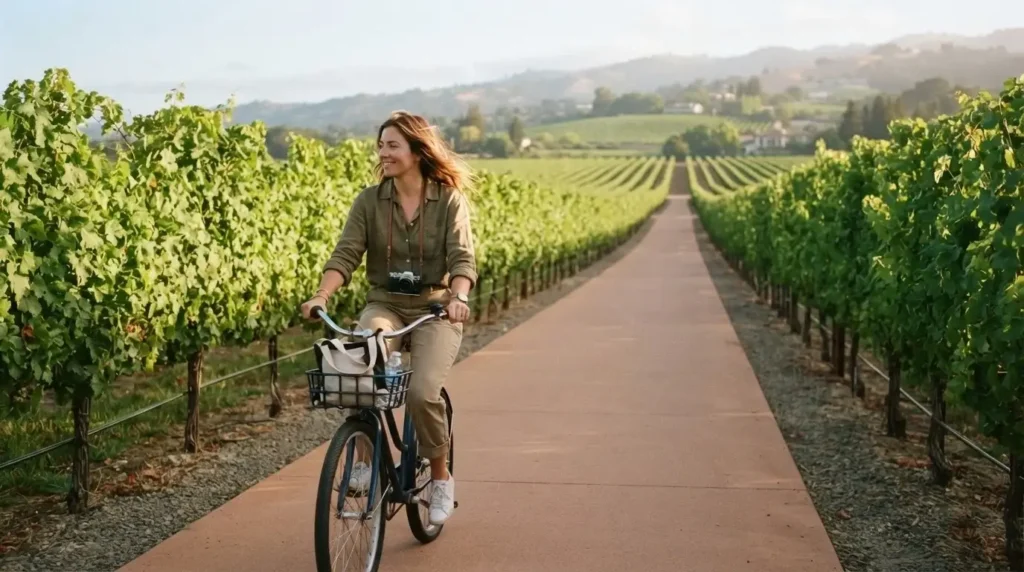
That said, Napa is still worth experiencing, especially if you approach it strategically. The official Visit Napa Valley tourism site actually published a dedicated solo traveler itinerary for Napa Valley that is genuinely useful. It includes the Napa Valley Vine Trail, a paved cycling path that runs from downtown Napa north toward Yountville, which is one of the best ways to move between wineries without renting a car. Cycling through the valley, past rows of vines and the Mayacamas mountain range in the background, is one of those experiences that makes you feel properly alive.
The smart budget move in Napa is to anchor yourself in downtown Napa rather than the more famous towns up-valley.
Downtown has boutique tasting rooms where fees are lower and the atmosphere is more relaxed. The Oxbow Public Market is an essential stop for food, local produce, and oysters at Hog Island, which are outstanding. For wine, Visit Napa Valley keeps a running list of tasting experiences under $50 that is genuinely helpful for budget-conscious visitors.
What to eat: The food in Napa is extraordinary. Even if you’re keeping costs in check elsewhere, one meal at a proper Napa restaurant is worth it. Yountville in particular has a concentration of incredible dining. The valley’s farm-to-table tradition means the produce and proteins you’ll eat here are sourced locally and treated with real care.
Best time to visit: Late spring (May-June) for good weather without harvest crowds. September and October are harvest season, which is spectacular but extremely busy and more expensive.
Willamette Valley, Oregon: The Pinot Noir Region That Earns Every Bit of Its Reputation
If Napa feels a bit polished and high-stakes, Oregon’s Willamette Valley is its more approachable, friendlier sibling. This is a region built around community and collaboration among winemakers, and that spirit shows in how visitors are treated.
The Willamette Valley is Oregon’s oldest wine region, established as an official AVA in 1983, and it is home to more than 700 wineries across a stretch of 150 miles. The valley sits between the Coast Range to the west and the Cascades to the east, which creates a long, gentle growing season with cool evenings that Pinot Noir loves. Eleven nested sub-AVAs each produce slightly different expressions of Pinot, from the volcanic Jory soils of Dundee Hills to the marine sedimentary soils of Chehalem Mountains. According to the Oregon Wine Board’s Willamette Valley region page, the valley accounts for two-thirds of Oregon’s wineries and vineyards and is recognized internationally as a premier winegrowing destination.
From Portland, you can be in the middle of wine country in 30 to 45 minutes. That proximity is a huge practical advantage for solo travelers. You can base yourself in Portland, use the city’s accommodation options, and do full-day excursions into the valley without paying for rural lodging. Some travelers prefer the slower pace of staying in McMinnville, the small city at the heart of Yamhill County, which has excellent restaurants, a charming main street, and genuine community character.
The Willamette also grows excellent Pinot Gris, Chardonnay, and Riesling alongside the flagship Pinot Noir. Tasting fees here tend to be significantly more reasonable than Napa, often ranging from $15 to $40 per flight, with many smaller producers offering intimate experiences where the winemaker might pour your wine themselves.
What to eat: The Pacific Northwest food culture here is remarkable. Pair your wine with local Dungeness crab, wild mushrooms (especially chanterelles in season), and the region’s exceptional hazelnuts and berries. Many wineries have on-site bistros with locally sourced menus.
Best time to visit: July through October for warm days and harvest energy. The International Pinot Noir Celebration in McMinnville, held each summer, is one of the wine world’s best events.
Finger Lakes, New York: The World-Class Region in My Own Backyard
Growing up in New York, I didn’t give the Finger Lakes much thought as a wine destination. That changed when I started paying attention to what wine people were actually drinking and talking about, and Finger Lakes Riesling kept coming up. It has now earned genuine global recognition, and the region as a whole has become one of North America’s most interesting wine stories.
Finger Lakes Wine Country spans five counties, three wine trails, and more than 3,065 square miles of upstate New York landscape. The lakes themselves, long and narrow and surprisingly deep, moderate the climate enough to allow wine grapes to grow this far north. Seneca Lake is the most wine-dense of the lakes, with over 50 wineries on its shores. Keuka and Cayuga Lakes have their own trails and their own personalities.
The dominant variety is Riesling, and the range is extraordinary: bone dry and mineral, off-dry and aromatic, semi-sweet and food-friendly. But producers here also make excellent Pinot Noir, Gewurztraminer, Cabernet Franc, and sparkling wines. The quality-to-price ratio in the Finger Lakes is outstanding. Tasting fees are very reasonable, often $5 to $15, and the landscape of gorges, waterfalls, and lake views surrounding the wineries is genuinely beautiful.
For solo travelers, the main practical challenge is transportation. The Finger Lakes is not walkable between wineries, and driving while tasting is not an option. The best approach is either renting a bike and staying along the lakeshores where wineries cluster, booking a guided wine trail van tour (several operate on Seneca and Keuka Lakes), or traveling with one other person to share driving duties. Plan on focusing on one lake per day rather than trying to cross between trails.
What to eat: The Finger Lakes food scene has grown significantly.

Look for farm-to-table restaurants in Watkins Glen, Geneva, and Ithaca. Local cheese, especially from Lively Run Dairy, pairs beautifully with Riesling. In the fall, apple cider doughnuts at farm stands along the wine trails are a genuine regional ritual.
Best time to visit: June through October. Harvest in September is stunning, and the fall foliage adds a second layer of beauty to the vineyard landscape.
Okanagan Valley, British Columbia: Canada’s Quietly Spectacular Wine Country
Here is a region that almost never appears in “Americas wine” content and deserves far more attention. British Columbia’s Okanagan Valley is a genuine world-class wine destination, and its combination of dramatic landscape, remarkable variety, and warm Canadian hospitality makes it one of the most personally enjoyable wine travel experiences on the continent.
According to Wines of British Columbia’s official Okanagan Valley page, the region stretches over 250 kilometres north to south and accounts for 86% of BC’s vineyard acreage. There are over 200 wineries producing more than 80 grape varieties. The growing conditions are genuinely unique: hot days with intense sunshine (up to 2,000 hours annually), cool nights with lake breezes, and soils shaped by ancient glaciers and volcanic activity. The northern end of the valley produces elegant aromatic whites like Riesling and Gewurztraminer. The southern end, near Osoyoos, edges into desert-like conditions that ripen bold Merlot, Cabernet Sauvignon, and Syrah to impressive intensity.
The Okanagan is also home to what is widely cited as the first Indigenous-owned winery in North America, a fact that reflects the region’s broader commitment to cultural depth alongside great wine. The lakeside towns of Kelowna, Penticton, and Oliver each have their own character and serve as excellent bases.
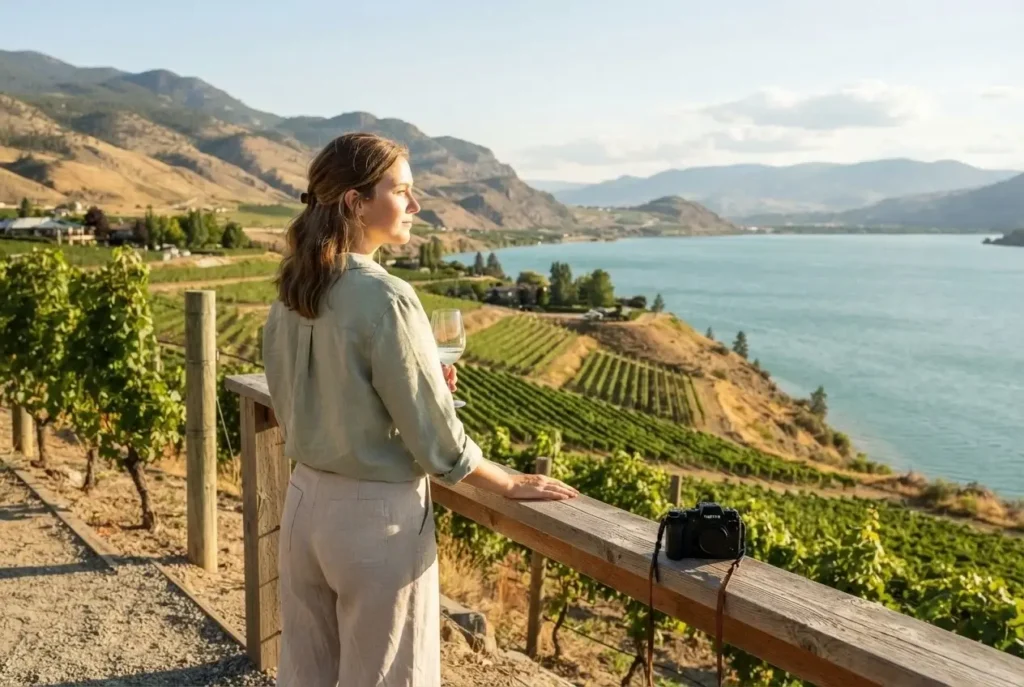
The Kettle Valley Railway, a converted historic rail route, now functions as a cycling and walking trail connecting communities and wineries throughout the valley, which is ideal for the kind of slow, immersive travel I love.
What to eat: The Okanagan’s farm culture is extraordinary. Summer peaches, cherries, apricots, and apples from local orchards are world-famous. Farm-to-table dining in Kelowna in particular has reached a very high level. The region’s Icewine, made from grapes frozen on the vine in winter, is a remarkable local specialty worth trying.
Best time to visit: July and August for warm lake weather and fresh fruit season. September for harvest. Winter is quieter but Icewine production season, which has its own appeal.
Mendoza, Argentina: Where the Andes Make Every Sip More Dramatic
From what solo travelers consistently report, and from everything I have read and researched about this region, Mendoza stands as one of the most compelling wine destinations anywhere in the world. Not just for the wine, but for the total experience: the scale of the Andes backdrop, the warmth of Argentine hospitality, the quality of the asado (traditional barbecue) culture, and the remarkable value for visitors traveling on international currency.
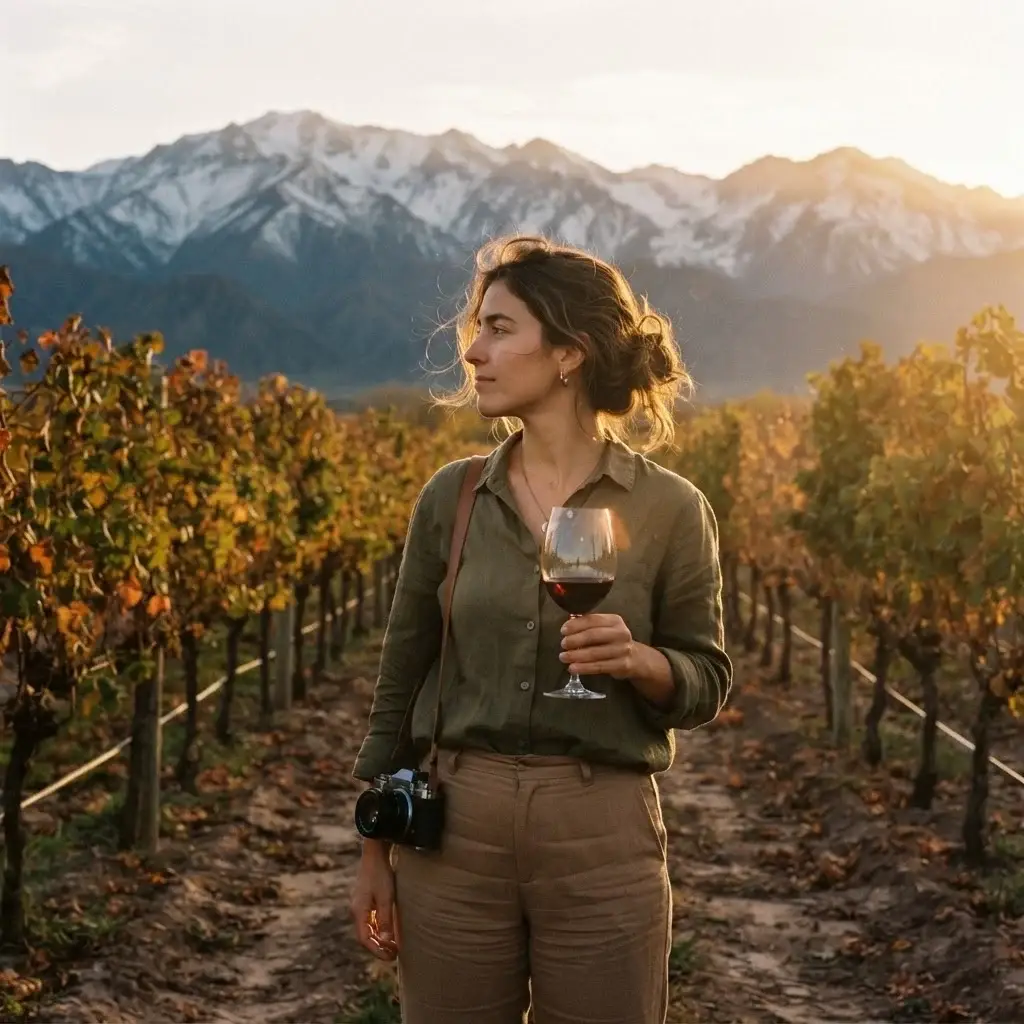
Mendoza is a recognized member of the Great Wine Capitals Global Network, a distinction it shares with Bordeaux, Bilbao, Cape Town, and a handful of other major wine cities worldwide. The numbers are staggering: 800 wineries, over 150,000 hectares of vineyards, and more than 320 sunny days per year. Mendoza produces 70% of Argentina’s total wine output. And the flagship grape, Malbec, which originated in France but found its greatest expression here in the high-altitude, low-humidity conditions of the Andes foothills, is one of the world’s great wine stories.
The main wine zones within Mendoza are Luján de Cuyo, the traditional heartland with deep Malbec heritage and Argentina’s first Denomination of Controlled Origin established in 1991; Maipu, closer to the city and good for self-guided bike tours; and the Uco Valley, a higher-altitude sub-region at 3,000 to 5,000 feet elevation that has become the exciting frontier for premium producers. Uco Valley Malbec tends to have greater structure, higher acidity, and more complexity than lower-altitude expressions.
For solo travelers, Mendoza city itself is a very walkable, very safe base with excellent cafes, restaurants, and accommodation across all budgets. Guided winery tours, which include transport, are the easiest and safest way to visit multiple bodegas in a day. Budget-priced group tours start around $35 and include visits to two or three wineries with tastings. Mid-range full-day experiences with gourmet lunch run $100 to $150. Private custom tours go higher but are still extraordinary value compared to similar experiences in Napa or Bordeaux.
What to eat: Do not skip the pairing of Malbec with a proper Argentine asado. Many Mendoza wineries have on-site restaurants where you can eat grilled beef, empanadas, and local charcuterie alongside the wines. The food culture here is communal, unhurried, and deeply pleasurable.

If you plan to be there in early March, Mendoza’s National Grape Harvest Festival (Fiesta Nacional de la Vendimia) draws over 350,000 visitors and is one of the most extraordinary cultural festivals in South America, with float parades, wine tastings in the streets, and a main ceremony that National Geographic has ranked among the world’s ten most important harvest festivals.
Best time to visit: March (harvest and festival) for maximum cultural immersion. October through December for shoulder-season value with good weather.
Casablanca and Maipo Valleys, Chile: Two Very Different Experiences Within Reach of Santiago
Chile doesn’t always get the credit it deserves as a wine destination, partly because its two most accessible regions, Casablanca and Maipo, serve very different purposes in the glass and appeal to different traveler personalities.
The Maipo Valley is Chile’s most historic wine region, sitting close to Santiago in the country’s central valley. This is Cabernet Sauvignon country, warm and continental, producing some of Chile’s most structured and age-worthy reds. Many of Chile’s most famous and largest wineries are here, including several that offer full tourism programs with guided tours, tastings, and restaurant meals. A day trip from Santiago to the Maipo Valley typically takes about 45 minutes to an hour by road, making it a very accessible half-day or full-day excursion.
Casablanca Valley tells a completely different story. Situated between Santiago and the coast, Casablanca is cool-climate wine country, heavily influenced by Pacific breezes. It is Chile’s home for exceptional Sauvignon Blanc, Chardonnay, and Pinot Noir. The whites here are vivid and refreshing, and the overall atmosphere at Casablanca wineries tends to be more boutique and intimate than the larger Maipo estates. If you’re traveling between Santiago and the UNESCO-listed port city of Valparaiso (a trip that passes directly through Casablanca), planning a winery stop is one of the most natural and rewarding itinerary moves you can make.
What to eat: Chilean cuisine pairs beautifully with the wines here. Fresh ceviche and grilled fish with Casablanca Sauvignon Blanc is a combination worth planning a lunch around. In Maipo, grilled meat with local Cabernet follows the same logic as Mendoza: robust wine, robust food, leisurely pace.
Best time to visit: March and April for harvest. November through January for Southern Hemisphere summer warmth and fresh energy in the vineyards.
Practical Tips That Apply Everywhere
A few things hold true no matter which of these regions you choose, and they will make your experience significantly better.
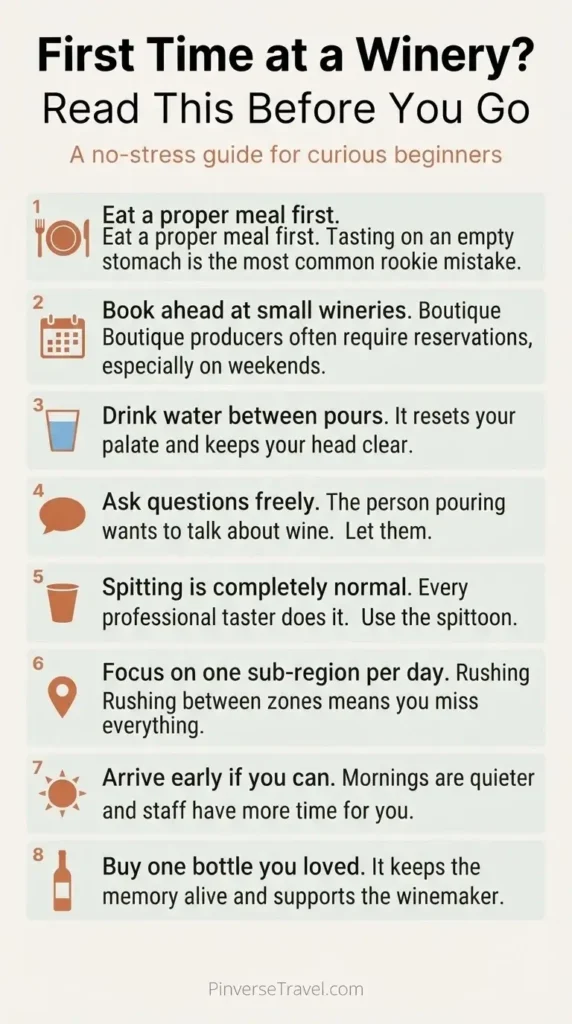
Book tastings in advance, especially at smaller producers. Many boutique wineries, in Willamette, Okanagan, and Finger Lakes especially, require reservations for tasting room visits. Showing up unannounced works better at larger commercial operations, but the small family-run places worth going out of your way for almost always want an RSVP.
Eat before you start tasting. This is the single most important practical tip in wine travel. An empty stomach and four consecutive tastings is a combination that ends badly for everyone. Most experienced wine travelers eat a proper meal before setting out, then pace themselves with water between pours.
It is completely acceptable to spit. No, really. Every professional taster does it. Many tasting rooms have spittoons for exactly this reason. If you’re visiting four or five wineries in a day and swallowing every pour, you are going to have a much shorter and blurrier day than you planned. There is nothing snobbish or wasteful about using the facilities provided.
Focus on one or two sub-regions per day rather than trying to cover everything. Wine regions reward slowness.
A morning at one winery where you talk to the winemaker, have lunch in the vines, and walk through the vineyard before your afternoon tasting is a far richer experience than five quick flights at five different stops. Solo travelers in particular benefit from this approach because the best encounters happen when you’re not rushing.
Ask questions. This is the one setting where the people pouring your wine genuinely want to talk about it. Ask what their favorite vintage was and why. Ask what grape they wish more people tried. Ask about the challenge of the last growing season. The conversation that comes from genuine curiosity is often the best part of the whole day.
Where to Start if You Can Only Pick One
If you are brand new to wine travel and want the deepest combination of value, culture, food, and landscape, Mendoza, Argentina is the answer. The pricing is exceptional for international travelers, the welcome is warm, the food and wine culture is inseparable and immersive, and the Andes backdrop gives the whole experience a drama that is hard to match anywhere.
If you want to stay domestic and are based in the US, Willamette Valley, Oregon gives you world-class Pinot Noir, a sustainable and community-focused wine culture, easy access from Portland, and significantly more reasonable costs than Napa. It is a region that rewards curiosity and punishes expectations, in the best possible way.
And if you haven’t been to the Finger Lakes since a childhood road trip, go back. The wine has grown up, and you might be surprised by what’s waiting for you there.
The best wine trip is the one you actually book.
Stop waiting for the perfect moment to plan it, pour yourself something good, and start looking at flights.