
From Bean to Cup: Finding the Best Coffee in the Americas

I grew up in New York City, which means I grew up thinking I already knew what a great cup of coffee tasted like. The city has a cafe on every corner and a fierce, unapologetic loyalty to its own coffee culture. But it was not until I started traveling, really traveling, that I understood how different a relationship with coffee can be depending on where you are in the world.
Coffee is not just a drink. In some parts of the Americas, it is a centuries-old economy, a family inheritance, a morning ritual tied to land and weather and altitude.

In other places, it is a modern art form being pushed forward by young baristas working with single-origin beans and precision brewing methods. And in places like New Orleans, it is a living piece of history that you can taste in every cup.
If coffee matters to you the way it matters to me, the Americas are one of the most extraordinary places on earth to chase it. This guide covers the regions and cities worth planning your trip around, from the farms in Colombia where the beans are grown to the specialty bars of Lima where they are being reimagined. It is organized by region so you can read the parts that match where you are already headed, or let it help you decide where to go next.
Why the Americas Are the Center of the Coffee World
Before getting into specifics, it helps to understand why the Americas dominate global coffee production and culture. According to the International Coffee Organization, the Americas collectively produce the majority of the world’s coffee supply, with Brazil and Colombia alone accounting for an enormous share of global output. But production and drinking culture are two different things, and the Americas happen to excel at both.
The “Coffee Belt” (the equatorial band where coffee grows) runs directly through Central and South America, which means countries like Colombia, Costa Rica, Peru, Guatemala, Honduras, Mexico, and Brazil are all producing high-quality beans grown in the kinds of mountainous, volcanic, humid environments that coffee plants love. What makes traveling in this region so special is that you can visit the source. You can stand on the hillside where the beans were grown, meet the family who picked them, and drink the finished cup at the farm before catching a bus back to your guesthouse. That is rare in any agricultural product, and it is something coffee in the Americas makes uniquely possible.
Colombia: The Zona Cafetera (And Why It Belongs on Your List)
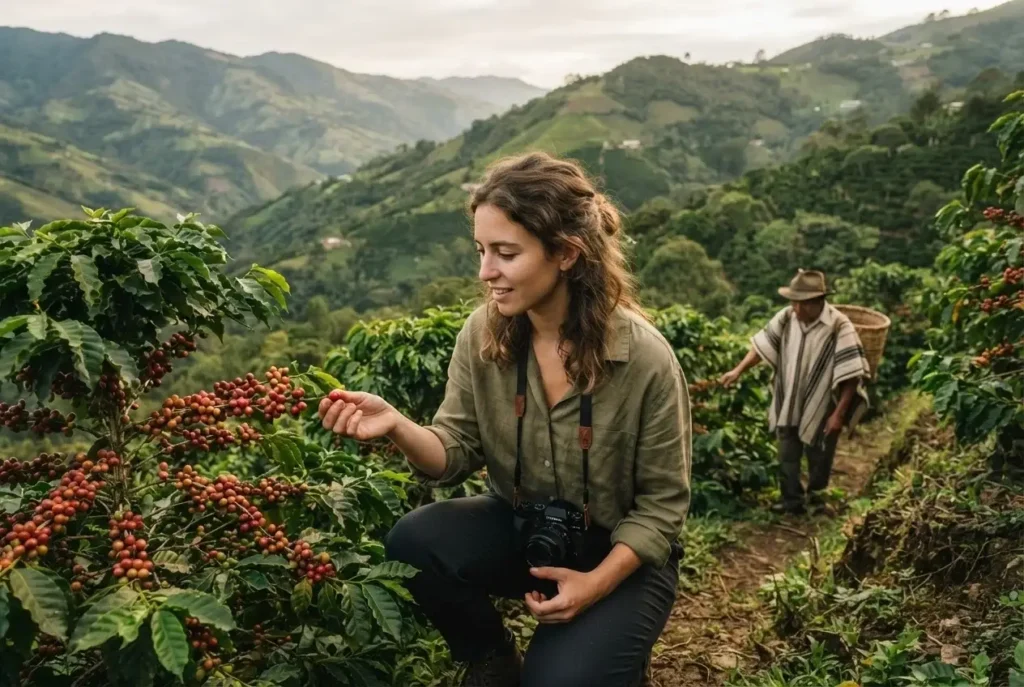
If there is one coffee destination in the Americas that every traveler who cares about coffee should know about, it is Colombia’s Eje Cafetero, more commonly called the Coffee Triangle or Zona Cafetera. This region covering parts of the Caldas, Quindio, and Risaralda departments was inscribed as a UNESCO World Heritage Site in 2011, recognized for its outstanding cultural landscape where coffee farming is not just an industry but a way of life passed down through generations of campesino families.
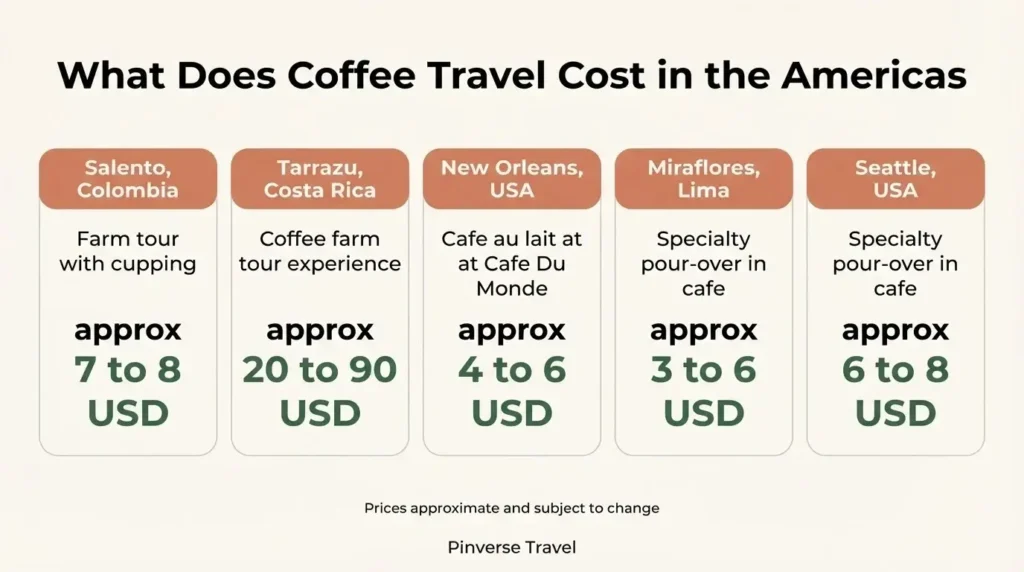
The towns to visit in this region include Salento, Armenia, Manizales, and Filandia. Salento is the most popular with backpackers and solo travelers, and for good reason: it is colorful, friendly, safe for solo visitors, and surrounded by coffee fincas (farms) that welcome tourists. A coffee farm tour at a place like Finca El Ocaso costs around 30,000 Colombian pesos per person (roughly $7 to $8 USD), which is one of the most affordable immersive farm experiences you will find anywhere in the world. The tour walks you through the full process: you see the coffee cherry plants growing on steep hillside slopes, learn how the fruit is handpicked at peak ripeness, watch the wet-milling process, and finish with a cupping session where you taste the result of everything you just witnessed.
What makes the Zona Cafetera different from simply visiting a farm is the density and authenticity of the culture. The architecture in towns like Salento is a fusion of Spanish colonial and indigenous Antioquian styles, with wooden balconies painted in bright colors overlooking cobblestone streets. The people here have been farming coffee for generations. That context changes the experience of drinking your morning cup entirely.
For practical planning, the official Colombia tourism board’s coffee region guide has solid orientation information including a breakdown of the major towns and how to get between them. The best base for first-time visitors is Salento, which is accessible from Armenia by bus (roughly 45 minutes to an hour) or from Pereira. Armenia has the nearest airport. From Bogota, the easiest route is to fly to Pereira or Armenia, both have regular domestic connections from El Dorado International Airport.
As a solo traveler, the Zona Cafetera is one of the more welcoming regions in Colombia. Salento in particular has a well-established hostel and guesthouse infrastructure, English is reasonably spoken in tourist-facing businesses, and the pace of life is slow and easy. You could spend three days here without rushing anything, and most people who visit wish they had stayed longer.
Costa Rica: Where Coffee Quality Is Written Into Law
Costa Rica is a different kind of coffee destination. Where Colombia gives you farming culture and heritage on a grand scale, Costa Rica offers precision and a strong emphasis on sustainable, high-quality production. Here’s a fact that surprised me when I first learned it: Costa Rica is the only country in the world that has legally banned the cultivation of Robusta coffee beans. By law, all Costa Rican coffee must be Arabica, which is a direct reflection of the national commitment to quality over quantity.
Coffee has been part of Costa Rican life since 1779, when the first beans arrived from Cuba. By the 1800s, it had become the country’s most important export, funding much of the country’s early infrastructure. Costa Rica also pioneered the “honey process” method of coffee production, a technique that has since been adopted by farms around the world. Honey processing involves removing the outer skin of the coffee cherry while preserving some of the sticky mucilage before drying, which creates naturally sweet, fruity flavor notes in the finished cup.
The official Visit Costa Rica website is genuinely one of the better tourism authority resources for planning a coffee-focused visit. Coffee is grown in eight distinct regions: Brunca, Turrialba, Tres Rios, Orosi, Tarrazu, Central Valley, Western Valley, and Guanacaste. The Tarrazu region, high in the mountains south of San Jose, is considered by many specialty coffee experts to produce the country’s finest beans. Farm tours across the country range from $20 to $90 per person depending on the level of experience, from a basic farm walk to full cupping and pairing sessions.
One practical thing to know: the original and most famous coffee tour operation in Costa Rica is Cafe Britt, which has been running organized farm tours for over 30 years near Heredia. It is theatrical, professionally organized, and family-friendly. If you want something smaller and more intimate, look for micro-tours offered directly through independent farms in the Tarrazu region. Those tend to attract fewer people and offer a more direct connection with the farmers themselves.
Solo travelers will find Costa Rica generally comfortable and easy to navigate. The country has a strong eco-tourism infrastructure, English is widely spoken in most tourist areas, and the safety situation for solo visitors is among the better ones in Central America.
New Orleans: North America’s Most Historically Significant Coffee City
People talk about Seattle and New York when they talk about great coffee in the US, and I understand why. But from a historical and cultural standpoint, the city with the deepest, most layered coffee identity in North America is New Orleans, Louisiana, and it deserves far more attention than it usually gets in coffee travel conversations.
New Orleans is currently the highest-volume coffee port in North America, receiving beans from more than thirty producing countries. Coffee has been fundamental to this city for centuries, shaped by French colonial history, the African diaspora, the Haitian Revolution, and the Civil War, all of which left permanent marks on how the city drinks its coffee. Perfect Daily Grind’s 2026 feature on New Orleans coffee culture tells the extraordinary story of Rose Nicaud, an enslaved woman in the early 1800s who sold coffee on the streets of the French Quarter from a makeshift stand, eventually earning enough to purchase her own freedom and that of her family. Her stand became a gathering place where all classes and cultures mingled over coffee, a democratic institution in a city defined by rigid social hierarchies. That legacy still shapes the culture here.
The most iconic coffee experience in New Orleans is the cafe au lait at Cafe Du Monde, established in 1862 and still operating 24 hours a day in the French Quarter near Jackson Square. The blend is a classic New Orleans recipe: dark-roasted coffee mixed with chicory root. Chicory became part of the city’s coffee tradition during the Civil War, when Union naval blockades cut off coffee imports and locals stretched their supplies by mixing in roasted chicory,
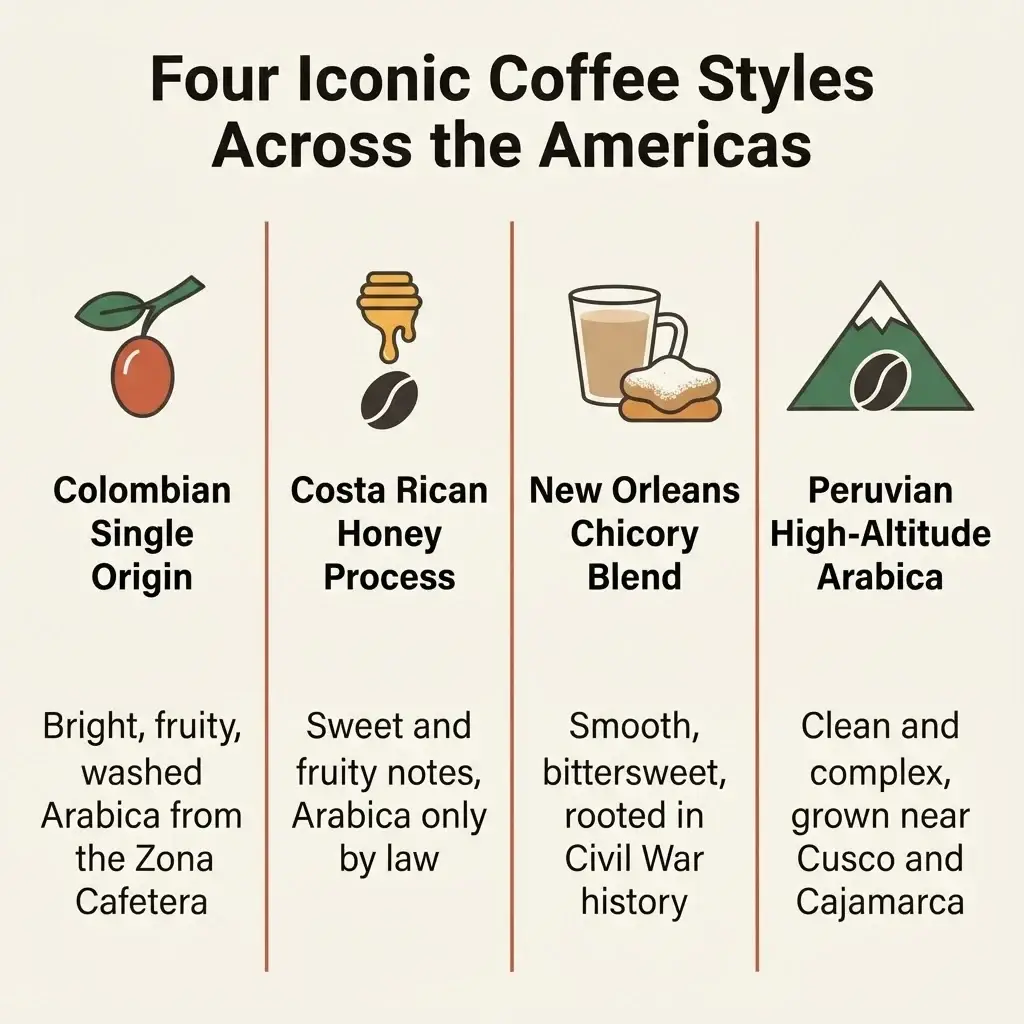
which has a smooth, bittersweet, slightly earthy flavor that complements coffee beautifully. Order your cafe au lait with a plate of beignets, sit outside if the weather allows, and let the moment happen at its own pace.
Beyond Cafe Du Monde, New Orleans has a growing specialty coffee scene that honors tradition while experimenting with modern techniques. There are now roasters and third-wave shops working with single-origin beans and pour-over methods alongside the traditional chicory blends. This is a city where you genuinely do not have to choose between history and excellent craft coffee — you can have both on the same morning walk.
Seattle: Where American Coffee Culture Got Its Ambition
If you are traveling through the US Pacific Northwest, Seattle is the city that put American coffee culture on the global map, and it still delivers. The original Starbucks opened on March 30, 1971, at Pike Place Market, and while the chain itself became a global phenomenon far beyond anything resembling specialty coffee, its origin story in Seattle sparked a broader national conversation about coffee as an experience rather than just a utility. That conversation has since evolved dramatically, and Seattle today is home to some of the most serious specialty coffee operations in the country.
From what travelers and coffee professionals consistently report, Seattle’s strengths are its roaster diversity (Victrola, Caffe Vita, Milstead and Co., and many others), its neighborhood cafe culture in areas like Capitol Hill and Fremont, and its proximity to the natural landscapes that make a coffee-fueled morning before a hike feel like a complete life experience. Food & Wine’s 2025 ranking of the best coffee cities in the US placed Los Angeles at the top, with Seattle and New York City close behind, reflecting just how competitive the US specialty coffee scene has become.
If you have a morning in Seattle and coffee is your priority, Pike Place Market is worth visiting not just for the nostalgia but because the market itself is a beautiful, chaotic, atmospheric place to spend a couple of hours. Then walk or take a short ride to Capitol Hill, which has the highest concentration of independent specialty cafes in the city.
Lima, Peru: South America’s Most Exciting Emerging Coffee City
Peru does not get nearly enough credit in coffee travel conversations, and that is starting to change. From what specialty coffee writers and travelers consistently report, Lima is one of the most exciting cities in South America right now for anyone who takes coffee seriously. Peru grows high-altitude Arabica beans in regions north and east of Lima, particularly around Jaen in Cajamarca and near Cusco, and the Lima specialty coffee scene is built around showcasing those domestic beans.
Sprudge’s Lima coffee guide, one of the most detailed English-language resources on the city’s coffee scene, paints a picture of a city that went from one Starbucks location in the early 2000s to a diverse and increasingly sophisticated coffee culture in a remarkably short time. Key neighborhoods to explore are Miraflores, which is the most accessible for travelers and has a dense cluster of specialty cafes, and Barranco, which is slightly more bohemian and increasingly home to interesting independent roasters.
Practical things to know about Lima as a solo traveler: Miraflores is considered one of the safer districts in Lima and is well set up for visitors, with plenty of accommodation at various budget points, good public transit connections, and walkable streets. The coffee tends to be very affordable by North American or European standards, and the quality at the better specialty shops is genuinely world-class. If you are already planning a trip to Machu Picchu or the Sacred Valley, Lima is almost certainly your entry point, and it is worth arriving a day or two early to explore the coffee scene properly.
Mexico: Oaxaca and Mexico City for the Serious Coffee Traveler
Mexico is one of the most underrated coffee travel destinations in the Americas, and Oaxaca in particular deserves a mention. The state of Oaxaca produces some of Mexico’s finest specialty coffees, grown at high altitudes in the mountains of the Sierra Norte by indigenous farming communities. Mexico City has responded to this with a specialty coffee scene that draws on the country’s own production in a way that feels genuine and exciting rather than imported.
From what specialty coffee travelers consistently report, Mexico City’s coffee bars are doing something interesting: many source exclusively from Mexican-grown beans, which means that drinking a cup in one of the better specialty shops in Roma Norte or Condesa is a direct connection to the farms producing the beans a few hundred miles south. That kind of traceability is part of what makes Mexico City’s coffee culture feel distinctive rather than generic.
For travelers heading to Oaxaca specifically, the city has its own growing specialty coffee scene built around locally grown beans, and the food culture there (mezcal, tlayudas, chocolate, mole) pairs beautifully with a coffee-focused day of exploration. Sprudge maintains a city guide resource that includes guides to Mexico City and Oaxaca and is worth bookmarking for pre-trip planning.
How to Approach Coffee Travel as a First-Timer
A few things I have learned from thinking carefully about how to make travel experiences meaningful rather than just logistical:
The most rewarding coffee experiences on the road tend not to be the ones you planned the most carefully. Yes, booking a coffee farm tour in the Zona Cafetera requires some advance planning and transport coordination, but once you are there, let the experience breathe. Stay for the second cupping. Ask the farmer a question. Do not rush back to your hostel to check your phone.
In terms of practical preparation, here is what tends to make a big difference. First, learn a few words in the local language related to coffee before you arrive. Even in Colombia or Costa Rica, where English is spoken in many tourist areas, asking for your coffee in Spanish signals genuine interest and almost always results in a warmer interaction with the barista or farmer. Second, resist the pull of the familiar chain. It is genuinely hard to walk past a comfortable international brand when you are tired and slightly disoriented in a new city, but the most memorable cups I have ever heard travelers describe were always in small, independent spots. Third, do not over-schedule your coffee days. Coffee tasting, like wine tasting, is best done slowly, with time to sit, absorb, and let the flavors settle.
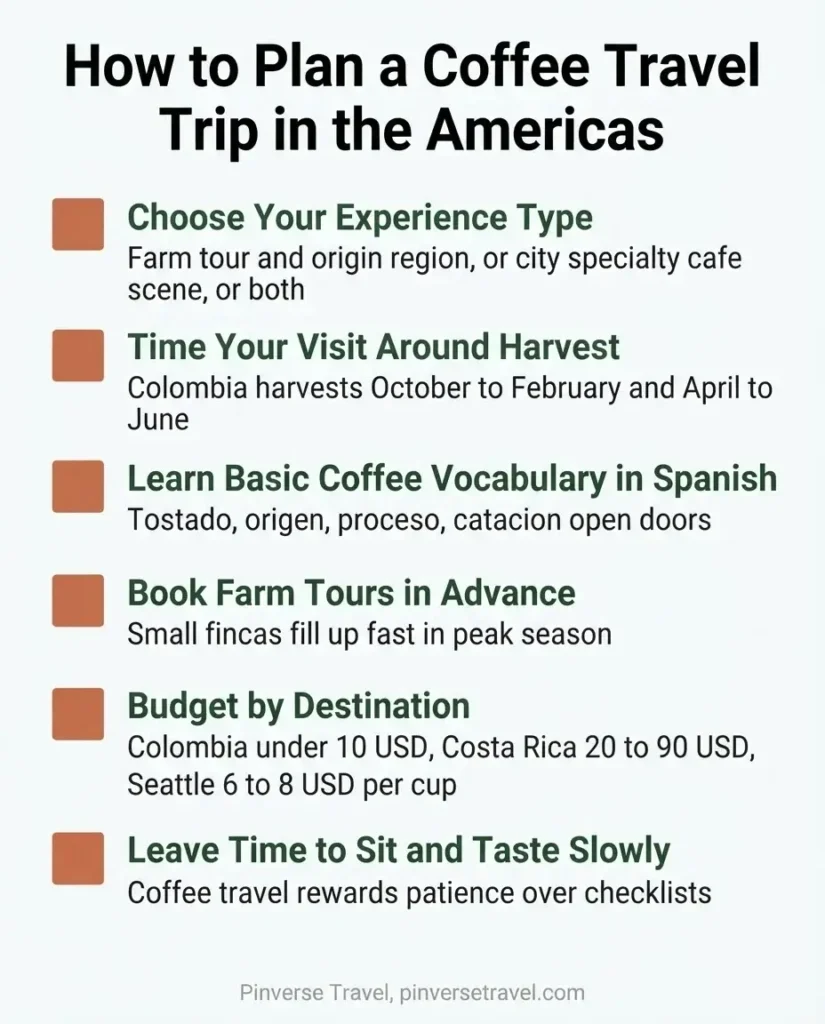
Finally, if you are building an itinerary around coffee, think about whether you want the production experience (farm tours, growing regions, the origin story) or the drinking culture experience (specialty cafes, city neighborhoods, barista culture) or both. The best trip probably includes a bit of each: a few days in a growing region where you see and touch the raw material, followed by time in a city where you taste what the best baristas are doing with it.
A Few Practical Notes Before You Go
Costs across the Americas are extremely varied. A coffee farm tour in Colombia runs under $10. The same experience in Costa Rica could be $20 to $90 depending on the operator. A specialty coffee in Lima or Mexico City might cost $3 to $6 USD. In Seattle or New York, expect to pay $6 to $8 for a specialty pour-over. Budget accordingly, but also know that the most expensive experience is not always the best one.
Language: Spanish is the working language across most of the coffee-growing regions covered here (Colombia, Costa Rica, Peru, Mexico). Learning how to order coffee in Spanish and ask basic questions about origin and process is one of the highest-return investments you can make before any of these trips.
Timing: Coffee harvest season varies by country. In Colombia, there are two harvests: the main harvest (October to February) and the mitaca or smaller secondary harvest (April to June). In Costa Rica, harvest runs roughly November to March. Visiting during harvest season means seeing the full process in action, which is a completely different experience from visiting in the off-season.
Whether you are starting in Colombia’s Zona Cafetera or finding your footing in a Lima specialty shop, the Americas will give you more than a great cup of coffee. They will give you a story worth telling.