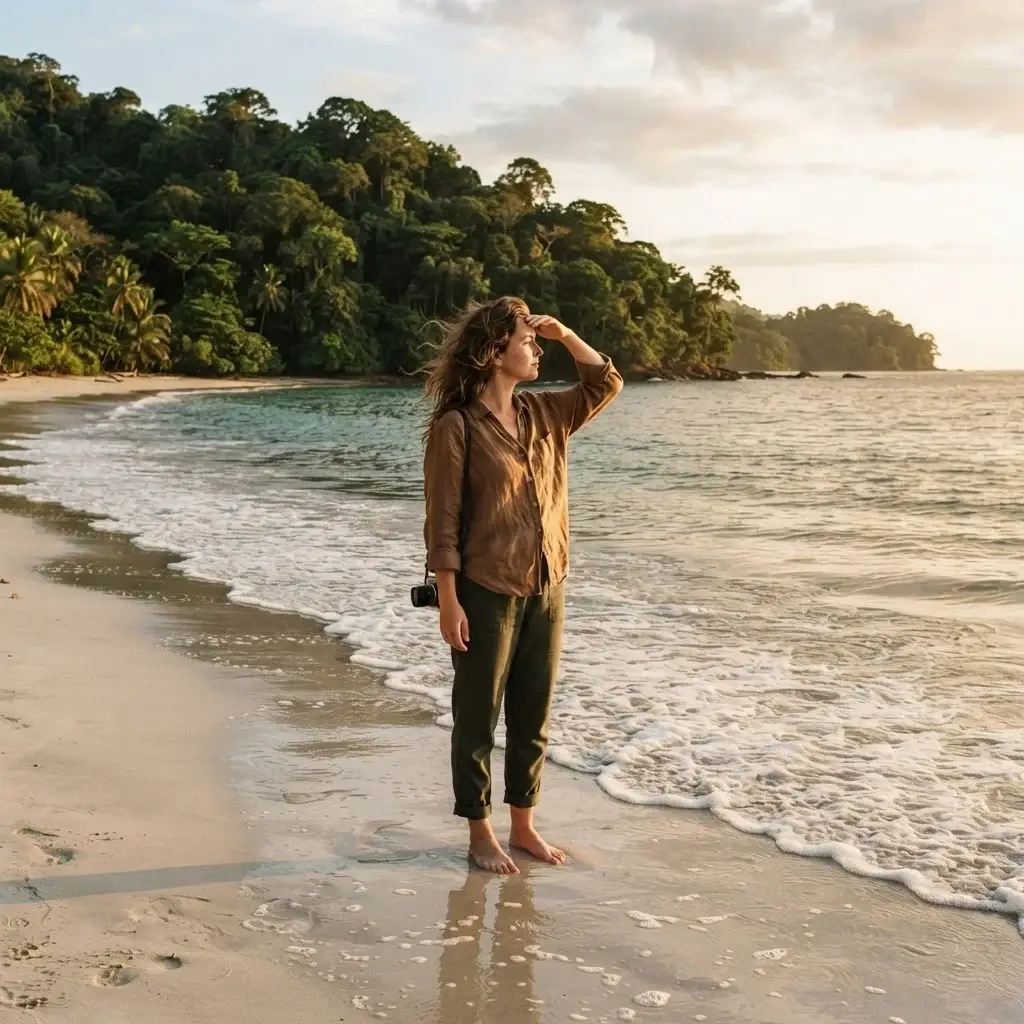
I remember the feeling well. You have an idea: Central America. Beaches. Maybe a few weeks of freedom. But then you open a tab and it fills up with ranked lists of places you have never heard of, generic safety warnings, and affiliate-stuffed articles that all sound exactly the same.
None of them answer the actual question you are sitting with, which is: which beach is right for me, and how do I actually get there without losing my mind in the process?
I have spent years building a travel life from the ground up, from backpacking solo across Europe with a busted budget to teaching English in Thailand and learning the art of slow arrival in a new place. I know what it feels like to research a destination for weeks and still show up feeling unprepared. So let me give you the kind of breakdown I always wish someone had given me.
Central America is not one thing. It is seven countries with seven different personalities, a Pacific coastline and a Caribbean coastline that feel like different worlds, and beaches that suit surfers, snorkelers, slow travelers, and culture seekers in completely different ways. Here is where to go, who each place is best for, and what you genuinely need to know before you book.
First, the Basics You Need to Know
Before getting into individual destinations, a few things will shape your entire trip planning and they are worth covering now.
Visa requirements: US citizens can enter Costa Rica visa-free for up to 180 days, which is extraordinary and underused. Panama allows up to 90 days visa-free by air or land. Belize allows up to 30 days. El Salvador, Guatemala, Honduras, and Nicaragua fall under a shared Central America Border Control Agreement, which gives US citizens a combined 90-day visa-free window across those four countries. You will want a return or onward ticket ready for most entry points. For the most current and complete entry requirements before you travel, check the official Visit Costa Rica entry requirements page for Costa Rica specifically, and the State Department for other countries.
Safety: This is the big question and it deserves a straight answer. The region is not uniformly risky. Some areas require more caution than others, and a good read from National Geographic’s practical guide to traveling in Central America frames it well: follow official travel advisories, avoid displaying valuables, carry only the cash you need, use a money belt, and avoid walking alone at night in larger cities or along dark beaches. These are precautions that apply in much of the world. The specific safety picture for each country is covered under each destination below.
When to go: The dry season across most of Central America runs from December through April. This is when skies are clearest, roads are more passable, and beach weather is most reliable. One thing to plan around: Semana Santa, which is Easter week, is when enormous numbers of local families descend on every popular beach across the region. Prices spike, accommodation books out weeks in advance, and the crowd vibe shifts completely. Either plan around it or lean in and treat it as a cultural experience.
Caribbean vs. Pacific: The Pacific coast tends to have stronger surf, drier weather during dry season, and more dramatic scenery. The Caribbean side (eastern coast countries, plus Panama’s Bocas del Toro) has calmer, warmer water, more reef snorkeling, and a distinctly different cultural character shaped by Afro-Caribbean communities, reggae, rice and beans cooked in coconut milk, and a pace of life that runs several gears slower than anywhere on the Pacific.
Now, the beaches.
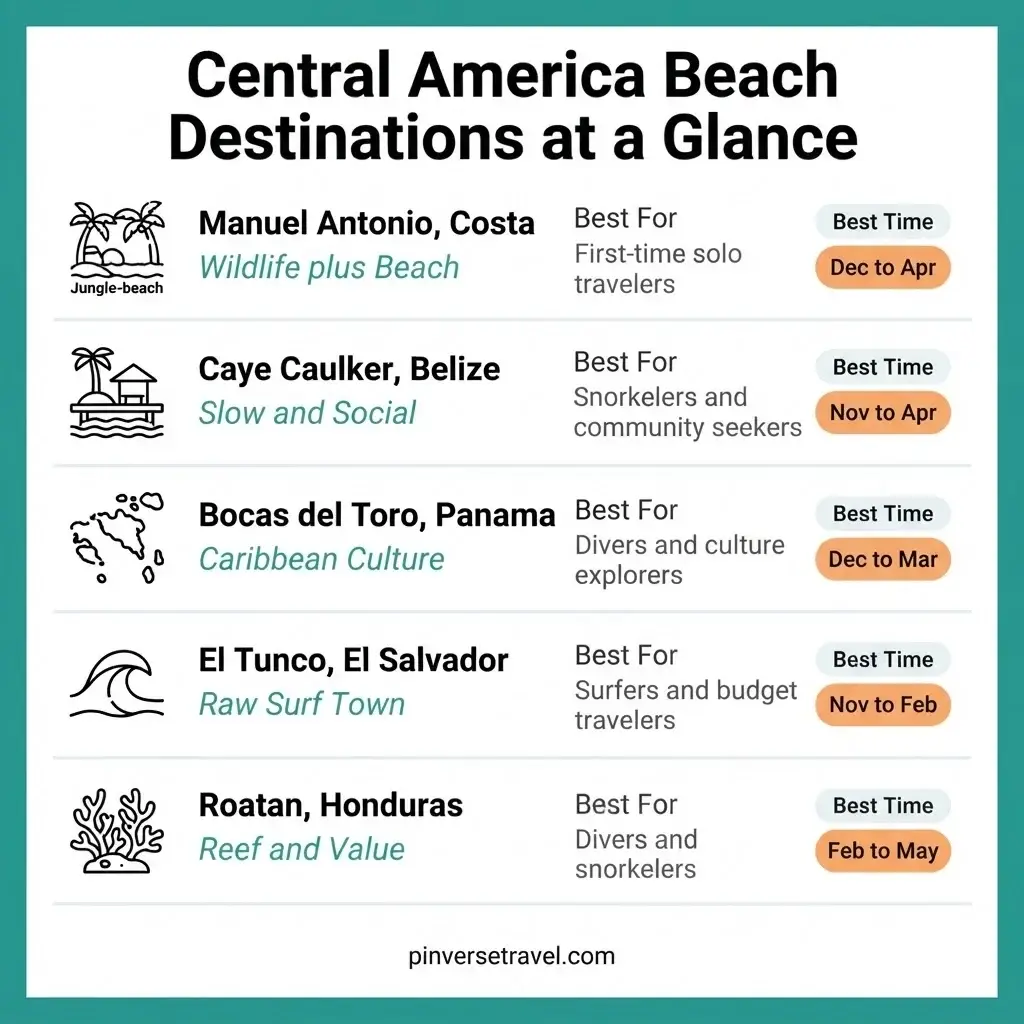
Manuel Antonio, Costa Rica
The All-Rounder That Actually Earns Its Reputation
Manuel Antonio comes up on every Central America beach list, and the skeptic in you might assume that means it is overrated and overcrowded. It can get busy, especially on weekends and during dry season peaks. But there is a reason solo travelers keep recommending it, and it is not just the beaches.
The beaches here sit inside a national park, which means they are clean, protected, and surrounded by actual rainforest. Monkeys wander through the trees above you while you are eating lunch. Sloths hang from branches at trailhead level. The biodiversity is extraordinary and immediately visible, even for someone who has never hiked a day in their life.
The park is small enough to navigate in a half day but rich enough to spend a full day without rushing. Trails wind between the forested interior and four distinct beaches, each with a different character. Playa Espadilla Norte is the main beach, open and lively. The inner park beaches are calmer and more sheltered. The water is warm and generally safe for swimming, which is not something you can say about every Pacific beach in the region.
One thing that catches first-timers off guard: tickets to the park must be purchased online in advance and there is a daily visitor cap. You cannot just show up and walk in. Book through the official SINAC platform before you arrive. The entrance fee for adult foreigners is $16 USD plus IVA tax. The park is open Wednesday through Monday, 7:00 AM to 3:00 PM, and is closed every Tuesday.
For solo travelers, the town of Quepos, just a few kilometers from the park entrance, has a solid hostel scene, restaurants at every price point, and easy bus connections from San Jose. You do not need a rental car here. Local buses and tuk-tuks cover the distance between Quepos and the park entrance cheaply. If you are watching your budget, eat where the locals eat in Quepos rather than at the tourist-facing restaurants near the park gates, where prices are noticeably higher.
Best for: First-time solo travelers, wildlife enthusiasts, anyone who wants beach plus jungle plus easy logistics in one place.
Caye Caulker, Belize
The Slow Lane, But Genuinely
Go Slow. That phrase is painted on walls, printed on t-shirts, and stitched into the philosophy of life on Caye Caulker. It is not just tourism branding. The island operates at a pace that feels almost deliberately designed to force you to decompress.
Caye Caulker is a tiny, vehicle-free island off the coast of Belize reachable by a 45-minute water taxi from Belize City. There are no cars. You walk or cycle on sandy paths. The pace of the island means that after one day you will have made three new friends, eaten more grilled fish than you planned to, and genuinely forgotten what your inbox looks like.
But the real draw is underwater. Caye Caulker sits within the Belize Barrier Reef, a UNESCO World Heritage Site listed since 1996 and one of the most pristine reef ecosystems in the Western Hemisphere. The snorkeling is genuinely extraordinary.
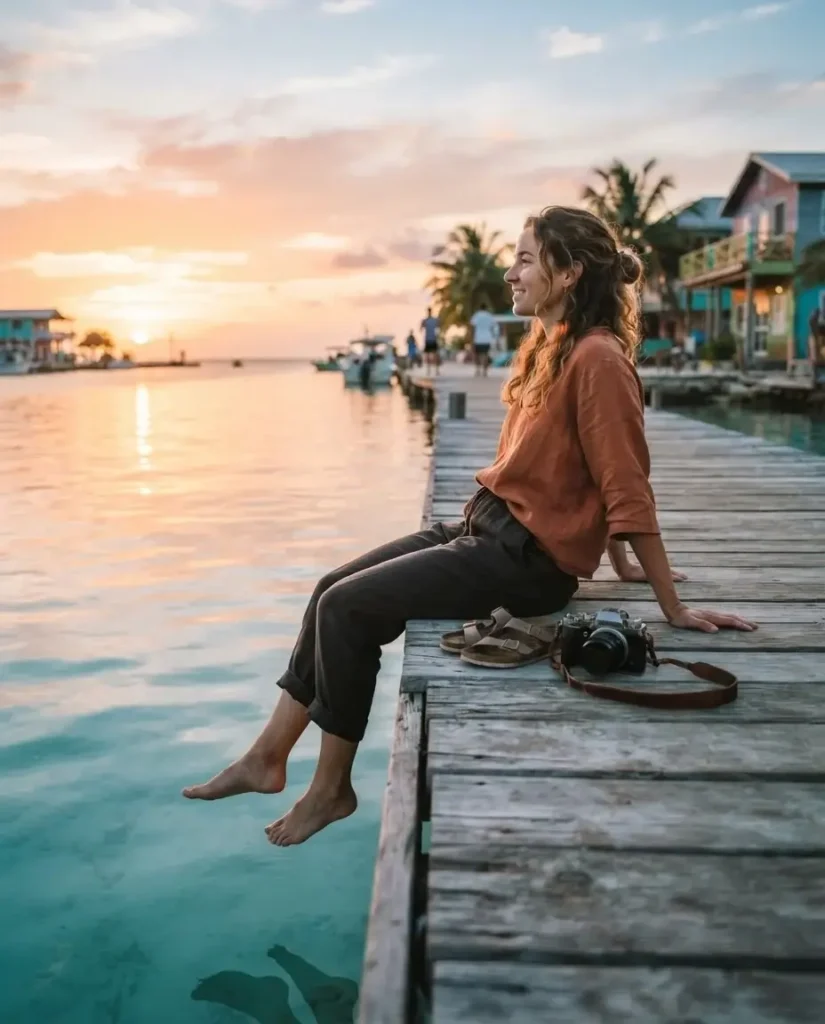
Most visitors do at least one guided snorkel tour to Shark Ray Alley, where nurse sharks and stingrays cruise in water shallow enough that you can almost stand. It is one of those experiences that sounds gimmicky until you are there, and then it is just incredible.
Belize is the only country in Central America where English is the official language, which makes it especially manageable for solo first-timers who are still getting comfortable with navigating a new country. Menus, taxi signs, and hostel staff all communicate in English as a default.
Snorkeling aside, Caye Caulker has a social scene that is almost custom-made for solo travelers. Hostels and small guesthouses fill quickly during high season but have genuine communal energy. The main strip near the Split, a narrow channel of water separating the island, is where people gather at sunset. There are floating bars, local vendors selling fresh fruit, and a crowd that tends to be international, young, and friendly.
Best for: Solo travelers who want community, non-surfers looking for great snorkeling, budget travelers, those visiting Central America for the first time who want a gentle entry point.
Practical note: The water taxi from Belize City to Caye Caulker costs around BZD $25 to $30 one way (roughly $12 to $15 USD) and runs several times daily.
Bocas del Toro, Panama
The Caribbean Archipelago That Operates on Its Own Rules
Bocas del Toro is a loose scatter of islands in northwestern Panama, and it has the feel of somewhere the rest of the world has not quite caught up to yet, even though the word is increasingly out. The Panama Tourism Authority’s Bocas del Toro page describes it well as a destination defined by its vibrant islands, Afro-Caribbean culture, marine life, and surf spots.
Getting there requires either a short flight from Panama City or a bus followed by a water taxi across the border from Costa Rica. That slight effort filters out the day-trippers and leaves a crowd that is mostly backpackers, surfers, divers, and people who came for a week and stayed for a month. The main hub is Bocas Town on Isla Colon, which has restaurants, hostels, dive shops, and enough nightlife to keep things interesting. But if you want to escape the social scene and get more nature immersion, the move is to take a water taxi to Isla Bastimentos, where the vibe is quieter, the beaches are wilder, and Red Frog Beach lives up to every description of it.
The culture here is genuinely distinct from the rest of Panama. Afro-Caribbean heritage shapes the food, music, and rhythm of daily life. Eat rice and beans cooked in coconut milk at a local spot in Bocas Town rather than at one of the tourist-facing restaurants near the dock. Buy fresh ceviche from a small stand. The food scene is affordable and deeply good if you go local.
Water taxis between islands cost just a few dollars and run throughout the day.
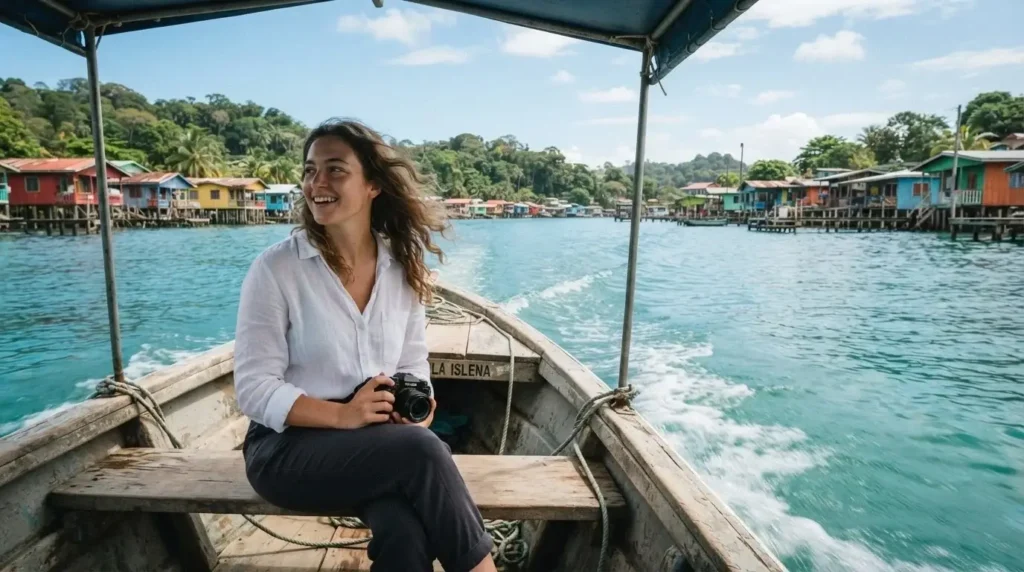
There is no need to pre-plan every movement. The archipelago rewards spontaneity.
One honest note: Bocas has a reputation for a party culture, particularly among the hostel crowd. That is real, but it is also easy to sidestep. The archipelago is big enough that you can find your own pace. Solo travelers who come looking for nature and genuine Caribbean culture rather than hostel nightlife will find both, as long as they are willing to explore a little further than the main dock.
Best for: Solo travelers who want Caribbean culture, diving and snorkeling, a mix of activity and true rest, and something that feels more remote than the obvious stops.
Playa El Tunco, El Salvador
The Surf Town That Tends to Surprise People
El Salvador does not always make it onto people’s Central America radar, and that is part of why El Tunco works so well for the travelers who do find it. It is small, unpretentious, and built almost entirely around surfing. The waves break on a dark volcanic sand beach, and the town exists to fuel the people riding them.
If you do not surf, El Tunco still has a charm. The pedestrian promenade is lined with small restaurants, surf shops, and bars that come alive in the evening. There are regular sunset bonfires on the beach. The food is good, local, and cheap. A full meal at a local comedor might cost you $3 to $5 USD.
For anyone considering learning to surf, El Tunco is one of the better places to start in Central America. Lessons are widely available, rental boards are cheap, and according to the Surf Atlas El Tunco guide, the dry season months from November through February bring smaller, more manageable waves that work well for beginners, while the March to October wet season brings overhead swells better suited to experienced surfers. Pick your timing based on your skill level.
From a safety perspective, El Salvador has had a dramatic and well-documented security transformation in recent years. The beach communities along the coast, particularly El Tunco and nearby El Zonte, have long been considered safe for travelers and have a strong international visitor presence. That said, apply the same common-sense precautions here as anywhere: avoid walking alone at night on dark stretches, keep your valuables out of view, and stay aware of your surroundings.
Getting to El Tunco from San Salvador is a bus or shuttle ride of about an hour to an hour and a half, making it a very accessible beach escape even from the capital. Many travelers use it as a starting point for a longer surf trip down the coast.
Best for: Surfers at any level, budget travelers, anyone who wants a real local beach town feel without a heavily touristy crowd.
Roatan, Honduras
One of the Best Reef Dives in the Western Hemisphere
Roatan deserves a separate conversation from the mainland Honduras safety picture. The US State Department currently holds Honduras at a Level 3 “Reconsider Travel” advisory due to violent crime, and that is worth knowing. But Roatan, as an island off the northern coast, operates in a very different context. Solo travelers and divers have been visiting Roatan for decades, and the island consistently gets strong safety reviews from the traveler community. Exercise the standard precautions, book reputable transport, and stick to the well-established tourist zones of West End and West Bay, and you will find a place that is far safer in practice than the mainland advisory suggests.
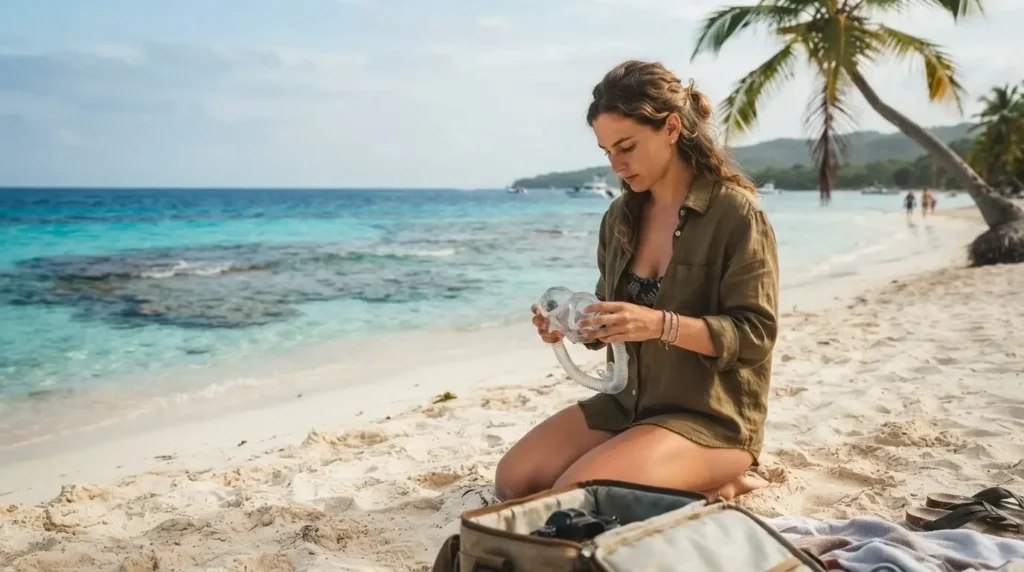
What Roatan offers that is difficult to match anywhere else in Central America is coral reef diving at a world-class level for a fraction of what you would pay in more polished dive destinations. The reef sits just meters off the beach at West Bay, which means you can snorkel without even getting on a boat. The visibility is extraordinary. Certified divers can access wall dives and reef formations that draw people from across the world.
West Bay Beach is the most photographed, the most polished, and the most resort-adjacent strip on the island. West End, a short water taxi ride away, is where the dive shops, hostels, and casual restaurants cluster and where the solo traveler community gravitates. West End has less of a luxury resort feeling and more of a Caribbean village feel, which suits most of the people who show up independently.
The food scene on Roatan is built around fresh seafood. Fish tacos, grilled lobster, and coconut shrimp appear on menus everywhere. The locally caught lobster is priced far below what you would pay at home. Eat it at a simple spot in West End rather than at one of the resort restaurants and you will pay a fraction of the price for an equivalent meal.
Best for: Divers and snorkelers, travelers who want Caribbean beaches without the price tag of more established destinations, anyone willing to navigate the Honduras advisory context for a genuinely special reef experience.
A Note on Getting Between Destinations
One of the things that keeps people from committing to a Central American beach trip is the logistics question. The region is compact, and while it is not always the easiest to move through, it is far more navigable than it can look on paper.
Shuttle buses and private minibus services connect the most popular beach towns and border crossings. Water taxis handle the island crossings in Belize and Panama. Domestic and regional flights exist between major hubs. With a smartphone, a basic Spanish vocabulary, and a willingness to ask questions, independent travel is very manageable in this region. From what solo travelers consistently report, the key is building in buffer days when crossing borders or catching ferries, because things run on a more relaxed timetable than you might be used to.
If you are traveling a longer stretch of the region, many people move through the Pacific side of Costa Rica, cross into Panama at Paso Canoas, and then make their way to Bocas del Toro, while others build their trip around the Caribbean corridor through Belize before dipping into Guatemala or Honduras. Both routes work well. The choice usually comes down to which beaches you prioritize.
Practical Packing Notes for Central American Beaches
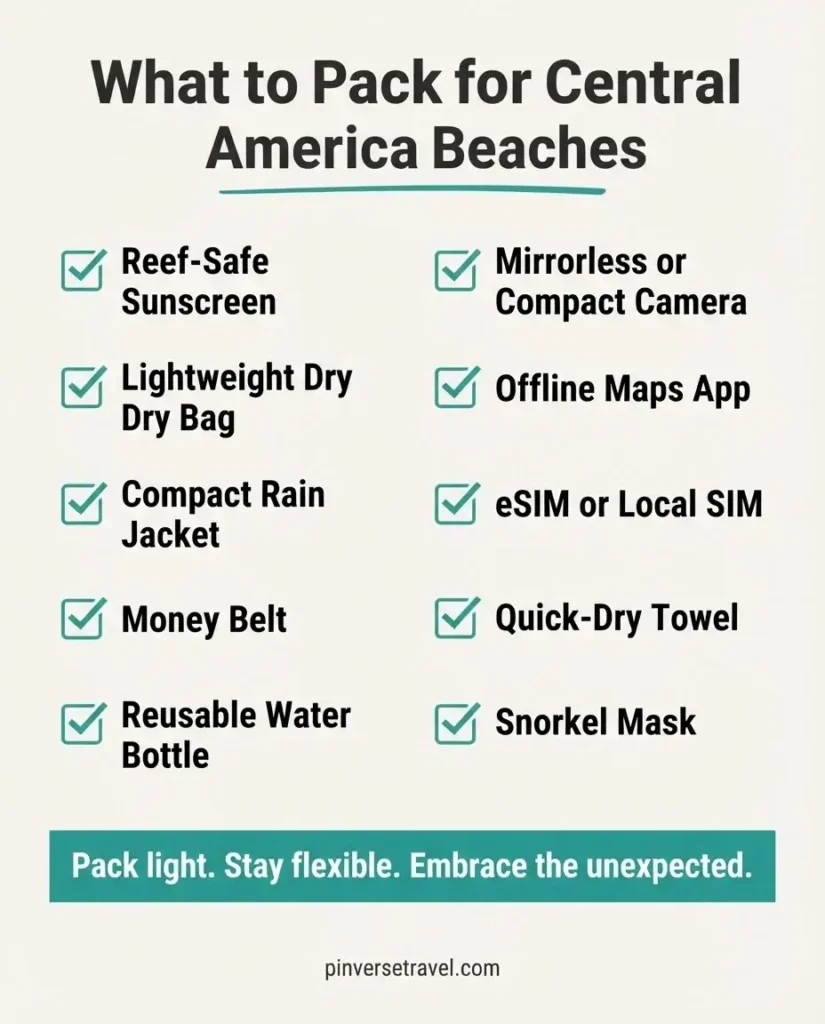
Central America does not require a complex packing strategy, but a few things make a meaningful difference. Reef-safe sunscreen is worth using, especially around protected reef zones in Belize and Honduras where standard chemical sunscreens are actively harmful to coral ecosystems. A small dry bag keeps your phone and passport safe on water taxi rides and boat tours, which you will be taking regularly. A light rain layer is smart even during dry season, because the region can produce short afternoon showers. A good money belt is less romantic than a backpack but genuinely useful in areas where pickpocketing is a risk.
The most important thing you can pack, though, is a flexible mindset. Central America rewards the traveler who is comfortable with a certain amount of improvisation. Buses that run late. A water taxi that leaves when it feels like it. A hostel that looks different from its photos. These are not disasters. From my own years of travel, including navigating completely unfamiliar systems when I was teaching English in Thailand and living with a family in Ghana, I can tell you that the moments when things do not go according to plan are almost always the moments you end up telling people about years later.
Where to Start If You Are Completely New to This
If you are planning your first Central American beach trip and you want a starting point that is genuinely beginner-friendly, start with Costa Rica. The tourist infrastructure is well-developed, English is widely spoken in beach towns, the entry process is simple, and Manuel Antonio gives you beaches plus wildlife plus national park in one place. Once you have one Central American trip under your belt, the rest of the region becomes far less intimidating.
From there, Belize makes a natural second trip. Caye Caulker in particular has a relaxed, community-oriented atmosphere that works especially well for solo travelers who are still building their confidence on the road.
The rest, including Bocas del Toro, Roatan, and El Tunco, will pull at you eventually. They always do.