There is a version of this decision that takes months. You open a new tab, search “best Caribbean islands,” read three listicles that all say the same five names, close your laptop, and tell yourself you’ll figure it out later. Then later becomes six months from now.
I have been in that exact loop before, not specifically with the Caribbean, but with trip planning in general. Back when I was working a rigid office job in New York, I spent more time daydreaming about destinations than actually booking them, because the respaddle stroke, without any distractions.earch felt overwhelming and I was afraid of choosing wrong. That fear is real, and I want to talk to it directly.
Here is the truth about the Caribbean for solo travelers: most of the well-known islands are genuinely safe, accessible, and deeply rewarding to visit alone. But each island has a completely different personality. The one that thrills your friend who wants beach bars and nightlife might bore you to tears if you want rainforest hikes and street food. So rather than handing you a generic ranked list, this guide is going to help you figure out which islands actually fit the kind of solo traveler you are.
We will cover five islands in real depth: what each one feels like to move through alone, what to eat, how to get around, rough budget expectations, and the thing most guides skip entirely, which is the cultural experience waiting for you beyond the beach.
Before We Talk Islands: A Note on Timing
Hurricane season in the Caribbean officially runs from June through November, with the peak risk window being August through October. Traveling during those months is not impossible, and many solo travelers do it to save money on flights and accommodation, but you need to build flexibility into your plans and buy travel insurance. The shoulder seasons of late November through December and April through May offer a strong balance of lower crowds, reasonable prices, and reliable weather. January through March is peak season, which means higher costs but also more energy, events, and other travelers to connect with.
The Passport Question Most US Travelers Forget
If you hold a US passport (or even just a US government-issued ID), there are Caribbean destinations you can fly to without a passport. Puerto Rico and the US Virgin Islands are US territories, which means American citizens can arrive with just a valid driver’s license or state ID. This alone makes Puerto Rico an incredible entry point for first-time solo travelers who are still getting their travel documents sorted. For all other Caribbean destinations, you will need a valid US passport, and most islands allow American citizens to enter without a visa for stays of up to 90 days.
Puerto Rico: The Best Starting Point for First-Time Solo Travelers
If you are nervous about your first solo Caribbean trip, Puerto Rico is the place to start. Not because it is the safest or the cheapest or the most beautiful, but because it removes every logistical barrier at once. No passport required for US citizens. US dollars work everywhere. English is widely spoken alongside Spanish. There are no international currency exchange headaches, no confusing SIM card situations, and domestic flights from most major US cities are short and affordable.
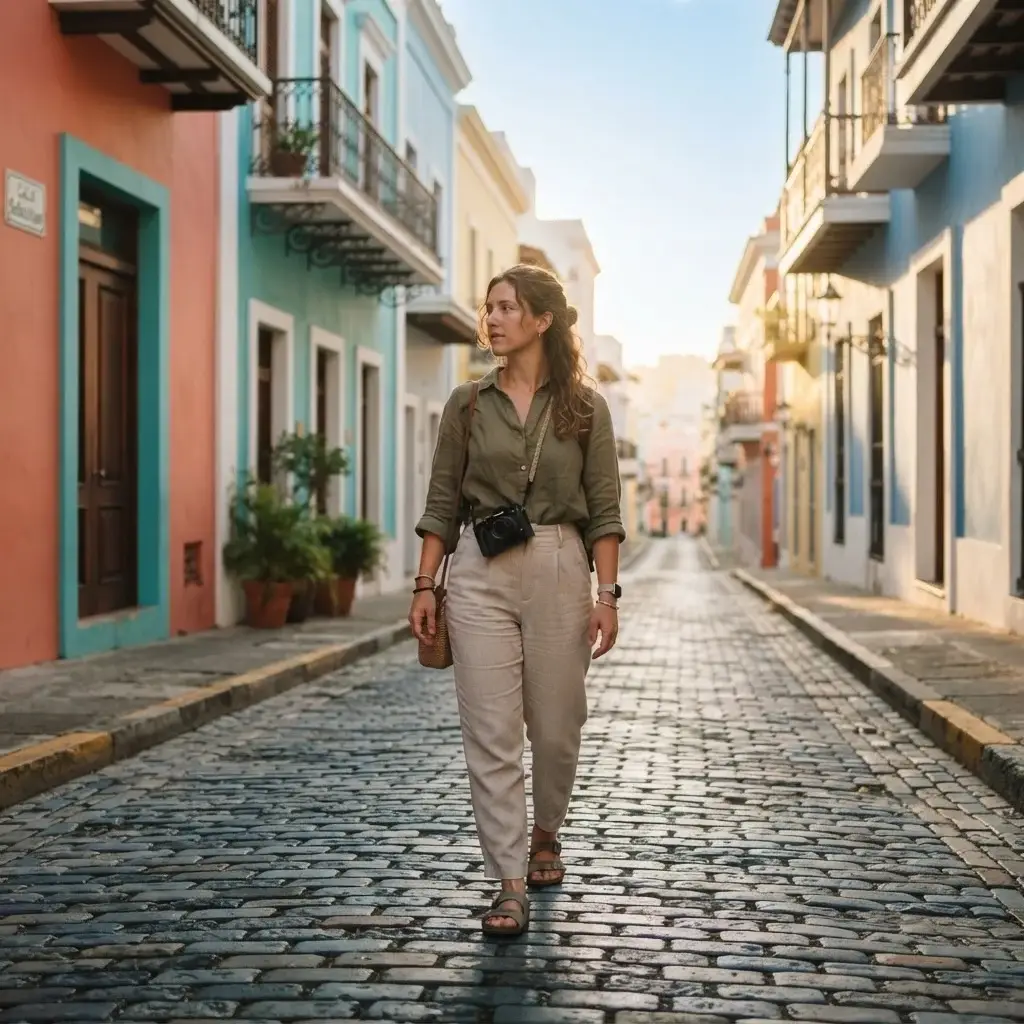
But do not let that ease fool you into thinking Puerto Rico is a watered-down experience. San Juan is one of the most architecturally stunning cities in the Caribbean. Old San Juan, specifically, is a 500-year-old walled city where the buildings are painted in jewel tones of yellow, blue, and coral, the streets are paved with blue-gray cobblestones, and the Spanish colonial forts of Castillo San Felipe del Morro and Castillo San Cristobal rise dramatically above the sea. Walking through the old city alone, especially early in the morning before the tour groups arrive, feels genuinely special.
From a solo travel perspective, Old San Juan is the kind of neighborhood you can wander for hours without a plan. There are local coffee spots, bakeries, small art galleries, and rum bars tucked into narrow streets. It is walkable, it is lively, and it is the kind of place where you naturally start talking to other travelers just because everyone is slightly overwhelmed by how beautiful it is.
For food, do not leave without eating mofongo, a deeply savory dish made from fried plantains that are mashed and filled with garlic, pork cracklings, and usually seafood, beef, or chicken. Street-level local restaurants called fondas often serve it for under $12. Lechon, slow-roasted whole pig, is another essential, and the town of Guavate in the mountains is famous for it if you want to go beyond the city.
The experience I most consistently hear solo travelers describe as a highlight of Puerto Rico is the bioluminescent bay tour. Puerto Rico has three of these, and Mosquito Bay in Vieques is recognized by Guinness World Records as the brightest bioluminescent bay in the world, glowing blue-green at night due to an extraordinary concentration of dinoflagellates in the water. You access it by kayak only, through a guided tour. It is the kind of experience that makes you genuinely grateful you went alone, because you can sit in your kayak in the dark water, glowing with every paddle stroke, without any distractions.

Getting around: San Juan is walkable in the tourist zone, and rideshares work well within the metro area. For day trips to El Yunque rainforest or the island of Vieques, you will need to rent a car or book a tour.
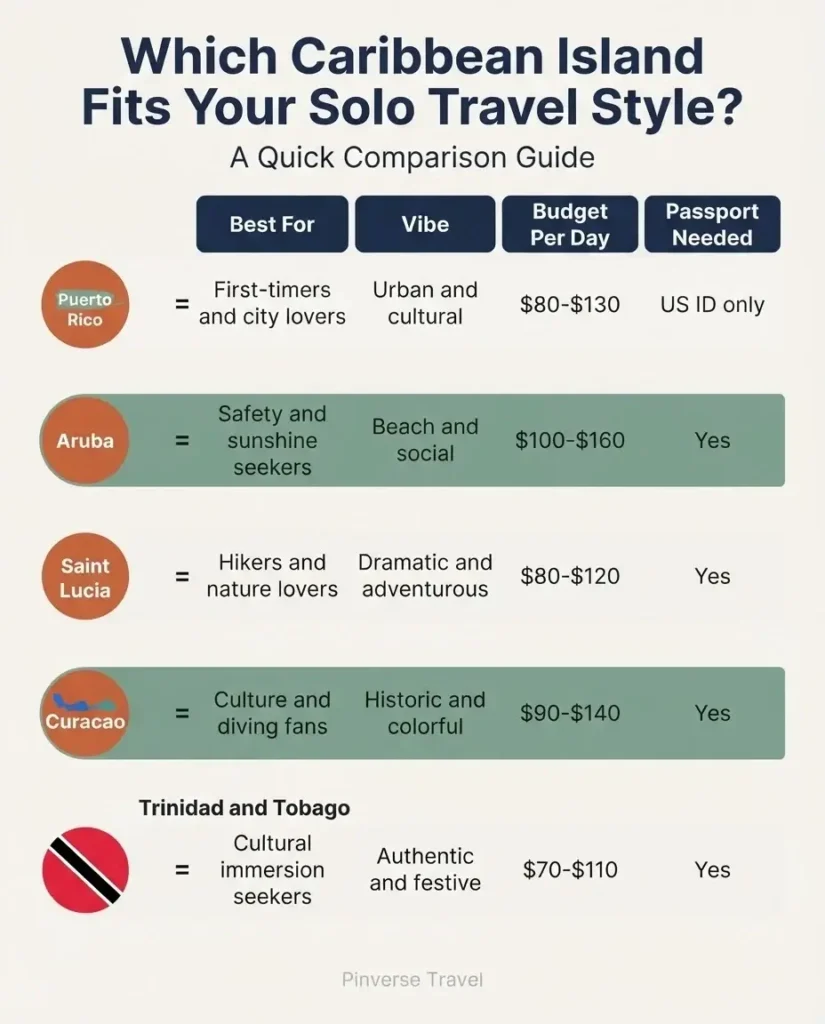
Budget: Expect to spend around $80 to $130 per day as a solo traveler for a mid-range experience in San Juan, covering a comfortable guesthouse, meals, and activities. Eating local rather than in tourist restaurants makes a significant difference.
Aruba: The Island That Earns Its Reputation
Aruba gets a lot of attention as a “safe Caribbean island,” and from everything solo travelers report consistently, that reputation is earned. The crime rate is genuinely low, the tourist infrastructure is well-organized, the people are famously warm, and the island receives more than 300 sunny days per year, which also means it sits outside the main hurricane belt. If reliable weather and a stress-free atmosphere are high on your list, Aruba belongs near the top.
What makes Aruba interesting beyond safety is the cultural texture. The island has a multicultural mix of Dutch, African, South American, and Caribbean influences that shows up most clearly in the food, the architecture of Oranjestad, and the way locals move through daily life. Aruba’s national language is Papiamento, a creole language that blends Portuguese, Spanish, Dutch, and African elements. You will hear it everywhere and it will sound unlike anything else you have encountered.
The official Aruba Tourism Authority, at aruba.com, has a genuinely useful trip planner tool called myAruba and a well-developed “solo traveler” itinerary written by a local. This is worth using before you arrive. There is also a $20 sustainability fee added to all visitor trips that goes toward environmental conservation.
For solo travelers, the Palm Beach area is lively and social, lined with beach bars, restaurants, and activity operators where you will naturally fall into conversation with other travelers. Eagle Beach, a short drive south, is quieter, wider, and consistently ranked among the most beautiful beaches in the Caribbean. It is the kind of beach that rewards slow mornings, a book, and a long walk.
Eat keshi yena while you are there. It is a traditional Aruban dish made from a whole Gouda cheese hollowed out and stuffed with spiced meat, olives, capers, and raisins, then baked until golden. It sounds strange and tastes extraordinary. Also try pan bati, a soft cornbread pancake served alongside most local meals, and fresh fish straight from the grill at any of the casual beach-facing restaurants near the waterfront in Oranjestad.
Getting around: Aruba is small enough that renting a car for a few days makes genuine sense. Buses connect the main tourist areas, and rideshares are available. The island is also flat enough that cycling is genuinely pleasant.
Budget: Aruba runs slightly higher than some other Caribbean islands. A solo traveler on a mid-range budget should plan for roughly $100 to $160 per day including accommodation, meals, and a rental car day or two. Eating local at the smaller family-run restaurants rather than the resort strip keeps costs reasonable.
St Lucia: For the Solo Traveler Who Wants to Feel Something
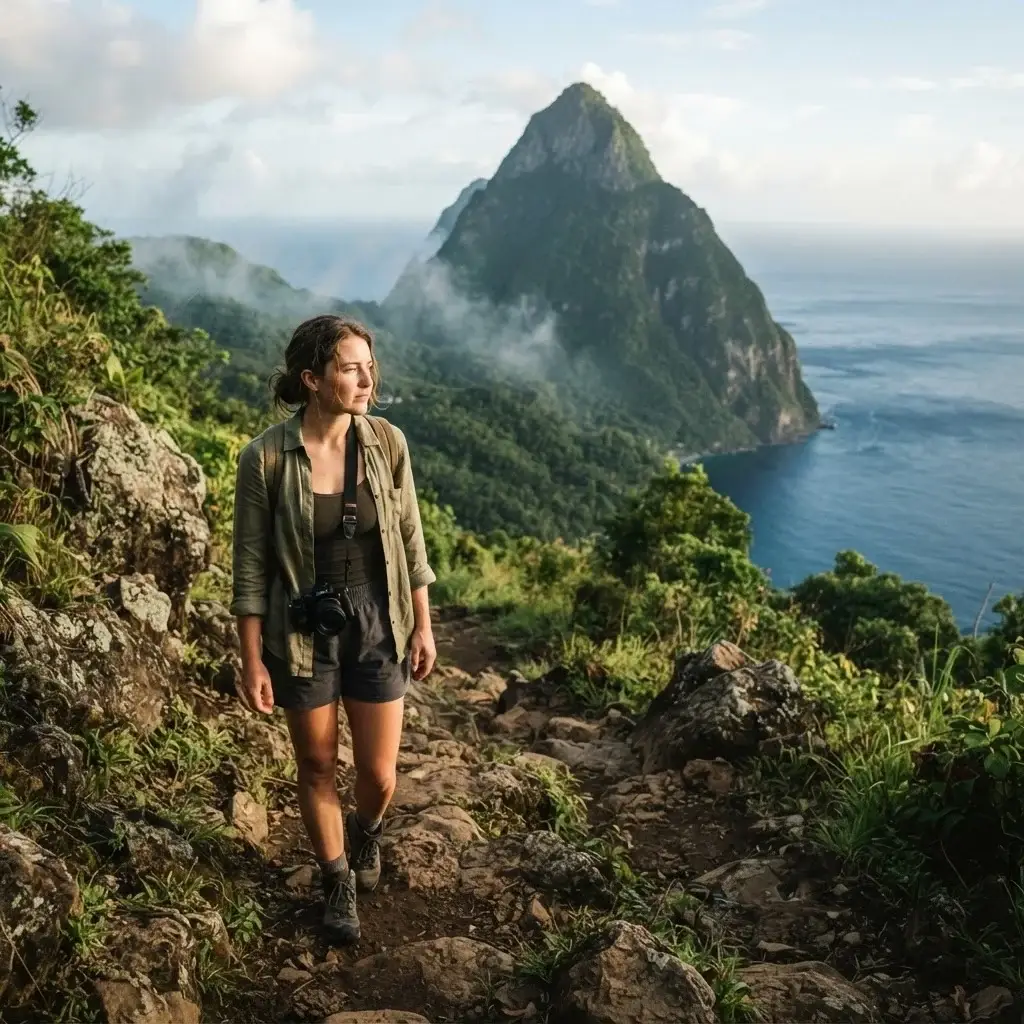
There are beautiful Caribbean islands, and then there is St Lucia. The dramatic geography of the island, with its twin volcanic peaks called the Pitons rising directly from the ocean, its dense rainforest interior, its sulphur springs, and its small, community-driven fishing villages, gives it a depth that beach-focused islands simply cannot match. If cultural immersion and natural wonder matter to you more than nightlife, St Lucia is the one.
The Pitons are the centerpiece of the island, and they are a UNESCO World Heritage Site. As the UNESCO World Heritage Centre describes them, the Pitons Management Area covers nearly 2,909 hectares of land and sea, encompassing two volcanic spires rising to 770 and 743 meters, along with geothermal springs, coral reefs, and extraordinary biodiversity. Gros Piton, the larger of the two, is the one most visitors hike. The entrance fee is $50 USD and includes an assigned local guide, which is not optional but also not a burden. The guides know the trail intimately and the conversations you have on the way up are often the part that stays with you longest.
For solo travel purposes, the official Saint Lucia Tourism Authority at stlucia.org is the best starting point for planning hikes, boat tours, and cultural activities. St Lucia is not a party island. The nightlife is low-key by Caribbean standards, which is a genuine feature if you are the kind of solo traveler who finds loud beach bars exhausting. Instead, the social life here happens at the Friday night Gros Islet Street Party, a long-running weekly fish fry and outdoor party in the fishing village of Gros Islet that draws a healthy mix of locals and travelers. It is exactly the kind of loose, friendly, street-level gathering where solo travelers do very well.
Eat grilled fish at Castries Market, the main covered market in the capital, where local vendors serve up freshly cooked lunches for a few dollars. Bouyon, a hearty stew made with breadfruit, green bananas, dasheen, and fish or chicken, is one of the most culturally representative dishes on the island. Green fig and saltfish, the national dish, shows up at breakfast in local spots and is worth ordering at least once.
Getting around: St Lucia does not have a public bus system in the traditional sense. You rely on minibus taxis, which are cheap but require some confidence in negotiating and understanding routes. Renting a car gives you the most freedom, but the roads in the interior can be steep and winding. Many solo travelers find that booking a half-day guided tour covers the main sites efficiently, then they explore on foot or by minibus for the rest.
Budget: St Lucia sits in a middle range. You can travel here on $80 to $120 per day if you choose a guesthouse rather than a resort and eat local food. The main costs tend to be activities, as the hikes, boat tours, and mud bath excursions near Sulphur Springs add up.
Curacao: The Solo Traveler’s Cultural Discovery
Curacao does not always make the top of Caribbean listicles, which is precisely why I want to talk about it. The island has a cultural richness that most of the more famous islands cannot match, and its capital, Willemstad, is genuinely unlike anywhere else in the region.
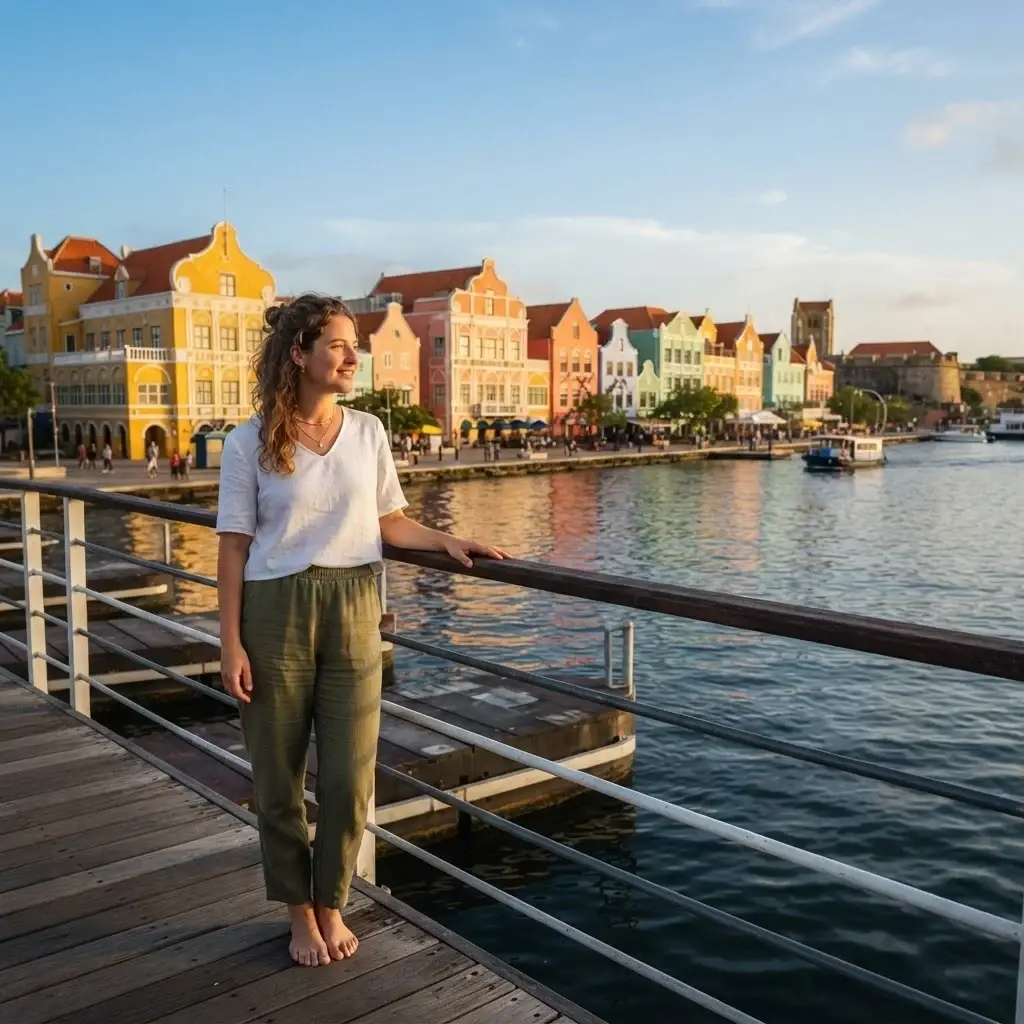
Willemstad’s historic district is a UNESCO World Heritage Site, recognized in 1997. As the UNESCO World Heritage listing describes, the city developed from a Dutch colonial settlement begun in 1634 and grew over three centuries into a multicultural port city shaped by Dutch, African, Caribbean, and Iberian influences. The tradition of painting buildings in vivid reds, blues, yellows, and greens dates to an 1817 prohibition on white exteriors, which were said to cause eyestrain in the tropical sun. The result is one of the most photographed and genuinely surprising cityscapes in the Caribbean. Walking across the Queen Emma Pontoon Bridge, the floating pedestrian bridge that swings open for ships to pass through Sint Anna Bay, with those candy-colored facades in front of you, is one of those moments that stops you mid-step.
For solo travelers, Curacao has a few qualities that make it particularly enjoyable. Willemstad’s Pietermaai district, a historically restored neighborhood of Dutch colonial townhouses that have been converted into boutique hotels, restaurants, and cocktail bars, is exactly the kind of compact, walkable area where solo travel works beautifully. You can cover it on foot, sit at an outdoor bar at midday, and find yourself in a natural conversation by the time you order a second drink.
The island also has some of the best shore diving in the Caribbean. The west coast, especially the area around Westpunt, offers coral walls just a short swim from the beach with minimal boat fees. For solo travelers who dive, Curacao is exceptional value.
Eat keshi yena here too (it appears across the Dutch Caribbean), but also try karko, which is conch stew cooked with local spices, and stoba di kabrito, a slow-cooked goat stew that you will find in local restaurants away from the tourist strip. Plasa Bieu, an old market building in Willemstad, is a famous lunch spot where local vendors serve traditional Antillean food from open-air stalls at very reasonable prices.
Getting around: Renting a car is the most practical option for exploring beyond Willemstad. The city itself is walkable. No reliable ride-share app dominates the market, so agree on taxi fares before you get in.
Budget: Curacao is mid-range, roughly $90 to $140 per day for a solo traveler. Accommodation in Willemstad’s boutique hotels can be surprisingly affordable outside peak season.
Trinidad and Tobago: For the Solo Traveler Who Craves Culture Over Crowds
Trinidad and Tobago is the most culturally complex destination on this list, and that is a genuine recommendation, not a warning. Trinidad in particular is not a beach-holiday island in the way Aruba or Barbados is. It is a working country with a vibrant, layered society shaped by African, Indian, Spanish, French, and British influences. Its food scene, music heritage (steelpan was invented here), and cultural calendar are extraordinary by any standard.
The biggest cultural event in the Caribbean takes place in Trinidad. The official Trinidad and Tobago Carnival happens every year on the Monday and Tuesday before Ash Wednesday. In 2027, the dates are February 8 and 9. Carnival is not just a party, it is a total immersion in music, color, communal energy, and centuries of cultural history. Solo travelers who attend often describe it as one of the most socially effortless travel experiences of their lives, because the entire country becomes one enormous shared celebration and strangers become friends within minutes.
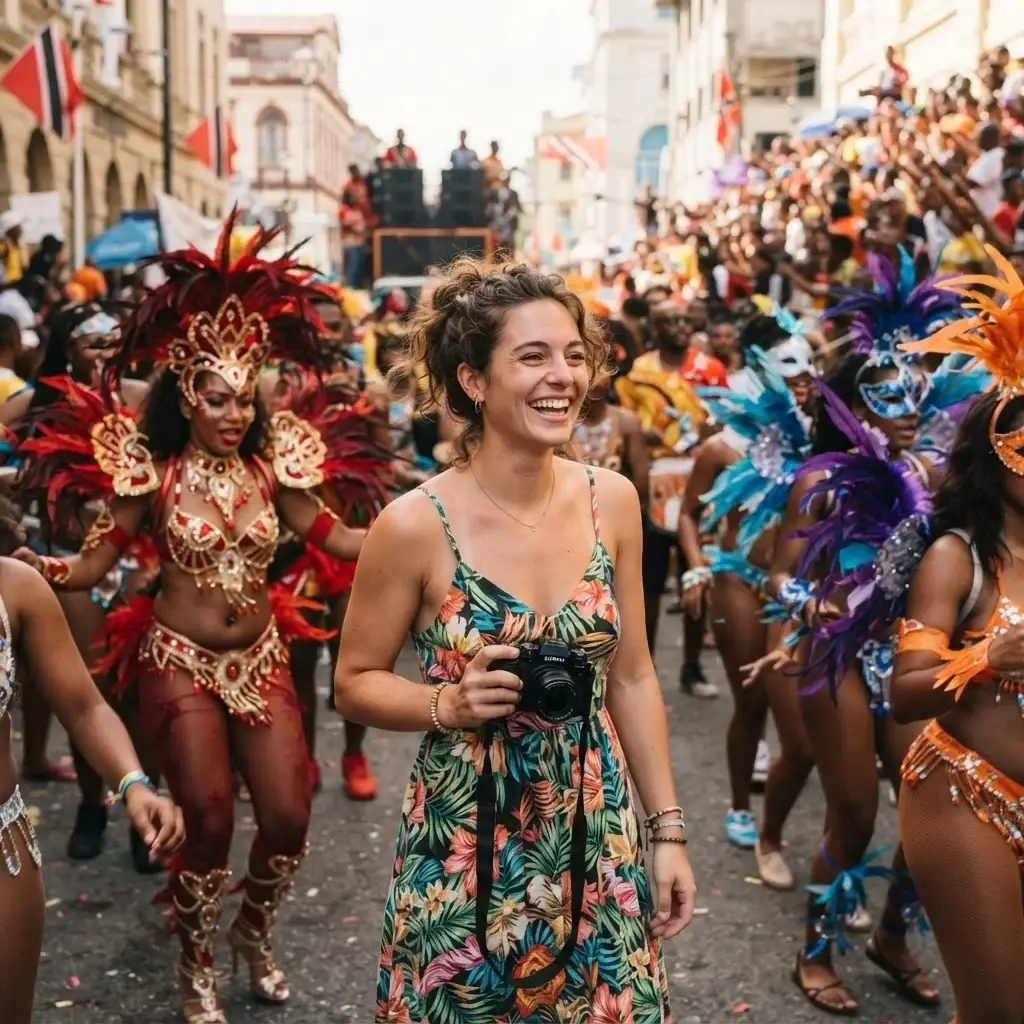
Outside Carnival season, Tobago, the smaller sister island, is where most international leisure travelers spend their time. Tobago is quiet, unhurried, and has some genuinely remarkable snorkeling and diving in the Buccoo Reef area. The people are famously welcoming. Solo travelers consistently describe Tobago as the kind of place where a morning walk to the beach turns into a three-hour conversation with a fisherman who ends up taking you to his favorite local cook shop for lunch.
Eat doubles in Trinidad before you do anything else. Doubles are the iconic street food of the island: two pieces of soft bara fried bread filled with curried chickpeas, topped with pepper sauce, tamarind, and cucumber chutney, served warm by vendors early in the morning for well under a dollar each. Also try roti with curry, pholourie (fried dough balls with dipping sauce), and crab and dumplings in Tobago.
A note on safety: Trinidad’s capital, Port of Spain, does have areas with higher crime rates, and solo travelers should take the same precautions they would in any large city. Stick to well-lit, populated areas at night, use recommended taxi services rather than unmarked cars, and review the current US State Department travel advisory page at travel.state.gov before you book, as advisories are updated regularly and are worth checking for any destination on this list.
Budget: Trinidad and Tobago offers good value by Caribbean standards. A mid-range solo traveler can expect to spend around $70 to $110 per day in Tobago, with Trinidad running slightly cheaper for food and transport since it operates more as a local economy than a tourist one.
The One Question That Actually Helps You Choose
Every single person who searches “best Caribbean islands for solo travelers” is really asking a more specific question underneath. And that question is: what do I actually want from this trip?
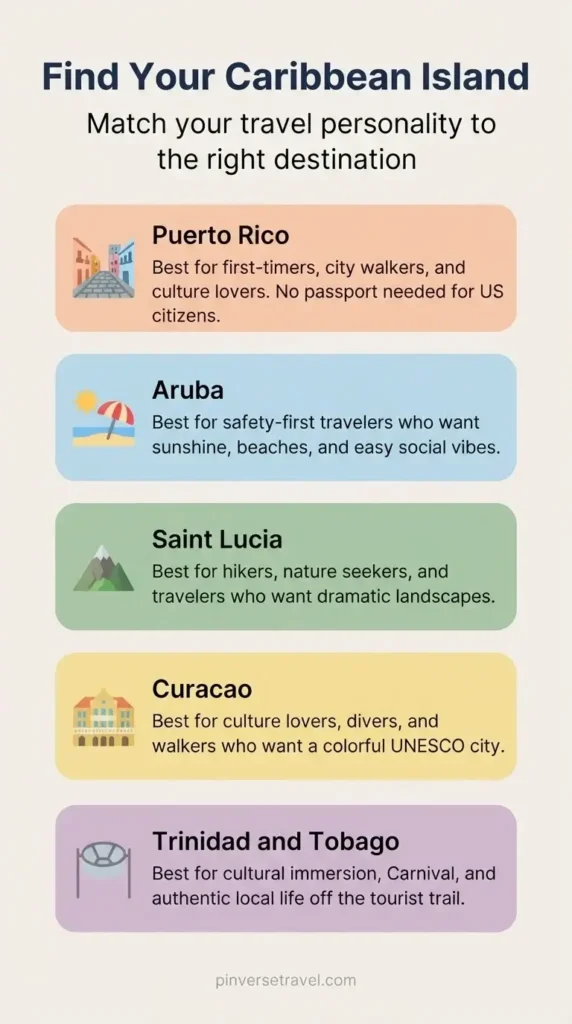
If you want cultural depth, street food, and history in a walkable city, you want Puerto Rico or Curacao. If you want natural drama, hiking, and a genuinely different landscape, you want St Lucia. If you want ease, safety, sunshine, and the social energy of a beach strip where you will naturally fall in with other travelers, you want Aruba. If you want to be fully immersed in local Caribbean life, music, and the most culturally layered experience on this list, Trinidad and Tobago will give you that.
None of these islands will disappoint a curious, open, solo traveler.
All of them will exceed your expectations if you go in willing to slow down, eat what the locals eat, walk neighborhoods that are not in the itinerary, and let a day go sideways now and then.
I say this as someone who has been the person standing on the edge of possibility, talking myself out of a trip that would have changed me. Do not wait for the perfect moment or the perfect companion. The best version of a Caribbean trip is the one you actually take.
Pack your bag. Book the flight. You will figure out the rest when you get there.