Where to Go in the Americas When You’re Done With Crowds

There is a specific kind of tired that only travel can create. Not the good tired from a long hike, but the exhausted, hollow feeling of standing at a “world-famous” viewpoint surrounded by a thousand other people, all of you waiting your turn for a photo that already exists ten million times on the internet.
I know that feeling. I have stood in enough crowded European squares and jostled through enough packed tourist markets to understand that busyness and richness are not the same thing. And the Americas, as enormous and varied as this hemisphere is, have a version of this problem too: the same handful of places absorb the majority of travelers, while extraordinary destinations sit largely undiscovered a few hundred miles away.
If you have done Machu Picchu, Cancun, the Grand Canyon at peak season, or Tulum before every luxury resort arrived, and you are now looking for something that feels genuinely quiet and real, this guide is for you. These are not obscure places with nothing to offer. They are fully accessible, deeply rewarding, and still operating at a human pace. That is a rare combination, and it will not last forever.
Before we dive in, it is worth understanding why crowd fatigue is not just a personal preference. According to Sustainable Travel International, overtourism occurs when visitor numbers exceed a destination’s capacity to manage them sustainably, leading to cultural erosion, environmental damage, and a diminished experience for everyone involved. Choosing quieter places is not just good for your own experience. It is better for the places you visit.
Here is where to go.
Oaxaca City, Mexico: The Place That Rewards Slowing Down
Oaxaca often appears on “underrated” lists, but it still draws significantly fewer visitors than Mexico City, Cancun, or Los Cabos, and the experience feels completely different from those places. It is a colonial city in the southern highlands of Mexico, ringed by mountains, built around a central zocalo of low ochre and jade-painted buildings, and buzzing with a creative and culinary scene that has no real equivalent anywhere else in the country.
The reason it has not been swallowed by mass tourism is partly geographic: you have to want to come here. It is not a resort destination. There are no beaches. You come for the food, the craft markets, the ruins, and the pace of life. That filters the crowd before anyone even arrives.
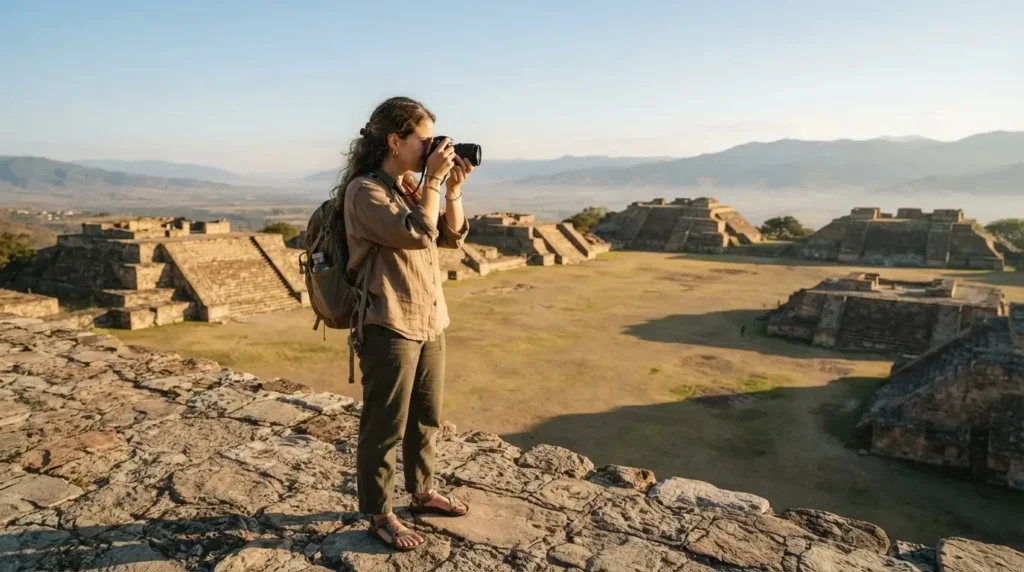
The historic center of Oaxaca and the archaeological site of Monte Alban together form a UNESCO World Heritage Site, designated in 1987. The listing describes over 1,200 catalogued historic monuments within the city alone, and Monte Alban, the ancient Zapotec capital that flourished from roughly 500 BC to 850 AD, sits just eight kilometers from the city center on a flattened mountaintop that offers one of the most striking views in all of Mexico. Early mornings, you can walk through the site with very few other people around.
But food is honestly the reason to spend time here. Oaxacan cuisine is its own world: you will find the seven classic moles (the black mole, made with chocolate and chili, being the most famous), tlayudas, which are large crispy tortillas topped with black beans and your choice of protein, and memelitas, small corn cakes topped with fresh cheese and salsa. The city’s mezcal culture is genuine and deep. In the mezcalerias around the Jalatlaco neighborhood, you can taste small-batch mezcal made by local producers in a way that feels nothing like ordering a cocktail at a resort bar.
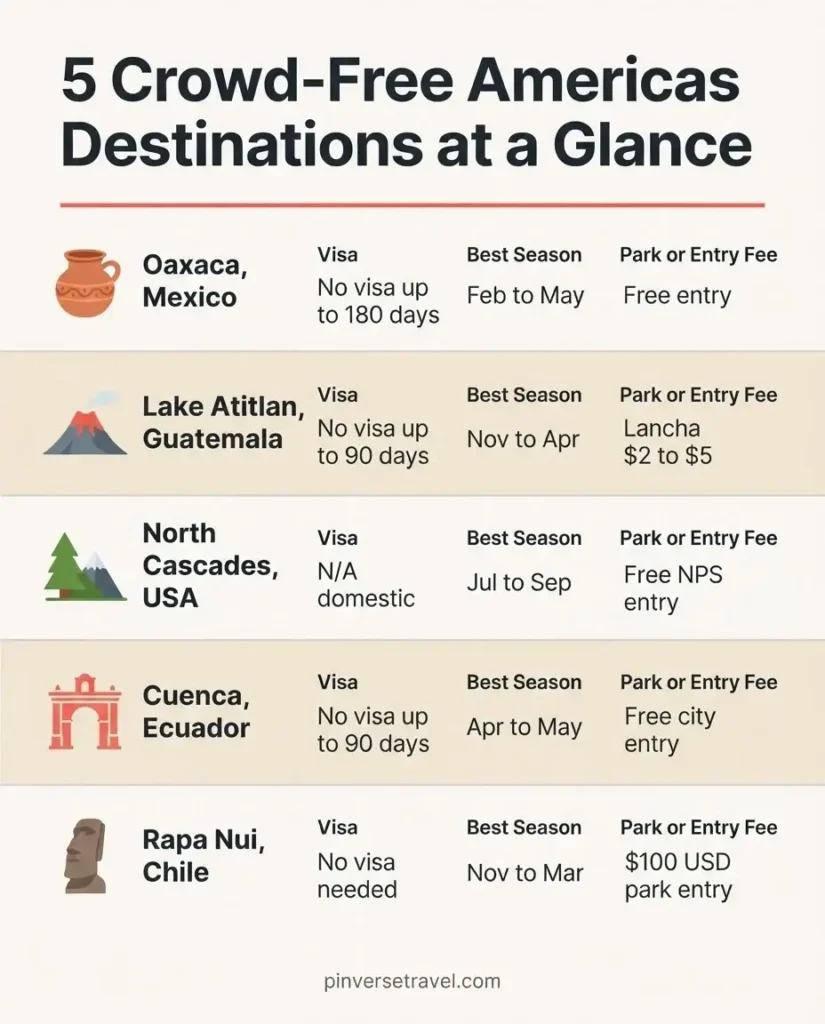
For practical logistics: US citizens do not need a visa to visit Mexico. Tourist stays up to 180 days are permitted without any special documentation beyond a valid passport. Flights connect directly to Oaxaca International Airport from Mexico City (roughly an hour) and increasingly from US cities including Los Angeles and Houston. The city center is entirely walkable, and the colectivo system (shared taxis on fixed routes) is cheap and reliable for getting to sites outside the center.
The best time to visit for quiet is February through May, before the summer rains and before the Guelaguetza festival in July, which brings large crowds. If you can attend Guelaguetza, it is genuinely one of the most remarkable indigenous cultural celebrations in the Americas. Just be aware that accommodation prices rise sharply and book out months in advance.
Lake Atitlan, Guatemala: Where the Volcanoes Watch You Back
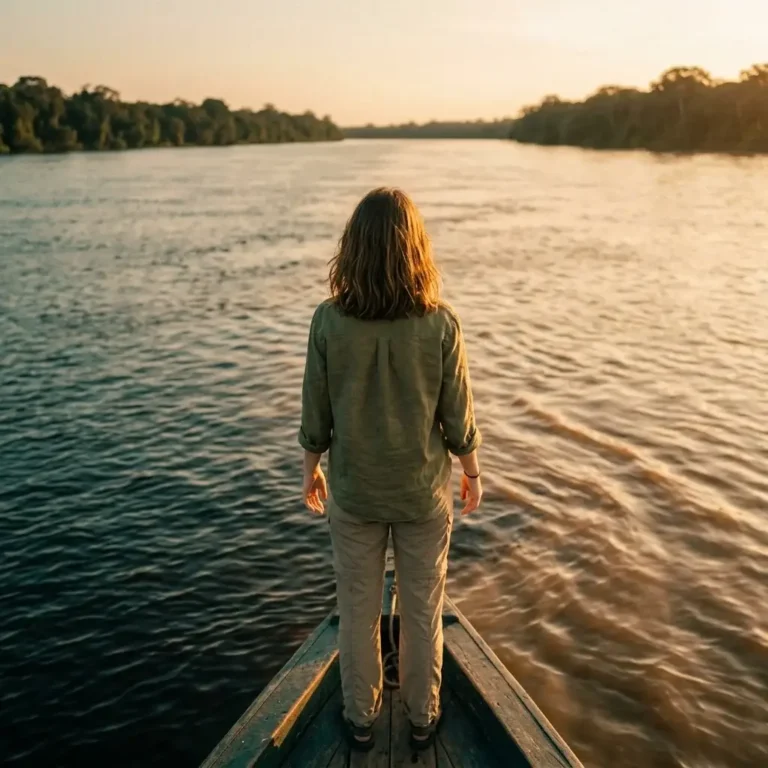
Aldous Huxley famously called Lake Atitlan the most beautiful lake in the world, and while that is the kind of claim that should always be treated with skepticism, it is hard to argue with the scenery. Three volcanoes rise from the lake’s southern shore. The water shifts from deep cobalt to silvery grey depending on the light. And a dozen small Maya villages dot the shoreline, each with its own textile traditions, its own market day, its own particular rhythm.
What keeps Lake Atitlan from being overwhelmed is simply that it takes effort to get between places. You cannot drive a car from village to village around the full lake. You take a lancha, a small motorboat water taxi, and they run on loose schedules that require a certain willingness to wait, adjust, and slow down. That informality is a natural crowd filter.
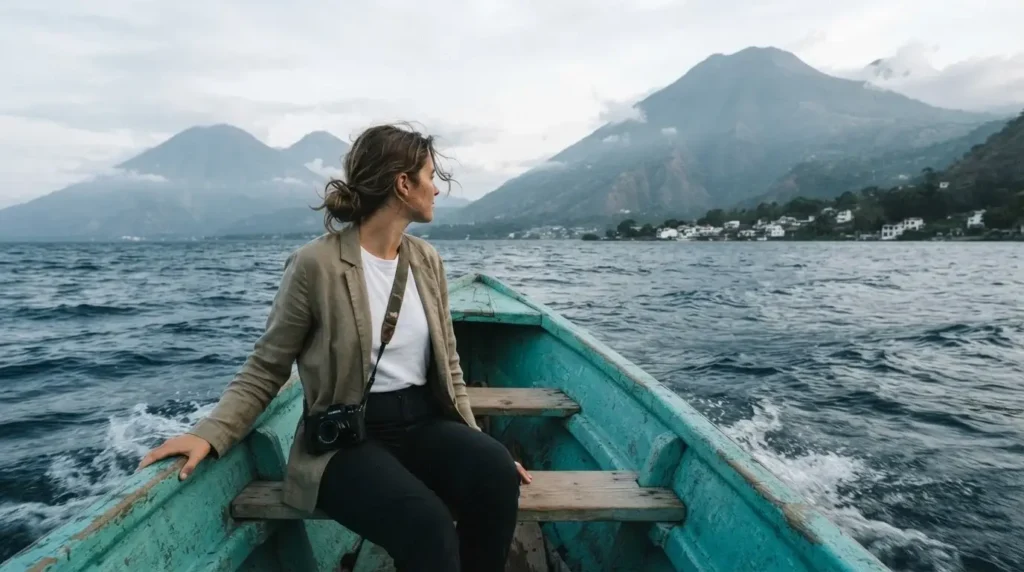
Package tourists prefer destinations where buses run on time and everything is labeled clearly. Lake Atitlan rewards patience.
The villages worth spending real time in are San Marcos La Laguna, which has a quiet, meditative atmosphere and a good trail up to a panoramic viewpoint; San Juan La Laguna, which has become a center for natural textile dyeing using local plants and a small art scene; and Santiago Atitlan, on the far southern shore, which is the largest town on the lake and home to the remarkable Maximon figure, a folk saint venerated by the Tz’utujil Maya whose effigy moves from house to house through the year and can be visited with a local guide.
The food near the lake reflects the local Mayan staples: black beans, corn tortillas made fresh and by hand every morning, and chiles in various preparations. In the market towns you can eat incredibly well for very little money.
On safety: the US State Department’s Guatemala Travel Advisory notes that Lake Atitlan is served by Guatemala’s Tourist Assistance Program (ASISTUR), a dedicated tourist police and protection service. US government employees are permitted to visit Lake Atitlan, which is one practical benchmark of relative safety. Standard precautions apply: don’t walk isolated trails after dark, use reputable lanchas, and store valuables securely. US citizens do not need a visa for Guatemala and can stay up to 90 days.
Panajachel, on the north shore of the lake, is the main arrival hub and has reliable ATMs and regular shuttle connections to Guatemala City (about 3 hours) and Antigua (about 2 hours). From Panajachel, lanchas to any of the lake villages cost between roughly $2 and $5 and run throughout the day.
North Cascades National Park, Washington: America’s Quiet Alpine Wilderness
Most people who visit national parks in the American West go to Yosemite, Zion, or the Grand Canyon, where millions of visitors a year are now simply part of the experience. North Cascades sits in northwestern Washington State with a completely different profile. The Smithsonian has reported that North Cascades received just 16,485 recreation visits in all of 2024, placing it among the least-visited national parks in the entire country. For context, Zion sees close to five million visitors annually.
The reason is partly access. There is no grand paved loop road. There are no visitor center spectacles or famous single landmarks that drive Instagram traffic. There are glaciers, roughly 300 of them, which is more glaciers than any other place in the contiguous United States. There are jagged peaks, ancient forests, and trails that go for dozens of miles without a crowd in sight.
The North Cascades National Park trail guide lists over 400 miles of trails across the park complex, including access to segments of both the Pacific Crest Trail and the Pacific Northwest Trail. The Diablo Lake Trail, which winds above the strikingly turquoise Diablo Lake, is a manageable day hike with extraordinary views. The Cascade Pass trail is one of the most scenic in the Pacific Northwest and still rarely congested because reaching the trailhead requires a 23-mile drive on a narrow mountain road that keeps casual visitors from drifting in.
For solo travelers who want wilderness without the backcountry permit scramble of Yosemite or the reservation system anxiety of other parks, North Cascades is a real option. The Newhalem area, accessible off Highway 20 (the North Cascades Highway), is a good base. The park is day-use accessible from Seattle in roughly 2.5 to 3 hours by car. Peak wildflower season runs July through early August. The highway closes in winter.
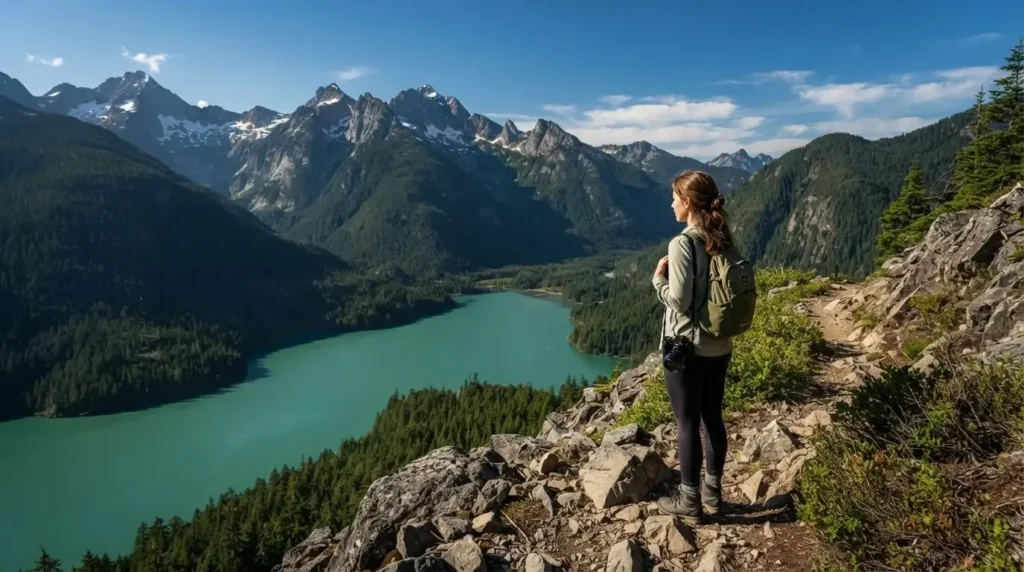
What to eat in the region: the small town of Winthrop, on the eastern side of the park, has developed a legitimate local food scene with farm-to-table restaurants and craft breweries. It functions as a good end-of-hike reward after crossing the North Cascades Highway. Stock up on supplies in Sedro-Woolley or Burlington before heading into the park, as services inside are very limited.
Cuenca, Ecuador: The Colonial City That Nobody Rushes
Cuenca is Ecuador’s third-largest city, and it is one of those places that travel writers mention in passing but never fully describe. That is a disservice, because solo travelers who choose to spend a week in Cuenca consistently describe it as one of the most livable, calming cities in South America.
The city sits at about 8,200 feet elevation in the southern Andes and has a climate that locals call “eternal spring”: cool mornings, warm sunny afternoons, mild evenings. The historic center is built around a cathedral and a river, with low colonial-era buildings in blue and white that glow in afternoon light. It has a working university population, which means coffee shops, bookstores, and street food that caters to people who actually live there rather than just passing through.
From what solo travelers consistently report, Cuenca stands out for how easy it is to fall into a daily rhythm here. The mercado 10 de Agosto is a working food market where you can eat a full set lunch for around $2.50 to $3, typically soup, a main course, juice, and dessert. The local specialty is hornado, whole roast pig with hominy and a sharp herb salsa. It is worth seeking out at the market stalls.
For the US State Department’s current entry and safety information for Ecuador, the Ecuador Travel Advisory is the place to check before you go. US citizens can enter Ecuador visa-free for stays up to 90 days in any 12-month period with a valid passport.
Getting to Cuenca is simple: the Mariscal Lamar Airport has direct connections from Guayaquil and Quito, with the flight taking under an hour.
From Cuenca, day trips to the Cajas National Park, a high-altitude moorland full of lakes and trails, take about 30 minutes by bus and are included in some organized tours or easily arranged independently. The historic center is entirely walkable and small enough to know it well within two or three days.
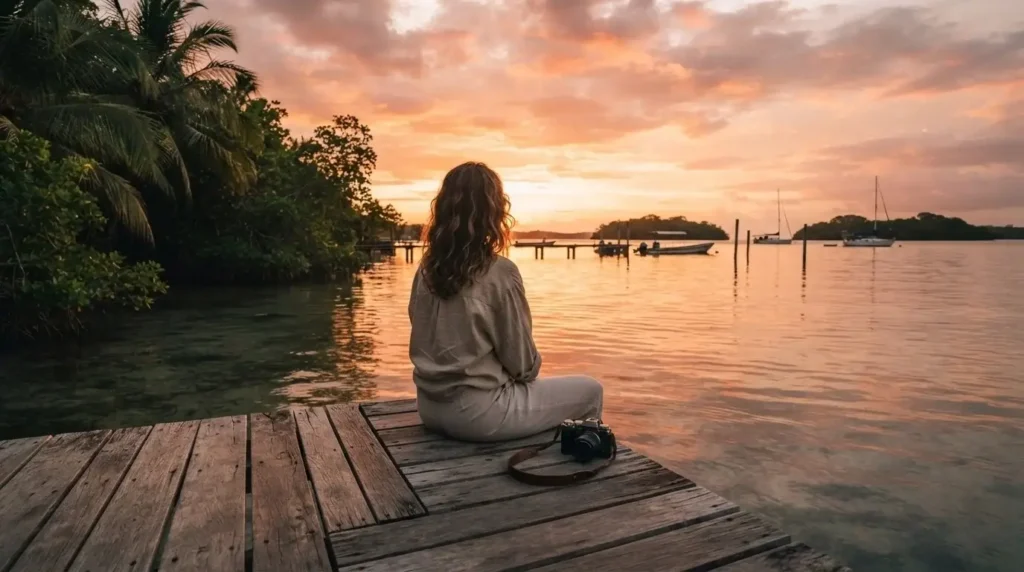
Bocas del Toro, Panama: Island Life Without the Resort Script
Bocas del Toro is a Caribbean archipelago in northwestern Panama that has been quietly growing in reputation among backpackers and slow travelers for years without ever tipping into mass-market status. It sits just across the border from the Costa Rican town of Puerto Viejo, and that border crossing is famously straightforward.
The islands are reached by water. The small Bocas del Toro airstrip connects to Panama City and David. From the dock at Almirante on the mainland, a water taxi crosses to Bocas Town on Isla Colon in about 30 minutes for around $6. Once you are on the islands, the system for getting around is the same: water taxis between islands cost roughly $3 to $10 per trip depending on distance and the number of passengers.
What keeps Bocas from becoming a polished resort machine is partly its infrastructure (the roads on Isla Colon turn to mud after rain, electricity sometimes flickers) and partly its culture. The population is a mix of Ngabe indigenous communities, Afro-Caribbean families, Panamanians from the interior, and a long-established expat community. The cultural mix produces a Caribbean-inflected cuisine: rice and beans cooked in coconut milk, fresh snapper, plantains in every form, and ripe fruits sold from dugout canoes in the channel.
The best beaches are not on Isla Colon. Starfish Beach, which actually has starfish visible in its shallow water, is a short water taxi ride away. Red Frog Beach on Isla Bastimentos is a 10-minute walk through the rainforest from the dock and is one of those places that makes you understand why people move to Panama and never leave. Bastimentos Island also falls within the Bastimentos Island National Marine Park, which protects both the reef and the nesting beaches of sea turtles.
Bocas is genuinely one of the better solo travel destinations in Central America. The layout of Bocas Town on Isla Colon puts most accommodation, restaurants, and water taxi docks within easy walking distance. You can get comfortably oriented in an afternoon.
Rapa Nui (Easter Island), Chile: As Remote as Travel Gets in the Americas
No list about crowd-free destinations in the Americas is complete without addressing the elephant in the room: Easter Island. It is one of the most isolated inhabited islands on earth, sitting in the South Pacific roughly 3,700 kilometers off the coast of Chile. It is technically part of the Americas by jurisdiction (it belongs to Chile), and it is worth including precisely because the crowds that do exist there are manageable in a way that similar UNESCO sites in other parts of the world are not.
The island, known to its indigenous Rapa Nui people as Rapa Nui, holds over 900 moai, the enormous stone figures that represent ancestral spirits and were carved between roughly the 13th and 16th centuries. Flights arrive from Santiago, Chile (about 5.5 hours) and from Tahiti, with LATAM Airlines operating the main routes.
Visiting the Rapa Nui National Park now requires a mandatory entry ticket and an accredited guide, managed by the indigenous Ma’u Henua organization. As of October 2025, international adult entry is $100 USD. This is a deliberate conservation measure to manage visitor impact, and it is worth paying. The guide requirement means you will have real context for what you are seeing, which transforms the experience from “strange big rocks” to a deep and genuinely moving story about Polynesian navigation, community governance, and the fragility of civilization.
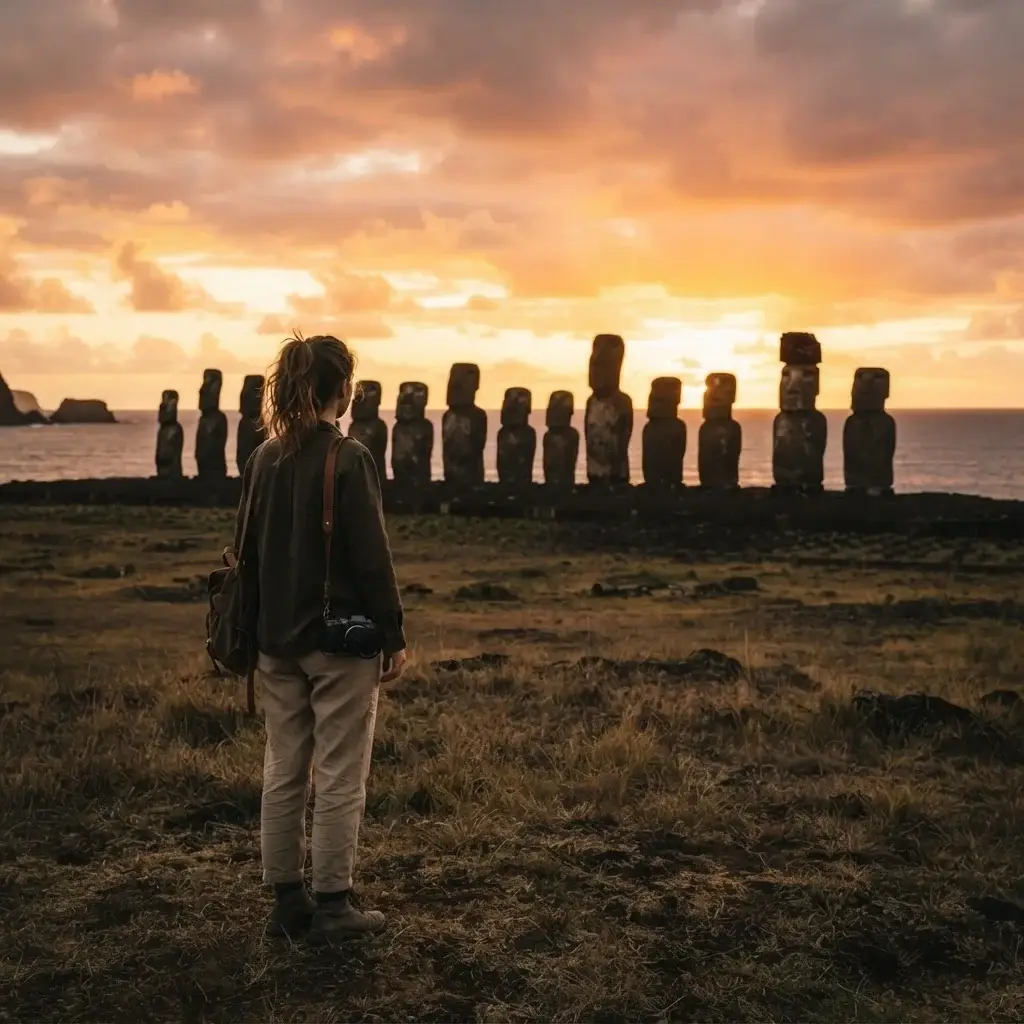
The key sites include Rano Raraku, the volcanic quarry where the moai were carved and where hundreds still stand in various stages of completion, Ahu Tongariki with its 15 restored moai in a row against the Pacific horizon, and Orongo, the ceremonial village perched on the crater rim of the Rano Kau volcano overlooking three small offshore islets.
Here is what solo travelers consistently report about the pacing: four to five days on the island is enough to see everything well without rushing. Many visitors come for two or three days, which leaves the experience feeling incomplete. Staying longer lets you catch the same sites in different light, with genuinely few other people around, especially early morning at Tongariki for sunrise.
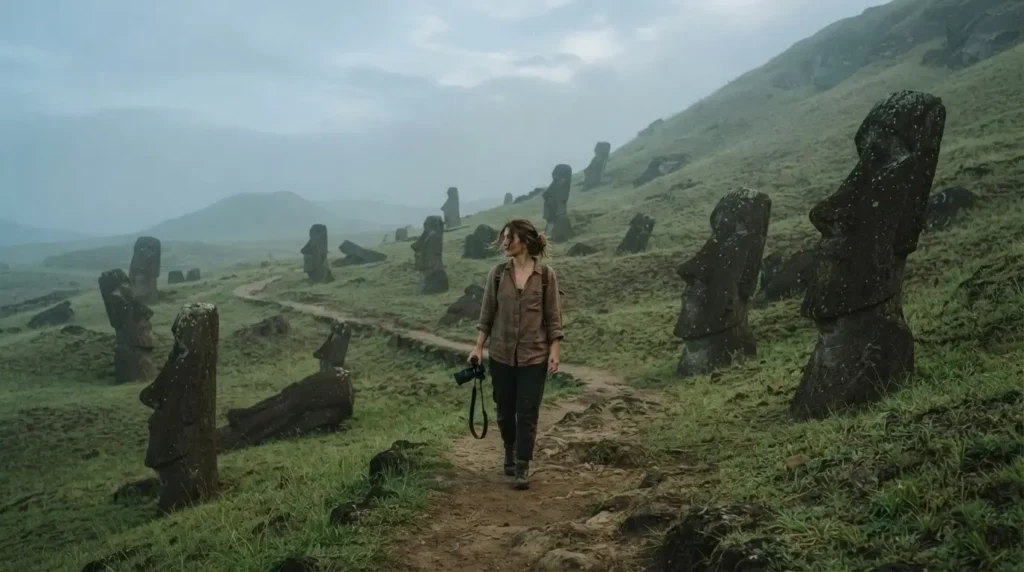
The island has one main town, Hanga Roa, which has restaurants, small guesthouses, and a surprising number of good kitchens serving fresh tuna ceviche, empanadas, and Polynesian-influenced fish dishes. It is not a budget destination: accommodation and food cost more than mainland Chile due to the logistics of importing nearly everything. But the experience of standing in front of a row of moai with the Pacific stretching to every horizon and almost no one else nearby is, by every account, genuinely different from any other place in the Americas.
A Note on Timing and the Nature of “Quiet”
None of these destinations are empty. They are not supposed to be. What they offer is a human scale: the chance to walk through a market and have someone actually talk to you, to ask directions and get an answer that includes a personal recommendation, to sit in a town square and watch the place function as a real community rather than a performance for visitors.
That is what slow travel looks for. Not isolation, but presence. Not the absence of people, but the presence of the right ones.
The best way to protect that experience is to travel in shoulder seasons, spend more than three days in each place, eat where locals eat, learn a few words of the local language, and resist the urge to compress five destinations into ten days. These places reward the traveler who commits to actually being there.
If you have been waiting for a reason to stop following the same tourist trail everyone else is on, you have it. The Americas are wider and quieter than most people realize. You just have to be willing to go where the crowds haven’t found the value yet.