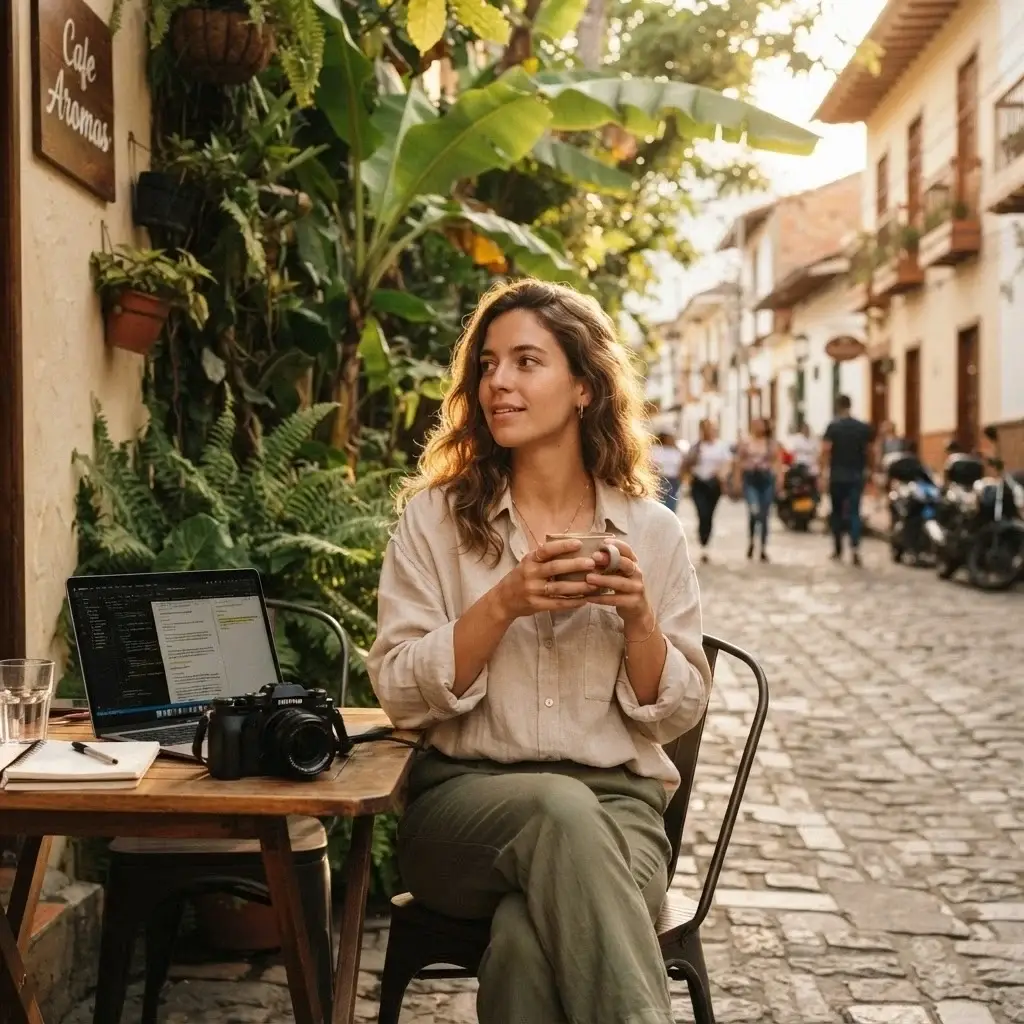
There is a moment most people have before booking a one-way ticket somewhere in Latin America. You have the tabs open. You’ve read three articles with the same exact list of cities. You know Medellin comes up a lot. You know Buenos Aires has something to do with beef and tango. You know Mexico City is big. But you still don’t know which one is actually right for you, and you don’t fully trust the cheerful, sponsored-sounding articles telling you it’s all amazing.
I get it. I’ve been the person staring at that decision point, trying to separate the real information from the noise.
I left a conventional desk job years ago to build a life around slow travel, cultural immersion, and writing. The lesson I keep relearning is that choosing where to base yourself as a remote worker is not just about cost and internet speed. It’s about what kind of life you want to live when you’re not at your laptop. The cities that work best for digital nomads aren’t the most photogenic ones. They’re the ones that make your actual daily life feel good.
Latin America has become one of the strongest regions in the world for remote workers, and for legitimate reasons. The time zones overlap well with North American clients. The cost of living in several cities is genuinely low compared to Western Europe or Southeast Asia. The food culture is extraordinary. The coworking infrastructure has grown significantly, with Latin America’s coworking market valued at around $1.84 billion in 2025 and continuing to expand. Multiple countries now offer formal digital nomad visa programs. And the quality of life in the top nomad cities, when you know what you’re doing, is hard to match anywhere in the world.
This article is not a ranked list with a winner. It’s a real guide to help you figure out which city fits your work style, your budget, and the life you actually want to build. Let’s talk about five cities that consistently deliver, what makes each one different, what the realities are, and how to get your entry right.
Before You Pick a City: The Question Nobody Asks
Most people research cities based on cost or Instagram appeal. A more useful first question is: what kind of nomad are you?
Some people thrive with a big social scene, co-living spaces full of other remote workers, walking everywhere to cafes, and a city that never slows down. Others, myself included, do their best work when they find a quieter neighborhood, a good local coffee shop that becomes a second office, and time to actually absorb the culture around them rather than just pass through it.
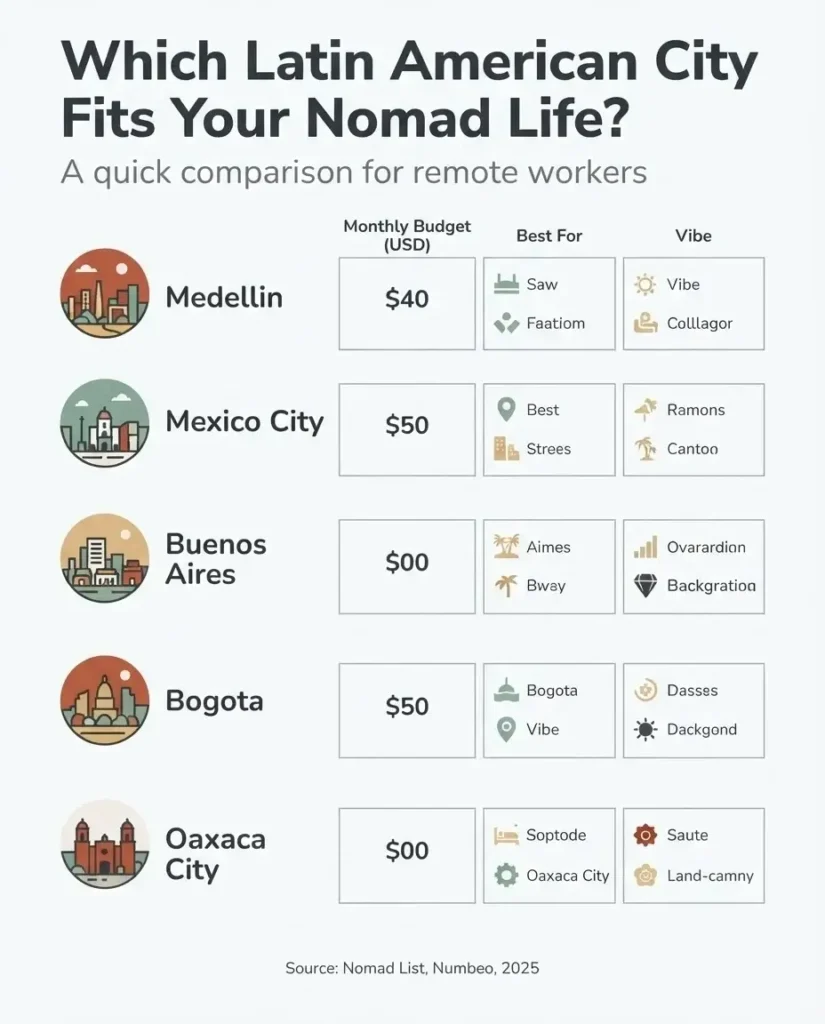
Latin America has cities for both types. The one you choose matters more than any other variable.
According to Nomad List’s live Latin America rankings, the top-scoring cities for remote workers in the region as of mid-2026 include Buenos Aires, Mexico City, and Medellin, with a regional average cost of living around $2,424/month. But those averages tell only part of the story.
Medellin, Colombia: The City That Earned Its Reputation
Medellin is probably the first city that comes up in any conversation about digital nomading in Latin America, and honestly, it earned that status.
The single biggest appeal of Medellin is the weather. The city sits at around 1,500 meters elevation in the Colombian Andes, which gives it what locals call “eternal spring.” Temperatures hover between 18 and 28 degrees Celsius year-round. No brutal humid summers. No cold winters. Just reliable, mild, comfortable working conditions every single day of the year.
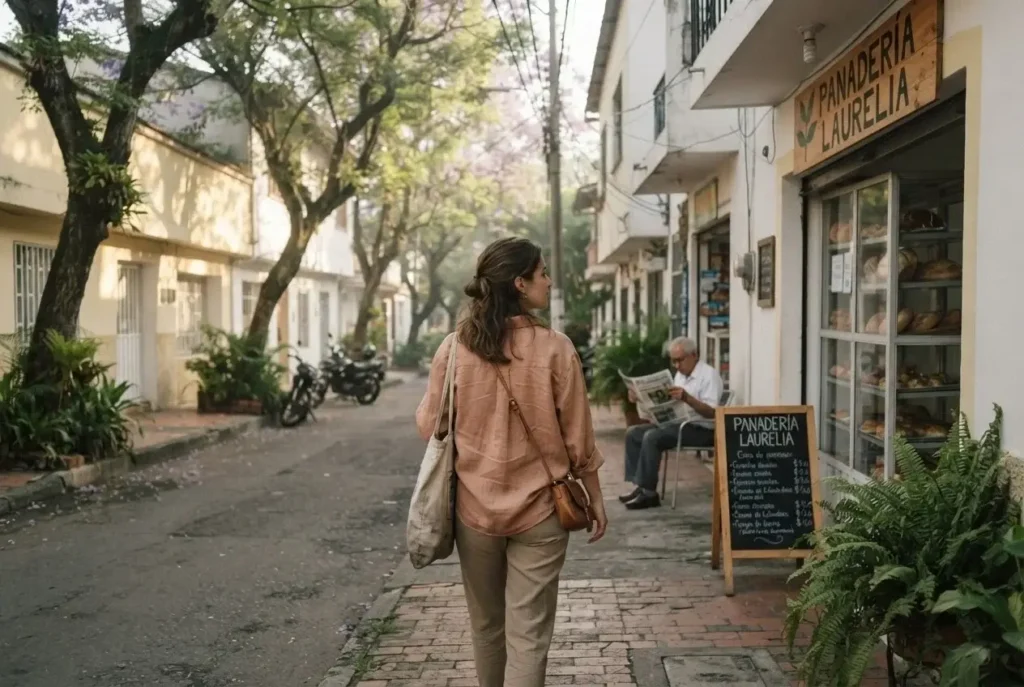
The nomad infrastructure is mature. El Poblado is the neighborhood most remote workers gravitate toward first, and it’s easy to see why: walkable streets, dozens of cafes with reliable WiFi, a dense cluster of coworking spaces, and a social scene built around other foreigners and young Colombians. If you want to walk out your door and immediately feel plugged into an international community, El Poblado does that.
But here’s something worth knowing if you’re thinking longer-term: many nomads who stay more than a month end up in Laureles or Envigado instead. Laureles sits just across the river from El Poblado and has a noticeably more local, less touristy feel. Rents are often 20-30% lower. The food is better for everyday eating, and the cafes are less crowded with other laptop workers. It’s the kind of neighborhood where you start to feel like you live somewhere rather than visit it. That distinction matters more than you think it will.
On costs, Numbeo’s most recent data for Medellin puts a 1-bedroom apartment in the city center at roughly 2,575,000 Colombian pesos per month (around $680-700 USD), and outside the center closer to 1,910,000 COP (around $500 USD). A meal at a local restaurant runs about 25,000 COP, which is roughly $6-7 USD. Broadband internet at 60 Mbps costs about 103,950 COP per month, which is under $30 USD. Most nomads comfortably live on $1,200-1,800 USD/month in Medellin, with some spending less.
For food, a few things you will genuinely not want to skip: the bandeja paisa, which is a massive plate of beans, rice, chicharron, chorizo, avocado, and fried egg that represents Antioquian culture more than any museum exhibit could. Arepas are everywhere and cheap. The fruit at local markets, from maracuya to guanabana to lulo, is worth an entire eating tour on its own.
The metro system is clean, safe, and remarkably well-organized for a city of 2.5 million. The cable cars that connect hillside comunas to the metro are free for residents with a metro card and offer some of the most unexpected city views in South America.
Getting in and staying legally: Colombia now has a dedicated Digital Nomad Visa (Visa V-Digital Nomad) that allows stays of up to two years. The income requirement is approximately three times Colombia’s legal minimum monthly wage, currently around $1,400 USD/month in foreign income. The application is done through Colombia’s official Cancilleria visa portal, with fees of roughly $55 USD for the study and $178 USD for issuance. If you’re just testing the waters, most nationalities (US, UK, Canada, EU) can enter Colombia visa-free for up to 90 days as tourists, extendable once for another 90 days.
One honest note on safety: Medellin has changed dramatically over the past two decades, and the neighborhoods popular with nomads, El Poblado, Laureles, Envigado, are genuinely safe for daily life. That said, this is still a city that rewards paying attention. Don’t walk while looking at your phone in quiet streets at night. Use InDrive or a metered taxi rather than flagging random cars. Learn which streets to avoid, and locals or your accommodation will tell you quickly. It’s the kind of city where common sense goes a long way.
From what solo travelers and remote workers consistently report across communities and forums, Colombia.co describes well why the country works so naturally for remote work: Medellin was named Innovative City of the Year by the Wall Street Journal back in 2013, and its investment in public infrastructure, transit, and connectivity has continued since.
Mexico City, Mexico: The One That Gets Under Your Skin
I want to be upfront: Mexico City (CDMX) is not the easiest adjustment, especially if you’ve come from a small city or a quiet corner of the world. It is enormous, loud, chaotic in wonderful ways, and absolutely full of life at every hour. But for a certain kind of remote worker, it becomes the most beloved city they’ve ever lived in.
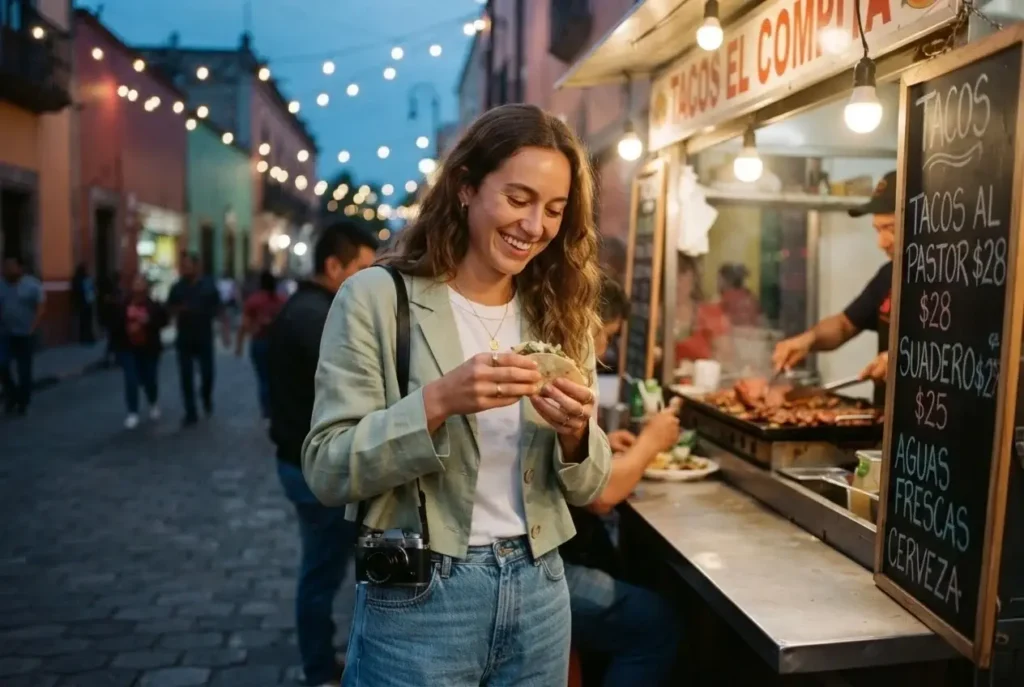
CDMX consistently ranks near the top of Nomad List’s global charts for a reason. The cultural offering is staggering. The food scene is legitimately world-class. The cost of living is flexible: you can spend $2,500 a month eating at nice restaurants every night in Polanco, or you can spend $1,200 a month eating street tacos, cooking at home, and taking the Metro everywhere. Both are valid and both are comfortable.
The neighborhoods matter enormously in Mexico City. Roma Norte and Condesa are the core nomad neighborhoods: walkable, tree-lined, full of independent cafes where sitting for three hours with your laptop is entirely normal, and safe enough that solo women consistently report feeling comfortable walking at night. Coyoacan is quieter, more residential, deeply Mexican in culture, and a wonderful choice if you want to write or work in peace. Condesa has the best parks for outdoor working on a good-weather day.
For food, CDMX is arguably the best street food city in all of Latin America, which is saying something. Tacos de canasta from bicycle vendors are a morning ritual. Tacos al pastor, with their upright spits, are everywhere, but the best ones are in Centro Historico late at night. Tamales from street vendors on weekend mornings. Tlayudas if you make a short trip south to Oaxaca, which is absolutely worth your time as a cultural side trip. CDMX also has a serious coffee culture now: neighborhoods like Roma are thick with specialty coffee shops that would hold their own in Brooklyn or Melbourne.
According to Mexico News Daily’s guide to remote work destinations, Roma and Condesa are recognized as particularly well-suited for nomads, laptop-friendly cafes, walkable streets, and an established culture of people working remotely in public spaces.
Getting in: Most nationals from the US, Canada, UK, and EU do not need a visa to enter Mexico as tourists. However, Mexico’s immigration rules have changed in a meaningful way that many articles haven’t updated: Mexico no longer automatically grants 180 days on arrival. Officers now grant a number of days corresponding to your stated travel duration. According to Mexperience’s updated guide on Mexico visitor permits, the 180-day maximum is still technically available but must be requested and justified, not assumed. If you’re planning a 3-4 month stay, state that clearly to the immigration officer and have an onward ticket ready. Mexico does not have a formal digital nomad visa; most nomads use consecutive tourist entries, with some choosing a Temporary Resident visa for longer stays.
One practical note: the altitude in Mexico City is real. The city sits at 2,240 meters above sea level. Most people adjust within a week, but your first few days can feel like you’re running slightly out of breath. Drink more water, walk slower, and don’t push yourself immediately. It passes.
Buenos Aires, Argentina: Europe in South America (With Better Steak)
Buenos Aires has a particular effect on people. Porteños, as locals are called, have built a city that feels unmistakably European in its architecture and cafe culture while being unmistakably South American in its warmth, late hours, and love of conversation that goes nowhere fast and everywhere at once.
For a digital nomad, Buenos Aires delivers a specific lifestyle that no other Latin American city quite replicates: working from a cafe where a single cortado gives you two hours of nobody rushing you out, then stepping into a bookstore that doubles as a bar, then eating a parrilla dinner with good Malbec at 10pm because that’s simply when people eat dinner here. If that sounds appealing, Buenos Aires might be your city.
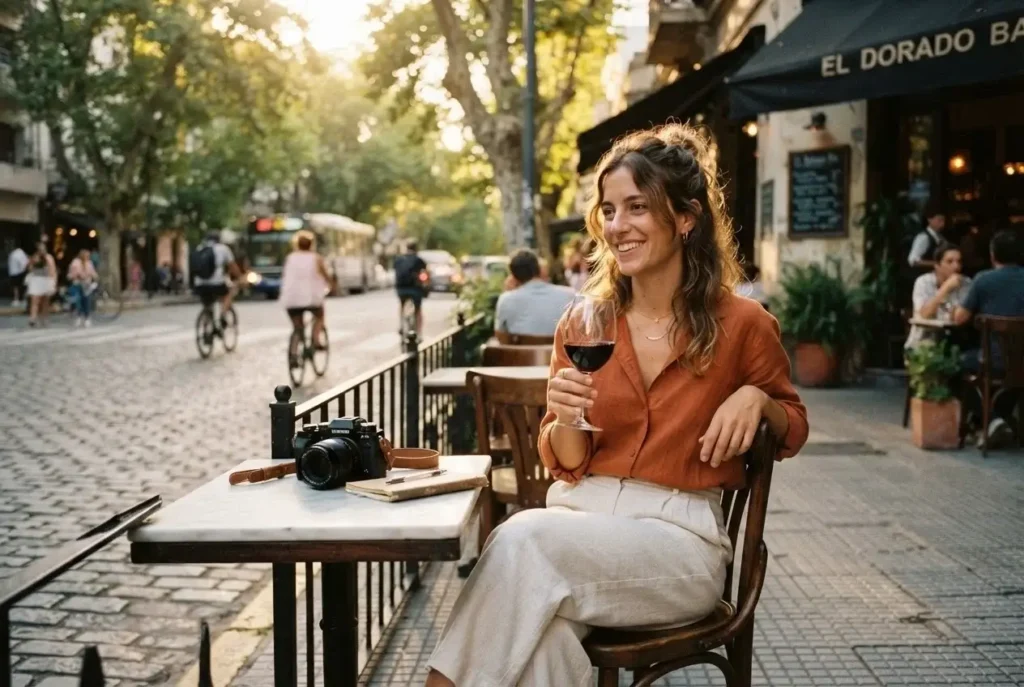
Palermo is the neighborhood most nomads land in first. It’s large, has distinct sub-sections (Palermo Soho, Palermo Hollywood, Las Canitas), and offers great cafe density, relatively safe streets, and a social scene that is easy to tap into. Recoleta gives you more classic Buenos Aires elegance, leafy avenues, the famous cemetery where Eva Peron is buried, and a quieter working atmosphere. San Telmo is more atmospheric and bohemian, cobblestoned and artsy, but less practical for daily errands.
Costs in Buenos Aires have been complex for years because of Argentina’s currency situation. As of mid-2026, Nomad List puts a solo nomad’s monthly costs at approximately $1,261 USD. You can live comfortably in Palermo on $1,500-2,000 USD/month, especially if you’re earning in a stronger currency. The exchange rate has stabilized somewhat compared to the volatility of 2023-2024, but it is still worth using official exchange channels and being aware of the economic context.
The food culture is built around social eating. An asado is not just a meal; it’s a three-hour event. The empanadas are a religion, and every neighborhood has its preferred local spot. Try the medialunas (Argentine croissants) with a cafe con leche at any traditional confiteria. The local wine, especially Malbec from Mendoza, is extraordinary and costs very little by any international comparison.
Getting in: Argentina has a digital nomad visa, the TIE provision under Article 24H, available specifically for citizens of countries that don’t require a tourist visa to enter Argentina. The cost is 200 EUR, and it grants 180 days of authorized stay, extendable for another 180. Applications are done entirely online through Argentina’s migration portal. Full requirements and the application link are available on the Argentine Embassy’s official digital nomad visa page. You will need proof of remote work activity, a curriculum vitae, and documentation of income. For many nationalities, the simpler route remains entering as a tourist (which is 90 days, extendable once), but the TIE is worth knowing about for longer stays.
Internet reliability in Buenos Aires is generally solid in established neighborhoods, with fiber connections available. The city runs on UTC-3, which gives good overlap with both US East Coast and some European business hours.
Bogota, Colombia: The Underdog That Deserves More Credit
Bogota doesn’t get the same immediate enthusiasm as Medellin from the nomad community, and I think that’s a mistake worth addressing.
Yes, Bogota is colder. The city sits at 2,600 meters elevation, which means temperatures in the 7-14 degree Celsius range much of the year. If you came to Latin America for warm weather, that’s a legitimate reason to choose Medellin instead. But if you came for culture, intellectual stimulation, food, and a genuinely cosmopolitan city that doesn’t feel overrun with tourists, Bogota delivers in ways that surprise most people who give it a real chance.
Chapinero, and specifically the barrios of Chapinero Alto and Zona Rosa, are the most practical areas for digital nomads. Good internet, walkable density, coworking options, and a cafe scene that is growing fast. La Candelaria, the historic center, is stunning for walks on weekends but less ideal for daily living. The food scene in Bogota tends toward the international end: you can find excellent Peruvian ceviche, Japanese ramen, and innovative Colombian fusion within a few blocks in Chapinero.
The visa rules are identical to Medellin: same Colombia digital nomad visa through the Cancilleria, same 90-day tourist entry for most nationalities. Many nomads use Bogota as a base while making weekend trips to Cartagena on the Caribbean coast or to the coffee region around Salento, which is one of the most genuinely beautiful landscapes in the continent.
Oaxaca City, Mexico: Slow Travel and Cultural Depth
Not everyone coming to Latin America wants a big metropolis. If you are drawn to slow travel, craft culture, extraordinary food, and a city that feels genuinely rooted in its own identity rather than shaped for international visitors, Oaxaca is a city worth serious consideration.
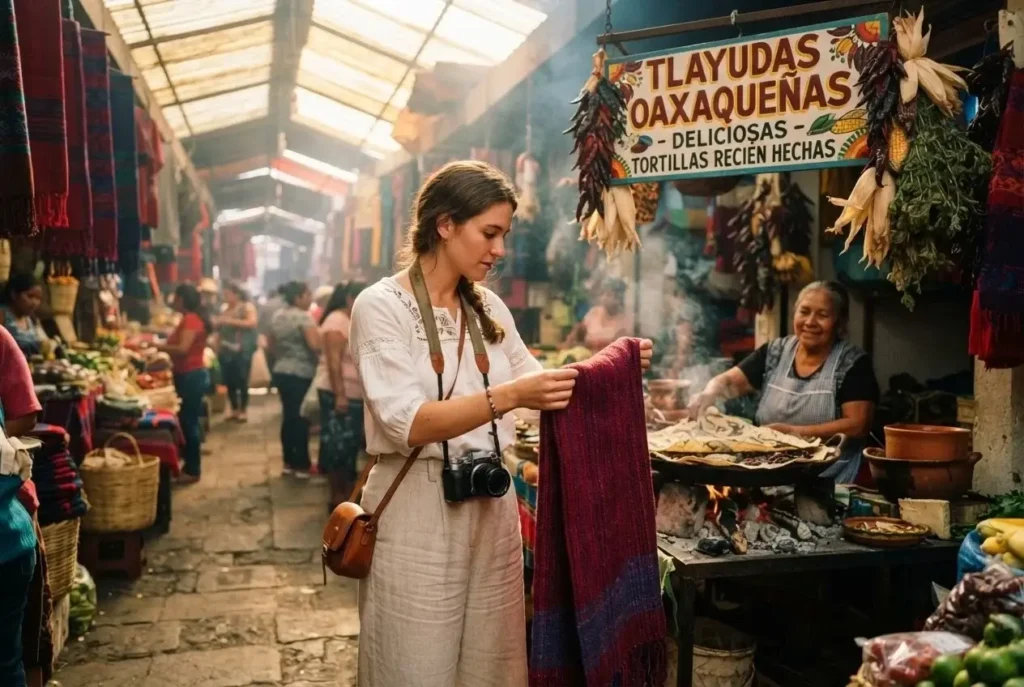
Oaxaca City is small, walkable in about 20 minutes end to end, and deeply embedded in Zapotec and Mixtec indigenous culture. The food here is unlike anywhere else in Mexico: mole negro, a complex sauce made with more than 30 ingredients including chocolate and dried chiles, tlayudas (large flat toasted tortillas with beans, cheese, and meat or vegetables), memelas, chapulines (toasted grasshoppers, a regional staple that is genuinely delicious on a tlayuda), and mezcal, the smoky agave spirit that Oaxaca produces in extraordinary variety.
For remote workers, Oaxaca has developed a modest but growing scene of cafes with decent WiFi and coworking options. Costs are lower than Mexico City: a 1-bedroom apartment runs under $800 USD/month in many cases. The trade-off is less community density and fewer fellow nomads to connect with, which can mean either peaceful focus or loneliness depending on your personality.
Oaxaca works best for people who are genuinely curious about cultural immersion, who do their best work independently, and who want to spend a month or two rather than a week. The entry rules are the same as for Mexico City: tourist entry, no formal nomad visa, and the same updated FMM rules about requesting your intended duration on arrival.
The Practical Foundation: What to Sort Before You Go
Regardless of which city you choose, a few fundamentals make or break the experience.
Health insurance. This is non-negotiable. Latin American public healthcare varies enormously in quality, and even in private hospitals, an unexpected event without coverage can derail everything you’ve built. World Nomads and SafetyWing are the most commonly used options in the nomad community, though comparing several plans based on your home country is always worthwhile.
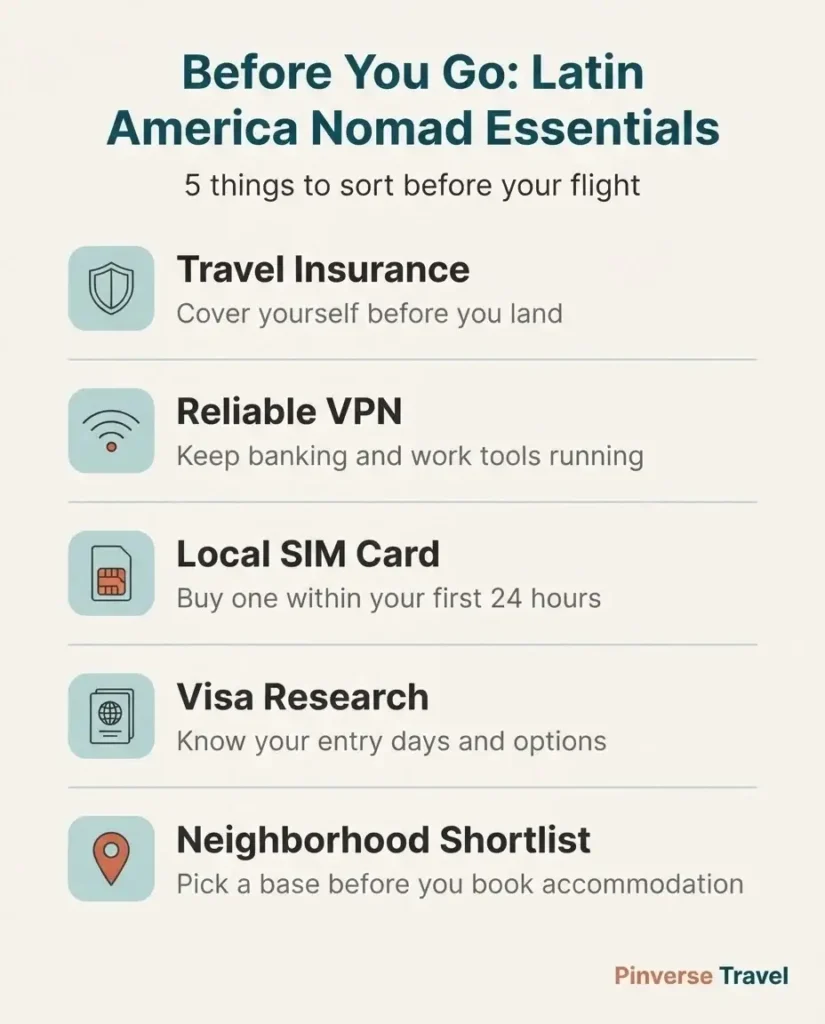
A reliable VPN. Not for anything illicit, simply because banking apps and some work tools flag or block connections from Latin American IP addresses. A good VPN keeps your work running without interruption.
A local SIM card on day one. Every city on this list has excellent mobile data coverage from local providers. Claro, Movistar, and Tigo cover Colombia and Mexico well. Buying a local SIM within your first 24 hours solves navigation, Uber, food delivery, and communication in one step.
Embrace slow arrival. The biggest mistake I see new nomads make, and it’s one I made myself when I first started traveling independently, is treating the first week like a tourist week and then panicking when the energy wears off. Spend the first 3-4 days finding your neighborhood. Identify one or two cafes that work for you. Figure out your grocery situation. Let the city become familiar before you start judging it. The nomad experience in any of these cities is dramatically better in month two than it is in week one.
Which City Is Actually Right for You?
Here is a simple framework based on honest research and what the nomad community consistently reports:
If you want the best combination of low cost, established community, great weather, and an easy first entry into Latin American nomad life: Medellin.
If you want maximum cultural stimulation, the most dynamic food scene in the region, and genuine big-city energy: Mexico City, Roma Norte or Condesa specifically.
If you want the most European-feeling daily life in South America, with excellent food, a vibrant arts scene, and a naturally social culture: Buenos Aires.
If you want intellectual culture, no tourists, and a sophisticated city at altitude without Medellin’s party reputation: Bogota.
If you want slow, immersive, culturally rich experience with lower costs and genuine daily life outside the tourist trail: Oaxaca.
None of these cities are wrong choices. All of them have genuine communities of remote workers who have built meaningful lives there. The difference is fit, not quality.
One Last Thing
When I left my office job years ago, one of the hardest parts wasn’t the practical logistics. It was the feeling that I needed to get every decision right from the start. The city choice felt enormous.
What I’ve learned, and what I hear consistently from travelers who’ve made this move, is that your first city is not a final answer. It’s a starting point. You will learn things about yourself as a remote worker and as a person that you couldn’t have known from a desk in an office. You’ll figure out whether you need community or solitude, whether a big city energizes or drains you, whether the food scene matters more than the nightlife or the other way around.
The research phase matters. But at some point, the most useful thing you can do is book the flight.