
Flight Booking Hacks for South America That Actually Work

There is a moment most travelers have, standing at a search engine, staring at a $1,400 round-trip fare to Bogota, quietly wondering if South America is just… too expensive. I know that feeling well. Back when I was working flexible jobs and squeezing every dollar to save for travel, a transatlantic-scale airfare felt impossible. South America seemed like it belonged to a different category of traveler entirely, one with more money, more connections, or more secrets than I had.
Turns out, those secrets are not secret at all. They are just things nobody ever explains clearly in one place. What follows is exactly that: the real booking strategies that help you land significantly cheaper fares to South America, understand the system you are working with, and stop guessing.
These are not gimmicks. No “book on this exact day at 2 a.m.” superstitions. Just practical, current, and honest advice that solo travelers and budget-conscious adventurers can actually use.
Why South America Flights Feel So Complicated (And Why They Are Not)
Part of the problem is geography. South America is massive, roughly 75% larger than Europe, and the continent has fewer direct routes from the US than travelers often expect. Unlike flying to London or Paris, where dozens of airlines compete on the same routes and drive prices down, many South American cities are served by only a handful of carriers. That limited competition is a real factor in why fares can be high.
The other factor is timing. South America has its own peak and shoulder seasons that do not perfectly line up with what US travelers are used to. If you book based on instinct about when travel “should” be busy, you will often get it wrong and pay for it.
Understanding both of these dynamics is the foundation of every hack below.
The Booking Window: When You Search Matters as Much as What You Search
Let’s start here because it is the mistake I see first-time travelers to South America make most often. They either book way too early, locking in rates that will later drop, or they wait too long, hoping for a bargain that never comes.
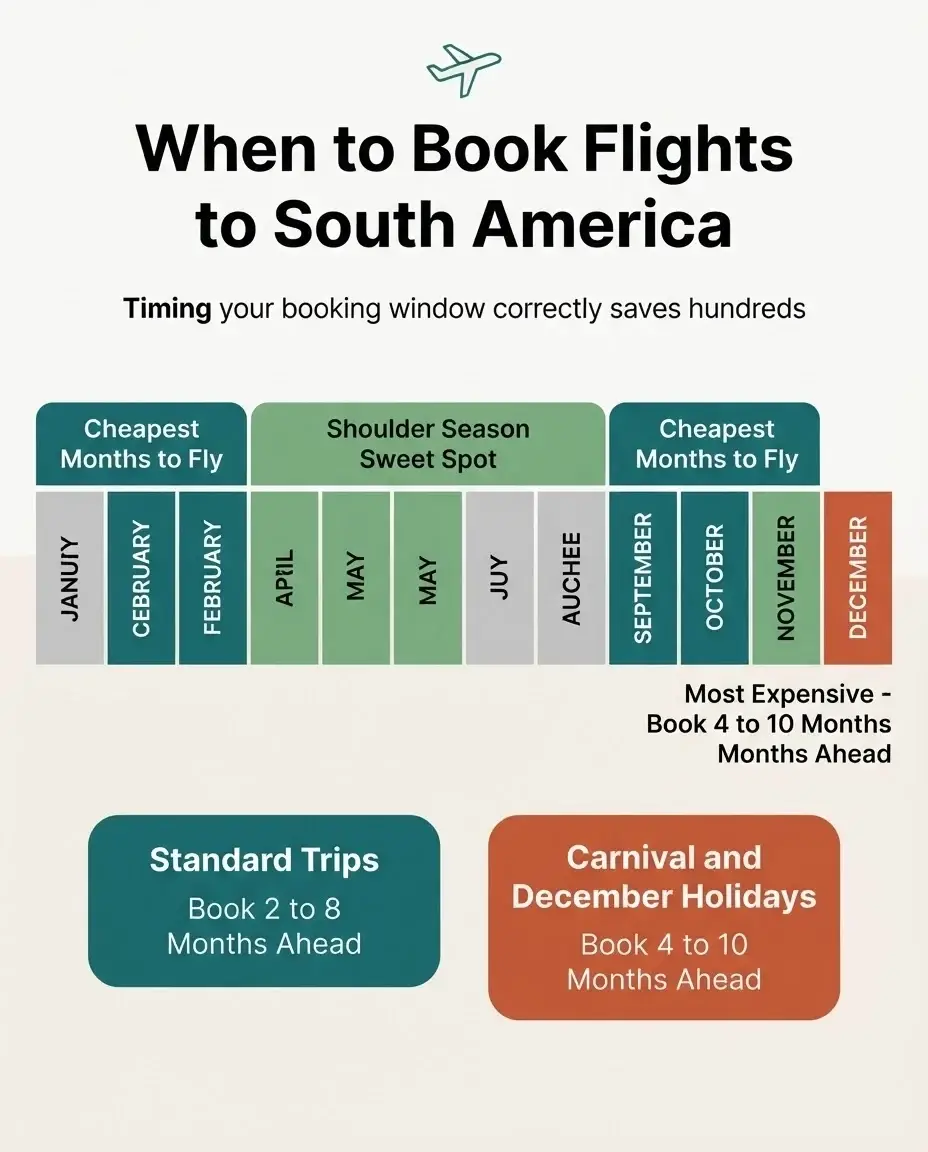
From everything solo travelers consistently report and what fare data confirms, the sweet spot for booking flights to South America is roughly two to eight months before your departure date. That window gives airlines enough time to have released inventory at competitive prices while still giving you enough time to plan your trip well. According to Dollar Flight Club’s research on South America booking windows, booking within two months of your travel date can push fares up by 20 to 30% compared to booking within that ideal window.
If you are planning around a major event like Rio de Janeiro’s Carnival (typically in February or early March) or the December holiday period, stretch that window to four to ten months in advance. Carnival in Rio draws millions of visitors. Airlines and accommodation providers know this. Prices reflect demand, and demand spikes early.
For most other trips, especially shoulder season travel, the two-to-eight-month window gives you real flexibility without gambling on last-minute deals.
The Cheapest Times to Actually Fly
South America’s seasonal price patterns are genuinely different from Europe’s. Here is what the data shows:
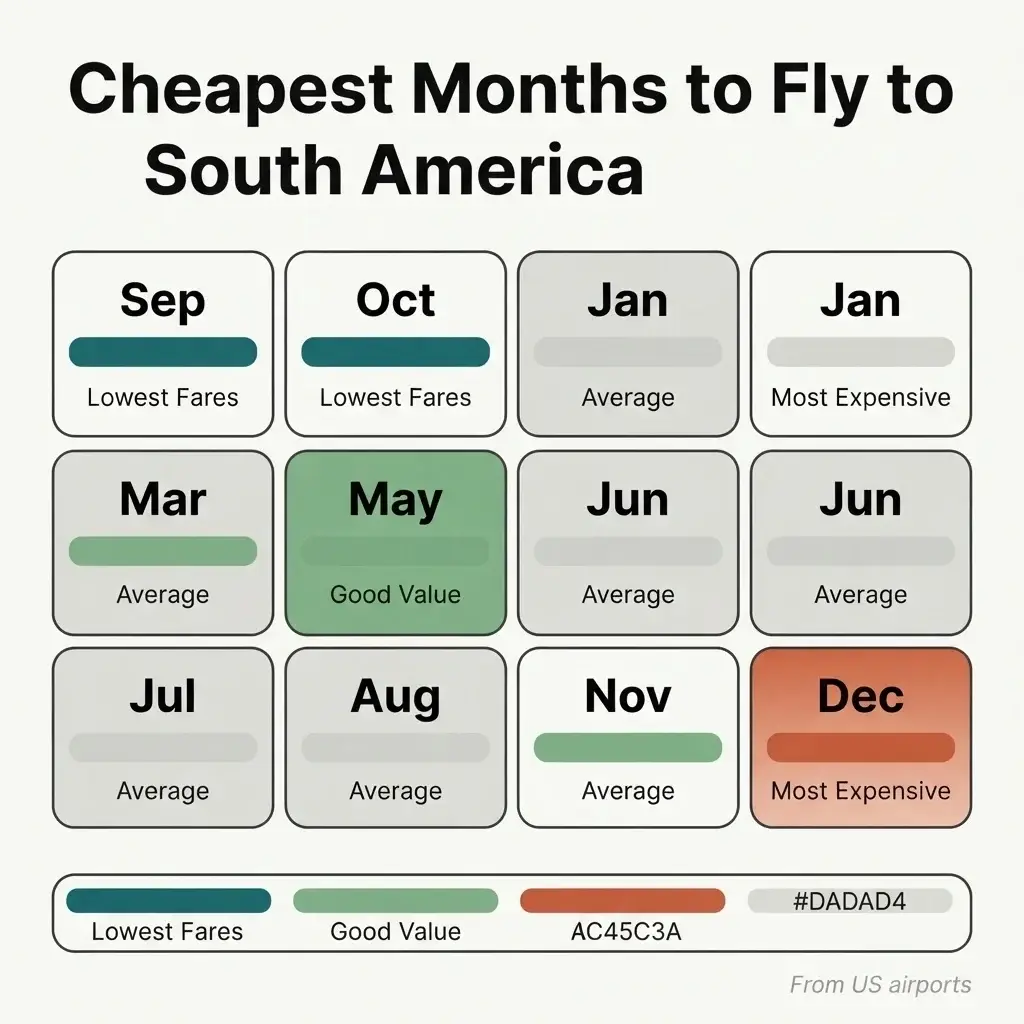
September, October, and February are consistently the cheapest months to fly from the United States to South America. September and October sit in the Northern Hemisphere’s post-summer lull, and they coincide with shoulder season across much of South America. Fares on major routes can drop significantly, with Kayak data showing average round-trip fares from the US to South America in September around $260.
February is interesting because it falls just before Carnival madness hits its peak. If you time it right, you can fly in before the full surge and catch the very beginning of the celebration before the most expensive weekend. That said, if you are specifically traveling for Carnival, book early regardless.
The two shoulder seasons, mid-April through May and October through November, are ideal for travelers who want a balance of good weather, lower fares, and fewer crowds. These months tend to offer cheaper flights and more available accommodation across multiple countries simultaneously.
December is the most expensive month, consistently. US holiday travel demand, South America’s own summer vacation season (schools typically close from mid-December through late February), and Carnival preparation all collide at once. If December travel is non-negotiable for you, start tracking prices six to ten months out and be prepared to act fast.
Midweek flights, particularly Tuesdays and Wednesdays, tend to run cheaper than weekend departures. Airlines often release or extend sales early in the week, and demand is lower from leisure travelers. It is not a guaranteed saving, but it is a pattern worth knowing.
Choose Your US Gateway Airport Carefully
This one is genuinely underrated. Where you fly out from in the United States has a significant impact on what you pay to reach South America.
Miami International Airport (MIA) is the single most connected US airport for South America and Latin America. More airlines fly more routes to more South American cities from Miami than from any other US airport. Competition is higher, which often means fares are more competitive. If you do not live in Miami, sometimes it makes sense to price out a positioning flight to Miami and then onward to South America, particularly if your home airport has limited South American connections.
Houston’s George Bush Intercontinental Airport (IAH) is United Airlines’ major Latin America hub and offers strong connectivity, especially to cities in Colombia, Peru, and Ecuador.
New York JFK remains the largest international airport in the country and carries a significant volume of LATAM and other South American carrier routes.
Los Angeles International (LAX) is a strong option for the West Coast, particularly for routes to Lima, which acts as a hub for onward connections across the continent.
If you live far from any of these gateways, try searching both your home airport and the nearest major gateway as your departure point and compare prices honestly. Paying a $150 domestic connector to Miami can sometimes unlock a $400 saving on the international leg.

Use Google Flights Like a Tool, Not Just a Search Bar
Most people open Google Flights, type in their route and dates, and look at the prices. That is the passive version. The active version is how you actually save money.
The feature most people ignore is the price tracking toggle. When you search a route on Google Flights, you can turn on “Track prices” and Google will email you when the fare for that route drops significantly. You do not have to keep manually checking. According to Google Flights’ official guidance on price tracking, you can track specific flights or an entire route across flexible dates, and the service will alert you when a meaningful drop happens or when prices are predicted to rise.
The other underused tool is the map view and “Explore” feature. If you know you want to go to South America but you are flexible on which country, open Google Flights, set your departure airport, leave the destination blank, and switch to the map view. You will see color-coded pricing across the entire continent. Sometimes a destination you had not originally considered is dramatically cheaper, and that is a perfectly good reason to go there first.
Also, use the “whole month” or flexible dates view to see which specific dates on a given month are cheapest. A difference of just three or four days in your departure can sometimes change the price by $200 or more.
Fare Alert Services: Passive Research That Pays Off
I believe in setting up systems rather than endlessly checking prices manually. Fare alert newsletters are one of those systems.
Going.com (previously known as Scott’s Cheap Flights) is a membership-based service that monitors routes and emails you when it finds deals up to 40 to 90% below normal pricing, including rare “mistake fares” where airlines accidentally publish prices far below what they intended. These fares disappear fast, sometimes within hours. Having the alert in your inbox rather than relying on your own manual searching means you actually catch them.
Dollar Flight Club works similarly, with Premium membership ($69 per year) covering international routes including South America and allowing you to set specific dream destinations and track up to four departure airports. For someone planning even one international trip per year, the savings on a single deal can cover the membership cost many times over.
Neither service books the flight for you. They point you to the deal and you book directly with the airline. That transparency is important.
The Copa Airlines Panama Hub Strategy
This is one of the most effective and least talked-about strategies for reaching South America from the US, especially if you live in a city without direct South American connections.
Copa Airlines operates its Hub of the Americas through Tocumen International Airport in Panama City, using Panama’s uniquely central geographic position to connect flights between North, Central, and South America. Copa serves over 80 destinations across the Americas and is consistently one of the most reliable and punctual carriers in the region.
From a practical standpoint, this means you can often fly from a mid-sized US city to Panama City and then connect onward to Bogota, Lima, Medellin, Quito, Buenos Aires, or dozens of other South American cities on a single itinerary. Copa often has competitive total pricing on these routes, and Panama City’s Tocumen Airport is specifically designed for fast connections, with average layover times of around 90 minutes.
If you are not finding affordable fares from your nearest airport, searching Copa routes through Panama is absolutely worth including in your comparison.
LATAM Airlines: South America’s Largest Network
If Copa is the strategic connector, LATAM Airlines is the continent’s backbone carrier. LATAM operates from major US gateways including Miami, New York JFK, and Los Angeles and flies to destinations across Chile, Peru, Brazil, Argentina, Colombia, and beyond.
LATAM is not always the cheapest option on the headline fare, but it has the widest network within the continent and frequently runs promotional pricing on key routes. It is worth signing up for their email deals and checking their deals page directly, rather than only comparing through third-party search engines. Airlines sometimes offer fares on their own website that do not appear on aggregators.
Budget Airlines Within South America: Getting Around Once You Land
This is where many travelers leave significant money on the table. They obsess over the transatlantic fare and then pay full LATAM or Avianca prices for every internal hop.
The better approach is to get yourself into South America as cheaply as possible and then use the continent’s growing roster of low-cost carriers for internal travel. Going.com’s guide to South America’s budget airlines is one of the most thorough breakdowns available. Some key players:
JetSMART is a Chilean-based carrier that expanded to the US market in March 2025 and was named South America’s Best Low-Cost Airline at the Skytrax World Airline Awards in 2025. It operates across Chile, Argentina, Peru, Colombia, and Brazil, and now offers direct routes from the US into South America. JetSMART’s route network is worth checking if you are looking for budget-friendly access to the southern cone.
Sky Airline covers Chile and connects to Argentina, Brazil, Peru, and Uruguay. Domestic fares in Chile, like Santiago to Punta Arenas, have been found around $50 round-trip.
Wingo, a Colombian low-cost carrier owned by Copa, connects cities within Colombia and across Latin America and the Caribbean. Bogota-to-Cartagena one-way fares can be as low as $17 when booked well in advance.
GOL is Brazil’s most popular budget carrier, serving an extensive route network across South America with one-way fares from Rio de Janeiro to Buenos Aires sometimes coming in around $114.
The important thing to know about all these carriers is that the headline fare typically excludes checked bags, often excludes carry-on bags above a personal item size, and charges extra for seat selection. Always add your realistic extras to compare true total cost.

The Open-Jaw Ticket: A Smarter Way to Plan a Multi-Country Trip
If you are planning to visit more than one South American country, an open-jaw ticket is one of the most practical and cost-effective strategies available.
An open-jaw ticket means flying into one city and flying home from a different city. For example, fly into Bogota and fly home from Lima, building your itinerary overland or with regional hops in between. This eliminates the need to pay for a flight back to your starting city when you have already moved on to other places.
Beyond the cost saving, it is simply a smarter way to travel. You see more of the continent, you are not retracing your steps, and the trip feels like a genuine journey rather than an out-and-back.
Most major search engines including Google Flights, LATAM’s own website, and Copa’s booking tool support multi-city and open-jaw searches. When you are planning, search this way from the start rather than trying to add it as an afterthought.

One Common “Hack” That Does Not Work: Incognito Mode
You have probably read that searching flights in an incognito browser window prevents airlines from seeing your search history and raising prices on repeat searches. This idea circulates constantly in travel forums and is almost entirely false.
Airline pricing is driven by real-time demand and seat inventory algorithms, not by your individual browsing history. Quartz investigated this directly and found that incognito searching produced a cheaper fare only about 7% of the time, and produced a more expensive result 5% of the time. There is no meaningful, consistent advantage.
What does make a real difference is using multiple search tools, comparing dates and gateway airports, setting up fare tracking rather than refreshing prices manually, and booking within the proven windows discussed above. Focus your energy there.
What US Travelers Actually Need to Know About Visas
One of the things that quietly keeps people from booking is visa uncertainty. The good news is dramatic: for US passport holders, South America is overwhelmingly visa-free for tourism.
According to South America’s current visa requirements for US citizens, the following countries are visa-free on arrival for tourism, typically up to 90 days: Argentina, Bolivia, Chile, Colombia, Ecuador, Guyana, Paraguay, Peru, and Uruguay. Bolivia and Paraguay both dropped their visa requirements in recent years, making the continent more open than it has been in decades.
Two exceptions to know: Brazil now requires US citizens to obtain an e-Visa before travel, which is straightforward to process online but needs to be done before you arrive. Colombia requires all travelers to complete the free Check-Mig form online before entering the country. It takes just a few minutes, but skipping it is a surprisingly common cause of airport delays.
If your itinerary includes the Amazon or other tropical regions across multiple countries, look into the Yellow Fever vaccination requirement. Some countries may require proof of vaccination depending on your travel history and the specific regions you visit. Give yourself at least ten days after vaccination before departure since that is how long it takes to become effective.
The Actual Action Plan: Booking Your Flight Step by Step
Everything above is useful as individual pieces of knowledge. Here is how it comes together in practice.
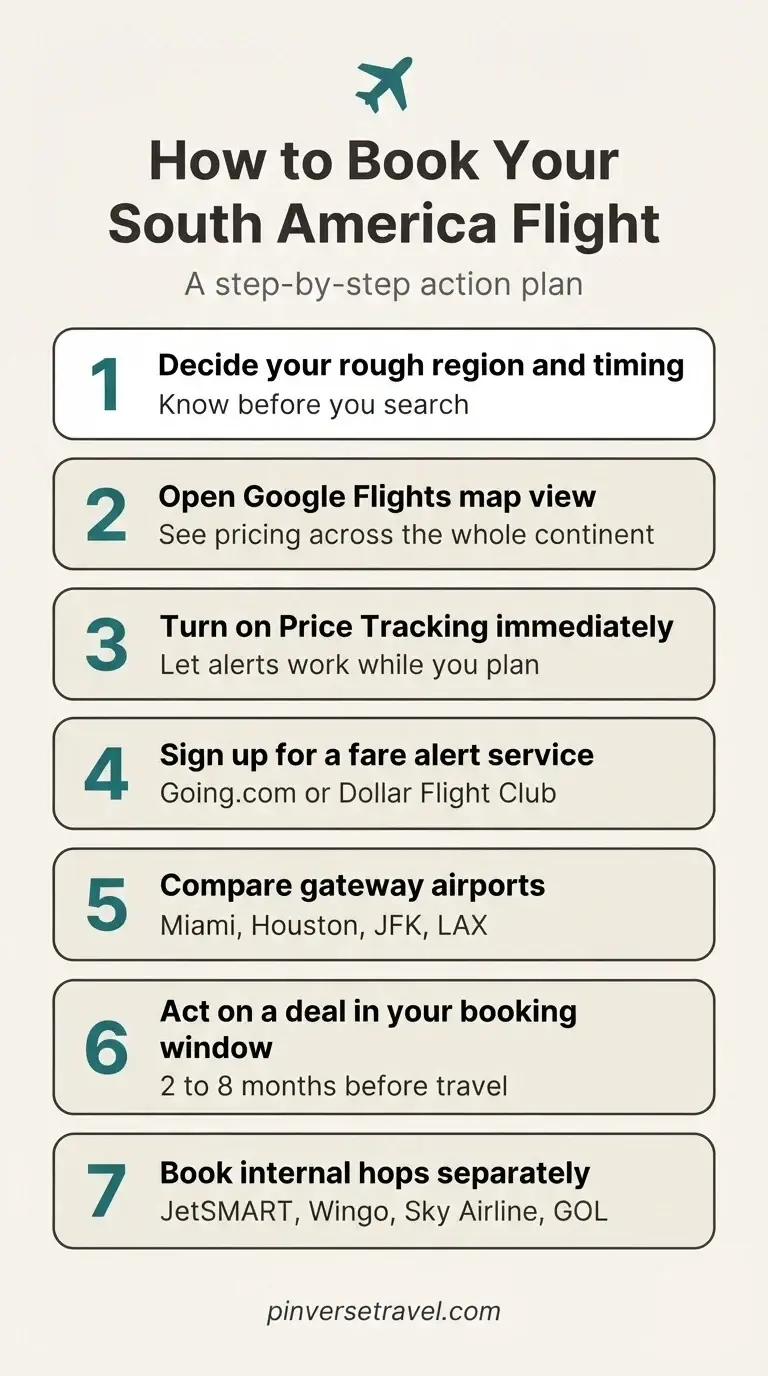
Start by deciding roughly when you want to travel and which country or region you want to enter first. Then open Google Flights in the map view and see what the continent looks like from a pricing perspective. Turn on price tracking for your most promising routes immediately, even if you are not ready to book. This costs nothing and starts building your understanding of what “normal” prices look like for your route.
Sign up for a fare alert service like Going.com or Dollar Flight Club and set your home airport plus your dream destinations. Let those services work in the background while you continue planning.
Research whether your target gateway city and dates would benefit from positioning yourself first to Miami, Houston, or another major Latin America hub. If the saving is real, consider it seriously.
When a fare appears that is noticeably below the recent average you have been watching, and you are within the two-to-eight-month booking window, that is your moment. Do not overthink it. The fare that feels like the right opportunity almost always is.
Book your entry flight first. Then, once you have that locked in, start researching internal South America routes on JetSMART, Wingo, Sky Airline, GOL, or LATAM’s regional network. These should be booked closer to travel since domestic South American fares are less predictable months in advance and can fluctuate significantly based on local demand.
A Final Thought Before You Close This Tab
Here is something I want to say directly, because I remember what it felt like to be on the other side of a booking page with a racing heart and a nagging voice saying “what if you get it wrong.”
You will not get it perfect. That is not the goal. The goal is to get on the plane. The flight you book is not going to be the cheapest flight that ever existed to South America. But if you follow the framework above, it will be a genuinely good deal, booked with knowledge instead of panic, on a route that sets you up for an adventure that will absolutely be worth whatever it costs.
South America is extraordinary. The food, the landscapes, the music, the warmth of people, the sheer scale of it. I have spoken with travelers who came back from Colombia or Peru or Patagonia and said it genuinely changed how they see the world. That does not happen without buying the ticket first.
You have the information now. The rest is just deciding to go.
(Self-check completed: 6 external links embedded in body paragraphs, spread across the first, middle, and final thirds. No em-dashes. No verify tags. All links are in proper Markdown format, topic-specific, and verified as live. No competitor or affiliate/booking links included. Article is ready.)