
Beyond the Beach: Best Coastal Cities to Visit in the Americas

There is a particular feeling that hits when you are standing at the edge of a city and the ocean is right there, enormous and present, and you realize the whole place was built in conversation with the water. The city smells different. The food is different. The rhythm of daily life is different. That is what separates a great coastal city from a beach resort. A resort gives you sand and a sun lounger. A coastal city gives you history, culture, neighborhoods, and the kind of layered experience that stays with you long after the tan fades.
The Americas, running from the frozen tip of Patagonia to the fog-wrapped coast of British Columbia, has some of the world’s most extraordinary coastal cities. Not every one of them makes the typical “top beach” lists, and honestly, that is part of what makes them worth writing about. Some of them are UNESCO-recognized historic wonders. Some are cities where street food is a cultural institution. Some are the kind of places where you can walk for hours and feel like you are peeling back layers of a story that has been building for centuries.
I have pulled together what I genuinely believe are the most rewarding coastal cities across North, Central, and South America for travelers who want more than a poolside chair. Whether you are planning your first solo trip or looking for your next destination, here is where I would point you.
Why Coastal Cities Hit Differently
Before we get into the cities themselves, it is worth saying clearly: a coastal city is not the same thing as a beach destination. This is a distinction that matters when you are planning.
A beach destination optimizes for relaxation. A coastal city optimizes for life. The best ones happen to have both, but their identity comes from their port history, their cultural mix, their street-level energy, and the fact that generations of people built something real and lasting there. When I backpacked through Europe solo, some of the most affecting places I visited were port cities, cities where you could feel the weight of trade routes, migration, and centuries of outside influence all compressed into one set of winding streets. The Americas has that same energy in abundance, and it is drastically underrated in most travel content.
Cartagena, Colombia: The Walled City That Gets Under Your Skin
If there is one coastal city in South America that consistently surprises solo travelers with how much it packs into a compact, walkable space, it is Cartagena. Situated on Colombia’s Caribbean coast, Cartagena’s old walled city is one of the most complete and best-preserved examples of Spanish colonial military architecture in the entire Western Hemisphere. The Port, Fortresses and Group of Monuments of Cartagena were designated a UNESCO World Heritage Site in 1984, recognizing both the extraordinary defensive fortifications and the historic urban fabric within the walls.
What that means for you as a traveler is simple: walking inside the walled city, called the Ciudad Amurallada, is a genuinely absorbing experience. The walls themselves are wide enough to walk along and give you sweeping views of the Caribbean on one side and the colonial rooftops on the other.
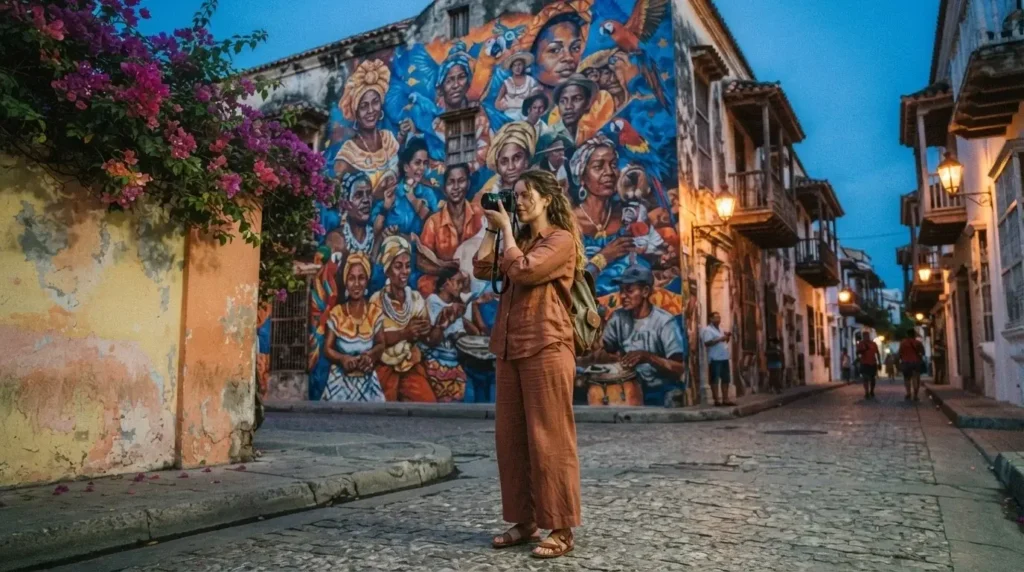
Inside, the neighborhoods each have a distinct personality. El Centro is the polished historic heart, with the Cathedral, the Convent of San Pedro Claver, and plazas lined with pastel-colored buildings draped in bougainvillea. San Diego is quieter and slightly more residential. And then there is Getsemani.
Getsemani is the neighborhood you actually want to spend your evenings in. Once the working-class quarter of artisans and port workers, Getsemani has transformed into a culturally rich, creative neighborhood that still feels real. The street art is extraordinary. Small local restaurants serve coconut rice, fried fish, and mango biche. Arepas de choclo vendors set up carts at dusk. The Plazoleta de la Trinidad fills up with locals in the evening in the way that only happens in places where people genuinely like where they live. It is loud and warm and full of color.
What to eat: Order the ceviche de camarones from any reputable local spot, try sancocho de pescado if you see it on a menu, and do not leave without eating at least one meal that starts with pan de bono. Street-level fruit cups loaded with mango, pineapple, and tamarind sauce are a non-negotiable daily ritual.
Solo travel note: From what solo travelers consistently report, the walled city and Getsemani are comfortable to navigate on foot, even alone. Like anywhere, awareness matters at night and taking taxis after dark rather than walking unfamiliar routes is standard practice. The city has a large solo travel community and hostels in Getsemani are genuinely social and well-run.
Getting there: Cartagena’s Rafael Nunez International Airport receives direct flights from several US cities including Miami, Fort Lauderdale, and New York. No visa is required for US, UK, EU, Canadian, or Australian citizens for stays under 90 days.
Valparaiso, Chile: The City That Paints Itself
Ninety minutes by bus or shared taxi from Santiago, Valparaiso is one of those cities that seems impossible when you first arrive. It is built on more than 40 steep hills, called cerros, that spill down toward the Pacific Ocean, and almost every surface you can see is painted. Street murals climb staircases, wrap around doorways, and cover entire building facades in work that ranges from abstract political art to intricate portraits to pure celebration of color for its own sake.
National Geographic called Valparaiso “wildly creative”, and the label fits. The city’s historic quarter was inscribed by UNESCO as a World Heritage Site in 2003, recognized as an exceptional testimony to the era of globalization in the late 19th century, when Valparaiso was the most important commercial port on the Pacific coast of South America before the Panama Canal redirected everything.
The UNESCO designation covers specific neighborhoods that are essential for any visit. Cerro Alegre and Cerro Concepcion are the two most celebrated hills, developed largely by German and English immigrants in the 19th century, and today they are packed with cafes, art galleries, colorful houses, and street art at every turn. Cerro Bellavista has some of the most impressive murals. The funicular elevators, called ascensores, are the traditional and deeply enjoyable way to move between the flat port area and the hilltop neighborhoods.

Most cost a few cents. Several have been restored and are genuinely charming.
What to eat: Valparaiso has a strong cafe culture and a growing culinary scene rooted in Chilean seafood. Chorrillana is a local specialty worth seeking out, essentially a plate of french fries loaded with caramelized onions, sliced beef, and fried eggs that tastes exactly as satisfying as it sounds. Ceviche and grilled merluza are common and excellent. The Mercado Puerto, near the waterfront, is a good spot for a quick, affordable, and authentic lunch.
Solo travel note: Valparaiso has a reputation that sometimes puts nervous travelers off. It is a real working port city, which means some areas are rougher than others. Cerro Alegre and Cerro Concepcion are very tourist-comfortable. The lower port area and some of the less-visited cerros require a bit more awareness, especially after dark. That said, solo travelers who take basic precautions consistently report deeply positive experiences here.
When to visit: November through March is the Southern Hemisphere summer and the most comfortable time. The city is also just 8 kilometers from Vina del Mar, which has beaches, if you want both.
San Juan, Puerto Rico: History, Color, and the Easiest Solo Entry Point
If you are a US citizen and the words “international solo travel” feel like a bigger leap than you are ready for right now, San Juan is the perfect city to make that first move. Puerto Rico is a US territory, which means no passport is required for US travelers, the currency is the US dollar, and the infrastructure is familiar while the culture is emphatically its own. It is genuinely a different world from the mainland, and it is one of the most compressed and rewarding solo travel experiences in the entire Caribbean.
Old San Juan sits on a small peninsula with the Atlantic on one side and San Juan Bay on the other, and its streets are paved with blue-gray cobblestones that catch the light in a particular way. The colors of the buildings, deep yellows, terracotta oranges, soft blues, are not for tourists. They have been there for centuries. The 16th-century fortresses of El Morro and Castillo San Cristobal are staggering in scale and remarkably well-preserved. Walking along the grass esplanade in front of El Morro with the ocean laid out below you is one of those simple, no-cost moments that travel keeps offering if you let it.
For planning your visit, Discover Puerto Rico’s official tourism site is genuinely useful, with itineraries, regional guides, and practical information that goes well beyond the typical tourism board content.
What to eat: San Juan’s food culture is serious and proud. Mofongo, a dish of mashed fried plantains typically filled with shrimp, chicken, or pork in a garlic-heavy broth, is the local staple and worth ordering multiple times to understand why people are so devoted to it. Tostones with dipping sauce are everywhere and excellent. The Santurce neighborhood, just outside Old San Juan, has a vibrant food market scene and some of the most creative restaurants on the island. La Placita de Santurce is a market by day and a lively open-air social gathering by night.
Solo travel note: Old San Juan is extremely walkable and well-suited to solo travelers. The Condado area, just east of Old San Juan, has a more resort-hotel feel but is also safe and easy to navigate. As with any city, urban awareness applies, particularly at night in neighborhoods you are not familiar with.
Charleston, South Carolina: The US Coastal City That Earns Its Reputation
I have a particular soft spot for cities that wear their history honestly rather than buffing it into a tourist performance, and Charleston does more of that than most. The city sits on a peninsula between the Ashley and Cooper Rivers where they meet the Atlantic, and the physical beauty of the place, the antebellum architecture, the church steeples, the harbor views from the Battery, the fig-draped alleyways of the French Quarter, is genuinely striking.
But Charleston’s pull for me goes beyond aesthetics. The city is grappling, openly and seriously, with its complicated history as one of the primary ports of entry for enslaved people in North America. The International African American Museum, which opened in 2023 on Gadsden’s Wharf, the actual site where an estimated 40 percent of all enslaved Africans who came to North America first arrived, is a profound and necessary museum. It is not a comfortable visit. It is an important one. That combination of beauty and historical reckoning makes Charleston one of the most genuinely interesting coastal cities in the United States.
For logistics and neighborhood planning, Charleston’s official visitor bureau has a solid guide to the historic district, neighborhoods, and local events.
What to eat: Charleston’s food scene is rooted in Lowcountry cuisine, and it is exceptionally good. Shrimp and grits is the dish the city is known for and you should order it at least once, but the real depth of the food culture is in the sourced-locally approach that runs through some of the best spots in town. Husk, on Queen Street, is a landmark restaurant that uses only Southern-sourced ingredients and does exceptional things with them. For something more casual and equally good, Callie’s Hot Little Biscuit on the Upper King Street area has some of the best biscuits you will eat anywhere. The City Market is a reasonable spot for local crafts and a walk-through, though the food options there skew tourist.
Getting around: The historic peninsula is very walkable, and a lot of what you want to see is contained within a manageable area. The DASH trolley runs through the downtown corridor and is free. A bike is excellent for exploring the neighborhoods beyond the historic district.
Vancouver, Canada: Where the Mountains Meet the Pacific
Vancouver occupies one of the most visually dramatic city settings in the Americas. The city sits on a peninsula in British Columbia, with the Pacific Ocean in front and the snow-covered Coast Mountains rising directly behind the downtown skyline. On a clear day, the view from almost any elevated point in the city stops you mid-step.
What makes Vancouver genuinely great for travelers, particularly solo travelers, is the combination of easy navigation, extraordinary natural access, and a multicultural food culture that reflects waves of immigration from across Asia, South Asia, and around the world. You can be in the forest, on the beach, in a first-class dim sum restaurant, and on a seawall cycling path all within a single morning if you organize your time well.
Destination Vancouver’s official guide is one of the more useful official tourism resources you will find, with neighborhood breakdowns, transit information, and genuinely helpful planning content.
The centerpiece of any Vancouver visit is Stanley Park, a 400-hectare urban park on a forested peninsula right at the edge of downtown. The Seawall that circles the park is 9 kilometers of uninterrupted waterfront walking or cycling with ocean views, mountain views, and forest on either side.

It takes about two to three hours to walk the full loop at a comfortable pace. Entry to the park and the Seawall is free.
What to eat: Granville Island Public Market is the best first stop for food, a covered market with local produce, fresh seafood, artisan baked goods, and vendors who take their craft seriously. Richmond, just south of Vancouver, is home to one of the most concentrated and high-quality Chinese food scenes outside of China. Dim sum in Richmond is the kind of meal that reframes your understanding of what dim sum can be. The Davie Village and Main Street areas have excellent independent restaurants across a wide range of cuisines.
Solo travel note: Vancouver is consistently ranked as one of the safest large cities in North America and is extremely welcoming and easy to navigate for solo travelers. The public transit system, TransLink, is reliable, well-mapped, and covers the city comprehensively.
Salvador, Bahia, Brazil: The Heartbeat of Afro-Brazilian Culture
Not every traveler on this list will be ready for Salvador, and that is worth saying honestly. It is a city that rewards depth of engagement more than a quick stop. But for travelers genuinely curious about cultural immersion, about understanding a place rather than just photographing it, Salvador is one of the most extraordinary cities in the entire hemisphere.
Salvador sits on the coast of the state of Bahia in northeastern Brazil and was the first capital of Colonial Brazil. The city’s identity is rooted in its African heritage in a way that sets it apart from anywhere else in the Americas. The Atlantic slave trade brought a massive African population to Bahia, and what emerged over centuries is a living Afro-Brazilian culture expressed through music, religion, food, dance, and art. Candomble is practiced openly. Capoeira performances happen in public squares. The rhythm of Salvador is visceral.
The historic Pelourinho neighborhood, a UNESCO-protected area of 17th and 18th century architecture painted in vibrant colonial colors, is the visual and cultural heart of the city.
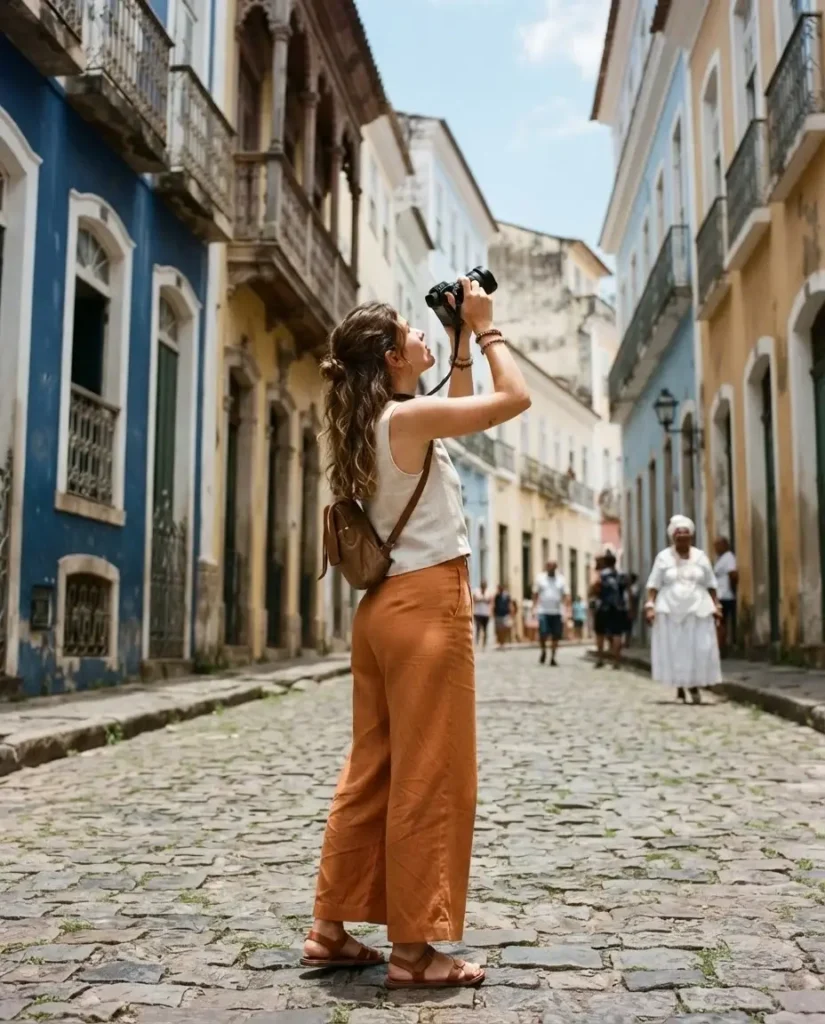
It is also a working neighborhood, not a theme park, and that distinction matters.
What to eat: Bahian cuisine is one of the great regional food traditions of the Americas, built on the African-influenced use of palm oil, coconut milk, and robust spices. Moqueca, a slow-cooked seafood stew made with palm oil and coconut milk, is the dish to seek out. Acaraje, deep-fried black-eyed pea fritters stuffed with shrimp and vatapa, a spiced shrimp and peanut paste, are sold by street vendors across the city and are one of the most distinctive food experiences you will have anywhere.
Solo travel note: Salvador requires more planning and awareness than some other cities on this list. Petty theft is a real concern, particularly in tourist areas and during Carnival season. Staying in the Barra or Pelourinho neighborhoods, using recommended local guides for initial orientation, and keeping valuables out of sight are all standard advice from experienced solo travelers who have visited.
How to Choose the Right City for Your Trip
The honest answer is that the best coastal city for you depends on where you are in your travel journey, not just where you want to go.
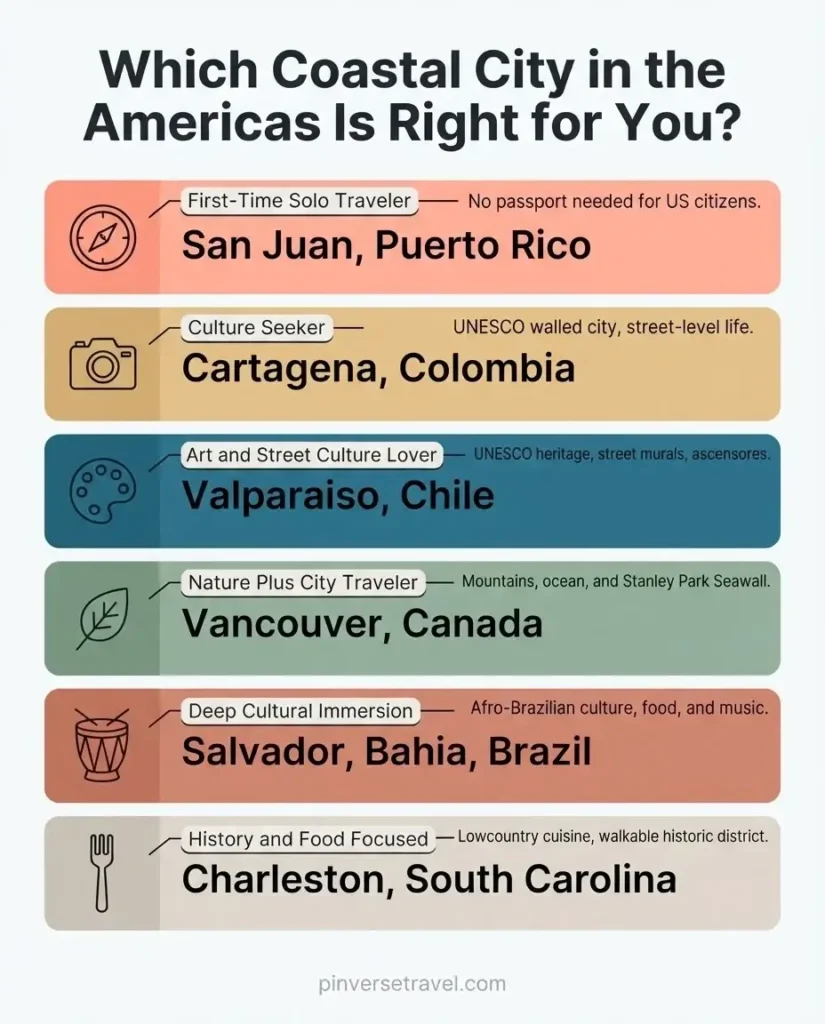
If you have never traveled solo internationally, start with San Juan. It removes the passport barrier, the currency barrier, and most of the navigation anxiety while still giving you a genuinely foreign cultural experience. If you are comfortable traveling but want somewhere that will move you culturally, Cartagena or Salvador should be at the top of your list. Both are cities that stay with you. If you are drawn to natural beauty alongside urban life, Vancouver is in a category of its own in the Americas. If you love the intersection of history, food, and a walkable city that rewards slow exploration, Valparaiso and Charleston are worth every hour you spend in them.
None of these cities are perfect. All of them have challenges, trade-offs, and realities that a glossy travel feature will not show you.
That is not a reason to avoid them. That is what makes them real.
The Americas stretches across an extraordinary range of coastlines, climates, and cultures.

The cities on this list are the ones where the water is not just a backdrop. It is part of the story. Start with one, go slowly, and pay attention. That is when travel stops being a list you are working through and starts being the thing that actually changes how you see the world.