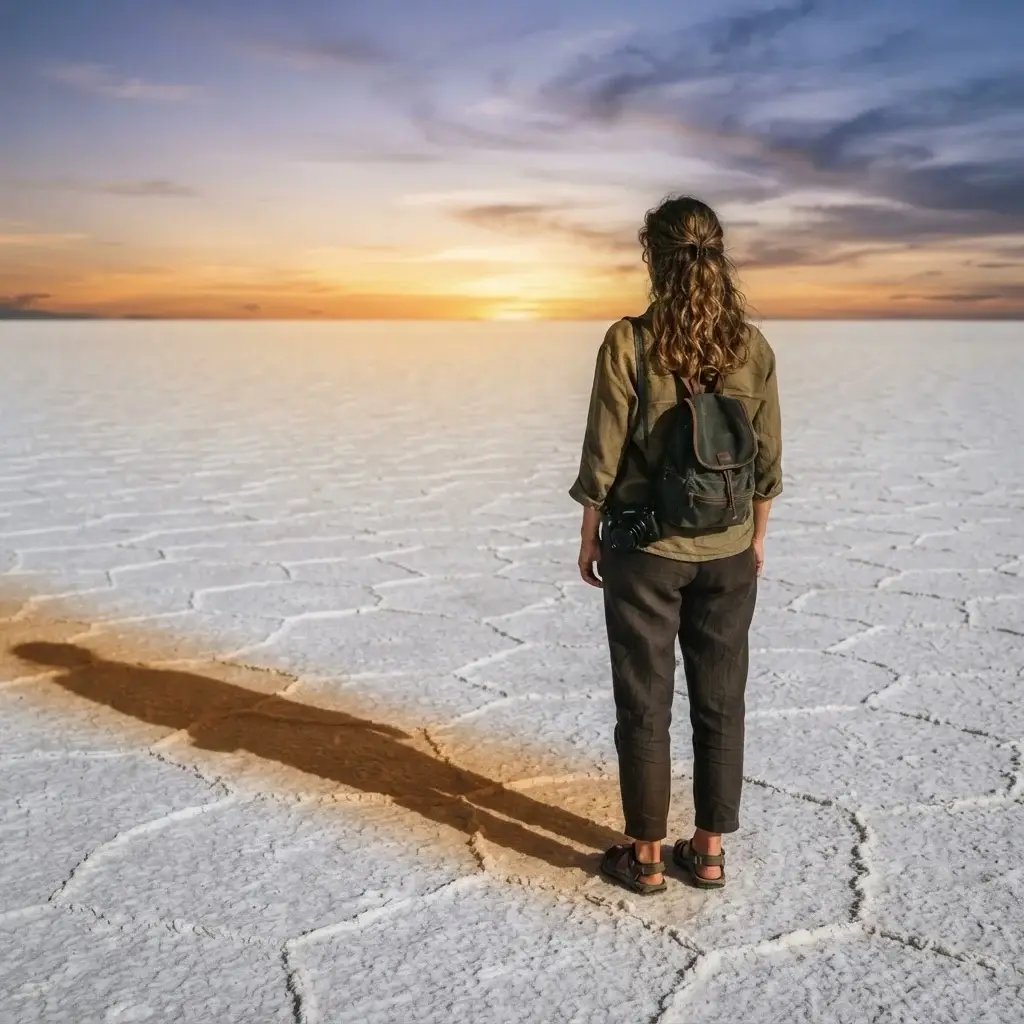
I remember the feeling of looking at a map of South America and thinking Bolivia seemed almost too remote, too high, too complicated. And then I started reading the actual numbers. Budget travelers consistently report spending between $25 and $40 USD per day in Bolivia, making it one of the most affordable destinations on the entire continent. Not just affordable for South America, either. Affordable by almost any global standard.
But here is the thing that most budget articles miss: knowing the daily spend range is only the beginning. The difference between a traveler who has an incredible, financially stress-free trip in Bolivia and one who burns through money or runs into avoidable problems almost always comes down to a handful of specific decisions. Which bus to take. Where to eat lunch. When to book a tour and when to walk in off the street. How to handle the ATMs.
I have spent years studying and writing about how solo travelers move through places like Bolivia, and what consistently separates a confident, budget-savvy trip from a stressful one is not luck. It is preparation. So let me walk you through everything you actually need to know before you go.
Before You Book Anything: Entry, Safety, and the Reality of Current Bolivia
Let’s clear the air about two things right away because they are the first questions I get.
First, visas. If you hold a U.S. passport, you no longer need a visa to visit Bolivia for tourism. As of December 2025, Bolivia waived the visa requirement for U.S. citizens, who can now stay up to 90 days per year with a valid passport. You can confirm this directly through the U.S. Embassy Bolivia’s official announcement. That is a significant shift that saves travelers $160 and a pile of paperwork.
Second, safety. I will always be honest with you about this because glossing over it does no one any favors. The U.S. State Department currently rates Bolivia as a Level 2 destination (Exercise Increased Caution) overall, with a specific Level 3 advisory (Reconsider Travel) for La Paz due to ongoing roadblocks and political demonstrations. This does not mean Bolivia is off-limits. Thousands of travelers move through the country every month. But it does mean you need to travel with your eyes open, monitor local news, have flexible plans, and build extra buffer days into your itinerary in case a road closure or demonstration disrupts your transport.
Petty theft is the most common issue, particularly pickpocketing in bus stations and tourist zones. Use a secure crossbody bag, do not walk alone late at night in city centers, and use only marked radio taxis (identifiable by the taxi company name and phone number on the roof). Avoid unmarked or rideshare cars, and never get into an unlicensed vehicle.
Enroll in the Smart Traveler Enrollment Program (STEP) before you go. It is free and takes five minutes, and it ensures the U.S. Embassy can reach you if things get complicated.
The Currency Question (This Will Save or Cost You)
Bolivia uses the boliviano (BOB), and at the current rate in mid-2026, one U.S. dollar gets you roughly 6.9 to 7.1 bolivianos. On paper that sounds simple. In practice, there are two things that catch travelers off guard.
First, ATMs in Bolivia are unreliable. They run out of cash regularly, especially in smaller cities like Uyuni and Potosi, and they frequently have mid-transaction glitches that can cause headaches with your bank. Bring enough USD cash to cover several days of expenses as backup, and withdraw what you need whenever you find a working ATM, not when you desperately need cash.
Second, Bolivian banks and currency exchange offices are strict about the physical condition of U.S. dollar bills. Any bill that is even slightly folded, has a small tear, has a pen mark, or looks worn will be flatly rejected. I am not exaggerating. Bring clean, crisp, new-looking bills only. This is a widely documented issue that surprises travelers every single time. Request new bills from your bank at home before you leave.
Cash is king in Bolivia. Most markets, local restaurants, small guesthouses, and rural areas are cash-only. Carry small denominations in bolivianos for daily purchases.
What Does a Real Budget Day in Bolivia Actually Look Like?
This is where it gets genuinely encouraging. Here is a realistic breakdown for a budget-conscious solo traveler:
A dorm bed in a well-rated hostel in La Paz or Sucre runs about 70-120 BOB per night, which is roughly $10-17 USD. If you want a private room, budget around $20-30 USD. Hostels in Bolivia tend to be social, well-located, and often include breakfast, which helps.
Food is where Bolivia really shines for budget travelers, and the key is understanding one cultural institution: the almuerzo.
The almuerzo is the main meal of the Bolivian day, eaten at lunchtime, and it is served as a fixed set menu at local restaurants called picanterías and small comedores. For anywhere between 15 and 25 bolivianos (roughly $2 to $3.50 USD), you get a full multi-course meal that typically includes soup, a main dish with rice and potatoes, a small salad, and a fresh juice. This is not budget food that tastes like budget food. The almuerzo is genuinely central to Bolivian food culture, and eating where locals eat means your money goes further while your experience gets richer.
Breakfast from a street stall (a salteña, which is Bolivia’s legendary baked empanada, and a juice) costs under $1 USD. A simple dinner at a local restaurant runs $3-5 USD. It is entirely realistic to eat three full, satisfying meals in Bolivia for $8-10 USD per day if you eat the way locals do.
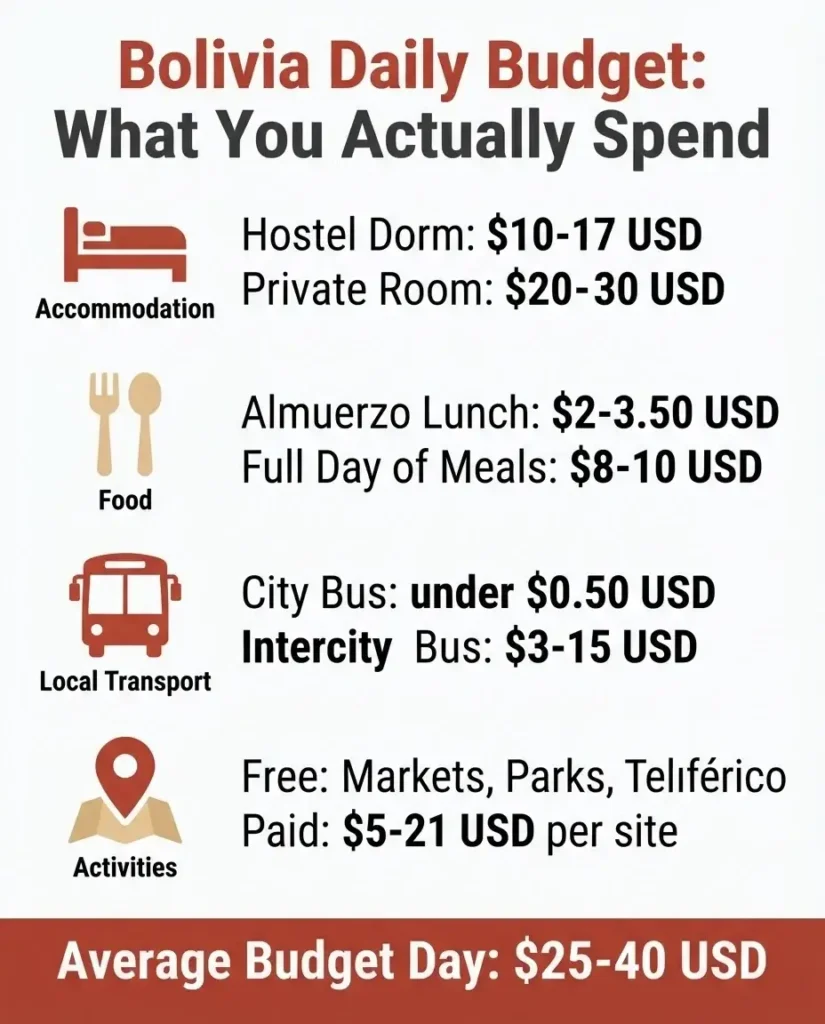
Add in a couple of local bus rides at about $0.30-0.50 USD each, and a daily transport spend of $3-5 USD is achievable within cities. Factor in occasional entrance fees and your daily average settles comfortably in that $25-40 USD range. On lighter days, like slow days in Sucre or hiking days near La Paz, many travelers dip under $20.
Getting Around Bolivia Without Emptying Your Wallet
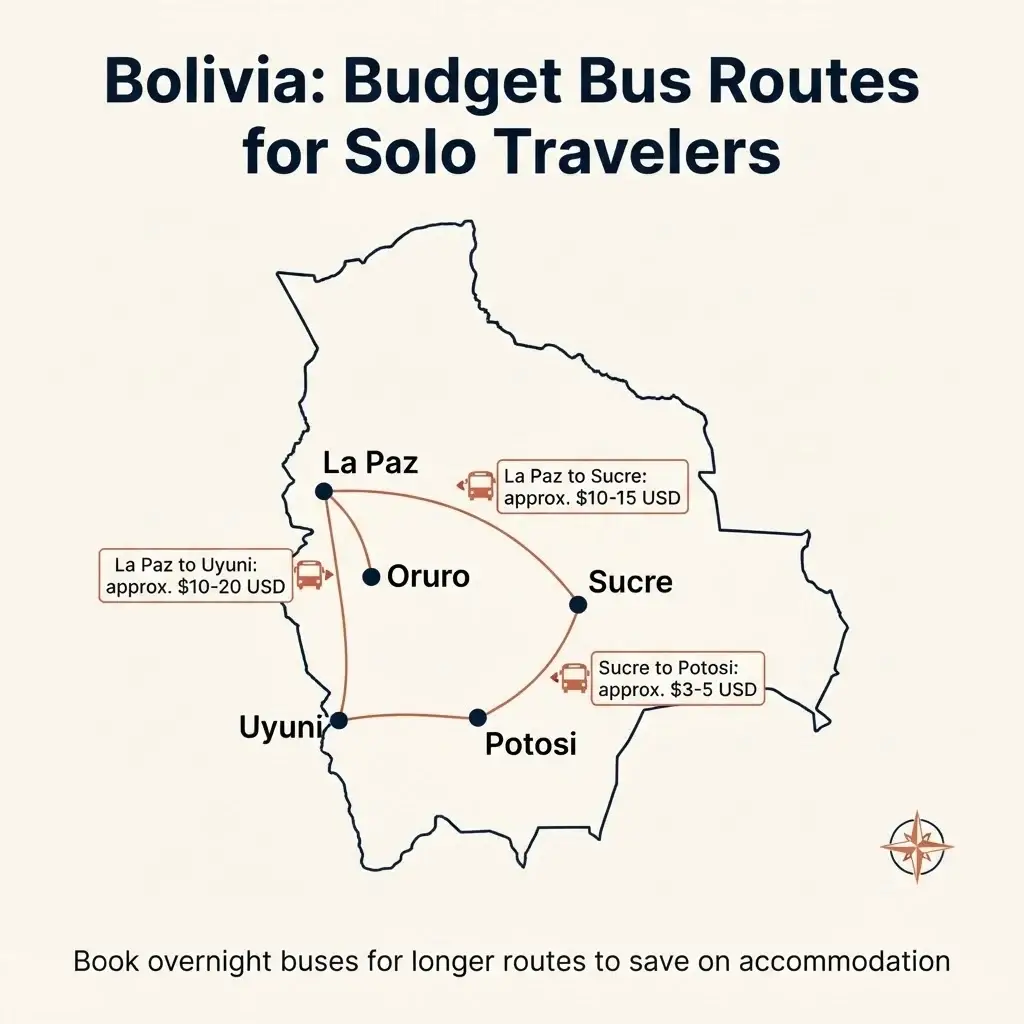
Bolivia’s intercity bus network is extensive and genuinely affordable. The bus is almost always the right choice for budget travelers moving between cities. A few examples of what to expect:
Sucre to Potosi is a 3-4 hour ride costing around $3-5 USD. La Paz to Sucre takes roughly 10-12 hours on a bus and runs about $10-15 USD. La Paz to Uyuni can be done overnight by bus or by a combination of train and bus, with prices ranging from around $10-20 USD depending on the operator and class.
For the longer overnight routes, I strongly recommend paying a little extra for a semi-cama or full cama (reclining seat or lie-flat) bus. The difference in cost is usually $5-10 USD more, and the difference in how you feel when you arrive (and therefore how much you actually enjoy your next destination) is enormous. Companies operating on the La Paz to Oruro to Potosi to Sucre corridor tend to have varying safety and comfort records, so ask at your hostel for current recommendations on reliable operators.
Within cities, La Paz has one of the most unexpectedly wonderful budget transport systems in all of South America: the Mi Teleférico cable car network. This aerial gondola system connects neighborhoods across La Paz’s dramatic vertical terrain, and a single ride costs about 3 BOB, which is under $0.50 USD. It is practical, genuinely scenic (the views over the city and toward the mountains are striking), and a completely unique way to move through a city.
From what travelers consistently report, riding the teleférico from one end to another is one of the best free-ish experiences in La Paz.
La Paz: Free and Cheap Experiences Worth Your Time
La Paz rewards slow, curious exploration more than it rewards rushing from attraction to attraction. Here is what to prioritize if you want to spend meaningfully and spend little.
The Witches Market (Mercado de las Brujas) on Calle Linares is one of the most genuinely distinctive street markets you will find anywhere in the world. Vendors sell dried llama fetuses used in Andean blessing rituals, medicinal herbs, amulets, incense, and traditional remedies rooted in Aymara spiritual practice. Browsing is free, and the cultural conversation you start by simply paying attention is priceless.
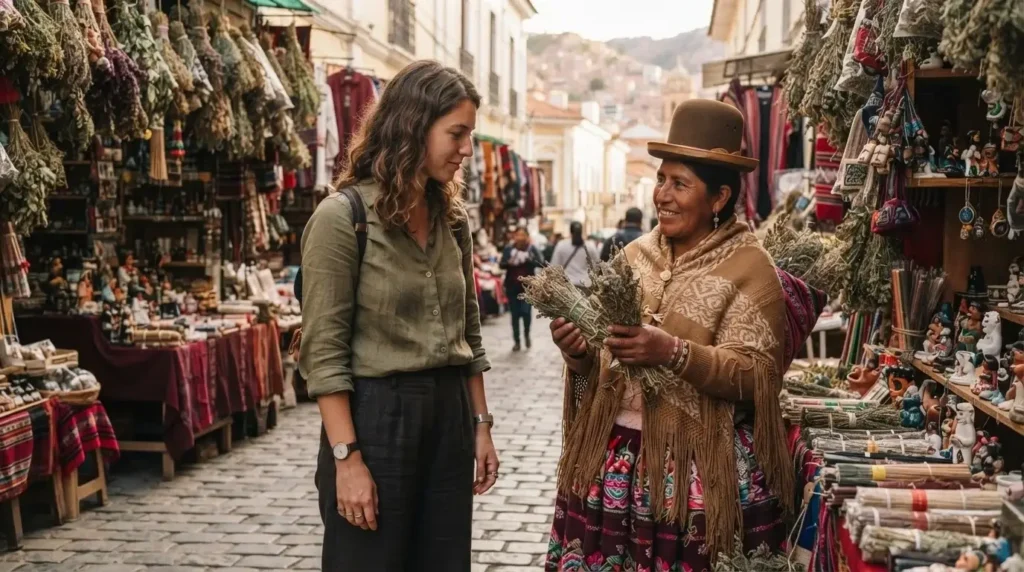
If you buy souvenirs, this is a far more authentic and lower-priced option than airport shops.
The Mercado Rodriguez is a local produce and food market where you can buy fresh fruit, vegetables, and snacks at prices that will make you laugh compared to anything back home. This is also where you will find some of the best almuerzo deals in the city.
Laikakota Park offers free city views and is a good spot to sit, breathe, and watch city life at altitude. The Prado boulevard is worth a long walk, particularly on weekends when the streets fill with vendors and informal entertainment.
The Uyuni Salt Flats: How to Do It Right Without Overpaying
The Salar de Uyuni is the reason many travelers come to Bolivia in the first place, and for good reason. It is one of the most surreal landscapes on earth: an enormous white salt flat stretching to the horizon, surrounded by volcanoes, with a sky so vast and a horizon so flat that it plays tricks with your sense of scale. During the rainy season (roughly December through March), a thin layer of water turns the surface into a perfect mirror that reflects the sky. It is extraordinary.
Here is the budget-critical information: book your tour in Uyuni itself, not online in advance. Tour agencies in Uyuni town line the streets near the main plaza, and booking locally typically runs 60-90 USD for a one-day tour and around 180-239 USD for a three-day tour into the surrounding Altiplano, salt flat, and Eduardo Avaroa National Park. Tour options and pricing are listed on the official Salar de Uyuni website. The same tours booked through international platforms often cost significantly more.
If you opt for the three-day tour, which I recommend if your schedule allows, you will also visit the Laguna Colorada (a strikingly red lake tinted by algae), geysers at sunrise, and the Dali Desert landscape. It is a genuinely once-in-a-trip experience, and three days gives you time to absorb it rather than rush through.

A few practical notes: nights on the three-day tour involve basic salt hotel accommodations with limited heating, and temperatures at altitude can drop sharply after dark. Bring warm layers regardless of when you visit. Also, the entrance fee to Eduardo Avaroa National Park is approximately 150 BOB ($21 USD) and is paid separately from your tour fee.
Potosi, Sucre, and the UNESCO Heritage Trail on a Budget
Bolivia is quietly remarkable when it comes to UNESCO-listed cultural heritage. The country has seven World Heritage sites, including the City of Potosi (listed 1987), the Historic City of Sucre (1991), the Jesuit Missions of the Chiquitos (1990), and the pre-Columbian archaeological site of Tiwanaku (2000). Visiting these sites gives your trip extraordinary cultural depth, and most of them cost very little.
Potosi deserves more time than most travelers give it. At over 13,000 feet above sea level, it is one of the highest cities in the world, and its colonial architecture, silver-mining history, and the dramatic Cerro Rico mountain looming overhead make it one of the most atmospheric places in South America. The Cerro Rico mine tour, where cooperatives of miners still work in conditions that have changed surprisingly little from the colonial era, is one of the most moving and thought-provoking experiences available to travelers anywhere in the continent.
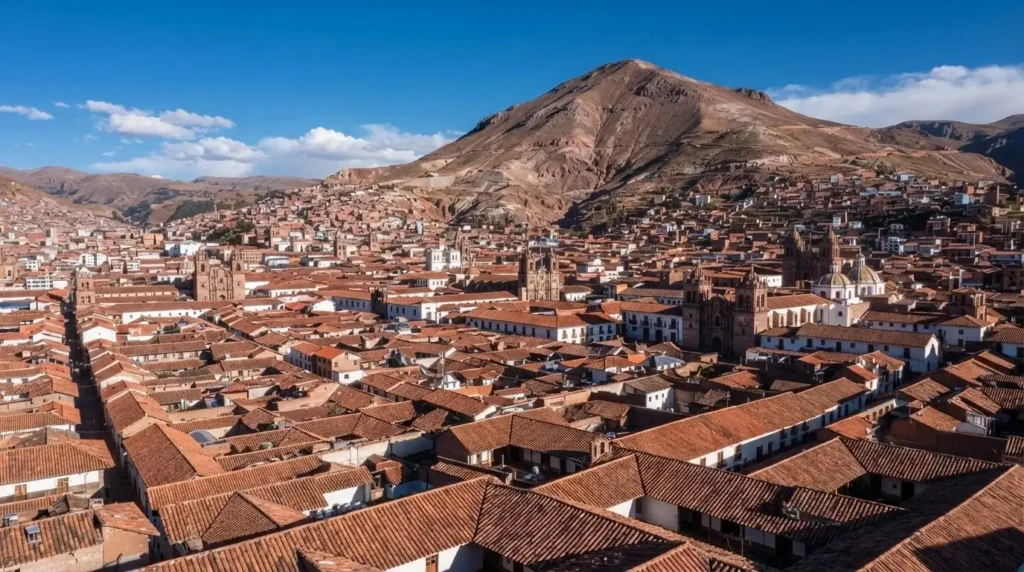
A half-day tour through local agencies like Koala Tours costs around 100 BOB ($14-15 USD) and employs ex-miners as guides. It is not a comfortable or sanitized experience, and that is exactly the point.
Sucre is Bolivia’s constitutional capital and one of the most beautiful colonial cities you will find anywhere in Latin America. The whitewashed architecture, relaxed pace, and concentration of museums, markets, and plazas make it genuinely easy to spend three or four days here without spending much at all. The central market has excellent almuerzo options, and many of the city’s most beautiful public spaces and viewpoints are free.
Tiwanaku, the pre-Columbian archaeological complex built by the Tiwanaku civilization roughly 45 miles west of La Paz near Lake Titicaca, is accessible as a half or full day trip by minibus. The site opens daily from 9am to 5pm and charges around 100 BOB ($14 USD) for foreign visitors, which includes access to both the outdoor ruins and the on-site museum.
Altitude: What It Costs You If You Ignore It
This section belongs in a budget article because altitude sickness is one of the single most common reasons travelers in Bolivia lose money, not to altitude-related medical bills necessarily, but to lost days. If you arrive in La Paz (elevation 11,975 feet / 3,650 meters) or Potosi (13,420 feet / 4,090 meters) and push straight into sightseeing, hiking, or long days of activity, you are taking a real risk of spending your first two days flat in bed with a splitting headache, nausea, and the specific misery of not being able to do anything about it.
The CDC’s guidance on travel to high altitudes is clear: ascend gradually when possible, rest on your first day, drink water constantly, avoid alcohol for the first 48 hours, limit caffeine, and eat light. Coca tea (mate de coca), widely available everywhere in Bolivia, is a traditional and genuinely helpful acclimatization aid. It is legal in Bolivia, deeply culturally significant, and many travelers find it helps significantly with mild altitude symptoms.
If you are flying directly from sea level into La Paz’s El Alto airport (which sits at a dizzying 13,323 feet), budget your first day as a rest day, full stop. Walk slowly, eat light, drink water, and let your body catch up. The small investment of one low-activity day will pay for itself many times over in the days that follow.
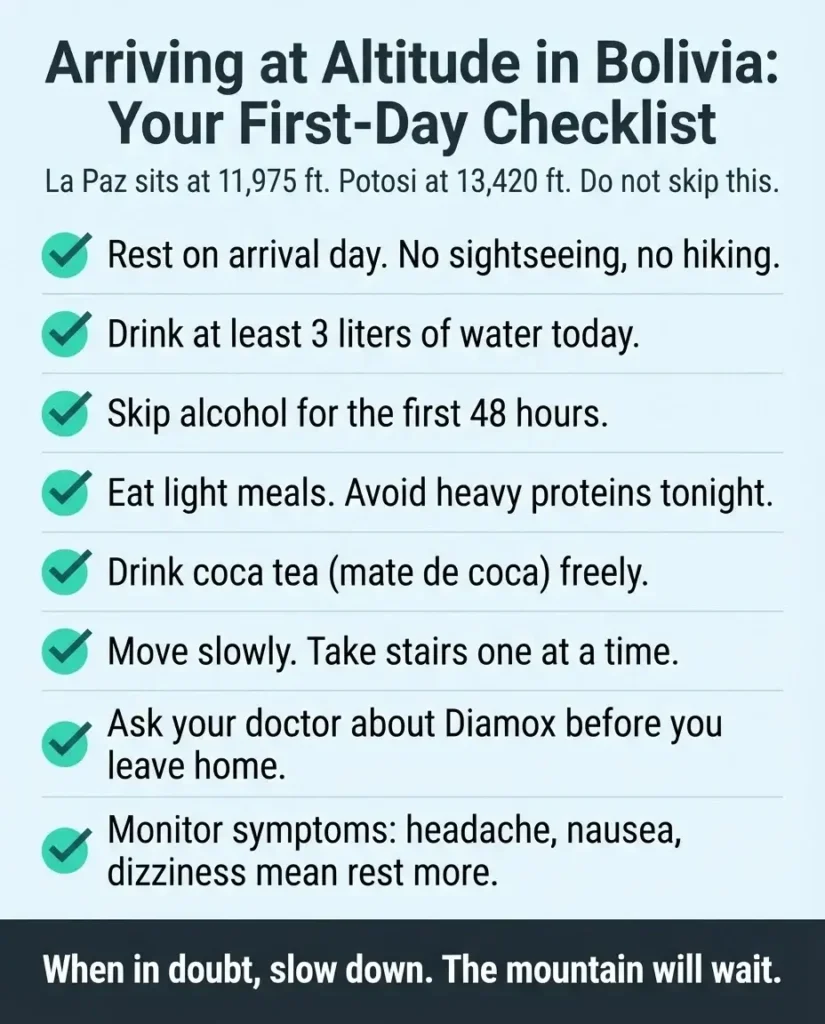
Some travelers also ask their doctor about acetazolamide (Diamox) before leaving home. It is a prescription medication that can help prevent and reduce altitude sickness symptoms. It is not a replacement for gradual acclimatization, but it is worth discussing with your doctor if you have concerns.
Health Prep That Is Not Optional
One more thing that sits at the intersection of health and budget: vaccinations. If you plan to travel to areas east of the Andes below 7,550 feet in elevation, including Santa Cruz, Beni, and parts of La Paz Department, the Bolivian government requires proof of yellow fever vaccination. The CDC Travelers Health page for Bolivia also recommends consulting your doctor about hepatitis A and B, typhoid, and malaria prevention depending on your itinerary.
Getting these vaccinations sorted before you leave is far cheaper, faster, and less stressful than trying to handle it on the road. Some travel clinics and county health departments provide these at low cost. This is absolutely not an area to cut corners on.
When to Go and When Not to Go (It Affects Your Budget)
Bolivia has two main seasons, and your choice matters both for experience and cost.
The dry season runs roughly May through October and is considered the classic “best time” to visit. Skies are clear, roads are more passable, and the Uyuni Salt Flats reflect the famous blue-sky views. However, this is also peak season, which means busier hostels, slightly higher prices, and more competition for Uyuni tours.
The wet season (November through March/April) brings rain, particularly to the lowland regions and Amazon areas, and road closures are genuinely possible. But it is also the time when a thin layer of water turns the Salar de Uyuni into that surreal mirror image that floods every travel photo feed. Accommodation is cheaper, and you will have fewer fellow travelers at the major sites. If you are flexible and not relying on tight connections, the wet season can be rewarding.
Avoid traveling during Bolivia’s major political protest seasons if you can help it. Check current news close to your departure date and always have a flexible return or exit plan.
The Rule That Will Save You Money in Bolivia
After everything, here is the principle that underlies every piece of advice in this article: eat where Bolivians eat, move how Bolivians move, and slow down enough to notice what is actually around you.
The travelers who overspend in Bolivia are almost always the ones rushing through on a tight itinerary, booking everything in advance through international platforms, eating in tourist-zone restaurants with English menus, and treating cities like checkboxes. The ones who get the most out of every dollar are the ones who take their time, find the almuerzo spot the hostel staff recommends, ask about buying tour tickets directly in town rather than online, and allow the kind of slow, curious wandering that makes travel genuinely unforgettable.
Bolivia is one of the most rewarding destinations in the world for a solo traveler who is willing to be patient, flexible, and genuinely curious. The challenges are real, from altitude to currency logistics to the current political climate. But the reward is a country that will genuinely surprise you: ancient salt deserts, colonial silver cities, indigenous markets that have been running for centuries, and a cultural depth that takes real time to begin to understand.
Build your budget, prep your health, and give yourself enough time to actually land in this extraordinary country before moving on. I promise the investment is worth every boliviano.