Where to Cycle Solo in the Americas: Cities That Get It Right

I’ve spent a lot of time thinking about what makes a city truly feel alive. When I was backpacking solo across Europe, one of the moments I remember most vividly is hopping on a bike in a city I didn’t know and just riding until something made me stop. No plan, no tour group, no agenda. Just me, two wheels, and whatever the city wanted to show me that day. There’s a specific kind of freedom in that feeling, and it’s one I believe anyone can access.
The Americas are an interesting case when it comes to cycling. People often assume the continent is a write-off for bike travel, dominated by sprawling car-centric infrastructure, chaotic streets, and a general indifference to anyone who isn’t driving. And look, that reputation isn’t entirely unfair for certain places. But it’s also increasingly outdated. Over the past decade, cities from Canada to Argentina have quietly transformed into genuinely bikeable destinations, building protected lane networks, launching well-designed bike share systems, and in some cases making cycling a core part of their cultural identity.
If you’ve ever wondered which cities in the Americas actually reward you for showing up on two wheels, this is where to start.
Why Cycling Is One of the Best Ways to Experience a New City Solo
Before we get into specific destinations, I want to make a case for cycling as a solo travel strategy, because it’s genuinely underrated.
When you’re on foot, you see a lot but move slowly. When you’re in a taxi or on transit, you move fast but miss almost everything. A bike sits perfectly in the middle. You cover enough ground to explore multiple neighborhoods in a single afternoon, but you’re still slow enough to notice the mural on the corner, the market spilling onto the street, the smell of something incredible coming from a doorway.
For solo travelers in particular, cycling creates natural opportunities for small interactions that deeper travel is built on. You stop to check your phone for directions and a local points you the right way. You lock up your bike outside a café and strike up a conversation with someone doing the same. You’re visible, approachable, and moving at the pace of actual city life.
From what solo travelers consistently report, finding a city with solid cycling infrastructure changes the entire tempo of a trip. You feel more confident, more independent, and more embedded in a place than any organized tour could get you.
Now let’s get into the cities.
Bogotá, Colombia: The City That Turned Its Streets Into a Movement
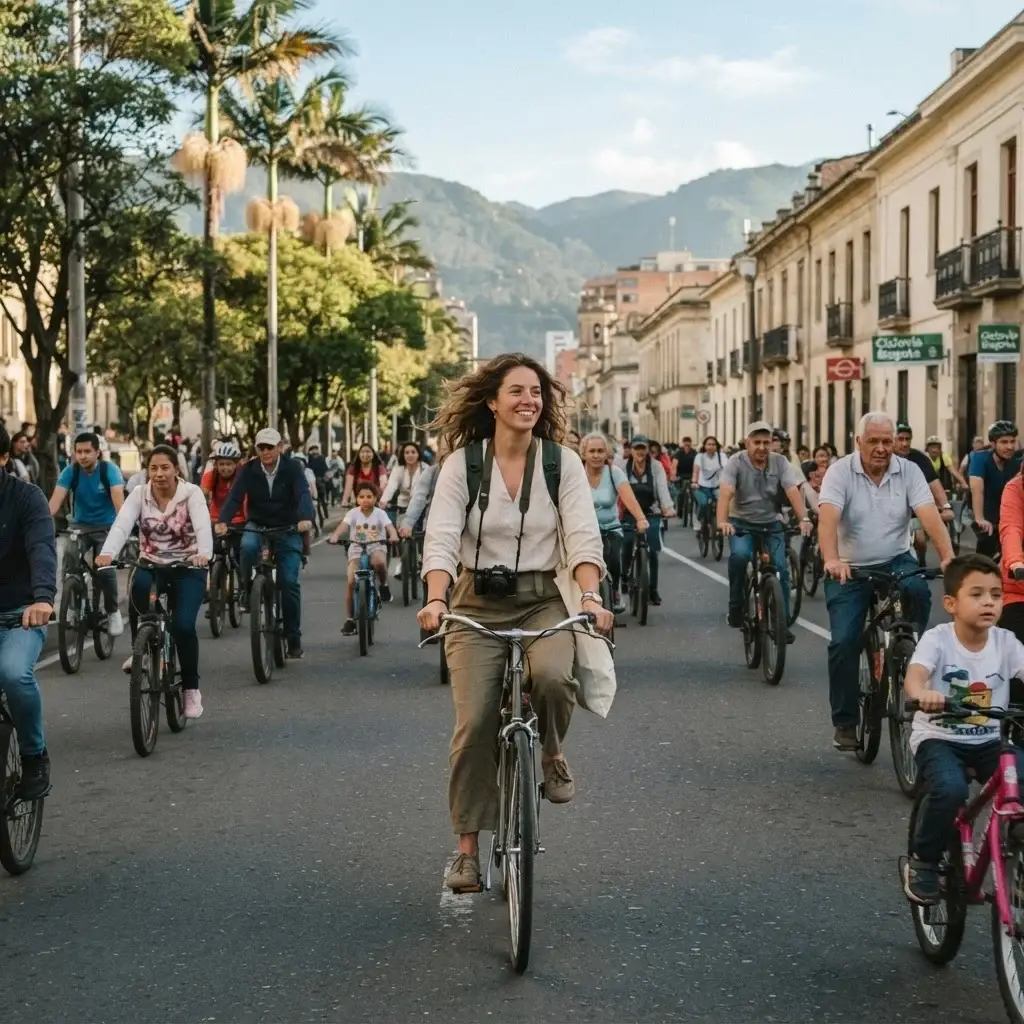
If you only know one thing about Bogotá and cycling, it’s probably the Ciclovía, and it absolutely deserves its reputation. Every single Sunday morning from 7am to 2pm, the city closes over 120 kilometers of its main roads to cars and opens them to pedestrians, cyclists, and anyone who wants to reclaim the street. No barriers between you and the road, no fumes, no traffic. Just people moving through their city on their own terms.
What makes Bogotá extraordinary, though, is that the Ciclovía is just the most visible layer of something much deeper. According to the World Resources Institute’s analysis of 50 years of Ciclovía, Bogotá has developed one of the most extensive protected cycle lane networks in the world, totaling over 540 kilometers of dedicated infrastructure. As of 2024, more than 51% of the city’s residents live near protected bikeways. Over 650,000 bike trips are made in the city every single day. The bicycle has been formally recognized as part of Bogotá’s cultural heritage.
For solo travelers, Bogotá is a remarkable place to explore by bike. The Ciclovía route itself takes you through neighborhoods that feel wildly different from one another. La Candelaria, the historic colonial center, gives way to the leafy streets of Chapinero, then the creative energy of Zona Rosa. Rent a bike from any number of local shops on a Sunday morning for around 10,000 to 15,000 COP ($2.50-$4 USD) per hour and just join the flow of people.
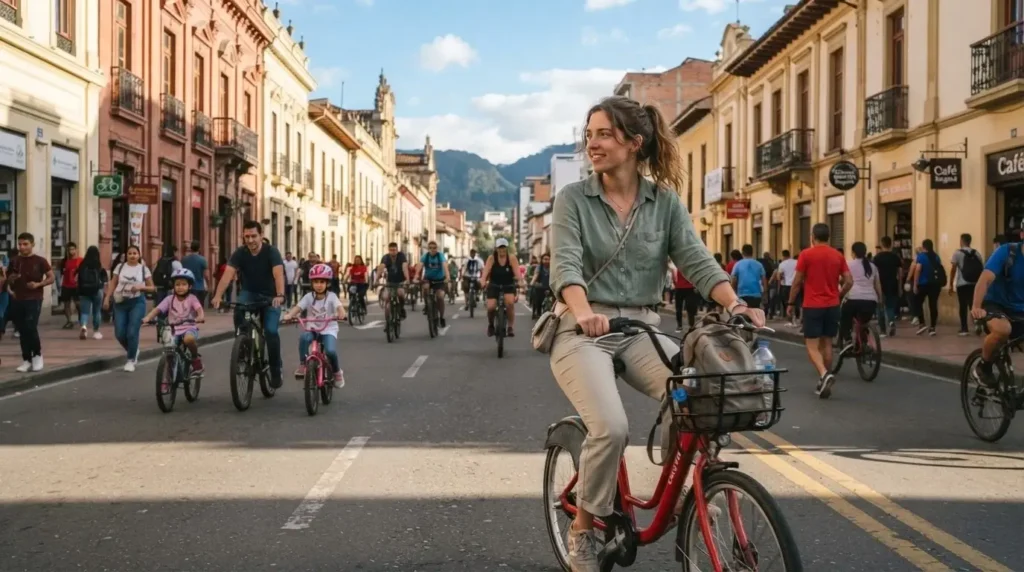
You’ll have no trouble finding your way, because on Ciclovía Sundays, the entire city is moving with you.
One practical note for solo travelers: Bogotá is a city with real economic inequality, and like any major Latin American city, it rewards thoughtful awareness. Stick to well-traveled routes, especially as a first-time visitor, ride during daylight hours, and keep a secondary bag rather than wearing an obvious camera around your neck. None of this should deter you. The cycling community in Bogotá is warm, inclusive, and genuinely proud of what their city has built.
What to eat along the way: Pull up near Parque de la 93 or the Usaquén neighborhood market and try arepas con queso fresh off the griddle, or a bowl of ajiaco, the hearty chicken and potato soup that is one of the most comforting things you’ll eat in South America.
Mexico City, Mexico: Chaotic on the Surface, Surprisingly Rideable Underneath
Mexico City has a reputation that can scare off first-time visitors, let alone first-time cyclists. It’s enormous, loud, and dense in a way that initially feels overwhelming. I get that. But from what cyclists who know CDMX consistently say, once you understand how the system works, the city opens up in extraordinary ways.
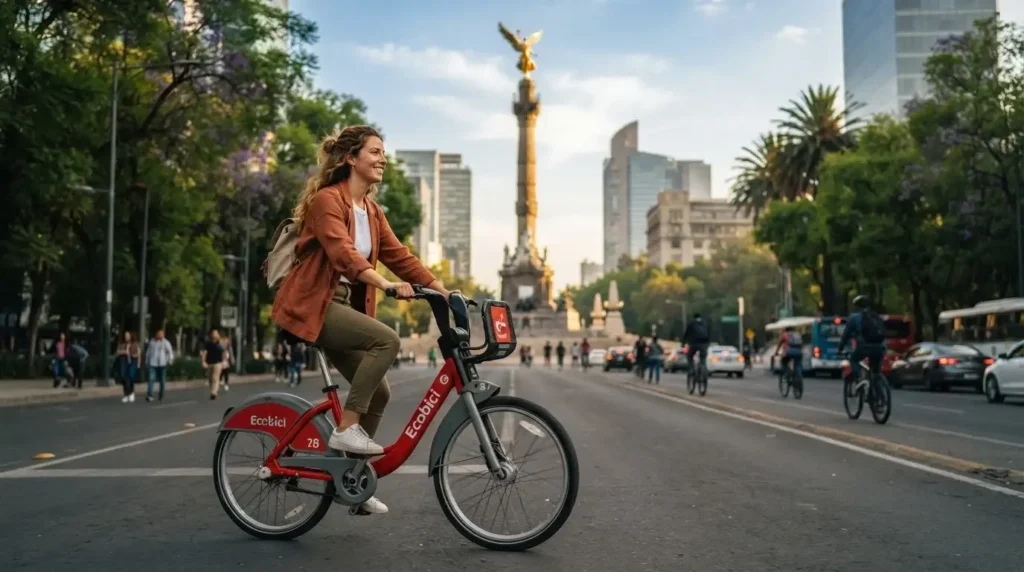
The key is the Ecobici bike share system, run directly by the Mexico City government. It’s genuinely easy to use. You download the app, register, choose a plan (day passes, three-day passes, and week passes are all available alongside annual memberships), and you can pick up a bike at hundreds of stations across the central districts. Each ride gives you 45 minutes before fees kick in, and the stations are frequent enough that you can simply dock and re-check out for longer rides. The system runs from 5am to 12:30am, seven days a week.
The trick to enjoying Mexico City by bike is to stay within the central neighborhoods: Condesa, Roma, Polanco, Coyoacán, and Chapultepec. These areas have more than 230 kilometers of designated bike lanes, reasonable street calming, and a culture where cyclists are at least acknowledged by drivers. The Paseo de la Reforma, one of the city’s grand boulevards, has a dedicated bike lane that connects Chapultepec Park to the historic center, and riding it on a Sunday morning when car traffic is reduced feels almost surreal. You’re pedaling past the Angel of Independence monument with the skyline in front of you and the park at your back.
Chapultepec Park itself deserves its own mention. It’s one of the largest urban parks in the Americas and cycling through it is a genuinely lovely way to spend a morning. Bike rental stations are clustered around the park entrances if you’d rather not commit to the Ecobici system.
What to eat nearby: After your Reforma ride, lock up near Colonia Roma and find a taqueria on Avenida Álvaro Obregón for tacos al pastor. The neighborhood is also full of specialty coffee shops that feel made for solo travelers who want to sit with a book between rides.
Buenos Aires, Argentina: Flat, Wide, and More Welcoming Than You’d Expect
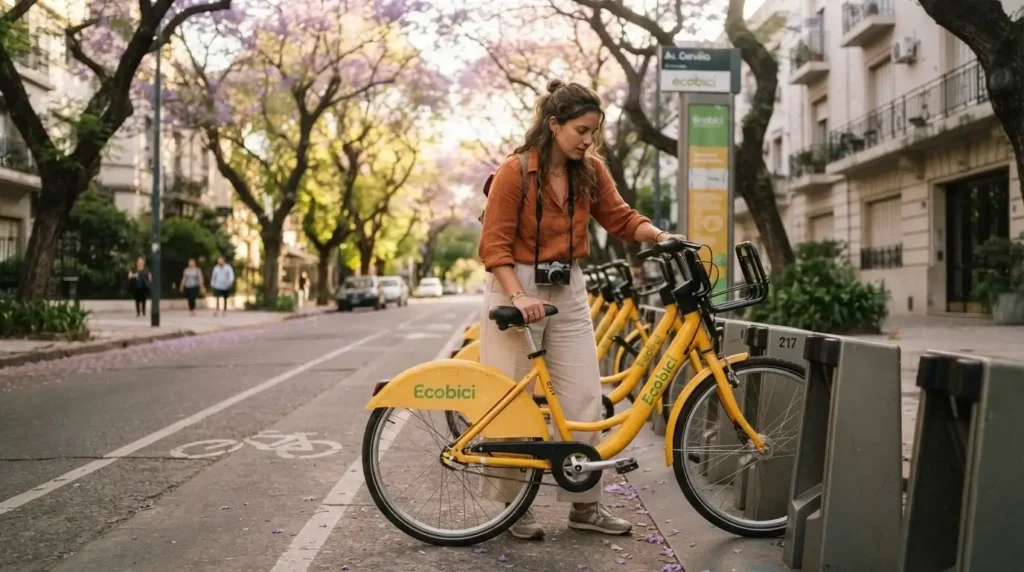
Buenos Aires is one of those cities that rewards slow exploration, and the flat topography makes it near-perfect for cycling. According to the Buenos Aires official tourism board, the city has over 130 kilometers of dedicated bike lanes threaded through its neighborhoods, and the Ecobici public bike share system (yes, Buenos Aires has its own version of Ecobici) lets you borrow a bike for free from more than 100 stations across the city. On weekdays, loans run up to an hour at a time. On weekends, you get two hours. Registration is through the BA Ecobici app or website, and while you’ll need to upload your ID, the process is straightforward.
The neighborhoods most worth cycling through are Palermo, Recoleta, San Telmo, and La Boca, but in that order of ease. Palermo is lush and broad, with wide tree-lined streets and enough cafés and parks to stop at constantly. Recoleta feels like a slightly grander Buenos Aires, with European-influenced architecture and the famous cemetery where Eva Perón is buried. San Telmo has a raw, antique energy that becomes electric on Sundays when the market overflows into the streets. La Boca is visually dramatic with its colorful Caminito street, but worth visiting briefly rather than riding through at length as a solo traveler.
One thing that stands out about Buenos Aires is how culturally relaxed the cycling environment feels. Portenos cycle to meet friends, to get coffee, to run errands. It’s social cycling, and as a solo traveler, it’s easy to feel part of the rhythm of the city rather than apart from it.
What to eat along the way: Stop for a medialunas (those buttery Argentine croissants that put all other croissants to shame) and a cortado at any neighborhood café in Palermo. If you’re riding through San Telmo on a Sunday, the outdoor market vendors sell empanadas that are among the best in the city.
Portland, Oregon, USA: Where Cycling Culture Runs Deepest
If there’s one city in the United States where cycling isn’t just infrastructure but identity, it’s Portland. As the official Portland travel guide notes, the city has almost 400 miles (around 650 km) of bikeways woven throughout its streets, making it consistently one of the top-rated cycling cities in North America. Portland’s bikeway network includes protected lanes, dedicated paths, and neighborhood greenways where cyclists and pedestrians genuinely have priority over cars. The PeopleForBikes 2026 City Ratings, which measure biking quality in more than 3,000 US communities, places Portland among the country’s top performers year after year.
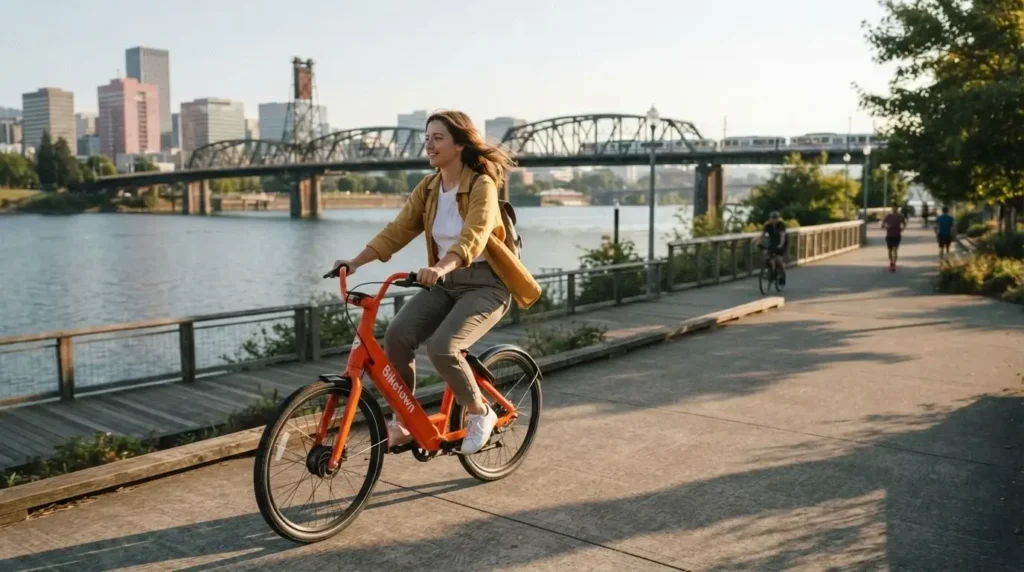
For visitors, the Biketown bike share program is the easiest entry point. After a one-time $5 sign-up fee, you pay around 8 cents per minute, roughly $2.40 for a 30-minute ride. The bright orange e-bikes are available at 240+ stations across the central city and come equipped with baskets, lights, and integrated locking technology.
What makes Portland special for solo travelers specifically is the culture, not just the lanes. The Pedalpalooza bike festival runs from June through September and features over 200 community-organized, themed rides that are entirely open to the public. Taco stand tours. Movie bike rides. Sunset cruises along the river. You show up, you join, and you immediately have company. For solo travelers who want the independence of exploring on their own schedule but also want moments of genuine connection, this is a rare find.
The Eastbank Esplanade route along the Willamette River is one of my favorite routes to recommend to first-timers. You ride with the river on one side, downtown Portland’s skyline on the other, and you can stop at the Saturday Market (one of the largest open-air markets in the US) on the way.
What to eat along the way: Portland’s food truck scene is unreal and cycles-per-blocks dense. Pull up to any food cart pod near SE Division Street or Mississippi Avenue and take your pick. The city does incredibly good Korean, Mexican, Vietnamese, and Thai street food from carts that locals take seriously.
Minneapolis, Minnesota, USA: Cold Weather, Warm Cycling Community
Minneapolis gets overlooked in conversations about great American cycling cities, which surprises anyone who actually knows the city. It consistently ranks among the top two or three cities in the PeopleForBikes ratings for large US cities, and its off-street trail network is genuinely exceptional. The city has 21 miles of on-street protected bike lanes and 106 miles of off-street paths and trails, including the legendary Chain of Lakes trail that loops through a series of interconnected lakes in the southwest of the city.
The Chain of Lakes route is one of the most enjoyable urban cycling experiences in North America. You can ride a continuous loop through Lake Calhoun (Bde Maka Ska), Lake Harriet, and Minnehaha Creek, mostly separated from vehicle traffic, with neighborhood parks and beach areas dotting the route. In summer, the trail fills with locals running, cycling, rollerblading, and generally inhabiting the outdoors with an enthusiasm that feels specific to cities that know winter is coming.
For solo travelers, Minneapolis rewards you with a genuine neighborhood-by-neighborhood variety. Cycling from downtown through Uptown to the lakes district to the coffee shops of Northeast, you cover dramatically different versions of the city. The Great Northern bike trail, still expanding as of 2025, is adding more off-street connectivity between neighborhoods.
Best season for cycling is May through September. Minneapolis winters are genuinely severe, and while die-hard locals do cycle year-round (with the right tires and the right attitude), visitors are better served planning a warm-season visit.
What to eat along the way: Minneapolis has an exceptional Somali food scene, particularly around the Cedar-Riverside neighborhood near the University of Minnesota. After a morning ride on the trails, it’s worth cycling over for a suqaar (a spiced meat dish) or a sambusa that you won’t find done this well anywhere else in the Midwest.
Vancouver, Canada: Mountains, Ocean, and One of the Best Seawall Rides on Earth
Vancouver is the kind of city that makes you feel grateful just to be in it. The combination of ocean, mountains, and a genuinely well-built cycling network makes it one of the most visually spectacular places in the Americas to ride a bike. The City of Vancouver’s cycling route network is regularly updated, and the 2026 cycling map features a range of featured routes spanning the Seawall, seaside paths, and creative urban routes through lesser-visited neighborhoods.
The Stanley Park Seawall is the crown jewel. This roughly 10-kilometer (6-mile) paved path circles Stanley Park, which sits on a peninsula at the edge of downtown Vancouver. You ride with the Pacific Ocean (and the mountains of the North Shore) on your left, the ancient forest on your right, and the city skyline appearing and disappearing behind you as the path curves.
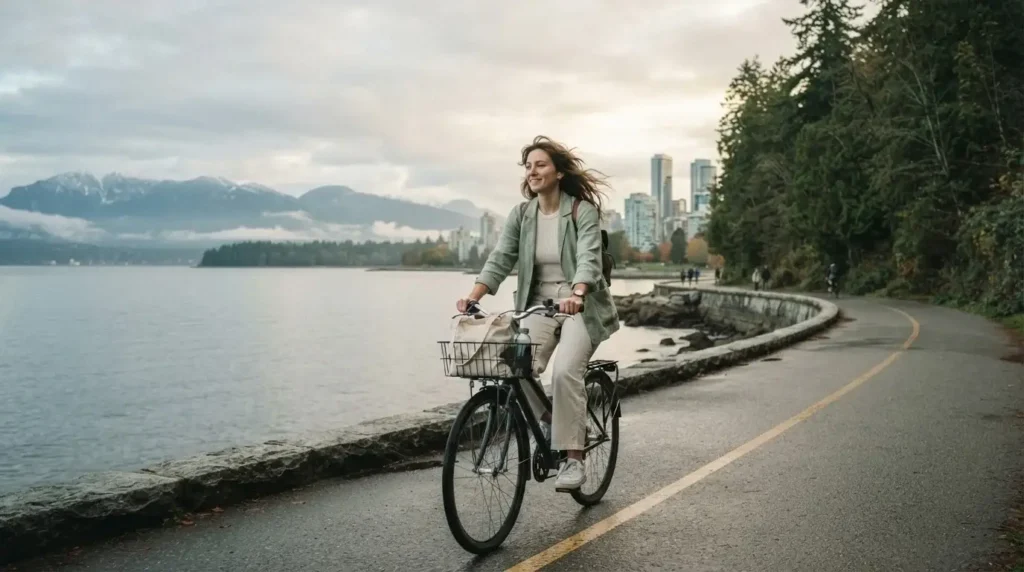
It is, genuinely, one of the most beautiful urban cycling experiences on the continent.
Beyond Stanley Park, the Seaside route connects the Seawall all the way through Kitsilano, Spanish Banks, and Jericho Beach, eventually reaching the University of British Columbia. The full out-and-back takes a good half-day and rewards you with a completely different set of views, neighborhoods, and picnic-worthy beach spots.
Bike rentals cluster around the entrance to Stanley Park on Denman Street, where you’ll find multiple operators with standard bikes, e-bikes, and tandems. Expect to pay around CAD $15-20 per hour for a standard bike or $25-35 per hour for an e-bike.
What to eat along the way: The West End neighborhood, just off the Seawall near English Bay, is full of excellent options. Grab a bowl of Japanese ramen or a Vietnamese banh mi and eat on the beach wall watching the boats. Few things in travel feel this right.
A Note on Safety as a Solo Cyclist
I’d be doing you a disservice if I wrapped this up without being honest about safety, because it does vary significantly across these cities and it matters especially for solo travelers.
The cities with the best cycling infrastructure, Portland, Minneapolis, Vancouver, and Montreal (which rivals them all, ranked first in North America on the 2025 Copenhagenize Index), have also invested heavily in the cultural normalization of cycling. Drivers are used to sharing the road. Bike lanes are protected, not just painted. Night riding on main routes is well-lit and relatively comfortable.
In Latin American cities like Bogotá, Mexico City, and Buenos Aires, the picture is more nuanced. Infrastructure quality varies dramatically by neighborhood. In all three cities, sticking to well-known cycling corridors, especially during daylight hours, is important. Locking your bike properly at every stop is non-negotiable. Carrying a basic lock and riding without expensive visible gear reduces both risk and anxiety.
None of this is a reason to avoid these cities on a bike. The cycling communities there are among the most vibrant and welcoming I’ve read about anywhere in the Americas. It just requires a bit more awareness than Portland or Vancouver.
Across all cities, the ITDP’s ongoing research into cycling infrastructure quality is a useful resource if you want to go deep on any particular city before you travel. Their data on protected bikeway coverage per city gives you a clearer picture of how connected and physically safe the lanes actually are, rather than just relying on total kilometers claimed.
Which City Should You Start With?
There’s no single right answer because it depends on what kind of traveler you are. Here’s a fast framework.
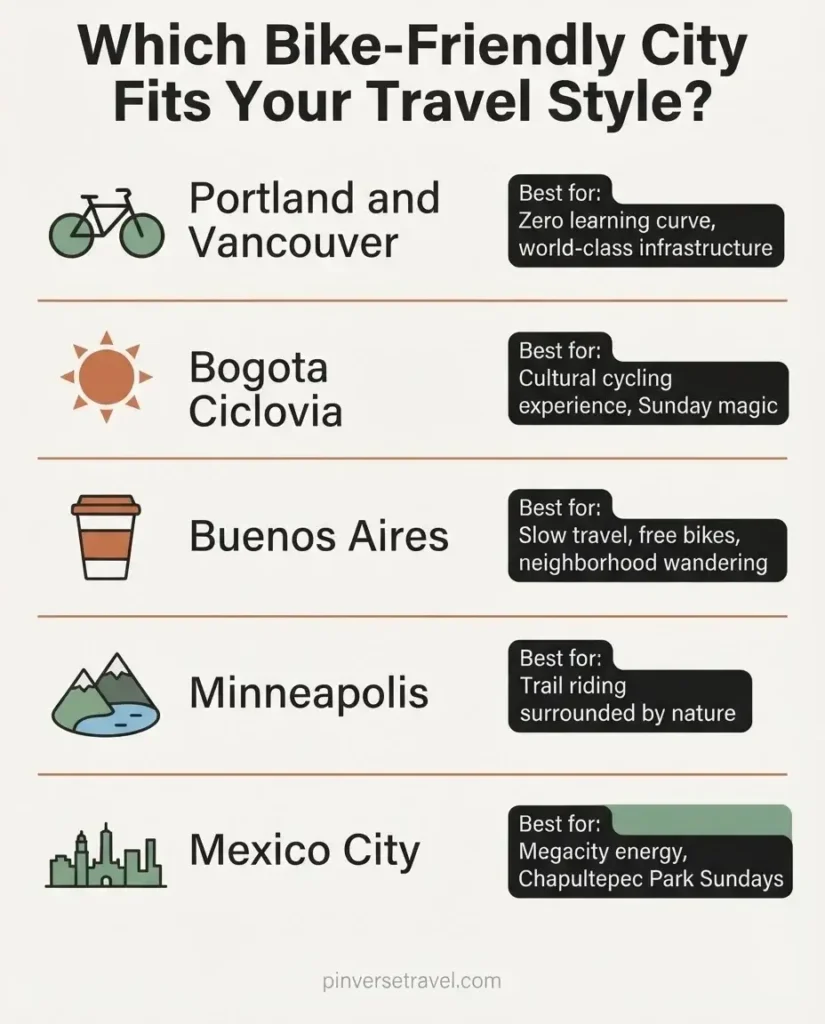
If you want world-class infrastructure with zero learning curve, Portland and Vancouver are your best entries. The systems are intuitive, the culture is supportive, and you’ll feel confident on day one.
If you want a cultural cycling experience unlike anything in North America, Bogotá’s Ciclovía on a Sunday morning is something that genuinely stays with you. It’s not just a bike ride. It’s a city expressing something true about itself.
If you want a laid-back urban cycling rhythm that integrates perfectly with food, coffee, and neighborhood-hopping, Buenos Aires is hard to beat. The flat terrain, free bikes, and unhurried pace are made for the slow traveler.
If you want trail riding surrounded by nature inside a major city, Minneapolis and Vancouver compete at the top. The Chain of Lakes and the Seawall are both extraordinary.
And if you want the energy and complexity of one of the world’s great megacities, navigated in a way that actually makes sense, Mexico City’s Ecobici system is your entry point, and Chapultepec Park on a Sunday morning is your reward.
Final Thought: Two Wheels, One Continent, Endless Possibility
I left my office job partly because I was tired of covering the same ground in the same way every day. Travel by bike, in any city, gives you the same streets but a completely different relationship to them. You stop when something catches your eye. You get a little lost and find something better. You arrive somewhere tired and hungry and completely present.
The cities in this list are proof that the Americas are not a cycling write-off. They’re home to some of the most intentional, vibrant, and culturally rich cycling cultures on the planet. You just have to know where to look.
So look here. Then go.