The first time I backpacked across Europe on my own, I was broke, jet-lagged, and honestly a little scared. I had left my office job in New York, saved up by working flexible gigs, and finally bought the ticket. I did not have money for taxis. I did not trust myself to rent a car and drive on unfamiliar roads. So I did the only thing I could afford to do. I walked.
And walking changed everything.
I discovered that the cities I loved most were not the ones with the biggest monuments. They were the ones I could feel under my feet. The ones where I could turn down a side street on a whim, smell bread from an open bakery door, and stumble into a square I never planned to see. That is the quiet magic of a walkable city. You are not a passenger. You are part of it.
So if you are dreaming about Europe but feeling nervous about buses you can’t read or cars you don’t want to drive, this guide is for you. These are the most walkable cities in Europe for travelers, especially solo travelers and first-timers, along with the honest, practical stuff most lists leave out: the terrain, the shoes, the food, and exactly where to start your first stroll.
What “Walkable” Actually Means for a Traveler
Here is something most articles skip. Walkable is not one thing.
A city can be walkable because it is flat. It can be walkable because everything sits close together. It can be walkable because cars are banned from the centre, or because the sidewalks are wide and the drivers actually stop for you. The best walking cities usually combine a few of these at once.
When surveys crown a “most walkable” winner, they are measuring different things. A recent locals-based ranking published by Time Out named Edinburgh the most walkable city in Europe, based on how residents rated getting around on foot. A separate study reported by Travel and Leisure crowned Krakow, pointing to how tightly its top sights are clustered. Both are right, because they are answering different questions.
For you as a traveler, the questions that actually matter are simpler. Can I reach the main sights without transit? Is the terrain kind to my feet? Is it safe and pleasant to wander, especially alone? Every city below is a strong yes on the first two, and I’ll be honest about the third as we go.
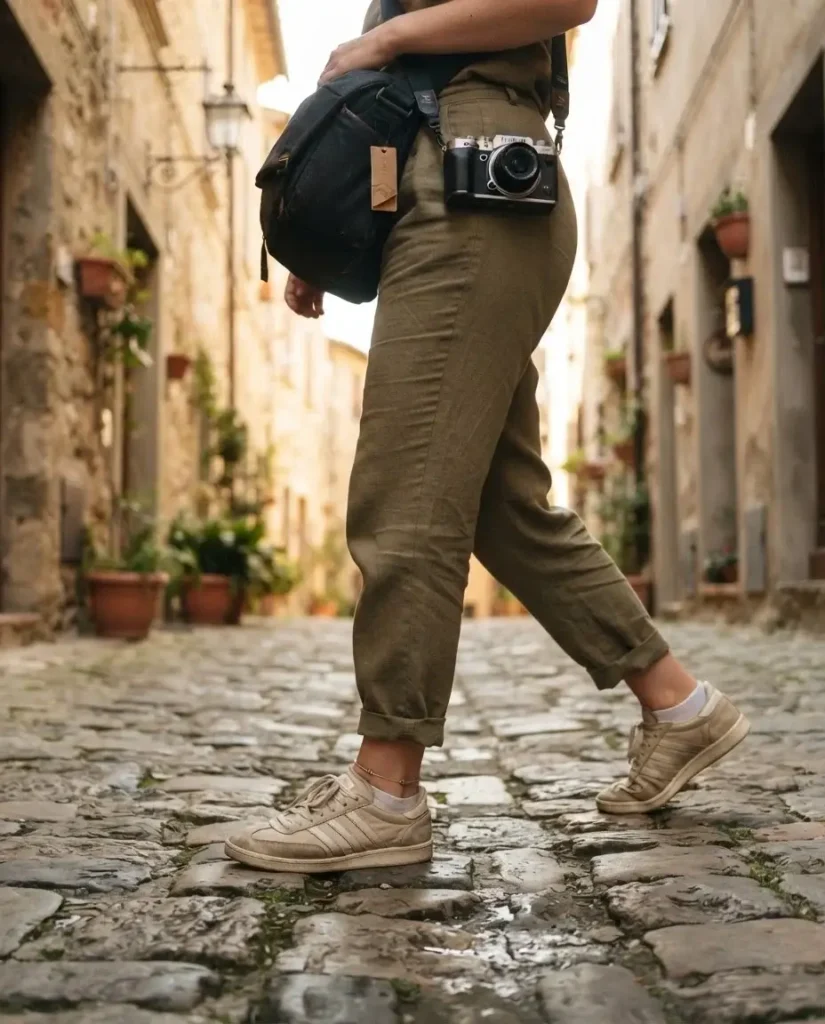
One rule I learned the hard way in Europe: pack proper shoes. Cobblestones are romantic in photos and brutal on flimsy sandals. Bring one pair of broken-in, cushioned walking shoes and your whole trip gets easier.
Krakow, Poland: The Compact Champion
If you are new to solo travel and want a city that feels almost designed for wandering, start here.
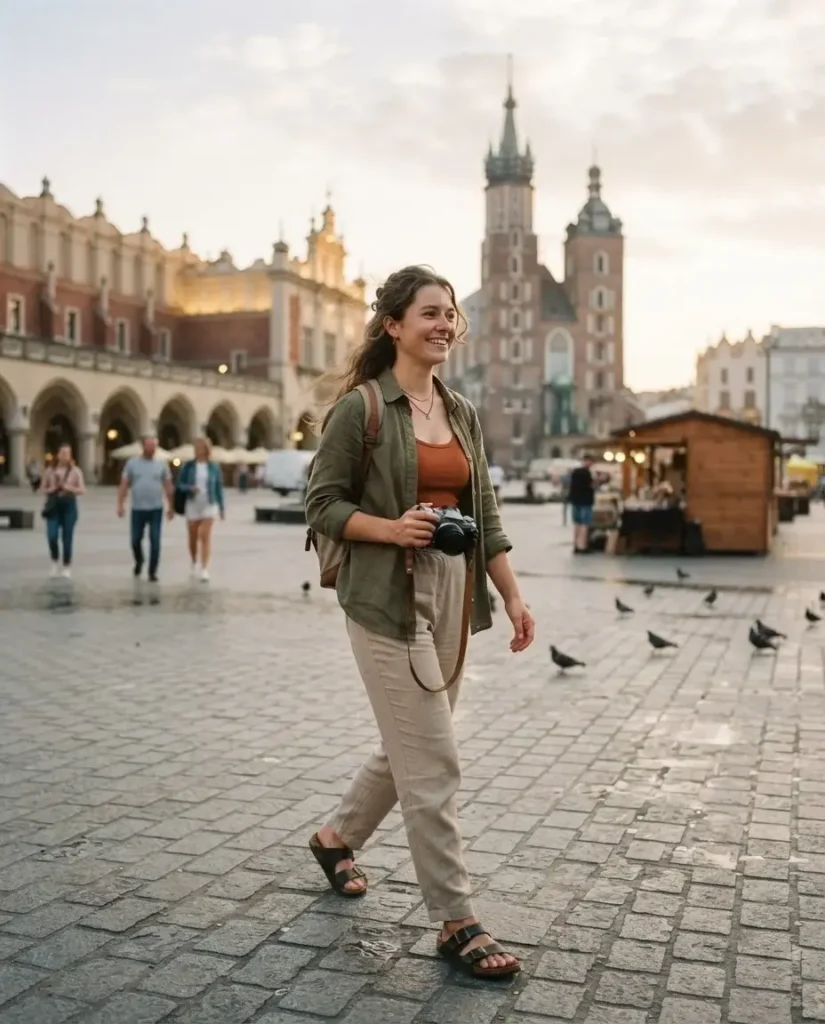
Krakow’s Old Town is wrapped by a green ring called the Planty, a leafy park that follows the line of the old city walls. Inside sits Rynek Główny, one of the largest medieval market squares in Europe, and from there nearly everything worth seeing is a short flat walk away. The official VisitKrakow guide to the Old Town notes that the square is only about a five-minute walk from the main train station, which means you can arrive and be strolling with a coffee within minutes of stepping off the train.
Where to start walking: Rynek Główny. Circle the Cloth Hall, then drift south down Grodzka toward Wawel Castle. When you want a break, follow the Planty ring the whole way around. It is flat, shaded, and impossible to get truly lost.
What to eat while you wander: Grab a zapiekanka, an open-faced toasted baguette loaded with mushrooms and cheese, from the round stalls at Plac Nowy in the Kazimierz district. It is cheap, hot, and perfect walking food. Pierogi are everywhere and worth every bite.
Solo note: Krakow is one of the easier European cities to walk alone. The Old Town stays lively into the evening, so you rarely feel isolated. As anywhere, keep your bag zipped in the busiest parts of the square.
Salzburg, Austria: Mountains, Baroque, and Barely a Car in Sight
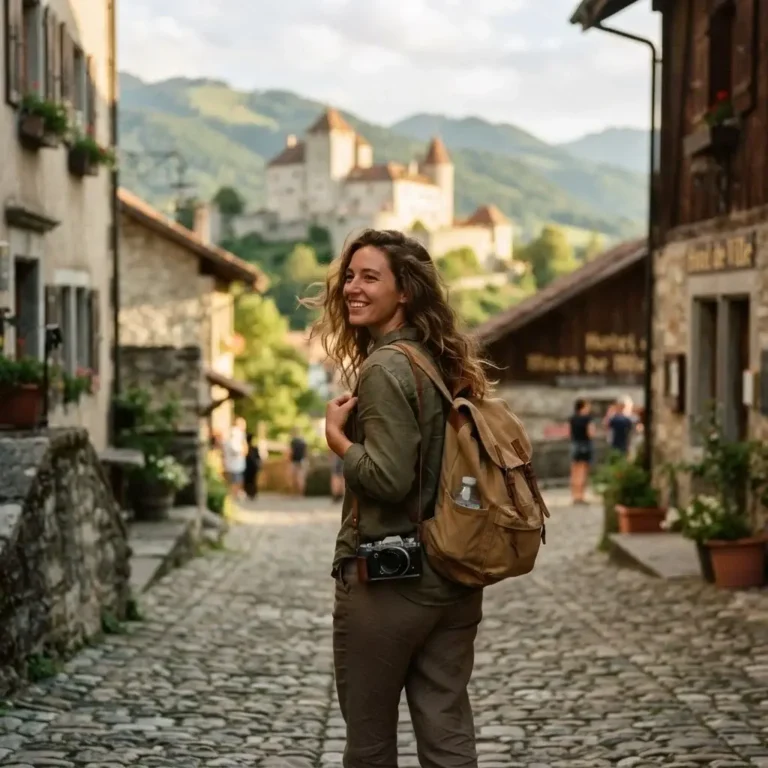
Salzburg is what people picture when they imagine a storybook European town, and it is genuinely tiny to cross on foot.
The Altstadt, or Old Town, sits in a bend of the Salzach River and is one of the best-preserved city centres north of the Alps. Much of it is pedestrianised, which means you spend your time dodging other wanderers rather than traffic. The official Salzburg tourism board lays out a self-guided UNESCO city walk that begins at the Cathedral and threads through the old streets, and it is a lovely no-cost way to structure your first afternoon.
Where to start walking: Getreidegasse, the famous narrow shopping lane with wrought-iron guild signs, then cross to the river for the classic view up to Hohensalzburg Fortress on the hill.
A terrain heads-up: The town itself is flat and easy. The fortress is not. If your knees prefer, there is a funicular up, so you do not have to earn the view the hard way.
What to eat: A soft pretzel from a bakery window and, if you have a sweet tooth, a slice of Salzburger Nockerl, a fluffy baked dessert shaped like the surrounding peaks.
Venice, Italy: The Only Truly Car-Free Big City
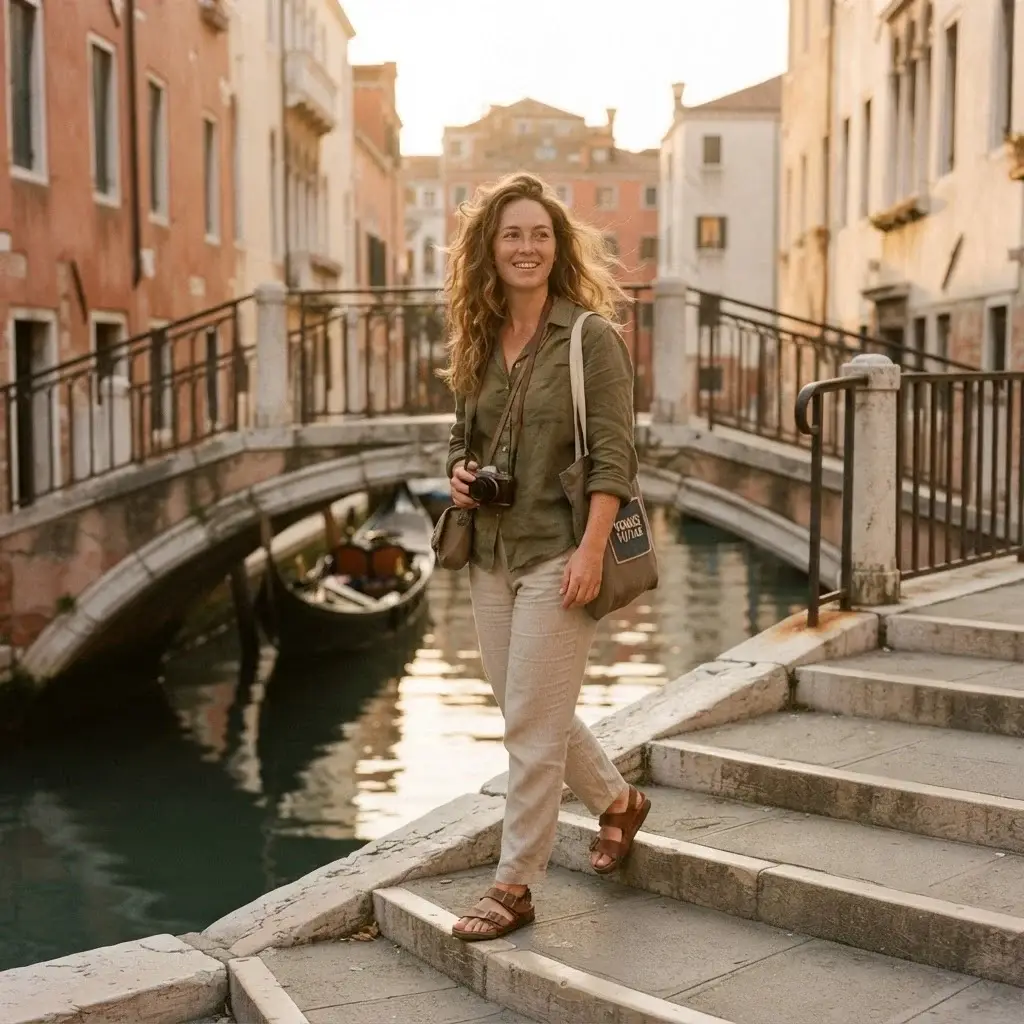
Venice is the purest walking city on this list, because it has no choice. There are no cars. None. You move by foot or by boat, and that constraint is exactly what makes it feel like nowhere else on earth.
Getting a little lost in Venice is not a failure. It is the whole point. The main sights sit close together across a maze of bridges and alleys, and every wrong turn hands you a quiet canal the day-trippers never find.
A practical planning note that catches many travelers off guard: on selected busy days, Venice charges day visitors an access fee. You book and pay it through the official Venezia Unica access fee system, and the standard day-tripper amount has been 5 euros. If you are staying overnight in the city, different rules apply, so check before you go.
Where to start walking: From the train station, skip the vaporetto and walk toward the Rialto Bridge, then on to Piazza San Marco. It takes roughly 35 to 40 minutes at a relaxed pace, and you’ll see more on that walk than any water bus could show you.
Terrain honesty: Venice is flat but has many stepped bridges. If you have a heavy bag or mobility concerns, arrive light. Wheeled luggage on bridge steps is a workout.
What to eat while wandering: Cicchetti, Venice’s small bar snacks, eaten standing up with a glass of wine. Duck into a bacaro (a small local bar), point at what looks good, and repeat. It is the tastiest way to walk the city.
Prague, Czech Republic: A Fairytale You Can Cross on Foot
Prague earns its reputation. The historic centre is compact and much of it is pedestrianised, so on foot is genuinely the best way to see it.
The classic route practically walks itself. From Wenceslas Square you drift into the Old Town Square with its astronomical clock, then across the Charles Bridge, then up toward the Castle. It is one of the most rewarding city walks in Europe.
Where to start walking: Old Town Square. Cross the Charles Bridge early in the morning, before around 8am, when it is nearly empty and the light is soft. This one tip will transform your photos and your mood.
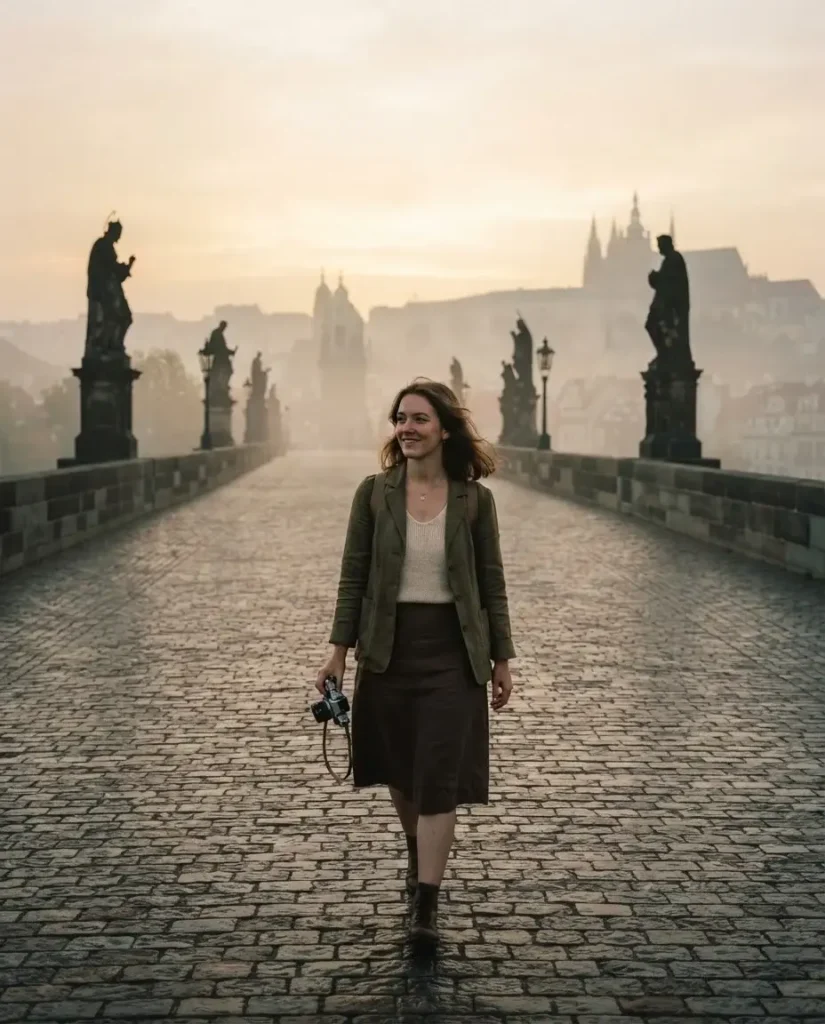
Terrain heads-up: Prague is not flat. The walk up to the Castle district climbs, and the cobbles are uneven. Take it slow and you’ll be fine.
What to eat: Skip the touristy “trdelník” hype and go for a proper svíčková, braised beef in a creamy vegetable sauce, in a sit-down spot when your feet need rest. For walking fuel, a fresh open sandwch (chlebíček) from a deli does the job.
Budget note: Prague remains one of the better-value walkable capitals in Europe, which makes it a favorite for travelers stretching their savings, exactly the way I stretched mine.
Florence, Italy: The Renaissance in Walking Distance
Florence packs an almost unfair amount of beauty into a small space. The UNESCO-listed historic centre of Florence covers roughly 505 hectares, bounded by the remains of 14th-century walls, and you can cross the heart of it in a leisurely walk.
The Arno River splits the city, connected by bridges including the famous shop-lined Ponte Vecchio. Nearly every masterpiece you have heard of sits within a compact core, so you spend your energy looking up at domes rather than figuring out transit.
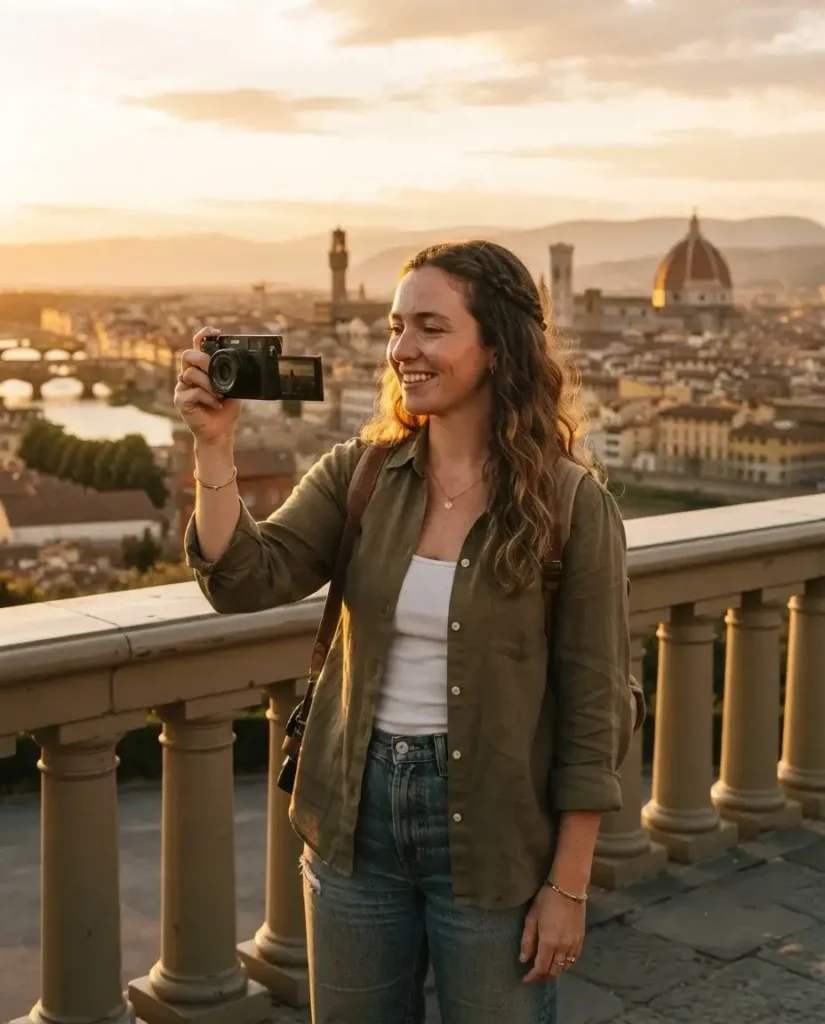
Where to start walking: Piazza del Duomo, standing under Brunelleschi’s dome. From there wander to Piazza della Signoria, cross the Ponte Vecchio, and climb toward Piazzale Michelangelo at golden hour for the view back over the terracotta rooftops.
Terrain heads-up: The centre is flat and easy. Piazzale Michelangelo involves a climb, but the sunset payoff is worth every step.
What to eat while wandering: A schiacciata sandwich stuffed with cured meats and pecorino, eaten on the go. And a lampredotto roll from a street cart if you are feeling adventurous. It is a true Florentine street food.
Bruges, Belgium: Small, Slow, and Made for Strolling
Bruges is so compact that in one walking study it topped the list for the sheer shortness of the stroll between its main sights. The medieval centre, canals, and cobbled lanes make it feel like a town frozen in the best possible century.
Where to start walking: The Markt, the main square, then wander toward the canals near the Rozenhoedkaai for the postcard view. Everything is within a gentle fifteen or twenty minute walk.
Terrain: Flat, though the cobbles are proper old cobbles, so comfortable shoes again matter.
What to eat: Belgian frites from a friterie, eaten from the paper cone as you walk, and a waffle if you have room. Chocolate shops are everywhere, and Bruges takes them seriously.
Dubrovnik, Croatia: Beautiful, Walkable, but Read This First
Dubrovnik’s Old Town is stunning and entirely car-free inside the walls, which makes it wonderfully walkable in one sense. But I want to be straight with you, because most lists are not.
The city walls, the iconic walk with sea views, run about 1,940 metres and involve a lot of steep stairs and uneven surfaces. The full-price adult ticket has been around 40 euros, and it is not a casual amble. It is a genuine physical activity in the sun.
Where to start walking: Enter the Old Town through the Pile Gate onto Stradun, the polished limestone main street. Do the wall walk early or late to avoid the midday heat and cruise-ship crowds.
Terrain honesty: This is the most demanding city on the list. If stairs are hard for you, you can still enjoy the flat Stradun and side lanes without doing the walls.
What to eat: Fresh grilled fish and black risotto made with squid ink. Sit near the old harbor and let your legs recover.
The Quiet Winners: Ljubljana, Copenhagen, and Edinburgh
A few more deserve a mention.
Ljubljana, Slovenia, pedestrianised its centre years ago, and the riverside old town is a dream for slow wandering with cafes spilling onto the banks. Copenhagen consistently ranks near the top for walkability and is famously flat and calm, which is part of a broader trend the EU’s Urban Mobility Observatory tracks as more European cities reclaim their centres from cars. And Edinburgh, recently voted Europe’s most walkable by its own residents, rewards you with dramatic Old Town closes and the climb up to the Castle, though it is genuinely hilly, so pace yourself.
How to Choose the Right Walkable City for You
Here is my honest shortcut after years of doing this.
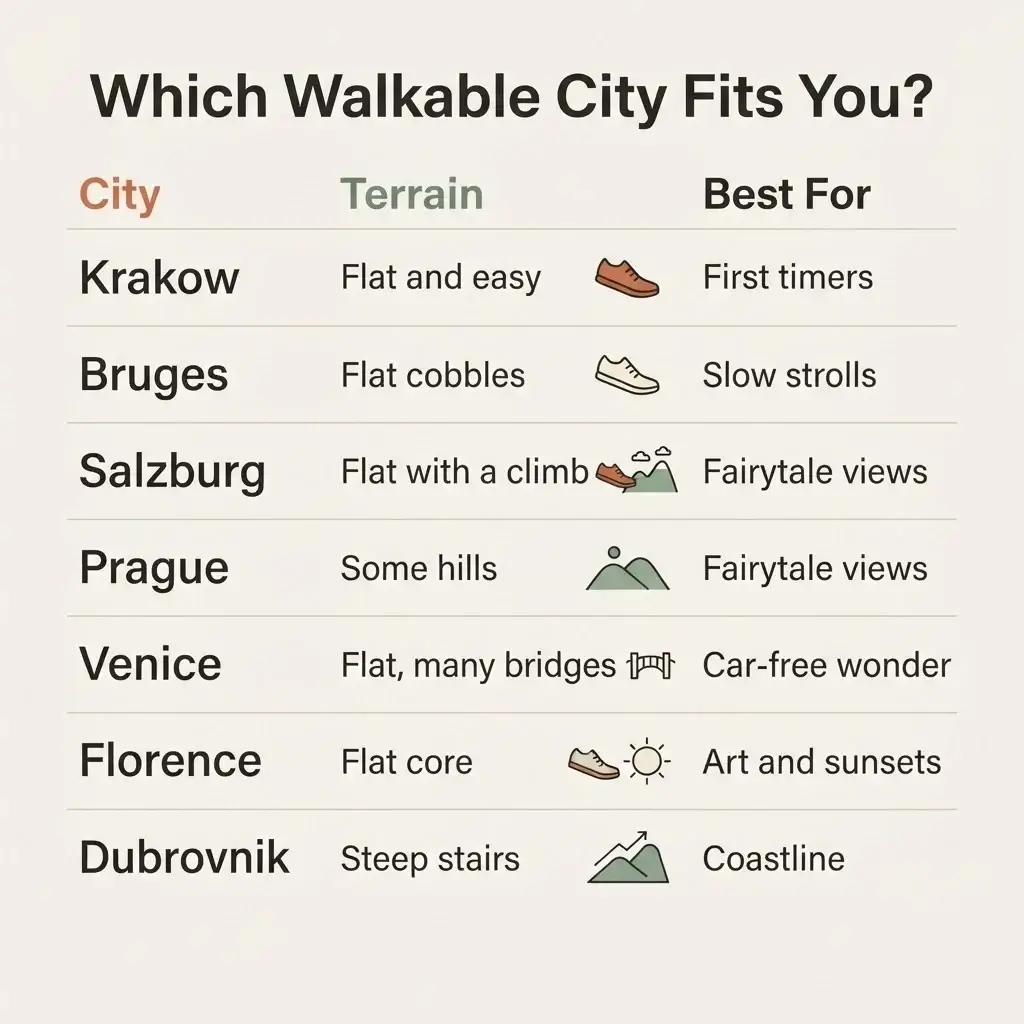
If you want the easiest possible first trip, choose Krakow or Bruges. Flat, compact, forgiving, and friendly to solo travelers.
If you want pure fairytale atmosphere, choose Salzburg or Prague, and accept a bit of a climb for the best views.
If you want a once-in-a-life sense of stepping into another world, choose Venice, where you literally cannot drive.
If you want jaw-dropping art or coastline and don’t mind stairs, choose Florence or Dubrovnik.
Match the city to your energy and your comfort, not to a ranking. That is the difference between a trip that exhausts you and one that changes you.
A Few Walking Habits That Make Everything Easier
Wear the good shoes. I will keep saying it because I keep meeting travelers limping through gorgeous cities in the wrong footwear.
Start early. The best European squares belong to you at 7am and to the crowds by 10am. Being a morning walker is the single biggest upgrade to any city trip.
Carry water and a small daypack, nothing more. The lighter you walk, the further you’ll go and the more you’ll see.
And let yourself get a little lost. Some of my clearest memories from Europe came from wrong turns. When I used to guide sightseers back in New York, the best moments were never the ones on the official route. They were the surprises. Trust that the same is true wherever your feet take you.
You do not need a car. You do not need to speak the language perfectly. You do not need to have it all figured out. You just need decent shoes, a little curiosity, and the willingness to step outside and start walking. The rest of Europe is waiting to be discovered one street at a time, and you are more ready for it than you think.