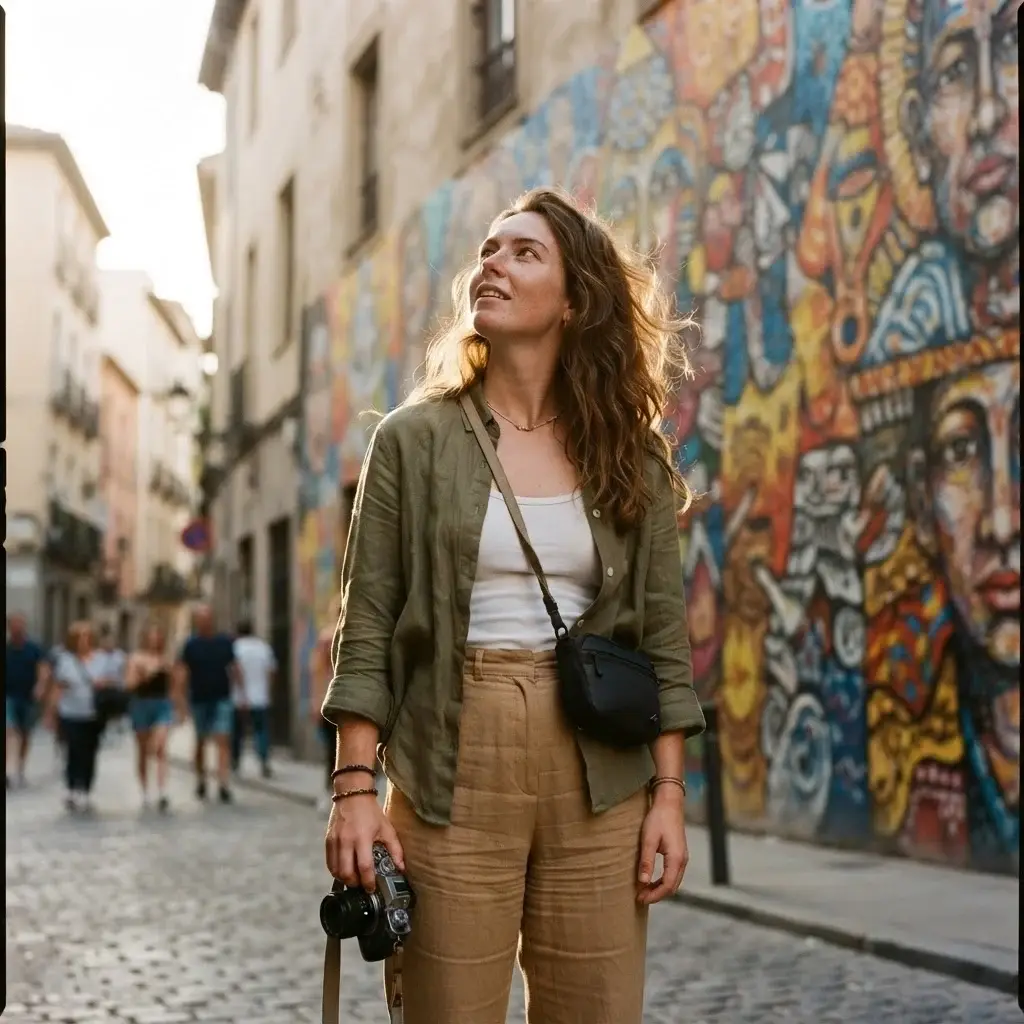
The first time I really saw street art, I wasn’t looking for it. I was backpacking across Europe on almost no money, killing time before a night train, and I turned down a side street to find a wall the size of a house painted with a face that seemed to stare right through me. I stood there for ten minutes. No ticket, no queue, no gift shop. Just me, a spray-painted stranger, and a quiet street.
That’s the thing nobody tells you about street art travel. It’s one of the most rewarding ways to explore a city, and it’s almost completely free. You don’t need a museum pass or a tour group. You need comfortable shoes, a little curiosity, and the willingness to wander. If you’ve been dreaming about a trip built around color and creativity instead of checklists and crowds, this is your guide to actually doing it.
I’m going to walk you through the cities worth your time, how to find art that literally changes month to month, how to stay safe and respectful as a solo traveler, and how to eat well while you’re at it. Let’s get into it.
Why Street Art Is the Perfect Trip for Curious, Budget-Minded Travelers
Back when I left my office job in New York and started stitching together flexible work to fund my travels, I became an expert at finding experiences that cost nothing but gave me everything. Street art was at the top of that list. When I worked as a certified sightseeing guide, I learned that the moments people remembered most were rarely the famous landmarks. They were the small, surprising, human things. A mural in a back alley delivers exactly that.
Here’s why it works so well as a trip theme. It’s free, so your budget stretches. It pulls you into real neighborhoods where locals actually live and eat, not the polished tourist core. It rewards walking, which is how you truly learn a city’s rhythm. And because the art is always shifting, no two people ever see the same version of a city. That’s the opposite of the “check the box” travel I try to steer people away from.
One quick bit of vocabulary that will make you feel like an insider fast. A “tag” is an artist’s signature, quick and stylized. A “throw-up” is a fast, bubbly piece, usually one or two colors. A “piece” (short for masterpiece) is the elaborate, multicolor work most people picture. A “stencil” is cut from card and sprayed, which is how Banksy built his style. And “wildstyle” is that gloriously tangled, hard-to-read lettering. Knowing these turns a wall from noise into a language.
How to Actually Find Street Art (Because It Moves)
This is the piece almost every guide skips, and it’s the most important. Murals get painted over. Festivals refresh entire districts. The wall you saw on Instagram two years ago might be gone. So instead of chasing a single famous piece, learn to find art the way locals and enthusiasts do.
My favorite tool is a mapped, crowd-updated database. The community platform behind the constantly updated Street Art Cities map for Lisbon, for example, catalogs hundreds of works with locations and photos, and it covers dozens of European cities, so you can pull up a live map wherever you land and route your own walk. It’s the closest thing to a self-guided tour that stays current.
Beyond apps, three habits will serve you well. First, follow the festivals, because they concentrate new work in one district over one weekend. Second, look up, down, and around corners, since the best pieces hide on rooftops, garage doors, and the sides of buildings you’d normally walk past. Third, when in doubt, join one guided walk early in your trip. A local guide gives you the stories and context, and then you can explore the rest solo with confidence. If you’re anything like me when I first planned a trip like this, one good walking tour on day one makes the whole city click.
The European Cities Worth Building a Trip Around
You could spend a year on this and not run out of walls. But if you’re planning a first street art trip, these are the cities that consistently deliver, each with its own personality.
Berlin: The Open-Air Museum of a Divided City
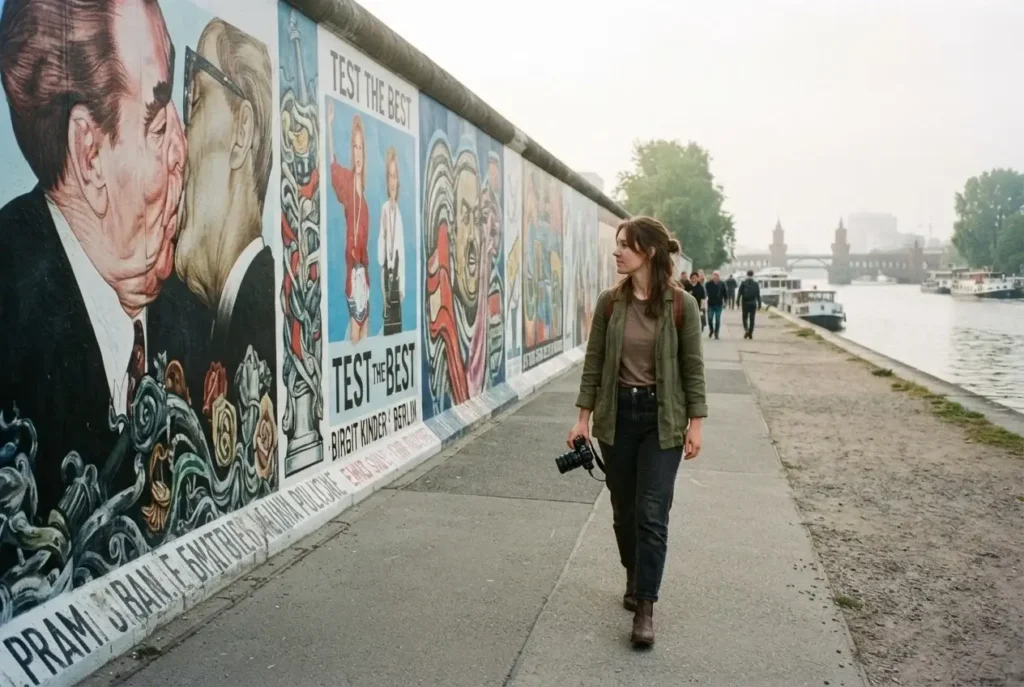
Berlin is where I’d tell most first-timers to start, because the art here is inseparable from history. The obvious anchor is the East Side Gallery, and it earns the hype. This is the longest surviving stretch of the Berlin Wall, running 1,316 meters along the River Spree in Friedrichshain. Right after the Wall fell, 118 artists from 21 countries painted it, and it opened as an open-air gallery in September 1990. According to the official Berlin tourism board’s guide to the East Side Gallery, it’s open around the clock and completely free, sitting on Mühlenstraße between the Warschauer Straße and Ostbahnhof stations. Go early in the morning if you want the famous pieces, like the Brezhnev-Honecker kiss and the Trabant bursting through the wall, without a crowd in every photo.
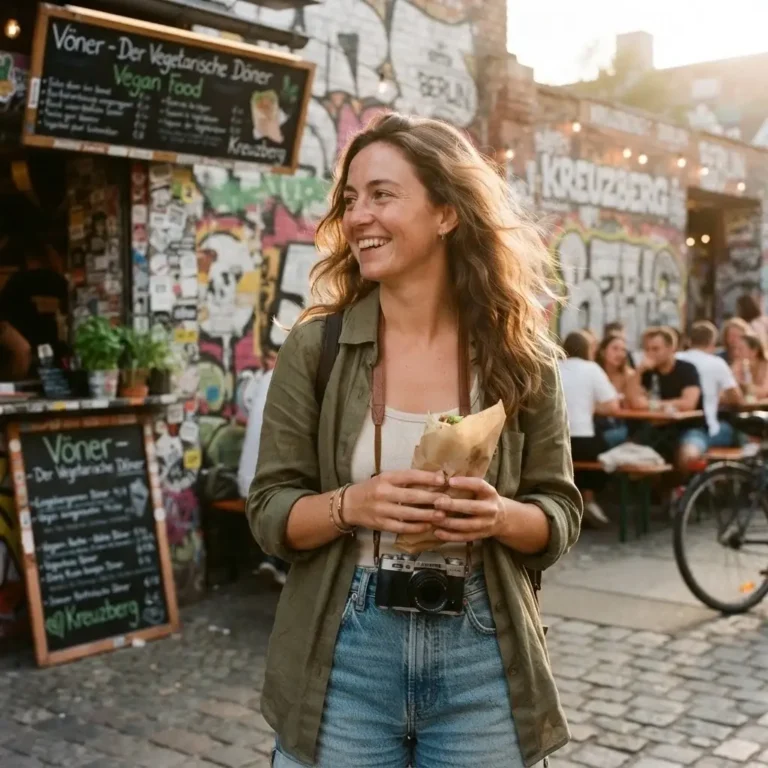
But please don’t stop at the Wall. The living, breathing scene is in Kreuzberg and around Friedrichshain, where huge murals climb apartment blocks and paste-ups cover every lamppost. Cross the Oberbaumbrücke between the two districts and just wander. For food, this is Berlin’s Turkish and multicultural heart, so grab a döner or a plate of mezze from a neighborhood spot between walls. Navigation tip: the U1 line threads through the best of it, so hop off at Schlesisches Tor and walk.
Bristol: Banksy’s Hometown and a City That Paints Itself
If one city has turned its whole self into a canvas, it’s Bristol. It was named one of the top destinations in Lonely Planet’s Best in Travel 2026 specifically for its street art, and it’s the city where Banksy got his start. From what visitors consistently report, the joy of Bristol is that the art isn’t roped off in one district, it’s woven through the city.
For the Banksy pilgrimage, the main works still on the streets are Well Hung Lover on Park Street, Mild Mild West up in Stokes Croft, and The Girl with the Pierced Eardrum down on the harbourside. For sheer volume and variety, Bristol’s official visitor guide to street art points you to North Street and East Street in Bedminster, plus Stokes Croft and nearby Montpelier, and the large-scale pieces on Nelson Street from the See No Evil festival. Stokes Croft is also where you’ll eat well, with independent cafes and vegetarian spots that match the neighborhood’s creative, slightly rebellious spirit. Navigation tip: Bristol is walkable but hilly, so wear real shoes and don’t underestimate the climb up Park Street.
Lisbon: Where the City Council Actually Commissions the Art
Lisbon has one of the most interesting street art stories in Europe, because the city government embraced it. There’s an official body, the Galeria de Arte Urbana (Urban Art Gallery), that commissions and safeguards murals across the city. Lisbon’s official urban art route from the city tourism board is a genuinely useful starting map, and it introduces you to the local legends whose work you’ll see everywhere: Bordalo II, who builds enormous animals out of scavenged trash to make a point about waste; Vhils, who carves haunting faces directly into walls; and Add Fuel, who riffs on Portugal’s traditional blue azulejo tiles.
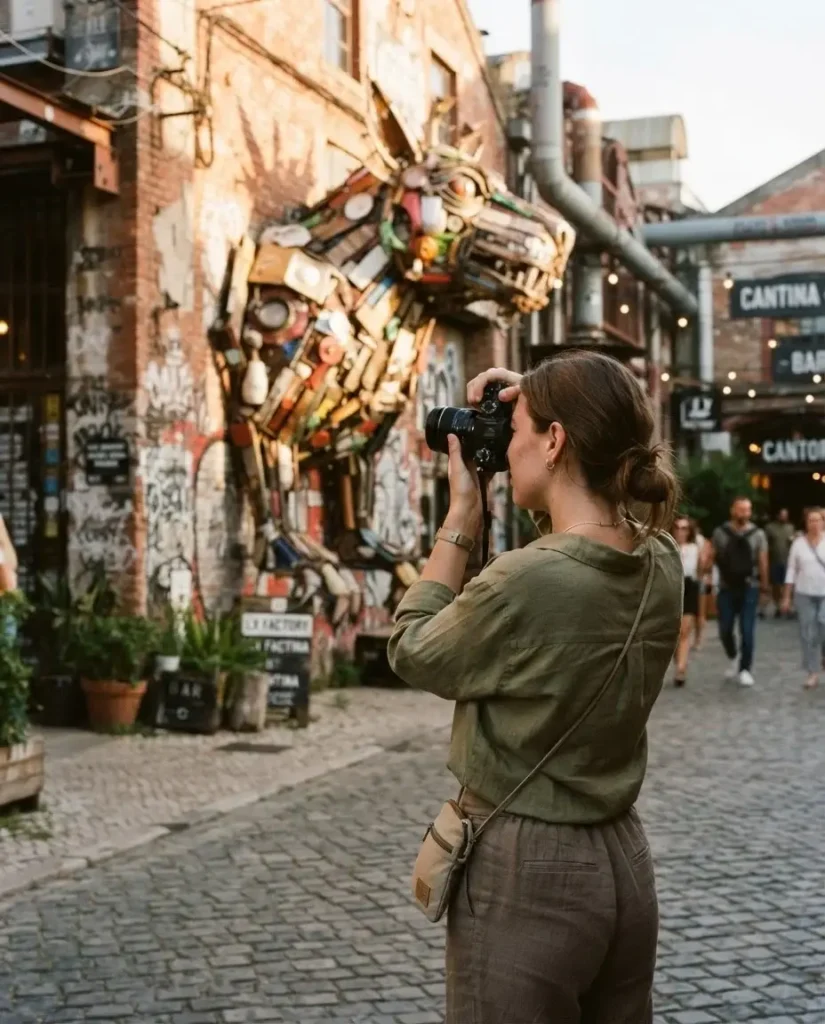
For a concentrated hit, head to LX Factory, a former industrial complex in Alcântara now packed with murals, bookshops, and cafes, including one of Bordalo II’s signature recycled-material creatures. The hilly Alfama and Mouraria districts also reward slow wandering. Eat a pastel de nata whenever you see a good bakery, and don’t skip a proper sit-down meal of grilled fish or a bifana pork sandwich. Navigation tip: Lisbon is brutally hilly, so use the trams and the funiculars, and let the free walking make itself count between them.
Athens: Raw, Political, and Absolutely Alive
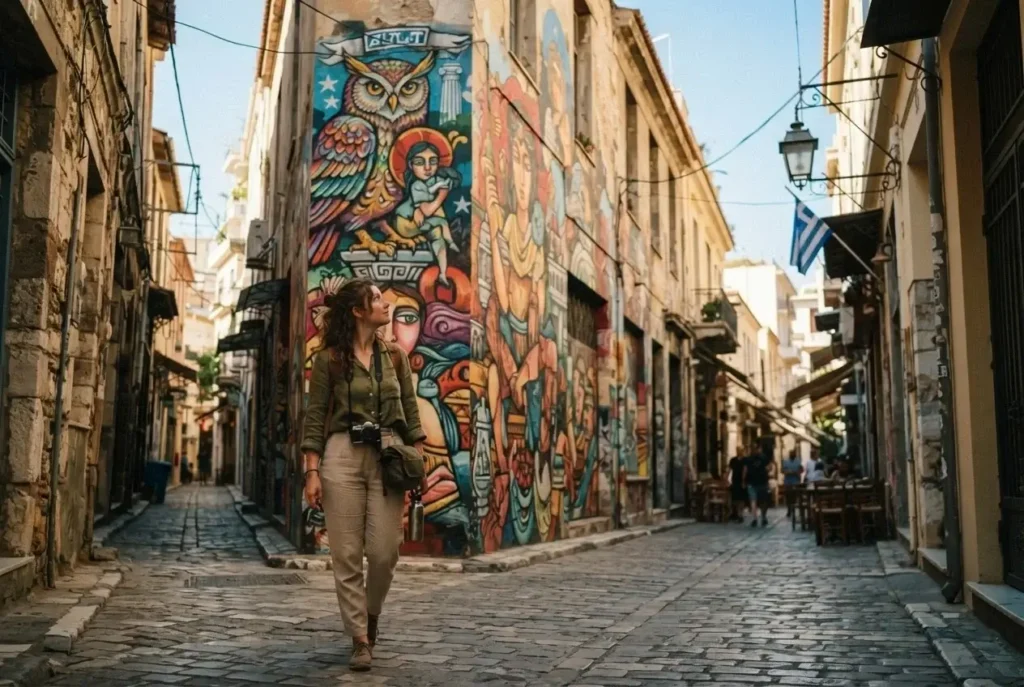
Athens surprised the street art world by becoming one of its most dynamic capitals, with an edge that feels urgent and political. The murals here often respond directly to the country’s recent economic struggles, which gives them a rawness you don’t always find. As the official Athens city tourism site describes the scene, the art has become part of the urban fabric, and a giant mural can loom five stories tall the moment you turn a corner.
The districts to walk are Psyri, Metaxourgeio, and Gazi, all clustered near the center and easy to string together on foot. Keep an eye out for the famous owl mural by the artist WD, a signature Athens piece and a fitting one, since the owl is the ancient symbol of the city. This is also fantastic eating territory, full of tiny tavernas and souvlaki joints, so plan your walk to end at a long, cheap, delicious lunch. Navigation tip: base yourself near Monastiraki metro and everything is walkable from there.
Valencia: Spain’s Sunlit Mural Neighborhood
If you want warmth, oranges, and color, Valencia’s El Carmen district in the old town is one of Spain’s most mural-rich neighborhoods. It’s compact, atmospheric, and full of narrow lanes where art spills across shuttered doorways and crumbling facades. From what solo travelers consistently report, it’s one of the easiest scenes to explore casually, because you can simply lose yourself in El Carmen’s maze and let the art find you. Refuel with horchata and fartons, or a proper paella since this is where the dish was born.
When to Go: Festivals Multiply the Magic
Timing your visit around a festival is a cheat code, because artists from around the world descend and repaint entire districts in a single weekend. The biggest is Upfest, billed as Europe’s largest street art and graffiti festival, held in Bristol’s Bedminster and Southville neighborhoods, where more than 170 murals stay up year-round even between editions. Watching artists work live, up on their lifts and ladders, is a completely different experience from seeing the finished wall. Many European cities run their own mural festivals through spring and summer, so it’s worth a quick search for your destination’s dates before you lock in travel.
Generally, late spring through early autumn gives you the best light and the most active painting season. Winter still works for seeing existing murals, just with shorter days and fewer live events.
Exploring Solo and Safely (Yes, You Can Do This)
Here’s the honest part, because I promised you I’d never pretend travel is perfect. Street art tends to live in neighborhoods that are creative and up-and-coming, which sometimes means grittier or more industrial. That can feel intimidating when you’re alone. But in my experience, feeling nervous and being in danger are two very different things, and the discomfort usually fades the moment you start paying attention to the art instead of your nerves.
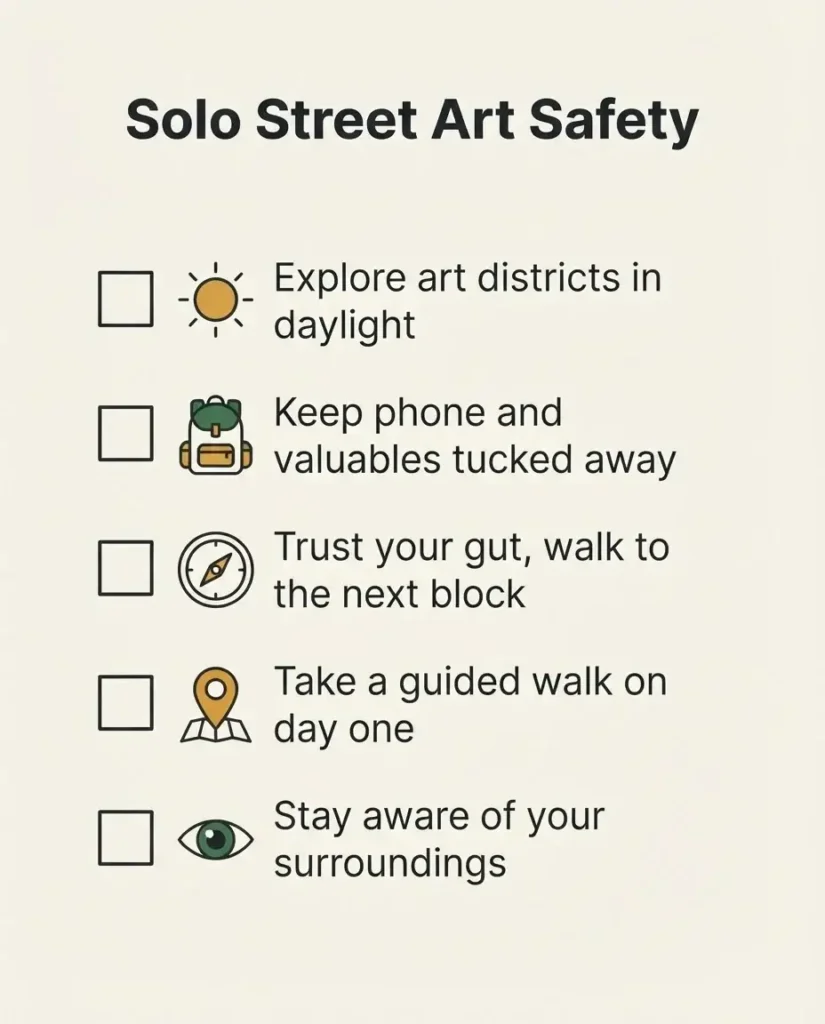
A few habits keep me confident. I explore art districts in daylight, when they’re busiest and easiest to photograph anyway. I keep my phone and valuables tucked away and stay aware of my surroundings, just like I would in any city. I trust my gut, and if a specific block feels off, I simply walk to the next one, since there’s always more art around the corner. And I let a guided walk on day one show me which areas are welcoming, so I explore the rest knowing where I’m going. Confidence, as I always say, grows through action. The first solo art walk is the hard one. By the third, you’ll feel like you own the city.
Etiquette: Respecting Real Neighborhoods and Living Art
This matters, and a lot of guides ignore it. You’re walking through places where people live and work. Photograph the walls, not people’s windows or private courtyards. Keep your voice down in residential lanes. Never touch or tag anything yourself, obviously. And understand that some of what you’re seeing is commissioned and legal while some is not, which is part of the culture’s tension and honesty, not something to judge loudly in public.
There’s also a mindset piece. Street art is often political, personal, and rooted in local struggle, especially in a city like Athens. Approach it with curiosity rather than treating it as a backdrop for your selfie. The more you learn the stories behind a piece, the more the whole trip means. That’s the difference between collecting photos and actually understanding a place.
Simple Photography Tips for Big Walls in Tight Streets
You don’t need fancy gear, but a few tricks help. For huge murals crammed into narrow streets, use your phone’s wide or ultra-wide lens and back up as far as you safely can. Morning light is softer and the streets are emptier. If a wall is in harsh midday sun with deep shadow, come back later or shoot the shaded portion. And take one photo for the memory, then put the phone down and actually look. Some of my favorite walls I never photographed well, but I remember them perfectly.
Building Your Route: Putting It All Together
If you have a week or two, you can chain several of these cities together without much fuss. A classic first trip might be Berlin, then a budget flight to Lisbon, then Bristol, three cities with completely different flavors of the same art form. Or keep it regional and pair Lisbon with a Spanish stop like Valencia.
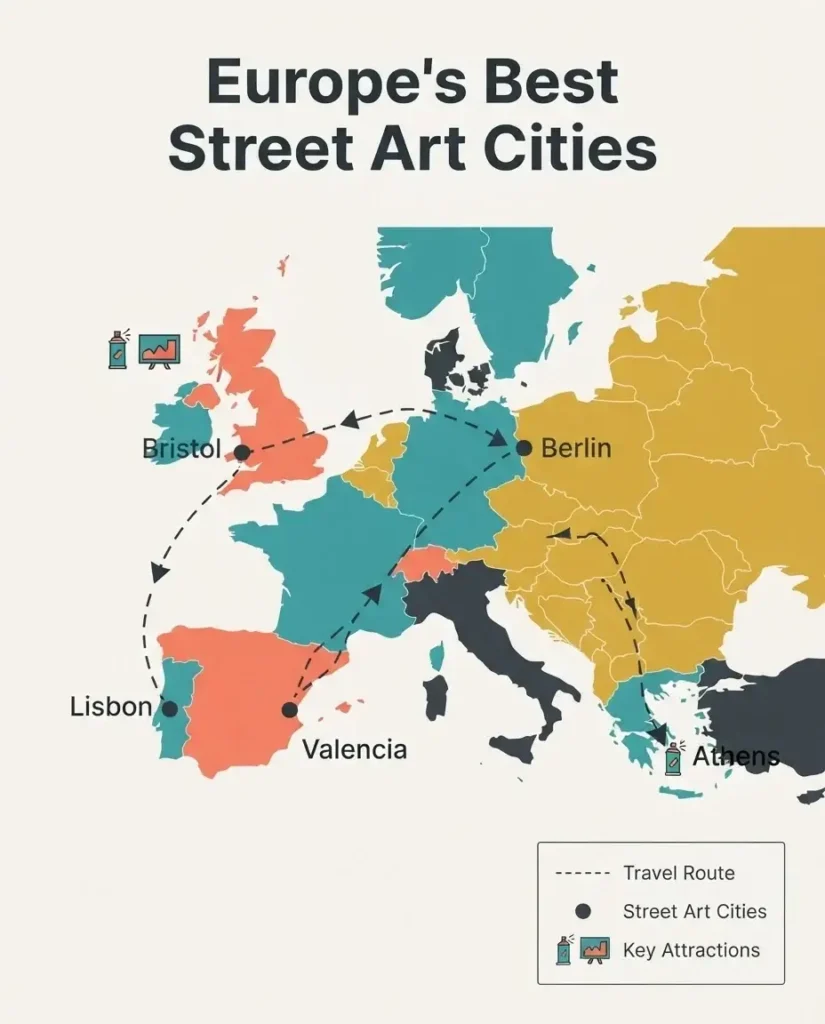
Don’t overplan. Give each city at least two full days, book central accommodation so you can walk out the door into the art, and leave real space for wandering, because the best pieces are almost always the ones you stumble into.
And here’s my honest encouragement, the same thing I’d tell a friend over coffee. You do not need to wait for the perfect moment or the perfect travel companion to do this. Street art travel is forgiving, affordable, and endlessly rewarding for exactly the kind of person who’s curious enough to be reading this. Pick one city. Book the trip. Turn down the side street. The wall is waiting, and so is the version of you who’s braver for having gone.