Solo Travel Guide to North America’s Best Kept City Secrets

There is a particular kind of travel high that has nothing to do with a famous skyline or a landmark you have seen a hundred times on Instagram. It is the feeling you get when you find yourself in a city that most people overlook, wandering a neighborhood that is genuinely alive and breathing, talking to locals who are actually surprised and pleased that you showed up. That feeling is what this guide is all about.
I have been fortunate to experience different versions of that feeling in places as far apart as Ghana, where I lived with a local family and watched a whole world operate outside of everything I had grown up knowing, and in the quieter corners of Europe during my solo backpacking years, where a detour off the main train route often led to the most memorable afternoons of the trip. The principle is the same whether you are on another continent or a two-hour flight from home: the cities that nobody talks about are often the ones that teach you the most.
North America has no shortage of them. While everyone is booking flights to New York, LA, and Toronto, there are cities across the continent where the food is extraordinary, the history is staggering, the arts scene is thriving, and a solo traveler can arrive without a crowd to compete with. If you have been wondering where to go next and you are ready to go somewhere that actually surprises you, here are the cities I would send you to first.
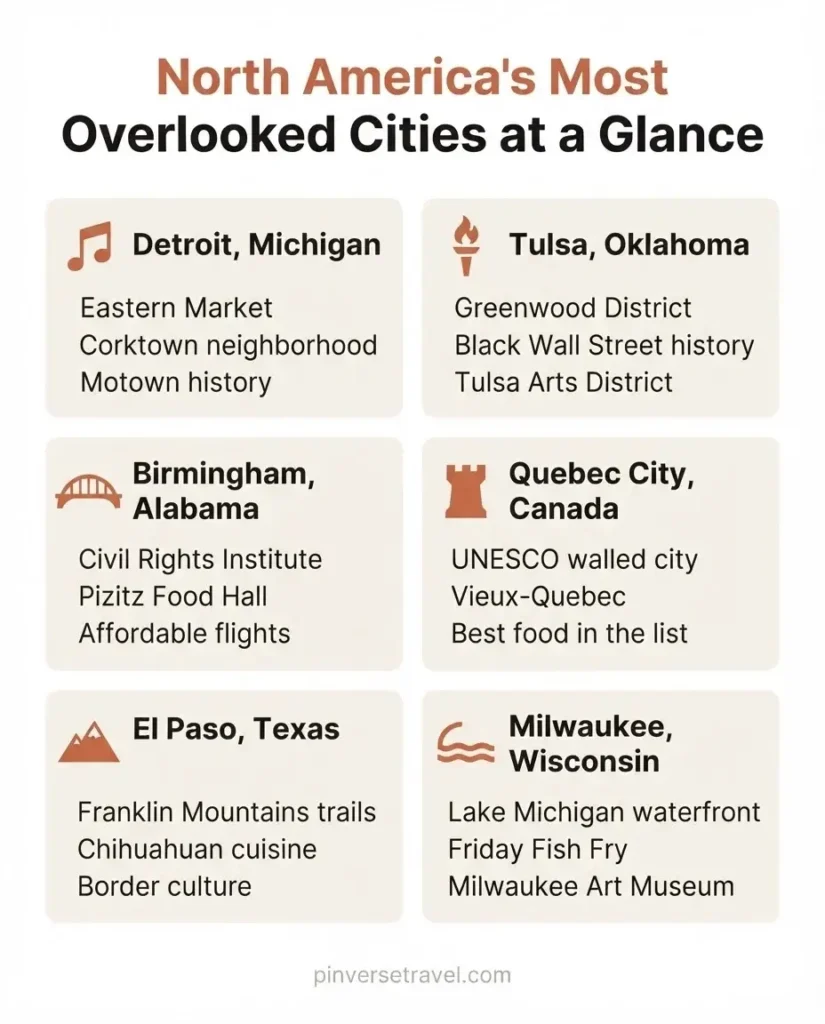
Detroit, Michigan: The City That Wrote Its Own Second Chapter
Detroit gets talked about in two very different ways. Either people who have never been describe it through the lens of its industrial decline, or people who have actually visited come back and cannot stop talking about it. If you have not been, I want to make a case for it right now, because Detroit is one of the most culturally rich cities in North America and it is still dramatically underrated as a travel destination.
The food scene alone is worth the trip. Detroit is home to a style of deep-dish square pizza that is completely its own thing, made in a blue-steel pan with the cheese pushed to the very edges so it caramelizes into a crispy crust. Beyond pizza, the city’s culinary identity is shaped by decades of immigration: Polish bakeries in Hamtramck, Middle Eastern restaurants in Dearborn (one of the largest Arab American communities in the country), and a growing wave of creative chefs setting up shop in neighborhoods like Corktown and Midtown. For a solo traveler, Corktown is particularly welcoming. It is Detroit’s oldest neighborhood, full of independent cafes, wine bars, and the kind of street-level energy that makes wandering feel productive.
One of the best ways to understand Detroit without spending a cent is to visit Eastern Market, the city’s historic public market that has been running continuously since 1841. The Saturday Market runs year-round from 6 AM to 4 PM and pulls in over 250 vendors selling local produce, baked goods, flowers, and handmade goods across several sheds the size of city blocks. It is loud, colorful, and completely real.

The surrounding neighborhood is also covered in murals, making the walk to and from the market its own kind of open-air gallery.
For music history, Detroit’s story is one of the most significant in American culture. Motown Records was founded here in 1959 and changed the sound of the world. The Motown Museum at Hitsville U.S.A. is currently undergoing an expansion and is planned to reopen in Spring 2027, so check the timeline before you visit, but the surrounding Berry Gordy neighborhood is still worth walking. The Detroit Historical Museum, meanwhile, is free and covers the full sweep of the city’s story from the fur trade to the automotive era. For solo travelers, Detroit is easiest to navigate with a rental car or rideshare since public transit has gaps, but Midtown and Corktown are both walkable once you are there.
Tulsa, Oklahoma: A History That Demands to Be Understood
Most travelers fly over Oklahoma without a second thought, and that is a mistake that Tulsa specifically does not deserve. This is a city with one of the most important and painful histories in the United States, and visiting it thoughtfully is one of the more meaningful things a traveler can do.
Tulsa’s Greenwood District was known in the early 20th century as Black Wall Street, a prosperous, self-sufficient African American community with its own newspapers, hotels, theaters, and professional offices. In May 1921, it was destroyed in one of the worst incidents of racial violence in American history, the Tulsa Race Massacre, in which mobs killed hundreds of residents and burned 35 blocks to the ground. For decades, this history was largely suppressed in schools and public discourse. Today, the Greenwood District is reclaiming that story. The Greenwood Rising history center is a state-of-the-art museum at the heart of the district that tells the full story of Black Wall Street before and after the massacre. Admission is $15 for adults, $10 for seniors, and $8 for youth, and it is open Tuesday through Saturday 10 AM to 7 PM. If you visit one thing in Tulsa, make it this.

But Tulsa is not only its history. The city has a remarkably developed arts scene centered on the Tulsa Arts District, a walkable stretch of galleries, studios, live music venues, and restaurants. The Blue Dome District and the Cain’s Ballroom, a live music venue that has been operating since 1924, are local institutions. The food scene punches above the city’s weight, with strong barbecue, farm-to-table restaurants, and a growing independent coffee culture. Tulsa is also one of the more affordable cities on this list, and for a solo traveler, the downtown area is compact and easy to explore on foot. Flights into Tulsa International Airport are frequently cheap from major hubs, and the city has become something of an unofficial destination for remote workers, which means the cafe culture is excellent.
Birmingham, Alabama: Where American History Comes Into Focus
I know what some people think when they hear Birmingham, Alabama, and I want to gently push back on any assumptions. Birmingham is a city that has worked hard to reckon with a difficult history, and what has emerged from that reckoning is a place of real cultural depth, extraordinary food, and neighborhoods that are genuinely exciting to spend time in.
The civil rights history here is not just background information. It is the reason to come. The Birmingham Civil Rights Institute is one of the most important museums in the United States, a self-guided journey through the history of the movement that uses photographs, recordings, and reconstructed environments to put you directly inside a world that most textbooks flatten into bullet points. It is open Tuesday through Saturday from 10 AM to 5 PM, with admission at $15 for adults. The institute sits across the street from 16th Street Baptist Church, where four young girls were killed in a bombing in 1963, and Kelly Ingram Park, where the marches and confrontations of the spring of 1963 took place. Walking this triangle of sites on a quiet morning is genuinely moving in a way that is hard to describe and easy to remember.
Beyond the history, Birmingham’s food scene has undergone a transformation that the rest of the country has been slow to notice. The city has a strong culinary identity built around Southern cooking, but the current generation of chefs here is doing something more interesting than nostalgia. The Pizitz Food Hall in the historic Pizitz Building downtown is a great starting point, with local vendors serving everything from Korean tacos to Alabama-style fried fish. The Cahaba River valley just outside the city provides hiking and outdoor options for travelers who want a half-day away from the urban core. Birmingham also has a large number of breweries for a city its size, and the beer scene has become a legitimate draw. For solo travelers, the city is genuinely welcoming and easy to navigate. Flying into Birmingham-Shuttlesworth International Airport is usually inexpensive from most US cities.
Quebec City, Quebec: The European City That Never Left North America
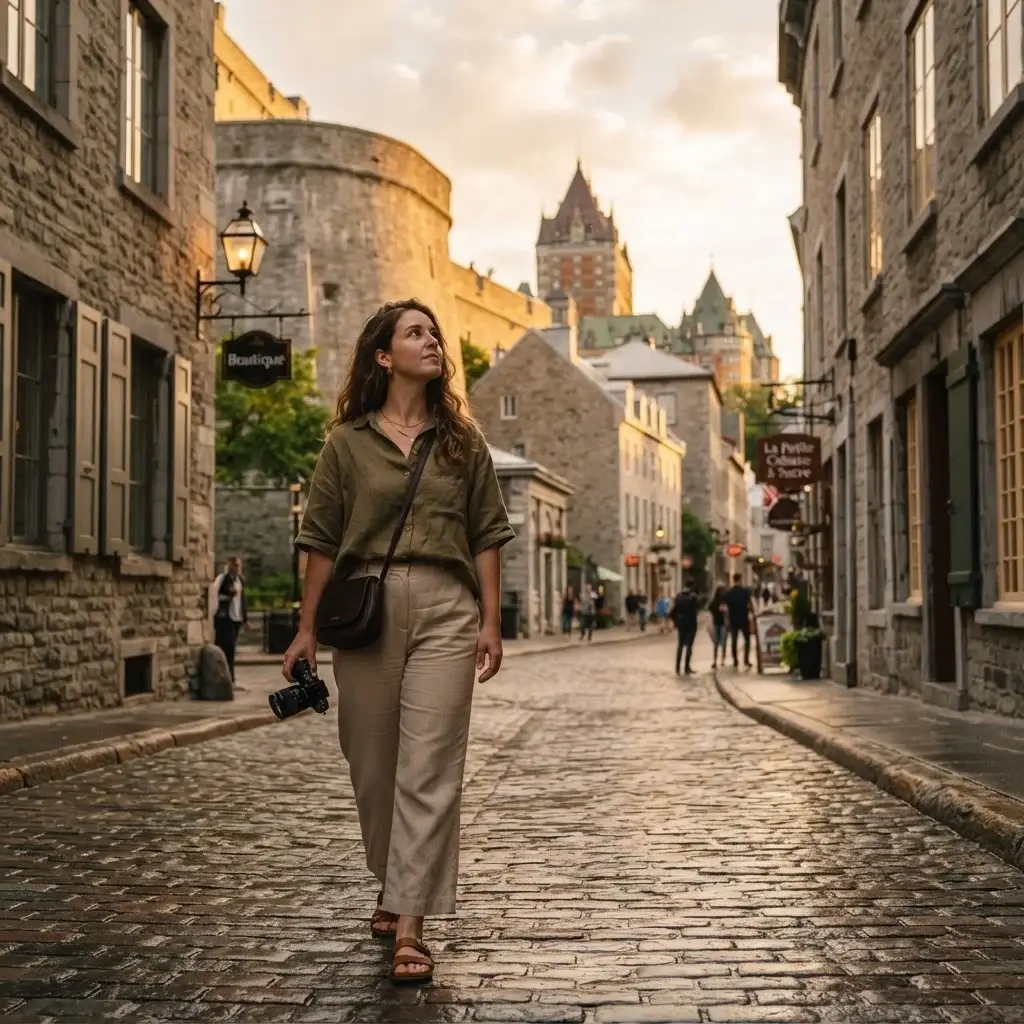
Quebec City is technically the most famous city on this list among Canadians, but American travelers consistently overlook it in favor of Montreal or Toronto, and that gap in attention is their loss entirely. Quebec City is one of the most distinctive urban environments on the continent. Walking through the old city feels like being somewhere in France or Belgium, except the food is better, the crowds are smaller, and you can get there on a two-hour flight from the northeastern United States.
The historic old town, Vieux-Quebec, is a UNESCO World Heritage Site and the only remaining fortified city north of Mexico. The city is divided into Upper Town (Haute-Ville) and Lower Town (Basse-Ville), connected by a funicular that costs a few Canadian dollars each way, or by the steep Breakneck Stairs for those who want the workout. The Quebec City Tourism guide to Old Quebec is well organized and genuinely useful for planning your days, and walking the ramparts (the old city walls) is completely free. The Chateau Frontenac, the castle-like hotel that defines the city’s skyline, is worth visiting even if you are not staying there: the view from the terrace out over the St. Lawrence River is one of the best in the city.
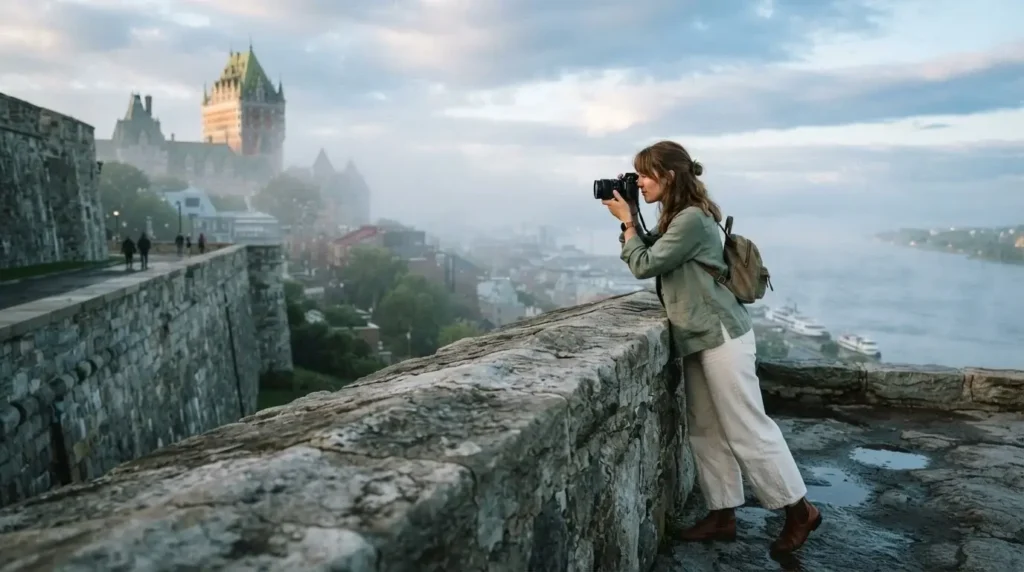
The food in Quebec City deserves its own conversation. Poutine here is the real thing: thick fries, squeaky fresh cheese curds, and a rich gravy, and the city takes it seriously. But the broader culinary scene extends to excellent French-influenced bistros, crêperies, and a strong sugar shack tradition that produces maple syrup products in quantities and varieties that feel almost medicinal in how satisfying they are. For solo travelers, Quebec City is one of the safest and most walkable cities in North America. The locals are friendly, English is widely spoken in tourist areas (though making even a small effort in French is genuinely appreciated and will earn you immediate warmth), and the city is compact enough to walk almost everywhere that matters in the old town.
El Paso, Texas: Desert Culture on the Edge of Two Countries
El Paso sits at the intersection of Texas, New Mexico, and the Mexican state of Chihuahua, and that convergence of cultures, landscapes, and histories makes it one of the most genuinely unique cities on the continent. Most travelers skip it entirely, which is genuinely baffling once you have spent even a day there.
The city’s identity is inseparable from its border location. El Paso and Ciudad Juarez, directly across the Rio Grande, together form the largest binational metropolitan area on the US-Mexico border, and the cultural blending that results from that proximity shows up everywhere: in the food, the music, the architecture, and the daily rhythm of the city. The food alone makes El Paso a destination. Mexican food here is not the Tex-Mex of Houston or Dallas. It is deeply rooted in the cuisine of Chihuahua state: red and green chile, carne adovada, burritos made with handmade flour tortillas that are almost translucent. The city has been making the same kind of food for generations, and it is extraordinary.
For outdoor travelers, Franklin Mountains State Park sits inside the city limits and offers 125 miles of hiking, biking, and rock climbing trails across a granite mountain range that rises directly out of the urban landscape. The visual contrast of desert peaks against a sprawling city is unlike anything in the rest of Texas.
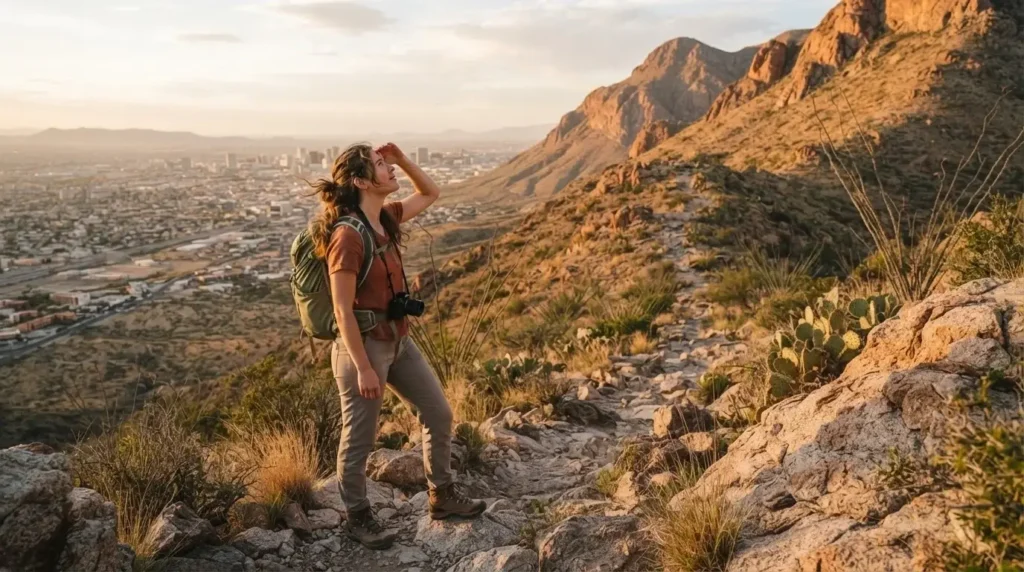
The park is accessible by car and is one of the largest urban wilderness parks in the United States. For a solo traveler comfortable with a modest level of adventure, this is a remarkable day out for very little money. El Paso is also a practical jumping-off point for visiting the White Sands National Park (roughly an hour and a half east), Guadalupe Mountains National Park, and even a day trip across the border to Juarez if you feel comfortable doing so.
Milwaukee, Wisconsin: The Lake City That Keeps Getting Better
Milwaukee has a reputation built almost entirely on beer and the Green Bay Packers, and while both of those things are real and part of the city’s identity, stopping there means missing a city that has transformed itself into something genuinely interesting for a curious traveler. Milwaukee sits on the western shore of Lake Michigan, and the lakefront alone is worth the visit.
The art scene here is anchored by the Milwaukee Art Museum, home to nearly 30,000 works and famous for its Santiago Calatrava-designed building with a movable brise soleil, a pair of white wing-like fins that open and close over the main hall, that has become an architectural landmark. The museum’s holdings are serious, with strong collections of German Expressionism, American decorative arts, and one of the largest collections of Georgia O’Keeffe works in the country. Beyond the art museum, Milwaukee’s Walker’s Point neighborhood has become a hub for independent restaurants, bars, and LGBTQ+ friendly spaces, and the Historic Third Ward is lined with galleries, boutiques, and some of the city’s best coffee shops. The Visit Milwaukee official guide is a solid planning resource that lists the city’s 100-plus annual festivals, 20-plus summer farmers markets, and more than 20 museums.
Milwaukee’s food identity is genuinely its own. The Friday Night Fish Fry is a Wisconsin tradition rooted in the city’s large Catholic population, and nearly every bar and supper club in the city participates. It is one of the most communal and affordable dining experiences you can have, and for a solo traveler arriving at a corner pub on a Friday night, it is a genuinely warm introduction to how locals actually spend their time. The cheese scene (Wisconsin takes dairy seriously), the Polish deli tradition, and the craft brewery culture all layer into a food identity that is specific, affordable, and deeply satisfying.
Flights into Milwaukee Mitchell International Airport are frequently cheaper than Chicago O’Hare or Midway, and Amtrak’s Hiawatha service connects Milwaukee to Chicago in about 90 minutes, making a multi-city weekend entirely feasible.
How to Actually Plan a Trip to a Place Nobody Talks About
One thing I have noticed over years of travel is that the hardest part of visiting a lesser-known city is not finding things to do once you get there. It is convincing yourself beforehand that it is worth going. There is a particular uncertainty that comes with booking a trip to somewhere that has not been written about a thousand times. You find yourself wondering whether you missed something, whether there is a reason nobody is talking about it.
My experience, both from my own travels and from everything solo travelers consistently report, is that this uncertainty is almost always unfounded. The reason these cities are underrated is rarely that they lack something. It is usually that they lack the marketing budget of a major tourism destination, or that they simply have not had their moment yet. And visiting before that moment arrives is exactly the point.
A few things that consistently help when planning a trip to an underrated city: lean hard on local sources. City subreddits, local food blogs, and the city’s official tourism board are almost always more useful than generalist travel lists. Give yourself at least two full days, because a city like Detroit or Tulsa reveals itself slowly, and one rushed day will not do it justice. And resist the urge to fill your itinerary before you arrive. The best things that happen in a city nobody has over-programmed for tourists tend to happen when you leave room for them.
A Note on Solo Travel and the Unexpected City
Part of what makes solo travel so genuinely powerful is that it forces you to engage. When you are alone in a city you do not know, you ask questions, you make small decisions, you have conversations you would never have had with a travel companion distracting you. The cities on this list are particularly well-suited to that kind of engagement because they are not set up to herd tourists from one attraction to the next. They require a little more initiative, a little more curiosity.
When I left my office job and started building a life around travel, one of the first things I realized was that the places that changed me the most were not the ones I had seen the most photos of. They were the ones that surprised me, the ones where I did not know what to expect and had to figure it out as I went. These cities can do that for you. You just have to show up.
Final Thoughts: Stop Saving These Cities for Someday
Every single city on this list is accessible, affordable, and genuinely worth your time. You do not need months of planning or a long runway of vacation days. Detroit is a long weekend. Quebec City is four days if you want to do it properly. Birmingham can be paired with a broader American South trip. Tulsa and El Paso reward a slow, curious approach that does not require you to rush.
The cities nobody talks about are waiting. The only thing standing between you and them is deciding that you do not need permission to go somewhere unexpected.